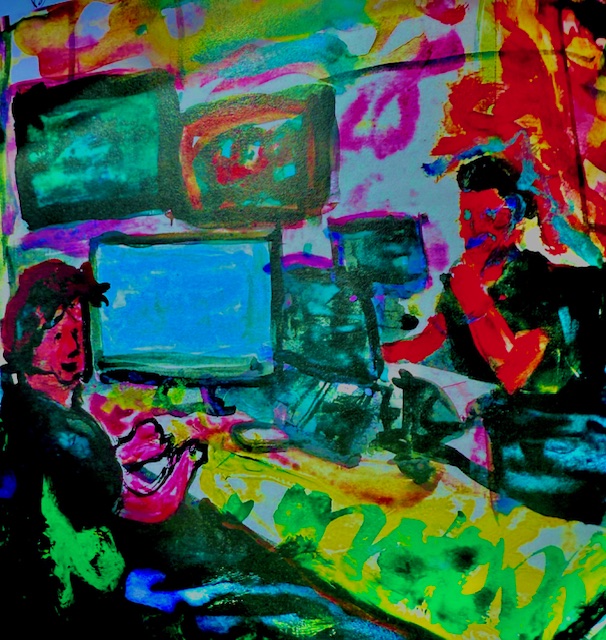
The New Show by Adam Kluger With Art by Dreck

“Excuse me

Excuse me

Excuse me!!!”

Gavin Tolkin was standing on a chair now as he tried to get the room’s attention.

“Hey Everybody – please shut the fuck up!”

A display of dominance was required from the show’s new show runner. The network was suddenly in the business of creating an episodic BTS docuseries on the NY newsroom. The brainchild of some bean counter at the big building on Madison Avenue— and Tolkin’s name was on the memo as the new sr executive producer of the whole magilla gorilla.

Tolkin guessed that some schmuck in corporate must have finally stumbled across an episode of TMZ and hatched a brilliant new idea on how to make money without spending money.

The crowd of employees started to stir in the newsroom around the tables of the writers pit. Tolkin needed a clear surface to lay out the new bible. He brandished it like Moses hoisting the 10 commandments and yelled again at the top of his lungs.

“My most esteemed and respected colleagues I need your kind support right now, please grab all your shit off the tables and find another place for it — we need this space to work on the new show—now!!!”

Tolkin felt the power the resentment and jealousy swirl around him as co-workers filed out of the room silently—aside from some random grumbling— with their folders, files and coffee mugs.

His number two, Headly Montague admired his boss’s balls or what do the Jews call it?

Chutzpah.

Tolkin’s name was on the memo and the show bible as the new show’s sr executive boss— so he better fuckin bring it like that every day or the whole operation would be untenable, unmanageable and everybody in the newsroom would probably lose their fucking jobs.

“How soon do those corporate idiots want this supposed television show on the air?“

“45 days big T”

“We’ll just see about that.”

“Hey Chief, ” a young intern named Rosamela interrupted, “someone to see you…The Fox?”

The Fox was a rising star at the network.

A young hitler-youth wannabe in his early 30’s who was quickly climbing the ranks to the top of the mushroom.

Always staring or smiling— the Fox was always assessing weaknesses in the smaller fish at the bureau and then whispering to a mystery suit who was always next to him. He was a prep school bully and if you went up against him you would lose and be fired. That was his power.

“Gavin”

“Fred”

“Just down here on directives from corporate to make sure the new project gets off the ground with the least amount of fuckups.”

“Just getting settled —Day 1 – we should be good in plenty of time to make the deadline.”

“That’s reassuring Gavin —because I was the one who chose your name out of a hat to run this new “concept.” So try not to screw the pooch on this one —like you did with that airline show.

“Thanks, Fred”

“Don’t thank me yet.”

“Right.”

-Break-

“T… all assembled in the main break room”

“Great. Head on in Headly and I’ll be right there”

(Urinal Flush the hands being washed momentarily in sink)

“Gavin?”

(Plop ker-plop, kerplop)

“Fred?

“Yeah, listen I’m thinking that the B-block needs to be shortened to include enough time

(Plop ker-plop, kerplop) …for a station ID break, mmkay?”

“uh… yeah, sure. No problem will make that change to the rundown as soon as I get to the break-room.”

“Great.” (Plop ker-plop, kerplop) I’ll look forward to getting the revised rundown later today.”

“I’m on it.” See you later (sound of bathroom door opening)

Tolkin had to admire the total un-self consciousness of the junior executive who couldn’t give a shit about taking a shit while they talked business in the men’s room. It was Fred’s little way of letting Gavin know where he stood in the network’s pecking order and that shit always rolls down hill.

“Alright, Shelley please take a note that we are taking the anchor wrap out of the end of the B Block and now bumping out with a beauty shot of the bridge with a music sting . That should shorten the B block”

“What’s the matter Bonehead? Are you getting tired of my end of segment ad-libs and timeless witticisms.”

“Of course not Chick. Your pre-commercial teases and patter are solid gold, Big Daddy… but the network needs a little more time to make the donuts.”

“That’s what this cockamamie show is gonna be Bonehead— a giant donut— if you keep cutting into my spontaneous moments of comic genius.”

(Appreciative laughter throughout the break-room)

“Duly noted, Chick… now listen everybody, the only way this show is going to have any chance to work is if we have our shit sewn tight. We need to each do our part to stay on top of all the small details and deadlines. We can’t have misspelled fonts, teleprompter issues, stage managers who are looking at their newspaper instead of cueing the guests on time. We need to operate like a team… like a well oiled-machine. Like a “REAL” TV show. Remember the cameras and audience will be watching everything we do in real time…Any questions?”

“Yeah, Bonehead. Who died and made you the king… I thought your main credentials were fetching me my pumpkin spice latte?”

“Still is, Chick, two sugars, right?”

(Laughter) (Door opens)

“How’s it going— everybody on page with the new format?”

“Hey Fred. All good. Chick was just leading us in the morning prayer before we go through the work bible page by page.”

“Great. I’ll let you all get at it. I’ve got a big budget meeting to attend to. See most of you folks later I’m sure. (Exits room)

“All right let’s start at page one. New flying logo, new theme song, with highlight montage dissolving into Chick at central anchor desk with a box on his left— no, I mean “screen left” — with new show title with a live crawl on bottom of the screen with clock and the bug…Go Chick.

“Good morning everybody on this beautiful Monday in New York City as we welcome you to a new behind the scenes look into the goings on at a real New York television station … kind of like TMZ … but not nearly as fun or cool”

(Laughter)

“No ad-libs just yet please Chick—let’s just try to get through the first read through”

“ jawohl Herr Bonehead or should we call you Pope Bonehead the First? Or better yet Senior Executive Coffee Boy…

(Laughter)

—Break—

“Hey Henry—what’s shaking at the top of the mushroom”

“Hey Gavin— nothing good, I’m afraid”

“How’dya mean?”

“Just got out of the annual budget meeting —what a bloodbath.”

“ They can’t disband the news unit —can they? That’s the network’s bread and butter isn’t it?“

“ All bets are off since the merger, belt tightening across the board was the operative word of the day —every unit is fair game as far as I can tell.”

“How bad is it gonna be?”

“ It’s not going to be pretty.”

“ or cinematic?”

“Line from the Sopranos?”

“Yep.”

“Apropos”

“How so?”

“ Someone or some unit is gonna get whacked every week from now on—til the end of the fiscal year.”

“Not good.”

“Oh hey— how’s the new TMZ inspired show coming along?”

“Oh just peachy — a cross between a pig fuck and a barrel of monkeys.”

“ Well put — at least they picked the right guy to put in charge.”

“Thanks, Henry”

“You bet kid. Keep your head up.”

—Break—

“Hey Chick —how’s it going?”

“Bonehead! Can’t you see I’m busy conversing with our most beautiful young fashion intern, Rondela er um Romela!!”

(Intern giggles and walks away)

“ Sorry, Chick just going for a coffee run wanted to know if you cared to join me?”

“What? You don’t know my standard order by now?”

“It’s not that — thought we could do a walk and talk — just wondering if you heard anything more about today’s bloody budget meeting?”

“Not a word — what? you worried we’re all getting shit-canned? That would be a blessing to get me off this stupid fucking TMZ ripoff show —Listen up Bonehead —

When you’re a comic genius —one show or gig gets cancelled —and lickety-split my LA agent Morty Seidelbaum is on the phone with five more TV offers already lined up for me to choose from — at least he used to do that —a couple years ago— haven’t heard much from him recently —for a couple years now. Don’t sweat it Bonehead if we all get whacked I’ll hire you to walk my pet shitzu, Marmalade—

“Thanks, Chick”

“ stop worrying and wipe that stupid look off your face… oh, that’s right … you can’t.”

“Hardy har har…see you at the bar in a little bit.”

“Cheers…you stupid Bonehead …now you got ME worrying!”

“Chick — YOU are the golden goose —they would never ever get rid of YOU— you also have a huge fan base — in Japan”

“ Domo arigato Mr. Roboto— too bad you fucked up that Japanese Airline show Bonehead —

“Yeah don’t remind me — and it wasn’t my fault if you remember.

“Ah-so… that’s what they called you after the terrible reviews came in— Mr. Ah-so —shit for brains producer—very bad!”

The two old friends/co-workers smiled, nodded and bowed to each other —and then headed in opposite directions.

##

Adam Kluger (Art by Dreck)

The Turtle by Adam Kluger With Artwork by Dreck

Jacob Shellstein was a soft-spoken New York Dermatologist who enjoyed collecting stamps, studying birds, reading Revolutionary War books and treating his patients.

When his wife had just about enough of their normal existence without the luxurious perks her other Upper East Side friends seemed to enjoy and flaunt in her face daily, she served Jacob with papers charging him with being “withdrawn, cruel and unusual,” and she took custody of their teenage daughter Annabelle, and moved in with that hedge fund manager Juan Carlo Esposito-Caron whom she had been having an affair with for years now.

Dr. Jacob, not one to get overly emotional, became even more withdrawn. As his practice started to dwindle and his finances suddenly dissipated after a contentious settlement (not that the good Dr. Jacob ever had any intentions to contest a thing), he looked through the mail on the kitchen counter of his new “bachelor” pad and saw a missive from an organization he knew well, “Doctors without Borders.” The telegram was from an old colleague he also knew quite well, Dr. Felicia Winstrom, she was in Guatemala handling a leprosy outbreak and she desperately needed her old mentor’s help.

Dr. Jacob was on a plane to Guatemala the next morning.

Felicia and Jacob had been more than just colleagues. He had wanted to marry her at one time but the timing had never worked out. Their love affair and shared passion for helping others made them perfect potential life partners. Dr. Jacob read about George Washington’s theory of enlightened procrastination on the small prop-plane as it circled over the Green Mountain Range and Jungles of Guatemala.

Felicia was just coming out of a tent when she spotted Jacob–she went to him, put her arms around him, pulled down her surgical mask and kissed him passionately with tears running down her eyes.

“You came, you came…my dearest love…I knew you would …I knew you would”

Felicia collapsed in Jacob’s arms, clearly sleep-deprived and overwrought. Jacob carried her to her small hut, laid her on her bed and let her sleep.

After speaking in Spanish with a couple local doctors and nurses Jacob got a better grasp of the nature of the outbreak –and knew from the description of the symptoms, exactly which type of leprosy it was, the warning signs to look for, and the utmost importance of keeping certain acutely infected patients away from the general population. Upon receiving those instructions, the nurses rounded up the patients with those particular symptoms.

Dr. Jacob explained to Felicia when she awoke that time was not on their side and that it was absolutely essential to try out a new, relatively untested, infectious disease treatment on at least one of the patients to see if it might reverse the awful symptoms.

The local doctors found a willing volunteer, a 10 year old boy whose face was starting to bubble like a gourd. Upon administering a large and painful hypodermic with a strong steroid and drug that had recently been FDA approved, the young patient’s symptoms started to go into remittance within 48 hours. The look of joy and relief on the boy’s face and the local doctors was matched only by the love in Felicia’s eyes for Dr. Jacob.

The rest of the acutely infected patients were quickly administered shots and all seemed to be under control except for one minor incident where an old villager, who did not appreciate the size and pain of the needle, and perhaps the nonchalance of Dr. Jacob, jumped up screaming from the table and bit his arm. Dr. Jacob calmed the old woman down, finished administering the shot, checked his arm and quickly wiped the area on his arm with a alcohol swab, bandaged it and continued on with the hundred or so remaining villagers.

The next morning, Felicia kissed Jacob on the cheek and was quickly off in a helicopter to another village area in the Ticataxa Region after having received a telegram regarding another outbreak. She couldn’t say no. The letter to Jacob included a photograph, a poem and a promise– that when the time was right they would find each other once more–and never be parted again.

Jacob felt relieved and was happy for the first time in what seemed like years.

When Dr. Jacob got back to New York he immediately started to feel funny.

He went into his office and gave himself a full physical. What he saw caused grave concern. He administered the hypodermic with the anti-infectious disease serum and waited 48 hours.

No improvement.

The symptoms were getting worse.

Of course, it must have occurred when that old woman bit me–but why did her leprosy symptoms go away–could I somehow be resistant to the cure?

He looked in the mirror and was shocked by his appearance.

His face looked almost reptilian.

Dr. Jacob was horrified, panicked and confused but knew exactly what he must do.

He needed to quarantine himself immediately. He packed a couple bags full of supplies, put on latex medical gloves sanitized the area, placed a hand-written quarantine sign on his outer door and waited for dark.

He drove upstate at night to his small, broken-down cottage in Millbrook where he kept a small laboratory and research center and often studied birds and nature. The area was beautiful for nature lovers with the nearby Innesfree Gardens and various farms, but of no interest whatsoever to his ex-wife. “Let him have his little nature shack she told her attorney, it’s not worth anything.”

Jacob called a trusted colleague and told him what had occurred and that he couldn’t risk starting a leprosy outbreak by infecting an ill-equipped hospital staff and that the best solution was either to find a cure in his laboratory–quickly– or kill himself by tying himself to a chair and lighting the shack on fire. There was no other way as he saw it.

His good friend could not believe the situation was so dire. Dr. Jacob assured him it was so.

“Paul, remember my old Medical School nickname?

“The Turtle?”

“That’s exactly what I look like now.”

“Jacob, …no…”

“I’ve got to go…no time.”

Jacob Shellstein was awarded the affectionate moniker of “The Turtle” early on by his adoring Columbia Medical School classmates because of his last name, his tortoise shell glasses, his methodical nature in the lab, his withdrawn personality outside the lab and because of his preternatural intelligence– if ever a man was the embodiment of a wise old turtle it was indeed Jacob. He graduated the top of his class and became a leading global specialist on infectious diseases. His charitable, pro bono medical work around the globe over the years had positively impacted thousands of lives.

Jacob carried the two large red plastic containers of gasoline up from the basement and plopped them down on the carpet next to the rocking chair in the study. He took a favorite old book on George Washington and placed it on the chair and then he went back into the lab.

He biopsied his leprous flesh and tested it for hours under the microscope. He poured through old books and scanned the internet looking for any similar cases of patients with similar reptilian-looking skin.

He thought he found one possibility about 20 hours in but it was a false lead–so he kept plugging away.

He listened to Gershin’s Rhapsody in Blue as tears ran down is turtle-like face, He loved the song and it made him think of his beloved daughter Annabelle Blue–who he might never see again.

His good friend Paul called and asked if Jacob wanted or needed anything.

Jacob joked– “a cure would be nice.”

“Absolutely, said Paul, awkwardly–let’s pray for that–what about a Blonde Russian Hooker? he joked in a thick Russian accent –a call-back to an old medical school joke about what would be a good solution to any problem? Jacob laughed and replied, “No Paul, she would probably just say, “I von’t fuck turtles!”

“Hang in there buddy–if anyone can figure this out, you can.”

Jacob smiled and then suddenly a light bulb went off. Joking about hookers suddenly made him think of a whole new group of unapproved FDA rejected HIV drugs (Interferon6QP & Glaxiclaplonase) that had shown great promise in tests on mice in combating certain infectious diseases when used in combination–but the potential side effects were still totally unknown if used on humans. Jacob probably still had the recently mailed samples in his medical kit –never used– he glanced into his study at the two containers of gasoline–and then quickly rifled through the kit. After preparing the hypodermic he said a short prayer. He quickly wrote a last will and testament with instructions to leave everything he owned to Annabelle Blue along with a brief note to her and he emailed it to Paul. Then he phoned Paul and left a message on his voicemail and told him that one bullet, or a torch thrown through the study window from a safe distance of at least 10 feet –would ignite the gas containers and set the house on fire and protect everyone from this new strain of untreatable leprosy and that NYPD/ Hazmat– if they have not already– should simply light his old apartment on fire as well-to be safe.

Jacob Solomon Shellstein, or the grotesque creature he had suddenly become, then took the large hypodermic needle and jammed it in his arm. the image of George Washington flitted quickly through his mind as he gasped in excruciating pain, closed his eyes, and then everything …just…went….black.

Two years later at a solemn dedication ceremony at City Hall, the Mayor of the City was heard saying, “…Today we remember the heroic spirit of a New York doctor whose courageous actions and selfless decisions protected the lives of thousands of our fellow New Yorkers…”

Later that day a family walking by Belvedere Castle in Central Park stopped at a little area before the Delacorte theatre.

“Now, what’s this big surprise?”

“Oh, I don’t know, Annie and I thought you might like this little part here Darling–it’s called…”

“I know exactly what it’s called Felicia, you minx…it’s Turtle Pond–home to red-eared turtles, loons, frogs, ducks and soon one very beautiful, retired and very pregnant wife of mine.

“Oh, Jacob… I’m so indescribably happy.”

The three of them hugged and soon there would be four.

Adam Kluger and Artwork by Dreck

The Mentor by Adam Kluger (Art by Dreck)

Brickhead wasn’t stupid he was just a little bit slower than the other guys.

I guess it was my job to bring him up to speed on how things at the office ran. Over drinks was the best way to get that shit taken care of.

Anyway, Brickhead wasn’t a bad guy. He was just young and from the Midwest or the country or some place somewhere where they had chickens and roosters and cows and hens and I really didn’t give a fuck about any of that.

It wasn’t my job to care.

It was my job to train the new recruits so they knew how things were supposed to go and to get things taken care of without making any mistakes.

That was the most important thing of all. No mistakes ever.

This bar I took them all to was called Mr. O’s—a favorite little shit hole because it was always empty, the bartender minded his own fucking business and he never charged me for drinks- why? I don’t know– but that was just fine with me.

The juke had a pretty good selection too —The Doors, The Stones, U2, The Who, The Police,Fucking ACDC, Good shit.

They even threw me free chicken wings –a big ol’ greasy bucket.

Yeah, man– Mr. O’s is the shit.

Ok so get this– Brickhead– who is nothing more than a little fucking shit-eating cowboy– he says to me –with this serious look on his face—-“So when do I get to handle some real action, already.”

Can you believe this fuckin guy–the balls on this fuckin retard.

I look at him and I’m about to slap this mutt silly but just then, Charlie the bartender, trots up with a couple free beers and a buckets of wings…and I just laugh to myself–I eat a couple wings and down my beer.

Then I grab this mother-fucking prick by his fucking neck with my right hand and I start to squeeze– and he looks at me–all surprised–but now I got his attention real good–I start squeezing harder and harder –and his face starts to turn redder and redder–like a real brick-head– now I got his full attention, his eyes start tearing up, he looks all confused and then I whisper–“when I say we talk about business–that’s when we talk about business…do you got me?…nod if you understand…” I helped the kid nod.

Then I slowly eased up on the vise.

Same routine for over a dozen new recruits.

What can I say? They gotta learn from the get go ’bout protocols.

Anyways for some reason schoolin’ this young prick made me think about all the other important stuff I had learned over the years about all sorts of shit.

Like, it’s always better to over-tip than under-tip. Just is. Red-heads are all crazy. They just are. Always mute commercials–that’s why there’s a mute button. Never answer a phone call from a phone number if you don’t recognize the number on caller ID. Police lie like a rug–just as much as criminals. Potato chips go great with ketchup. Always double down when you can. Don’t order take out sushi. Never write down shit or text or email important stuff only use payphones. Women never look fat…not if you wanna get laid.

Don’t ever bet on the Jets.

Always expect traffic.

Don’t trust nobody.

Adam Kluger (Art by Dreck)

When They Start Writing About You by The Drifter

“You know something is happening here/ But you don’t know what it is /

Do you, Mr. Jones?” – Bob Dylan

Last week, one of my adoring fans wrote a story about me, then sent it to me. He informed me, directly, that this story was not just inspired by me, it was (and is) about me. In other words, I am one of two main characters in the tale. My last name, in real life, is Barrigar, and my credentials are MFA, PhD, which I sometimes use, since I earned them.

This author changed my name, in his tale about me, to Bannister, MFA, PhD.

In the opening scene of this story, I am presented as a drug addict who bursts into a woman’s room, beats her into submission, and steals all her money so he can buy drugs. While I admit to having been forced into borrowing money from a few lovely, generous, and wealthy ladies in the deep past (mostly for food), the scene of physical violence that was (and is) portrayed in this story about me is so far from anything I would ever do in life (or have ever done in life) that its effect upon me, the reader of the tale that is directly about me, was (and remains) disturbing.

(I have never struck anyone in my entire life, even when struck first, although I have had to take a few people out in other ways, like tripping them or throwing them down onto the ground before swooping away like a ghost and disappearing around the corner. The message is, and has always been, Don’t tread on me.)

Next, in this story about me of which I speak, I am portrayed as if I were some sort of Ivy League, bicoastal elite because I spent over twenty years teaching (in various forms) in academia.

But I was a college dropout until I was twenty-five years old. I’ve lived in the Midwest (Michigan, Illinois, and Kansas) for 97% of my life. I attended humble state universities (the University of Illinois, Wichita State University, and the University of Illinois at Chicago). I took out an enormous (and even ungodly) amount of loans to finance my own education. I worked as a pizza delivery driver for a large portion of my twenty-somethings, and was mugged more than once while doing so. At one point I was teaching at three different colleges in the city of Chicago and spent four or more hours, four or five days a week, commuting, by car, train, and feet. And I only stayed in academia so long because I couldn’t find a job that would pay me for writing (even though I also do come from a family of teachers, so a lot of the work felt fairly natural in that sense; and on the other hand, I was often teaching so much to keep my head above water that I had no time for my own writing, postponing my development as a writer without any doubt whatsoever at all).

Finally, in the story about me, I am simplified, distorted, turned into an unrecognizable cartoon villain, and presented entirely as someone I am not, even though it’s obvious that the writer of this tale about me (which, again, he himself directly said is about me in no uncertain terms) has read a lot of my autobiographical writings to write something about me that almost, in just a few places, weirdly resembles who I almost am (but only almost, and only in a very few places).

The story about me is very poorly written and obviously tossed off in a fit of rage and pique after I verbally warred with this person online about the nasty things he was saying about my writing, and also about the writing and art of other people, on the independent literary site I am an editor for. And yes, when the vitriol and hard feelings become intense enough, it is a form of psychological warfare; and I will continue to defend my own work and the work of other artists we choose to publish on this blog until my dying day or until the site closes its doors. I consider it very much a part of the wider war against philistinism and closed-mindedness in this nation and world.

It is a weird thing to know that someone out there hates you so much that he or she is willing to sit there for hours writing a story about you that obviously shows some sort of weird obsession with you even though it also makes its disdain for you as clear as it could possibly be, and then sends it straight to you the next day, even after a cool-down period. (This sort of thing also happened to me a few times back in the old days, when I was a member of writing workshops, etc.)

None of us can understand any of the others of us in this world, not even when we think we do (or especially not when we think we do).

But sometimes, when the writer has done her or his work after long hours (and years, or decades) of patient toil and joyful, painful labor, that writer is able to start producing material that transcends the self, at least some of the time.

Almost no writers ever get to this point, and definitely almost all best-selling writers these days never get to this point. Just cast your eyes over all the best-seller lists these days, and see how all the material is: all the same, all the same, all the same (all the same, with only the names changed). Formulaic writing is not transcendent writing; and one could also say that it’s not even “writing” at all, in the sense I mean here.

After decades of toil, often-unrelenting pressure, danger, and more toil, you finally find your voice in prose. And then someone who doesn’t understand you, or your project, at all, casually happens by and pisses all over it; like a dog trying to mark a territory that was never meant for him at all.

END NOTE: Thank you to Bob Dylan for the song “Ballad of a Thin Man” which gives the epigraph to this (all-too-true) essay. There is nothing new under the sun.

In the title, “thin” means, among other things, of no real substance, insignificant, pointless; Dylan is brilliant at reinventing words (not using them in a sloppy, imprecise way).

END NOTE: The great poet Matthew Arnold first used the term “philistinism” in the nineteenth century, to describe a middle- or upper-class hatred of high culture, which is consequently a hatred of artists and art: due to the love of comfort, possessions, and money, to the exclusion of all else (hello, Mr. El Presidente and billions more).

The Drifter

Summer Photo Gallery by Christopher J Ananias

As I scanned the SD card, a theme emerged. First it was birds in flight, then I sort of got taken by the vivid colors of summer. I thought about Paul Simon’s “Kodachrome.”

I don’t have any Kodachrome, but I do have a Nikon camera… It takes a nice photograph. I always get fascinated by foxtail weeds. They are quite photogenic. Morning glories steal the show when the soybeans dry and summer slips into fall, but we’re not there yet. Let’s not rush into anything.

So while we’re not there yet. I took some pictures of flowers. Flower Power, and why not? I can’t claim that era, but I can enjoy the flowers. Get a little dream going in the hammock.

Christopher J Ananias

He’s So Quiet by Christopher J Ananias

(Images by Christopher J Ananias)

It wasn’t a big deal or was it? Keifer stared at the baby for a long time. Archie was sleeping, right? He put the slobbery dog toy, next to Archie’s little red ear, SQUEAK-SQUEAK-SQUEAK. Archie didn’t move—not even an eyelash.

Better than his stupid fucking crying, thought Keifer. “Good boy.” Like Archie was the dog. Who always ran, like a chocolate streak, for the bedroom when Keifer trounced down the hall in his shiny paratrooper boots. It was rough being a dad when you’re seventeen.

It was hot, but after he jacked-off—all sweaty. Keifer preheated the oven to 425 degrees for a Tombstone Pizza. He sat on the couch, eating a thick slice with hot cheese and red sauce dripping on his olive green PTSD T-shirt, watching WAR movies.

The explosions, helicopters flattening the elephant grass, M-60 machine gunfire, were so loud, people walking by the dirty white bungalow, with big yellow dandelions sticking up, ducked for a second, thinking an active shooter was on the loose.

If the baby had been crying, Keifer couldn’t hear it, anyway.

CJA

(Ed note–CJA is also a great photographer and we would like to refresh the readerships’ memory with a few of our favorites by him–Leila and Dale)

and

CHRIS ANANIAS

and

and

CHRIS ANANIAS

The Drifter Presents Grandmother

(All images by The Drifter)

When he was five years old, his mother got down on his level, as she often did. But this time, she told him something different, something he’d never heard before.

She told him he was going to spend the summer with his Grandmother.

And that she herself, his mother, would come to visit him a lot, with his father; but they also wouldn’t be seeing him for a while.

And she immediately informed him, before he panicked, that this was a good thing – NOT a bad thing, and certainly not a punishment of any kind.

She reassured him about how much both she and his father loved him (and he already knew that very well, since they had showered him with love and attention since day one).

Then she told him that he was going to stay with his grandmother for the summer because his grandmother had things to teach him that only she, his grandmother, could teach him.

He couldn’t wait to get going.

…

He wasn’t scared or nervous at all as his mother drove him north from their very modest Detroit suburb to the thumb area of Michigan, where his grandmother lived in a trailer park on the edge of a small town.

It was a town that was made up mostly of German American and French American people who almost all claimed Indian blood of some kind, usually Chippewa or Iroquois. All the small merchants of the town were former farmers who served all the many farmers who lived spread way out all around the town. It was, and is, some of the most fertile land not just in the USA, but in the world. The town was (and is) fifteen miles away from Lake Huron, one of the Great Lakes.

His grandmother was what can only be called a kind of German mystic, although no one called her that.

But they all came to her when they needed something.

Not when they needed money, because she didn’t have any of that.

But when they needed consolation, needed healing, needed advice, needed a friend, needed someone to listen to them without passing judgement, they came to her.

His mother dropped him off in front of his grandmother’s trailer with his little suitcase. She didn’t make sure he was safely inside or anything. She just picked him up, hugged him, kissed him, said goodbye, then gently put him down and shoved him toward the door of the trailer, where his grandmother was waiting inside.

And then she drove away.

…

At first he and his grandmother didn’t do anything special.

And he almost never got bored, because whenever he started getting too bored, he retreated, and entered a world that no one else around him could see. They thought he was in a trance, but he knew he was somewhere special.

It was a world of the imagination, filled with wild characters, wonderful animals, amazing adventures, the ability to literally fly wherever and whenever he wanted, and also to turn invisible and roam around, wherever and whenever he wanted to.

And they watched a lot of TV.

And she sometimes told him stories about the family, in her quiet voice, what it was like on the ship coming over from Germany, accidents or good things that had happened to people on the farm, wild and crazy things the farm animals had done, stories about weather and storms and harvests, stories about sickness and healing.

And sometimes she read to him, especially about Peter Pan and Winnie the Pooh, and even more often than that, from the Bible, stories about Adam and Eve, Cain and Abel, Noah and the Ark and the animals and the rainbow, Moses, David and Goliath, Joseph and the coat of many colors, Job and the Whirlwind, Jeremiah and the well, Jonah and the whale, Jesus and his mother, Mary, and the adventures of Paul while he was spreading the Gospel, like Johnny Appleseed in America, who she also told him all about, many times. There was only one picture on the walls of the trailer, and it was a picture of Jesus’ face. He wasn’t being crucified in the picture. In the picture, he was quietly smiling upward with mysterious eyes and a weird kind of halo light falling down behind his head onto his shoulders out of the clear blue sky.

And then one day they started planting things.

Some of the things were flowers, and other things were other, small, green plants.

And she showed him how to plant, how to dig in the soil, how to treat the plants tenderly, how to place them where they now belonged, how to put the dirt back on top, how to pack it all down snugly, but not too snugly, how to water the earth.

And they planted things all in and around the trailer park on the edge of the town.

Then one day when he was sitting on the couch looking at a Bible picture book with all the grown men with their long hair and beards, and the beautiful women in their flowing robes with their flowing, long, beautiful hair, he smelled something wonderful. It was a loaf of bread she was baking.

A little later she showed him the loaf of bread under a kitchen towel. His mouth watered and it looked wonderful.

She told him they needed to go take the bread to a man she wanted him to meet.

…

She drove slowly, cautiously, patiently, calmly, and fearlessly.

She had strong, gnarled hands, a simple bracelet on one wrist, and her long, graying, pretty hair was pulled back with a simple blue ribbon around it.

They drove for a long time.

They didn’t talk, and they were completely comfortable around one another not talking.

They both enjoyed just going, the wheels flying over the road, the farm fields all around them always with trees in the distance.

The man they were going to meet was called Old Joe.

That wasn’t his name, but it was what they called him.

Old Joe was a local legend.

He was such a local legend that stories about him had appeared in the local newspaper a few times, and even on the local TV news station one time.

He lived way out in the middle of nowhere, alone, in a shack, in the middle of a huge, vast field with trees and a river in the distance, and a few huge trees that loomed over and sheltered his shack with their leaf-filled arms.

Except he didn’t live alone.

As the boy’s grandmother pulled the car over to the side of the road by the field where the shack was way over there, she pointed, and he saw that there was a whole, huge pack of gigantic dogs lounging around on the ground around the shack.

She told him that there were at least twelve dogs.

And then he saw the goats.

The little goats were all leaping and jumping and playing and shivering with joy in the tall grass of the field. They were bumping into each other and munching and chomping on grass and little scrub trees in the field. A goat shot away from the rest of them and one of the dogs leapt up and shot after the goat and circled around it, bringing it back, and they looked like they were playing a game on the way back.

His grandmother and himself got out of the car, and started walking across the field toward the shack and the dogs and the goats on a little trail. They held hands as they went and his grandmother held the loaf of bread under her other arm, wrapped in the towel.

The dogs all came over in a pack wagging their huge tails and greeting them. The goats kept to themselves but seemed to start jumping around even more, almost like they were excited by the visitors.

But Old Joe was nowhere around.

They sat down in a couple of old, broken-down chairs that were sitting outside the shack and they waited for him in the warm sunlight as they petted the shaggy dogs and talked to the shaggy, friendly, wagging-tail dogs, and laughed and waved at the goats, some of whom started approaching them and looking at them with curious eyes before bounding away again.

And before very long they saw a man approaching them across the field from the direction of the river.

He walked slowly and steadily and when he was about half way toward where they were he raised his hand and waved at them one simple time.

When the man got to where they were, the boy was shocked, and almost terrified for a few seconds, but then just fascinated.

Old Joe wore a beat-up old black hat that came down very low almost covering his eyes. His eyes beneath the brim of the hat were the darkest, most intense eyes the boy had ever seen. The man’s nose was large and he had a gigantic mustache covering his mouth and a huge, dark, graying, tangled beard that came down to the middle of his chest. He wore a suit of old, black, tattered clothes that was dusty and filled with patches. He had old, battered boots on his feet.

And he never said a word, not even hello.

He just came over to the boy’s grandmother who handed him the loaf of bread. As Old Joe went over to take the bread into the shack, a bird swooped down out of one of the trees over the shack and landed on his shoulder. It rode his shoulder into the shack, and when Old Joe came back out of the shack, the bird flew back up into the tree again and landed in the leafy green branches.

Old Joe pulled over another old, broken-down chair from over behind the shack, and then he sat down right next to the boy. Old Joe leaned forward with his elbows on his knees and just sat there, very close to the boy, while his grandmother continued to pet the dogs and talk to them. Old Joe never said a word. Not one word.

Pretty soon the boy’s grandmother and Old Joe just looked at each other. They both had tiny, small smiles in and around their eyes. No one ever said a word.

Then the boy’s grandmother said it was time to get going. Old Joe just sat there, elbows on knees. The dogs surrounded him, like they were protecting him.

The boy and his grandmother held hands again as they walked back to the car on the little trail through the beautiful, glowing green field that was now popping with harmless grasshoppers hopping all around them.

As they drove away, she told him that Old Joe was her brother; his great-uncle.

…

There was one more thing from that summer that the boy would never forget.

He didn’t remember his grandfather, who’d died right before (right before) he was born.

She told him that his grandfather visited her almost every night (but not every night), just for a few moments.

She would know when he was about to appear because she could suddenly feel it; and then he would sit gently on the other side of her bed, the bed they had shared together, only for a few, dreamlike moments that only seemed half-real.

And he came to tell her that, though it was hard to believe, everything was (even when it wasn’t) okay: now, yesterday, tomorrow, forever, and always.

There were no fences anywhere.

The Drifter

Report from a Burning Planet: Chicagoland, USA, July, 2026; or Cabin Fever by Dr. Dale W. Barrigar

“Buck did not read the newspapers, or he would have known that trouble was brewing…” – Jack London, The Call of the Wild

I realized recently how much I love going outside when I couldn’t go outside.

I couldn’t go outside because I live in Chicagoland, and the other day we had, by far, the worst air quality in the world. The AQI was at nine hundred million billion zillion or some such number.

The air was truly toxic and as soon as you stepped outside, as soon as you stepped outside, you knew it.

It was like a yellow and grayish toxic fog of smudge filling the air everywhere that made your lungs burn. The dogs, too, started coughing. You literally could not stay outside unless wearing a mask, and last time I checked, dogs can’t wear masks, thus, you had to take them out quickly to do their business (if you have dog/s) and then right back inside.

It was wildfires from Canada, hundreds of miles away, that were causing this dystopian, toxic situation.

The smoke blew down from there to here, mixed with the city air and the 105-degree F “real feel” temperature, and created the toxic air.

Even the professional baseball games were canceled. All the Lake Michigan beaches (28 straight miles of free public beaches in the city of Chicago alone) were closed.

I am not a person who needs a mountaintop, a seashore, or a desert on a daily basis, although I have been known to travel to those kinds of places frequently in the past, and I go down to visit Lake Michigan pretty frequently. (Lake Michigan is 307 miles long and 118 miles wide at its widest, with a maximum depth of over 900 feet: i.e., an inland sea, connected to four other inland seas and forming the Earth’s largest fresh water system, or 20% of the world’s surface fresh water. There will be a lot of people trying to move to this area by the end of the century.)

But all I need on a daily basis is some trees (or even one tree), some flowers, some grass (or snow in winter), a few parks, or the local, humble forest preserves, which look modest and are actually filled to overflowing with such creatures as: frogs, toads, snakes, turtles, bees, beetles, butterflies, dragonflies, praying mantises, other insects, hawks, herons, ducks, geese, song birds, other birds, deer, coyotes, raccoons, opossums, squirrels, skunks, rabbits, river otters, muskrats, and even some beavers. And even the fish in the river must’ve been coughing during the latest Toxic-Sludge-Air Event. (Hemingway roamed this area as a teenager and John Wayne Gacy dumped bodies into this river 25 miles upstream which, to me, shows the best and the worst of humanity all coming together at the river.)

And when you can’t go outside, you start to get cabin fever. (Or: when I can’t go outside, I start to get cabin fever.)

Cabin fever usually denotes not being able to go outside because it’s too cold and there’s too much wind and snow; but now it also means not being able to go outside because when you do, it makes your eyes and your lungs burn, your hair and clothes smell like smoke, your healthy adult dogs cough, and the fact that it’s hard to breathe out there starts giving you the fantods (and the heebie-jeebies) because there’s an onslaught of toxic particles infesting your lungs and eyes – literally, seriously; like something out of an H.P. Lovecraft horror story (not exaggerating here) and that self-admitted weird guy could really make up some creepy stuff. Weird Tales, indeed.

If you start feeling like you’re in the middle of an H.P. Lovecraft short story and it’s real life, do something!

I suggest putting your mind above it all, like Jesus on the cross (even though there’s also a time to shout out, “Why have you forsaken me!?”).

Sitting Bull used to sit down in the middle of bullets whizzing all around his head, pack his pipe calmly, and sit there smoking his pipe, calmly, while all the bullets continued whizzing around his head.

No one knows why, but all the bullets missed, all of the times, except once when he was younger, and at the end.

And I realized that when I can’t go outside, I start to go insane.

Then we had a Noah’s Ark and the Rainbow moment here.

I woke up today and the sky was blue and clear, and the air was okay again, just like that: and the temperature was perfect enough at a “real feel” of just 90 degrees F.

When I was a little kid, about fifty years ago (I’m 59 now), 90 degrees F was VERY HOT and very rare.

Now it’s normal for a midsummer day here in the middle of the American Midwest in the middle of North America. Just like tornadoes and floods are much more common here in Illinois now, and in the wintertime we sometimes get a thing called “thundersnow” (thunder storms and snow simultaneously) which is a thing that did not even exist around here at all when I was a kid. The first time I saw it I was so flabbergasted and amazed that I felt like Moses on a mountaintop being shown the Burning Bush almost.

And I still love, as do my dogs, going outside.

Crucial Dog Notes: I have the dogs for a literal multitude of reasons, one of them being that I don’t get along with the vast majority of herd humanity very well on a face-to-face basis most of the time because they give me the fantods and the heebie-jeebies (the people I do get along with I get along with fine, and very well, usually) which is why I always appear to be running away from people or hiding and lurking behind doors, like Emily Dickinson; or faithfully wearing my sunglasses, like Lightnin’ Hopkins or Jeffrey Lebowski; and another of those huge, crucial reasons is that we all love going outside together so much.

END NOTE: The wildfire smoke is back today (but not as bad).

Dr. Dale W. Barrigar

(Images by DWB)

Goodbye Everybody and Hello by Dale Barrigar

(The images by Dale Barrigar)

“The Dream Songs have given me more pleasure than any other poems I have ever read.” – Nick Cave

The American poet John Berryman (1914 – 1972), author of The Dream Songs, once famously said that he wished to be given cancer because it would test him.

In the context of the full quotation, one can tell that he was probably being metaphorical and even ironic.

But he was also not kidding. Because that’s the kind of guy he was.

Berryman, who was a severe, chain-smoking alcoholic with a bad case of Bipolar Disorder (known as Manic Depression while he lived), was a badass.

Too many people in our global society today, as in far, far, far too many millions or even billions of people, are far too soft. They are far too soft, too enormously large, too enormously corpulent, gigantic, obese, overflowing, slow, flaccid, slow-moving, slow-thinking, spreading, steady, useless, entitled people.

If they were all attacked by a single samurai warrior they would be toast.

Not all heavy, or even enormously fat, people are lazy, despite all the stereotyping that goes on. John Belushi, John Candy, Chris Farley, Harold Bloom, Marlon Brando, Elvis Presley, Orson Welles, Madame Blavatsky, Shakespeare’s Falstaff, all were or became enormously fat folks.

And they had energy; they had life; they had spark; they had liveliness; they had chutzpa; they had attitude; they possessed what one needs to be and become (a process that never stops) who one is.

But too many enormously overweight people have let themselves go, are addicted to poison food and sugary beverages, and they don’t move enough, and what’s more, they don’t want to move – ever. Or barely.

John Berryman leapt to his death from a bridge over the Mississippi River in Minnesota at the age of 57 years. He was massively, manically depressed, totally intoxicated, utterly drunk, woefully strung out, completely burned out, and totally done when he did so.

Hart Crane, the American poet (born on the SAME DAY as Hemingway, July 21, 1899, exactly one-hundred-and-twenty-seven years and two days ago from today) leapt from a ship into the Gulf of Mexico at the age of thirty-two and was never heard from again.

Right before he did so, he happily shouted out to a bunch of travelers, “Goodbye everybody!” They all knew who he was and some of them weren’t even surprised.

He too, at the time of his death, was manically depressed, intoxicated, drunk, strung out, burned out, and done. He went out with a bang, not a whimper – like Berryman, Hemingway, Sylvia Plath, Hunter S. Thompson, Vincent Van Gogh, Kurt Cobain, Chris Cornell, Anthony Bourdain, and many other artists, near-artists, and sensitive souls in the world’s history. Having been suicidal myself in the past, I know it’s almost always what should really be called a kind of accident. (And I believe that God catches these people when they fall for the final time, NOT sends them to hell.)

Berryman’s famous magnum opus The Dream Songs helped establish and create what was and is called “confessional poetry,” which is both a good and a bad name for what it tries to describe.

Berryman’s book is oftentimes awfully overwritten. Frequently, one can tell that Berryman was, without doubt, blasted out of his mind when he wrote this stuff, like William Faulkner when William Faulkner wrote much of his (later) stuff. Gabriel Garcia Marquez once pointed out (from personal experience) that it was really good to write while you were drinking because it freed the mind and inspired the writer – but only up to a certain point. Once a person is too blasted on anything (whether it be benzos, weed, booze, cocaine, all of the above, or whatever), the writing is sure to suffer, and sometimes it will take a dive straight into the toilet, depending on how blasted the writer is.

Sometimes, when Berryman wrote, he was far too blasted, on booze and pills; and it’s obvious.

But the highly flawed Dream Songs is still a landmark in twentieth century American poetry. It’s one of those often-unreadable books that everyone should have on a shelf. See Dream Song #107 for a wonderful poem about a drunk writer’s encounter with the wonderful animal called the raccoon, which deeply characterizes not just the raccoons but the writer.

And Berryman (though he could very, very often be seen just lying around, at least half the time) was not a lazy, soft, snarky, sarcastic, useless, entitled person.

He was a badass!

Crucial End NOTE: The term “badass,” like the word “cool,” both originated in their current form/s within the African American jazz culture of the 1940s. Those folks were badass/es; and they were totally cool.

John Berryman, like Hart Crane before him, was hugely influenced by jazz and blues. Berryman’s book The Dream Songs could not, and would not, have been written without his love of jazz and blues, which inspired the form/s, the spirit/s, and the meaning/s of his poems, as he himself so often admitted and said, and preached and talked about.

Dale Barrigar

The Psychedelic Renaissance by Dale Barrigar

(Images by Dale Barrigar)

My psychiatrist (who is employed at a very well-known and well-respected hospital and medical establishment in the city of Chicago) calls the time we are living in right now The Psychedelic Renaissance.

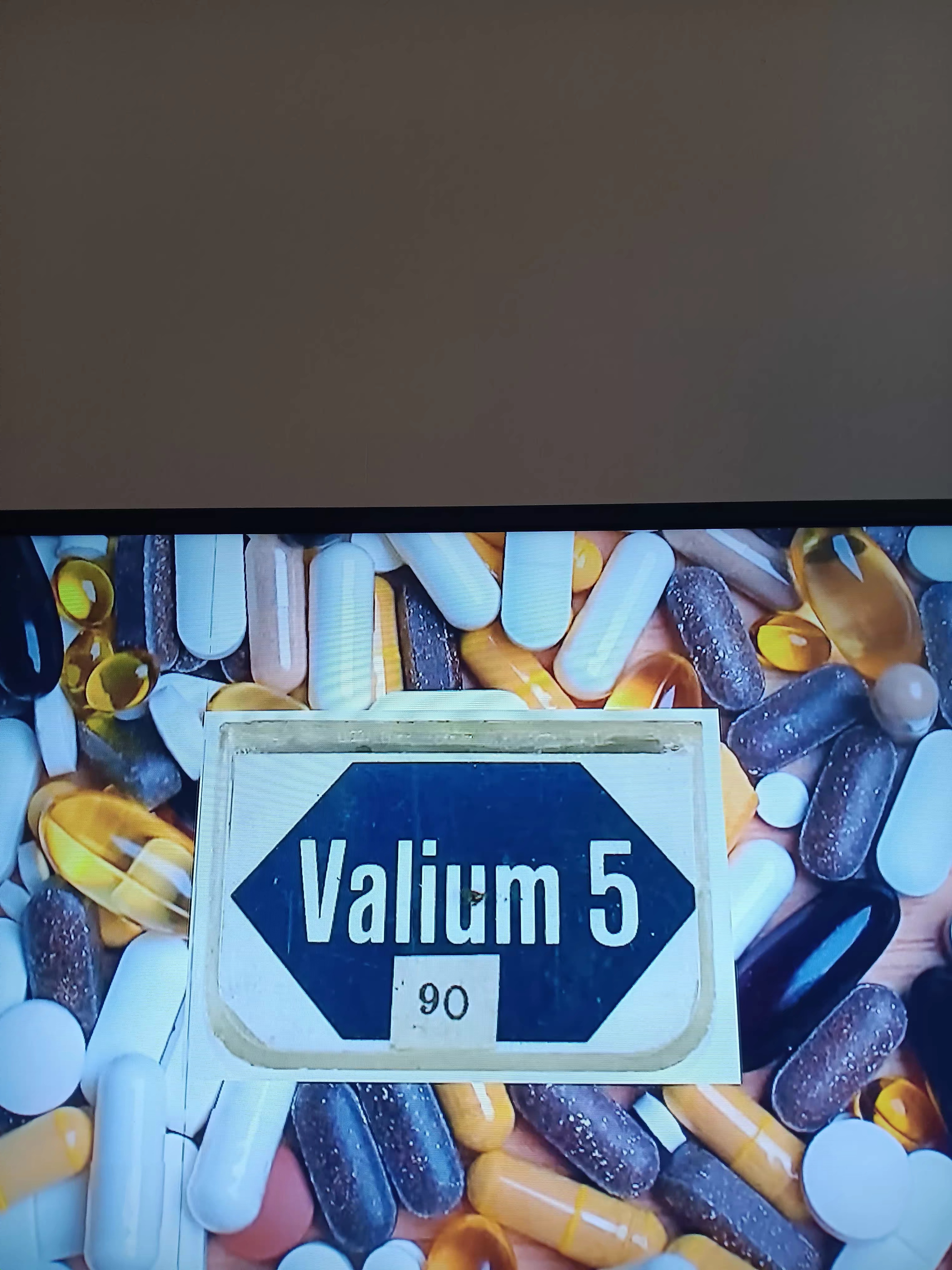
He calls this time that name because of all the research that is currently being done on what are known as “Magic Mushrooms” on the street. Magic Mushies, or psilocybin, are being researched right now as an effective treatment for a wide array of modern issues, including, but not limited to: treatment-resistant depression; Obsessive-Compulsive Disorder; adult ADHD; and Substance Use Disorder.

To those not in the know, it may sound ironic, and even ridiculous, to give someone who has been addicted to alcohol or opioids Magic Mushrooms instead; but, trust me, the difference between these substances is profound, and one important name for this kind of treatment is: “HARM REDUCTION.” I.e., taking a few Magic Mushes now and then might be beneficial, and is not deadly in the way a full-blown addiction to alcohol and/or opioids is deadly.

HOWEVER: lest anyone think that Magic Mushrooms are perfectly harmless and you can take as much as you want whenever you want, I offer a few examples (taken straight from life, and experience) to make you think again.

If you take too many Magic Mushes all at once, accidentally or on purpose, you can really, really get yourself into some big trouble. Number one, it raises your heart rate and can trigger strokes or heart attacks.

Number two: it can make you paranoid. It can make you very, very, very, very paranoid. It can make you so paranoid, if the dose is large enough, that you become, temporarily, psychotic, which means, totally out of touch with reality.

Taken every day in large doses over, say, a two- or three- or four-week period, a person can slowly, steadily start to become separated from “reality” in a very, very serious way, as in believing you are being watched by the police when you are not being watched by the police, or thinking that your neighbor is out to get ya.

(I am not saying I know these things from personal experience; but I know these things from personal experience.)

Magic Mushrooms have their street terminology, like all drugs. One term is: “hero dose.” It means taking a massive dose and going on a long, strange journey, or trip. Another term is: “micro dose.” It means taking a small, controlled dose, kind of like having a single cup of coffee instead of nine or ten cups of coffee, or a few puffs on a cigarette instead of the whole pack. A third term is really beautiful: “afterglow.” This is what happens when the hero dose or the micro dose starts wearing off, but is still “there.” This phase of the experience is, very often, the very best phase of all. And sometimes it lasts for days (on and off). Literally.

I have seen a grown man sitting on a couch weeping like a little baby and asking the people around him to call his mother because he “wanted his mommy,” even though mommy had been dead for twenty years. This man was not me (I only witnessed this) but damn and wow, did it make an impression.

I have also seen a teenager hiding her head in a bucket for over six hours while believing that “THEY” were at the front door and about to “get her,” because she took a massive “hero dose” accidentally and then freaked out so bad she literally went insane for a while.

Again, it wasn’t me that happened to but I witnessed it, up close and personal, and damn and wow, did it make an impression.

Magic Mushrooms are A DRUG. They are a much safer drug than ALCOHOL, the most dangerous drug of all, along with crystal meth, fentanyl, cocaine, etc. etc. They are a much safer drug than “the hard stuff.”

But if you think you can take as much as you want without losing your shit, you are wrong.

END NOTE/s: They also affect your balance and coordination and can make you fall down.

Never drive on these things unless you are Paul Newman!

Dale Barrigar