One Writer’s Life (Lately) by Dale Barrigar (Images by Dale Barrigar)

“The earth’s proper scripture could be carried on a three-by-five card if we weren’t drunk on our own blood.” – Jim Harrison, from After Ikkyu

INTRO NOTE: This little article about five photographs appears to jump around a lot; but that is only because it is an EXPERIMENT in attempting to capture the process/es of one writer’s mind during a mini-siege of controlled thinking.

I repeat: THIS IS AN EXPERIMENT. In the same way that scientists do experiments is this. (We know as little about the mind as we do about the entire universe which is just one reason why I believe Mind Experiments are productive.)

Henry David Thoreau once said: If I knew anyone better than I know myself, I would write about them (instead of writing about myself.)

Second Intro: These five pictures are called “One Writer’s Life” for six simple reasons.

ONE: I write in my car (a small, fuel-efficient vehicle), a lot, by hand, while roaming around, or ferrying my kids around, from work to school and back again, sometimes while actually driving.

I can drive like Paul Newman or Steve McQueen. There are a trillion things in this world I’m no good at, at all (even unto the point of being mentally deficient at some level, at least by this society’s standards), but driving is not one of them. (Writing an essay about all the things I’m not good at is on the agenda.)

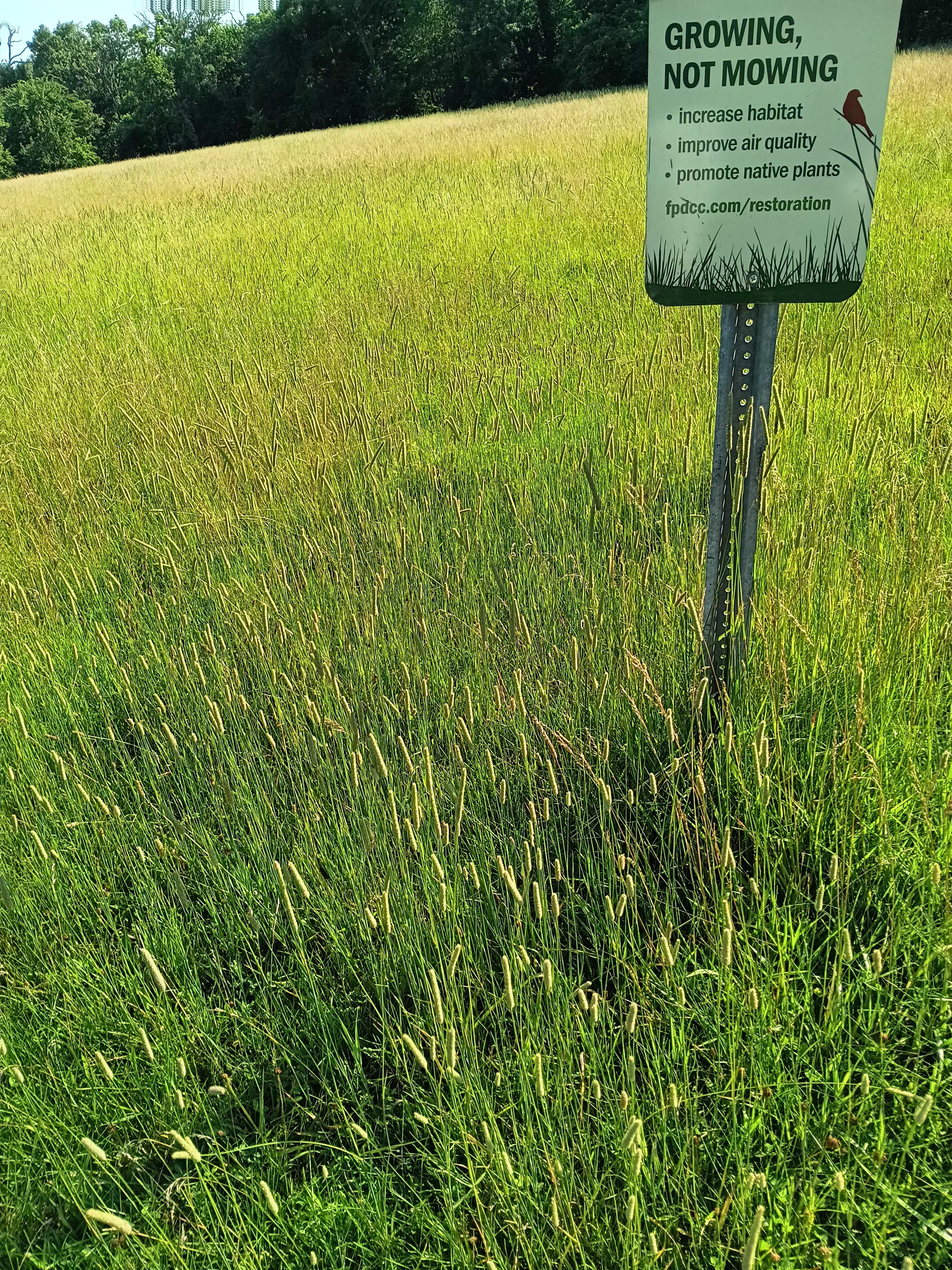
TWO: I spend a lot of time in the northeastern Illinois fields roaming around with and sometimes without my three dogs, and writing, by hand, on paper, with multicolored pens, in all four seasons, which I love equally well. (Every time I try to pick my favorite month, I remember that all the other months are equally good for different reasons.)

I use many-colored pens because I like many colors (it makes the page/s look alive and vibrant, and reminds me of my heroes, Van Gogh and Walt Whitman), and because it helps me tell what the hell is going on in the packed page/s later (if and when the pages don’t fall out of my pockets for someone else to find, or not find, later).

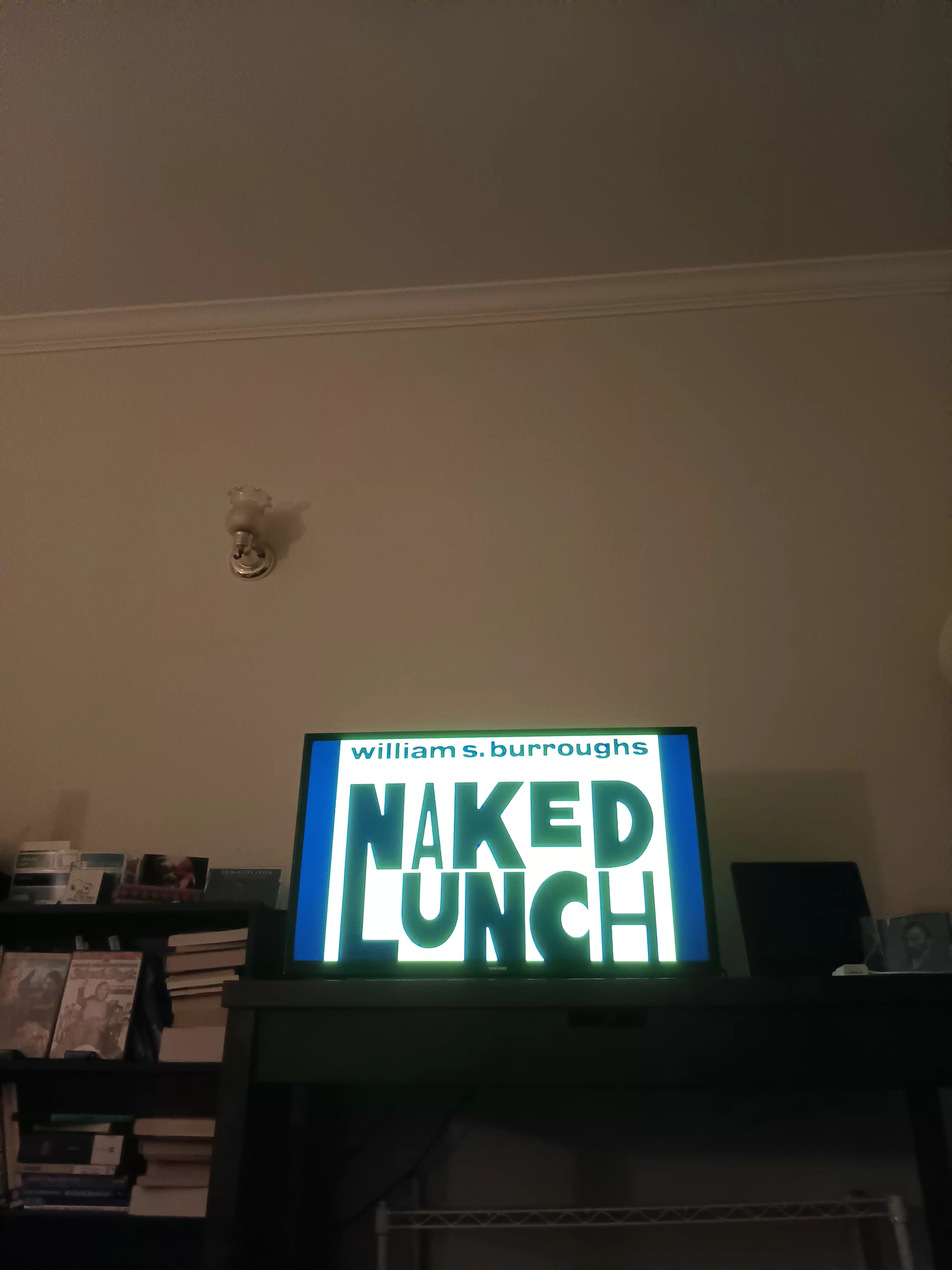
THREE: I watch a lot of documentaries about writers in my down time, when I’m too tired to read or think on my own.

(I have (almost) no regular furniture in my small, fuel-efficient apartment, and if I did have it, I wouldn’t use it (which is why I don’t have it).)

FOUR: I write outside, as stated previously, a lot, including at night. I rarely use an umbrella even in the rain because my uncle, who was a Marine sniper in the Vietnam War with two tours of duty (and later regretted his actions but felt he was serving his country at the time), told me that Marines never use umbrellas unless it’s holding one over someone else, and I admire that kind of humble, dutiful, rock-solid toughness; but I still find umbrellas beautiful for some reason, I think because of my fondness for Asian culture and some of the beautiful paintings I’ve seen.

The lonely plant here, reaching toward the stars (not touching the stars: reaching toward them) is a symbol of the real (and HUMAN, all-too-human!) writer.

The stars are not of this world; and at the same time, they are the only thing that’s truly important in this world at all.

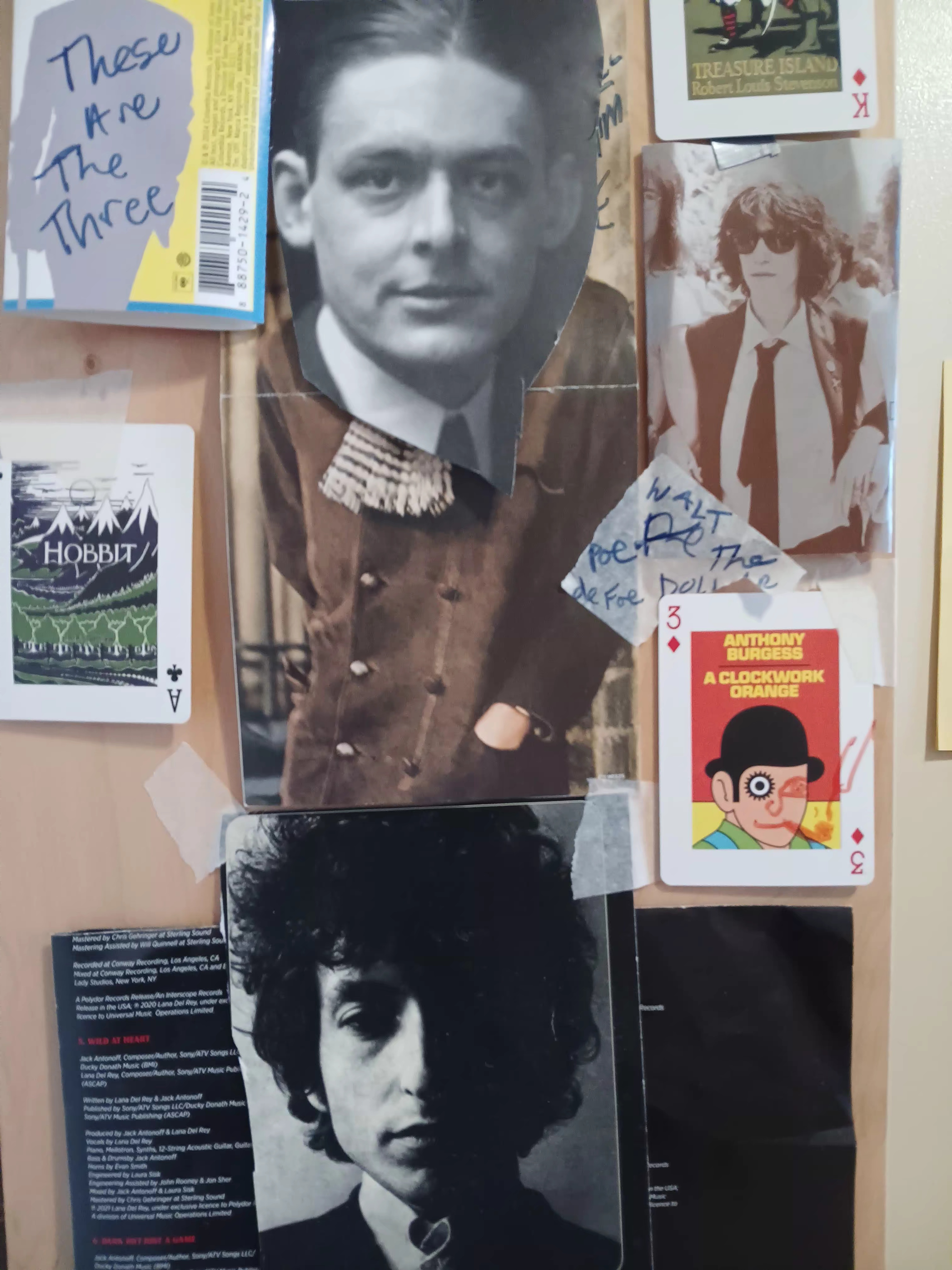
FIVE: In the mode of William S. Burroughs, that great Kansas aristo-cat who always wore an Army jacket and baseball cap in his later years, I sometimes toss together half-assed collages of writers when I’m not writing.

At the present moment (I counted) I have 103 pictures of various writers (and a few other artists, especially Van Gogh (who was also one of the greatest writers of all time, just pick up his letters and dive in anywhere), Picasso, Leonardo da Vinci, Marilyn Monroe, and Joan Crawford, one of whom reminds me of my mother and another of whom reminds me of a few someone/s I won’t talk about right now) up all over in my apartment.

Many of the pictures are small, like postcard-sized and so forth.

I see them much more than I see any other humans these days except strangers on the street and my kids, and sometimes their friends, etc.

SIX: Real writers are more introspective and self-conscious, and less publicly performative and pushy, than all other kinds of artists (in general, or mostly) and many of them definitely fit into the category of “neurodivergent,” and many of them in many more ways than one, too. And many of them are always dodging and disappearing around corners, like Herman Melville, and Emily Dickinson, were both equally wont to do, on a regular basis.

Hurray for the Human Writer, the Outsider Observer who cares (and struggles and strives) and can get it all down in words!

They call/ed Jesus “The Word” because they knew he is the greatest writer who ever lived, bar none.

Paul first spread The Word’s teachings through the word. (Open his letters anywhere and dive right in; Kurt Vonnegut repeatedly called himself a “Christ-loving atheist”; Charles Bukowski said, “Jesus had style.”)

Literature is the deepest, most profound, most complex, and longest-lasting Art form (without any doubt whatsoever at all).

Almost all of the greatest military generals in the history of Planet Earth (from Alexander the Great to Napolean to Ulysses S. Grant) have known and acknowledged this fact.

Michelangelo, and Picasso, and Rodin, all also acknowledged this fact.

They were all obsessive readers of Literature, and either were, or wanted to be, Writers.

Dale Barrigar (Words and Photos)

Goodbye Everybody and Hello by Dale Barrigar

(The images by Dale Barrigar)

The Dream Songs have given me more pleasure than any other poems I have ever read.” – Nick Cave

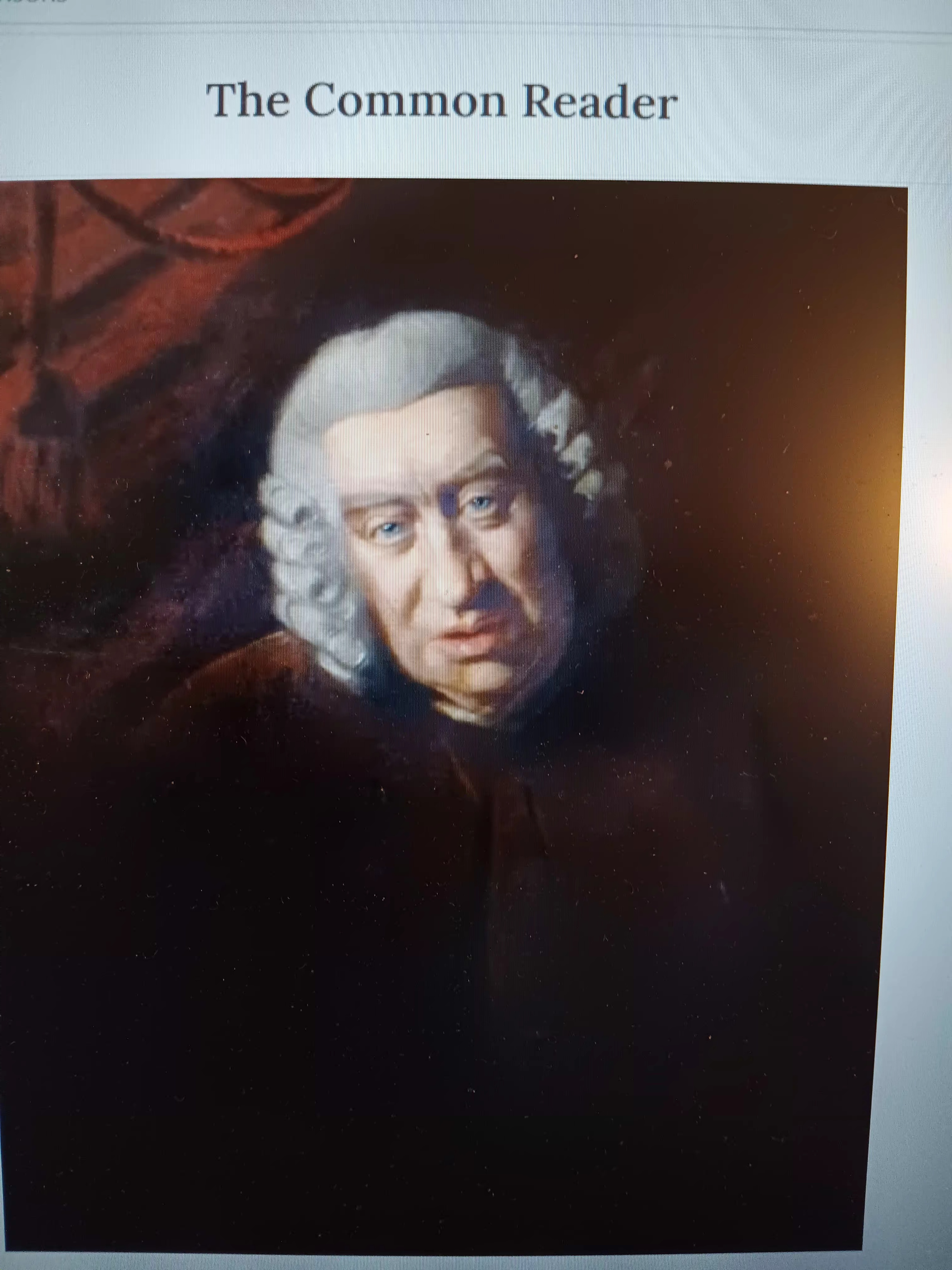
The American poet John Berryman (1914 – 1972), author of The Dream Songs, once famously said that he wished to be given cancer because it would test him.

In the context of the full quotation, one can tell that he was probably being metaphorical and even ironic.

But he was also not kidding. Because that’s the kind of guy he was.

Berryman, who was a severe, chain-smoking alcoholic with a bad case of Bipolar Disorder (known as Manic Depression while he lived), was a badass.

Too many people in our global society today, as in far, far, far too many millions or even billions of people, are far too soft. They are far too soft, too enormously large, too enormously corpulent, gigantic, obese, overflowing, slow, flaccid, slow-moving, slow-thinking, spreading, steady, useless, entitled people.

If they were all attacked by a single samurai warrior they would be toast.

Not all heavy, or even enormously fat, people are lazy, despite all the stereotyping that goes on. John Belushi, John Candy, Chris Farley, Harold Bloom, Marlon Brando, Elvis Presley, Orson Welles, Madame Blavatsky, Shakespeare’s Falstaff, all were or became enormously fat folks.

And they had energy; they had life; they had spark; they had liveliness; they had chutzpa; they had attitude; they possessed what one needs to be and become (a process that never stops) who one is.

But too many enormously overweight people have let themselves go, are addicted to poison food and sugary beverages, and they don’t move enough, and what’s more, they don’t want to move – ever. Or barely.

John Berryman leapt to his death from a bridge over the Mississippi River in Minnesota at the age of 57 years. He was massively, manically depressed, totally intoxicated, utterly drunk, woefully strung out, completely burned out, and totally done when he did so.

Hart Crane, the American poet (born on the SAME DAY as Hemingway, July 21, 1899, exactly one-hundred-and-twenty-seven years and two days ago from today) leapt from a ship into the Gulf of Mexico at the age of thirty-two and was never heard from again.

Right before he did so, he happily shouted out to a bunch of travelers, “Goodbye everybody!” They all knew who he was and some of them weren’t even surprised.

He too, at the time of his death, was manically depressed, intoxicated, drunk, strung out, burned out, and done. He went out with a bang, not a whimper – like Berryman, Hemingway, Sylvia Plath, Hunter S. Thompson, Vincent Van Gogh, Kurt Cobain, Chris Cornell, Anthony Bourdain, and many other artists, near-artists, and sensitive souls in the world’s history. Having been suicidal myself in the past, I know it’s almost always what should really be called a kind of accident. (And I believe that God catches these people when they fall for the final time, NOT sends them to hell.)

Berryman’s famous magnum opus The Dream Songs helped establish and create what was and is called “confessional poetry,” which is both a good and a bad name for what it tries to describe.

Berryman’s book is oftentimes awfully overwritten. Frequently, one can tell that Berryman was, without doubt, blasted out of his mind when he wrote this stuff, like William Faulkner when William Faulkner wrote much of his (later) stuff. Gabriel Garcia Marquez once pointed out (from personal experience) that it was really good to write while you were drinking because it freed the mind and inspired the writer – but only up to a certain point. Once a person is too blasted on anything (whether it be benzos, weed, booze, cocaine, all of the above, or whatever), the writing is sure to suffer, and sometimes it will take a dive straight into the toilet, depending on how blasted the writer is.

Sometimes, when Berryman wrote, he was far too blasted, on booze and pills; and it’s obvious.

But the highly flawed Dream Songs is still a landmark in twentieth century American poetry. It’s one of those often-unreadable books that everyone should have on a shelf. See Dream Song #107 for a wonderful poem about a drunk writer’s encounter with the wonderful animal called the raccoon, which deeply characterizes not just the raccoons but the writer.

And Berryman (though he could very, very often be seen just lying around, at least half the time) was not a lazy, soft, snarky, sarcastic, useless, entitled person.

He was a badass!

Crucial End NOTE: The term “badass,” like the word “cool,” both originated in their current form/s within the African American jazz culture of the 1940s. Those folks were badass/es; and they were totally cool.

John Berryman, like Hart Crane before him, was hugely influenced by jazz and blues. Berryman’s book The Dream Songs could not, and would not, have been written without his love of jazz and blues, which inspired the form/s, the spirit/s, and the meaning/s of his poems, as he himself so often admitted and said, and preached and talked about.

Dale Barrigar