In the next seat to Alan on the plane, his fellow-passenger sighed as he replaced his plastic knife and fork in the cardboard food box, he turned to Alan and said, ‘That meal was the worst thing I’ve ever tasted.’ Four hours into the flight, they were the first words he’d spoken.
Alan felt obliged to reply. He thought about it and said, ‘I reckon that meal was only the second-worst thing I’ve ever tasted. The very worst taste was when I accidentally brushed my teeth with a tube of my wife’s hair removal cream.’
His fellow-passenger stared at Alan for a moment and let out a great belly laugh. He turned out to be a guy called Niels, a Dane who worked for Maersk, the shipping company. In turn, Alan explained that he was retired and on the Vancouver flight to visit his sister there, who hadn’t been well. Niels, like a lot of big guys, was tactful in his enquiries: he didn’t ask about the sister’s diagnosis or prognosis, merely observing that it would be a treat for her to spend some time with her brother again. Instead, Niels mentioned that he himself was planning to retire soon: how was Alan enjoying his retirement?
Alan talked about his allotment and also about some family genealogical research he’d been doing. He mentioned that he’d been fascinated by one of his mother’s ancestors, Thomas Bridges, a nineteenth-century missionary to one of the native tribes in the island of Tierra del Fuego, at the southernmost tip of South America. Rev. Bridges had laboured long and hard there to produce a dictionary* of the Yamana language, containing more than 30,000 Yamana words…
Niels was shocked: ‘Wow, that’s a big achievement.’ He smiled: ‘That’s some relative you’ve turned up.’
Alan was playing, distractedly, with the airline plastic fork. ‘Well, the thing is: I’m not so sure about the achievement. You see, over the years Thomas Bridges was there, the native population was decimated, almost entirely wiped out – a smallpox epidemic, a land war with incoming settlers, the local seals that the tribe depended on for food were almost all slaughtered by visiting whaler crews. The last native Yamana speaker died in 2022. The site of his old mission station is now the main departure port for Antarctic cruise ships.’
Niels nodded his understanding. But Alan wasn’t finished: ‘Did you know that in a single day, January 15th, 1965, Bob Dylan recorded the final versions of Maggie’s Farm, On the Road Again, It’s Alright Ma, Gates of Eden, Mr Tambourine Man, and It’s All Over Now Baby Blue? In a single day.’
It was a telling comparison. Niels intuited that his fellow passenger was distressed that his ancestor’s huge labours over the decades may have been utterly futile. Niels was a compassionate guy, and they still had a long way to travel together before they reached Vancouver. He spoke hesitantly:
‘Dylan’s music, like all art, is a form of play – yeah? It involves so many aspects of living – novelty, risk-taking, beauty. But your ancestor’s dictionary wasn’t art, it was a scientific endeavour. It involved concentration, judgement, rigour. Maybe it’s a mistake to compare Mr Tambourine Man and the dictionary? They were both very worthy achievements, very different aspects of living. We should celebrate them both.’
He caught the stewardess’s eye and ordered a couple of whiskies. They toasted each other and looked out the window. The plane was flying up the west coast of Greenland, and something out there was attracting other passengers – something utterly divorced from human endeavour. A Greenland glacier was calving as it edged into the ocean. Several new-launched icebergs were lying offshore. Things of strange beauty, tinged with pink from the low sun as they started their journeys of flotation and slow dissolution.
*Yahgan Dictionary Language of the Yawane people of Tierra del Fuego ms. of Rev. Thomas Bridges (later annotations by Rev. John Williams) dated 1865, text published on line by Patagonia Bookshelf 2004-2013.
“The mighty moral growth of the author, during his literary activity, is written in indelible characters in these exquisite short stories.” – Leo Tolstoy on Guy de Maupassant
I recently heard an admirably fired-up You Tuber say that almost all fiction writers do their best work in the short form.
Then he said he didn’t know why short fiction, i.e. short stories, are not more popular right now, in the modern world, since most fiction writers do their best work in this form.
I instantly knew I agree/d with the first thing he’d said (since I’ve said it myself many times before, in many different formats; there are no “original” ideas: period).
I also know that short stories, while they are making a small resurgence, are not money-makers in the mainstream publishing world today and far from it.
I started wondering more about why that is, because of what the You Tuber had said.
And I came to the conclusion that it’s because short stories are where fiction writers do their best work.
In other words, short stories are very often the deepest work out there and readers today (in the mainstream, that is) are not looking for depth or challenging material; they are looking for cheesy reassurance, easy affirmations, boring normalness (because it’s comforting) dressed up as something exciting.
There was a moment in American fiction when short stories were where the money was at.
F. Scott Fitzgerald and Kurt Vonnegut both made boatloads of money writing short stories in the early to middle twentieth century. Fitzgerald made far more money from short stories than he ever did from his novels, including Gatsby, which was a financial and critical failure and flop during his lifetime (like Melville’s Moby Dick, or the paintings of Vincent).
But Scott and Kurt both quickly found out that, in order to make that dough, the stories needed to be romantic (unrealistic) tales, easy to digest, and written with contrived (formulaic, used-before, tried-and-true, but not true-to-life) plots. And no ragged, Chekhovian, ambiguous, challenging, thought-provoking, open endings allowed; nor any Dostoevskyean extremity of atmosphere; nor any out-of-this-world Borgesian thought experiments, either.
The best short stories right now are not hugely popular because they are not hugely easy to read.
The first thing they require is pausing from your daily life, concentrating, thinking, feeling, sympathizing, empathizing, decoding, interpreting, imagining, understanding, challenging your own assumptions, stepping away from it all, meditating, reaching out toward characters who might make you uncomfortable, and being comfortable with uncertainty (which ability John Keats called “Negative Capability”). “Beach read” novels and various kinds of thrillers now dominate the fiction best-seller lists, almost literally without exception, and almost all of them (NOT all, but almost) are, by definition, easy, stereotypical, non-challenging, seen-it-before (many times), simplistic, and unrealistic works.
And yet, short stories are, literally, everywhere in our world. School, the internet, and television all overflow with short stories, and almost all movies are far more like short stories than like long novels. Nightly and daily news broadcasts are now presented as dramatic (and, unbelievably, unrealistic, since it’s supposed to be “the news”) short short stories, one piled on top of another in an endless, ridiculous stream.
The relationship between television programs and short stories is a fruitful study for anyone interested in modern fiction writing for any reason and goes back to the very roots of the TV medium.
The Twilight Zone, Star Trek, and Alfred Hitchcock Presents are all classic television programs with very close connections to short stories in many ways.
The works in the Arabian Nights, the Canterbury Tales, and the Decameron are all early short stories.
Short stories are so closely tied to religion that they ARE religion.
The Good Samaritan, The Prodigal Son, Dives and Lazarus, Buddha and the Flower Sermon, Lao Tzu disappearing into the mountains after he (for free) penned the 5,000-word Tao Te Ching and handed it to the guard who’d asked him to write it, are all short stories in their (eternal) way.
This short little essay now concludes with a short little list of passed-on (but still here) fiction writers who’ve all done their best work in the short story (plus a few crucial after-thoughts afterward).
Arthur Conan Doyle. Franz Kafka. Clarice Lispector. Ernest Hemingway. James Joyce. Flannery O’Connor. Hans Christian Andersen. William S. Burroughs. James Baldwin. Grace Paley. Raymond Carver. John Cheever. D.H. Lawrence. Thomas Mann. Joseph Conrad. Dorothy Parker. Shirley Jackson. Ambrose Bierce. O. Henry. Harlan Ellison. Ralph Ellison. Frank O’Connor. William Gay. Larry Brown. Barry Hannah. Rick DeMarinis. Washington Irving. Jorge Luis Borges. Gabriel Garcia Marquez. Denis Johnson. Thom Jones. H.P. Lovecraft. Nelson Algren. Cyrus Colter. Donald Barthelme. Ivan Turgenev. Nikolai Gogol. Isaac Babel. Isaac Bashevis Singer. Katherine Mansfield. Eudora Welty. William Saroyan. E.T.A. Hoffman. Ray Bradbury. Rudyard Kipling. Guy de Maupassant.
Poe and Chekhov are sort-of left off the official list because their greatest works might be poem/s and play/s; but The Raven is a kind of short story for sure, as is The Cherry Orchard.
Many modern fiction writers who did not do their best work in the short story did their best work in the novella, instead (not the novel), but that is a subject for another (annoyingly opinionated) exploration by THE DRIFTER (sometimes known by local canines and felines, ’coons, squirrels and birds as “Dale the Drifter”).
Almost all of the great nineteenth century novels were published in serial form, that is, as separate magazine or journal installments over an extended period, one chapter at a time.
As just one example, War and Peace, that episodic behemoth, originally appeared as a serial over two years (1865 to 1867) in the journal The Russian Messenger before being, heavily, revised and expanded over the next two years after that, then finally published as a stand-alone volume in 1869.
Frank O’Connor called the short story The Lonely Voice. (Just exactly why he did so is also another subject for a future exploration from: The Drifter.)
When the world is a dark pit, and you find yourself locked up with lunatics. Sometimes, a person needs a slice of sunshine. So that’s what this series of photos will try to capture, but alas, it’s hard to catch a sunbeam.
Then again, I don’t need my baseball glove or butterfly net. Not when I have this magical weight around my neck. It’s left the dark room behind, this is true, but I have my own just in case.
I try to explain this alchemy, as if to a five-year-old or my giant German shepherd dog, to these folks on the ward, but they just cock their heads. I talk about apertures, f-stops, and blinking eyeballs.
No respondo, Ernesto just gazes away from me and talks to people who aren’t there. All of their heads turn, and I finally have an audience.
I’m free again, on Antabuse, so I’m back with the camera therapy of nature and sunshine. The technology that I couldn’t explain to them—resting in my hands. Like a thousand picture books.
The shutter is eager to slide over its mechanical eye, snapping pictures of the sun and everything under it, but you have to be careful taking so many pictures of God.
“The earth’s proper scripture could be carried on a three-by-five card if we weren’t drunk on our own blood.” – Jim Harrison, from After Ikkyu
INTRO NOTE: This little article about five photographs appears to jump around a lot; but that is only because it is an EXPERIMENT in attempting to capture the process/es of one writer’s mind during a mini-siege of controlled thinking.
I repeat: THIS IS AN EXPERIMENT. In the same way that scientists do experiments is this. (We know as little about the mind as we do about the entire universe which is just one reason why I believe Mind Experiments are productive.)
Henry David Thoreau once said: If I knew anyone better than I know myself, I would write about them (instead of writing about myself.)
Second Intro: These five pictures are called “One Writer’s Life” for six simple reasons.
ONE: I write in my car (a small, fuel-efficient vehicle), a lot, by hand, while roaming around, or ferrying my kids around, from work to school and back again, sometimes while actually driving.
I can drive like Paul Newman or Steve McQueen. There are a trillion things in this world I’m no good at, at all (even unto the point of being mentally deficient at some level, at least by this society’s standards), but driving is not one of them. (Writing an essay about all the things I’m not good at is on the agenda.)
TWO: I spend a lot of time in the northeastern Illinois fields roaming around with and sometimes without my three dogs, and writing, by hand, on paper, with multicolored pens, in all four seasons, which I love equally well. (Every time I try to pick my favorite month, I remember that all the other months are equally good for different reasons.)
I use many-colored pens because I like many colors (it makes the page/s look alive and vibrant, and reminds me of my heroes, Van Gogh and Walt Whitman), and because it helps me tell what the hell is going on in the packed page/s later (if and when the pages don’t fall out of my pockets for someone else to find, or not find, later).
THREE: I watch a lot of documentaries about writers in my down time, when I’m too tired to read or think on my own.
(I have (almost) no regular furniture in my small, fuel-efficient apartment, and if I did have it, I wouldn’t use it (which is why I don’t have it).)
FOUR: I write outside, as stated previously, a lot, including at night. I rarely use an umbrella even in the rain because my uncle, who was a Marine sniper in the Vietnam War with two tours of duty (and later regretted his actions but felt he was serving his country at the time), told me that Marines never use umbrellas unless it’s holding one over someone else, and I admire that kind of humble, dutiful, rock-solid toughness; but I still find umbrellas beautiful for some reason, I think because of my fondness for Asian culture and some of the beautiful paintings I’ve seen.
The lonely plant here, reaching toward the stars (not touching the stars: reaching toward them) is a symbol of the real (and HUMAN, all-too-human!) writer.
The stars are not of this world; and at the same time, they are the only thing that’s truly important in this world at all.
FIVE: In the mode of William S. Burroughs, that great Kansas aristo-cat who always wore an Army jacket and baseball cap in his later years, I sometimes toss together half-assed collages of writers when I’m not writing.
At the present moment (I counted) I have 103 pictures of various writers (and a few other artists, especially Van Gogh (who was also one of the greatest writers of all time, just pick up his letters and dive in anywhere), Picasso, Leonardo da Vinci, Marilyn Monroe, and Joan Crawford, one of whom reminds me of my mother and another of whom reminds me of a few someone/s I won’t talk about right now) up all over in my apartment.
Many of the pictures are small, like postcard-sized and so forth.
I see them much more than I see any other humans these days except strangers on the street and my kids, and sometimes their friends, etc.
SIX: Real writers are more introspective and self-conscious, and less publicly performative and pushy, than all other kinds of artists (in general, or mostly) and many of them definitely fit into the category of “neurodivergent,” and many of them in many more ways than one, too. And many of them are always dodging and disappearing around corners, like Herman Melville, and Emily Dickinson, were both equally wont to do, on a regular basis.
Hurray for the Human Writer, the Outsider Observer who cares (and struggles and strives) and can get it all down in words!
They call/ed Jesus “The Word” because they knew he is the greatest writer who ever lived, bar none.
Paul first spread The Word’s teachings through the word. (Open his letters anywhere and dive right in; Kurt Vonnegut repeatedly called himself a “Christ-loving atheist”; Charles Bukowski said, “Jesus had style.”)
Literature is the deepest, most profound, most complex, and longest-lasting Art form (without any doubt whatsoever at all).
Almost all of the greatest military generals in the history of Planet Earth (from Alexander the Great to Napolean to Ulysses S. Grant) have known and acknowledged this fact.
Michelangelo, and Picasso, and Rodin, all also acknowledged this fact.
They were all obsessive readers of Literature, and either were, or wanted to be, Writers.
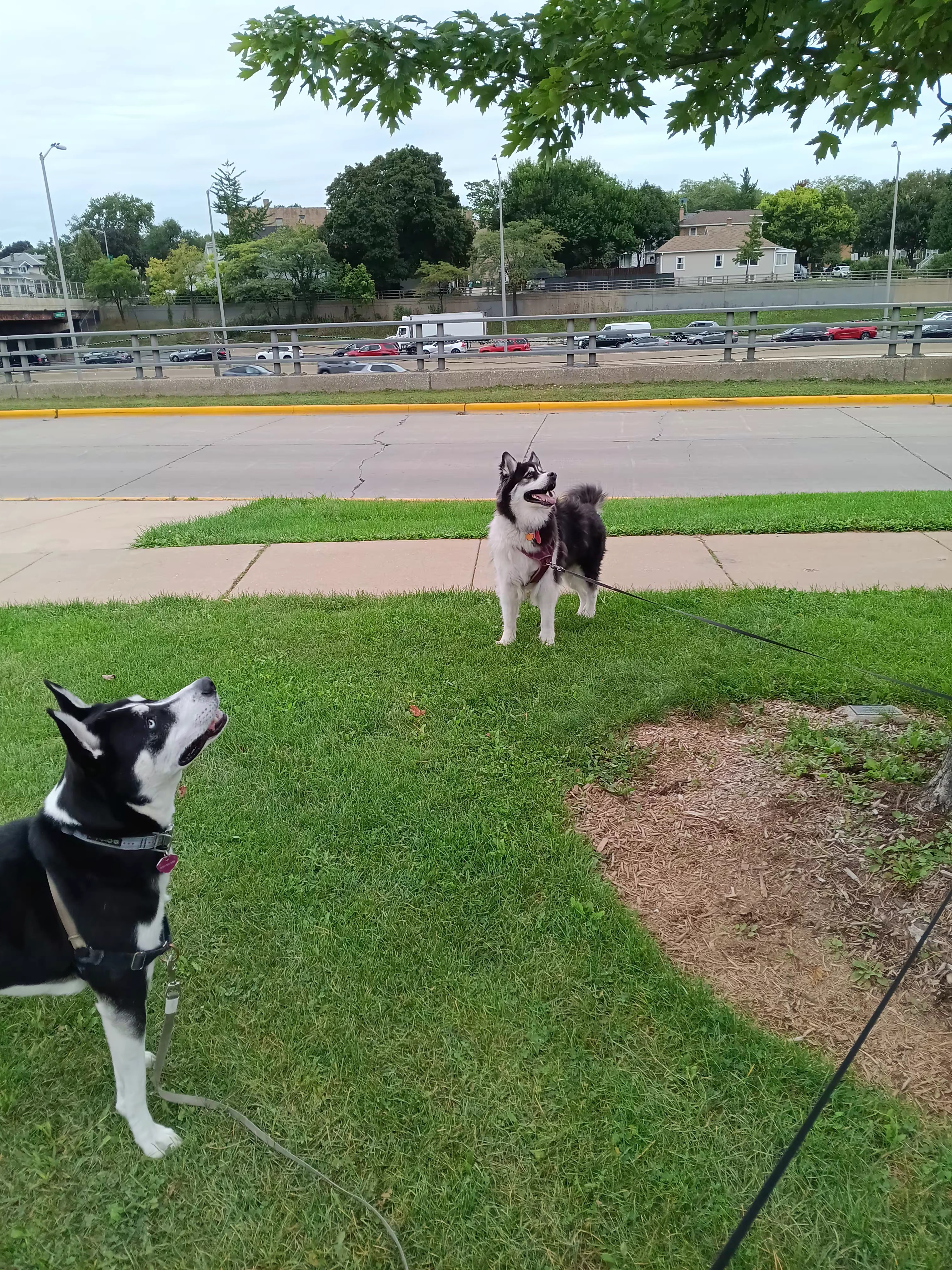
This here shaggy dog is headed to Jensens Island in the middle of Big Bearskin Lake in far northern Wisconsin.
I am not aware of whether he knows the details of all that, but he isn’t used to being on boats and one thing is certain from looking at these photos: even though he isn’t used to them, he isn’t scared, either.
That’s because he has a fearless and bold nature that makes him plunge into situations such as these almost (not quite) without thinking twice.
He’s also jumpy and paranoid in certain ways, hyper-aware of what’s going on around him and the best guard dog, when it comes to people, you could ever hope to meet.
He doesn’t care about material objects or possessions or probably even money, near as I can tell, as long as he usually has a full belly when needed and somewhere to lay his head, also when needed.
But the people in his life – he would die for them if he had to, without thinking twice.
There are many people in this world who would say, and do say, that a Dog is just a dog.
Anyone who attributes spiritual properties to their animals, like I do to mine, and like the Chippewa of northern Wisconsin used to do (and some still do) to theirs, will think that such people as that are lacking something in their nature. Not that they aren’t fully human, but yes that they are humans with cold (or at least colder than they should be) hearts.
For me, one look in his eyes tells you instantly that there is a lot more going on in there than some people give him credit for.
In some ways I even believe that he’s much smarter than your average, run-of-the-mill, boring, materialistic human – and very much so, at a level that cannot be scientifically tested or verified at all – and is even more true for all of that.
Words and pictures by Dale Williams Barrigar and, of course, Boo
(A late happy 133rd birthday to Dorothy Parker, a keeper of the little god of suicide)
Suicide is a big part of art, so I’ve been told. It’s big in my family, I know that much. My father, both my grandmothers did it. My mother could have hung on another year or so but went Bartleby on dialysis. I’ve seen enough. And on the early morning of 21 December 1989, at the age of thirty, I did it. Damn wonderful, really; and such a revelation of freedom; those were the free-est, purest, most honest five seconds of my life. For once I was doing something Big. Fuck boredom and being embarrassed about being alive. But I failed. While blasted, I deliberately aimed my car at a sturdy utility pole, floored it and woke in the hospital. If a spur of the moment thing can still contain the shape of a plan, then there you have it; but of Mice and Drunks and the little devils that protect us, I was chosen to survive. My Colt looked like a crushed beer can yet I survived with a concussion, a bunch of stitches and a DUI. “Could be worse,” I told myself at the wrecking yard a few days later, as I managed to reach in and extract the eightball of blow I had in the glove box. “Yessir, could be a whole lot worse.”
Funny thing is that even though I was in a moderate bit of trouble (DUI, five days in jail and about five grand for messing up the pole), like in The Exorcist the demon inside that wanted to die bailed when we hit the pole. Just like the bastard to do something like that. Cheap fucking 80’s demon. Not like the old-timey grandmother demons who drop from the gallows with you. You could depend on them.
I do not write this for sympathy nor to shock. It’s just something that happened more years ago than I had been alive at the time of its happening. The odd thing is the missing demon-feeling. It felt like it had always been with me, something about death, a weirdly detached point of view that came up in certain situations (especially when blasted–but still, always there). I can trace back to the time, but I cannot remember the actual fabric of the feeling, the touch of being. I only remember that it always felt like night, and a certainty that good times were over, and that I had missed out on something I could never understand.
For me there is only one bit of art that comes close to describing the feeling (which, actually, is an anti-feeling, if that makes sense). It is the song Tomorrow Wendy performed by Concrete Blonde, written by Andy Prieboy. The writer is a member of the Wall of Voodoo, whose artistic respect lies somewhere between that held for the 1910 Fruitgum Company and Aha. But, hey, a job is a job and I completely understand.
Prieboy wrote it about a woman he knew who got into heroin, prostitution and eventually contracted HIV. Instead of waiting to die in the slowest, most agonizing way possible (this was the 1980s, no drug cocktails as of yet), Wendy loaded a needle and found her way to the door. But on her way out she had many devastating opinions to share. The song is a stunner, and I cannot think of a voice keener than Concrete Blonde’s Jonnette Almalfitano to deliver it. The production is first rate and it is one of those rare, perfect pieces of music that cannot exist in the same dimension with the usual pop stuff (both the good and bad) because it is too honest. It hurts too much to hear and it makes Clapton’s Tears in Heaven come off overrated (which, for me, mind you, is. Obviously a horrible situation, but I find it strangely aloof and too neatly done for honesty).
I never told anyone how I was feeling. I had a thought that they did not want to hear about it, plus the idea of confession felt as though I would cheapen something in me that was stunningly complicated and even artistic in its own fashion. I did not tell them because they were terrible people (most were, but I like em just fine), but because nearly every little thing we say and do is designed to either obscure or lessen the truth. Big ticket items tend to create an instant vacuum into which bullshit immediately fills. Besides suicide is something that varies from person to person. I believe that some people can be saved by speaking out, but others need to act out in some way. Moreover, we are still very much in the grip of the old thinking, in which suicide, depression (not always mutually exclusive), substance addiction (for some reason we still normally divide alcoholism from drug addiction, even though they are the same complaint) and fifty other troubles are moral failings, indicative of spiritual weakness. Anyway, it is too big a responsibility for a mortal to tackle. The best idea is to shut up and listen. Leave the “You are needed” tripe for Hallmark cards.
A few years ago a guy went over a land bridge in Port Orchard, Washington. It stands over a creek and a valley and is way the hell over a hundred feet above stark reality. I walk that bridge a lot and I saw the little arrangement of flowers someone left behind and a message of hope left in sharpie–signed “A Stranger.” Yes indeed we sure give a fuck after the fact. But really, I cannot see any message of hope and a Dollar Tree candle stopping somebody determined to go over that bridge. I peeked over the rail. So much shit to hit on the way down–and trust me that is a big down. The type that puts a jittery feeling in your knees to look at. And for a moment I had nothing but love for the man. He made a real statement against all the superficial labors we must endure. He made himself holy. Such courage to do that–A that which is as untake-backable as any that gets. I felt like kicking the cruddy little shrine down into the abyss, but it did not deserve the rapture.
I honestly do not believe that a song or any kind of art on its own can save a person. I also feel that such cannot destroy anyone either. But allowing good things to enter your thoughts, and by good, I mean sincere, can help. One of the few things I do remember was a terrible cycle of repetition in my mind. Certain images and thoughts chasing themselves like Cats after their own tails.
I think Wendy did the right thing for herself. That’s because she had a terminal condition that was not going to end well. Cook, jab, Goosh, sweet speedball, and sleep–the good kind, like when your mom or dad put you to bed after a late night, melting into the sweet embrace of wind dried pillow cases and sheets. And I do not think there is a “perchance to dream” part coming for people like Wendy–as in the inferred rottenness pondered by the Prince. If there was more, I’d rather it be the happiness that eluded her in life.
It is a touchy subject. Unless you spout the “You are needed, take your vitamins, it is always darkest before the dawn (to which I retort “Everything will be at its brightest when the sun explodes”) company line, you risk “causing a tragedy” or the accusation of promoting self murder. That is a lie told by people who have limited imaginations and monochromatic solutions, and it belies an attitude that contributes to pain due to its artificiality. Find someone to talk to, if you haven’t got anyone, find a priest–even if you do not believe in God. But listening to that one voice over and over and over will get you nowhere.
She really wanted to come over and see him and he really didn’t know quite why that was, but he said okay and hung up the phone.
The year was 2003 and the time of year was midsummer and he didn’t have a cell phone yet (on purpose) and wouldn’t (on purpose) for a long time.
The landline wasn’t his either.
He was house-sitting for a friend while the friend and his wife were in France for the summer.
The house was in the northside Lincoln Square neighborhood of Chicago, just off Lawrence Avenue. This was before Lincoln Square became horrifically, and ridiculously, gentrified but at a time when it was already on its way, fast, on the downward slope.
The house he was house-sitting in for the summer was ridiculously large by his standards, a person who was used to living in many different, small, cheap apartments all across the city over the last however-many years.
Only two people usually lived in the house but it had five upstairs bedrooms, four bathrooms, a gigantic kitchen, a massive dining room, a huge living room with a massive fireplace, a really big family room with an incredibly large TV, a gargantuan basement with at least six separate rooms and lots more TVs, several rooms on the ground floor that were used for things like libraries and studies that were never used, etc. etc. etc. (“Sleeping” alone in this large of a house gave him waking nightmares which usually led to him crashing on one of the first-floor couches near a window by a tree.)
His friend, the husband, wasn’t that loaded, but his friend’s wife came from a family in Oklahoma that was so rich with oil money it wasn’t really funny except it also was kind of funny – in a perhaps sick way.
When the main character of this story’s friend arrived she looked beautiful because she was beautiful. She was, somehow, much more beautiful than the last time he’d seen her, about three or four months ago at the university where they were both lecturers in the English Department.
Her long, fresh-smelling brown hair came down to the middle of her back and had blonde streaks in it that looked natural and golden when she moved her head. Her perfect face was cat-shaped and insomniac-pale, looking for something, and her large, gray, long-lashed eyes sparkled with satirical humor and a wild, one-of-a-kind, literary intelligence. She wore a dark red lipstick and had sexy crooked teeth.
She immediately bummed a cigarette off him and asked for a beer because she knew he would have some of both.
They went out into the backyard, on the beautiful green grass (that kind of grass can often be beautiful even though it literally is an environmental catastrophe for Planet Earth) which was very long and thick because, while he was supposed to keep it mowed to the neighbors’ standards while he was house-sitting, he did not do so. (The neighbors often gave him dirty looks. When the summer was over it would take him a long time to get that grass mowed before his friend and his wife returned from France.) The temperature was at a perfect eighty-three degrees F, the sun was out, the Chicago sky was blue and clear, she was in a really great mood, he was in a very great mood too, he was lighting her cigarettes for her (she kept on bumming more from him but he had a carton in the house), the beer tasted wonderful, and the two of them, both writers who made their livings as lecturers and not lecturers who made their livings as writers, were “writing in air.” In other words, they were doing it purely for the love of it (not only aiming for the $ by following trends and corporate style books).
“Writing in air” is a phrase that was used by the great American writer James Agee, author of the classic text Let Us Now Praise Famous Men which accompanied the famous Walker Evans photographs of the poor folks down in Alabama.
Like many writers then and now, too, Agee became an alcoholic and spent a great deal of time as a younger writer “writing in air,” which is to say, spending more time talking about writing with other aspiring writers than actually writing.
Such behavior looks like a waste of time to a lot of the world but it is not a waste of time. It only becomes a waste of time later. When the writer is fairly young, as these two were then (early thirties or so), “writing in air” can be extremely beneficial for the writer as she or he tries out ideas, becomes fluent in the use of verbal flow and tricks, talks about stories, poems, essays, and books, and listens (the deep, active listening is key) to the opinions and ideas of others as well.
These two were having a great time writing in air in the backyard, such a great time that day became evening became nighttime became them in the bar that was just across from the house on Lawrence Avenue.
The bar was called The Ritz and it was run by a guy who called himself Alfred.
That wasn’t his name. It was what he called himself.
The Ritz was one of the most dangerous dive bars the main character of this story had ever been in, and he had been in a million of them all across the USA, from coast to coast and from Fairbanks, Alaska, to Key West, Florida, and in at least forty-five or forty-six other different states too, as well as several in Canada, Mexico, and Jamaica, where he’d almost been killed in one of them (but that is a different story).
The Ritz is there no more. The place where The Ritz was is now a phone store.
Back then, as soon as you walked in the door, you could smell the menace and danger oozing from every single corner of the room.
The place was a garish nightmare from the mind of Poe or Dostoevsky. It had blood-red walls, a deep, sickening green ceiling, very low, yellowish lighting, very dark, hidden corners with very shady people lurking in them, and a gigantic man (as in six and a half feet tall and built like a freight truck) with a vicious scar all the way across his face and nose standing at the door glaring at everyone who walked in the place. Don’t say hello to him because he won’t answer.
The clock was upside down, the only bathroom was dirtier than the one pictured on the Rolling Stones album cover for Let It Bleed, the clientele contained gang bangers, mafiosos, hookers, prostitutes, street walkers (none of these three are always the same thing), drug dealers, thieves, hit men. Yes, “Alfred” had once told the main character of this story that several regulars in this bar sometimes made their livings taking out people for money. But don’t worry, said Alfred. They only kill who they are paid to kill and they don’t enjoy it. They don’t mind it, but they don’t enjoy it, either.
Alfred looked like an emaciated, cadaverous, half-Asian, needle-hiding version of Alfred Hitchcock who’d been resurrected from the grave and presented with a set of gold teeth which he was always flashing then hiding behind dry, cracked, pursed lips. When he gave you a drink he acted like you’d won the lottery.
It may sound half mad that the main character of this story, who wasn’t really (much of) a criminal himself after all, would’ve spent so much time in a place like this, back in the old days. No one knows why, but the facts are the facts.
And the amazing thing was that she understood the danger and the shadiness of the place very well, and wasn’t afraid of it at all.
The two of them entered the Ritz just before midnight and began drinking even though they’d already been drinking (and chain smoking) since way earlier in the day.
They started doing shots of tequila.
Lots of shots of tequila.
In The Ritz you were allowed to do whatever the hell (and whatever the F) you wanted to do, even if it brought you to hell. You might end up dead, injured, crippled, wounded, tied up, kidnapped, maimed, scarred, sick, ill, brain-dead, missing, or otherwise unaccounted for, but no one was going to stop you here. When you stepped in the door, all bets were off, and you had now entered underground Chicago, Land of the Gangsters, at its lowest, or its highest (depending on your perspective) levels.
The two of them retreated to a corner, commandeered a nasty little booth and started making out in the almost-dark, while still drinking and smoking.
After closing time (because even The Ritz had to close at some time) they made it back across the street (somehow) wrapped in one another’s arms.
She had accidentally, somehow, burned his hand with one of their cigarettes. Later tomorrow he would realize how badly and deeply the top of his hand was burned, but right now, he didn’t even notice, or feel, it.
Both of them were married (to other people). Neither of them lived with their spouses, nor had they for a long time.
She reminded him of his wife. But she was not his wife.
That fact, or those facts, made her dangerously attractive to him. She tasted like honeydew. Her flesh was manna.
They both fell down trying to make it upstairs to the bedroom. That is, while holding each other and trying to drag each other up the stairs to the bedroom, they both took a tumble, all tangled together, and somehow ended up at the bottom of the stairs, wrapped in each other’s arms, on the floor, instead of at the top of the stairs, in the bedroom.
They continued making out, there on the floor at the bottom of the stairs, before they both passed out, in each other’s arms, on the floor, at the bottom of the stairs, with the front door wide open, the summer air blowing in.
In the morning the hangover was so bad it was worse than hell. Much, much worse. Whatever hell is and however bad hell can be, this was worse! (It was so bad that this kind of thing would cause him to completely quit drinking forever in two years or so, which was almost impossible at first and also felt like freedom beyond belief – but that is another story.)
The hangover had a million different things about it that made it especially horrible, horrific, harrowing. After staggering around for a while with the splitting, near-blinding headache, he saw and reached for an almost-empty vodka bottle that was located on one of the tables in the house and took a swig to kill the pain. But it didn’t kill the pain (not yet). He retched. The cigarette which he then located and lit after finding a lighter under one of the couches made his heart pound like an old-fashioned steam engine about to permanently explode. He noticed that the top of his left hand had a deep red cigarette burn upon it (that would turn into a permanent scar weirdly almost in the shape of a heart, like a token of this story, and if it wasn’t a cigarette burn it was some other kind of burn, but he’d had cigarette burns before (a few self-administered in front of other people to impress them) and this looked like one) and that his fingers were all yellow from smoking. Three of his fingernails were bruised, and bleeding, a little; he had no idea why. His knee was killing him, probably from toppling down the stairs which he, vaguely, remembered. He located one of the three remaining Vicodin pills he’d gotten off a friend last week and gulped it down without water, then chugged a ton of water, straight out of the sink, while bending over it.
No one on Planet Earth knew how many cig’s he’d had yesterday but a good estimate was five packs of twenty (just like John Wayne). He was guessing that the number of drinks sat at around thirty – minimum. Actual solid food all day, and all night, long – zero. Cups of strong black coffee with cigarettes before she’d arrived – seven or eight. He saw a Chicago hit man loading a pistol with a blank look on his face then reaching out the other hand to take the wad of cash from Alfred. And he knew this was the truth.
One of the worst things about the hangover was that, when he woke up, she was already gone.