I want to thank Doug Hawley for accepting the open invitation to Saragun Springs. I would go to a lengthy introduction, but through his words, I feel, Doug does a great job introducing himself. There is a fine line between being a wise curmudgeon and a pain in the ass, and I find that Doug keeps (mostly) on the correct side of that divide. Of course you would not be reading this if I thought otherwise. We welcome you to his world beginning today and on through Friday.
Leila
Mr. Writer
Fran Leibowitz wrote an honest book in 1981 which told it as it is. Homosexuals are well over represented in the arts, not that there is anything wrong with that. They earned it with talent. That isn’t the point I want to make, but it does illustrate her honesty. Another thing she said (I may be paraphrasing, it’s been a long time) is that there is only one “ize” and that is fertilize. That’s a little overboard, but I hate to see “weaponize”. Does it mean “use as a weapon”, then say so. There are a couple of worse ones: “incentivize’ and “medicalize”. It is to ralph.
It really hurts when I see some variation on “Baseball is where (could be when) there are nine players on a field”, particularly by someone who is supposed to be a writer, or even literate. Ask anyone “Is baseball a location or a time?” Even many politicians know the right answer.
A couple of words are being changed for no good reason. Past tense of cast has been cast, but now I’m seeing casted. Google backs the old man on that one. “mike” has been the short form of microphone for years, now “mic”. Because the object is pronounced mike-ro-phone, I object. The pro audio industry backs me up according to Google.
As a certified fogey, I object to the verbing of nouns, and the nouning of verbs. I may be given a task, but I will never be tasked with. No one may approach me with a “big ask”. I might be amenable to a request. I could go on, but I’m sure you’ve seen enough.
A rogue’s gallery of clichés (being introduced by a cliché) which have become intolerable:
“Walk it back” for lied or mistaken
“Optics” for appearance
“Receipts” for proof or evidence
“At the end of the day” I welcome Morpheus, I don’t come to a conclusion
When I was an actuary, one of my jobs was to write insurance policies. The job was mostly assembling boiler plate, but our government overlords were concerned about readability for the poorly educated. In order to pass that hurdle one had to get a high Flesch score. Despite the name, it wasn’t the least bit sexy. Short sentences got high scores, sentences with clauses got low scores. Something like “Then” “he” “left” would get a winning number. I don’t know if Flesch affected books, but I think it is the reason newspapers started to break up sentences into choppy parts to prove readability. In order to reach the lowest level we get writing that keeps stopping at the wrong place. Clauses are evil; starting a sentence with a conjunction is divine according to the rule makers. I still believe that a period is a red light, not a green light, and will write for an educated reader.
Some people, perhaps someone from Literally Stories may disagree, but I hold out for “issue” meaning something debatable, not a sore back or a grammar error Using “issue” for mistake, error, or problem looks like weak tea to me. Call it what it is: Broken arm, not an arm issue.
As the president of the Society To Preserve Affect And Effect, I’d like to destroy the ubiquity of “impact”. An asteroid hits the earth, sure that’s an impact. I get sick from the flu, that’s the effect of a virus. Someone steals my license plate that affects me. “Impactful” is the evil child of impact.
“Community” and “actually” are two words which are frequently unnecessary, and in the case of “community” misleading. I live in Lake Grove which is a community. Scientists, Polish people, the disabled, and so many more that are labeled community show no characteristics of “community”. “Scientist” is a profession, “Polish” is a national group, and the “disabled” share a status. There is no difference between “scientists” and “scientific community” that I know. Community has become a pointless writing twitch and actually has been redundant for a long time, but still used. Compare “He went to school” and “Actually he went to school”. They say the same thing.
Periodically I see the advice: “Develop a brand.” I believe brands are for cereals and live stock. A writer with a brand is predictable and not that creative. It may sell books, but it stifles creativity.
Brevity is good. I don’t know if Stephen King included that in his book on writing, but if he did he’s not following his advice. I like to write with the economy of Hemingway. No metaphors, similes, or description of the furniture unless relevant.
As an uneducated writer, I ignore these two writing rules. Eschew adverbs, and show, don’t tell. It may happen, but I doubt that a reader who comes to “she drank thirstily from the faucet” concludes that he is reading a poorly written story, even if a lit professor objects. “Show don’t tell” works in graphic novels, but many people still read the Bible with all of its “tell not show”, and telling is an efficient way to provide information.
I know I’m fighting a losing battle, but it allows me to keep my curmudgeon badge.
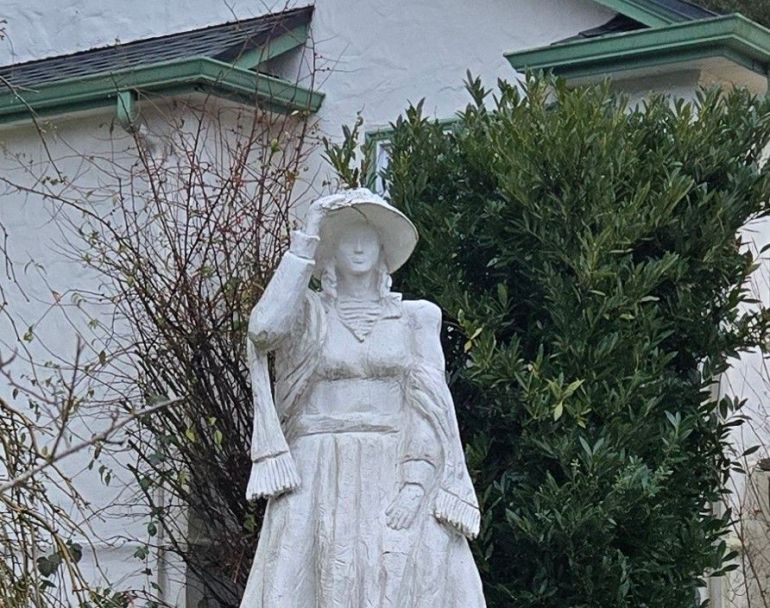
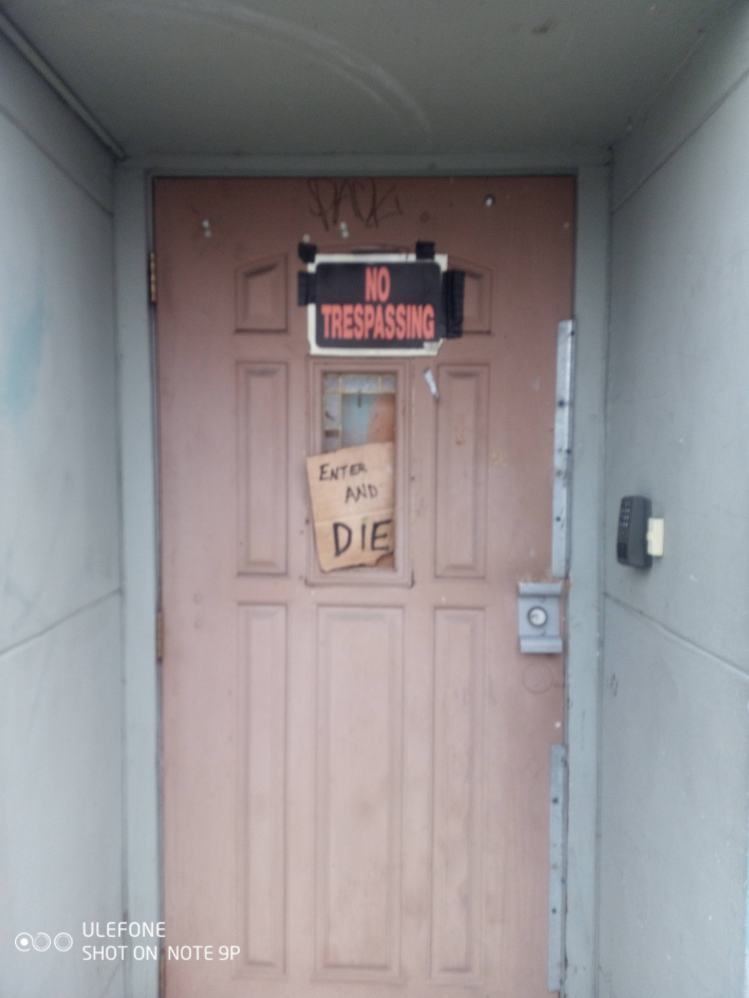
(Top image: Elina in Chicago 14 June; Second image: Tressa With Emma Lazurus Poem. Both supplied by the Drifter)
The Crowd and the Protest
“The shepherd enters through the gate.” – John, Chapter Ten
ONE
Sadly, the question might easily arise as to WHY anyone in their right mind would bother to fight for, or defend, the so-called “American Dream” any more, in this Year of Our Lord 2025.
The Gonzo journalist and prose master Dr. Hunter S. Thompson, in his prophetic mode, rightly proclaimed the American Dream dead and buried over fifty years ago, not too long after Tricky Dick got finished with his sad, partially unconscious, and certainly pathetic attempts to clownishly crown himself and end American democracy forever.
It seems to me that the American Dream has now become the most destructive lie and delusion the human race ever invented for itself, a vast, mass mental and spiritual health crisis and pandemic that has spread globally everywhere from here to India and all places in between, and has destroyed the human and humane spirits of, literally, billions of people all across the globe (although not everyone).
Because the so-called “American Dream” is nothing now in its very essence and core except a pixie dust mental disorder, a vast, sometimes-seemingly-all-consuming, LSD-like, schizophrenic delusion that is not based on Fantasy (the bad kind), but IS Fantasy the bad kind itself at every level.
Romance Fantasies, House Fantasies, Computer Fantasies, Car Fantasies, Shopping Fantasies, Political Fantasies, Property Fantasies, Robot Fantasies, Rocket Fantasies, Gambling Fantasies, Lottery Fantasies, Vacation Fantasies, Hero Fantasies, College Fantasies, Economic Fantasies, Flower Fantasies, Music Fantasies, Dancing Fantasies, Fame Fantasies, Job Fantasies, Retirement Fantasies, Revenge Fantasies, Drinking Fantasies, Drug Fantasies, Food Fantasies, Screen Fantasies, Sex, Power, and Money Fantasies have burned and buried the real minds and hearts of so many people walking, standing, sitting, or lying down on the globe right now that it’s really chilling and yes, even horrifying, when one thinks on it for more than two seconds before going back to casually scrolling one’s phone as the world burns.
So why fight for the American Dream? Because there’s another side to everything in this world: what the great Chinese poet, philosopher, drinker, and drifter Li Po called the Yin and the Yang.
Harold Bloom, the great American writer, voice and citizen, said many times that an American never feels free unless she or he is alone. And when an American is alone, they do always feel free (even if sometimes terrified, too).
That liberating essence, or core, of American democracy still exists, even though Sojourner Truth, Crazy Horse, Frederick Douglass, Thomas Jefferson, Daniel Boone, and John Wayne are gone (“The mountains have been my church,” said Wayne in his final movie). It means everything to the human mind, heart, spirit and soul all over the globe, is America’s one great contribution.
And that is why I will fight for it, in my own way, and in the spiritual warrior sense of the word fight. I, and many others.
TWO
We came up out of the subway tunnel and were instantly swallowed by the Chicago crowd. I was with my teenaged kids and a few of their friends. I could see the Picasso statue in the distance over the heads of the crowd. It was there, the statue the great Picasso gave to the city of Chicago for free, the one that looks like a horse’s head from a certain angle, a woman’s head with long hair from another angle, something else you had never really imagined before and can’t name, from another angle.
I’d spent a lot of time in the past sitting around in downtown Chicago and studying that huge metal statue. Now I was packed into the middle of so many hot, pressing, human bodies suddenly that I couldn’t even move, not right, left, front, backward or center. One of my daughters had been swallowed and pushed along by the crowd. We were all worse than sardines in cans right now. Suddenly I realized that if I had another stroke like I’d had last year, I would be in a very bad spot because there were angry, shouting, pressing, hot-blooded, hot-breathed, neck-veins-bulging, stinking, sometimes-perfumed, protesting people pressing all around me and there would be no medical assistance happening out here. I turned around again trying to find the stairs from where we’d come up from the subway so we could go back down, but it was already too late. We’d been sucked into the vast black hole of the hot, pressing crowd, literally even before we knew what was happening.
We kept talking to each other in the middle of the crowd as we tried to inch our way out of it. I instructed all these teenagers I was with to follow me, and trusted (no choice) that my other wildly intelligent daughter (they both are) would be able to fend for herself, but no one in the crowd was moving, they were all just standing there pressing upon one another (no room for anyone to even sit down, not that you would want to here), holding up signs, screaming slogans and chants, breathing their hot breath on the backs of one another’s necks, and I could feel the outraged intensity of every single one of their souls (it felt like) pressing down on my own personality, which was very quickly becoming nothing less than outraged at their outrage. Trying to keep it under control, trying to keep it under control…
There were very many angry and shady-looking people pressing in the crowd, folks trying to pull suitcases or carrying awkward-looking backpacks, all of the above large enough to carry explosives of course, folks dressed all in black with hands hidden in pockets large enough to carry pistols, folks hunched over with hoods over their heads and masks on their faces and sunglasses covering their eyes.
It was a vast ocean of bodies pressing over me and I realized I was about to panic perhaps because I was now having a bona fide LSD flashback right here in the middle of the crowd, actually triggered by the crowd, in fact. But I had to keep it together in order to lead my daughters and their friends to safety.
It had been my idea to come down here, after all. My kids and their friends instantly agreed. Then I remembered that I had been inspired by them during the George Floyd protests when it had been their idea to go to the protests before it had been mine. We were trying to inch our way along to escape from the crowd. Some people, obviously many people, do not get too claustrophobic in such conditions, because a lot of these protesters actually seemed to be enjoying themselves. But myself, my daughters, and our friends were not some of the non-claustrophobic ones. The kids call it “tweaking” these days. It’s when you’re losing your grip on things, feeling like you’re having an acid flashback, panicking or almost panicking, freaking out, in other words. I was now, officially, and internally, tweaking at every single level I could or couldn’t think of. I was able to hold it together for only two reasons.
One: in order to try and help my daughters and their friends (and myself) get out of this.
Two: I knew if I really started freaking out, it would be like throwing a flaming torch on top of a keg of gun powder.
I knew now, in my blood, how easy it is, and how fast it can happen, that people get trampled to death in a crowd like this.
THE CROWD is so terrifying and horrifying to some of us because it means a complete and total loss of individuality, and control, at every level.
The only place you can maintain your own self-control in conditions like this is within your own mind, and under these kinds of conditions, that is very hard to do, especially when an acid flashback, or whatever it was, is making every single nerve end in your body and brain feel like it’s on fire right out of the blue.
Thoughts of Buddha helped save me this time. His chubby ghost (to me he was chubby) appeared out of nowhere and wafted in front of my mind. It was his kind of mind control I turned to in these desperate circumstances. I was having an acid flashback in the extreme but the purposely recalled thoughts of the strength of Buddha’s mind helped me regain, and keep control of, my own mind. I turned around and all the kids I was with had vanished in the crowd, we had been separated, I couldn’t turn around, and I couldn’t find them. I kept on trying to worm and inch my way out of the crowd, trusting their safety to God, because it was the only thing I could do now.
THREE
During the worst moments of being suddenly caught unawares in the middle of THE CROWD like that, it felt like nothing short of being buried alive in the middle of the most vivid Edgar Allan Poe buried alive short story you’ve ever read, except you’re not reading the story at a safe distance, you are the character in the story who’s actually buried alive, worse than in a dream. For me, to suddenly have millions of anonymous bodies pressing all over mine without warning is one of the worst living nightmares I can possibly imagine. (I’m fond of keeping my distance, which is an essence of being a drifter.)
There are other nightmares just as bad, like maybe being stalked by a great white shark while out swimming in the ocean and you know he’s there but are still a mile away from shore. Only being buried alive for real could possibly be worse.
Losing contact with my kids in the crowd like that was even worse than the buried-alive feeling.
FOUR
It took me ninety (90) minutes to inch and worm my way out of the crowd. Ninety minutes that felt like nine months jammed down into a Siberian prison holding cell (because of the acid flashback/s).
When I finally broke free, onto famous State Street in Chicago, I looked up and there was the Van Gogh-like Muddy Waters mural on the side of the building I’d seen many times before. I had lost track of where I was in the downtown area, and had only been following my instincts to get out. And I got out. And I was free. And there was Muddy, one of my great and lifelong heroes, Muddy Waters, staring down at me. And we were both free.
I had to wait around for another thirty (30) minutes before my kids also broke free from the crowd.
But fifteen (15) minutes before that, I received the first text from them telling me they were OK.
FIVE
There is no doubt that I’ll continue to protest personality-crushing authoritarianism wherever it exists, whether that is at the “highest” business and political levels, or within the classroom or the workplace, or on the street corner, or within myself, or anywhere.
Next time, however, I shall be much more careful about how I approach THE CROWD. A word to the wise: The Crowd is bad. In the worst sense of the Word.
ADDENDUM from The Drifter
There are a million different ways to protest, of course, and attending a so-called “Protest” is certainly not the only way, although, as the American Civil Rights Movement showed, it is sometimes a necessary way. The famous “three and a half percent” rule, proved by social science, says you only need that amount of a nation’s population to resist and overthrow the lockdown of true authoritarianism, the kind where the jack-booted thugs are standing around armed on all street corners with their faces hidden and the little old lady you thought was your friendly neighbor just reported you to the secret police for something you didn’t do.
The following poem by Walt Whitman outlines another way to protest, just as profound, or more profound, than the other way.
Poets to come! orators, singers, musicians to come!
Not today is to justify me and answer what I am for;
But you, a new brood, native, athletic, continental,
Greater than before known,
Arouse! For you must justify me…
I am a man who, sauntering along without fully stopping,
Turns a casual look upon you and then
Averts his face,
Leaving it to you
To prove and define it,
Expecting the main things
From you.
“The Drifter” is drifting off for now in order to steady his nerves via a combination of medical, psychological, and spiritual advances. This world we currently inhabit will make you nervous if you’re alive; do what you need to; pursue the right kind of excess and eschew the wrong kind as much as possible.
“The Drifter” doesn’t know yet what the column will be about next Sunday in this “Postcards from the Drifter” Sunday series; what he does know is that he will be here.
The main character in the following lyric cry goes barefoot most of the time, wears animal skins when he wears anything, carries a spear, wears an amulet around his neck that protects from evil spirits which he knows often, but not always, come from other people, and has never shaved, although he has cut off his beard and hair when they get too long so they don’t get in his way; he also takes magic mushrooms, walks for days on a regular basis, hangs around the fire a lot, also spends a lot of time alone, sees visions, makes cave paintings he never looks at again, or sometimes returns to as if to an old friend for days on end; and in this poem, is inventing, or elaborating, human language, while also simultaneously developing the gift of human mercy which Jesus himself, and his mother Mary, would bring to perfection many thousands of years into the future from where this character is perching in this poem – right now.
Alone at Blue Rocks on the Shoreline
Prehistoric Man/kind perches on the cusp of a decision, and speaks.
The rocks here at shoreline are blue.
Blue like the water and sky.
Blue like the blue bird and the big ice.
And they rise half as high as the ice, as the big ice.
The rocks here under this sunset tree are red.
Red like her hair, and the sacrificial hare in the sun, in the trap, twitching.
(LET IT GO.)
Your costume only becomes you
and your uniform once you
wholly own it somehow
after long tries
and once you wholly own it you’ll
uniformly know and your uniform
costume will simply become a way
of knowing and a way of knowing more
about what you already know you know
but aren’t always so sure about, in this land
of the wooly mammoth having you for breakfast
on his horns
and the saber-toothed tiger around
every
bushy
turn.
So the hare, let it go, LET IT GO.
The hare released.
Look at him go!
He flies because I
have chosen
not to sacrifice.
Dr. Dale Williams Barrigar is an impoverished poet-scholar from the Midwestern USA who learned much of what he knows about primordial humankind by reading and pondering the works of Sigmund Freud, Carl Jung, William Butler Yeats, William Wordsworth, William Blake and William Shakespeare, as well as lots of intuition, imagination, and experience thrown into the balance. Experience alone is never enough, and neither is reading; they have to be combined.
(Note–Daisy has acquired a Penname. As you have guessed it is “The Moving Hoof.” She is now, as she just informed me, Dame Daisy Cloverleaf-Kloverleaf, the Goatess of GOAT and The Moving Hoof. A gallon of vodka weighs more than The Moving Hoof yet it contains only half as many delusions–LA)
I waited outside the church for Tess, I knew she wouldn’t leave early since it was now up to her to protect Mom’s credit at Graydon’s. Everywhere we ever walked seemed to be a mile from home and though there were shortcuts they always came with an extra hill to climb. Too many weirdos afoot to let Tess walk home alone.
There was a little store across the street. “Don’s Market” was the only business on Anoka Avenue. It was run by a Korean couple who didn’t bother to change the name when they bought the store and adjoining house from old Don, who went to Arizona to die. We never lifted from little stores because they were the proprietors’ livelihoods. This was not altruism, for unless you had the bad luck of landing a real asshole, a supermarket clerk would only chase you only so far– until the fact that they’d get paid anyway kicked in. And no supermarket was rumored to have a loaded shotgun stashed below the cash register. Mom and Pop outfits tended to equate five finger discounts with felonious behavior. So, extremely aware that I was being watched, I bought two cans of coke with honest cash earned via school porn sales. I crammed the cokes into my front pockets, crossed the street back to the Presbyterian church and climbed a maple tree that stood in the far corner of the parking lot, which gave me a view of the church’s front door. It was quiet and hot, and I could hear the cracking of Scotch broom pods that only my ears were particularly attuned to.
Coke cans in one’s pants pockets interfere with skillful tree climbing. But I’d reached the nook where the trunk split in twain about ten, fifteen feet up or so without much difficulty. Good News Club was scheduled for an hour. I didn’t have a watch but I figured that there might be forty-five minutes of tree-sitting in my immediate future. I extracted the cokes and placed the one I bought for Tess in a small notch in one of the main branches, tapped the top of mine and pulled the tab, which I automatically placed in my pants pocket for Tess’s art projects. I’d once heard that tapping the top of a can prevents carbonated eruptions–which, of course, is bullshit–but like removing a cigarette from a freshly opened pack and putting it back in upside down for luck (as long as it’s smoked last) it’s something I still catch myself doing to this very day, here on the down side of life.
From my vantage point I saw Dumbo and his mother leave the nearby Catholic church. Dumbo’s Mom, Mrs Holman, was a patient widow of somewhere between fifty-five and sixty–Dumbo was around thirty, but as it goes with people afflicted with his condition, his face wasn’t marked by time. They passed on the walk and did not see me.
A lot of the kids in the neighborhood used to tease Dumbo. Called names. Threw rocks. They did it because they were scared of what he was. I never did, but I didn’t do anything to stop it, either. Tess would. She’d stand up to the others and tell them that Dumbo can’t help being the way he is. No one dared to flip Tess shit because I was her sister, so they laid off when she was around–which, in a sense, meant that I had helped to improve his situation.
I climbed higher in the tree, leaving my soda next to Tess’s. I gained another ten feet because I could; I was skinny yet as powerful as a boa constrictor. When I was alone I didn’t stay in one spot long because it gave the inexplicable sadness that had recently begun its lifelong chase a chance to find me.
There was a pack of Old Gold and a box of matches in the rolled cuff of my right sock. Concealed by my pants, I kept the pack on the inside of my ankle to prevent smashing it. I’d started smoking at nine but didn’t become completely addicted until I was in high school. Mom was a Winston chainer, but I didn’t boost hers unless I had no other choice. Our organic disdain for each other extended to the brand we smoked. The world took place in a nicotine haze. There was no such thing as smelling it on you.
One of the things about Mom I envied was her ability to bring a match off any surface. She could strike one anywhere like Clint Eastwood in a spaghetti western. Said she learned it at Catholic school. She also learned how to roll a cigarette with one hand, deal cards from the bottom of the deck, palm tips off tables and how to change raisins to wine. Not like she told us any of it besides the match part, but Mom sometimes got loose with her tongue while sipping loganberry flips and yakking on the horn with Nora. She was also under the odd impression if she lowered her voice in a confidential manner while on the phone that we wouldn’t make a special effort to listen. We got a lot of information that way.
I was getting good at bringing a match myself. Though hitting one off a dry tree bark was hardly a trick. I lit my smoke and took a long look at the Catholic church I had seen Mrs. Holman and Dumbo exit. It stood at the end of Anoka and had that impressive look you see in mental institutions and prisons.
Although there were a bunch of Christian churches atop Holy Hill on Anoka, It was easy to see who had the most money. The Presbyterian church was an old building, kept clean by volunteers and its white paint job was regularly maintained. But it had no grounds to speak of and there was a definite sag to the building that I also noted in the Baptist Church that most of the colored people attended. It too was extremely clean, but there were cracks in the concrete foundation and their bell tower was missing a few shingles. Not so with the Catholics. Closely followed by Mormons on the east side of town, the Catholics had the cushiest operation going.
They had two blocks all to themselves, and unlike the others did not rent the property. One block was shared by the rectory house, which looked like a mansion to us, and the school, whose students ran from kindergarten age to 8th grade, and yet every kid had to dress in the same uniform. And there were nuns and priests all about in flowing garments that gave the whole place a magical aura present at no place else in Charleston. They had actual grounds covered with green grass, hedges and rose bushes, all maintained by a paid staff of gardeners.
The immense brick church was across the street. I glanced at the cross atop the bell tower and immediately understood to the last atom of my being that there was nowhere near enough happiness on earth for everyone; nor a just afterworld that ends pain and evens the score–unless nothingness counts as fair. And no matter what gods we might suck up to, Tess and I were born to live lives just as third rate as Mom’s. Just more hole in the wall people living hole in the wall lives.
Charleston would not exist if not for the Puget Sound Naval Shipyard. At least it would not be as much as it is. Located between Bremerton and Port Orchard Washington (two other places that have the same condition of existence) on Philo Bay. Charleston, like Rome, is a city of hills.
Torqwamni Hill stands higher, but “Holy Hill” is a close second. It is marked by an impressive pile of bricks that is the Catholic church and school complex, which can be seen from just about everywhere in town. But the pope doesn’t stand alone. The crest is topped by Anoka Avenue, which runs about six blocks north to south and is heavy with religion. The Lutherans, Methodists, Baptists, Seventh Day Adventists, and a Synagogue were up there when Tess and I grew up–since, a Mosque and Sikh Temple have joined the fun–but the Buhddists, Iglesia Del Cristo and Mormons built on the other side of town. And there was the Presbyterian Church at which “Good News Club” was held on Wednesday afternoons.
Most communities had the decency to run Good News Club apace with the school year; but Charleston was an especially godless town so Good News ran year around. Turned out that all the Christian churches (except the despised Catholics, who had their own thing, and didn’t like the competition, either) were in on it and took turns hosting what’s best described as a booster shot of Sunday School–just in case the urge to since rebounded by mid-week. Not that Tess or I knew anything about Sunday Sunday School–we’d never set foot in a church of any kind before, but that was the gist of Good News.
And there we were on Wednesday. Tess was sparkling and pretty in one of the two school dresses that still fit her. While I was in my “uniform”–jeans and white tee shirt for summer, cords and sweater for school. The Charleston school system had announced that girls no longer needed to wear dresses to school, we just had to be clean. A new era had dawned. The high school even erected a “smoke shack” for the students–so they wouldn’t sneak off into the woods behind the school and set the bushes on fire. Those were forward thinking times.
It was we because Tess had lucked into an easy way to get me to come along. Her charm had nothing to do with my attendance; she had found a brand new Swiss army knife just lying there in a parking lot on Saturday–ten times the quality of any we had ever found in a vehicle and not the sort of thing stores made easy to take. The little witch seized the opportunity to trade it for me accompanying her to Good News–and not to ditch at any time unless it was her idea.
The meeting room was in the clean, well lit basement. About half the size of a regular classroom, the walls were that faux knotty pine paneling you could not get away from in the seventies. There were three rows of folding chairs facing a lectern that had a portable blackboard behind it.
“Bet they serve shortbread cookies,” Tess said.
“And lemonade that looks like pee.” I replied.
The defining theme of the room, surprise, was Jesus. Although the sober Presyterians had hung only one picture of the Lord on the wall, it was big and inescapable. Tess whispered that he looked like George Harrison with John Lennon colored hair; I thought he looked constipated. Seems to me there was a copy of the Ten Commandments hanging somewhere, as well as a poster containing the Lord’s Prayer, but I really don’t remember. I do recall that there were no plaster crosses, Madonnas or anything else that could be interpreted as a “graven image”–none of the stuff you see in a Catholic home.
The other kids ranged in age from seven to thirteen. They were the usual assortment of scrubbed goody-goodies and spazzes that I associated with obedience. Some had been hit with the Jesus stick so long that they radiated auras void of individuality.
Tess was a social chameleon who blended everywhere; I always appeared to be up to something and my reputation caused far more people to talk about me than to me.
Some people are addicted to the idea of belonging to something bigger than themselves. Maybe joining teams and clubs that require you to attend meetings when you’d rather be elsewhere are just in the blood. Could be we all are supposed to feel that way and I may be a freak for never wanting to belong to any structured environment by choice. Early on I spied a certain amount of butt kissing expected in every organization from the Brownies on up to Heaven. Something about hierarchical set ups smelled wrong–especially those that gathered children to exalt a higher power of some sort. And although nothing like it happened at our local Good News, history shows that an inordinate amount of sex perverts are attracted to mentoring opportunities.
But my aversion to such things ran deeper than my views on secret handshakes and participating in bake sales–and even deeper than the universal hate of pedophiles. For I’ve always known that giving myself to anyone or anything else other than Tess and her memory would diminish my devotion.
Mrs. Graydon and an old biddy (whose name I never learned) in support hose that concealed monumentally swollen ankles, ran the meeting, which was scheduled for two sharp. It was still a few minutes before the hour when Mrs. Graydon and the biddy entered, both carrying platters of shortbread cookies that the Thriftway bakery sold for a quarter per dozen–or free–if your hands were fast enough. One of the spazzes got excited over the cookies. Even Jesus can’t take some people anywhere.
Mrs. Graydon saw what I was wearing and it shitted on her attitude. She approached and whispered just loud enough for everyone to hear, “Susan, I thought I told your mother that we wear our Sunday best for the meeting.”
I don’t recall ever having respect for adults. The minute I was fast enough to outrun them and big enough hit back with meaning, whatever fear I had for them dried up–but I did have the sense to avoid the I Don’t Give a Fuck hardcases that inhabited our neighborhood; the guys who observed no standards when it came to victims. I used to think there was something wrong with me–for example, right then, her ugly moon face hovering near mine, I wanted to bury the main blade of the Swiss knife I had in my pocket deep into Mrs. Graydon’s neck just to see the look on her face. Fortunately for her, I had some measure of impulse control, and foresaw consequences not worth the experience.
“This is what I wear on Sunday.”
Tess just sat there and gazed at me with I told you so eyes. The other kids had that jackal shine in their faces–which comes when a grown up is on a kid’s case but you are not the kid in trouble; a perverted twist of the sympathetic heart, which knows all about the being on the spot feeling but enjoys watching the screws put to somebody else for a change.
This was where Mrs. Graydon could have ended it with a reminder to dress properly in the future. I’d hate to think what a stone bitch she might have been without the Lord’s guidance, because she didn’t let it drop. She pushed.
She sighed and shook her head. Mrs. Graydon savored the little moments of power that entered her life and seized every opportunity to play the Big Shot. Like the rest of us in our neighborhood, she couldn’t help being born poor anymore than she could help coming out stupid and ugly. But she could have helped the cheap little meannesses that flowed from her frustration, she could have pulled back and not do her best to embarrass people in order to feel better about herself.
“All right, Susan–we have charity dresses upstairs in the office–follow me–”
“My name is Sarah,” I said.
I had been saving that for the two years or so the cow had got it wrong. For a don’t fuck with it moment that had finally arrived. Mrs. Graydon didn’t have enough inside to take being wrong even about the smallest stuff without it fucking with her in some deep and reachable only by regression hypnosis sort of way. It has always pained me that so many of the people who practically beg for a beating can’t take a punch. The hurt little expressions in their secret faces, that show for just a second, make me feel as though I’m stomping an infant to death. And for a second it appeared that she was going to challenge me for knowing my own name.
Before Mrs. Graydon could bounce back, I stood and handed the Swiss knife to Tess.
“No deal.”
I left and that was the end of my relationship with organized religion.
We lived in a basement apartment in an immense old house on the Wyckoff side of the alley that should have razed after the War. It stood five floors with an attic just above Dumbo’s place. Built for a rich family at the turn of the century, it had fallen on hard times and was converted into apartments during the Depression. The place was always threatening to burn itself down but never got around to it; the overloaded fuses were constantly blowing and you often caught a whiff of a smoldering mattress wafting through the halls because everyone smoked in bed. Our unit had three rooms and a bath–the rent was something like fifty bucks a month. There was only one (often rain-swollen) door, which opened into the kitchen. Being mostly underground the place was a cave and the walls sweated no matter the weather; but it was fairly cool in the summer.
It got too hot to hang out in Fort Oxenfree so we went home and were surprised to see Mom seated at the kitchen table talking on the phone, most likely with her best friend Nora. She usually disappeared on the weekend, ostensibly leaving us under the guardianship of perpetually Percodan gacked Anna Lou, who lived a few blocks up the road; she’d call once in a while but seldom dropped by. If it was early in the month there’d be a five dollar bill under the toaster, sometimes food stamps we sold for half value–but mostly we were left to our own devices.
“Let me call you back, hon–double trouble just blew in.”
This was around the time when Mom had stopped speaking directly to me unless absolutely necessary, or was pissed off enough to do so. Tess had the charm of ten and served as our go between.
“Hiya Mom,” Tess said.
“Hi yourself,” Mom said, cradling the phone. “Goddam old bat Graydon came by a while ago. Said she looked out her window and saw you two lift a bunch of empties from behind the store this morning.”
Mr. and Mrs. Graydon ran the little store in our neighborhood. He had one arm and she was a Jesus freak. Both were as plump as old Elmo and continuously sweaty no matter the season; Mr. Graydon must have had the cardiovascular systems of a tin of Crisco; he was perpetually in recovery from his latest heart attack.
We never boosted anything from inside the store, nor was Graydon’s a prime source for returnables. But those bottles, all with a nickel bounty on their heads, were just lying there in the shadows, screaming “Steal me!” Which we did, first thing that morning. (I later suspected funny business: no one ever told us to give the bottles back or inquire about them in any way. This made me wonder if Mrs. Graydon had set a trap; though planning such would have pushed her limited brain power to the max, she was the sort of person who’d do such a small, shitty thing.)
“Oh, Mom,” Tess laughed, “we didn’t know they belonged to the store.” Unlike Mom, Tess told convoluted, outrageous lies that not even a mental defective like Dumbo would buy. Yet her lies were like TV wrasslin’–you knew it was bullshit but you played along anyway. “We thought someone must’ve left them there by accident.”
I was nosing about in the fridge. I found a Nesbitt’s orange soda that I opened by holding the edge of the cap against that of the counter and giving a good whack with my palm. Unlike the nasty tiki punch, it was cold and I drank half in one swallow then gave the rest to Tess. “Miz Graydon’s soft in the head,” I said to the room in general. “She thinks my name is Susan.”
“Good thing they go by numbers where you’re headed,” said Mom, sufficiently pissed to speak to me.
For a second I almost told her about it. All of it. The Elmo’s business, the shoplifting and the breaking into cars. Tess was a blue-eyed strawberry blonde who resembled the man in the photo album we were told was our father. Although I already had six inches on Mom, we had the same dark hair and eyes, startlingly identical faces and similar personalities. And neither of us liked that–it intruded on our individuality. For decades, she and I successfully explored each other for the evil we knew was in our own hearts. And we were pretty close in age, for she was married and a mother while only a teen. If it was just me I’d have fucked with it, but there was Tess to consider.
Yet I had to say something.
“Maybe you can stay home and we’ll attend church as a family tomorrow.”
It was still another few months before we began swinging at each other. I’m pretty sure something would have happened then if Tess hadn’t been able to defuse the bomb.
Sensing danger, Tess wrapped her arms around Mom’s shoulders from behind, kissed her on the cheek, nuzzled her ear and offered her a drink of orange soda. “We’re sorry Mama,” Tess laughed, “puleeze don’ give us to the cath-lick orph-nage with the mean nuns.”
It was funny to watch Mom, who, next to lying, took pride in her ability to manipulate people (mostly men) get played herself, utterly ignorant that it was happening to her. She was as smart as she was shrewd and amoral, but it was as though her atrophied sensitivity and subdued credulity gathered only for Tess–who could innocently and, eventually, ruthlessly, play Mom like a fifth ace.
A sinister smile appeared on Mom’s face. She had something to play herself. She never smiled like that unless she held the advantage.
“No orphanage,” she said, “but I did agree to send you guys to some Christer thing the Graydon biddy runs called ‘Good News.’”
Before I could protest, Mom raised her voice, just a touch. What she said next was both the best and worst in Mom; it still rings fresh in my mind after more than fifty years.
“I woulda told any other Christer to fuck off. But since Graydon lets us have credit, and since you guys prefer eating to starving at the end of the month, you can go till the check comes.”
Religion was one subject on which I had respect for Mom’s point of view. She’d been born in Canada, was orphaned and became a ward of the Catholic Church. For reasons never made clear until the end of her life, Mom was “shipped” to the United States. She ran away from Saint James Academy in Seattle for good at seventeen (although much, much later, she confessed that her actual age was two years younger), got married soon after, had me at eighteen and was a widow with two kids at twenty–and learned late, like so many, that she wasn’t cut out to be a mother because she didn’t like children. Though Mom habitually embroidered the Dickensian details of her war with the nuns, the soul of the experience sounded true enough. One thing was for certain, the great hostility she had for all things Christer was unimpeachable.
Still, Mom wasn’t an idiot. She knew Tess would do as told, but my attendance hinged on Tess’s strange ability to get me to do things I would not normally do. I don’t think Mom cared much as long as one of us went; she figured it would be enough to shut Mrs. Graydon up, thus protecting our account. Besides, a potential fifty percent Spahr sister conversion was better than a reasonable Christer would hope for.








 Saragun Springs