Menopausal Male Bombshell by Michael Bloor

Alan had won second prize in a writers’ magazine poetry competition for his ‘Ballad of the Menopausal Male.’ The postman had just delivered the prize, a copy of The Chambers Thesaurus (5th edition).

As Alan hefted the thesaurus in his hand, he recalled that, in what used to be termed The Dark Ages, poets were feted and richly cosseted in the courts of Kings and Great Lords. When Gunnlaug the Worm-Tongue* (‘worm’ as in snake), the great Icelandic skald (= poet) was presented to the English king, Ethelred the Unready, Gunnlaug chanted four lines in praise of the king and was rewarded with a gold-thread-embroided, fur-lined cloak and was invited to spend the entire winter at the royal court.

Continue reading →

Christmas To-Do List, Nick Botkin Edition by Yashar Seyedbagheri

(Editor note–We like to welcome Yash to the Springs. He holds the record for most stories published in one year at what I like to think of as , if not sister, but our cousin publication of Literally Stories UK. One read will tell you why he is so successful–Leila)

The to-do list stares at me, letters running across the page, like railroad tracks of responsibility.

Pick up sisters’ favorite wines. Nan likes Sauvignon Blanc. Colette worships Merlot; Nan is not drinking any fucking Merlot (sorry, Paul Giamatti, I know I plagiarized Sideways, but original words are stuck in my throat).

Continue reading →

The Odyssey of Ellison by Doug Hawley and Bill Tope

(Ed note-Gotta live dangerously. Here we go with another fresh one during this month of reruns. Enjoy-Leila)

Looking Back

Ellison stood in her lavish garden, staring across the expanse of hydrangea, bougainvillea and sundry other plants, at her husband of 20 years. He was standing over the BBQ grill, his usual place during the summer months. He wasn’t pretty, she thought. Nor was he tall nor particular fit, but he fit her well enough. She smiled.

Feeling himself under scrutiny, Dewey glanced back at his wife. Dewey thought, not for the first time, how lucky he had been to lock onto such a foxy lady as Ellison. Even now, more than two decades after they met, she was a sight for sore eyes. What was that smile about, he wondered. But then, Ellison often seemed to be lost within herself, tickled by what she saw. He turned back to the pork steaks.

The next thing Dewey knew, Ellison was at his side, doing provocative things to his backside.

“Hey, sailor,” she whispered.

Dewey grinned. “Can I interest you in some…grilled meat?” he said, then thought, wow, what an original line. “You wanna pork steak, Babe?”

“Um,” she murmured. “I’d prefer a wiener.”

“I’ll need to put some on,” said Dewey.

“I’ll take care of it,” she told him, and led him into the house.

Later, after they’d done unspeakable things to the other, they lay atop the mattress, talking.

“Are you happy with me, Ellison?” asked Dewey. “With us, I mean? Is there anything we’re missing?”

“Well, I’d prefer $10 million in our IRAs, but no, I’m happy enough. You?”

Dewey could have played it cool, but he decided to come clean. “Baby, I’m over the moon happy with you. In fact, happy doesn’t even touch the way I feel.”

“Aw,” said Ellison, leaning in for a kiss.

“Really,” he said. “You gave me two beautiful kids,” meaning Vin and Sugar, who were in their first year of college, half way across the country.”

“Well,” she said, “I do have a case of empty nest syndrome, you know? Seems the kids were always under foot, but now that they’re gone, I miss the hell out of them.”

They lay in silence for some time before Dewey said, “Do you wanna have another kid?”

Ellison said nothing.

Dewey shrugged, felt a little rejection, but decided to put the issue off until later. Then he heard Ellison’s soft snoring and realized she had not dismissed the idea after all. He smiled and thought back to where it all started…

Get Her Number, First

Dewey Mercer looked up at the new barista in his favorite Starbucks and noted with appreciation her slender hips, her cute face and the gorgeous auburn hair spilling down her back and shoulders. He had noticed her the last two times he’d been here, but had been too afraid to approach her. He wanted to ask her out; what to do? He thought for a second; his older brothers, Huey and Louie, always told him, “Either dazzle them with brilliance or baffle them with bullshit, man.” Nodding to himself, Dewey stared into her pale green eyes and stalked forward and stood before the pretty young woman. She looked to be about his age — 19. She glanced up, smiled, and asked, “Yes, how can I help you?”

Dewey’s mind spun. Brilliance or bullshit? he wondered wildly, momentarily at a loss. Then he gave it to her with both barrels: “The Double Ristretto Venti Half-Soy Nonfat Decaf Organic Chocolate Brownie Iced Vanilla Double-Shot Gingerbread Frappuccino Extra Hot With Foam Whipped Cream Upside Down double blended, One Sweet’N Low and One Nutrasweet, and Ice.” He gasped for breath.

She stared at him blankly for a moment, then blinked. “Would you like a cookie with that?” she asked. He shook his head no and she went about the process of preparing his Frankenstein drink. Dewey scowled; that hadn’t gone well; she took it in her stride and now he was on the hook for an expensive libation. After some minutes, the cute barista set the drink atop the counter and said, “$149.99 please.” It was Dewey’s turn to stare blankly and blink.

“Put it on my card,” he muttered, pushing his debit card forward. His Visa, of course, was stretched beyond its limit. She told him so. He hung his head. Now there was a crowd growing at the busy coffee shop. Deprived of their caffeine, they were turning ugly.

“C’mon, move the line,” someone behind Dewey groused.

“He ordered some freakin’ bogus drink and now can’t pay for it,” hissed another.

“Deadbeat!” seethed a third.

Feeling belabored and outnumbered, Dewey went for broke. “Could I…uh…have your number?”

She surprised him and smiled. “Are you asking me out?”

He smiled too. “Uh huh. I’m Dewey,” he said.

“I’m Ellison,” she confessed.

“I know, I read it on your name tag.” They both tittered.

“C’mon, get a room!” someone in line barked. “I want my latte!”

Ellison scratched out her number on a paper napkin and handed it over.

“I’ll call you, Ellison,” he promised, shoving the napkin in his pocket and turning away. That went well, he thought, smiling.

First Date

They met at Clarke’s Pub. Ellison’s expression indicating she was slumming. Dewey understood and asked “I can see you aren’t overwhelmed by where I took you. Why did you agree to this date?” He took a big drink of his beer.

“You aren’t good looking, you clearly don’t have money, so the only reason I could think of that you were so confident was that you were a great lover or stoned.”

Dewey turned red and blew beer out of his nose.

Ellison said “Maybe I said that wrong. Is it that you’ve got something great in your pants?”

Dewey had no more beer to expel out his nose, so he gathered his thoughts and said “Yes, I do have great taste in pants. I have ten pairs of great pants.”

Dewey and Ellison stared at each other and then broke out laughing. This time Ellison blew beer out her nose.

Coda

Dewey stood at the foot of the hospital bed, regarding the science experiment that was his wife. Tubes and wires and monitors and all the surreal accoutrements of hospice were onerous in their intensity.

Ellison’s oncologist entered the private room and walked up to the bed, tablet in hand. He had done his due diligence, thought Dewey, and even now, at the end, was playing his part. Finally he looked at Dewey.

“Is it the end, Doctor?” he asked, his voice coarse and scratchy.

“Ellison’s living will compels us to forgo heroic measures,” he replied.

Dewey nodded. “She didn’t want to lie on display, dying with no hope.”

“As of yesterday, we discontinued the meds, aside from the morphine. We still give her water, of course, and do what we can to make her comfortable, but the late stage medicines, the Belzutifan and the Welireg and the others, were withdrawn. It’s up to God now, Mr. Mercer.”

Dewey nodded. He cast his thoughts back two weeks, to just before Ellison entered hospice, to the last cogent conversation he’d had with his wife of 60 years.

. . . . .

“I want you to meet someone new, Dewey,” she said.

Dewey frowned. “Ellison, I’m 80 years old. I’m not interested in dating.”

“You know you’ll go crazy if you have to live in that big house by yourself,” said Ellison. “I…I don’t want you to be lonely, is all.”

Dewey heard her softly sobbing and quickly sat by her side on the bed. “You’ll be with my always, Ellison; I’ll never be alone.”

Ellison, obviously in pain, looked at her husband with a little smile and said, “You always knew what to say. You were never pretty, but you had a way with words. I want to sleep, Baby,” she said, and crawled under the covers.

. . . . .

As the heart monitor signaled Ellison’s flatlining, Dewey gave a start. The room was suddenly flooded with hospital workers. As Dewey stared helplessly at his wife’s corpse, a strong hand folded fingers over his bicep and a voice said,

“C’mon, Dad, let’s go home.” Dewey recognized his son’s voice and went with him from the room. Since his diagnosis of dementia, Dewey’s son, Vin, had bought a home on the same block as he and kept close tabs on his father.

That first night, alone in his strangely empty bed, Dewey thought back to his favorite Starbuck’s and the monster drink he’d ordered in order to score points with the woman he loved with all his heart for the next half century and more.

Ellison was hovering over the drink and contemplating Dewey’s rejected credit card. She asked him with a crooked half smile, “Do you want a cookie with that?”

Doug Hawley and Bill Tope

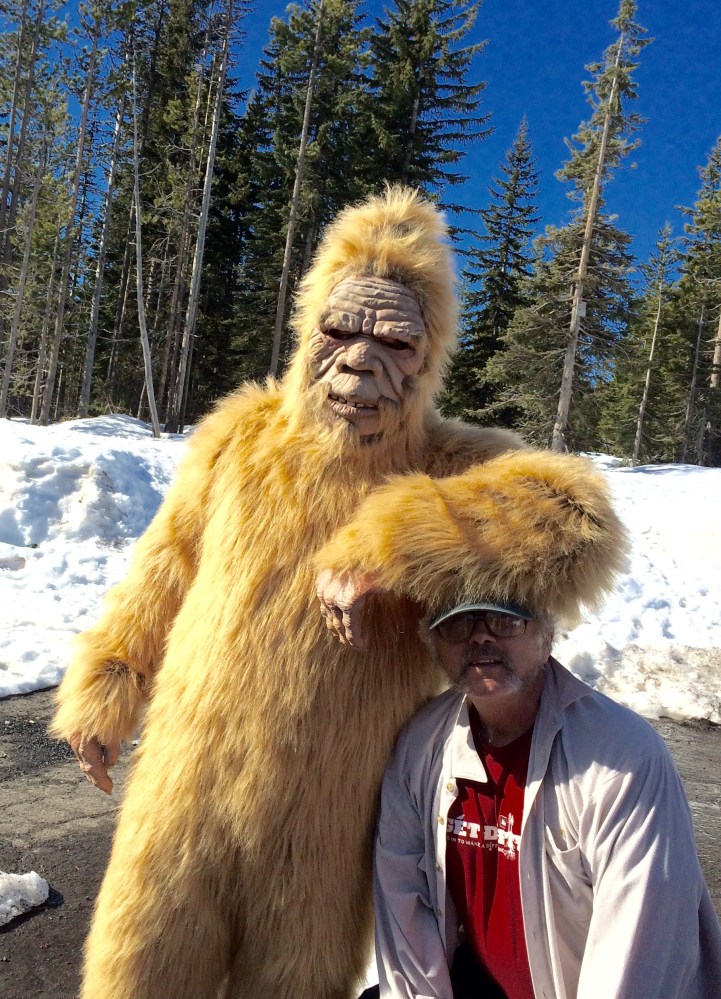
(Image provided by Mr. Hawley. He is assumed to be the shorter fellow)
he-man, all-too he-man, by Geraint Jonathan

(We are blessed with another new item for this month–three actually by Geraint Jonathan. The first appears today, the second tomorrow and the third next week–Leila)

i said to her i said

unhesitating obedience is all i ask

taking what i say as gospel

hanging on to my every syllable

is all that’s required

apart from that

you’re free to do as i tell you i said

my good books are easy to be in

it’s wordy there for sure

but listen is an anagram of silent

& your silence is the best i’ve heard yet

& if you think that’s a riddle think again

that’s what i said i couldn’t’ve been clearer

but did she listen not a bit of it

so off i went

you’ve a vengeful nature she said

out of nowhere just like that

vengeful nature now is it i said

we’ll fucking see about that

Whatever happened to solidarity by Michael Bloor

(Note–Not everything this month before we go public is a rerun; and today we bring you a fresh one by our friend, Michael Bloor–LA)

Andy and Davie were on their usual walk, along the banks of the Allanwater as far as the wooden footbridge, and then back again. They were discussing Scotland’s nail-biting victory last week over the Danes, sending the Scots to the World Cup Finals for the first time since 1998. Andy was English and had little interest in football, but he’d been deeply impressed by the tremendous, spontaneous upwelling of joy across the entire Scottish nation that the game had caused. Davie was trying to explain that it wasn’t just about the result, but the circumstances – the manner of the win. Three of the four goals were truly things of beauty. The match took place at Glasgow’s Hampden Park in front of a delirious home crowd, screened live and free-to-view in every home and every pub. It followed years and years of failure to qualify – some of the present team being unborn at the time Scotland had last qualified.

Andy nodded good-humouredly, but Davie could tell that he hadn’t yet got his point across. He tried again:

‘I was ten when I first started going to the football. In ‘The Boys Enclosure’ (admission: 9 pence – 5p. in new money). It was always packed solid, but you were always among friends, you roared, you booed, you sang, and when they scored you all swept forward like a mighty wave. Like I said, I was ten, and for the first time I felt a part of a whole. That was what Scotland felt when that lovely fourth goal hit the net in the last minute of extra time: it felt that we were part of a whole. It was a feeling of solidarity.’

‘OK, yeah, I’ve got it now, Davie. Solidarity: maybe I didn’t recognise it ’til you said it. Solidarity eh? I thought that had disappeared back in 1985.’

‘1985?? Ah, you mean Polmaise?’

[Polmaise Colliery, or the remains of it, lay just nine miles away. All through the year-long miners’ strike in 1984-85, the Polmaise miners never posted pickets at the mine gates to try to deter fellow miners from returning to work: they didn’t need to. They knew that Polmaise miners were all, to a man, solidly behind the strike. Polmaise was famous: they’d previously struck for 10 whole months back in 1938; they’d already been out on strike for a fortnight in 1984, before the national miners’ strike was declared. When the national strike was broken, a whole year later, and the union voted for a return to work, Polmaise, alone, stayed out for a further week.]

‘Yeah, I mean Polmaise. That was solidarity, Davie. I was there, you know, with the whole village at the gates to applaud the lads coming off the last shift, when the Thatcher government closed the pit two years later.’

‘Good for you, Andy. I understand: that was solidarity. So, instead, what would you call our nation of leaping hearts when the ref blew the final whistle at Hampden Park the other night?’

‘Maybe Communion? A transcendent thing, shared and remembered. ‘

‘Ah, like Archie Gemmill’s solo goal against the Dutch in the World Cup Finals in Argentina in 1978?’

‘Ha, if you like.’

‘OK, I’ll settle for communion over solidarity. By the way, do you know what William McIlvanney, your favourite Scots author, did when he got the publisher’s advance for his first novel?’

‘Beats me, Davie.’

‘He jacked in his teaching job in Kilmarnock and headed off to watch Scotland and Archie Gemmill in the 1978 World Cup Finals in Argentina.’

Andy smiled, but he was absorbed in watching a Dipper fossicking in the Allanwater shallows over at the opposite bank. Part of the attraction of Dippers is that, like Puffins, they are both comical in appearance and surprisingly successful in their daily tasks. Dippers are about the same size as a thrush, but black and definitely portly in appearance, with a big white bib under their chin. They are called ‘Dippers’ because they constantly bow and nod their heads up and down, like manic Victorian butlers. Yet these clown-like birds are surprisingly swift underwater swimmers and efficient finders of caddisfly larvae on the bottoms of rivers, lochs and burns.

Davie followed Andy’s gaze. ‘That Dipper looks perfectly happy on his own over there. Maybe we don’t really need communion with others?’

‘Ah, but he’s in communion with Nature.’

Guest Writer Times Two: Heroes by Michael Bloor

(Note: We conclude this latest guest week with Mick with two of his micro fictions, which both get a fresh look on the net today. We thank Mick and are always glad to have his work be a part of the site–Leila)

Heroes by Michael Bloor

Patrick, my friend and neighbour, and myself were arguing back and forth about our literary heroes:

is their influence always for the good? I spoke in their defence, citing Robert Burns fostering the belief of every Scot that ‘A Man’s a Man, for A’ That.’

Patrick denied that literary talent necessarily overlaps with moral courage, political acuity, or even a healthy quotum of commonsense. He instanced Conan Doyle, who believed in faeries and dodgy spiritualism, but clinched his case with Kafka’s diaries. The entry for August 2 nd 1914 reads:

‘Germany has declared war on Russia. In the afternoon, swimming lessons.’

And…

Mother and the Minister by Michael Bloor

Sixty years ago, it was still commonplace for ministers in rural Scotland to call on all their parishioners, welcome or not. Mother would seat him at the kitchen table and put the kettle on, while I listened at the door as they discussed father’s behaviour. After one particularly disreputable episode, the visitor concluded:

‘Weel mistress, you’re nay marrit. So my advice wud be just to put him richt oot the door.’

My mother pondered this a moment, ‘Aye, minister, I’ll do as ye say. Can I ask a favour though? Would ye collect his pay packet for me every Saturday?’

Michael Bloor lives in Dunblane, Scotland, where he has discovered the exhilaration of short fiction, with more than a hundred pieces published in Literally Stories, Everyday Fiction, The Copperfield Review, Litro Online, Firewords, The Drabble, The Cabinet of Heed, Moonpark Review and elsewhere (see https://michaelbloor.com).

Guest Writer: Making Chutney by Michael Bloor

(A one-hundred word gem by Mick–Leila)

I’ve been making green tomato chutney. Outside in the street, I see a woman and a small boy. He’s walking unevenly, avoiding cracks in the pavement. His mum gives his hand a mighty tug: mother and son, out-of-step.

Then, I can’t remember what weight of sultanas to add. When I find the yellowed recipe, I see it’s in my mum’s handwriting. She’d spelt ‘tomato’ with an ‘e’ at the end, which upset me a little.

I used to say my mum was a difficult woman, but perhaps she wasn’t all that difficult. Maybe it was just that we were out-of-step?

Michael Bloor lives in Dunblane, Scotland, where he has discovered the exhilaration of short fiction, with more than a hundred pieces published in Literally Stories, Everyday Fiction, The Copperfield Review, Litro Online, Firewords, The Drabble, The Cabinet of Heed, Moonpark Review and elsewhere (see https://michaelbloor.com).

Guest Writer: A Misapprehension by Michael Bloor

(This little one was published on 7 September 2018 by The Drabble–Gotta love them Ponies–Leila)

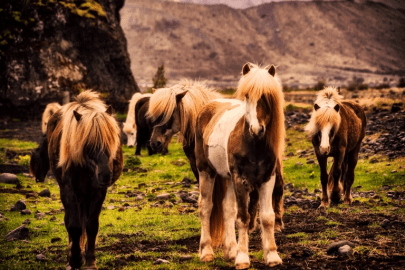
Beyond the barren rubble of an antique lava-flow, a herd of Icelandic ponies graze on rough pasturage among rashes and dwarf birch. A stallion sniffs the breeze; mares and foals snuffle among the grass and herbs. The stirring and shifting of their manes and tails seem all of a piece with the jagged mountain silhouettes on the horizon and the jumbled lava – a wild, young, restless country. I turn to Guðmundur: ‘Those horses … they’re almost an emblem of freedom.’

Guðmundur paused, smiled and shook his head: ‘My grandfather made his living selling them to work down the Scottish mines.’

Michael Bloor lives in Dunblane, Scotland, where he has discovered the exhilaration of short fiction, with more than a hundred pieces published in Literally Stories, Everyday Fiction, The Copperfield Review, Litro Online, Firewords, The Drabble, The Cabinet of Heed, Moonpark Review and elsewhere (see https://michaelbloor.com).

Guest Writer: The Great Book of Angharad by Michael Bloor

(Note: I forgot to mention yesterday that this week features pieces Mick had published on sites that have since fallen into the ominous black hole that publishers do our best to avoid. Still, no longer is is not the same as never was; therfore this highly entertaining work was published by Occulum in 2017–Leila)

     They keep asking me why I did it. Then, as soon as I start to explain, D C Grainger butts in with: ‘Was this on the morning of June 11th?’ I deal with that and then D C Singh chimes in with: ‘Did you tell anyone that was where you were going?’ I struggle past that, and then as soon as I get to the bit about the Holy Spring, I see ‘em exchanging those ‘Has he escaped from the funny farm?’ looks. A dispiriting business for a university professor accustomed to a respectful audience. So I’m setting it all down on paper. And then I’m not telling the police another bloody word.

     I live in Scotland now, but most years I manage a visit to my mother’s country, the Welsh Borders. When I was a child, I used to spend every summer holiday in the Abergavenny house of my grandparents, Harry and Gladys Cecil. The little town is surrounded by seven hills, but for a child the hill that holds the greatest glamour is the Sugar Loaf (its Welsh name is Pen y Val), which looms over the north of the town. Every summer, I would pester Grandad Cecil to re-tell the story of how Buffalo Bill brought his Wild West Show to Abergavenny in the summer of 1903. Grandad had been one of the children in the audience when Buffalo Bill vowed to his audience that he would walk up the Sugar Loaf. And that’s just what he did the next morning, accompanied by half the adults and all the children of Abergavenny.

     Bear with me. I’m trying to explain that the mountain exerts a strange pull – even a hard-bitten old-timer like Buffalo Bill could feel it. It remains a big draw today and the most popular routes have carparks at the foot of them. For sentimental reasons I take a less travelled route, setting out from Deriside (where my grandparents lived), crossing the ford by Harris’s farm, round the foot of Rholben, and up St Mary’s Vale. Just like the Sugar Loaf/Pen y Val, St Mary’s Vale has both an English and a Welsh name. Granny Cecil said that the Normans conquered the broad lowlands, but the Welsh always held the hills, and the head of the Vale is known by its Welsh name Cwm Trosnant, which means the valley of the three springs. St Mary’s Vale starts out as a gentle valley covered in beech woods. In June, the leaves are a dizzying, iridescent green, squirrels dart up the towering grey tree boles and scold you – ridiculously – from the upper branches, the stream splashes over sandstone pebbles. Again, I’m telling you this because you need to understand the pull of the place.

     As you make your way up the Vale, it narrows and the great beeches give way to stunted oaks and thorn trees – you’ve crossed an invisible border into Cwm Trosnant. Near the head of the cwm, the path strikes off steeply to the right and the hidden summit of the mountain. Just a few metres onwards and upwards, the path passes by one of the three springs from which the cwm gets its name. It issues, cold as your fridge, from the roots of a thorn tree. As a child, sixty years ago, I often stopped to watch the mysterious welling of the waters out of the earth and into the light. I would dangle my hand in it, but I never drank from it, mindful of my mother’s frequent warnings of the dangers of polio – the great child killer of the 1950s. The springs of the Welsh hills were holy places, a source of wonder, even before the coming of Christianity. Hermit saints understood the mesmeric attraction of the springs and built their churches beside them. Even today, there’s an isolated, ancient church beside a spring a few miles from Abergavenny, where pilgrims still leave spring-side offerings. Sixty eight years old and no longer bound by my mother’s injunctions, on that June day I bent down and cupped my hands to drink.

     Bending down to the clear, bubbling water, tasting it on my parched tongue, I had a sensation of the world behind me being progressively suffused with brilliant light. As I lifted my head, I was entranced to see the cwm transformed. It was still a narrow upland valley, but instead of the bracken, thorns and stunted oaks, there was a miraculous pleasance. I say ‘pleasance’ rather than garden, because I knew instinctively that this was no modern landscape. There were roses, lupins and hollyhocks; the thorn above the spring had been replaced by an apple tree suffused with blossoms. It was as if I was in Tennyson’s ‘island valley of Avilion… fair with orchard lawns and bowery hollows’ where King Arthur was carried by barge after the Last Battle. Enchanted, I turned to see a woman in the middle distance, walking towards me. Her beech-green dress, which swayed about her body as she walked, was long and trailed among the daisies at her feet. Her red-gold hair was coifed above her brow but fell about her shoulders. Her face was solemn and ageless.

     She spoke to me in what I took to be Old Welsh (as a child, I learned Welsh from my mother), but I could make little of it. She switched to English, spoken clearly but with the punctilious correctness of a foreigner:

     ‘Well met, Michael, son of Mary, daughter of Henry. Long have I waited for you here beside the great spring of Taliesin Ben Beirdd. We are kin, you and I, because I am Angharad, wife of Sitsyllt ap Dyfnawl.’

     I knew the name. The slaying of Sitsyllt is a well-known piece of Abergavenny local history. In 1177, William de Braose the new Norman Lord of Abergavenny, invited around seventy leading local Welshmen to a Christmas feast in his Great Hall. Among them was Sitsyllt of nearby Castell Arnallt, a formidable warrior. As was the custom of the time, the Welsh nobles, surrendered their weapons before entering the dining hall. Once the Welsh were all assembled, they were set upon by de Braose’s men-at-arms and slaughtered to a man. The men-at-arms were then dispatched to Sitsyllt’s Castell Arnallt, which they destroyed and took Sitsyllt’s wife, Angharad, back to Abergavenny as a prisoner. Sitsyllt’s kin eventually anglicised their name to Cecil, my mother’s maiden name.

     ‘Those of Sitsyllt’s kin who drink at Taliesin’s spring receive the gift of true sight, but they are also honour-bound to strive to remedy the dishonour done to Sitsyllt’s house and name. Do you accept the obligation I shall lay upon you?’

     I nodded. I could scarce do otherwise.

     ‘Very well. I know you are a scholar; I give you a scholar’s task. Among the booty from the sacking of Castell Arnallt, the Normans took away my Great Book. The court of my brother, the Lord Rhys of Deheubarth, was the greatest centre of learning in all Britain: bards and sages, harpists and holy men were all welcomed there and competed in the recitation of the laws, the lineages, the ancient wisdom and the holy truths. By the bidding of my brother, I wrote down all that was good and true, and I bore that book as a love-gift to my husband, Sitsyllt. The Great Book has passed through many foolish hands since the Norman theft. Finally, a drunken sot of a clergyman willed it to his old college, Dodson College, Oxford.’

     She saw my look of surprise. ‘Yes, it lies in the library of your old college, unexamined and uncatalogued, stored as the bequest of the late Reverend Pugh. You must right the wrong and return the book to me, here on Midsummer’s Eve. Take this ring: when you come back with the book, throw the ring into Taliesin’s spring and I will return to you, with my thanks and the thanks of all our kin.’

     The ring was of a curious, twisted, gold-filigree design. It was too small to fit on my finger. I slipped it into my pocket and went back to the pub where I was staying. I checked the Dodson College website on the internet. I was dismayed to find that the college librarian was an elderly, retired party who had been a don in the college when I was an undergraduate there fifty years ago. A colourless individual who had adopted a pipe in lieu of a personality, but nevertheless possessed a certain capacity for mischief and fussy cantankerousness: his nickname was Gollum (I know, I know: first a gold ring and now Gollum turns up – where have you read this before?). I realised then and there that there would be no sense in appealing to the college authorities to restore The Great Book to the Cecils: I would simply be alerting the college to the fact that they had overlooked a valuable asset which they could flog off. Instead, I’d have to steal it, albeit knowing that I had justice and history on my side. I checked out of the Black Bull pub that evening and before ten o’clock I’d checked into a bed-and-breakfast in a village outside Oxford.

     I went for a reconnaissance the following morning. I was amazed to discover how little the college had changed. The library was still housed in the same cramped quarters and contained the same out-of-date texts, translations and bound periodicals. There was no space to store uncatalogued volumes. I guessed that they would have been dumped in the cellars. There were two different sets of cellars: the wine cellars beneath the dining hall appeared to have a formidable door and lock; the other cellars, in the same bloc as the library, had a neglected appearance and a simple clasp lock on a fragile-looking door – child’s play, I thought.

     I bought a jemmy and a powerful torch and waited for dark. I confess that I was rather enjoying myself. The college gates were no longer locked in the late evening, but the porters’ lodge still housed a night porter, so I decided to climb in using the same route that I’d used fifty years ago, via the bike sheds. This proved more difficult than I’d anticipated: the spirit was willing, but the flesh had withered. I sustained a nasty graze, a sprained ankle and a ripped jacket, but I got over. In contrast, the hasp on the cellar door was a breeze and came away like cobwebs.

     There was lighting in the cellar, but it wasn’t working: I hunted for a mains switch in vain. In the torchlight, the crowded cellar contents looked as a chaotic as an earthquake in Legoland: there were piles and piles of discarded furniture, tea chests filled with the abandoned possessions of past generations, some old lead piping, tied bundles of papers, ancient chemical apparatus, a battered croquet mallet… It seemed that, unless I was very lucky, the search would take more than one night. My dust allergy kicked in right away, but I stuck to the task. After an hour or so, I did come across an open tea chest full of books, but they proved to be the abandoned private library of past undergraduate, seemingly someone of my generation – I recognised ‘Zen and the Art of Motorcycle Maintenance’ and RD Laing’s ‘Divided Self’. Underneath it, was a closed tea chest, which I assumed contained more of the same, but when I jemmied it open I saw it contained hardback books from an older period. I flicked open the topmost book – a collection of sermons – and on the flyleaf I read ‘Ex Libris Reverend Augustus Pugh.’ Oh Joy.

     The Great Book of Angharad was right at the bottom of the chest. It was a massive thing that looked to have been re-bound at some point, with metal-edged leather covers and a clasp. I heaved it out the chest and opened it up at random – a foolish thing to do, because the eight-hundred-year-old pages were very brittle. Part of a page broke off as it was opened. I shut the book and closed the clasp, but not before I’d satisfied myself that the writing seemed to be in Old Welsh.

     ‘Well, well, if it isn’t Guy Fawkes!’ Two torches snapped on. In surprise, I dropped The Great Book back in the tea chest. I then dodged behind some derelict desks, deeper in the cellars, but the two police patrolmen quickly picked me out again. It seemed I’d been betrayed by my dust allergy: the night porter on his rounds had heard the sneezes, found the broken lock on the cellar door, and called the cops.

     The charges I was facing were ‘breaking and entering’ and ‘criminal damage’ – the college authorities claimed I’d destroyed the roof of the bike sheds. At first, I refused to say anything, beyond giving my name and address. But the duty solicitor at the station persuaded me to explain what I’d been doing in the cellar, saying it would look better in the magistrates’ court. So I told him. A few hours later, I told the same story to the two detective constables in the interview room. They plainly thought I’d lost a marble or two when I fell off the bike sheds, but they sent a constable round to the cellars to see whether there was indeed a big book in the bottom of the tea chest. He found Gollum, the librarian, there ‘checking whether there was anything missing or damaged.’ The tea chest was empty.

     Well, maybe I have lost a marble or two, DC Grainger and DC Singh. But how would you explain Angharad’s celtic ring, safely hidden in my washbag at the B&B? And it’s plain to me who has snaffled The Great Book. I sense a second family connection here: Gollum’s surname is ‘Pugh.’ I suggest you get a search warrant.

Michael Bloor lives in Dunblane, Scotland, where he has discovered the exhilaration of short fiction, with more than a hundred pieces published in Literally Stories, Everyday Fiction, The Copperfield Review, Litro Online, Firewords, The Drabble, The Cabinet of Heed, Moonpark Review and elsewhere (see https://michaelbloor.com).