The Saragun Springs Gazette Presents Booze Reevooze by Renfield

(My Imaginary Friend and second in command of the realm, Renfield, has the unique ability to wake after a bout of binge drinking without the slightest trace of a hangover. There are only two ways to avoid the hangover, stay loaded around the clock or be lucky enough to have the constitution of an Imaginary Friend. Now, alcohol still affects her in the usual short term way, which makes her as good a candidate to provide a review every Friday–Leila)

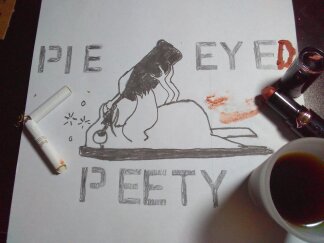
Booze Reevooze by Renfield

Hullo parched readers! Today I examine a classic no longer available on Earth but is (thank Zod) plentiful in Saragun Springs, by name, the legendary Bacardi 151.

Sadly the modern “grown-ups” cannot handle 75.5 proof inflammable rum. The modern day wussieness confounds and embarrasses awesome persons such as myself. Then again anyone who rides a child’s scooter to work while huffing on something that produces an odor similar to blackberry jam probably shouldn’t be messing with the hard stuff.

I like my 151 with Coke. As always I will voice dictate my experience as I work my way down the bottle. Now, as I pour my first drink, I can just smell flames of inebriation wanting to burst.

Mmmmmmm…talk about smooth–hoo wee. Oh yes, there’s nothing like beginning a day with a bottle on an empty stomach. Allow me to refill my glass and catch a toasty mental wave.

Sorry gang but I snuckered one without recording it. Such awesomenicity.

Three in row brings the visions! Ho Zod! You know, I was at the bar the other day, right? Just sittin there and this Horse comes up and sez “Hey baby.” I told him fuck off, but all lady like. But no, turns out he had a lisp and said “hay bale, pleeze” to the beerkeep. I went with the sorries and sprung for an alfalfalafa shooter.

Five alive, not even half an hour! New record…What was I sying–um, saying? Oh yeah on a scale of one-ten I give Ronnie B. here a, what else, 151! Zoddamnit!!!

I tell ya bout the Horse? I think I did. Big ol sum bitch. Anyway, I don’t feel like talking right now….got sum serious drink on…

Come back nest wick and learn about Missississississippi corn squeezins….

Renfield

(Second Ed. Note–This is the longest Booze Reevooze to date. The writer usually cracks the seal of the bottle, says hello and forgets about the column in about a hundred words. So she goes-LA)

From The Saragun Gazette: Dear Daisy

(Ed. Note–Today, from the Saragun Gazette, I present the most popular feature, Dear Daisy. Daisy Kloverleaf is somewhat no nonsense with her beseechers. In fact, from observation, I must conclude that every one of her missives ends with the same advice. Still, again from observation, I conclude it to be sound advice–LA)

Q: Dear Daisy,

I am sad because I am a lovelorn and lonesome lost soul. My friends tell me that there is someone for everyone, and being that I possess a wonderful personality, it might take a little more time for God to send me that perfect love match. People also tell me to turn that frown upside down, be a citizen of SaraCAN Springs and not to accept wood coins in matters of commerce.

Do you, wise Daisy, have further advice? It seems that God is taking a very long time to answer my prayer.

Yours truly, Desperate Doolie.

A: Dear Desperate

It sounds like you are bankingly banking on your “wonderful personality” to bringly bring true love. And I will wager that where looks are concerned your best feature is your “wonderful personality.” Money can erase a lot of problems here, but rich people do not send letters that arrive with postage due, so I guess we can rule that out. The good news is you will not have to sift through the shallow element but there won’t be much “Plan B” either.

Regardless, since you let the cliches of others direct your life to the pointly point you must ask a ten pound herbivore for advice, I think it is for the best that you should fail to reproduce. Consider it as givingly giving back.

Dame Daisy

(Ed. Note–I forgot to mention that Daisy is an adverb junkie. But I guess you have probably figuredly figured it out by now–LA)

Saragun Verse: Ode to Foul Waters

i

The Spring is the thing in Saragun

It creeps up from the nether-nether land

Located below the meanest sin

Where you can fry Peter without a pan

ii

It smells of charnel houses and sulfurized souls

Mouldy shoes, dollar store cologne

Lovers lies and quitters’ scorn

And the still rooms of the should ne’er been born

iii

And yet it is the best of devices

A sucking abyss for idiot crisis

And it leaves our air cleanly grown

Fresh to the lung not previously blown

iv

Yes the Spring is the thing in Saragun

It takes out the trash and dung

It’s a happy exit for the aggressively putrid

We wave bye bye to anti-Cupid

Saragun Verse: Tell the Pope to Buy a Telescope

i

Galileo looked into the night

and learned the truth was an old lie

And he sighed, knowing his fate:

If I write that again Someone will tell the Vatican

ii

Pope on a rope, Lucy in the Sky

Hope is a trope, acid an alibi

Time came unglued and rearranged

Except in Rome, where it is always the same

iii

Galileo wrote his heretic tome

With Pope as the dope thick of dome

But not so obtuse to forget the guards

They brought an offer: soft or hard?

iv

So, for some, the spheres (and spears) remained

But for many it was never explained

Why God controlled the meek

By promising torture to one hell of a geek

Saragun Verse: Moonfog Returns

i

Moonfog Madrone nods in the lush field

In vegetable dreams seldom revealed

Little goes against Moonfog’s serenity

Save humankind the greedy enemy

ii

Little colored flags and a for sale sign

Once entered the doze of Moonfog’s calm mind

He cast an enchantment into below

Where the little fey gods flicker and glow

iii

“Bring forth a shake to unkind human steps

Those that never feel the earth is kept

By Forces more elemental than gold

Little gods I say do as you are told!”

iv

The flags and for sale sign went away

For when humans touched the field it swayed

Some said nature, others, the will of God

Moonfog cared not, for he was on the nod

Drifter Self Portraits

(Images provided by the Drifter–Boo and Vincent)

I only show myself when the holy spirit of creation is upon me.

Or in its aftermath.

Or in the lead-up to it.

Or in some other form of extremity that embodies some sort of emotion that can be used for good in this world, if one looks hard enough, one way or another.

I have pictures of myself where I look one hundred and ten years old.

And not a healthy one hundred and ten, like Moses was when he died.

They say he was as strong and mentally acute at that age as he had been at forty. And that his sight and hearing were as strong as they’d ever been, too. But it didn’t stop him from dying.

Yes, I have pictures where I look bad old.

Beaten and broken, weary and bloated, or shriveled, wasted and worn, worn out.

I only keep these pictures for myself (for now), in the same way that Hamlet held up poor Yorick’s skull to his own (for now) living face and spoke to it.

A memory of the future, which is the definition of memento mori.

I started experimenting with drawn and photographic self-portraits in the 1980s, when I was in my teens.

I was partially glad when the Selfie came around, because it partially justified me, at least in the legend of my own mind.

Before that, even people who were otherwise on my side would sometimes make fun of me for taking “selfies” – before “selfie” was even a term, or a word.

But ever since there were cameras, there have been poets who have done this.

Walt Whitman, Philip Larkin, and Robert Johnson are only three examples.

I was raised in the Lutheran Church in Michigan; their religious art influenced me in enduring and subconscious ways that I can’t even diagnose in myself because they go so deep.

Other influences on my self-portraits include classic album covers, certain movie posters, author photos, and of course the classic self-portraits by the great classical artists.

I had a stroke at the age of 57 in the Year of Our Lord 2024.

After that point I started making self-portraits just to prove to myself that I was still alive – as alive as ever, or even more so.

I had one grandmother who remained youthful up until the very end, at 88. I had another grand who remained youthful until the age of 92 (and then her slow decline until “the end” at the age of 94).

I only make the self-portraits on my regular phone. No tricks. I’m no technologist. As in all art, spontaneity and selectivity are the keys. These, and dogged determination.

I got this phone three years ago. I’m 58 now. So I call all of these self-photos the 55 and Up Series. Almost everything else disappeared with the other phone.

I also make the pictures to taunt all my enemies, and all the people who left me in the dust when I didn’t want them to.

There were others who left me in the dust and I was okay with it: or even goaded them into doing so.

Signing off for now until next Sunday: “The Drifter.”

I Was Ten When Elvis Died By Dr. Dale Williams Barrigar

They called him fat and they called him a fool, but when he stepped behind the piano he was neither fat nor foolish.

He was Elvis, in South Dakota, in a small theater, about to sing another song, just a few weeks before he would fall to the floor in his bathroom back at Graceland and leave us for good – so suddenly.

And thereby catapult himself into the earthly realms where no one dies. Because now he’s the quintessential American, globally more famous than Abraham Lincoln, or maybe equally so.

(We say nothing of current people who may be more “famous” than either of them at the moment, because this kind of fame is only for the moment and will fade. In the annals of humanity, the good ones last longer than the bad except for the exceptions, like Hitler; and you really have to be bad to be as horribly bad as him.)

Before he sat down at the piano it was almost as if he was fat and a fool. He looked quite overweight although still more handsome than the most handsome movie star ever (because he was never really a movie star), and he was obviously high as hell on something, or rather not one something, but many somethings.

He was so high that he couldn’t talk right, not at all. He mumbled and muttered, he lost his train of thought, he shook his head to try and get it back, he laughed at himself up there on stage. He was high and jonesing for more at the same time, he was wired and wasted, he was surrounded by gigantic cups of ice and Coca Cola that he drank nonstop and to wash the pills down with (dozens or even hundreds of pills per day) (and he was fatter from the beverages than the sandwiches because eating interfered with the endless buzz of being him); he was high in the way that someone gets high who sees it almost as a duty and an obligation, certainly not a pastime or a hobby: he was so high that he was high as only ELVIS could be high: admirably high, utterly high, completely wasted, totally wired, and yet still walking around, telling the jokes, laughing at all. And about to sing another song.

And when he opened his mouth, the world suddenly knew (or only the parts of the world that live in South Dakota – for now) that Elvis was no longer a pop musician; he had left that behind him long ago. (“Don’t look back,” said Bob Dylan.)

Because now he was a CLASSICAL MUSICIAN. Now he was on the level of an opera singer, better than Pavarotti. Now he was someone who Beethoven and Mozart would hang out with. Now he had elevated his art into the highest levels of art that art can achieve, and his version of “Unchained Melody” was so good it made you want to compare it to (and I want to compare it to) the Mona Lisa or the Statue of David.

Elvis was fat and sometimes acting foolish; he was high as high gets when you can still walk around, and he couldn’t even talk right. But when he opened his mouth and began singing this one song, he truly belonged, and truly does belong, with the best of the best and the greatest of the greatest, not just in America, now, but in the world, anywhere, any time.

And then the song was over. And no one even applauded at first (before it exploded). But even the ordinary folk of the great state of South Dakota knew what had just happened.

Elvis had outdone himself. He had elevated himself, had increased his own greatness, had increased the greatness of art and the human race in the few minutes of one song.

His voice had been so powerful, so subtle, so nuanced, so loud, so ringing like a bell, so true, so lasting, so effecting, so mountainous and river-like, so sad, so tragic, so affirming, so massively grand, utterly great, and endlessly hopeful and emotionally pure and poetic that no one else who ever lived could sing that good, at least not what he did in that one song one time in South Dakota three weeks before he died.

Now they laugh at him as the fat fool a lot more than they celebrate him as the grand and great singer, the one true voice, the best of the best in the purity of American song. And that says a lot more about us than it does about him.

The rubes and the dupes and the snake oil sales folks all know who he is; but not one of them really knows who he is.

Only Elvis could have become ELVIS that way. Just as only you can become YOU in the way you need to.

Instead of laughing at him we should listen.

END NOTE: He was reading A Scientific Search for the Face of Jesus by Frank Adams when he died; the book was found not far from his body.

John Lee Hooker’s House Rent Boogie by Dr. Dale Williams Barrigar

“A man alone ain’t got no chance.” – Hemingway

Like all great story-telling, John Lee Hooker’s “House Rent Boogie” can make you feel much better about yourself, if you’re willing to meet Hooker half way.

In a nation filled, more and more, with what Noam Chomsky calls the “precariat,” or economically disadvantaged folks who live paycheck to paycheck, dwelling to dwelling, meal to meal, buzz to buzz, never knowing, as Henry Miller put it, when the chair will be yanked out from under their rear ends, and they will be tossed out into the street again, Hooker’s “House Rent Boogie,” also known as “House Rent Blues,” can offer solace and encouragement to many of us.

This kind of story-telling shows what story-telling is really for, which is helping the human species to make its way in this world while we struggle to survive our allotment of days here on the rapidly warming earth.

“House Rent Boogie” comes in different versions. Bob Dylan is famously, and rightly, known for reinventing his and other people’s songs as he travels the world like a modern-day Homer, the great Greek poet, but the great blues players and singers were doing this very same thing quite a while before Dylan came along, as he readily acknowledges. An original version of this story-song appeared some time in the early 1950s.

But the most entertaining, complete, and enduring version of the song, absolutely, one hundred percent, is the one that lasts for six minutes and twenty-four seconds, recorded in 1970, when Hooker was in his 50s. (He was born in 1912 or 1917 and lived until 2001.) This is, truly, one of the greatest blues performances of all time that we have a recording of. J.L.H. is the peer of the best of the best, from Bessie Smith and Billie Holiday to Muddy Waters, Howlin’ Wolf, Buddy Guy, and B.B. King.

(Buddy once followed my wife-at-the-time into the Ladies’ Room at a show in central Kansas in the 1990s while continuing to play his electric guitar the entire time, giving her his big smile in there before modestly retreating. I saw B.B. front row in central Illinois in the 1980s, and was blown away not just by his playing and voice, but by his PRESENCE. For some reason, I kept being reminded of Eisenhower pushing forward the Civil Rights Movement after Louis Armstrong called him a coward, which speaks very well of both men.)

“Precariat” is a combination of the words “precarious” and “proletariat.” “Boogie” means many things, including a fast, strong style of piano blues, a dancing to such music, a dancing to other music, and a way of escaping, literally or figuratively. Hooker’s complex story-telling uses the term in all of the above senses, as he explores and explodes what it’s like to be a part of the precariat in America or any other land, but especially in America, Land of the Almighty Dollar and Home of the Greedy.

The first line of the song is “I’m gonna tell you a story.” This is the talking blues, backed by electric guitar, harmonica, piano, bass, and drums. Hooker’s deep, mellow, profound, strong, confident, masterful, laughing, lamenting voice tells the tale of a man who’s lost his job. While he was employed and had a full wallet, the world was his friend and so were all the people in it. Now that he’s become down-and-out and busted, everyone has suddenly turned dismissive, sarcastic or apologetic as they resolutely turn away. It’s a tale that illustrates Scottish thinker Adam Smith’s “vile maxim,” which was that you shall care for, and worry about, no one but yourself.

Smith is one of the most misunderstood philosophers in the Western world, and he was virulently against adopting this maxim, but he saw how outrageously prevalent it was, especially in commercial and mercantile countries like Great Britain and America. In the Land of the Scam and the Home of the Selfish. John Lee Hooker, no less a philosopher, one who boils down his sense and experience of the world into a personal, satiric, universal narrative, gives the heartless human sphere the solid drubbing it deserves in this eternal song. As a black man in America who was in his 40s before the Civil Rights Movement came along, and who once worked as a factory janitor in Detroit, Michigan, among other such jobs, Hooker knows deeply about what he speaks and sings of.

Charles Mingus called his experimental autobiography, which he spent twenty years on and off writing, “Beneath the Underdog.” This phrase gives a taste of Hooker’s point of view in “House Rent Boogie.” Once your wallet goes in good old America, and you’re thrown back on nothing else but yourself and your wits, things can go bad very quickly, in the land where “the masters of man,” as Adam Smith called them, are perhaps more ruthless than in any other land before or since, or at least just as ruthless.

In 350 or so Hemingwayesque words, including realistic dialogue which Hooker acts out with his voice and punctuates, undercuts, and dramatizes with his electric guitar, his piano player, and his other musicians, who’s chiming, banging, bumping, and ringing away along with him is like the supporting characters in a Shakespeare play, this parable about being down-and-out says so much about the way we live now that it could have been created yesterday, instead of fifty-four years ago.

A recent story on the radio described the United States as a place where it’s “expensive to live and hard to get a job.” And the majority of jobs that are available are so crushingly boring and meaningless for many of us that it’s damn near deadly; or just plain deadly. In America, vast Tower of Babel, where language itself, humanity’s greatest invention, has been stolen and perverted by the politicians, preachers, mass media, ad people, and snake oil sales folks on tv and everywhere.

In the Land of the Avaricious and the Home of the Homeless, where real art and artists, and real thinking and thinkers, are not just rejected, ignored, mocked, and spat upon, they are sometimes even downright crucified, and certainly laughed right out of town. Henry Miller called his own version of this story “The Rosy Crucifixion.” Charles Bukowski wrote about it in almost every line he ever typed. Hooker too is rosy about his busted story, when he switches point of view and comments on himself, the main character, “He rocked on.” He rocked on, and kept going somehow, no matter what. Because this, thank God, is another strong strain in the American character. Perhaps the American Civil Rights Movement of the 1960s showed this strain as well as, or better than, anything else in our history.

In 1980, Hooker appeared in the Blues Brothers movie alongside the white black brothers, Belushi and Akroyd. He was in the Chicago street with his band in front of the Soul Food Café playing “Boom Boom Boom,” and his appearance lends the film the aura of an American reality that’s still ringing true like a bell forty-four years later, maybe more than ever now. And I seem to remember Hooker in the ‘80s and/or early ‘90s in music videos on MTV, wearing his shades with Pete Townshend and being the epitome of cool as much as Miles Davis himself ever was.

Some people in America know what cool is, and some don’t, as Norman Mailer pointed out in his essay “The White Negro” from 1957, originally published in “Dissent” magazine. Mailer’s essay was and is intensely controversial and provocative, probably wildly mistaken in many of its points, but also profound and utterly ground-breaking, praised by the likes of Eldridge Cleaver, and intensely engaged with by James Baldwin and Ralph Ellison. The average Soccer/football Mom, Soccer/football Dad, or Corporate Mom, Corporate Dad are a few who do not know what cool is, according to Mailer. Anyone who’s ever been on the street and all real artists are some of the ones who do know. Mailer’s hipster from the essay is an absolute precursor of hip-hop to the level of being prophetic, except for the crucial point that Mailer’s hipster wants NOTHING at all to do with the so-called American Dream, which Hunter S. Thompson rightly claimed was dead anyway no later than the mid-1970s, ushered out by none other than Tricky Dick himself, the sly old alcoholic precursor of all current want-to-be American dictators and authoritarians.

If Hooker, with his wide range, deep knowledge, and tales of American experience in over 100 albums recorded, is a kind of fragmentary or experimental novelist, as the great Chicago radio host and writer Studs Terkel told me the one and only time I ever met him for ten minutes in the early 2000s, then “House Rent Boogie” is one of his best chapters. Play it loud, and over and over and over. Play it loud, and don’t just listen. Study it.

Scottish farmer-poet, song master, and exciseman Robert Burns, up there right after Shakespeare as one of the most quoted and known writers in the world, is a precursor for all of the American blues poets, story-tellers and singers. Burns’ social justice sympathy extended even unto a mouse whose house, or nest, was wrecked by the plow. His heart and mind went out to the under-mouse as well as the underdog. In similar fashion, John Lee Hooker’s “House Rent Boogie” extends a hand to everyone who’s ever lost a job, lost a friend, lost a romantic partner, or been on the outside in any way. His song title “Teachin’ the Blues” tells us much about his intentions. He was a professor of life, like Muddy Waters and Howlin’ Wolf.

Hooker also has an album called “The Healer.”

Hooker was the Mississippi son of a popular sharecropping minister who thought the blues was the devil’s music. As such, he wouldn’t let his son play his guitar in the house. But Jesus of Nazareth himself was thought to be a devilish demon-conjurer by most of the leaders in his own society. A bunch of townspeople tried to throw him off a cliff one time long before he was finally crucified by the Romans. JC is the first and most profound precursor of the blues. Not only did he have sympathy for the underdog, he knew very much what it was like to be one. Just like John Lee Hooker.

Howlin’ Wolf: Moanin’ at Midnight by Dr. Dale Williams Barrigar

“You create yourself.”

– Ralph Ellison

If you want to get an idea of what it might have felt like to be near the Southern cottonfields of the United States prior to the Civil War, turn to your favorite music source, and play the song “Moanin’ at Midnight,” by Howlin’ Wolf, so often that it seeps into your bones and steeps your very soul.

Sam Phillips called “Moanin’ at Midnight” “the most different record I ever heard.”

Released as Wolf’s first single for Chess Records in Chicago in 1951, the B-side became much more popular for many years. It shows the way great art so often goes under the radar for months, years, decades, or centuries after its creation, and also how it so uncannily returns.

Chester Arthur Burnett of West Memphis became Howlin’ Wolf and moved to Chicago in 1953, which can thereby be named the first year of rock and roll.

In France, “Waiting for Godot” was premiering in a small theater to boos and gasps, reflecting the modern feeling of absurdity/ambivalent hope. “The Crucible” was opening in New York, reflecting the hysteria of the McCarthy hearings. Hank Williams, the cowboy Shakespeare, had just died in the back seat of his automobile on the way to yet another show. Charles Bukowski, Post Office employee and classical music expert, was 33. “Wise Blood,” by silent, brooding Flannery O’Connor, was one year old.

In “Moanin’ at Midnight,” in less than three minutes, with less than sixty words, and with one drum, one harmonica, one electric guitar, and one massive, utterly unique voice that could probably only come from a man who was six feet three inches tall and weighed 275 pounds, Wolf creates an artistic masterpiece that is also a human and historical document as valuable, in its own way, as the Mona Lisa.

The song is also a tale of terror that could only have been created by a black person in America before the Civil Rights Movement; and a story so universal it can rightly be said to belong beside one of Shakespeare’s sonnets, or one of Robert Burns’ haunting Scottish border ballads about the continuance of love after death.

The ringing telephone in the song’s lyrics reminds the reader/listener that paranoia, anxiety, and deathly fear cross all boundaries in time and space. The knocking on the door in the song, like the knocking at the gate in “Macbeth,” reminds the hearer that IT is coming for all of us one of these days, no matter your race, creed, color, gender, opinions, or bank account.

Howlin’ Wolf’s moaning, humming, singing, talking voice in this song is so absolutely, finally, terrifyingly, consolingly uncanny, that it cannot be accurately described in words. It only invites failure to attempt to do so. Henry Miller called music as an art form, “absolutely sufficient unto itself” because it “tends toward silence.” If you’re alive, Wolf’s voice will give you the chills, and thrills, give you goosebumps, and increase your heart rate all at the same time, conjuring up some feeling from childhood you’ve never been able to name or live down. Play it loud. Play it very loud. Over and over again.

At the age of 43, after time in jail and the army, Wolf drove to Chicago for the first time in his own Cadillac, having made money on the radio in the Memphis area. Like Muddy Waters, he eventually moved to the Chicago suburbs, where he lies buried. He ran with fast women. He intimidated dangerous men. He lived with pit bulls. He wasn’t a man to cross the color line, he was a man to explode it or pretend it didn’t exist, depending on his mood, or who he was staring down at the moment.

“Moanin’ at Midnight” is a song that is almost part of nature. He was channeling a world as much as he was conjuring up THE world and creating it all in a picture whose psychology is so deep and profound it’s downright Jungian. He didn’t know how to read, they say. But he knew everything there is to know about the human soul. He was as much Jesus-like teacher from the Book of Mark as devilish blues musician from the Deep South. He was a professor of the blues and of life itself. In the 1960s and 1970s, Wolf played more shows on college campuses than anywhere else. His teaching was deep and profound, filled with consolations, challenges, provocations, and indelible gifts.

Frederick Douglass, a writer and American visionary who makes a fourth with Walt Whitman, Herman Melville, and Mark Twain, wrote of the slave songs, “Those songs still follow me.” It was long after he had bested the slave-master in a physical fight and escaped to the north, where he would eventually meet in person, and influence, none other than Abraham Lincoln.

Douglass also wrote, “You have seen how a man was made a slave; you shall see how a slave was made a man.” In many ways a far too under-sung, and even unknown, American master, and hero, Howlin’ Wolf gets the last laugh as his voice, spirit, and genius live on.

The Rolling Stones: Memory Motel by Dr. Dale Williams Barrigar

“I hit the bottle, I hit the sack and cried.”

The Stones’ song, “Memory Motel,” from their 1976 album, “Black and Blue,” is an overlooked and underappreciated masterpiece. This story-song is well worth looking at and listening to again. And again and again. One of their very best works, it’s a shining, enduring example of the Anglo/English ballad tradition which was incorporated into the black American blues idiom and then re-worked again by white singers and groups like Elvis and Jerry Lee Lewis, and later on to the Stones, Led Zeppelin, Janis Joplin, Van Morrison, and Eric Clapton, leading to crucially important artists of today like Nick Cave; Lana Del Rey; Taylor Swift (“All Too Well (Sad Girl Autumn Version)”); Snoop Dog; Eminem; Bonnie “Prince” Billy; Conor Oberst (of Nebraska); and Wilco.

These cross-cultural exchanges, sometimes violently resisted by mainstream society, were moral acts which led to more than just rock and roll, bending the arc of the human universe toward greater justice by vastly increasing integration and racial equity throughout the world. Real music isn’t just music, from Bach, Beethoven and Mozart to now.

“Memory Motel” is a song which connects everyone by exploring the gnawing ache in the bones of lost love and the passing of time which all humans experience, no matter their race, creed, income levels or gender. In seven minutes and seven seconds, in a song recorded in Germany, the Stones tell the tale of a heartbreaking, breathtaking love affair starring a beautiful, hazel-eyed, long-haired, wild-haired woman who grabs the guitar from the hands of her man; drives a green and blue, broken-down pick-up truck; and sings genius songs in a bar in Boston. The narrator is an equally brilliant rock singer on the road. The setting a haunted motel on a remote seashore.

Shakespeare’s Juliet, Robert Burns’ Highland Mary, William Wordsworth’s Lucy, Keats’ Fanny Brawne, Mary Shelley, and Byron’s half-sister Augusta Leigh are all somehow drawn together in this intense mini-drama told in the idiom of the English blues.

Long-haired, unshaven, shirtless, piratical Richards, holding a Jack Daniel’s bottle and a cigarette, absconds on the guitar and only sings for most of this piece, which means he’s bringing everything he can to his vocals; while long-haired, unshaven, checkered sport coat-wearing, show-biz Jagger pounds the piano keys as if they were a typewriter and he were trying to write an entire Emily Bronte romance novel within one song (bottle of Jack Daniel’s next to his ankle and his red socks on).

Richards enters the song half way through as a third character in a shadowy performance worthy of Christopher Marlowe, Shakespeare’s rival, establishing an emotional threesome in the song’s situational dynamics that lends a profound layer to this public closet drama. His voice continually praises the intellectual and emotional uniqueness of this special woman, never expressing jealousy or anger, but sometimes grief at her loss. The mainstream cliches about Keith are completely undercut by his progressive feminist perspective and his depth of emotional expression in this autobiographical story performance, which is heart-breaking, realistic and long-enduring in human terms.

(Keith only sings co- or lead vocals on a double handful of Stones tunes. Almost every one of them is one of their best works.)

Richards co-wrote a fascinating, Hemingwayesque autobiography called “Life.” He was an obsessive reader of Byron at one point. The Byron who went around the higher levels of English society with gigantic dogs, a laudanum bottle, and sometimes a monkey (or a trained bear at college). Byron’s girlfriends and friends were collaborators, competitors, and rivals. One of his beautiful, regal, and intellectually intimidating ladies labeled him, the great lord, “mad, bad, and dangerous to know.”

“Memory Motel” implies this kind of tragic history, as surely as Mick Jagger read aloud portions of Shelley’s elegy for Keats, “Adonais,” in honor of Brian Jones. (Jones is a member of the eternal 27 Club. Keats was 25 upon dying. Percy Shelley was 29. Wordsworth was 80. At this writing, Jagger and Richards are 81 and 80, recently on tour here in Chicago, home of Buddy Guy, Muddy Waters and Howlin’ Wolf, and where the Stones recorded their second album sixty years ago in 1964.)

“I hit the bottle, I hit the sack and cried.”

As I grow older, every time I go back to my own Memory Motel, I hear more.

I had become a failed literature professor at the age of 52, because they took my job away. Also, another relationship had ended. I couldn’t bear to keep the photos of her and us, nor place them in the dumpster either. So I took one of the small, black-and-white, photo-booth photos of beautiful, genius, red-haired her from when we were on our trip to Nashville seeing a retrospective of Bob Dylan and Johnny Cash at the Country Music Hall of Fame. And I placed the photo deep in the middle of a library book which I put in the middle of a bunch of other library books I returned.

A librarian named Veronica called the next day and returned the photo to me.