(Today we have a story by Edward S. Barking and bonus artwork by the hand of Dredk–we hope you enjoy)
I’m sitting in my Manhattan psychiatrist’s office feeling so anxious and depressed that my limbs aren’t sure whether they should twitch spasmodically or rest heavy and stone-like inert. But the shrink, let’s call him Dr. Becks (in real life his surname is actually just a different brand of beer), has my fickle attention suddenly. Why? Because instead of talking about how to cure me of my various mental illnesses (the impossible dream) he’s talking about an idea he has to make my all but moribundfantasies of big-time Hollywood success come true. He thinks this screenplay idea that he thought up, based on some show he saw on the History Channel, would make a perfect project to attract the attention of one of his celebrity actor patients – let’s call her Kali Kass (in real life her first name is just that of a different Hindu goddess). And who better to write the initialspec screenplay treatment (i.e., unpaid long synopsis) than me,Evan Breach (pseudonym), the man who has written and directed micro-budget films that have been reviled around the world at tiny film festivals (and even the occasional big one, where at the coyote-like reviewers were waiting to rip him apart with mere words, their fangs dripping auteurial blood).
Dr. Becks is a nice guy and also a very intelligent one. At the time of the events I am relating (and now at present for that matter), he really, genuinely felt (feels) bad for me that I was(am) mired in this swamp of unwellness. He also thought I hadundiscovered talent and would have liked nothing better than to see me achieve some modicum of success in the Hollywood game. He watched my last film, nearly a decade old, called “Uxoricide,” a decade ago, and thought it was memorable if notquite great. (FYI, “uxoricide” is the word for killing your wife – and that was what the movie was about. A young business executive finds out his wife is a con artist who has sheared him like a sheep, financially speaking, and he takes drastic measures to get revenge and his money back.)
As a top-flight therapist, Dr. Becks has some famous patients, some of them actors who often complain about the lack of good scripts for them to choose from. What he suggested I do was to write a short treatment for this idea he had come up with – and in return he would daringly violate the ethics of his profession by recommending the fledgling project to his celebrity patient, Kali Kass. Naturally, I jumped at the chance to get Kali Kass attached to a project I was involved with; so what happened was, I watched the show on the History Channel the next time it aired, recorded it and started taking notes.
In case you’re curious, the TV show was about this Celtic queen from olden times, Boudica, who became a warrior leaderand nearly defeated the Darth Vader-evil Roman army as it tried to subdue various territories outside the then bounds of the Empire. In other words, it was fodder for your typical Hollywood big-budget period piece spectacle war movie.
Anyway, the long and short of it is that I write this treatment (it takes me only several days as I’m jobless (on disability due to my mental state)) and then turn a hard copy over to Dr. Becks, who in turn hands it over to Kali Kass at her next scheduled appointment. Then at my next appointment, a little less than two weeks later, I sit in the waiting roomwondering if she has read the thing yet and, if so, whether she had anything kind to say about it. Dr. Becks always keeps me waiting about ten minutes before admitting me into his inner sanctum, so I have a bit of time to fret over what news he will have for me.
As it turns out, all is quiet on the Eastern front this time;but at the beginning of my next visit Dr. B – I’m just going tocall him Dr. B from now on – lets me know immediately that Kali read my treatment and liked it quite a bit. Just the kind of role she’s looking for, she said – something where a gal can play royalty and really kick ass at the same time. Elated, I ask my doc what the next step is. To which he replies that Kali would like permission to share the treatment with famed Hollywood director Scott Ripley (for the curious, fake name but not changed that much), with whom she is friendly and has long wanted to work. I am all for bringing Ripley aboard on the project and just sit there beaming in my shrink’s office, feeling like for the first time in a long while maybe the universe likes me.
A couple of sessions later, Dr. B tells me that Ripley wants in but there are two problems: (1) he is in various stages of production, pre-production and post-production on about five different movies and doesn’t have time right now to try to get a new one off the ground, and (2) he did a little research and heard that a famous, and now notorious (due to some ethnic slurs he made in an interview) actor turned director already had a picture about Boudica in the works. The only hope for me was that the actor/director ( let’s call him Lem Gibbons) hated the script that had been written for him by two untalented neophytes and was thus in severe need of a rewrite. Hearing this, Dr. B informed me, Kali got on the phone and called Lem Gibbons personally to offer her services as lead actor in his version of the Boudica story and my services as gun-for-hire screenwriter to create(perhaps, comically, along with Dr. B) a screenplay with which everyone involved could be happy. To her disbelief, Gibbons, jerk that he was (is) widely reputed to be, told her he didn’t care much for her acting and would not be tendering her any onscreen work in the near or distant future. Dr. B told me never to tell anybody about this humiliating rejection, and I never haveto this day (though I’m coming dangerously close here, I realize). Anyway, I thought, so much for getting that project into development. A lot of mental energy wasted. Farewell, Boudica!
A few months later, while reading the newspaper and feeling demoralized and panicky as usual (such is my syndrome), I come across an article about a woman whocontracted a mysterious skin disease that began to rapidly age her and, in a matter of days, turned her from a young woman into someone of very advanced years. This story gives me an idea for a script. What if, I think – what if the woman was not just some regular woman but instead a narcissistic fashionmodel whose worst fear was a pimple on her nose – and I put her through the ringer with this relentless disease? The model would have to face, for the first time, her own fears of aging and mortality. She would have to stop being a mere image of desireand become an actual human being. I immediately start drafting a treatment.
I finish the piece in about a week and give it to Dr. B, who likes it. As before, he turns my work over to Kali and she reads it while I wait on the proverbial bed of nails. At the beginning of my next session with Dr. B, I hold my breath waiting for him to say something like “So, Kali read your piece and was quite excited about it.” Or “Kali thinks you’re a very talented writer and would love to be associated with your project.” Somethingflattering and upbeat along those lines. But instead he just says, “So, how have things been going?” Although Dr. B almost always shows sensitivity to my state of mind, he obviously doesn’t seem to realize that Kali Kass holds the key to my happiness in her hands and that my mood is totally dependent on her opinion of my work. I have nothing else going on my life and am totally at the mercy of the fickle Hollywood winds. Nothing else is going on, Dr. B! You must tell me what is going on before I can tell you!
Finally, a month later, my patience is rewarded. Dr. B tells me that Kali enjoyed reading my new treatment, could see herself in the role and, most importantly of all, thought it was commercial. Her plan is to give the piece to her manager and let him shop it around to see if anyone else is interested in making a movie out of it. Once again I am elated. But now, as before, I must play the waiting game; I must let the manager make his moves out there in the world as time passes – and passes oh so slowly.
As always happens, though (it is a law of the universe), time goes by. And with every passing session with Dr. B, there is no word from Kali Kass. One visit I ask him if he can ask her what the status of the project is the next time he sees her, but he says he can’t really – it’s a delicate situation, as he’s bending theethical rules of medicine already and does not want to get too involved with acting as my agent and business manager. But he promises if she brings the subject up, he will pass along any information he gleans from her. I thank him, feeling a bit stymied and less than satisfied with the situation.
At any rate, months pass, and there is no word from Kali Kass. It is a long winter. By the time March rolls around, thetreatment (the written one, not my medical one) has ceased to be a topic of conversation for me and Dr. B. Amazingly, one afternoon when I drop by his office to pick up a prescription, I see Kali – the stunning movie star herself – putting on a coat in the waiting room. I want to say something, but I freeze, unable to vocalize, and the moment passes with me just standing there like a tourist from Wyoming. Kali, the fabulous Kali, puts on her jacket, then walks to the door and leaves. I can’t help thinking that I will probably never see her in person again.
Spring arrives to find me utterly without hope. I have no prospects, I have no girlfriend, I have no prospects of having a girlfriend. I am not writing. I think I have writer’s block. Dr. B says that I am suffering from something called “poverty of thought,” which affects depressed people by making their minds sluggish and uncreative. I ask him what I can do about it and he says I need something to jolt me out of my funk a little. “I’ll tell you what,” he says. “What is the best script you’ve ever written? Give it to me and I will pass it on to Kali and two other nameactors, Debbie Moorehead and Rinnie Ziegler, and the director Will Anders” (all patients except for Anders (a social contact)and names all made up). “How does that sound?” he asks me. I tell him it sounds great, but there is a problem because there are no good female roles in my best script. He says that’s okay, what we’re looking for in that case is for the director to take a liking to it or for one of the actresses to pass the screenplay on to a male actor who might be interested. Once again my hopes are on the rise. I tell Dr. B that the script I have in mind is universally liked among Hollywood types (although nobody has liked it enough to film it). It is called “The Hell with Hollywood” and is the story of a great dramatist who tries to pitch his masterpiece (called “The Hell with Hollywood”) to the movie studios and gets nowhere until a drug-addled teen heartthrob takes an unlikely interest in it and tries to shove it down a studio’s throat.
So I email Dr. B my script, and for months afterwardabsolutely nothing happens. And I mean nothing. Not one of these four celebrities can find the time to read it. They are all busy getting divorced or having babies or checking into rehab – whatever celebrities do when they’re not busy on the set of some cinematic misadventure. I have never before in my life sent a script to someone and had him or her completely ignore it. I am dejected and heartbroken. The only thought that goes through my mind is this: The hell with Hollywood.
It is the dog days of summer and I sit there in the doctor’s office fuming and thinking that one thought:
The hell with Hollywood.
***
It is a few months later and I’m sitting in the Friendship diner on 84th St. one morning as usual with my buddy the publicist and closet writer Craig Bugowski (the name I’m giving him is his alter ego in some of his fiction), and I have officially ceased and desisted from all writing activities. “What is the point after all?” I think. Why would I write anyway? If it wouldn’t be to be “a big success” anymore, would it be for my own amusement? To gratify myself with my own cleverness? Connect on an emotional level with a few other human beings? Try and make a little money somehow? Someone help me, I think to myself, because I am at a total loss.
I should mention that Craig is having a rough go of it too. The small public relations firm of which he is president and sole proprietor is constantly on the verge of going out of business. He no longer has anywhere near as many clients as he used to when the economy was good, many a moon ago – and some of his clients are deadbeats who don’t pay, bounce checks, or are slow with settling their bills. Things got so bad business-wisefor Craig at one point that he had to switch to smaller offices three times in one year and, on top of that, borrow money. But the money all disappeared quickly to pay rent and otheroverhead, and he was soon forced to embark on an ingenious scheme where he (much to his chagrin) let all his salaried workers go and hired unpaid interns in their places. Some of the interns hung around for a few months, some not so long. But whenever one departed, Craig soon found another desperate 25-year-old to take his or her place. The one thing you have to admire about Craig is that he is a survivor. Although he has been threatening for years to merge with some huge PR entity and “work for the man” at a much improved salary, the fact is that he likes being his own boss and whenever his corporate bank account is down to its last fifty dollars, he finds some wayto, Houdini-like, come up with a client check to tide him over.
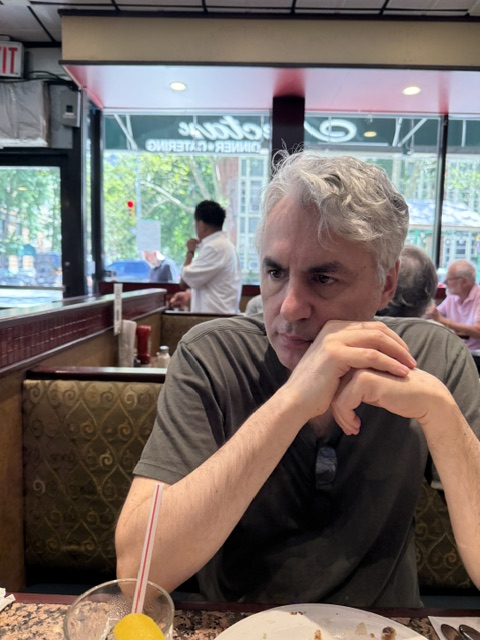
Anyway, we’re sitting and eating in the Friendship diner (FYI, “Friendship” is also a fake name (and a synonym for that of the real diner)), and I like sitting and eating there because I’m friendly with the staff and because Friendship is cheaper than the other diners in the area and has more booths, while offeringbasically the same quality of food. This particular morning I’m having pancakes and scrambled eggs with coffee, while Craig isdrinking an iced coffee through a straw and eating the turkey that is the inside of a turkey sandwich, occasionally picking at the bread on the outside.
Craig takes one last bite of his sandwich and picks up his BlackBerry. He starts to play with it with both hands while simultaneously leaning over to sip iced coffee through his straw. The BlackBerry is the bane of Craig’s existence, as it is constantly running out of juice and usually fails at the most inopportune time. Craig has been vowing for months to buy a new battery for the smartphone or a new smartphone entirely, but he has not yet gotten fed up enough with his malfunctioning hardware to take action. He is too busy putting out other fires in his life, on the corporate and domestic fronts alike (Craig is married with children – enough said).
I finish my coffee and am turning around to signal one of the Greek or Mexican waiters in the establishment to refill my cup, when Craig warns me sternly: “Dude, you’re touching my knee.”
Although we are both over forty, we still act and talk like we’re in college, at least to each other.
“Appy polly loggies, my little droog,” I say, loosely quoting A Clockwork Orange, one of my favorite books.
By way of explanation, Craig has a thing about people invading his personal space. Once, the wife of the owner of Friendship gave him a big playful hug, and it took him about a week to recover. We never shake hands and only bump fists liketwo pro athletes or homeboys.
Craig seems appeased by my jocular rejoinder, so I return to searching for a waiter. The waiters are all huddled around the kitchen in the back for some reason, avoiding their appointed rounds. We are seated in the front of the diner, near the front door, which is now closed.
“It’s so hot in here,” Craig complains for maybe the hundredth time this year, even though it is not really that warm and he is wearing only a black Devo T-shirt which, cartoon-like, he seems to wear every day. Not that I see him every day, but I extrapolate to make a point – which is that Craig could give a rat’s ass about fashion and only dresses up for business meetings. (I’m one to talk, I should say, as I am at the momentwearing gray sweatpants and a well-worn blue fleece. Like George Costanza from “Seinfeld,” whom the two of us often reference, I figure if I’m miserable, I may as well be comfortable.) Anyway, I wait for Craig to threaten to defect to another diner in case they don’t start making the air temperature at Friendship room temperature minus about five – but nocutting comment is forthcoming today. I think Craig knows thatI am way too cheap and broke to, Benedict Arnold-like, frequentcompeting enemy diners – and also that I have a plan in case he makes good on his threat to defect: I will eat a bowl of cereal and drink a protein shake at home, then come down to join him at the enemy diner and order nothing but coffee, coffee, coffee.
“So, Evan,” Craig says, setting aside his BlackBerry and iced coffee for the moment and picking up his trusty copy of The New York Post. “I’m almost done putting together Desperate Times, which I don’t know if you remember, is theguy-lit… that’s male-oriented writing to you… short story collection I’ve been working on and I was wondering if you had anything you want to contribute. “
“What do you mean?” I ask. “Like my opinion?”
I have temporarily given up on getting any coffee. I hear the nearest waiter bark somewhat cryptically at one of the cooks: “Short stack, two scrambled high and dry! Onion omelet, whiskey down!”
“No, dude,” Craig says. “ I’m talking about short stories.”
“Short stories, huh? Not really my area, but I might have a couple in my closet somewhere. I’ll take a look. Why not.”
“Do they feature desperate male characters by any chance?”
“Uh…” I say, thinking. “Probably, yeah. A couple of them.”
“Nice,” says Craig, whose favorite writer is Charles Bukowski . “You know I respect your writing abilities. I really dug that script you wrote, ‘The Hell with Hollywood.’ Really funny stuff.”
“And you know I dig your stuff, too, man. ‘The Hangover,’ that’s classic boy meets girl.”
“Thanks, dude. You know I appreciate your kudos.”
“And I yours,” I say, concluding the proceedings of the mutual benefaction society.
Craig’s BlackBerry starts making noise. He puts down the newspaper and checks the smartphone display briefly before setting it aside again. Then he takes a very long pull on his iced coffee and says, “So how are things going with you anyway? Everything hunky dory?”
“What can I say, man?” I say. “ Life is life. It’s like… every other day something in my apartment breaks. A few days ago it was a standing lamp, then it was my computer, now it’s the toilet… And this toilet is like the toilet from hell. I’ve hadthe handyman, the porter, the super come by to fix it and it never gets fixed. I’m an expert on plumbing by now. I know all the different parts of the toilet – there’s the flapper, there’s the chain, there’s the filling mechanism, can’t remember what it’s called, there’s the handle and the arm – “
“Dude, this is all very fascinating but why do I care again?”
“Because we’re talking about life and life is just one gigantic struggle against the second law of thermodynamics. Everything is gradually getting less organized, falling apart, getting ready to die. ”
“Woah, man, you really need to get laid, don’t you?” Craig laughs.
“Yeah, I’ve totally given up on that front,” I tell him.
Craig gives me a wryly sympathetic smile, then says: “What you need to do is get out of your apartment a little and mix it up a bit. Maybe meet a little hottie somewhere. ”
“Craig, man,” I say, “I’m totally undateable. I’ve got no job, I’m on disability, I don’t know any human beings in this city besides you…”
“Just pull a Costanza,” he says, referring to our favorite television character. “Just walk up to a girl and say, ‘My name is Evan Breach, I’m unemployed and mentally ill and I would totally love to buy you dinner.”
“I think at this point the most I’m prepared to do is go to a bar and watch a Knicks game with you and maybe one other person.”
“Okay,” Craig says. “I don’t want to push you too hard. For right now maybe all you need to do is take a few baby steps. Get out there a little, see how you feel once you’re amongst other people.”
Craig doesn’t wait for me to reply, but picks up his BlackBerry and Post again and says, “Anyhow, I’m off to the factory now. Want to walk me to the subway?”
“The factory” is what Craig derisively calls his office(wherever it happens to be located at the time).
I’m done with my breakfast now, so I tell him, “Sure, I could use a little fresh air before I lie down on my couch for the rest of the day.”
He chuckles, “You are funny, Evan, he says. “You crack me up, you know that?”
“Too bad I’m not joking,” I say, half joking.
Craig throws on his jacket (a trendy shiny black lightweight down coat that his wife bought him so he could be a bit more fashionable), leaves some money on the table and gestures toward the door. “Shall we?”
I pay the cashier directly (which is what you’re supposed to do) and leave a meager tip. Then we exit the diner.
“So, how come you never pay the cashier, dude?” I ask himonce we’re out on the street. It’s probably not the first time I’ve asked him, but I can’t recall what he told me previously.
“Because we make the rules, my friend,” he says. “Didn’t anyone tell you that?”
“Is that the royal we you’re using?” I say, his excuse not ringing a bell.
“No, I’m including you as someone who has the ability to make the rules.”
I nod, chuckle. We start walking.
When we get to the subway station a few minutes later, we bump fists, two Upper East Side homies.
“So, anyway, dig up some short stories for me when you go home, okay?” Craig says.
“Will do.”
“And if you want, why don’t you write a new one? Might be good for you to keep your instrument sharp. Keep the old neural synapses firing.”
“Didn’t I tell you?” I say. “I retired from writing.”
Craig laughs and heads for the stairs leading into the fetidsubway station. He hustles down them, brushing past a homeless man.
“Have a nice day at the factory!” I shout after him, referencing rather obscurely the movie version of A Clockwork Orange, but he doesn’t hear me.
Back in my apartment, conveniently located less than two blocks from the diner (roughly the same distance Craig negotiates from his pad), I go through the papers that have been accumulating in my closet for over 15 years – I have lived here seemingly forever – and start looking for short stories I’ve written. After some effort, I find a brief and snappy one called “Guy and the Baby Doll.” I realize that I wrote this story in the late 1980s, on a Mac that had a total hard drive memory of something like 512K. The story was about an angry jilted boyfriend who confronts the object of his affections in the middle of the night, on a date.
I keep searching and find a small box containing floppy disks. I read the faded print on the labels and lo and behold I find two more stories. One is from about 15 years ago and the other, 10. The one that is from 15 years ago, “Goodbye Wall Street” is about a disaffected Wall Streeter who becomes a temp worker and suffers further indignities at the hands of corporate America. The remaining story, “Not Drinking with Erin” is a boy-meets girl thing that takes place at a famous writer’s annual Christmas party.
I spend the next hour and a half of my life typing the text of “Guy and the Baby Doll” (which no longer exists on disk) into my desktop PC. Once that task is completed, I copy the two files on floppy disks onto the computer (I actually have a floppy drive on my obsolete machine) and try to open them. Miraculously Microsoft Word opens them both. Without further ado, I write Craig an email and attach the three stories to it. I hit “Send,” then go lie down on the bed and take a mid-morning nap. I should mention that I don’t really want to take a nap that early in the day, but I don’t have much choice, as the medication Dr. B has got me on makes me feel incredibly drowsy, especially in the morning for some reason. I’m okay for about an hour after I take the little green pill, but then a wave of fatigue hits me like the cliché of your choice – let’s call it a ton of bricks. Another annoying side effect is excess salivation; so when I fall asleep I immediately start drooling all over my pillow. Nice, right? The only thing worse than waking up to a lake of spittle on my pillow case is the feeling that attends me upon waking, of being reborn kicking and screaming into a terrifying world that has no use for me.
Maybe 35 or 40 minutes later – I have no idea how Craig reads so quickly – I get an email back from him saying: “AWESOME, MAN!!! THESE STORIES ROCK!!! LET’S USE THEM ALL!!”
“Thanks, man!“ I reply electronically after reading his message, genuinely pleased that he likes my stuff. “Glad to be part of your project.”
“ No, dude, you’ve got three stories in this collection now, it’s your project now too,” he writes back. “We’re partners.”
“I’m honored,” I reply, actually quite flattered.
“I’m sending you the text of Desperate Times right now, minus your stories obviously. See if you dig it.”
“OK,” I write.
So, Craig emails me the manuscript and I read it. As I read, I start to get excited. The stories are good. Not just Craig’s but all of them. They need some editing and proofreading (Craig is more of a big picture guy than a detail guy), but basically he has come up with the goods. Maybe a career in the literary field awaits, for both of us, I think. Adrenaline surges in my chest.
Basking in what I surmise to be my sudden good fortune, I go into the bathroom to urinate. While I’m in there I notice that there is water dripping from the ceiling. I look up to inspect and see that the paint is bubbling all over the place, directly above my toilet: There is a major leak. I curse to myself because I know what this means. First the plumber the building hires will blast through my wall and fix the leak, then the plaster man will come to plaster and then come back again to paint. Three mornings of my life, sacrificed to the god of entropy. Why must everything malfunction and fall apart? I take my leak and flush.
Amazingly, I’m still in a fairly good mood the next morning. That AM, while Craig and I are sitting in the diner, he tells me that, with the addition of my stories, the collection isnow “good to go” in his opinion, and the first order of business is getting an agent. This will be no easy task, he warns me, as short story collections aren’t very commercial. Our stuff has to be super-good to be agent-worthy. Which, he says, it is.
“So how do you propose getting an agent?” I ask him.
“Well, I figure I’ll go online and do a little research, come up with a list of agents. Then, while I’m at the factory, maybe you could research them and figure out which ones are appropriate for us and, for the ones that are appropriate, what their submission criteria are. ”
“I think I can do that,” I say. “It might take me a few days though.”
“No problem… And in the meantime, I’m going to contact a writer I know who has an agent, see if we can get our stuff on the top of the pile with him. And I’ll start working on a query letter to send out with our material.”
“Nice,” I say, noting to my gratification that Craig really seems to be on top of his game.
Later that day, Craig emails me a list of about 100 agents who consider short story collections. I surf the web for a few hours, compiling a list of appropriate agents and criteria. The problem is the agents’ criteria are all maddeningly different. It is as if each agent sees him- or herself as the only agent each writer is querying, even though the chances of any given writer’s getting a positive response from a given agent is probably something like one in a thousand. As I plow through website after website in search of targets, I note: Some want just a query letter, others a sample story in addition; of the ones who request a sample story, some want your story in the body of an email, others in a Word document; some want you to go to the agency’s website and upload all your information, some to write an email from the site; and so on. It’s a logistical nightmare. After a few days of slogging through online information, I complete a list of about 25 agents who might be right for us. I email the list to Craig, and he emails me back, “On it.”
Within the next few days, he sends out query emails from his PR firm to almost every agent on the list (excepting the ones whose criteria are too crazy and/or onerous) and another 20 or so that I didn’t research. He doesn’t bother with criteria for this second group, saying we’re losing momentum with all this research, and just sends a query and sample story (“Not Drinking with Erin”) to everyone on this list. When I question the wisdom of sending queries out blind, he says “Dude, we have just as good a chance of getting somewhere if we don’t follow the rules as if we do. So I say forget it. I say we make the rules. You dig, bro?”
So the queries go out, and we go about playing the waiting game. While we’re waiting, Craig’s writer friend reads the story collection and says he likes it. Craig tells me on the phone, “He really liked your stuff, man. Want to see what he had to say about it?”
“Sure,” I say, as I can use all the positive feedback I can get.
Craig forwards me the friend’s email to him a few minutes later. It is very complimentary, and I read it twice. I let Craig know how appreciative I am that his friend, a real genuine commercial author, thinks that my stuff is “far better than that of most published authors” that he knows. This praise is about the highest that I have ever received in my long and undistinguished writing “career” (if it can be called that).
Edward S. Barkin


Dreck


Edward
Welcome aboard. Your story has realism and it feels like I am in the same room with the characters–yet at the same time you keep a perfect narrative distance. A hard thing to judge, but you won over.
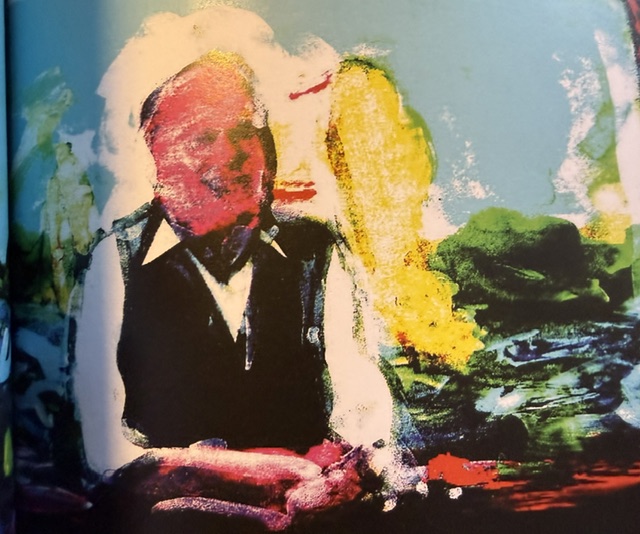
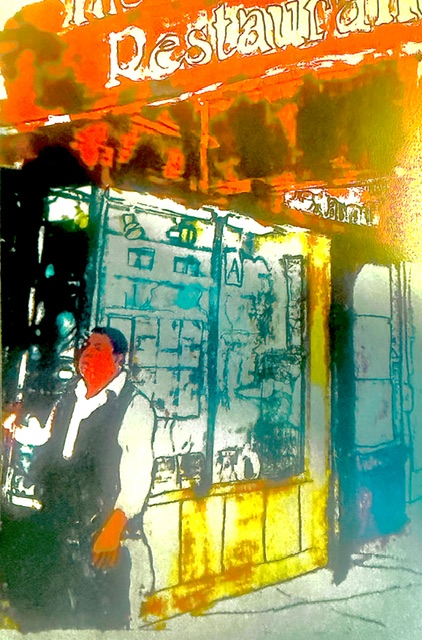
And what more can be seen for Dreck? The duty of the Artists is to view and report the world s/he sees. The eye of the art speaks of a familiar yet utterly alien otherworld.
Thank you guys1
Leila
LikeLike
Edward
The bringing together of psychiatry and creative writing in this is sheer brilliance!
Sheer brilliance because it’s so relatable and realistic, while also being so specific to this particular main character/narrator.
The setting and conflict/s in this also propel it forward. The setting emerges through the small details and the conflict is internal and external which adds to the intrigue.
Writing about the writing life is a humanistic thing to do in the 21st cen.! Bukowski was ahead of his time in this as in so many things.
Writers need to step forward and become the explorers of our time.
Dale
LikeLike
Dreck
The effects of your artwork are always striking. One brilliant thing about it is the subject matter, i.e. the human characters and the humanity of the characters.
The visual effects are visionary, expressionistic, surreal and dreamlike, realistic and raw, and amazingly colorful.
The visual is almost never visionary in the culture of this day-and-age. But somehow you manage to make it so again, and for the future. Truly impressive creative WORK.
Dale
LikeLike