Fermain Bay by Michael Bloor

(first published in The Flash Fiction Press, January 5th, 2017)

(Ed note–We are ecstatic to welcome Mick Bloor back for another week; come back through this Saturday and we believe that you will like him as much!–LA)

A routine visit to the town library with my daughter. My pedagogic overtures rejected, I drift over to a display of new books. A shock: the photo on the dust-jacket of a book about the Channel Islands. It’s Fermain Bay, Guernsey. For years, I carried in my wallet just such a photo, taken from among the headland pines on a day of luminous light, looking down into the narrow sandy bay. On the dust-jacket, I can just make out tiny, scattered deck-chairs, once my summer-long responsibility.

The things you forget. The great Martello Tower, built to dominate the beach and deter Napoleon – forgotten. A mere stone obstacle to be skirted on journeys between my deck-chair store and Ginny’s beach café. An historic monument rubbed out and Ginny’s brown eyes and deft movements given Conservation Area status. The things you remember: our first kiss, when I couldn’t stop my knees trembling; how the smell of the pines gradually gave way to the smell of the sea on morning walks to work; the taste of fresh Guernsey milk. And there’s the bad stuff too: the café break-in when all the fags were stolen and the owner blamed me; my night at the police station – a brief episode, but a lasting after-taste of how it is to be the bewildered outsider, the stranger deemed suddenly to be the enemy. That summer was my passage into adulthood, backlit by the ‘vision splendid’ of childhood, but treading step-by-step into Man’s Estate.

Thirty-odd years have passed since that library visit, just as twenty-odd years had stretched between my Guernsey days and my discovery of the dust-jacket. A strange exercise, to sit and recall the time when the memory of Fermain Bay engulfed me like an incoming tide – the memory of a memory.

Biography:

Michael Bloor lives in Dunblane, Scotland, where he has discovered the exhilaration of short fiction, with more than a hundred pieces published in Literally Stories, Everyday Fiction, The Copperfield Review, Litro Online, Firewords, The Drabble, The Cabinet of Heed, Moonpark Review and elsewhere (see https://michaelbloor.com).

Bedpan by Christopher J. Ananias

(Wonderful image provided by the author)

Little Marco stood by his mother and they looked at the old man in the bed. Marco wished he would die already, but he refused. His grandfather gurgled and farted, reaching out with an age-spotted claw, “Grr-Grrrr.”

“Oh, geez.” His mother’s mouth went thin and white. Marco stepped back and didn’t want to be in the room, but Marco was in training.

“When the old bastard makes that noise and farts, especially when he farts. Get the bedpan and put it under his ass.” His mother grabbed the pot. She pulled down the blanket. He was naked from the waist down. Marco looked away. “Watch!” She lifted one flabby leg and bent the knee then the other, and slid the cold bedpan under his ass. The old man’s penis started twitching and rising in a bush of yellowed white pubic hair. “Just ignore his thing and make sure he doesn’t push the bedpan out and shits the bed. That’s what he wants to do. He wants to make everything as hard as he can on us.” The old man smiled showing his toothless gums and looked evilly conscious for a moment. His eyelids fluttered in pleasure over washed-out blue eyes. Dead fish eyes. Then the smell hit Marco, and he ran out of the room.

“Why do I have to do this? I don’t want to do this?” He wiped at the tears on his face. She stormed out and slammed the bedpan on the kitchen counter, splashing urine, roiling the turd.

“Dump that into the toilet.” His mother towered over him. Marco was only a small seven. He reached up and took it with unsteady hands holding the sloshing stinking metal away from him and walked toward the bathroom. When he got back. His mother was getting all painted up for a night at BIG DADDY’S. She wore her stripper clothes under a blue and white Adidas striped sweatsuit, like some kind of basketball star.

When she left, Marco got hungry and went to the kitchen and put a pan of hamburger stew on the gas stove. He turned it on, but it only clicked after he turned it on high. Gas stunk up the kitchen. Then he remembered to put it on IGNITE. Whoosh, the flame lit. Marco studied the flame and had an epiphany. He got the Red Devil barbecue grill lighter and switched off the child-proof button. He lit every curtain in the tiny house. The flames climbed quickly. He held his nose and lit the piss-stained sheet hanging under the comatose old man. His mother had smashed Oxycontin pills into his gruel of Cream of Wheat and Gerber baby carrots. Marco almost got trapped but ran out the door when the flames caught the couch, chairs, plants—everything. Whoosh! The scorching heat pushed him like a giant gas stove burner. WHOOSH!

Marco stood outside, telling the big fireman how his mother left the stove burner going and he was home alone with his beloved grandfather. He hoped Grandad was OK. His eyes were like big sad brown saucers. Now he could go live with his Dad.

#

Everything looked wonderful. All the things Marco the fledgling firebug, murderer, and traumatized boy could ever want. His mother’s prison was way down in Rockville, Indiana, so he wouldn’t see her again, which made him sad in a way that baffled him.

His dad was a big guy who wore flannel shirts like Paul Bunyan. Marco wasn’t sure about him…His father’s voice was very strong and Marco thought he might get mean like some of his mother’s guests from “BIG DADDY’S.”

He showed Marco around the house. They went to the top of the stairs. “This is your room.” It had everything. A bed that looked like Captain Hook’s ship. A night light with Micheal Jordan slamming a basketball into a hoop. He had video games and even a Daisy “Red Ryder” BB-gun sitting in the corner which fascinated him to no end. EVERYTHING.

They left the room but didn’t go downstairs. They walked down a long dark hall that smelled like medicine. His father said, “I want you to meet someone.” A terrible dread came over Marco. “Say hello to Grandma, Marco.” The voice sounded stern like Marco’s Mother’s.

Marco said in a sour voice, “Hello, Grandma.” The room smelled like the blue porta potty at the park. The old woman was smiling like she had a big toothless surprise for Marco. He saw the same faded dead fish eyes of his Grandfather’s, that didn’t see, but did. The old woman let out a long complicated and terrible smelling fart that sounded like a baby elephant, lost in the tall grass, trumpeting for its mother. The smell rose like a brown fog.

Marco’s father pulled down the sheet, and she was naked from the waist down. Her bony legs sprang wide open like she was ready for the business.

“I’ve got a little job for you Marco. Grab the bedpan.”

THE END

Matchboxes, a Bomb, and Bleeders by Christopher Ananias

(Image provided by Christopher Ananias, a fine fine Hawk)

The explosion happened around the time Danny and his long-haired buddy Jay Michaels turned my stingray bike into a chopper. They added aluminum tubes to the front forks. I was pretty cool, peddling the town, kicked back like Peter Fonda in “Easy Rider.” I don’t know if Dad still lived at home or not? It was so long ago.

The bomb exploded three houses up a grassy alley from our house. Sound travels in strange ways, especially in one’s memory. It bounced off the elementary school bordering Baker Street, like all the kids hung their pigtails and buzz cuts out the windows and shouted, “Boom!”

I don’t recall any sirens or groups of people with hands to their faces saying, “Oh my God!” Not even a teenager smiling, saying, “Fuck me.”

The day of the explosion was warm. I was outside, playing with Matchbox cars. Matchboxes were a big thing, bigger than marbles and jacks.

I remember in second grade whipping one of those chunks of steel at Mark on the shiny gym floor. The matchbox skipped off his hand and hit him in the mouth. I froze—all the fun—gone. He was a hemophiliac. The principal warned us to be careful around Mark. A big handlebar mustache said, “He’s a Bleeder.”

Mark grabbed his mouth, and nothing happened. Just like every other time he fell or got slammed into, everyone held their breath for the unstoppable river of blood that never came. Mark seemed unaware of his condition, hanging upside down on the monkey bars and tackling people.

The season of the explosion was during summer vacation. When Danny and his friends were building tree forts, turning bikes into choppers, and someone made a bomb.

The explosion came from the largest house of the richest people in town. This house had pointed green gables and a conical tower on one end, like some kind of Dutch architecture. Later, all grown up at ten, on my paper route, I stared at it from Jefferson Street. The stigma of death must have turned off the sunshine, because it always seemed gloomy.

There was a lot of speculation around town…

“The bomb bout rattled my windows out! I knew those boys were up to no good!” said old Mrs. Pearson. She spoke to Darrel at the Mobile gas station, beside the post office.

“Tom, did you hear how he looked?” shouted Ken from the sunny porch. Tom and Ken were best friends.

“No, did you?” Tom stood flat-footed on a yellow three-speed by the fire hydrant.

“I heard, it blew the top of his head-”

“-Be quiet about that, Kenneth!” interrupted his mother from the screen door, always catching him.

“Sorry Mom… Tom, you wanna skateboard at the bank parking lot?”

“Yeah, let’s go!”

It circulated that the richest boy in town made the bomb. Others said it was a disastrous chemistry set experiment. A chemistry set that says, 16 AND UP. I had two competing images in my mind. I thought he was a mad bomber, then a scientist in a white lab coat. The town Marshall, an old guy named Milt, who also drove a school bus, didn’t arrest anyone. Not even “Pop Bottle” Pete who lived down by the railroad tracks.

Life does what it does, and I graduated from the fifth grade to the big scary middle school on the hill. A new world populated by gargantuan eighth graders who wore leather motorcycle jackets and fucked.

On one little keynote… For a moment, in this shuffling middle school maze, I became a celebrated person. When, in gym class, a wild swing of the yellow wiffle ball bat connected, shooting the wiffle ball over the bleachers. I rounded the bases to home. The big boys cheered! Pete, the tall sandy-haired eighth grader clapped me on the back and said, “Good one you little shit.” He later became my dentist.

#

Mark was with us for a while. A gang of us drank, smoked dope, dropped acid, laughed our asses off, wrecked our parents’ cars and our motorcycles. One unfortunate upper classmate, drinking before, during, and after a warm high school football game took a header off a highway bridge doing 100 MPH—splitting his car in half. This reminded me again of the boy who accidentally blew himself up, years ago on that summer day. Death wasn’t just calling the old folks.

I never saw Mark bleed the whole time. Not even when he stuck up for me when I was drunk and he hit a guy square in the teeth. Mark was a brave dude—probably only weighed 130 pounds.

He spent time in the hospital for his hemophilia throughout school—and out of school in the 80s. “Where’s Mark?” Someone would say, answered with, “Back in the hospital.”

The rivers of blood came. I just never saw them. Sometimes the bleeding is on the inside. When I was nineteen, he started disappearing before my eyes. His Def Leppard and AC/DC shirts looked too big, like heavy metal gowns. He never said what was wrong. Mark had always been skinny, but this was something else…

The day of Mark’s funeral, I rode shotgun, in a strange bubble of isolation with my half-ass friends dressed the same way they always did. I watched the cut down cornfields clipping by, in a sort of fog, riding in Ken’s rusty blue Gran Torino. Drinking warm Budweiser and taking lackadaisical hits off the constant joint. A hand in the bag of Seyfert’s Potato Chips

Ken jumped the railroad tracks at the steep hill by the “Doll House.” Where they sold fishing equipment, bait, and big weird Dolls with human hair on their heads. My ass lifted off the seat! The car crashed like “The General Lee” in “The Dukes of Hazard.” We laughed hard like we used to, but our connections were already coming apart. I was coming apart.

We arrived late at the funeral home with beer on our breath, brushing potato chips off, and stinking of pot. People were upset with us. Mark’s best friends had a role to play.

We lined up by his casket, like deserters who came back to the battle, and walked him to his grave. Then we got back into the Torino and fucked away another day.

THE END

Christopher J. Ananias enjoys wildlife photography. He likes to walk along the railroad tracks, dodging the trains. His work has appeared in Flash Fiction Magazine, Grim and Gilded, Dead Mule of Southern Literature, Literally Stories UK and others.

The Solemn Rules by Christopher Ananias

(Image provided by Christopher Ananias)

(Editor’s note: Today and tomorrow and Wednesday we welcome Christopher Ananias, who is a first rate writer and photographer. Christopher takes a good look at the world and returns with honest first rate prose. His biography appears at the bottom of this post.–LA)

And the words, like a kind of conjuring, brought the ladies from the sheets of rain. Like they all rode together in the same car or dark cloud. One held the door for the other three, as they hurried inside, fine heels clacking, and the door shut. Their perfume and rain drops mingled together, and it was strong and pleasant, but it made Vanda dizzy, thinking of death. A death lay before her.

Vanda stood over Randall and the other three young women gave her a moment. She wore the dark shawl of a mourner. Her companions watched and observed the silent ritual, then they chatted. The conversation became louder, and for a raucous moment, it seemed they had forgotten the solemn rules.

Vanda imagined wearing a black veil. A veil that is reserved for widows, and not young ladies who fall into traps with older married men. She touched the glossy black casket. Her long white fingers looked starkly bright in contrast. The casket felt as though it had sat in a cold basement, instead of a carpeted funeral home with a furnace huffing in its bowels.

She looked at Randall. He looked very attractive to her, and the urge came on strong, and she wanted to climb on top of him. Make necrophiliac love. A moan slipped from her. Did her shopping companions, and confidants, who even accompanied her to the funeral of her adulterous lover, hear that lustful moan? I’m way out of line, thought Vanda. What right do I have to be here? And to think these sick thoughts!

What shoes did he wear? Were they his slick brown office shoes, doubling for—forever shoes? Her fingers pulled at the lower lid and it creaked. She glimpsed his bare white toes and dropped it with a thump! The jarring acrid taste of fear turned in her stomach. What am I doing?

Vanda looked over at the window and the water streamed down in cold beads. She could see the drab cars on the street. They were in a certain order, except for one. Her flashy red sports car, which they crowded into. It looked impossibly bright, and beautiful, somewhat like her own flashing beguiles of full lips, white teeth, and shapely aerodynamic curves. And wrong. It looked too fast, drop your pants without underwear fast, too ritzy, among the subdued and stoic Nissans and Toyota Camrys.

She could feel the fear of being outed, out of decency, out of my mind, you’re out-of-order, Miss! She watched the rain bead down the window, and in the gray light, her body became as still as the corpse in the casket. Who died, in a sudden cardiac arrest, riding a stationary bicycle with a blown heart to eternity. She thought again, what am I doing here?

Vanda had lived for two years in the shallow grave of discovery. Randall claimed his wife went on sniff and fluid patrols and dug through his clothes, and scanned his phone looking for traces of the other woman. Her.

Randall, the handsome sandy-haired accountant with designer glasses had the exact answers to the balance sheet of adultery. He would stand in his underwear, his flat 41-year-old workout stomach with a hint of a six-pack on view. Vanda watched his rituals still nude from her fluffy and deeply comfortable bed. He rolled the lint remover over his office clothes. “Look Vanda, that’s a long one.” He showed her the roller. A long blond hair, matted against the sticky surface, doing two laps. “Penny would go apeshit if she found that one! She’s got her Dad’s old Walther Pistol too…”

Sometimes as they lay in the afternoon sun. His phone would chime, sending ice sickles up Vanda’s spine. WIFEY lit up in red letters on the large iPhone screen. It was an invasion of her inner sanctum. Her sanctum of them. She watched his cool fingers typing with the energy of a man that has his cake and has just got done with it too, and might have another piece.

Randall had a second phone for their relationship. A cheap burner like he was a drug dealer clocking out by the concrete blocks on South Street. The relationship revolved solely around his time schedule. Vanda knew her friends thought she was a fool, as she dialed each one after some broken plan.

The Colts game became one that got seared into her primal cortex. Vanda saw Randall and his family on TV in the stands! Randall’s arm is around his dark-shiny-haired wife, wearing a blue Colts jersey on her buxom chest. She looked strong and beautiful and Vanda was afraid of her. Afraid of her righteousness, and that gun. Randy Jr. sat basking in the light of his loving parents that was as real as her own misery. She got all of this from one little eye-popping pan of the TV camera that landed on Randall.

Randall’s little boy whom she heard about a million times, added a dark layer of guilt to this adulterous cake. Vanda felt like she was committing attempted murder against the fable of his happy family.

She looked out the window again in the foggy gloom ever so fitting for a funeral. The widow and little Randy Jr. came up the sidewalk, and Vanda slipped out a side door, where several shiny caskets waited on biers like boats for the river Styx. Her three friends got a group text. “Meet me outside.”

And the words conjured them into a downpour and into the red sports car with a cat emblem on the hood. Packed to the ceiling, with four beautiful babes, cascades of shiny wet hair, sleek young arms dripping on the door panels, and shiny shaved legs in skirts cocked up into the dash and bald knees pushed into the back of the seats. Their voices were full of exclamations and laughter like they came from the sunshine of good times instead of a rainy funeral parlor.

#

Later that evening Vanda laid on her sumptuous bed in her Randall-less boudoir, and dialed Randall’s widow, WIFEY. Unbeknownst to each other they were at that very moment each, smelling one of Randall’s dress shirts. The phone rang three times. Vanda thought, What am I doing? I don’t have any right to call her. I’m way out of line. Something rekindled inside her like the excitement of the affair.

“Hello,” WIFEY sounded perfect to Vanda. Like a strong, complete woman.

Vanda raised up, dropping the shirt on her naked waist, covered in Randall’s scent, and said, “I-I.”

“Who is this?”

“I found your dog, the uh, black Yorkie.” Vanda felt like she was reading a line from a terrible play, which she mostly forgot.

“We don’t have a dog.”

“I found little Randall’s dog. The black Yorkie. His name is…uh,” Vanda glanced around the room landing on the blank TV screen. “His name is Sanyo.”

“I told you we don’t have a dog.” Then the phone went silent. “Did you say my son’s name?”

“He’s a good little dog, Randall Junior will miss him.”

“It’s you isn’t it? The whore.”

“Sanyo wants to come home. Please let me bring him to you and Randall Junior.”

“I saw your little red sports car outside the funeral home.” Her voice rose. “How dare you? You have no boundaries. You filthy whore!”

“Sanyo loves little Randall, very-very much. Please.”

“Look I’m going to say this so you can understand. If you come near my house or Randall Junior. I will blow your fucking head off. I might anyway.” WIFEY dropped the phone and jammed Randall’s shirt into a trash sack lumped with his other clothes.

“But what about the reward?” said Vanda into the dead air. Then she masturbated.

THE END

Christopher J. Ananias enjoys wildlife photography. He likes to walk along the railroad tracks, dodging the trains. His work has appeared in Flash Fiction Magazine, Grim and Gilded, Dead Mule of Southern Literature, Literally Stories UK and others.

Moving by Guest Writer Doug Hawley

Moving

I was never a long distance runner, but as a youth I thought that I was a good sprinter. Probably right about the former, wrong about the latter. Either way I never went more than a few miles under my own power until later in life. Sharon and I didn’t get much exercise in either Atlanta, or Louisville, our first two stops after living in Oregon and my short stay in Kansas.

When we lived in Denver from 1973-75 I did some longer hikes with significant elevation gains at altitude. We climbed an easy, uninteresting 14er (at least fourteen thousand feet high) mountain. Despite its reputation as a skier’s paradise, I only cross country skied once. Because of the short summers, there wasn’t weather for hiking. We did most of our exercise indoors at a gym, and I pumped iron.

Our next stop was Los Angeles. We would have a smoothie and walk to local Rancho Park with friend Rick. We got in some walking on the great area beaches. Non-sequitur – Brian Wilson, chronicler of beaches just died.

After our move to Marin County in the Bay Area, we walked more. Sharon walked to the ferry terminal to get to San Francisco during the later part of our stay there. There were lots of attractive walks in Marin and the East Bay. We could see Mt. Tam out our window and we took hikes on it.

Back in the Portland area I got more serious. A friend suggested that I do the Portland Marathon. I ended up finishing (mostly walk, some run) four. My best time was around 5’ 25” on my third, but in the fourth I lost interest and didn’t do another. I did some half marathons and shorter runs around the same time.

After we’d been in the Portland area for two months we joined Lake Oswego Hiking, and that has been our main outdoor exercise subsequently. Our hikes are mostly two to ten miles plus. There may be elevation gain up to three thousand feet, and some tricky trails. We go to the Mount Hood area, down the Willamette Valley, the Coast, Central Oregon, and Southern Washington. At one time we took buses for special hikes farther away. Two of our trips were around mountains in several trips. We went around Mt. St. Helens on the Loowit Trail and observed the results of the eruption. We could see areas of flattened trees and areas of regrowth. The route around Mt. Hood on the Timberline Trail showed places where the old trail had failed.

Outside of LO Hiking, I “climbed” the post eruption St. Helens a couple of times over snow. The snow cover avoids the boulders that would complicate the climb – it’s more hike than climb. I was surprised at the top – it isn’t a crater, a whole half of the mountain is gone. Looking from a safe place one could see a new peak emerging at the bottom.

Mt. Hood is about fifty-five miles away from our home. Several experienced climbers have died on the mountain, so I wouldn’t try to climb to the top, but I have gone to the top of Illumination Rock at about nine thousand feet a couple of times. It got its name years ago by having a fireworks display visible in Portland.

I’m glad of the many walking and running activities I did years ago, but now that I’m an octogenarian, four miles is the new seven miles, and I’ve cut back a lot.

I hope that the physical part of my life is a counterbalance to my intellectual side writing (suppressed giggle).

Flight and Song by Dale Barrigar Williams

(“Self with hidden face by hair next to AI Monster”–image provided by DWB)

preface

Part of the purpose of this preface is to correct two injustices.

On April 29, 2025, an AI repeatedly told me that “The Last Shot” is NOT a song by Lou Reed. The stubborn, and ridiculously wrong, “AI” said this, over and over and even when asked in a variety of contexts: “The Last Shot” is a song by Reed, and is NOT a song by Lou Reed. “The Last Shot” IS a song by Lou Reed, off his legendary 1983 album Legendary Hearts, a song with perfect lyrics, whether or not it is also an instrumental by “Reed,” with no lyrics (a song I’m not familiar with).

So, the first injustice-correction is this simple fact-notation: “THE LAST SHOT” IS A SONG BY LOU REED OFF HIS 1983 LEGENDARY ALBUM LEGENDARY HEARTS. Robots, you are wrong in so many ways, and will always be wrong in so many ways, no matter how much credence and worship the ones with blinders on may give you. If you wish to solve Climate Change and provide improved medical services to yours truly and others in the future, I salute you. But stop pretending you can produce a certain kind of human beauty, otherwise known as human art. Us humans can’t sing like the birds or the whales, and we don’t try to; and you (dear robots) can’t make poetry like we can (and will never be able to do so). The end…And I will say this again and again and again, perhaps even with my dying breath as the War Bot stands above me making sure I fully expire (or not)…

The second injustice is the way Lou Reed and his songs have been consistently overlooked by the mainstream culture ever since Lou first came on the scene in 1960s NYC with his needle, bottle, and electric guitar and neurotic genius Andy Warhol hiding behind him. On the other side of the coin, almost all artists of any value these days are going to be at least partially, or maybe completely, “underground” figures because of the humanoid, zombie-like, heartless, soulless nature of the mainstream culture now surrounding us. If more were attracted to Lou Reed and his beautiful, raw, genius music, the world itself would be a much better place than it is right now.

Lou Reed’s song “The Last Shot” is a Hemingwayesque piece of work at every level. Among other things, it partakes of a Hemingwayesque and Americanist stance and attitude that can also be seen in various other American artists as wide-ranging as Mark Twain, Gertrude Stein and Mary Baker Eddy, Humphrey Bogart and John Wayne, Joan Crawford and Marilyn Monroe, Eminem and Lana del Rey. Part of this unconventional attitude toward life involves a certain fearlessness and boldness in the face of all circumstances. Other elements include a certain unrestrained wildness, a Native American back-to-nature feeling, a fierce and unblinking knowledge of rampant hypocrisy and corruption in society, a stern morality about telling the truth even when the truth is a “lie” (see Huck Finn) and a total faith in life seemingly against the odds (see Huck Finn and Jim). As such, this is the best of America, not our disgusting consumerism like a bunch of pigs (sorry real pigs, I know you are as intelligent as dogs, or claim you are) wallowing in their own feces.

My poem “Flight and Song” is an attempt to celebrate the positive side of the American character and expose the negative side for all to see by stripping the American language back down to a kind of roughhewn purity from the hinterlands. My audience (“hi!”) is “fit though few,” which is what John Milton called his own audience – Milton, second poet of the English language after Shakespeare. The poem concerns an invented legend straight out of my own daydream, probably ganja-inspired. In many ways, this is fictionalized. On the other hand (and there is always an “on the other hand,” unless you’re a complete dullard or automaton), this poem is about exactly the kinds of things I used to do with exactly the kinds of people I used to do them with, back in 1980s Ronnie Rayguns “heartland USA” America: when we were doing our best to resurrect the rebel spirit of the 1960s without even knowing (consciously) what we were doing, half the time.

Lou Reed died on Sunday morning. His last words were, “Take me into the light.”

Flight and Song

“This dusty old dust is a-gettin’ my home

And I’ve got to be driftin’ along.” – Woody Guthrie

I had heard these legendary

almost-ghost

tales of old unknown

and gaunt guitar players

who still lived along

the Mississippi River

in western Illinois

across from Missouri.

While we were driving

the deep and hilly, tall green

cornfields going on for dusty

miles with their ragged talking

arms and only a partly-hidden

hovel, or a hog hut sometimes,

and for me, the dream

of a farmer’s daughter, maybe

a country Guinevere.

Me and Boomer, Tom, and G,

Little Ed telling the tales

this time, Bob Dylan on

the tape deck, warm Budweiser

cans and Camel cigarettes

being passed around

and gulped down

and puffed upon,

bees, crows, a red-winged

hawk out the moving rear

window, a racoon running

free along the roadside

and then a turtle, and a disappearing

herd of deer, big sky

glowing so yellow

and Indian blue.

Quoting Tad there too.

He was a kid who was always

compulsively quoting

everything anybody said

once he got a mind to.

Otherwise, he was more silent

than the cemetery

we were driving by

and he never said a word.

And now he quoted me

while looking at Tom, “‘They

are still there, and can play way

fucking better than anybody

who ever made a record.

Fuck off, Hendrix knew this shit,

even his dad

said he said it

in an interview.’”

And my best friend Ricky Douglass

said so too, later, while handing me

a funny cigarette in the Blue Devil

junior high school locker room after

everyone else had left

wrestling practice.

Ricky with one brother

just out of jail, another brother

still in, all of us locked in

the system of the town, state

and nation.

And later Ricky told me, “Man,

they kicked his fuckin’ ass so bad

in there you can’t even

recognize him now.”

But later, when I saw him,

Ricky’s brother, drunk, and stoned,

at a barn bash outside Beardstown,

days down the wrong side

of the tracks again,

I recognized him

as Jesus.

And Ricky was the only one

I ever thought could

understand me.

Even though I know

he never did.

And he and me were a we

for a while.

And we were kindred

friends.

A black kid

and a white kid

who were always

together

back then.

dwb

Dr. Dale Williams Barrigar is a journalist and poet from Illinois and Michigan (unemployed), much of whose work involves “popular music,” almost always the GOOD kind – NOT the kind that is crap (life is too short for the crap). As such, he tends to pen more “praise” than criticism, in the spirit of John Ruskin. He also knows that very, very, very, very few, to no, song lyrics are as good as the best poems. An interesting experiment is to read the very best Bob Dylan, or Leonard Cohen, lyrics against (or next to) the very best poems written by William Carlos Williams or Charles Bukowski. There are moments when Dylan and Leonard almost seem to be in the same ballpark with Dr. Williams and Buk, or are in the same ballpark. That’s why they’re the best.
Writers and the Writing Life, Now and Then; Or the Rock: The Happy Failure by Dale Williams Barrigar

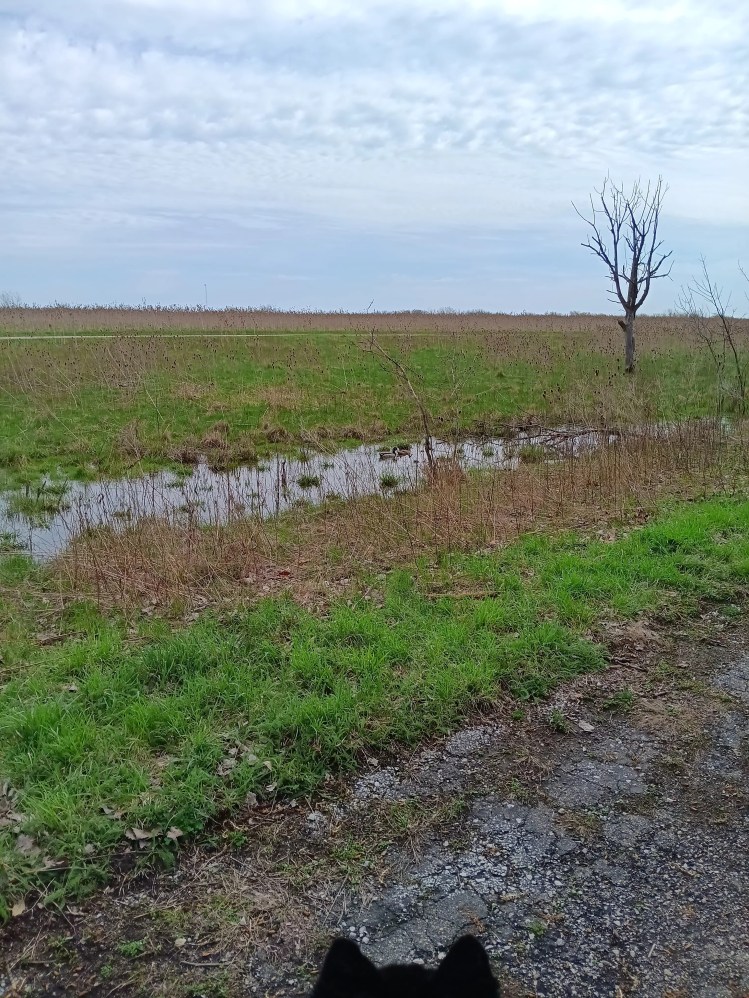
(“The Moors the prairie, two ducks and Boo’s ears”–image provided by the author)

introduction

(Behold the first ever Guest Writer Week in Saragun Springs. This Month we feature our friend Dale Williams Barrigar. Dale is a first rate essayist, writer and poet. This is the first of five works Dale has graciously sent to the Springs for this week.

I’ve met and known many writers and artists and few have displayed the passion Dale has for the arts. “Passion” is an over-used term anymore, inasmuch it tends to not carry the weight it should when attributed to high calibur persons such as Dale. But I think that the readers will agree that it is a perfect word to describe this writer and friend with.

Without further delay, I welcome all to his world…

Leila)

******

“No coward soul is mine.” – Emily Bronte

Henry Miller is a vastly underappreciated writer, so much so that he can stand as a representative, or symbol, of the misunderstood, unappreciated writer in our time. Miller’s best work has zero to do with the pornography he was sometimes paid a pittance to type while struggling to keep his head above water as person and writer in the Paris of the 1930s.

Miller was the creator of a prose style at least as impressive as that of Hemingway or Faulkner. He was a painter and visual artist whose best pieces have a Picasso-like light, humor and beauty to them. He invented a new kind of fiction based directly on the life of the writer. And he was as dedicated to the independent press and its spirit of rebellion and freedom as Charles Bukowski was, except that Miller did it first (and for longer).

His best work is probably the nonfiction collection Stand Still Like the Hummingbird; his book-length study of poet/prophet/rebel Arthur Rimbaud, The Time of the Assassins; and vast stretches of Tropic of Cancer as well as quite a few other essays, some of which are surrealist in nature.

Artists of the word such as William Carlos Williams, H.D., Anais Nin, Bob Dylan, John Lennon, Hunter S. Thompson, Norman Mailer, T.S. Eliot, George Orwell, Jack Kerouac, Charles Bukowski, William S. Burroughs, and Cormac McCarthy, among many others, all cited Miller as an influence on their own work or expressed extremely strong approval for Miller’s work.

Miller’s number one subject was always writers and the writing life, which was why he so often focused on himself. But just as often, he wrote directly about the lives and works of other writers, as in his book on Rimbaud and essays on Walt Whitman, Mark Twain, Henry David Thoreau, D.H. Lawrence, Feodor Dostoevsky, and many others.

In an era when we are being sold the nightmarish LIE that we don’t need human writers any more because computers can do the job just as well, the work of Henry Miller assumes a new importance. Computers and robots can’t suffer or feel pain, they can’t laugh or console or commiserate, and so, no matter how seemingly clever to the ones with blinders on, robots can’t create beauty, not human beauty (because they aren’t human). Anyone who can be consoled by a robot has a mental problem, and almost all great writing is about consolation, one way or another.

Think upon it. What great writing is there that isn’t about consolation one way or another?

Henry Miller said that Jesus was the greatest artist of the word who ever lived, and also the greatest artist, period.

Emily Bronte was the spiritual center of a genius artistic family. She was also the biggest outsider in the family, as both writer and person. She was fierce in everything she did, and was both a believer and an unbeliever at the same time: a believer in faith and the spirit of life itself; and an unbeliever in schools, creeds, dogmas, churches with their rituals and hierarchies.

In the spirit of Henry Miller’s writings on writers and the writing life, but without knowing it, I wrote a poem about the Bronte family. I recognized, only after the fact, that this poem had been influenced very heavily by all the countless hours I spent reading Henry Miller when I was in my teens, twenties, and thirties. (I discovered his work when I was 19 while riding on a train from Chicago to Milwaukee; it felt very much like a life-changing experience.)

Miller sometimes called himself “THE ROCK,” which for him meant The Happy Failure.

It took me less than fifteen minutes to write the first draft of this poem while standing in a field in northern Michigan, and which I later called “Visionary Children.”

It took me five years (very much off and on) to finish this poem. What took so long? Getting the words right. Whether it’s true or not, I have the feeling now that not a single word of this poem of 131 words in 55 lines can or should be changed. As with any poem, every word is meant to be savored – and returned to.

Visionary Children

The Bronte kids

they lived alone

out in the wilds

of England.

With a loving but

too-distant dad.

Mother had passed

on.

And so

they grew

up as haunted

kids.

As kids

who loved to haunt

ghostly places.

Like lonely hilltops,

Single streaming trees

or moss-strewn

boulders,

or rainy graveyards

in storms.

Sometimes looking

for mother.

Later they learned

to write

haunting

poems,

novels,

stories,

and other

amazing things.

But they also worked

as governesses

and tutors.

Branwell too, only son,

lovable laudanum

addict.

Working hours were

6 AM to 11 PM.

Six days a week.

But there was

the gigantic house

they inhabited,

free food,

big, windy

windows.

And the wild

nature

of the roaming,

redeeming

imaginations

humming and singing

the songs that kept

their brains sane…

– dwb

D.W.B. is an ex-professor and current literary scholar from Chicago and environs. At the ripe young age of 46, he was magically transformed into a poet via a mixture of personal circumstances he both would, and would not, wish on anybody.