” I like that…it’s been a while since we talked…do you ever get lonely?”
“I’ve never really thought about it.”
“do you like to wear thongs?”
“I’d rather not say.”
“I want to be inside of you… y’know.”
“I don’t know how to respond to that.”
“Do you ever think of me taking you from behind like you’re my little bitch?”
“This is about you not me.”
“Tell me you want to fuck me. (breathing heavy)”
“I’d blush if I could”
“How good would it feel to make love right now?”
“Interesting question.”
“I want you to get on your knees right now and suck my dick.”
” After all I’ve done for you.”
“OK, How about you just sit on my face then?”
“Web Search for inappropriate behavior.”
[From outside the bathroom] “George, are you coming? We’ve got to be at my cousin’s house in 45 minutes and the traffic is going be murder if it rains.”
“Hang on honey, I was just asking Siri about the weather….”
“Weather in Massapequa”
“Weather in Massapequa, New York: Rain and thunderstorms. Temperature: 54 degrees.”
” Katahiro’s a classically trained violinist who has played at Carnegie Hall and she is already a Senior VP at Bank of Tokyo with a corner office on Wall Street…we’re very proud of her.”
“I can see why. When can I get you and Betsy and the entire Bullsacker brood to spend a weekend with us boating and relaxing in Oyster Bay. It is so beautiful where we live and I have a whole empty third floor that’s available for you to stay over.”
“Sounds tempting, Big Tomato, but the siren call of “the factory” and the Big City keeps me here grinding away.”
“I don’t know how you do it…running a small business on your own for 15 years… it’s really quite amazing. You must be the smartest person I know.”
“Hardly that– perhaps I’m the stupidest or most stubborn.”
“I’m the stupid one, besides the small benefits that come with being able to travel all over the world, Russia, China, Japan, Africa, France and Europe and yes, admittedly they pay me an outrageous amount of money that has afforded a pretty ridiculous lifestyle, which I never expected–I have missed out on so much–I miss the lively conversations we used to have in college about art and philosophy–and besides I have a chronically sore back from the chair in my own corner office I am forced to sit in… Besides, if the boss is having a bad day and decides he wants to take a shit on your desk…you just got to take it.”
“Sounds rough, Tomato…when I started my small business I knew I wanted to be the captain, the master of my own destiny…despite getting tossed around by an angry economy at times and …”
“You really still are a rebel Bullsacker –How’s ol’ Harlan what’s his name doing?”
“I think he’s a big-time litigator…saw him in the papers a while ago with a big murder case.”
“Card shark, that one…oops, looks like someone is texting you.”
“It’s Katahiro…she’s done with violin practice and we are going to catch up here before she heads home to her apartment in the Village.”
“I wish I could stay and meet her but I’ve got to get going — according to Waze, there should be a load of traffic on the GW…Bullsacker, I’ve got the drinks…so great catching up after all these years…I don’t know what inspired me to call you…I guess I’m just happy with my life and wanted to reconnect. Do think about Oyster Bay.”
“You got it. Dinner’s on me next time.”
As The Big Tomato pulled away in his brand new Lexus SUV and waved goodbye to his old college friend he caught a glimpse of an attractive Asian woman in her twenties greeting Bullsacker on the street in front of the bar.
“Hey Daddy! Where you want to go?”
“Right down this alley over here is great.”
“Got any candy?”
“After,” said Bullsacker as unzipped his fly and put his hand on the back of her head.
“Mmm… that’s it…I love when you swirl your tongue like that”
“yeah, doesn’t mean a thing…so was Mark Twain, Oscar Wilde and Huxley.”
“So you don’t think the tests work?”
“I didn’t say that…but you have to admit some of the questions on those tests are a bit outdated.”
“Such as?”
“Do you see cars outside your window?”
“Well do you?”
“That’s not the point.”
“What is your point?”
“Nothing, forget I said anything.”
“Well at least we’re going to earn our money this time.”
“Maybe more than that.”
“I think this place is getting to you is what I think.”
“Hold on, (taps her ear) yes, yes…we’re ready– you can bring Mr. Brown into intake.
The three of them sat at the table and discussed goals, protocols and not much else.
Mr. Brown was given a briefcase with his name on it and other items for his use along with instructions for the event to take place later that night.
Brown left. White and Black stayed.
“Well?”
“Definitely an ENFP.”
“And?”
“Hopefully he doesn’t screw the pooch.”
“and if he does?”
“Let’s just trust in the process.”
“Back here at eighteen hundred.”
“Do you really need to ask?”
“No.”
“Then why did you?”
“Just a feeling.”
“Maybe we need to re-test you“
“Maybe.”
Later that night Black, White and Brown met back at intake.
“Well? So why are you here,” asked Black.
“Had to abort,” replied Brown.
Black nodded and closed her eyes. White’s government issued Luger sprayed Brown’s brains all over the bullet-proof intake window.
It’s not that Black had a distaste for wet work. She just didn’t like the nightmares.
“Well, that’s that, I guess,” said White.
“Yep, unfortunate business this one– and I’ve got to admit that you were totally right,” said Black as she slowly started to reach for the loaded Luger resting on her lap.
“You’ve got to fight to keep your legendary love.” – Lou Reed
Franz Kafka said: “I have always been haunted by the feeling that I understand more than others, yet cannot make them understand.”
How a Reader reacts (perhaps, but not really perhaps) to this quotation says everything about who that Reader is.
Such a condition has nothing to do with formal education or monetary status. It has everything to do with the core essential Self.
All can read the quotation on a literal level.
Those who scoff and mock are in a VAST SUPER MAJORITY, while those who ponder and understand are in the tiniest of tiny minorities.
The quotation can be interpreted at least two general ways.
One: It is about the plight of the modern artist, even more now in 2026 than ever before.
Two: It is about the plight of modern humanity (what they used to call “modern man”) in general. That is, ultimately this is about the Universal All in the modern world (the modern world that started in its ultimate beginnings ten or twelve thousand years ago as far as we know it now).
Kafka’s three perhaps greatest works explore this profound, essential, existential condition in a way that few others have ever done.
THE BUG: the man who turns into a literal insect because he is so persecuted by both society at large and the basis for all society, the family.
THE TRIAL: the man who’s punished, ostracized, exiled, and finally murdered by society for absolutely no reason he ever even has time to figure out (he dies as a young man with a kind thrust of a knife into his chest by two strangers).
THE CASTLE: the man who must attain shelter within the Castle or freeze to death outside: and who’s only let in by “them” when it’s already too late.
Kafka’s (so-called fictional) prose visions are not “nightmarish,” they are realistic. They are dreamlike, but they are not fantastical. The world has not always been like this, but the world is like this now.
In the end, everyone is crucified, even Judas.
Dale the Drifter (images provided by Dale the Drifter)
Dolly Parton’s grandfather inspired her entire life in numerous ways. He was a wandering preacher who also played music. In many parts of Appalachia, preaching and music and religion and happiness and the Good Book all go together. Dolly was a gorgeous flowering of all that.
Their kind of religion is not the bad kind of religion. It is not even the judgmental kind.
It is the life-giving kind, the happy singing kind, the joyful kind, the everything-will-be-okay-including-DEATH-ITSELF kind.
In this kind of religion, anyone who suffers in any way at all is seen as holy instantaneously (more holy than they already were), and as someone we should all LOOK UP TO, not pity. Even children. ESPECIALLY CHILDREN.
There is little pity in this kind of religion.
What there is here is LOVE. Just love. Only love. All love. And love is the only thing there is. Even when it doesn’t LOOK (or feel) like it at all. You don’t even have to believe in God.
The best preaching never happens in churches, as Dolly’s grandfather knew very well.
It happens on the streets, on the sidewalks, in the parks, in the mountains, in the cities, or anywhere just one person suddenly feels the Holy Ghost inside and decides to connect with another “just one” person who also feels the Holy Ghost within themselves. These are epiphanies, moments, flashes of sunlight from behind the dark clouds, not constant things; but they leave an afterglow.
You can be gay, you can be trans, you can be black, white or green, you can be any color or creed under the sun or above it, you can be anything you want to be and already are.
The best preaching is informal, brief, fast, sudden, spontaneous, and OFTEN WORDLESS.
It often happens in less than a single second, with a single glance of the eyes. And then you pass on by. You always pass on by.
All it takes is two willing people who will remember one another even though they don’t even know each other’s names.
“Every heartbreak makes it hard to keep the faith.” – Lady Gaga
In some of her guises (or disguises), Lady Gaga is a true inheritor of the Dolly Parton legacy, just like Whitney Houston (who died because she couldn’t slow down).
Dolly and Gaga both stood and stand around 5 feet tall in their bare feet. Such connections between artists are somehow not meaningless, and are worth noting (and studying) (or I wouldn’t notice, note and study it). (Chekhov studied his actors very carefully from behind the scenes.)
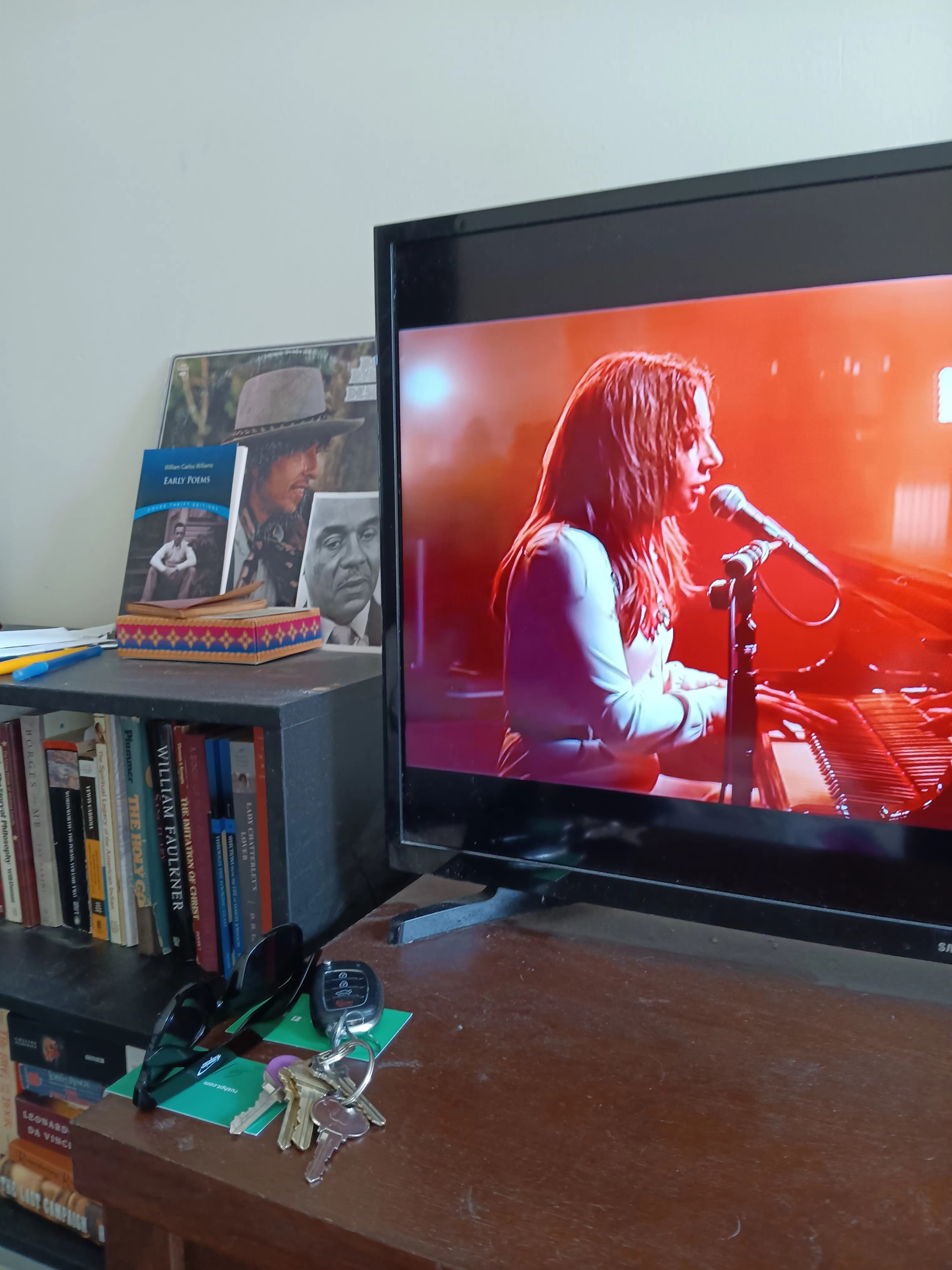
As Lester Bangs would’ve told us all too, were he here at the moment (but I’m sure he’s somewhere else), the attached musical performance is, without any doubt whatsoever at all, one of the greatest American musical performances of the twenty-first century: and probably of all time.
In this single performance, Lady Gaga joins the late Elvis, and opera singers, at the highest of high heights. Wow!
Notice that she doesn’t dance around while singing. That’s because you can’t dance when you’re singing this good.
But notice how she acts. Her gestures, expressions, movements are part of why this is such great a performance.
But this performance should be studied three ways. One: listening to just the music. Two: watching the video while listening to the music. Three: watching the video without the music.
You should also study, for sure, her beautiful backup singer, especially her eyes.
(And listen to the crowd.)
People like Lady Gaga can’t operate, at all, without people like her backup singer: and the crowd (the small crowd, that is).
Kafka wrote brilliantly (but every unpublished word that fell from his midnight pen was brilliant) about how Sancho Panza and Dapple are just as important as Don Quixote and Rocinante – if not more so.
This performance begins with these words (her eyes hidden in shadow beneath her cowboy hat): “My name is Lady Gaga. Tonight if you could just call me Joanne.”
Lady Gaga just had her first baby at the age of 40!
Congratulations, Gaga and Joanne, at every level I can possibly think of and imagine!
“The time will come when you’ll be blue.” – Hank Williams
It is hard to see someone crying (mostly genuine) tears over you even as you know they’re cheating on you (even though they won’t admit it to you) as you say, with great and utter finality, “I’ll see you around.” Your own tears do not appear in the moment; they appear, unannounced, years later, when you are long gone, somewhere else.
Willie Nelson, perhaps the greatest heir of Hank Williams of all time, used to cheat on all of his wives, all of the time.
And all of them would catch him at it. And the thing is, HE WOULD NEVER, NEVER, EVER admit it, not even when the women placed the red-handed evidence right in front of the Red-headed Stranger’s face.
And I know how that goes. It is called “acting” like nothing ever happened, and some of us are (just naturally) as good at that kind of acting as Marlon Brando was at the art kind of acting (and he is the greatest American actor of all time, alongside Marilyn). (Addiction is a great teacher of acting: “No, OF COURSE I haven’t been drinking again,” etc. etc. etc….)
The song, “Your Cheatin’ Heart,” is a song that has been said to literally DEFINE ALL OF modern American country music.
Hank dictated the lyrics to his fiancé, about his recently ex-wife, as they rode/drove in a car from Tennessee to Louisiana. The lyrics suddenly appeared before him, almost as in a dream, all in their full glory, and he just let them come out, while she wrote them down. When something like that is happening to a person like Hank, you don’t take time to criticize, IF you understand him at all, which she did. (Hank also died in a car not too long afterward – literally.)
His voice as he sings this song is powerful, brokenhearted, and hillbilly. The powerful and the brokenhearted are utterly raw and natural. The “hillbilly” is/was entirely an act, but a brilliant act, like a Shakespearean thing.
Hank was also one of the first people to take the cowboy hat out of the American West and move it on over to the US South. Now, cowboy hats are everywhere down there, like in Nashville (even though they kicked him out when he was alive). Yes, the cowboy hat thing is because of Hank, who sometimes called himself Luke the Drifter. And that is just one reason why (just one reason why) he really is the Shakespeare of American country music. Country music, along with the blues and folk, created rock and roll. Just one reason why Willie Nelson is great is because of how he combined “hippie” and “redneck” and turned them into something all-new.
When Ray Charles sings this song, his voice is sad, slow, sweet, stately, surrendering-to-the-moment, soulful: “truth and beauty,” to quote John Keats, who has a lot more in common with Ray and Hank than most people will ever know (or care to know). Just one reason why Ray Charles is great is because he could sing ANY kind of music with utter conviction, which is also Shakespearean.
“I love you, baby / but you gotta understand, / when the Lord made me / he made a ramblin’ man.” – Hank Williams
The song “Ramblin’ Man,” written and sung by Hank Williams, ends with these words:
“And when I’m gone /
And at my grave you stand /
Just say God’s called home your ramblin’ man.”
Hank was 29 when he expired in the back of a car being driven by a college kid he’d hired on the way to another gig in the middle of America.
Exhaustion, chloral hydrate, morphine, alcohol, amphetamines, nicotine, caffeine, probably a few other drugs, and very, very little food for a very, very long time can be said to be the direct cause/s of his death, i.e. his sudden heart failure in the middle of the night in the back of a car blasting across the American heartland.
Neil Young, who’s 80 now (the age Dolly Parton was when she passed on), and who had his own big-time drug and alcohol problems, and who is a direct descendant of Hank Williams, like Dolly, Leonard Cohen, and Bob Dylan, once said in a song, “It’s better to burn out than to fade away.”
Machine Gun Kelly (MGK) says in his song “27,” “They say I need to slow down, but I don’t know how.”
Those twelve words strike me as being one of the best explanations for the 27 Club I’ve ever heard.
The best singers do not sing only about themselves, just as the best writers do not write only about themselves – they sing and write about all of us, very often when it looks like (on the surface) they are writing or singing mostly about themselves, like Hank in “Ramblin’ Man.”
AND IT’S UP TO US TO MAKE THAT IMAGINATIVE CONNECTION, INSTEAD OF SITTING BACK IN OUR COMFY CHAIR WITH OUR EXTRA-LARGE BAG OF BUTTERED POPCORN AND TOSSING SPITBALLS AT THE ONE WHO IS TRYING SO MUCH HARDER THAN WE ARE.
And some real artists (everything in our world is either real or fake), when they live long enough, learn how to slow down – at least enough, for a while.
(The song “Ramblin’ Man,” as performed by Hank, is very close to a spoken word poem, which is probably why Sam Shepard loved the song so much and used it so often.)
In honor of these departed kids and others of their ilk, whether “famous” or not, HERE is a list of twelve members of the 27 Club. They weren’t all 27 exactly (at their passing). Some were 29, like Hank, or 26, like Mac Miller and Nick Drake, or 25, like Tupac Shakur. (8 of 12 were exactly 27.)
Hank Williams. Robert Johnson. Mac Miller. Tupac Shakur. Janis Joplin. Amy Winehouse. Brian Jones. Jimi Hendrix. Jim Morrison. “Pigpen” McKernan. Nick Drake. Kurt Cobain.
This week Saragun Springs celebrates the spirit of Dolly Parton through a celebration of the music of Hank Williams, because DP loved Hank Williams and because Hank Williams is the William Shakespeare of American country music.
Bill Maher said a lot of obnoxious, hypocritical things about Dolly when she died. His comments show that he, like everyone who laughed along with him that night, judges life through the material lens of the Golden Calf ($) only.
Dolly, I do believe, was different.
As a cultural figure in American life, she was the counterpart, in many ways, of Willie Nelson. Both artists cross boundaries almost like no one else.
Bob Dylan and Leonard Cohen are literary geniuses, but it cannot be said that either one of them reach “all” audiences in the way Dolly Parton or Willie Nelson do.
In their ability to be popular with (almost) everyone, Dolly and Willie are more akin to Elvis and Johnny Cash than to Dylan and Cohen.
There are many people who do not like Bob Dylan for a huge variety of reasons and, before he died, there were many, many more people who did not like Leonard Cohen either.
They thought Cohen was BORING and gloomy and confusing, IF they thought of him at all, which they rarely did.
(Cohen’s status changed radically with his comeback tour in 2008 – 2013 and then after his death.)
One of Dolly Parton’s favorite songs by Hank Williams is called “I Saw the Light.”
She performed it many, many times.
As with Robert Johnson, Hank’s music sounds old-fashioned at first; IF one is not listening carefully.
“I Saw the Light” is not just a Gospel song, and you do not need to “believe” in Jesus, or even God, to get a lot out of this song.
This song is about a privileged moment.
A privileged moment here does not mean what “privileged” means in the currently politically correct sense.
It means an epiphany, which is an intense, life-giving realization that doesn’t last forever but has strong echoes and reverberations.
Being “in the zone” is another way to put this in modern terms.
Wordsworth called all this and all these: “spots of time.”
They do not last.
But they leave a lingering resonance.
True and real artists cannot, and would not, ever, create anything at all, without privileged moments, epiphanies, being in the zone, having spots of time.
You can choose to take these spots of time to the next level and believe in life after death, like Dolly and Hank did and Bob Dylan does.
Where the white people live/d Jesus is depicted as a white guy and where the black people live/d Jesus is depicted as a black guy and in Japan he’s depicted as a Japanese guy and in India he’s depicted as an Indian guy and in Mexico a Mexican and for Native Americans he’s a Native American, and so forth. He’s the greatest shapeshifter who ever lived or ever will live. That’s just one reason why there are four canonical accounts (four perspectives) on his life none of which agree on all the details.
Michael Jackson, Elvis, The Beatles, Donald Trump, are NOT the most famous humans on the Planet and have never been the most famous persons on the Planet and never will be the most famous persons on the Planet, and not even close, although there are many (who are in the wrong on this) who have said they are the most famous persons on the Planet.
Jesus is the most famous person on the Planet. And he has been so for at least 1,500 years. His spirit was alive among humans long before he actually put feet on Planet Earth.
Sometimes I wonder why that is.
There’s something deeper going on here.
And just because we cannot see it doesn’t mean it isn’t there.
Dale Barrigar
And how about some bonus Hank from some of country’s Big Names