Octave for Janet by Tony Dawson

Spring and summer blossoms populated

our family tree that stood so straight and tall.

Then the blossoms gradually faded into fall

bringing the fruit that we so eagerly awaited.

When our winter hesitated and finally never

came, apparently because of climate change,

our blossoms bloomed and flourished once again.

An Indian summer in which to bask forever.

Tony Dawson

(Image is of the esteemed poet)

Your Jesus by Geraint Jonathan

It’s true that your Jesus came back. His bar mitzvah coincided with the end of the First World War. As eldest scion of second generation Nazarene immigrants, he no doubt had his work cut out for him in the heartlands of a newly ruined Germany.

As you’d expect it was his talk brought the grief, the trouble. Said he had such news as would overturn the world and so forth. In short, words best whispered, or better yet, left unsaid. Those who rejoiced to hear them would soon lose their ears. And soon enough he and his raggletaggle crew were among the ten thousand others on the slow train east.

He did everything he could, your Jesus. But it was no good. Some clocked him as a collaborator – owing to that enemylove spiel of his. The bread not in his belly started to show on his face; but still he shared what few scraps he could procure, making himself no friends by doing so.

As for his ‘fate’: it came without warning, during morning roll-call: he was hanged along with two others before the work detail set off. His executioner was a man known as ‘Ape’ – a sobriquet supposedly derived from his reputation for “going ape” when beating people to death. ‘Ape’ himself was promoted to captain shortly before the end of the war. He disappeared soon after.

Geraint Jonathan

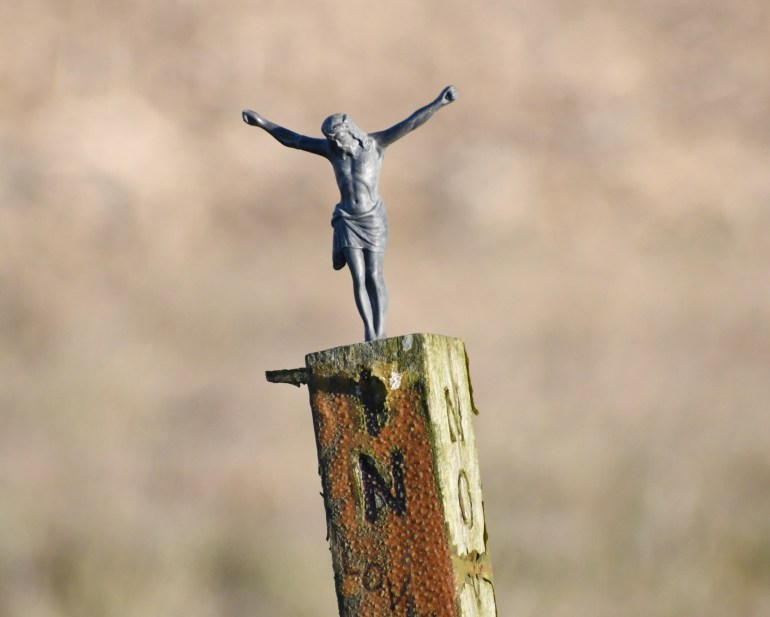
(Image by Christopher J Ananias)

word is by Geraint Jonathan

don’t you dare say marl

nothing deserves it

likewise heft or skirl

avoid them as you would

verdant

& if it’s evening keep it that way

don’t go with gloam

anymore than you would darkfall

darkfall being

like gloam

down there with

verdant

the sky can never again be azure

anymore than the stars above can twinkle

though sooner by far the stars above twinkle

than a sky ever again be azure

& if deny yourself mulch you must

then do so

mulch having about it the very vetch & sedge

& graunch to convey the earthy

itself a proposition of dubious provenance

wouldn’t you say

mulch?

it’s not down there with verdant

but it’s close

there’s a leatheriness survives i suppose

a compact sogginess

wet as mulch is

generally

Geraint Jonathan

(Wonderful images by CJA)

Symmetry by David Henson

His fractured kaleidoscope

of a childhood obsessed him

with symmetry. He’s transfixed

with how it glistens

in snowflakes, sparkles

in diamonds, graces

the wings of butterflies

he pins to savor

up close. He forces

snips for his girlfriend’s

lazy eye, insists his wife

arrange the furniture

just so, and requires symmetry

during sex. He balances

his desire with an equal

measure of deceit.

When he overhears

his wife’s phone whisperings,

she laughs

How do you like your fucking symmetry now?

For the first time he knows how it tastes.

(end)

The Girl Who Tilted the Earth by David Henson

A waitress finds her

wailing and convulsing

‘midst porcelain and tile.

A fighter, she held on

‘til methadone prevailed.

Her history scares

couples wanting to adopt.

She grows up wandering

in a forest of fosters.

When she’s thirteen,

a man sneaks into her room,

puts his hand over her mouth.

She takes to the streets,

her body her coin.

Robbed of innocence

too soon, the child

leaves her own behind

at a storefront.

Tempting fate once

too often,

she imagines floating

high above rooftops

and rickety fire escapes.

She crashes so hard,

the earth’s axis tilts,

imperceptible but real.

Like her life.

(end)

David Henson

(Image provided by DWB)

Mime by David Henson

The mime motions for a volunteer.

A young man emerges from the crowd.

The mime tips an imaginary hat.

The young man likewise.

Chuckles mingle among the onlookers.

The mime holds his pretend hat

to his head, leans

against an imaginary wind.

The young man does his best.

The mime nods.

The mime presses his hands

against the walls

of an invisible box,

crouches and pushes

his chin to his chest.

The box is shrinking.

When it appears the mime

is about to be squashed,

he strains his hands above him

and, arms trembling,

struggles to his feet.

The young man tries

to imitate the maneuver,

but the invisible box

continues contracting.

The young man’s mouth opens

in a silent scream until

he disappears.

Someone holds up a phone,

shouts Viral video!

The mime sweeps a bow,

motions for another volunteer.

Twenty hands shoot up.

(end)

David Henson

Ars Longa Vita Brevis

Juan de Valdés Leal was a Catholic,

a devout believer in the four

last things: Death, Judgement,

Heaven and Hell, as illustrated

by his paintings, the postrimerías.

Acutely aware of the brevity of life,

and that Man’s faith and works

would be weighed in the balance

to determine whether he entered

Heaven or was condemned to Hell,

he also adhered to the idea that

Ars longa compensated for Vita Brevis,

so, his canvas entitled In ictu oculi

shows a skeletal, hollow-eyed Death

standing on the right gazing at us.

The fingers of its right hand

are touching the adage In ictu oculi

to snuff out the flame of life.

A coffin is tucked under its left arm,

while its left hand clutches a scythe

that has raked over the baubles

of earthly glory: a tiara, a crown,

books of science, rich vestments,

the accoutrements of high office.

Death’s sinister foot presses on a globe:

mortality is the great leveller.

Life is over in the blink of an eye,

but the art of Valdés Leal lives on.

Tony Dawson

Penned in Blood: A Valentine by Dale Williams Barrigar

William Carlos Williams, famous

local doctor, spark plug

of his landscape, set of wheels

for his community, delivering

babies among sexy

poor people who couldn’t,

or wouldn’t,

always pay, and some of them

I loved a little too well, and one of them

I loved,

much too well.

Herman Melville, harpooneer

of Moby Dick, became an Inspector of Things

with no visible promotions

for nineteen years.

But I was working

by the seashore, near the sailor

who broke my heart, which usually

made me feel better, because,

by now, I was

the mystical mariner, and the sea

was in my eyes

wherever I was.

Miguel de Cervantes, who wrote

and was windmill-tilting

Don Quixote, Sancho Panza, Dapple, Rocinante, and

Dulcinea, gorgeous, beautiful Dulcinea,

the most perfect love,

romantic angel,

with such a long pen,

was a tax collector on horseback

for too many years.

People would throw things at

us.

And I wondered

how I had become

this.

I said to myself,

“How have I become

this

weary, sad-eyed, wine-soaked,

broken-hearted old soldier

with a bad hand from that long-forgotten

sea battle no one seems to remember

but me.

Next, I was a slave,

captured by pirates.

Later writing many

chapters of my only, endless

book while locked up

in their jail.

For something I probably didn’t do

and don’t remember

if I did do it.

Because someone stuck up

was down

on my energy.

As a noble Roman said somewhere, in jail

being where

more than one good book has been

penned.

For love.

In blood.”

Troubadours By Dale Williams Barrigar

Two teens talking

around the turn table

in 1983

A.D.:

“Maybe they were just unseen,

trouble-making vehicles

for bringing new, pure and cool,

lasting, low, good, flute-like hill tunes of old

to the people’s plains.”

“The trenchant word that well stings the eyes

of the soft heart from the eternal, hidden streams

at earth’s core.”

“Sometimes…”

“So soothing to a needy few…”

“Law man, doctor, debtor or fake, banker,

horse-back tax collector or user nurse, draftsman

or driver, musician, druggist, jailed, and jailor,

sailor, librarian, book thief, art thief, drunkard

delivery dude, public urinator…”

“Traveling teachers of all kinds blood humming

the Underground Railroad songs of another America

across a Missouri of the modern musical mind…”

“All the black and white rappers, sax, trumpet,

Charlie Parker, guitar player,

and she, she, she.”

“Was a Wichita piano player who landed in East St. Louis

on the dime

and somehow she died

on the morphine line.”

“My Christian Science

Fiction

Kiowa

Cowgirl who always pushed it

just a little too far!”

“On purpose!”

“Rise from the provinces, be normal enough

most of the time but always

further along.”

“And she seemed too young.”

“And that was the end of her one,

good song.”