The Martyrdom of St. Peter by Tony Dawson

Michelangelo Merisi da Caravaggio,

a troublemaker who gloried in sadistic

violence, especially in his paintings,

was the Prince of Darkness of Baroque,

the pioneer of the style dubbed tenebrism.

Together with his realistic portrayals

of the subjects who populate his canvases,

“the terrible naturalism that attracted

and ravished human sight”, as Scannelli put it,

they are the distinctive features of his work.

His painting, The Crucifixion of St. Peter,

commissioned by Monsignor Tiberio Cerasi,

is an archetype of Caravaggio’s tenebrism

and how he exults in depicting brutality.

The distribution of the four individuals

conjures the shape of St. Andrew’s cross.

A beam of light traverses the canvas

from the top left of the frame

to the bottom righthand corner

illuminating St. Peter’s torso, left arm,

and hand nailed to the crosspiece,

every muscle and sinew of the martyr

tensed. A blend of pain and terror cross

the face of the Saint. High to the left,

the only executioner to escape anonymity

embraces Peter’s shins and the upright

of the cross to help a second executioner

whose woollen jacket is rucked up

by the rope he’s using to haul the cross

upside down as it is placed in the hole,

dug by the third executioner’s shovel.

Petra, the rock in the foreground,

evokes Peter’s name, the rock

upon which the Christian Church

is unified, emphasised further

by the shadowy rocky landscape

in the background darkness.

Tony Dawson

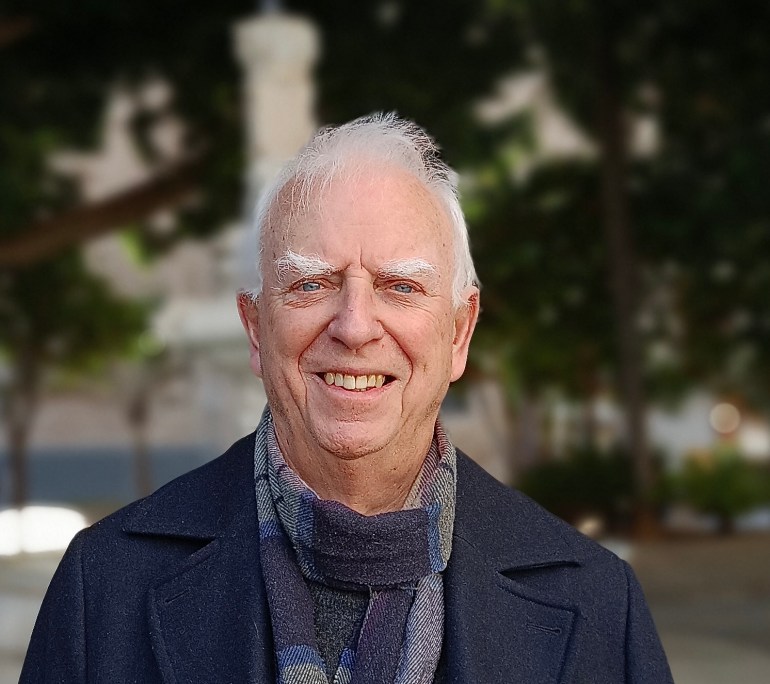
(Image is of the author; would be strange if another fellow, now wouldn’t it?)

Octave for Janet by Tony Dawson

Spring and summer blossoms populated

our family tree that stood so straight and tall.

Then the blossoms gradually faded into fall

bringing the fruit that we so eagerly awaited.

When our winter hesitated and finally never

came, apparently because of climate change,

our blossoms bloomed and flourished once again.

An Indian summer in which to bask forever.

Tony Dawson

(Image is of the esteemed poet)

Third of May 1808, by Francisco de Goya by Tony Dawson

is a virtuoso display of dynamic brushwork.

In his visceral need to capture the moment,

his depiction has anticipated impressionism.

The speed at which he applied the paint

has infused the canvas with ominous terror.

The left side of the canvas is bathed in light

from a box lantern at the feet of the faceless,

hooded, firing squad of Murat, on the right:

evil is being perpetrated under cover of darkness

by the French incarnations of Death.

The Spanish victims, each a non-combatant,

standing beside three slaughtered patriots

whose bodies lie bloodied in the dirt,

show a mixture of fear, resignation and defiance.

One of them, a monk, his hands clenched in prayer,

seems to be hoping to receive clemency.

The man in the white shirt throws his arms

out wide, challenging the soldiers to shoot him

as more civilians are herded up the slope

to meet their deaths like cattle in an abattoir:

the horrors of war laid bare by an artist in despair.

Tony Dawson, 12 February 2026

Finis Gloriae Mundi by Tony Dawson

Juan de Valdés Leal has shrouded

his canvas in deepest darkness.

Two open coffins lie side by side:

a bishop and a knight of Calatrava,

each a worldly exemplar of vanitas,

two souls awaiting the Last Judgement.

The prelate is in an advanced stage

of putrefaction, the flesh of his skull

consumed by worms and beetles,

his crozier clutched by scrawny fingers.

An angel’s hand suspends the scales

of the Last Judgement above them both.

One plate, sustaining a dog and horned goat,

each animal representing mortal sins,

is ominously labelled NIMAS (NOMORE).

The other plate, NIMENOS (NOLESS),

with the Sacred Heart of Jesus, IHS

and the Bible, contains the virtues

that must outweigh the sins of men

if they are to receive eternal rest.

Many other corpses are hinted at,

sprawled in the background gloom.

A messenger to the underworld,

an owl, surveys this scene of doom.

Tony Dawson