Saragun Verse: In Memory of the Crow’s Nest Tavern

It was not supposed to end like this

A parking garage over the abyss

Wall-eyed Bob used to cogitate

From his stool in 19-something-and-8

he’s dead

like Viv and Tom

and that

other Bob

and that

Robin so ugly

save for blue eyes

and that

weird little guy

Who sang like Merle Haggard

On Karaoke Night

Glaciers creep down mountain faces

No one alive will see the changes

An inch a year means not ten feet to lives

Whose times were measured by Saturday nights

Saragun Verse: Pope of Alpha Centuari

i

How far are you willing to fly

To find a vicar to shine your mind

What insult will you bear

In grace for a ten percent share

ii

Who’s gonna to serve your mass

Now

That you’ve departed the blue ball of

Vow

Indulge your sins and pledge your soul

To me

The Pope of Alpha Centauri

iii

The universe is an endless second chance

But everywhere it is still a dimebag a dance

Open up and for a tiny fee

You can be an angel wild and free

Courtesy of me

The Pope of Alpha Centauri

iv

Pain is the same inside every skin

And the losses still out number wins

Take four years at the speed of light

Everyone in hell loves the night

Endless and without memory

The Pope of Alpha Centauri

The Drifter: The Writer’s Most Important Job in 2025 (and Beyond)

(Wonderful images provided by The Drifter)

In the present age, the writer has one single solitary job to do which is far, far more important and crucial than all other aspects of the writer’s work.

It is a job so important that if the writer fails in this, she or he immediately loses all credibility and all right to call one’s self a writer.

It is a job so important, too, that it’s more important than any other job anyone else in society is called upon to do – by far.

It is a job so crucial, and so difficult, and so nearly impossible almost all the time, that it shows us why so few people in this world have really earned the right to call themselves writer in the highest sense of the word.

Without this job, which the writer must do alone, totally alone, society itself is utterly doomed. Utterly doomed as in destined to fail, to completely collapse, if this job of the writer, this one key job of the writer, were to completely disappear from society.

This job of the writer is so important that it’s even more important than the writer actually writing anything, especially today in a world drowning in meaningless words.

And it’s far more important than the writer gaining any kind of mainstream “success.” (Fame in a land of zombies is about as solid and valuable as air, as thin, thin air.)

This job will sound simple. It will sound so simple that you may even be amazed – at first.

THE WRITER MUST STAY SANE.

THEY MUST STAY SANE, BE SANE, REMAIN SANE, ALWAYS BE SANE, AND NEVER NOT BE SANE. THE WRITER MUST BE, WITHOUT PEER, THE SANEST PERSON IN HIS OR HER SOCIETY.

An AI computer, no matter how intelligent it becomes, cannot do this job for humans. Only humans ARE humans, and only humans can think for humans about what it means to be human.

The writer is a thinker who sees more nuance than anyone else. Without nuanced thought, which is profound thinking, which is against “black and white,” “us and them” thinking, the writer’s work becomes mere regurgitated entertainment, a thing the world is literally swamped with, a thing that may cause a flood so bad it will make the Noah’s Ark story look like child’s play.

The real (human) writer must stay sane and be able to see reality for what it truly, really is.

All other jobs of the real writer are utterly subservient to this.

The irony is that, in this society, USA America 2025, the writer looks like the nuttiest person on the block to most folks in mainstream society.

Staying apart from the herd, refusing to believe what almost everyone else believes (because they are lies sold to us by snake oil sales folks), drifting around with your eyes wide open, living “underground” (literally or metaphorically), and keeping your inner eye so clear that IT IS NEVER DELUDED, NOT EVEN FOR A SINGLE SECOND, are all jobs that are so hard to do it can actually cause one to lose one’s footing again and again and again. And to fail, and to fall, again and again and again.

But the real writer never stays down; or not for long.

They may stay down long enough so they can rise again once rested.

And that too is sanity, though it surely looks like madness to the rest of the world, as the writer lays there in plain sight with eyes closed, refusing to move, almost as if paralyzed.

But the writer is never paralyzed. Not if they really are a writer.

The inner vision, the eye that sees beyond the party line, the other eye that can see around corners, the eyes that can see through walls, the eyes that can see someone who is thousands of miles away, the eyes that can see the future and the past as clearly as they can see the present, are always the sanest eyes in town.

Many millions of American men stand around outside with their leaf blowers now in November determined to obliterate every beautiful fallen leaf from their well-manicured lawns. And they will stay there all day, with their blinders on and their leaf blowers blowing, creating horrendous noise pollution and other pollution, and do it. Meanwhile the world burns with global warming, rising seas, species extinctions happening before our eyes, climate change – faster, much, much faster climate change than has ever happened on the Planet before except from extreme events like an asteroid hitting the ground and blowing up the dinosaurs.

Many millions of American women sit around online, watching each other take fancy vacations and shop endlessly at the most fun online locations, whether that be shopping for goods or services or romantic partners. Meanwhile, seven hundred thousand Americans live on the streets and don’t know where their next meal is coming from (and in many cases they are much happier than the people within the houses, which also says something profound).

Many millions of American children live their lives chained to tiny, dominating machines that shape, mold, shrink, and rot their brains, and turn their eyes into useless orbs of nothingness reflecting unreal, lifeless screen dreams manufactured by technological monsters. And getting a pat on the head from mom and dad before being sent back to their rooms for more screen time.

And those three examples are just a tiny few of the surface symptoms.

There is something much, much deeper and more profound going on. It’s so evil it doesn’t even have a name.

And people in the United States have lost touch with themselves.

And they have lost touch with reality.

And they have lost touch with each other, too.

Our cold and distant and sometimes even frozen hearts have gotten the leaders and the systems and the lifestyles that we deserve.

Only the writer, or people like the writer (and there are many of them, although they are a vast minority), can see through it all, beyond it all, within it all, around it all, and over it all – above it all.

The writer must stay the course, remain sane in an insane world, and tell the human truth.

Great fiction itself is nothing less than a lie that tells the truth.

Great poetry is the truth boiled down to its essence in beautiful language.

Great essays are poetry in the form of prose.

Staying sane in an insane world is the hardest thing in the world to do.

It’s a thankless task but somebody has to do it.

The reward for the writer is inner wholeness, and ultimately, inner peace, an inner peace that can perhaps only be matched by someone like a genuine Buddhist monk, a Tibetan Buddhist monk – who is a kind of writer.

“Only that day dawns to which we are awake,” wrote the writer Henry David Thoreau.

Guest Writer Times Two: Heroes by Michael Bloor

(Note: We conclude this latest guest week with Mick with two of his micro fictions, which both get a fresh look on the net today. We thank Mick and are always glad to have his work be a part of the site–Leila)

Heroes by Michael Bloor

Patrick, my friend and neighbour, and myself were arguing back and forth about our literary heroes:

is their influence always for the good? I spoke in their defence, citing Robert Burns fostering the belief of every Scot that ‘A Man’s a Man, for A’ That.’

Patrick denied that literary talent necessarily overlaps with moral courage, political acuity, or even a healthy quotum of commonsense. He instanced Conan Doyle, who believed in faeries and dodgy spiritualism, but clinched his case with Kafka’s diaries. The entry for August 2 nd 1914 reads:

‘Germany has declared war on Russia. In the afternoon, swimming lessons.’

And…

Mother and the Minister by Michael Bloor

Sixty years ago, it was still commonplace for ministers in rural Scotland to call on all their parishioners, welcome or not. Mother would seat him at the kitchen table and put the kettle on, while I listened at the door as they discussed father’s behaviour. After one particularly disreputable episode, the visitor concluded:

‘Weel mistress, you’re nay marrit. So my advice wud be just to put him richt oot the door.’

My mother pondered this a moment, ‘Aye, minister, I’ll do as ye say. Can I ask a favour though? Would ye collect his pay packet for me every Saturday?’

Michael Bloor lives in Dunblane, Scotland, where he has discovered the exhilaration of short fiction, with more than a hundred pieces published in Literally Stories, Everyday Fiction, The Copperfield Review, Litro Online, Firewords, The Drabble, The Cabinet of Heed, Moonpark Review and elsewhere (see https://michaelbloor.com).

Guest Writer: Making Chutney by Michael Bloor

(A one-hundred word gem by Mick–Leila)

I’ve been making green tomato chutney. Outside in the street, I see a woman and a small boy. He’s walking unevenly, avoiding cracks in the pavement. His mum gives his hand a mighty tug: mother and son, out-of-step.

Then, I can’t remember what weight of sultanas to add. When I find the yellowed recipe, I see it’s in my mum’s handwriting. She’d spelt ‘tomato’ with an ‘e’ at the end, which upset me a little.

I used to say my mum was a difficult woman, but perhaps she wasn’t all that difficult. Maybe it was just that we were out-of-step?

Michael Bloor lives in Dunblane, Scotland, where he has discovered the exhilaration of short fiction, with more than a hundred pieces published in Literally Stories, Everyday Fiction, The Copperfield Review, Litro Online, Firewords, The Drabble, The Cabinet of Heed, Moonpark Review and elsewhere (see https://michaelbloor.com).

Guest Writer: A Misapprehension by Michael Bloor

(This little one was published on 7 September 2018 by The Drabble–Gotta love them Ponies–Leila)

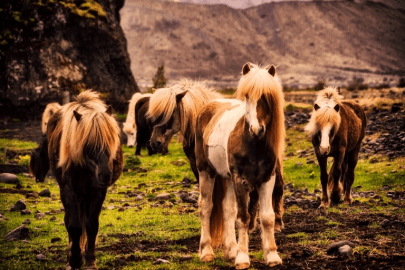
Beyond the barren rubble of an antique lava-flow, a herd of Icelandic ponies graze on rough pasturage among rashes and dwarf birch. A stallion sniffs the breeze; mares and foals snuffle among the grass and herbs. The stirring and shifting of their manes and tails seem all of a piece with the jagged mountain silhouettes on the horizon and the jumbled lava – a wild, young, restless country. I turn to Guðmundur: ‘Those horses … they’re almost an emblem of freedom.’

Guðmundur paused, smiled and shook his head: ‘My grandfather made his living selling them to work down the Scottish mines.’

Michael Bloor lives in Dunblane, Scotland, where he has discovered the exhilaration of short fiction, with more than a hundred pieces published in Literally Stories, Everyday Fiction, The Copperfield Review, Litro Online, Firewords, The Drabble, The Cabinet of Heed, Moonpark Review and elsewhere (see https://michaelbloor.com).

Guest Writer: The Great Book of Angharad by Michael Bloor

(Note: I forgot to mention yesterday that this week features pieces Mick had published on sites that have since fallen into the ominous black hole that publishers do our best to avoid. Still, no longer is is not the same as never was; therfore this highly entertaining work was published by Occulum in 2017–Leila)

     They keep asking me why I did it. Then, as soon as I start to explain, D C Grainger butts in with: ‘Was this on the morning of June 11th?’ I deal with that and then D C Singh chimes in with: ‘Did you tell anyone that was where you were going?’ I struggle past that, and then as soon as I get to the bit about the Holy Spring, I see ‘em exchanging those ‘Has he escaped from the funny farm?’ looks. A dispiriting business for a university professor accustomed to a respectful audience. So I’m setting it all down on paper. And then I’m not telling the police another bloody word.

     I live in Scotland now, but most years I manage a visit to my mother’s country, the Welsh Borders. When I was a child, I used to spend every summer holiday in the Abergavenny house of my grandparents, Harry and Gladys Cecil. The little town is surrounded by seven hills, but for a child the hill that holds the greatest glamour is the Sugar Loaf (its Welsh name is Pen y Val), which looms over the north of the town. Every summer, I would pester Grandad Cecil to re-tell the story of how Buffalo Bill brought his Wild West Show to Abergavenny in the summer of 1903. Grandad had been one of the children in the audience when Buffalo Bill vowed to his audience that he would walk up the Sugar Loaf. And that’s just what he did the next morning, accompanied by half the adults and all the children of Abergavenny.

     Bear with me. I’m trying to explain that the mountain exerts a strange pull – even a hard-bitten old-timer like Buffalo Bill could feel it. It remains a big draw today and the most popular routes have carparks at the foot of them. For sentimental reasons I take a less travelled route, setting out from Deriside (where my grandparents lived), crossing the ford by Harris’s farm, round the foot of Rholben, and up St Mary’s Vale. Just like the Sugar Loaf/Pen y Val, St Mary’s Vale has both an English and a Welsh name. Granny Cecil said that the Normans conquered the broad lowlands, but the Welsh always held the hills, and the head of the Vale is known by its Welsh name Cwm Trosnant, which means the valley of the three springs. St Mary’s Vale starts out as a gentle valley covered in beech woods. In June, the leaves are a dizzying, iridescent green, squirrels dart up the towering grey tree boles and scold you – ridiculously – from the upper branches, the stream splashes over sandstone pebbles. Again, I’m telling you this because you need to understand the pull of the place.

     As you make your way up the Vale, it narrows and the great beeches give way to stunted oaks and thorn trees – you’ve crossed an invisible border into Cwm Trosnant. Near the head of the cwm, the path strikes off steeply to the right and the hidden summit of the mountain. Just a few metres onwards and upwards, the path passes by one of the three springs from which the cwm gets its name. It issues, cold as your fridge, from the roots of a thorn tree. As a child, sixty years ago, I often stopped to watch the mysterious welling of the waters out of the earth and into the light. I would dangle my hand in it, but I never drank from it, mindful of my mother’s frequent warnings of the dangers of polio – the great child killer of the 1950s. The springs of the Welsh hills were holy places, a source of wonder, even before the coming of Christianity. Hermit saints understood the mesmeric attraction of the springs and built their churches beside them. Even today, there’s an isolated, ancient church beside a spring a few miles from Abergavenny, where pilgrims still leave spring-side offerings. Sixty eight years old and no longer bound by my mother’s injunctions, on that June day I bent down and cupped my hands to drink.

     Bending down to the clear, bubbling water, tasting it on my parched tongue, I had a sensation of the world behind me being progressively suffused with brilliant light. As I lifted my head, I was entranced to see the cwm transformed. It was still a narrow upland valley, but instead of the bracken, thorns and stunted oaks, there was a miraculous pleasance. I say ‘pleasance’ rather than garden, because I knew instinctively that this was no modern landscape. There were roses, lupins and hollyhocks; the thorn above the spring had been replaced by an apple tree suffused with blossoms. It was as if I was in Tennyson’s ‘island valley of Avilion… fair with orchard lawns and bowery hollows’ where King Arthur was carried by barge after the Last Battle. Enchanted, I turned to see a woman in the middle distance, walking towards me. Her beech-green dress, which swayed about her body as she walked, was long and trailed among the daisies at her feet. Her red-gold hair was coifed above her brow but fell about her shoulders. Her face was solemn and ageless.

     She spoke to me in what I took to be Old Welsh (as a child, I learned Welsh from my mother), but I could make little of it. She switched to English, spoken clearly but with the punctilious correctness of a foreigner:

     ‘Well met, Michael, son of Mary, daughter of Henry. Long have I waited for you here beside the great spring of Taliesin Ben Beirdd. We are kin, you and I, because I am Angharad, wife of Sitsyllt ap Dyfnawl.’

     I knew the name. The slaying of Sitsyllt is a well-known piece of Abergavenny local history. In 1177, William de Braose the new Norman Lord of Abergavenny, invited around seventy leading local Welshmen to a Christmas feast in his Great Hall. Among them was Sitsyllt of nearby Castell Arnallt, a formidable warrior. As was the custom of the time, the Welsh nobles, surrendered their weapons before entering the dining hall. Once the Welsh were all assembled, they were set upon by de Braose’s men-at-arms and slaughtered to a man. The men-at-arms were then dispatched to Sitsyllt’s Castell Arnallt, which they destroyed and took Sitsyllt’s wife, Angharad, back to Abergavenny as a prisoner. Sitsyllt’s kin eventually anglicised their name to Cecil, my mother’s maiden name.

     ‘Those of Sitsyllt’s kin who drink at Taliesin’s spring receive the gift of true sight, but they are also honour-bound to strive to remedy the dishonour done to Sitsyllt’s house and name. Do you accept the obligation I shall lay upon you?’

     I nodded. I could scarce do otherwise.

     ‘Very well. I know you are a scholar; I give you a scholar’s task. Among the booty from the sacking of Castell Arnallt, the Normans took away my Great Book. The court of my brother, the Lord Rhys of Deheubarth, was the greatest centre of learning in all Britain: bards and sages, harpists and holy men were all welcomed there and competed in the recitation of the laws, the lineages, the ancient wisdom and the holy truths. By the bidding of my brother, I wrote down all that was good and true, and I bore that book as a love-gift to my husband, Sitsyllt. The Great Book has passed through many foolish hands since the Norman theft. Finally, a drunken sot of a clergyman willed it to his old college, Dodson College, Oxford.’

     She saw my look of surprise. ‘Yes, it lies in the library of your old college, unexamined and uncatalogued, stored as the bequest of the late Reverend Pugh. You must right the wrong and return the book to me, here on Midsummer’s Eve. Take this ring: when you come back with the book, throw the ring into Taliesin’s spring and I will return to you, with my thanks and the thanks of all our kin.’

     The ring was of a curious, twisted, gold-filigree design. It was too small to fit on my finger. I slipped it into my pocket and went back to the pub where I was staying. I checked the Dodson College website on the internet. I was dismayed to find that the college librarian was an elderly, retired party who had been a don in the college when I was an undergraduate there fifty years ago. A colourless individual who had adopted a pipe in lieu of a personality, but nevertheless possessed a certain capacity for mischief and fussy cantankerousness: his nickname was Gollum (I know, I know: first a gold ring and now Gollum turns up – where have you read this before?). I realised then and there that there would be no sense in appealing to the college authorities to restore The Great Book to the Cecils: I would simply be alerting the college to the fact that they had overlooked a valuable asset which they could flog off. Instead, I’d have to steal it, albeit knowing that I had justice and history on my side. I checked out of the Black Bull pub that evening and before ten o’clock I’d checked into a bed-and-breakfast in a village outside Oxford.

     I went for a reconnaissance the following morning. I was amazed to discover how little the college had changed. The library was still housed in the same cramped quarters and contained the same out-of-date texts, translations and bound periodicals. There was no space to store uncatalogued volumes. I guessed that they would have been dumped in the cellars. There were two different sets of cellars: the wine cellars beneath the dining hall appeared to have a formidable door and lock; the other cellars, in the same bloc as the library, had a neglected appearance and a simple clasp lock on a fragile-looking door – child’s play, I thought.

     I bought a jemmy and a powerful torch and waited for dark. I confess that I was rather enjoying myself. The college gates were no longer locked in the late evening, but the porters’ lodge still housed a night porter, so I decided to climb in using the same route that I’d used fifty years ago, via the bike sheds. This proved more difficult than I’d anticipated: the spirit was willing, but the flesh had withered. I sustained a nasty graze, a sprained ankle and a ripped jacket, but I got over. In contrast, the hasp on the cellar door was a breeze and came away like cobwebs.

     There was lighting in the cellar, but it wasn’t working: I hunted for a mains switch in vain. In the torchlight, the crowded cellar contents looked as a chaotic as an earthquake in Legoland: there were piles and piles of discarded furniture, tea chests filled with the abandoned possessions of past generations, some old lead piping, tied bundles of papers, ancient chemical apparatus, a battered croquet mallet… It seemed that, unless I was very lucky, the search would take more than one night. My dust allergy kicked in right away, but I stuck to the task. After an hour or so, I did come across an open tea chest full of books, but they proved to be the abandoned private library of past undergraduate, seemingly someone of my generation – I recognised ‘Zen and the Art of Motorcycle Maintenance’ and RD Laing’s ‘Divided Self’. Underneath it, was a closed tea chest, which I assumed contained more of the same, but when I jemmied it open I saw it contained hardback books from an older period. I flicked open the topmost book – a collection of sermons – and on the flyleaf I read ‘Ex Libris Reverend Augustus Pugh.’ Oh Joy.

     The Great Book of Angharad was right at the bottom of the chest. It was a massive thing that looked to have been re-bound at some point, with metal-edged leather covers and a clasp. I heaved it out the chest and opened it up at random – a foolish thing to do, because the eight-hundred-year-old pages were very brittle. Part of a page broke off as it was opened. I shut the book and closed the clasp, but not before I’d satisfied myself that the writing seemed to be in Old Welsh.

     ‘Well, well, if it isn’t Guy Fawkes!’ Two torches snapped on. In surprise, I dropped The Great Book back in the tea chest. I then dodged behind some derelict desks, deeper in the cellars, but the two police patrolmen quickly picked me out again. It seemed I’d been betrayed by my dust allergy: the night porter on his rounds had heard the sneezes, found the broken lock on the cellar door, and called the cops.

     The charges I was facing were ‘breaking and entering’ and ‘criminal damage’ – the college authorities claimed I’d destroyed the roof of the bike sheds. At first, I refused to say anything, beyond giving my name and address. But the duty solicitor at the station persuaded me to explain what I’d been doing in the cellar, saying it would look better in the magistrates’ court. So I told him. A few hours later, I told the same story to the two detective constables in the interview room. They plainly thought I’d lost a marble or two when I fell off the bike sheds, but they sent a constable round to the cellars to see whether there was indeed a big book in the bottom of the tea chest. He found Gollum, the librarian, there ‘checking whether there was anything missing or damaged.’ The tea chest was empty.

     Well, maybe I have lost a marble or two, DC Grainger and DC Singh. But how would you explain Angharad’s celtic ring, safely hidden in my washbag at the B&B? And it’s plain to me who has snaffled The Great Book. I sense a second family connection here: Gollum’s surname is ‘Pugh.’ I suggest you get a search warrant.

Michael Bloor lives in Dunblane, Scotland, where he has discovered the exhilaration of short fiction, with more than a hundred pieces published in Literally Stories, Everyday Fiction, The Copperfield Review, Litro Online, Firewords, The Drabble, The Cabinet of Heed, Moonpark Review and elsewhere (see https://michaelbloor.com).

A Conversation at Pisgah by Michael Bloor

(This week Michael Bloor returns to the Springs. We are always pleased to run stuff by Mick. This one shows his wonderful ear for language-LA)

As I crested the ridge, I saw the figure in the middle distance, staring out eastward. I thought at first he was watching the hang gliders: Hatterall Hill, on the eastern edge of the Black Mountains of South Wales, is a favourite weekend haunt for these enthusiasts, if the winds are favourable. And the hang gliders cater for two kinds of spectators – those who admire the graceful and those who love the comic. I’m afraid I used to belong in the latter category, happy to eat my lunch watching these masochistic individuals launch themselves and their wings off the ridge and into the wind, only for the iron law of gravity to assert itself, so that man and machine would tumble into the bracken and scrub on the lower slopes of the hill. I never witnessed any of these poor souls coming to serious harm. Instead, they would laboriously disentangle themselves from their machines and the scrub, drag themselves back up the slope, lurch momentarily into space again, and then plunge earthwards once more, for my further entertainment. I would find myself wishing that my old Dad could have seen the show: slapstick was his favourite form of comedy.

However, familiarity has lately dulled my own appreciation of the hang glider spectacle and so I pressed on, past the Iron Age ditch and rampart, towards the summit of the ridge and its solitary occupant. The nearer I approached him, the more attractive he became: a sturdy guy of medium height, with a longish grey beard and tousled grey hair, a great cloak, negligently worn – he reminded me of photos of that eminent Victorian poet, designer, and revolutionary, William Morris.

Quickly, I confirmed my impression that he wasn’t studying the varying fortunes of the hang gliders. He was looking way out to the eastward, taking in a view of a verdant landscape that familiarity can never dull: the mile-after-mile-after-mile of patchwork, rolling, Monmouthshire and Herefordshire countryside – fields and woods and wandering streams, all miniaturised for a Giant’s delight.

He turned at my approach. I nodded. ‘A fine day and a fine view.’

He nodded in turn. I asked if it was his first visit to Hatterall Hill. The ridge attracts quite a few holiday walkers, being on a well-known, long-distance footpath, The Offa’s Dyke Path.

‘No sir, I am not a visitor to the hill. I dwell in its shadow, though I call it “Pisgah”, not Hatterall.’

The slightly formal speech and his clear enunciation made me think that English was not his first language: he was a native Welsh-speaker, a minority in this part of South East Wales. I recognised his Biblical reference too, having been raised as a Chapel-going Methodist, and I responded: ‘I understand. We are standing at Pisgah, and like Moses, I take it that you’re privileged to gaze upon The Promised Land, but you’ll never have it for your own?’

‘Correct, my friend. But perhaps you think my claim would be extravagant. Allow me to introduce myself, I am Owain Glyndwr, the last native Prince of Wales. The English know me as Owen Glendower. At one time, with my battle-hardened archers and men-at-arms beside me, I thought I could win back all those fair lands – fields, orchards, and pastures – snatched from us by the hordes of Saxons, Danes and Normans that bore down on my ancestors like plagues.’

I imagine that you will find it pretty odd that I didn’t, for one minute, think I’d met a mad man. On the contrary, I was attracted: he had far more than a famous name, he had bearing of a great man.

I knew a fair amount of the six-hundred-yearold Glyndwr backstory: after some very considerable early success, in battles and sieges, Owain’s revolt against English overlordship had eventually petered out. Despite a large reward being offered, he was never betrayed and Owain’s death was never announced. He simply disappeared and he has no known grave. Some authorities, I understand, have suggested that Owain, in defeat, went to stay quietly in his daughter’s and son-in-law’s house, a successor of which is still visible from this very hill.

I also knew that Owain was widely believed by his enemies to be a Mage, with esoteric knowledge and strange powers. I’m afraid that all I can truthfully repeat is that I didn’t take him to be mad. From the very first, I found him utterly believable, albeit six hundred odd years old.

He did not ask me to pledge my silence. And I feel a duty now to set down what I can remember of our conversation…

Glyndwr: ‘There was a time when all the land you see below us seemed about to fall to my arms. We had driven King Henry’s invasion force from the field at Stalling Down, nearly all Wales was under my control. I was crowned Prince of Wales as a direct descendent of Llewelyn the Great. I convened a Parliament at Machynlleth: we re-established traditional Welsh Law, and declared an independent Welsh Church. We drew up the Tripartite Indenture with Henry Percy (‘Harry Hotspur’), Earl of Northumberland, and Edmund Mortimer, claimant to the English throne. Percy and Mortimer would divide England between them. And all these Welsh Marches at our feet, all the lands west of the River Severn and the River Mersey would revert to the Principality.

‘If only Hotspur had brought his forces to join with mine outside Shrewsbury, instead of attempting (and failing) to defeat King Henry independently, then it might have all ended very differently.

‘So the chance, and the land, was lost. I was already long in years when the thieving and treachery of the occupying Norman overlords drove me at last, against my will, into revolt. So I was weary indeed, like Moses, when I came at last here to Pisgah.

‘But I am being discourteous, sir. I have seen you on Pisgah, more than once. Is your house nearby?’

I nodded: ‘I live down the valley in Abergavenny, Prince.’

Glyndwr: ‘Ah, Abergavenny. You will know that I seized Abergavenny castle and burnt the town to the ground. I burnt all the towns of the merchants that had grown up in the shadow of the castles of the Norman overlords. My own people counted their wealth in cattle, not in coin.’

‘I understand. You wished to return Wales to the world celebrated in the old songs of the bards. And you almost succeeded, Prince. Your skills as a commander were legendary. Your enemies called you a wizard, able to control the elements on the battlefield…’

He laughed deeply: ‘That was foolish talk of men who knew nothing of the weather lore in the Welsh mountains. But it is true that I had a fine library of many strange subjects before my enemies burnt it down. And the bards, like my old friend Iolo Goch, were welcome at my home with their tales of the old wisdom. In the old stories, did not the wizard, Gwydyon, fashion a living bride out of flowers for his nephew, Lleu? Summoning storms would have been a small matter to Gwydyon. The same old wisdom told that the greatest of the old heroes, Arthur among them, did not die. They are only sleeping. But, alas, much of that old wisdom was lost long before the Normans came to Wales.’

He was silent then, I hoped to draw him out a little further: ‘Much of it was lost, you say. But perhaps not all of it, Prince?’

Glyndwr: ‘Perhaps…’

He smiled, nodded, and turned to descend from the ridge. A sudden breeze ruffled his hair and beard. I knew better than to try to follow him.

Michael Bloor lives in Dunblane, Scotland, where he has discovered the exhilaration of short fiction, with more than a hundred pieces published in Literally Stories, Everyday Fiction, The Copperfield Review, Litro Online, Firewords, The Drabble, The Cabinet of Heed, Moonpark Review and elsewhere (see https://michaelbloor.com).

The Drifter

Beatific Dreams

For Leonard Cohen

“I sang in my chains like the sea.” – Dylan Thomas

(Images provided by The Drifter)

Hello!

“The Drifter” writes this with a wickedly bad, early November Chicago head and lung cold which he contracted from his kids’ friends and the sneezing baby in their care while he was driving them to Urgent Care.

I didn’t enforce a mask policy and now I’m paying the price.

Symptoms include the usual coughing, sniffling, loss of appetite, stomach issues, and body aches.

But the worst part of a cold for me is always, always the horrible MALAISE and FATIGUE (and brain fog) that always comes with it.

Thinking slows down. Therefore writing, too, slows down. If I don’t write on a regular basis, I start to lose touch with it all. On the other hand, after a few days of not writing, the writing energy usually returns with a (very satisfying) vengeance.

The reason why the malaise and fatigue are always so horrible for me is because I have an advanced case of Bipolar One Disorder.

“Disorder” is a wonderful word for this sometimes magical, sometimes terrifying brain disease, because it causes so much constant disorder in the life of the sufferer.

But “bipolar,” while I like the term well enough, is not as vivid and telling as the older term: MANIC DEPRESSION.

Manic Depression can mean many things in many ways. One thing it means that most people are not aware of is that, for many of us who have this, the depression itself is often manic (sometimes called a mixed state).

Manic depression, where the word manic is an adjective describing the depression, is the “worst” kind. This is the kind that leads to the most suicides.

Another thing about us bipolar people is that we CANNOT STAND TALKING ON THE PHONE.

This is a very, very, very, very common symptom of bipolar disorder, so common that almost everyone who has bipolar also has an intense phobia of the phone.

Those who don’t have bipolar disorder are almost always hard-pressed to understand WHY bipolar people are terrified of talking on the phone.

There are many and many more reasons.

One reason is because the mind of a bipolar person has much trouble confining itself to the requirements of a conventional phone call, for example when dealing with a medical or insurance issue. Listening to the other person, or robot; following instructions; answering immediately; speaking clearly; being immersed in and surrounded by a generic world; all can cause intense Kafkaesque anxiety, general uneasiness, mental and emotional disruption, and even panic and terror in the average bipolar person.

And sixty percent of bipolar people are alcoholics, alcohol abusers, heavy drinkers, or former alcoholics, alcohol abusers, or heavy drinkers.

A single wrong phone call can cause a bipolar person to suddenly feel SUICIDAL.

It can cause a bipolar person to suddenly fall off the wagon, too.

Or if they don’t fall off the wagon, it can cause them to FLEE. To disappear. To vamoose. To vanish. Again. Without warning.

People who have to deal with this sort of behavior up close and personal tend to get very annoyed by it. Even when they themselves are suffering from some sort of bipolar disorder.

It appears utterly irrational (that is to say, at least half insane, or “just plain nuts”) to the “average,” non-bipolar, well-adjusted person.

A bipolar person has a lot of trouble following society’s rules, especially things like all the coordinated schedules, highly structured group activities, and rigidly organized social situations, all the boxes they make you check and recheck and check again.

Oftentimes, bipolar folks have so much trouble following society’s rigid rules that it is utterly impossible for them to do so at all.

This can really irritate and annoy misunderstanding bosses, employers, family members, friends, romantic partners, the public in general, and the unlucky ones who have to deal with the bipolar person on the phone.

People who have bipolar disorder often suffer from headaches, digestive issues and the shakes; they frequently feel battered by life to the point of total burnout and exhaustion; they are frequently astonished; frequently amazed; and frequently quite lost in flights of fancy that mask as being lost in space.

The author of this column will now, before he loses energy today, supply a round half dozen further symptoms of most bipolar people, in honor of Leonard Cohen, who himself suffered from bipolar disorder and always acted as an advocate for the mentally ill in various ways, from writing songs and poetry about it, to speaking openly about it, to performing free shows in mental wards throughout his career.

These six do not say it all. They only begin to say some of it.

One: frequent, intense, out-of-control arguments with other people, followed by various forms of emotional, mental, and hormonal collapse.

Two: wicked, truly wicked, Irritability coupled with uncontrollable Impulses, such as walking off the job or burning other bridges with unpredictable dramatic flair, later hauntingly regretted.

Three: feeling so thin-skinned that the smallest brush-off from someone else can give you a minor nervous breakdown or make you want to break out into tears, fits of rage, or both. Morbid sensitivity coupled with an extremely tender heart.

Four: intense difficulty being around other people while also needing to sometimes be around other people.

Five: the feeling of being watched by people (or spirits) even when they’re not there. Paranoia about being watched in general.

Six: regular, lifelong Insomnia coupled with inexplicably intense dreams (day dreams and night dreams), sometimes horrific; SOMETIMES BEATIFIC.

Drifter” Concluding Note: Happy Death Day to Dylan Thomas, one of the most inspiring Manic-depressive Alcoholic Writers of the twentieth century. I say “Happy Death Day” because I don’t believe he’s really dead.

Robert Browning said, “Never say of me that I am dead.” What he really meant by that remains to be explored by everyone, whether they know it or not.

(Do it now before it’s too late…)