2 + 2 = Goldfish by Guest Writer David Henson

(Today and tomorrow we are pleased to run works by David Henson, a fine person and writer, whose biography appears at the end of the story. We are always pleased to welcome guests and we hope the readers feel the same–LA)

2 + 2 = Goldfish

When it first happened, I thought I was getting dementia even though I was only … What comes after 34? Nothing does anymore, I guess.

Scientists and philosophers used to debate whether humans discovered or created mathematics. I never understood why anyone could believe the latter considering birds, dinosaurs and all life that preceded humans couldn’t have evolved without math.

Nowadays everyone agrees humans discovered math. But a number of years ago—I can’t say how many because nowadays things don’t work that way—some rogue scientists took things further. Mathematics, they reasoned, begat the laws of nature from which everything else sprang. Math was a creator. Math, they said, was alive.

“Pish posh and bullshit” said other scientists and theologians. After an initial splash, the rogue theory sunk into the mud and muck at the bottom of the pond of prevailing wisdom and was largely forgotten. Until strange things began happening to everyone.

In my case it had been an ordinary day. I was checking out at a grocery store. After paying in cash, I tried to calculate in my mind how much change I had coming. Couldn’t do it. I noticed the cashier staring at the register.

“It’s not telling me how much you’re due.” She read the receipt dangling from the register. “It says Mississippi for subtotal, tax of purple, and grand total of antlers.” She whacked the register.

I opened the calculator app on my phone. “How much did I give you?”

The cashier stared at the bills in her hand and held them up for me.

My mind blanked. I fought through the confusion and tapped 2 + 2 on my phone. The display showed a goldfish emoji. I tried several other calculations and got nonsense answers every time. I told the cashier to keep the change, bagged my goods and left.

Driving home, my car started sputtering and clanking. The gauge showed the tank was half-full, but thinking it could be broken, I stopped for a fill-up. As I pumped, the dials spun at random.

People everywhere were having similar experiences. Folks came to realize the rogue scientists were right. Mathematics was alive. But it had died.

People tried to resurrect math. Groups, more like cults if you ask me, worshipped the various branches of mathematics — geometry, trigonometry, calculus … even lowly arithmetic.

The arts got in on the act, too. Although the day the math died, music did, too, poets were inspired. “I think that I shall never see / a heaven lovely as the number seven.”

Despite all the prayers and praise, humanity couldn’t roll the stone from mathematics’ tomb. Cash registers and computers lost their coherence. The stock market either crashed or set an all-time high; we couldn’t tell the difference.

But even though the mortar was gone, the laws of nature didn’t come tumbling down. The changes were gradual and irregular. The speed of light diminished by a fraction then increased by a whit. On average, it remained the same. The planet’s orbit drifted outward. But the physics that determine nuclear fusion were jumbled so our sun generated more warmth, and our world didn’t become a snowball. Offsetting changes in the physics of gravity kept humanity’s feet planted firmly on the ground.

Over the years, people have adapted to our altered reality. We’ve become an agrarian society because machines, which depend on math, went kaput. Folks play ball for fun and exercise, but there are no winners or losers because there’s no score. Clocks don’t work. Most people use the position of the sun. I’ve found my stomach is pretty reliable. Turns out, I prefer time without numbers.

We trade based on barter. When I offer my neighbor a few eggs for ears of sweet corn, we don’t base the transaction on numbers. We agree on what looks fair.

All things considered, life without mathematics isn’t bad. The calamities that should have befallen us when math died didn’t occur. Does that mean the universe itself is alive and going out of its way to preserve us? That’s for smarter people than me to debate. I’m just happy my Leghorns are good layers.

(end)

David Henson lives in Peoria, IL with his wife and their dog, who loves to take them for walks in the woods.  He enjoys playing classical and boogie woogie piano.  His work has appeared in Ascent, Lullwater Review, Pikestaff, 7×20, and 365 Tomorrows, among others, including years worth of work on Literally Stories UK.

SaragunSprings New Thing

i

I ask why I silently passed me by

At the head of the stair in my mind

Was I afraid to assay my soul

Or just too stingy to say hello

ii

Soft drugs and slurring thugs I may combine

Into a false god whose shit’s divine

But it is a fixed game of bitch and snipe

Only the true know which end to wipe

iii

Cosmic buzzwords do not reveal

Blabber-bobble orange heads only conceal

Little flat bubbles of pointless victory stall

And fail to rise high above the stink of it all

iv

And yet it was I who passed me by

In silence at top of the stair in my mind

I’m ashamed of the false god that I preserve

Because I get what I deserve

(Note–trying out a new spelling: SaragunSprings, ‘tis a new thing–LA)

October Eve in SaragunSprings or Saragun Springs

Let us bid fair September a fond farewell till next year and examine the upcoming month of October. Aside from being the month in which most people finally clean their AC filters and begin wearing tees beneath the Hawaiian shirts that we are loath to eschew due to our hitting the mini candies (available since August) more often than the gym, it is also the time of year in which darkness reigns supreme. At no other time of the rolling annum does darkness cast a wider spectrum. ‘Tis found in, and between, the Kitty Kat costumes worn by chocolate crazed three-year-olds and the brutal doings of Robb Zombie’s Firefly “fambly” (although some of us note little difference between the two mentioned classes). It is always a matter of taste, and whether you get your sugar from an endless binge of Three Musketeers or off constant jugs of hobo muscatel, do remember, constancy is key in October.

The month in the Springs will be the same as it has except on Halloween we will be making a Big Announcement regarding the future of this site, an announcement that will become official on New Years Day, which we hope will not be the same day that Hell is closed due to over capacity.

The word “we” means two things in SaragunSprings. In the human, earth-business sense it refers to the two Co-Editors, Dr Dale Williams Barrigar PhD and, myself, Irene Leila Allison, who has used ph paper in the past but to no memorable result and certainly to no degree worth mentioning beyond this post.

The second meaning of we includes the great many Fictional Characters (FC’s) of in and about the realm, chiefly Renfield, Dame Daisy Kloverleaf and so forth. Funny thing about the FC’s is I do not know if they resulted from insanity (on my part) or if they have come to rescue me from madness. Sadly, since it is neither illegal nor advisable to go mad in the United States, the question is likely to go unanswered long after the data is tallied. We is a flexible concept and we hope to see it expand after Halloween.

(And there now comes to mind a third “we”–the monochrome Dog Pack: Boo, Colonel and Bandit along with their various whispering attendants.)

This month, as before, throughout the summer, will feature guest writers, beginning with two from David Henson who makes his site debut day after tomorrow and on Friday. Then we will be blessed by the continuing wise observations of The Drifter every Sunday. And there are the usual thisses and thats we use to fill the empty spaces. But in months to come, Dale (and/or The Drifter) will be doing these little monthly roundups as much or even more so than I (even though he is learning that right now).

Oh yes, the open invitation to readers to send poetry and such to saragunsprings.com is still open, but after October things will be much tougher for good reasons to be divulged on Halloween (this is what we writerly types call “fanning the flames” of obscure repetition in hopes of starting a rumor, then, maybe, we hope, a frenzy). So if you are seeking an audience of several dozen lookers for no more effort than it takes to give away money on the street, now would be a good time to accept the offer.

As you may have noticed I am toying with calling Saragun Springs SaragunSprings. For some reason that second one has attracted my eye.  No, that’s a lie. You see every time  I type Saragun my keypad changes it to Sargun. I keep resetting it but it always creeps back. Still, let’s just say both are correct and wait and see which one finally gets over.

Ever obscurely yours,

Leila

Saragun Verse: On the Plateau of Sphinxes and Finxes

i

It was the year of the Octopus bong

Stairway to Heaven was our favorite song

And when the past spoke of tomorrow it said

Never let the promising future go to your head

ii

We vowed to love till death’s last breath

But we were too young to hedge the bet

When forever came calling in ’93

No one wanted to write a new CD

iii

Statues of heroes missing their noses

Played out Sphinxes whom the future exposed

As blowhards who ruled for gold and by prick

Even those fey foals named Elizabeth

iv

It’s always the year of the powerchord

On which generations still light bowls

Forward not straight we go merrily along

Some wondering why Stairway is the greatest song

Agnostic Preview by Michael Bloor

(first published in Potato Soup Journal, July 5th, 2021)

(Ed Note–We hope you have enjoyed Michael’s return this week. We always do ourselves!–LA)

At first when I died, it was rather predictable. Beginning with that out-of-body-experience thing: I’m hovering, up near the ceiling, in the local Accident & Emergency Department, looking down on a rather battered and splattered me, plus an attendant nurse and junior doctor. Then it’s the dark-tunnel thingy, with a wee pin-prick of light that’s starting to get bigger and brighter, and bigger and brighter.

And then…. Pop! I’m in a largish, empty room with white walls. Now it starts to get different…

The white door opens and Leonard Cohen comes in. He consults his clipboard: ‘Hello, erm, Malcolm Barnstable? Welcome to the First Circle; I’m your guide. My name’s Cohen, Leonard Cohen. According to my records here, you were run over by a herd of dairy cows. We don’t get many of those.’

It took me a second or two to gather my wits. ‘Got you now: it’s Dante’s First Circle of Hell, for all those nice pagans. And you’re the stand-in guide for Virgil, as a fellow poet?’

‘That’s pretty much it, Malcolm. Call me Leonard, why dontcha? Virgil’s still knocking about. But, with the numbers coming in these days, he’s needing a helping hand. So Percy and I now do the English speakers.

‘Percy?’

‘Yeah, Percy Shelley. “My name is Ozymandias, King of Kings,” and all that.’

‘I see. Er, you’re not wearing laurel leaves on your brow?’

‘Nope, no leaves. They were offered, but I prefer the fedora – it’s kind of a trademark. But Percy wears the old laurel leaves. He said it was either that or some seaweed. You’re stuck with me because you’re down in the records as “agnostic.” If you’d been signed up as “atheist,” you’d ‘ve got Percy. You want your tour just now? Or would you like a spot of nectar first?’

I settled for the nectar, which I could definitely develop a taste for. As tactfully as I could, I asked about Leonard’s co-habitation of the Agnostic First Circle.

‘Yeah, yeah, I know. It’s true that, strictly speaking, I’m a Jewish Zen Buddhist, but that’s a pretty small constituency. And you might say that agnosticism is a central tenet of Zen Buddhist practice. Though if you had the inclination, I could nit-pick that one with you. After all, you’ll find you have plenty of time here for long discussions of abstract…’

And then: Woah! Oooff! Ouch! Suddenly, I’m back in Accident & Emergency.

Biography:

Michael Bloor lives in Dunblane, Scotland, where he has discovered the exhilaration of short fiction, with more than a hundred pieces published in Literally Stories, Everyday Fiction, The Copperfield Review, Litro Online, Firewords, The Drabble, The Cabinet of Heed, Moonpark Review and elsewhere (see https://michaelbloor.com).

Twenty-First Century Mr Chips by Michael Bloor

(first published in The Fiction Pool, September 9th 2017)

‘Hello. You have eight messages. First message, received Friday, May 20th at 6.30 pm…’

‘You dirty nonce! Messin’ with kids’ lives. I know where you live, you shit! I’ll be round to see you wi’ a pair o’ garden shears. Guess what for?’

‘Second message, received Friday, May 20th at 7.10 pm…’

‘Hello love. Where are you? Don’t tell me you’ve forgot again. I think those sleeping pills are making you a bit dopey. The meat’s spoiling. Lucky we both like it well done! Hoping to see you soon. I mean VERY soon. Lots of love, Lucy.’

‘Third message, received Friday, May 20th at 8.45 pm…’

‘Andy, it’s me. Your meal’s in the bin. Again. We can’t go on like this. I mean it.’

‘Fourth message, received Friday, May 20th at 11.52 pm…’

‘Still not pickin’ up, you nonce? We wuz discussin’ you in the pub. Someone suggested some petrol through the letter box. But I say: why spoil a perfeckly good ‘ouse? So we’ll still be bringin’ the garden shears. Thought you’d like to know.’

‘Fifth message, received Saturday, May 21st at 9.30 am…’

‘Andy, it’s Jonathan here. So sorry to call you on the weekend. But I wanted you to know that we had a school governors’ meeting last night. You’ll understand that I had to make the governors aware of the allegations against you. They agreed with me that we have only one possible course of action. I’m afraid that, in view of the seriousness of the allegations, you’ll be on gardening leave for the present. So please don’t show up on Monday. If you need to get in touch, it’s best that you do it through the Foundation’s solicitors. Sorry about that, but I’m sure you understand that the school’s good name has to be my first concern.’

‘Sixth message, received Saturday, May 21st at 7.20 pm…’

‘Well, I did think you’d at least have the decency to ring and apologise. I think, under the circumstances, we should cancel that holiday in France: you’ll probably forget to come to the airport.’

‘Seventh message, received Sunday, May 22nd at 2.15 pm…’

‘Andy, it’s Lucy. Are you alright? Came past and saw the curtains drawn. When you get this, please call back to let me know you’re OK.’

‘Eighth message, received Monday, May 23rd at 10.00 am…’

‘Mr Robertson, this is Detective Constable Brailsford here. I’m ringing on behalf of Detective Chief Inspector Williams. We wanted you to know that, following investigation, we believe the allegations that have been made against you are unfounded. The child who made the allegations has withdrawn them – they appear to have been malicious in intent. Off the record, I’d like to say that both my boys were previously pupils at the school and hold you in high regard. I’m sorry for the trouble that has been caused, but you’ll understand that, in the present climate, every such allegation or complaint has to be thoroughly investigated. If you’d like any further information, please feel free to ring me back.

‘You have no further messages.’

Biography:

Michael Bloor lives in Dunblane, Scotland, where he has discovered the exhilaration of short fiction, with more than a hundred pieces published in Literally Stories, Everyday Fiction, The Copperfield Review, Litro Online, Firewords, The Drabble, The Cabinet of Heed, Moonpark Review and elsewhere (see https://michaelbloor.com).
Chess Nuts by Michael Bloor

(first published in Potato Soup Journal, February 2nd 2022)

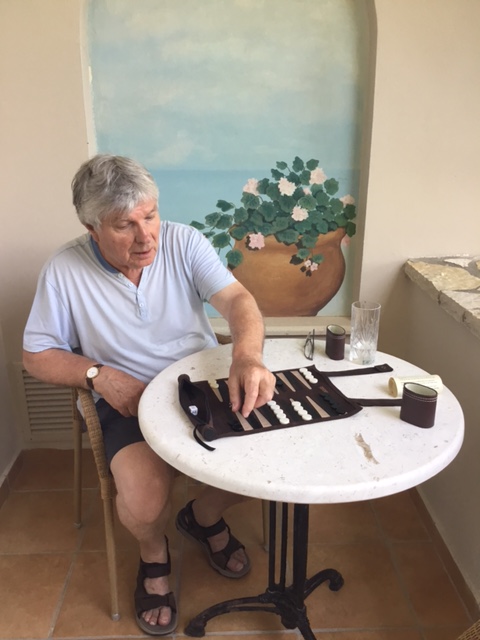
In the town chess club, the final of the annual Earl’s Cup competition was about to start, the finalists being Willie Anderson, the holder, and a new member, Archie Drummond. The club was a friendly, welcoming place, but there was a surprising coolness between Willie and the new member. Although Archie Drummond was indeed a new club member, he wasn’t new to the town, having been born and raised here before going away to spend his working life (profitably) in Hong Kong. Apparently, as young men, Willie and Archie had fallen out over a girl: there had been a memorable stramash in the Gents toilet at the old Mecca Ballroom. Forty-odd years on, one gathered that the ballroom bout was regarded by both parties as inconclusive.

Willie was setting the electric clock, with each player to make thirty moves in an hour, plus twenty minutes each to finish. Archie was studying the inscription on the solid silver cup, the oldest chess trophy in Scotland, presented to the club in memory of the Earl’s eldest son, Captain Albert Abercrombie-Smith, club champion 1876 & 1877, slain by Zulus at the Battle of Isandlwana, 1878. Silently, Willie showed the set clock to Archie for his inspection and was rewarded with a grunt of agreement. The traditional hand-shake at the beginning of the game was perfunctory in the extreme.

Other games were being played in the clubroom that night. But, as they ended one-by-one, the players clustered around the black-and-white battlefield where Willie and Archie were joined in silent struggle. The pawns clashed and fell, the knights leapt forward and fell back, the bishops obliquely threatened, the castles took up their defensive positions, and the overbearing queens stalked the board. The clock ran on, the moves became more urgent and the competition entered the endgame: the kings emerged from behind their defensive ramparts and began a dancing duel. A couple of stray pieces fell here and there, but to no clear advantage. With less than a minute left on his clock, Archie managed to force his last remaining pawn to the back rank, converting it to a queen. Unsportingly, Willie played on, hoping to avoid mate long enough for Archie to lose on time. Archie mated him with just three seconds left on his clock. The audience, hushed until that point, now erupted with exclamations, congratulations and rival theories of how alternative endings could have been contrived. In the hubbub, the customary concluding handshake was somehow omitted.

After a short delay, the club president presented Archie with the cup and a photo was taken for the website. Willie had left the room, but his prostate often required sudden temporary absences. The night was concluded and we all streamed out of the club. Archie Drummond bore off his cup in his BMW, like a Russian Prince in a horse-drawn midnight sleigh. Willie Anderson watched the tail-lights dwindle down the Kirkgate: ‘Weel, weel, he’s carried awa’ the cup, but I carried awa’ Dorothy, bless her.’

Biography:

Michael Bloor lives in Dunblane, Scotland, where he has discovered the exhilaration of short fiction, with more than a hundred pieces published in Literally Stories, Everyday Fiction, The Copperfield Review, Litro Online, Firewords, The Drabble, The Cabinet of Heed, Moonpark Review and elsewhere (see https://michaelbloor.com).

Commuting in Warsaw by Michael Bloor

(first published in The Flash Fiction Press, May 5th 2017)

Jenny Birkett was sitting in the bar with five fellow psychiatrists at an academic conference. A quiet middle-aged woman with quiet clothes and a gentle manner, it wasn’t unusual for her to take little part in professional chitchat. The discussion was about some remarks that the opening conference speaker had made in his plenary address. He had referred to a famous paper that the great Swiss psychotherapist, Carl Jung, delivered to the annual meeting of the British Medical Association in the summer of 1914, ‘The Importance of the Unconscious in Psychopathology’. At the time, Jung secretly feared that he himself was suffering from schizophrenia. Two days after he delivered his paper, the First World War broke out. In the middle of that collective European madness, Jung’s recovery was slow and painful: he later interpreted his initial disturbance as a precognition of the European slaughter.

The conference speaker had suggested that personal experience of mental illness could be valuable to psychiatrists in caring for their patients. The suggestion had sharply divided the group in the bar. Old Danny McCafferty, who knew Jenny better than most, noticed not just her quietness, but a clouded, troubled expression. Hesitantly, he asked her if she had an opinion. Jenny spoke so gently that they had to strain to hear her above the hubbub of the bar: ‘I don’t say that personal experience of psychiatric illness is going to be helpful to us in diagnosis or treatment. But there was an occasion when I felt sure that I was going mad and I’ll never forget the sheer anguish that I felt then. It’s got to be valuable for us to understand – to know from our own experience – the awfulness that our patients are living through. I hope it’s helped me to bring more compassion to my patients.’

There was a pause. Jenny reached for, and swigged, her dry white wine. She ran her finger over the wet ring her glass had left on the table. ‘I suppose, after a declaration like that, I owe it to you all to tell you what happened…

‘Nearly twenty years ago, I went to Poland on an EU exchange scheme. I learnt the language at my mother’s knee: she had fled Poland during the war. I spent six months in an academic psychiatric department in Warsaw and a Polish colleague, Darek, came to my unit in Edinburgh. I had his flat in Warsaw and he stayed in my cottage in Roslyn. You probably know that the ancient centre of Warsaw was painstakingly recreated after the destruction of the war. But most of the city’s population don’t stay in the chocolate-box city centre: they live in the countless high-rise flats in the suburbs. Like everyone else, I used to travel in and out to work on the bus, down long, long avenues of these post-war workers’ flats. A dreary journey.

‘One autumn evening of murk and rain, I was absorbed in an article I was reading and almost missed my stop. I scurried into the downstairs lobby of the flats and into the battered lift. Darek’s flat was on the eighth floor. There was no light on the landing and it was always a titanic struggle to locate and operate Darek’s battered door-lock. So it was a relief when, finally, the lock yielded. But once inside the flat, it always used to feel homely. The living room used to be lined with books in Polish and English – literature and philosophy, as well as medicine. Darek was evidently a polymath whose learning put me to shame.

‘But that night, when I switched on the light, I got a stupefying shock. The books and the book shelves were gone. So were the warm Afghan rugs and the rich red curtains.

‘I dropped my briefcase and almost collapsed myself. I sat down abruptly on a battered dining room chair (never previously seen) and, not daring to lift my eyes, stared at the unfamiliar scuffed lino at my feet. The lino was patterned with entwined pink roses on a green background: the thorns on the roses seemed unnaturally large. I struggled against the panic, tried to control my rasping breathing, and sought desperately for some rational explanation of the changes. Sought and failed: how could somebody (a relative of Dareks? a housing official?? the security police???) have entered the flat and, in a few short hours, completely refurnished it with this old tatt – this scuffed lino? In truth, I knew that nothing could explain the transformation of the flat. There had to be something wrong with my perception: I, a psychiatrist, was delusional. My eyes filled with tears; I have never known such pain.

‘I thought back to patients I had known, trying and failing to recall similar cases. And then I was mistrusting my recall, as I had already mistrusted my perceptions. Inexpressible wretchedness. My breathing was now quite out of control, my heart was banging like a gong. I felt faint and I got up to open the living room window, to breathe some cold air. As I stood at the window, struggling with the catch, I glanced out to the evening street below…

‘It was a different street.

‘And then, in a flash, I knew. This was a different street: it wasn’t Darek’s street and this was not Darek’s flat. Unknowingly, I had got off the bus at the wrong stop. Unknowingly, I had run through the rain into the wrong block of flats. Unknowingly, I had contrived with Darek’s key to open the shoddy lock to the wrong flat.

‘Such relief. But my understanding of my patients was changed utterly.’

Biography:

Michael Bloor lives in Dunblane, Scotland, where he has discovered the exhilaration of short fiction, with more than a hundred pieces published in Literally Stories, Everyday Fiction, The Copperfield Review, Litro Online, Firewords, The Drabble, The Cabinet of Heed, Moonpark Review and elsewhere (see https://michaelbloor.com).
The Visionary Librarian by Michael Bloor

(first published in The Copperfield Review, February 6th 2018)

January 1st, 1781. I do not fully know my reasons for setting down this record of past events. I have studied the works my great contemporary, David Hume, and I therefore no longer cleave to the kirk and to the faith of my fathers. Yet the purging of what others call my soul, penitence, and the striving for a moral life, they all remain a habit with me. Furthermore, I have a strong presentiment that I shall not live out this winter. These days of bitter chill may be my last opportunity to reveal my hidden crime and to state my case, not to the Maker in whom I no longer believe, but perhaps to my better self – the self who always seeks but never finds, who can carefully shape a principle but cannot always live by it. If others should find this manuscript after I am dust, may they read it and know that even a puir body can try to do his duty.

I have taught the school in the parish of Inverallan for thirty seven years and I trust I have discharged that duty honourably, though no Inverallan weaver’s or ploughman’s bairn has joined the ranks of David Hume, Adam Smith, William Robertson, and William Fergusson – the Philosopher-Kings of Edinburgh and all Europe. However, the Inverallan dominie has a further duty yet – a duty greater, I believe, than that of schooling the Inverallan bairns – I refer to my duty as Keeper of the Books. A hundred years since, the Inverallan laird bequeathed his library of two hundred volumes (together with a respectable sum for their upkeep) as a free library to all men and women who wished to borrow them. When the old minister, Mr MacKellar, informed me of my appointment and showed me the library that was to be in my charge, I could conceive of no duty under the sun that could be more pleasurable. I was not to ken then the rue that would come to me.

In the early years of my charge, Inverallan and the surrounding parishes were in a sorry state. The laird had declared for Prince Charles Stuart, and when the laird is for a cause then the tenants have little choice but to follow. Two score of men had marched off with the laird, my elder brother Alexander among them. Only three lads limped home. At first, we had good news of Alexander. It seemed that he had distinguished himself in the field at Preston Pans and, when the laird fell ill and was left behind in Edinburgh, Alexander took charge of the laird’s men on the march into England. On the retreat from Derby, Alexander was detailed to be part of the garrison the Prince left in Carlisle. After that we heard nothing. Cumberland’s army marched through our parish on their way to Culloden: they fired the laird’s castle and drove off all our cattle and our remaining horses.

It was in February 1752, a time of want and bitter cold, that I had more news. In the late evening there was a tapping at my window, but the pane was so frosted over that I could not see out. I took up my lantern and opened the door. A tall figure, muffled in a cloak stood before me. There was a bright moon, but his face was shadowed by his hat.

‘They tell me our parents are both dead.’ It was Alexander. I dropped the lantern; we embraced.

I fed him some porridge and spirits and studied him as he ate and drank. To my surprise, he seemed hardly changed, for all his seven-year absence. Only his rich, travel-stained clothes spoke of a difference. He told me bits and pieces of his story: it seemed that in the ’45 several men had died at his hands; more recently, he been in France in the service of the Stuarts, but Scots were no longer welcome there; he had used the last of his money to pay the ‘freetraders’ (as the smugglers are commonly called) to land him near Kirkcaldy; he had travelled to Inverallan only by night, there being a price on his head. But rather than talk over-much about himself, he had the charming ability to draw out the talk of others:

‘Well, Jamie lad, you’re quite the scholar now. I see on the table that “Lock’s Works” is your present study eh?’

‘Philosophy is only one of the subjects to be found in The Free Library, Sandy. There are books on geography, history, theology, and mathematics, translations of Ovid and Virgil, maps, collections of sermons…’

‘Yon is a strange conceit, is it not? to make a pile of your books, some of them doubtless worth a year of our faither’s labour. And then offer them up to any passin’ ploughboy that has a fancy for them?’

‘Each ploughboy, as you put it, must sign for each volume that he borrows. But Sandy, I don’t think you’ve grasped the wonder of the thing. They come here from their fermtouns and weavers’ cottages, limbs stiff after a hard day’s labour, walking miles through the sleet and the glaur. They carry back with them Shakespeare’s Sonnets to read by the ill light of their cruisie lamps. And that is their taste of Rhenish wine and honey cakes, their bed of goose down, their transport to Samarkand. With a book in his chapped hand, every ploughboy is an equal of the Duke of Argyll and the Marquis of Breadalbane. This free library is a growing light in a dark world, Sandy.’

‘Pish, Jamie. Your ploughboy is a duke’s equal (mention not that damned Argyll to me) in the alehouse, wi’ a tankard in his hand and a maid on his knee. What need of books, when you’ve left the schoolroom?’

In my eagerness to convince Alexander, I fetched the Borrower’s Register to show him. As he turned the pages, he murmured: ‘Well, well, Andra Comrie borrows Abercrombie’s Sermons. I thought him dead on the field at Falkirk.’ He turned to me: ‘Jamie, I have need to borrow a pile of your books… Indefinitely.’ I stared. ‘There’s a bounty on my head. I know of a vessel at the Broomielaw in Glasgow that will carry me to a new life in the Carolinas. For a price. Your books are as good as ready currency.’

My elder brother faded before my eyes and a simulacrum took his place. The brawling spirited lad I had idolised and run after was vanished like snow off a dyke. Now before me was the callous gallant who had left his parents to fret and go to their graves thinking him dead on a battlefield, who had fawned and intrigued for place and favour in foreign courts, and who had only returned briefly to his native Scotland to profit from, and ruin, his brother’s position of trust. Worst yet, he would pillage the free library – the library that is, and should remain, a hope and consolation in a wretched world.

Every schoolroom is a stage for the dominie to strut and strike a pose. It was now my turn to dissemble and fall in with Alexander’s plans. We made up his bed, despite his faint protestations (‘I’m an old campaigner, Jamie – the heather has oft times been bed enough for me’) and fixed that he would stay hidden with me the next day, departing in the dusk with his booty of sixteen books (more than he needed for his fare, I’ll warrant).

That next day, I watched him take the less-frequented moorland road. I marvelled at how he hardly bent his back, shouldering the coarse linen sack of books. When he was past the castle ruins, I grabbed my hat and walked over to the manse, to beg the loan of the minister’s mare (I was still a communicant in those days and a member of the kirk session). I then took the military road to Stirling. I had slow progress over the half-frozen snow and dawn was breaking when I reached Stirling Brig. Mares’ tails of mist were twisting over the River Forth, which Alexander had to cross to gain the Glasgow road. I had the Brig sentry call up the Sheriff’s Officer, an old pupil of mine, to whom (in confidence) I told my tale.

After resting the horse, I turned for home and only heard the end of the story a week later. Samuel Haldane, the Sheriff’s Officer, came by to return the linen bag of books. I sat him down at the fireside and poured him a glass. He told me that Alexander, as he’d surmised, had been too canny to try to cross the brig: Haldane had put a concealed watch on the upstream ford and his men had taken Alexander there by surprise. However, as the party were marching back to Stirling, Alexander had slashed at one man with a concealed dirk, broken away and ran for the river. Whether the pursuers’ musketry had been successful, or the cold of the river had overcome Alexander, Haldane was unable to say, but Alexander’s body was seen to be borne away by the current, down to the sea.

Haldane could see that his news had pierced me. He rose and laid a hand on my shoulder: ‘Mr Robertson, your brother Alexander was well-kent in all this countryside from Stirling to Crieff, even before The Rebellion. He was too wild a man for these New Times.’

Though Haldane’s words were some comfort to me, mine is nevertheless the sin of Cain. But I did not commit fratricide merely to repossess a bag of books. Rather, I would claim that I sinned for a great principle, the principle of free knowledge. I have served that principle (not always constantly, but as best I can) for thirty seven years. And, if I could still pray, I would pray that the light of Inverallan library would shine out across all Scotland and the whole wide world.

Biography:

Michael Bloor lives in Dunblane, Scotland, where he has discovered the exhilaration of short fiction, with more than a hundred pieces published in Literally Stories, Everyday Fiction, The Copperfield Review, Litro Online, Firewords, The Drabble, The Cabinet of Heed, Moonpark Review and elsewhere (see https://michaelbloor.com).

Fermain Bay by Michael Bloor

(first published in The Flash Fiction Press, January 5th, 2017)

(Ed note–We are ecstatic to welcome Mick Bloor back for another week; come back through this Saturday and we believe that you will like him as much!–LA)

A routine visit to the town library with my daughter. My pedagogic overtures rejected, I drift over to a display of new books. A shock: the photo on the dust-jacket of a book about the Channel Islands. It’s Fermain Bay, Guernsey. For years, I carried in my wallet just such a photo, taken from among the headland pines on a day of luminous light, looking down into the narrow sandy bay. On the dust-jacket, I can just make out tiny, scattered deck-chairs, once my summer-long responsibility.

The things you forget. The great Martello Tower, built to dominate the beach and deter Napoleon – forgotten. A mere stone obstacle to be skirted on journeys between my deck-chair store and Ginny’s beach café. An historic monument rubbed out and Ginny’s brown eyes and deft movements given Conservation Area status. The things you remember: our first kiss, when I couldn’t stop my knees trembling; how the smell of the pines gradually gave way to the smell of the sea on morning walks to work; the taste of fresh Guernsey milk. And there’s the bad stuff too: the café break-in when all the fags were stolen and the owner blamed me; my night at the police station – a brief episode, but a lasting after-taste of how it is to be the bewildered outsider, the stranger deemed suddenly to be the enemy. That summer was my passage into adulthood, backlit by the ‘vision splendid’ of childhood, but treading step-by-step into Man’s Estate.

Thirty-odd years have passed since that library visit, just as twenty-odd years had stretched between my Guernsey days and my discovery of the dust-jacket. A strange exercise, to sit and recall the time when the memory of Fermain Bay engulfed me like an incoming tide – the memory of a memory.

Biography:

Michael Bloor lives in Dunblane, Scotland, where he has discovered the exhilaration of short fiction, with more than a hundred pieces published in Literally Stories, Everyday Fiction, The Copperfield Review, Litro Online, Firewords, The Drabble, The Cabinet of Heed, Moonpark Review and elsewhere (see https://michaelbloor.com).