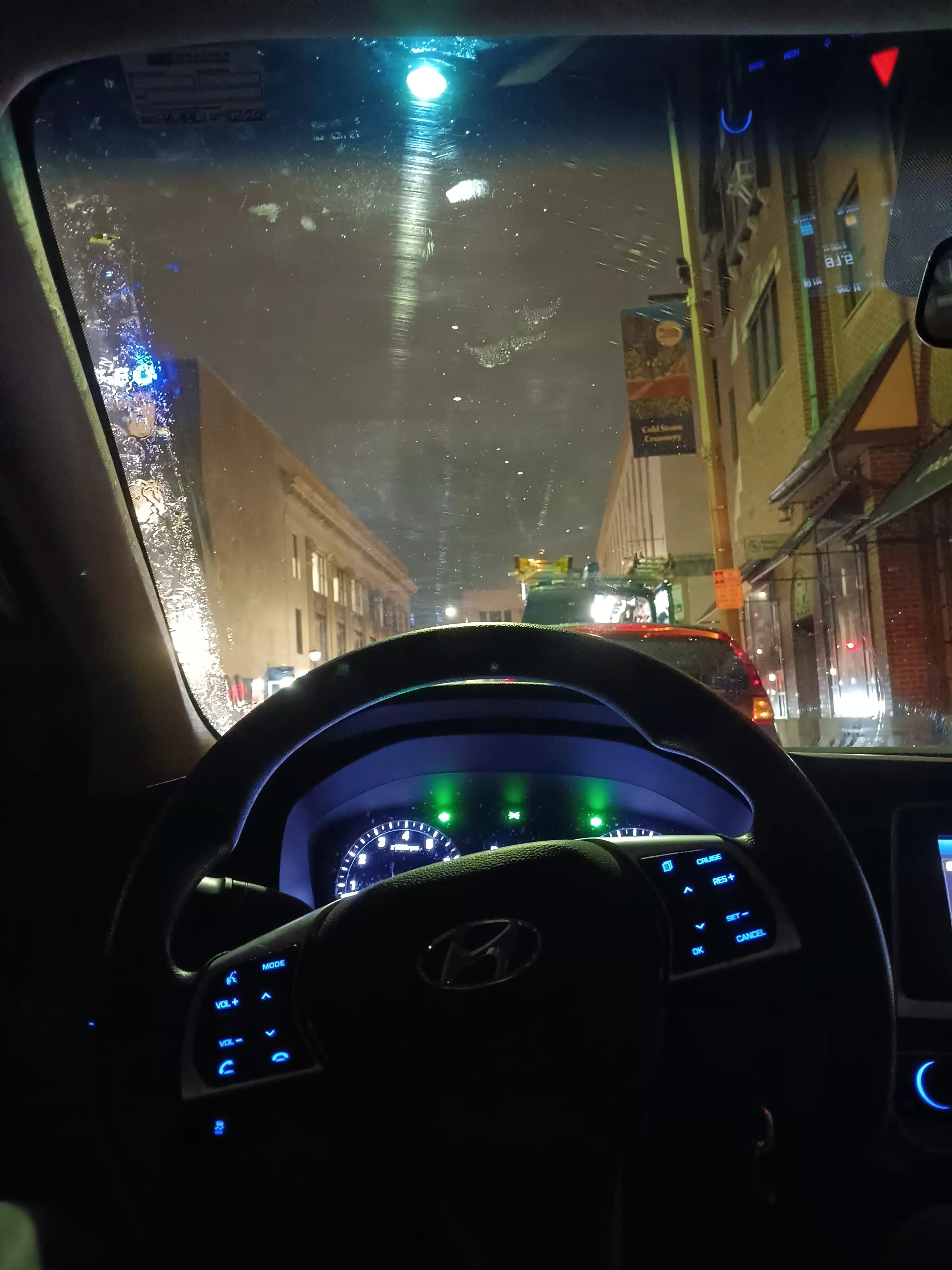
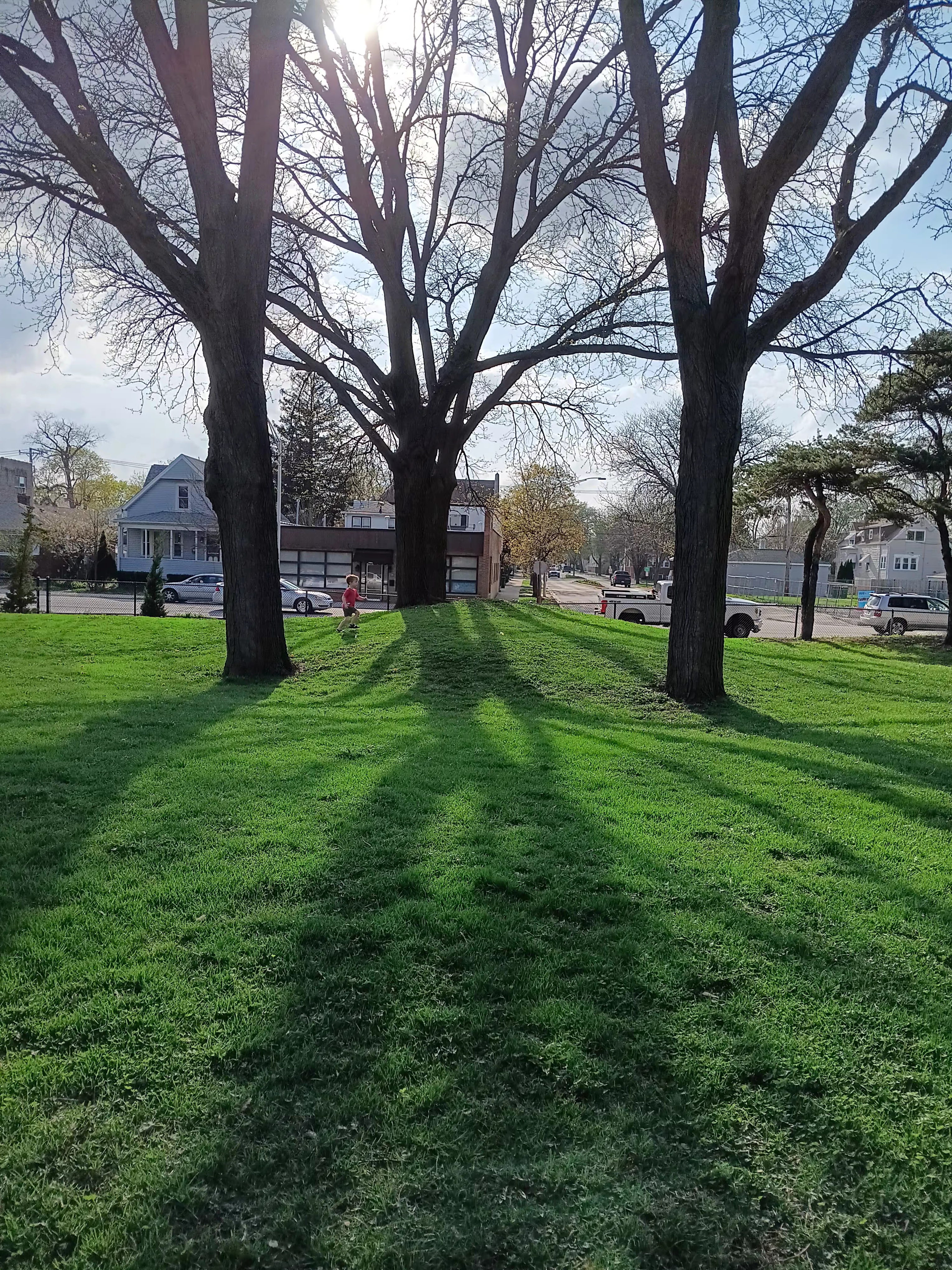
I deeply respect law enforcement because I deeply know that when the shit really hits the fan, it’s them who you have to call for assistance.
But when it’s them you have to start barring and blockading your door against, worrying that they’re going to barge in for no real reason in the middle of the night, times have changed around here for some of us.
Such things have happened in my neighborhood too recently – and there are many who say such things will start happening again soon, in earnest.
The world has never been a safe place for anyone – just ask all those folks who used to have to spend so much of their time keeping their eyes peeled for saber-toothed tigers around every bush, tree, rock, and boulder.
It was so hard to spend time scrolling on your phone when the big cats were out to get ya.
No wonder we find cats’ eyes to be so weird and eerie (as well as cute and cuddly).
Even now, too much comfort and complacency is a great killer in the good ol’ USA.
FUCK ICE indeed – especially if you have a heart of ice – no matter which side you’re on.
END NOTE/S:
I was born in Dearborn, Michigan, USA, which is the town where Henry Ford invented that thing we now call “the car.” In my birth town currently, over fifty percent of the population reports Middle Eastern or North African ancestry, which means it has one of the highest percentages of that type of population in the entire country. I very much embrace such diversity, even though I also know it can cause problems, especially for the ones who get kicked out of the place/s they used to live, which happens here in the USA, just like anywhere.
Regarding ICE barging into my apartment in the middle of the night, mostly I’m worried that if they did so, my Siberian would attack them and they’d shoot him dead.
That is why I bar and blockade the door/s in the middle of the night, so I can hear ’em coming, if they want to come, even though I’m very much an American citizen, born and bred, and hardly ever left to go anywhere else but here.
Because my Sibe and I would die for each other without thinking twice, if that’s what it took.
“Mona Lisa musta had the highway blues, you can tell by the way she smiles.” – Dylan
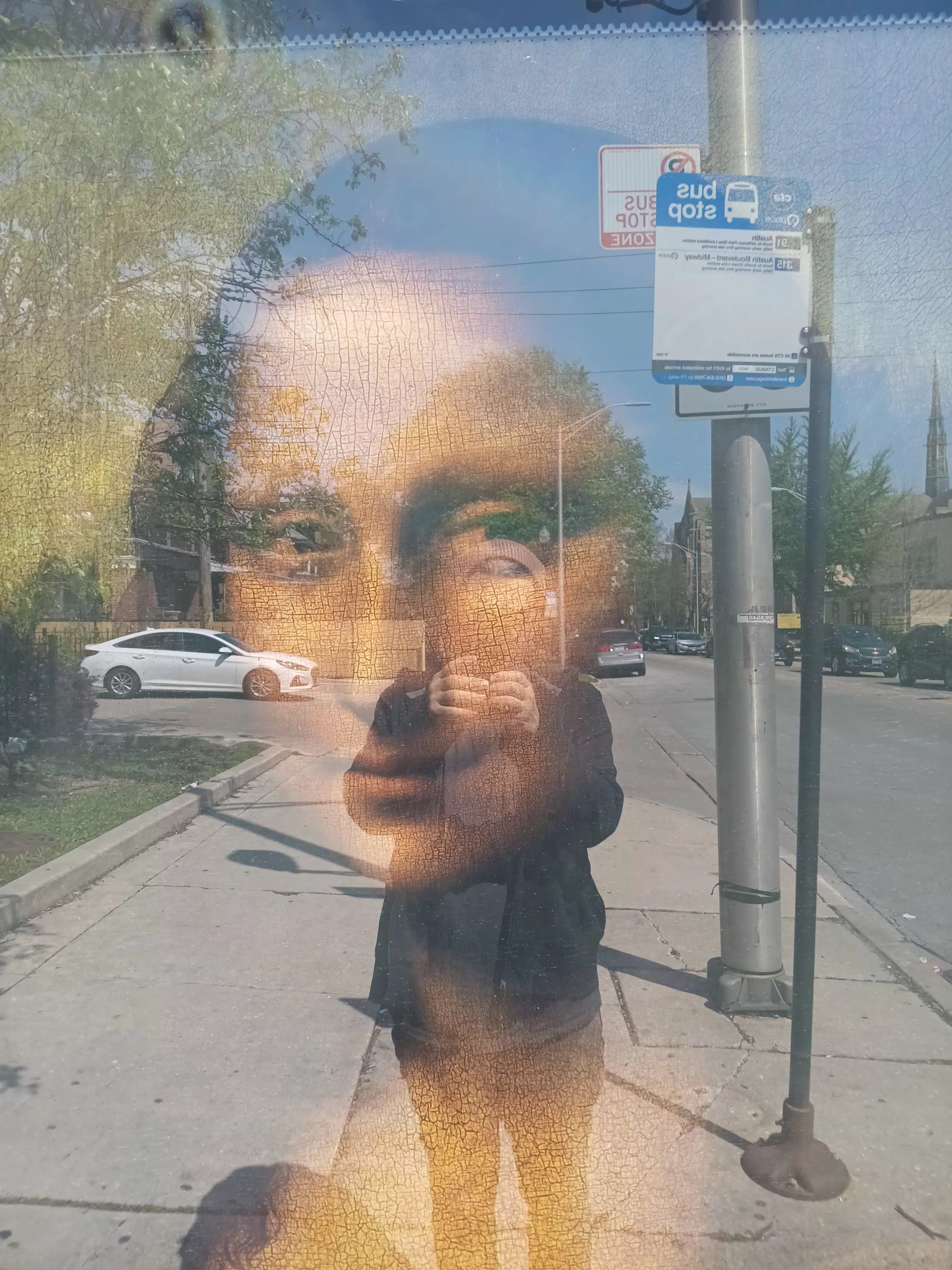
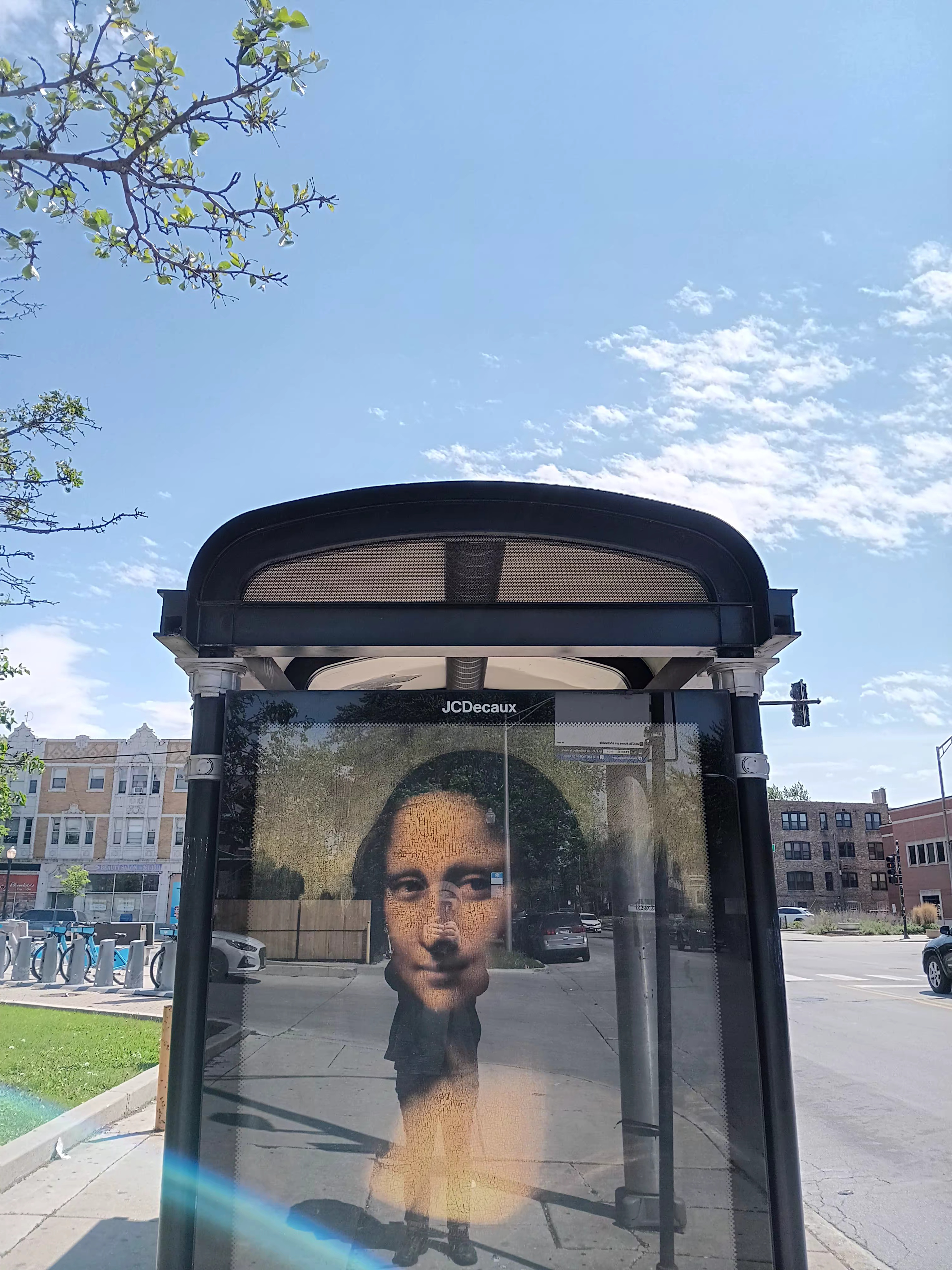
The Mona Lisa Street Scene series arose on the West Side of Chicago, along Madison Street.
Sketchy people were wafting about there and here, buses were pulling in and out of the hulking garages, the El tracks were shaking with trains, cars going by, seagulls soaring above all in from the lake looking for chicken bones in the gutters, grass blowing in the vacant lots, garbage rotting in the alleyways, food smells floating from nearby hot dog stands (Chicago has more hot dog stands than McDonald’s, Wendy’s, and Burger King combined, even though McDonald’s was invented here and has its world headquarters here), leaves fluttering on the trees, weeds coming up from the cracks in the sidewalks, cats climbing on stairways, buildings groaning with ghosts, rats baring their fangs and claws, doves cooing and gently moving their wings without flying, but dreaming of flying, which is, after all, only – another kind of flying.
Because I’m feeling silly and I like to celebrate my city, these are the names of eleven comedians who are from Chicagoland, i.e., Chicago and environs: John Belushi, Jim Belushi, Bill Murray, Harold Ramis, Betty White, Steve Allen, Jack Benny, Chris Farley, Robin Williams, Redd Foxx, Bob Newhart.
“But don’t you place the blame on me / As you pour yourself another drink, yeah.”
– Eminem
I heart Ems because he talks about, explores, and explains what it’s like to be from Michigan, which means, of course, what it’s like to be from the American Midwest: “flyover country.”
It’s kind of like America’s greatest rock critic (by far), Lester Bangs, who always loved to wear his “Detroit Sucks” T-shirt while living in, and loving living in, the Detroit area, which is known as both Motown and Rock City among other monikers. I can’t believe he was only three miles down the road co-creating Creem Magazine while I was living there as a rebellious little kid. And yet, such is (weirdly for me as a person) true.
There is a simple four-part formula for understanding the essence of Eminem as an American artist, I say!
I speak here of his best, most mature, and most fully developed work, not every single thing he’s ever done. He is a very profuse, honest, sometimes dark, and prolific artist, and if I wanted to slam him, I could choose lots of things to slam. He’s also a very self-aware and self-critical artist – anything anyone can say about him, he’s already said about himself a million times before (much like the poet Charles Bukowski).
The four-part formula goes like this.
One: What it’s like to be from the state of Michigan.
Two: What it’s like to be from the American Midwest (“flyover country”).
Three: What it’s like to be an OUTSIDER.
Four: How the figure of The Outsider, in his work, becomes a symbol of the modern Human in general, plain and simple, and also not simple at all.
Someone once asked him if he believes in God; he said, “I don’t go to church, but I do pray.”
Such an answer shows how he is a kind of modern-day Everyman who modern-day Everywomen can also relate to.
Every place in America, and I mean every place in America, has great heroes and heroines who lived there in the past or are living there right now. By “heroine” and “hero,” I simply mean someone who can be looked up to in some kind of way; someone who proves that humans are, somehow, worth it; and can act as a representative figure somehow (which is also much more of a burden than it might sound like at first blush).
Because if we don’t question the fact of human nobility sometimes, we are blind and mad. And if we don’t ultimately believe that humans have that noble strain within them, we become someone like the current president of the USA, who believes that everything, and that means everything, comes down to nothing more than a monetary transaction, one way or another. Think well of other people – without being blind – and eventually you start to think well of yourself, too.
Eminem’s gated KMart mansion is fifteen miles away from where I lived for the first ten years of my life.
My parents were young and our neighborhood was modest and I often find myself back there in my dreams or in the smell of rain or snow or grass or in the warmth of the sunshine, all of which I learned there first.
We lived in the area where Eminem’s film 8 Mile is set.
Five of Eminem’s greatest songs are from his 2013 album The Marshall Mathers LP 2.
When this album came out, I was separated from my wife and broken up with my truly-beloved, soul-mate girlfriend (who I took up with only after my wife kicked me out and I also kicked myself out even more, which she tended to forget (about the girlfriend) a little too often, since we never lost regular contact while taking care of the kids, in front of whom we always retained a friendly family demeanor in between the poison barbs we regularly aimed at each other; see the quote from Eminem himself at the top of this essay for an example). Two people I deeply love were battling cancer (they got over it, but I didn’t know if they would, at the time; and one of them was her). And my mother had recently passed on. And I was losing my job, a process that took, on and off, two years. Unlike the cancer/s, I knew how this one would pan out from the start, but I never stopped fighting (even though lost in a fog-of-war confusion most of the time, at the time) until it was over (when I immediately plunged into a periodic three-year depression that almost killed me lots of different and exciting ways).
The Marshall Mathers LP 2, and especially the five songs I’m about to list, provided me with great, deep consolation, comfort, and inspiration at the time. For some reason, the album cover has one of my favorite numbers hidden in plain sight upon it: 946.
My two kids, who are forty years younger than me almost to the day, also love/d these songs, then and now, as do most of their friends.
This album was/is one of the rare times when great art and the American mainstream actually come together these days. Lana Del Rey, at her best, is another example of this; as is Taylor Swift (at her best); as is Lady Gaga – at her best.
“The Monster” (co-vocals by Rihanna). ALSO SEE THE MUSIC VIDEO WHERE RIHANNA WEARS BLACK LIPSTICK AND EXTRA-LONG FINGERNAILS!
“Legacy” (co-vocals by Polina).
“Headlights” (co-vocals by Nate Ruess).
“Stronger Than I Was.”
“Bad Guy” (the sequel to Ems’ great song “Stan”).
Remember the spirit of the 1960s (even if you weren’t alive at the time) and play it loud!
These songs are not really rap or hip hop per se; they are more like rap rock, like when he sampled Black Sabbath or Nick Cave on earlier songs; and even more like something one-of-a-kind in a genre of their own, a genre of Eminem’s own invention. Like all great art (including all great essays), these songs don’t really fit into any pre-conceived categories: at all.
But these five songs are so great, they can, very rightly, be compared to the best of The Beatles; Bob Dylan; Nina Simone; The Clash (London Calling); Nirvana. Yes, it’s true: Eminem, at his best, is that good.
Another thing many folks don’t know about Eminem: he took better care of his little brother than their parents did; and he took better care of his three daughters than their mother/s did (two are adopted, from his ex-wife with another man and from his ex-sister-in-law).
Unlike everyone else, he stuck around.
Exciting End Note/s:
I can also recommend Eminem’s powerful 2010 album RECOVERY.
Especially these songs: “Cold Wind Blows,” “Love the Way You Lie,” “Not Afraid,” “Going Through Changes” (one of the songs where he samples Black Sabbath, brilliantly), “Space Bound.”
This essay was written in a single burst while sitting in the car outside Frank Lloyd Wright’s Home and Studio in Oak Park, Illinois, USA, on May 12, 2026, which is right around the corner from Ernest Hemingway’s boyhood home. I do not use, and have never used, and will never use either grammar or spell check, believing my brain should be the one to do the work instead of any sort of a computer for a multitude of reasons some of which I can’t even explain. I believe that any typos or mistakes (if there are any) are deliberately made by something else. Therefore I let them stand if I catch them after a certain point (after my brain says “Finished”).
SEE THE QUILLEMENDER OF MY CO-EDITOR LEILA ALLISON!
(Borges rightly says that the real writer is never afraid to write a bad page.)
I saw seven GIGANTIC wild rabbits in Wright’s yard while writing this!
They were running around chasing each other because they know that it’s SPRING.
“For when words cease to cling close to things, kingdoms fall, empires wane and diminish.” – Ezra Pound
This week The Drifter offers a twenty-three-line poem because that’s what occurred – or arrived. In the unlikely event that anyone out there wants more “Drifter” today, I advise perusing this pome (not a typo) a multitude of times. This is not an article from The New York Daily Bullshit with a tag on it saying, “2 min read.” Reading this piece very, very, very, very, very, very, very slowly (aloud, or inside) is the recommended method – a form of medicine. I here predict (and if I’m wrong, I won’t know it, or care) that this one will be around for a while.
In the title, “Beauty” is a name, as in the old French legend, “Beauty and the Beast.”
This piece contains the past and the present, and has eyes on the future, in a writing where hundreds of things are deliberately hidden within every line.
And: age, does it not sneak up on us like a thief in the night?
With sincerity,
The Drifter
April 30, 2026 AD, 11:33 AM
The Heaven of Beauty
When I thought of your long red silver hair
and how many years it’s been that I haven’t seen it
blowing in the wind,
I was surprised, and almost shocked,
and I couldn’t believe that it was almost May again.
May,
month of dying
purple lilac petals in Berwyn,
another chance, a thawing of the heart, a re-resolution,
despite all.
May,
a sinking of the heart, a re-realization,
a too-real realization, and a knowing, that nothing,
“So you may say, / Greek flower; Greek ecstasy / reclaims forever /
one who died / following intricate song’s / lost measure.” – H.D.
Today’s discussion of medical issues is from a layman’s point of view since I am a Doctor of Philosophy and not a medical doctor. But the medical facts have been garnered and gathered from folks who are medical doctors – in person, not just through reading. So this column offers the best of both worlds: the medical facts filtered through a philosophical perspective, with a touch of Edgar Allan Poe and Franz Kafka, except that THIS IS REALITY.
…
The “Mad” Woman
You walk back into your tiny apartment after another trip around the block. The second you enter your one main room, you realize that something is amiss. Someone has been in here again during your 30-minute absence. Not only have they been in here again, they have rearranged some of your items. The difference in placement is very subtle. A hair brush you thought had been over here is now over there. Your coffee cup has been moved three inches away from the place you left it. And the television remote control device is now sitting on the opposite end of the end table from the one you left it upon when you left your apartment thirty minutes ago. Because the people, or beings, who enter your apartment and rearrange your stuff when you are gone are very subtle, very secretive, and very sly. You do not know why they are targeting you and rearranging your stuff; but “they” have been doing this for years. You slowly move around the apartment putting everything back in its right place. Then you notice that the dart board on your wall has also been rearranged. It has been moved exactly three inches to the left. You suddenly realize that the dart board is not a dart board: it is an eye. It is a GIGANTIC EYE through which THEY are watching you. THEY also follow you around on the streets sometimes. You have been incarcerated more than once for accosting these spies on the street. You approach them unannounced and unawares, demanding to know why they are following you, whose orders they are following, and why they don’t feel guilty about being spies. The authorities sometimes show up when you take these interrogation tactics too far. Sometimes that’s when the straight jackets come out and the incarceration thing happens again. You are aware that all of this seems “crazy” to them. But you are being followed, tracked, and surveilled within your apartment. Not just the dartboard but also the bathroom mirror is an EYE watching you. Watching you and reporting your activities to THEM. That’s why sometimes you don’t move for hours. You just sit there alone in your chair in your apartment utterly unmoving, not even daring to get up and go to the bathroom. Some day you will figure out who is doing all of this, why they are doing it, and what the universal ramifications are. You’re pretty sure that most of the spies are human. Others are definitely demons who look like humans. A few are humans you’ve been long familiar with, like your sneaky and wily landlord. That landlord of yours who always acts so friendly on the surface then turns around when you’re not looking and reports all of your activities to the authorities. The ultimate authorities are not human. They are not God, either. Rather they are some kind of currently unknown (to humans) creatures who live on a Planet called the North Star that is not in our galaxy and not even in our universe. One day you will know the reason for all of this, and it will elevate you. In the meantime, you can’t get a job because your life is constantly taken up with dealing with them, fleeing from them, thinking about them, analyzing them, dreaming about them, hiding under the covers from them in the tiny bedroom. (Under the covers is the only place they can’t see you, although they can still sometimes say things to you, like, “You stupid fucking bitch” over and over again.) Maybe some of them are friendly though (you are hoping this is true). Maybe everyone and everything in the world is not your enemy. Maybe. Maybe. Maybe! If you weren’t on medication, things would really start to get bad. You remember that you haven’t taken your medication in a few days, not since the last time you saw your therapist. You go to the medicine cabinet. To retrieve your medication. It should come as no surprise that your medication has disappeared because THEY have stolen it. Later you will locate the medication bottles in a different area of your apartment and realize that the jerks who are following you around and messing with you have moved your medication again. You dump all the many multicolored pills all over the floor and slowly and methodically begin to count them again, over and over and over again…counting the pills in this way also keeps the voices in your head quiet as night comes on, at least for the most part…
…
Welcome to the wonderful world of full-blown schizophrenia. The low moods and crazy highs of bipolar disorder look like a cake walk compared to this. Bipolar disorder is an episodic disorder where the patient is rarely, if ever, psychotic, i.e. totally out of touch with reality. There are a few medications that work really well in helping to control the occasional, extreme moods of bipolar disorder along with all of its daily intensities, mini-nervous-breakdowns, hilariously dangerous outbreaks, and sometimes-constant hyper-irritability. There are no medications that are great, or even very, very good, at controlling schizophrenia, although some med’s can help control the delusions and hallucinations a little. There is not much chance that any of this will change, at least not in the next couple of centuries…
…
The Native Americans, like the ancient Greeks, believed that “crazy” people were in touch with the gods in a special way that made them special people. They weren’t just sad, pointless cases with no reason, no goals, no ambitions, no purpose. Instead, their unusual condition was seen as a thing that was bringing messages to the rest of us. Not clear messages, ambiguous messages. But messages nevertheless. In the modern, secular, capitalistic, warlike, atheistic (or fundamentalist religionist), consumerist, commercialized, monetized, advertised, atomized, and alienated world, your value is the price tag on your head. Special people are not special, they are worthless, pointless junk to be discarded if possible. The medical professionals who do more than anyone else to try and help these people also often do more than anyone else to stigmatize, traumatize, and stereotype these people. There are literally millions of severely mentally ill people in the USA alone, and that doesn’t count the rest of the world. It’s a known fact that schizophrenics in the USA and UK, for instance, usually hear voices that are harshly criticizing them; while schizophrenics in places like Africa or India usually report (instead) hearing the voice of God.
These people really are messengers. It’s us who are not listening.
The next time you see someone standing on the street corner yelling at and kicking a telephone pole as if it were alive, or staring into the sky with a terrified look on their face as if an angry Martian were gazing down at them and scolding them, see if you can get inside their head before you pass on.
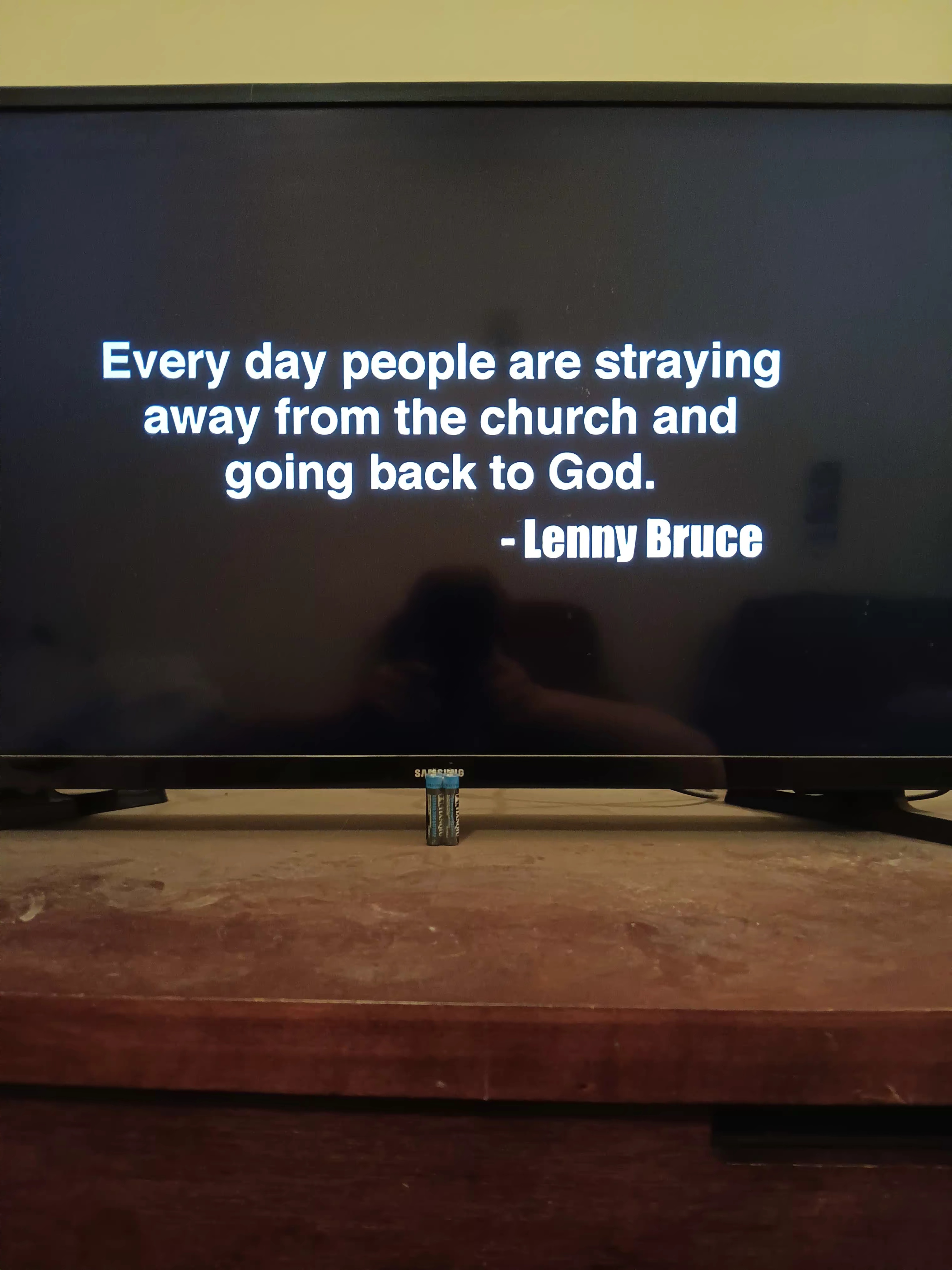
Martin Luther was a man who had one of his most profound religious revelations of his entire life while in the middle of a painful bowel movement. And he found this fact, in retrospect, to be so extraordinary, and so hilarious, that he never hesitated to tell this little tale to almost anyone who would listen when the mood struck him; and he especially enjoyed telling the tale in mixed company. He especially told the tale after putting a bunch of ale into himself. He was a man who enjoyed copious quantities of beer like most in his day. His sense of humor was so ribald, wild and infectious that he sometimes kept the folks around him in stitches for an entire evening. Then again, back then there was no television. And yet, we can still see that Martin Luther’s powers of humor were extraordinary and subversive. Just like Lenny Bruce.
Back then, messing around with THE LAW, which meant the Catholic Church, was not just something that could get you excommunicated, or even just exiled from the community. Dante, when he was banished from his hometown, was told: if we ever see your face around here again, mister, we will jump you and burn you alive publicly at the stake. It was a good enough reason for Dante to never see Florence, which he deeply loved, again. Back then, messing around with the law, i.e. The Church, meant that you might have your arms and legs cut off while you still lived. Then for good measure they would take your intestines out of your body and show them to you in case you were wondering what they looked like. And only then would they chop your head off and place it on a pike so they could put it on the corner to warn other ne’er-do-wells such as yourself. Martin Luther faced down the Catholic Church and condemned them in fiery and public terms for being a corrupt institution that cared nothing for anything at all except money, money, money. The way to win your eternal forgiveness back then was to make a little donation to the Catholic Church, who would then contact God on your behalf and make sure you were okay now with The Big Guy. They had forgotten what their great hero, Jesus, said about a rich man, heaven, a camel, and the eye of a needle. Luther spent an awful lot of time in hiding, and he escaped torture and execution because his wily nature and the truth of his position won out in the end.
In 2018 or ’19, Elina, Mary Ellen, and I saw Bob Dylan live on the campus of the University of Illinois Chicago at the small stadium there which was right across from the building where I had my office at the school for fifteen years. We were in the third row and the only thing we ever actually saw of Dylan himself was his wild and messy hair bobbing around above his electric piano, because of where we were in the crowd, because of how his piano was set up to block him, and because he hid behind his instrument the entire time with his head mostly bent down low and never once directly addressed the crowd, at all, except in song.
When he began to sing his song “Lenny Bruce,” from his 1981 Christian album Shot of Love, a sudden hush went over the entire audience, and it was obvious that more than just me in the crowd knew that this was a special and unusual moment. “Lenny Bruce” is one of Dylan’s least-known, truly great songs. The surprise performance he gave of it that night was almost heavenly, or at least as heavenly as it gets on this side of the Great Divide. Anyone who thinks Bob Dylan can’t sing was not there that evening, or is mentally sleeping.
“They said that he was sick / ’cause he didn’t play by the rules / He just showed the wise men of his day / to be nothing more than fools / They stamped him, and they labeled him / like they do with pants and shirts / He fought a war on a battlefield / where every victory hurts / Lenny Bruce was bad / He was the brother you never had.”
If forced or requested to select my favorite character in all of Shakespeare other than wild and wily Shakespeare himself, it would probably have to be the Dark Lady (or at least today it would definitely be the Dark Lady).
She is Good Will’s Mary Magdalene.
Anyone who’s ever loved a brilliant, promiscuous, raven-haired Spanish woman with darkly olive-colored skin and a shady reputation (to say the very least) will understand the attraction.
Her musical and poetic and intellectual abilities, her independent spirit and the fact that she inspired all this (all these deathless sonnets by the Western world’s greatest writer other than those who wrote the Bible) are her greatest calling cards.
“I do believe her, though I know she lies,” is one of my all-time favorite lines of poetry.
There have been myriads of scattered interpretations about the shades of meaning contained in this line.
And I know just what it means.
It’s about, among other things, Shakespeare’s voyeuristic obsessions and jealousies; and mine.