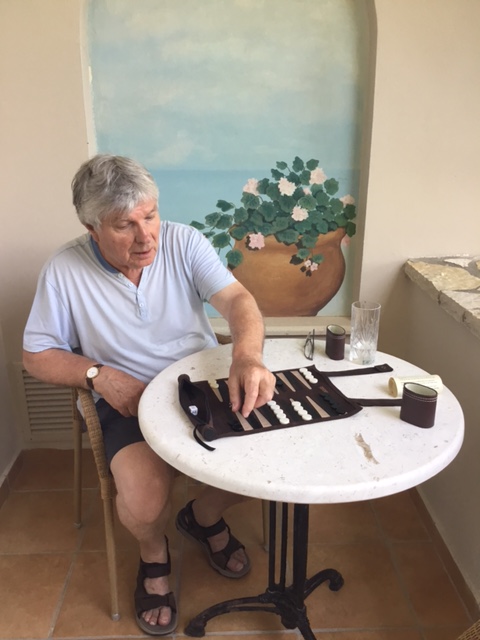
(This week Michael Bloor returns to the Springs. We are always pleased to run stuff by Mick. This one shows his wonderful ear for language-LA)
As I crested the ridge, I saw the figure in the middle distance, staring out eastward. I thought at first he was watching the hang gliders: Hatterall Hill, on the eastern edge of the Black Mountains of South Wales, is a favourite weekend haunt for these enthusiasts, if the winds are favourable. And the hang gliders cater for two kinds of spectators – those who admire the graceful and those who love the comic. I’m afraid I used to belong in the latter category, happy to eat my lunch watching these masochistic individuals launch themselves and their wings off the ridge and into the wind, only for the iron law of gravity to assert itself, so that man and machine would tumble into the bracken and scrub on the lower slopes of the hill. I never witnessed any of these poor souls coming to serious harm. Instead, they would laboriously disentangle themselves from their machines and the scrub, drag themselves back up the slope, lurch momentarily into space again, and then plunge earthwards once more, for my further entertainment. I would find myself wishing that my old Dad could have seen the show: slapstick was his favourite form of comedy.
However, familiarity has lately dulled my own appreciation of the hang glider spectacle and so I pressed on, past the Iron Age ditch and rampart, towards the summit of the ridge and its solitary occupant. The nearer I approached him, the more attractive he became: a sturdy guy of medium height, with a longish grey beard and tousled grey hair, a great cloak, negligently worn – he reminded me of photos of that eminent Victorian poet, designer, and revolutionary, William Morris.
Quickly, I confirmed my impression that he wasn’t studying the varying fortunes of the hang gliders. He was looking way out to the eastward, taking in a view of a verdant landscape that familiarity can never dull: the mile-after-mile-after-mile of patchwork, rolling, Monmouthshire and Herefordshire countryside – fields and woods and wandering streams, all miniaturised for a Giant’s delight.
He turned at my approach. I nodded. ‘A fine day and a fine view.’
He nodded in turn. I asked if it was his first visit to Hatterall Hill. The ridge attracts quite a few holiday walkers, being on a well-known, long-distance footpath, The Offa’s Dyke Path.
‘No sir, I am not a visitor to the hill. I dwell in its shadow, though I call it “Pisgah”, not Hatterall.’
The slightly formal speech and his clear enunciation made me think that English was not his first language: he was a native Welsh-speaker, a minority in this part of South East Wales. I recognised his Biblical reference too, having been raised as a Chapel-going Methodist, and I responded: ‘I understand. We are standing at Pisgah, and like Moses, I take it that you’re privileged to gaze upon The Promised Land, but you’ll never have it for your own?’
‘Correct, my friend. But perhaps you think my claim would be extravagant. Allow me to introduce myself, I am Owain Glyndwr, the last native Prince of Wales. The English know me as Owen Glendower. At one time, with my battle-hardened archers and men-at-arms beside me, I thought I could win back all those fair lands – fields, orchards, and pastures – snatched from us by the hordes of Saxons, Danes and Normans that bore down on my ancestors like plagues.’
I imagine that you will find it pretty odd that I didn’t, for one minute, think I’d met a mad man. On the contrary, I was attracted: he had far more than a famous name, he had bearing of a great man.
I knew a fair amount of the six-hundred-yearold Glyndwr backstory: after some very considerable early success, in battles and sieges, Owain’s revolt against English overlordship had eventually petered out. Despite a large reward being offered, he was never betrayed and Owain’s death was never announced. He simply disappeared and he has no known grave. Some authorities, I understand, have suggested that Owain, in defeat, went to stay quietly in his daughter’s and son-in-law’s house, a successor of which is still visible from this very hill.
I also knew that Owain was widely believed by his enemies to be a Mage, with esoteric knowledge and strange powers. I’m afraid that all I can truthfully repeat is that I didn’t take him to be mad. From the very first, I found him utterly believable, albeit six hundred odd years old.
He did not ask me to pledge my silence. And I feel a duty now to set down what I can remember of our conversation…
Glyndwr: ‘There was a time when all the land you see below us seemed about to fall to my arms. We had driven King Henry’s invasion force from the field at Stalling Down, nearly all Wales was under my control. I was crowned Prince of Wales as a direct descendent of Llewelyn the Great. I convened a Parliament at Machynlleth: we re-established traditional Welsh Law, and declared an independent Welsh Church. We drew up the Tripartite Indenture with Henry Percy (‘Harry Hotspur’), Earl of Northumberland, and Edmund Mortimer, claimant to the English throne. Percy and Mortimer would divide England between them. And all these Welsh Marches at our feet, all the lands west of the River Severn and the River Mersey would revert to the Principality.
‘If only Hotspur had brought his forces to join with mine outside Shrewsbury, instead of attempting (and failing) to defeat King Henry independently, then it might have all ended very differently.
‘So the chance, and the land, was lost. I was already long in years when the thieving and treachery of the occupying Norman overlords drove me at last, against my will, into revolt. So I was weary indeed, like Moses, when I came at last here to Pisgah.
‘But I am being discourteous, sir. I have seen you on Pisgah, more than once. Is your house nearby?’
I nodded: ‘I live down the valley in Abergavenny, Prince.’
Glyndwr: ‘Ah, Abergavenny. You will know that I seized Abergavenny castle and burnt the town to the ground. I burnt all the towns of the merchants that had grown up in the shadow of the castles of the Norman overlords. My own people counted their wealth in cattle, not in coin.’
‘I understand. You wished to return Wales to the world celebrated in the old songs of the bards. And you almost succeeded, Prince. Your skills as a commander were legendary. Your enemies called you a wizard, able to control the elements on the battlefield…’
He laughed deeply: ‘That was foolish talk of men who knew nothing of the weather lore in the Welsh mountains. But it is true that I had a fine library of many strange subjects before my enemies burnt it down. And the bards, like my old friend Iolo Goch, were welcome at my home with their tales of the old wisdom. In the old stories, did not the wizard, Gwydyon, fashion a living bride out of flowers for his nephew, Lleu? Summoning storms would have been a small matter to Gwydyon. The same old wisdom told that the greatest of the old heroes, Arthur among them, did not die. They are only sleeping. But, alas, much of that old wisdom was lost long before the Normans came to Wales.’
He was silent then, I hoped to draw him out a little further: ‘Much of it was lost, you say. But perhaps not all of it, Prince?’
Glyndwr: ‘Perhaps…’
He smiled, nodded, and turned to descend from the ridge. A sudden breeze ruffled his hair and beard. I knew better than to try to follow him.
Michael Bloor lives in Dunblane, Scotland, where he has discovered the exhilaration of short fiction, with more than a hundred pieces published in Literally Stories, Everyday Fiction, The Copperfield Review, Litro Online, Firewords, The Drabble, The Cabinet of Heed, Moonpark Review and elsewhere (see https://michaelbloor.com).
 Saragun Springs