“The love of money is the root of all evil.” – Paul the Apostle
“A good column makes you want to argue with it.” – Charlie Rose
“Yes!” – Norman Mailer
(All images provided by the Drifter)
The idea and outline for this column arrived in what I can only call a night vision as I lay in bed half dreaming and half waking or in some other similar liminal state. Each little section of this essay/column appeared fully formed in my mind as if it were being placed there by the gentle hand of someone not myself who had suddenly appeared in the room (where I was alone), someone far outside of me who had arrived from another side of an unseen universe on an errand only to bring this little thing my way. After this messenger’s job was done, after all the pieces had been indicated and almost as if “written down” in my mind, the being who’d brought the goods vanished into air, into thin air, as utterly silently as s/he had come. When I awoke, I did nothing else but write down what I was told to write down. Following is the result. (It’s the message of this piece, and not the quality of the writing in this piece, which is the most important thing. And any quality the writing has, has been created by the pressure of the message. The being also told me how to write this first paragraph…)
…
There’s something called “kick-in time.” It’s the amount of time it takes for a work of art to truly reach the honest reader, viewer, or hearer after one’s first contact with it. Different things kick in differently for different people. The greatest works of art, like Shakespeare’s best plays, kick in repeatedly over decades throughout one’s life and never stop kicking in every time they are returned to. Other things kick in and stay with you for a while and later they begin to fade away. Some pieces of art, like Leonardo’s Mona Lisa, do not kick in immediately. Almost everyone on the Planet who sees the Mona Lisa for the first time as a young person CANNOT TELL, at all, what the hell is so great about it. It looks so unassuming, so ordinary, so “normal,” so utterly boring even, that very few young people understand this painting (reproductions of it) when they see it at first. They’re told it’s great and they might even believe that on some level since the authorities are ordering them to believe it, but they have absolutely no idea WHY that is so. Yes indeed. It takes many, many years for the Mona Lisa to “kick in.” After that, it will keep on kicking in for the rest of your life, once you understand it, every time you return to it (vast stretches of time away from it are also key to fully grasping some of its mysteries).
…
I was nineteen years of age the first time my favorite poet (other than Emily Dickinson) kicked in for the first time. I’d been trying to read his various works for at least five years by that point. I had already read and understood much of Melville’s novel MOBY DICK by that point, and while I knew Whitman was great, and was utterly fascinated by the photographs of him for some reason (as with those of Abraham Lincoln and Frederick Douglass), none of his writing had quite kicked in with me yet.
Suddenly “Song of Myself” swept me away in such an uncanny way that I literally felt like I was lifted out of my body while reading the poem. I was literally stunned by the time I finished. Forty years later, this memory is still one of the most vivid memories I have from all life, and it was one of the most profound experiences I’ve ever experienced.
This long, self-published poem by Whitman has repeatedly been called the single greatest American poem of all time, and it’s hard to think of another poem that could even come close to knocking it off that pedestal, not even “The Wasteland.” Ralph Waldo Emerson, whom Harold Bloom called “the mind of America” because of Waldo’s profound impact on American thought, life, writing, politics, and religion, said of Whitman’s poem that it was “the greatest piece of wit and wisdom America has yet produced.” Emerson was including everything, including items by Thomas Jefferson and Ben Franklin. No one has surpassed Whitman since then (in poetry), and it’s hard to see how anyone ever will.
About a year later, while I was reading “Crossing Brooklyn Ferry,” I found these lines:
“Closer yet I approach you, / What thought you have of me now, I had as much of you, I laid in my stores in advance – I considered long and seriously of you before you were born. / Who was to know what should come home to me? / Who knows but I am enjoying this? / Who knows, for all the distance, but I am as good as looking at you now, for all you cannot see me? / …Great or small, you furnish your parts toward the soul.”
Twenty-five years later, I read those lines aloud at my mother’s funeral.
…
Whitman is capable of entering anywhere in “Song of Myself.” From a speck of sand to the farthest star, from the lowliest peasant, pauper or slave to the highest queen and king or the rest of the “nobility,” and everyone in between, from the most orgiastic experiences (including orgasm, masturbation and every kind of sex you can think of) to the most horrible death throes, from the most serene feelings of peace to the most turbulent out-pourings of distress or violence, the most beautiful physical form and the most deformed (which he makes seem beautiful), everything and anything, all that is, was or ever will be (seemingly) human and non-, old Walt easily, clearly, grippingly catalogues it all, somehow, in 1,333 lines broken into 52 short sections.
The term FREE VERSE does not just mean that he eschews rhyme and meter. It means he is FREE to do anything in his poem. Thomas Wentworth Higginson, Emily Dickinson’s friend, said of Walt’s poem, “It is not a great shame that he wrote it – only that he didn’t burn it afterward.” Higginson was one of the more liberal readers of his time. Another famous writer of the time actually threw his copy of the poem into the fire. To say that Whitman had a “bad reputation” (kind of like the Charles Bukowski of his day) is understatement.
Whitman’s ultimate theme is UNITY. Everything is connected. The most up-to-date physics in the beginning of the twenty-first century have only confirmed the insights old Walt had (surging through his body and brain) a hundred and seventy years ago.
In his prose book DEMOCRATIC VISTAS Walt also predicted that the love of money above all else (not money itself) would be the downfall of America.
…
Minnesota poet, scholar, editor, translator, prose writer, pacifist, activist, and shaman/teacher Robert Bly was someone whose genius could compete with Walt Whitman’s, even if he couldn’t beat him.
Bly thought the following lines were the most beautiful lines in American Literature:
“I wish I could translate the hints about the dead young men and women, / And the hints about old men and mothers, and the offspring taken soon out of their laps. / What do you think has become of the young and old men? And what do you think has become of the women and children? /
They are alive and well somewhere, / The smallest sprout shows there is really no death, / And if ever there was it led forward life, and does not wait at the end to arrest it, / And ceased the moment life appeared. /
All goes onward and outward, nothing collapses, / And to die is different from what anyone supposed, and luckier.”
…
Gripping DRIFTER PHOTO NOTES, MUSICAL NOTES, HISTORICAL NOTES, and More (What the Core of the Message Is):
Walt the Wanderer was also a New York bar hound in the middle part of the journey.
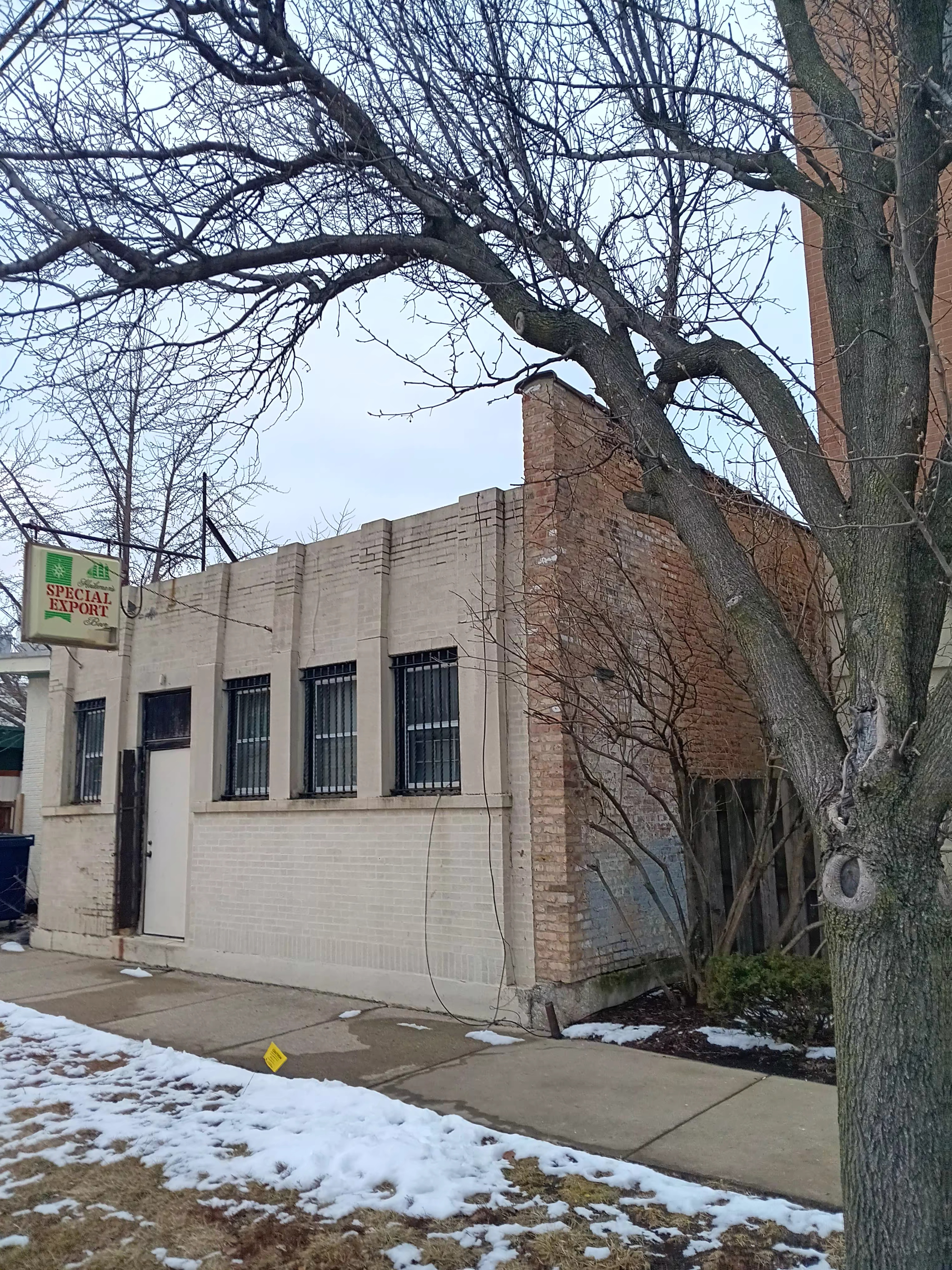
One of these four photos shows one of the Drifter’s old watering holes in Al Capone’s old hometown of Cicero. Still joyously serving customers after all these years, now with bars on the windows.
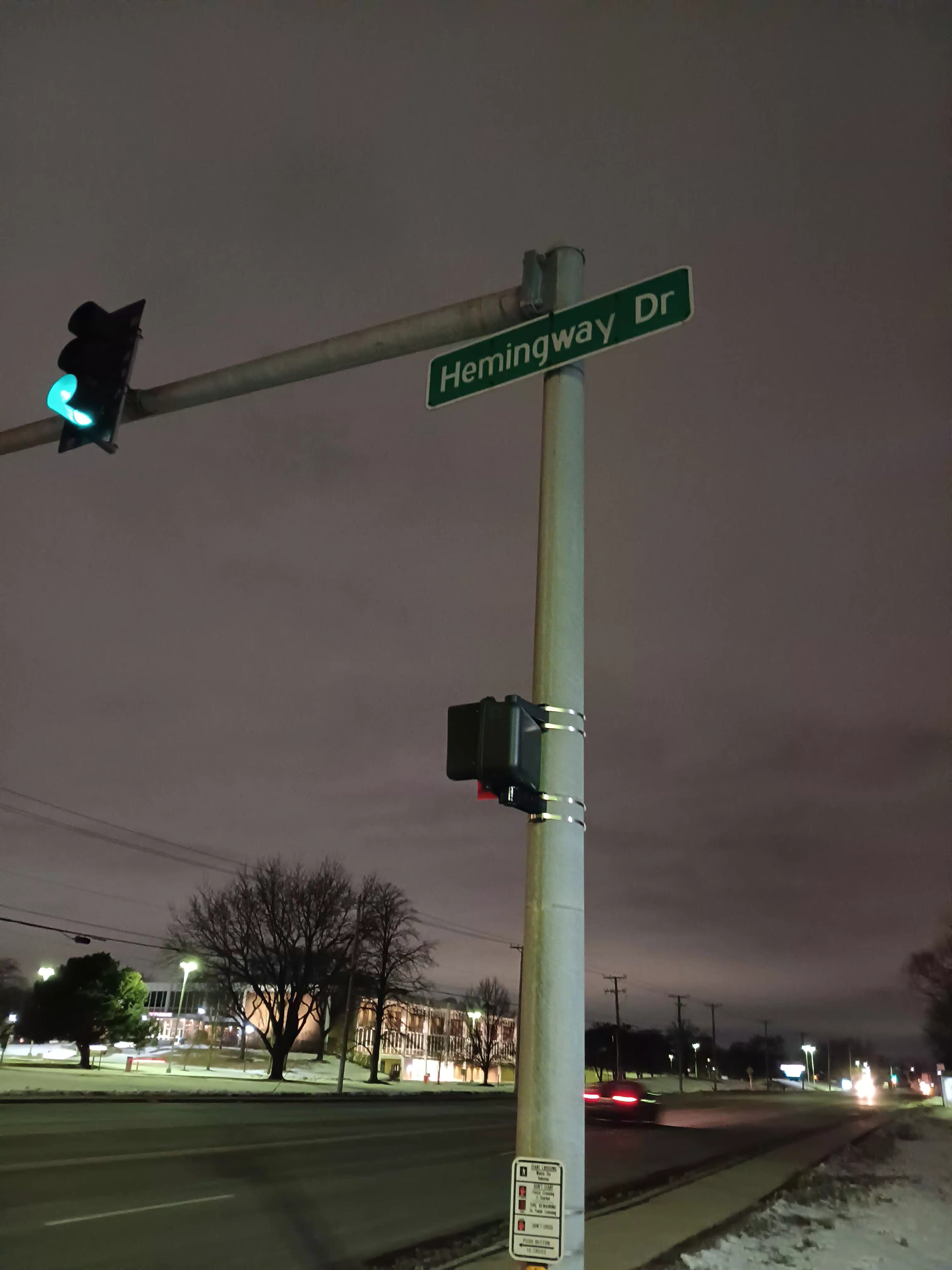
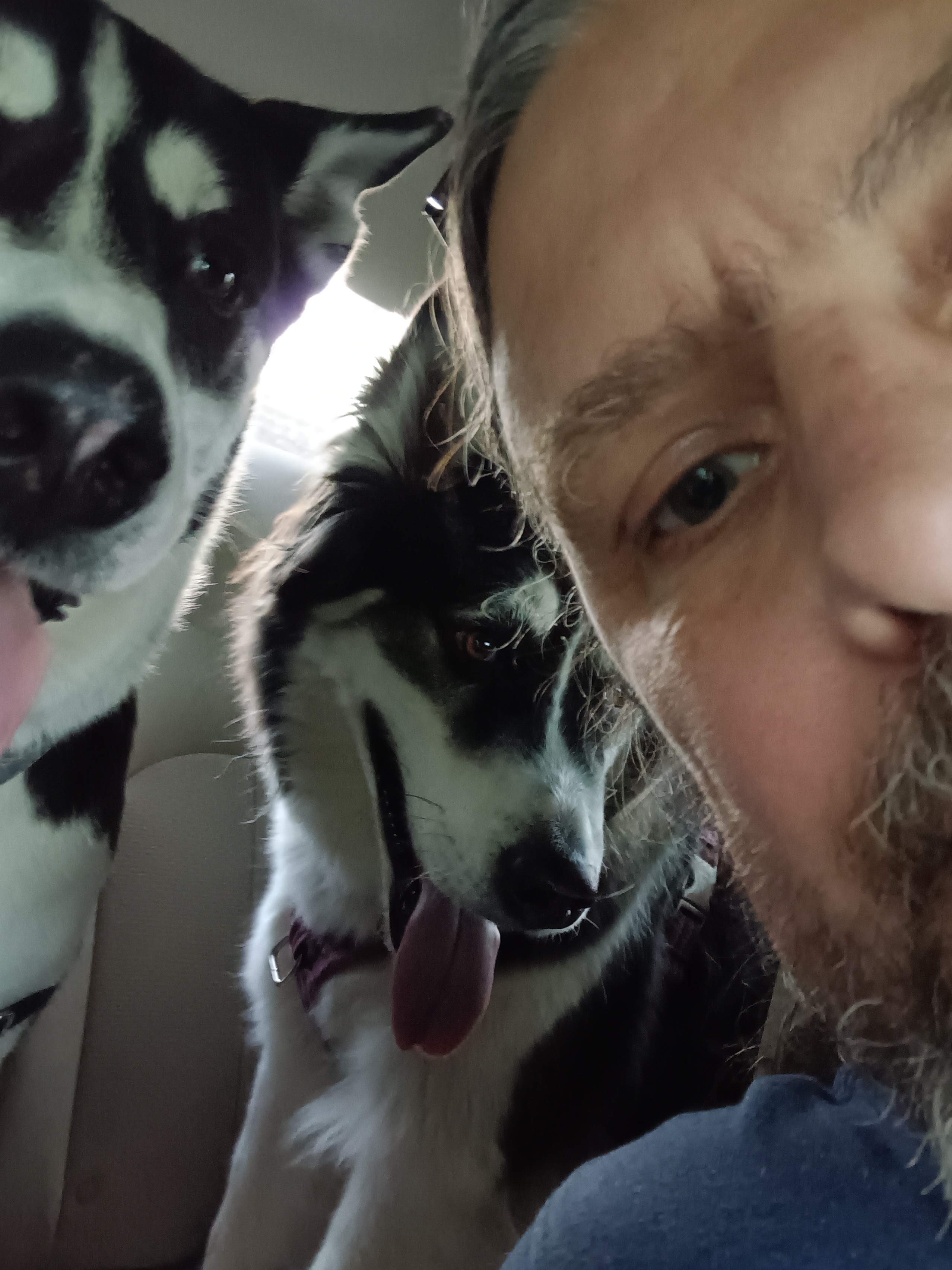
The street photo is on the campus of the Drifter’s kids’ current college, Triton. They also attended Hem’s high school. The mascot of that school is the Siberian Husky. The yearbook cover for the Drifter’s kids’ senior year showed a Siberian Husky wearing a stocking cap and asking, “Where’s Hemmie?”
Harold Bloom has an utterly brilliant essay in which he proves that Whitman’s line, “I am the man, I suffered, I was there” (about the Civil War and all life) is the source not just for Hemingway’s writing style but for his whole life.
(The essay is so brilliant that Bloom wrote it again across decades at least ten times (changing little)).
Whitman had a stroke at the age of 53, never married, and lived from 1819 until 1892, almost all of it except for a few months in the New York area and then Washington, D.C. during the Civil War. Like Lincoln, his hero, he never traveled abroad.
He was a volunteer nurse during the Civil War. He worked, for free, in Washington, D.C. with both Union and Confederate soldiers. He did things like hold the soldiers while they were dying and sit by their bedsides trying to give as much aid and comfort as possible while they struggled to get through the most hideous wounds imaginable. He also helped them write letters home, and he wrote the letters home to the families after his patients had passed on. Most of the people dying or missing limbs (or recognizable faces) were 25 years old or less, often much less.
Hemingway was never a soldier. He was an ambulance driver who got blown up at the age of eighteen (200 shrapnel wounds in the legs) while saving someone else’s life by dragging them out of the line of fire.
Bob Dylan’s eight-minute-long song “’Cross the Green Mountain” is Walt Whitman on the Civil War brought to music. No one will ever be able to do it better, but all American musicians should try something with Whitman, whether Civil War-related or not.
Lana Del Rey has succeeded in capturing a different aspect of Walt in her song, “I Sing the Body Electric” (title and chorus by Walt, brilliant lyrics by Lana). (“Elvis is my daddy, Marilyn’s my mother, Jesus is my bestest friend…”)
FINALE Note (For Now); or, the Crux of the Message:
President Obama recently gave the best advice I can think of in a crisis, Whitmanic advice: “Don’t sit around waiting for someone to come and save you.” Jesus said the same: “The kingdom is within you.” The essential advice is: “SAVE YOURSELF (look inside).” Beyond that, exactly what saving yourself means will be very different for every single human on the Planet (and it might drastically effect what happens after we are no longer on this Planet in physical form).
Dostoevsky and Bonhoeffer both proved that saving yourself can be done even in front of a firing squad – even when imprisoned by the Nazis.
“Nero can kill me but he can’t harm me.” – anonymous Stoic philosopher
The Tufted Titmouse shamelessly workin’ the pole at Big Daddy’s.
The Mississippi Kite was way off course in a nature park near Indianapolis. Many of our fellow birders flocked in to see it, careful not to disturb.
The “Chipping Sparrow” is one of the smallest sparrows. A friendly little bird that will help themselves to your black sunflower seeds and seedcakes for dessert.
The Sandhill Crane a large marsh bird who’s got the moves.
THREE O’CLOCK IN THE MORNING IS THE WITCHING HOUR. Forget midnight—too many pyre-inclined mortals are still awake and bungling about for sticks and matches at that time. No, what witches crave is a highly unpopulated hour to perform proper witchery in; an hour indistinguishable from the way things go in the grave.
Joey had begun to think of herself as a witch. Really not much else to do—not when you are awake, again, still, at 3:00 A.M. Up until the freaking three-A-of-M on the morning of June the eighth (the eighth, mind you), Joey’s knowledge of witches involved the usual school-patter about Salem, Massachusetts, The Wizard of Oz, and that old-timey staple of retro-TV, Bewitched. Joey saw something wrong with the Bewitchedset up. Yeah, yeah, it’s just a show, I know, I know. But the idea of a powerful, beautiful witch getting married to become the barefoot and pregnant slave of some asshole with a face like something wonked-up by Dr. Seuss pissed her off. In her current state of being pregnant and six days past the due date for her first (and only–goddam right there, baby) child, Joey’s estimation of the male side of the human race was at an all time low; and with it being three–No! three-oh-two, in the morning (again and still) her rating of the fellas continued to plunge.
Lying there in the feeble light cast by the clock radio, she took stock of her sleeping husband, David. Unkempt and utterly defenseless, David didn’t look like he had been wonked-up by Dr. Seuss.
Instead, he resembled Shaggy, the bungling proto-dude ostensibly responsible for a dog by the name of Scooby Doo. Between Shaggy and Scooby there were maybe six good brain cells—and Scooby has most of them. Together this duo got the better of ghosts and werewolves and, yes, witches by the third station break. In the real world these individuals would be bilked for all their Scooby Snacks by online Nigerian princes. But not in TV-land—Oh, no. In TV-land men and their toadies are far more clever than witches. David was a mortal. It remained to be seen just who was more clever, now that it was the Witching Hour.
By the time the clock radio informed Joey that it was 3:04, Joey understood that she needed to complete an action of some sort that might allow her to sleep; an action that lay somewhere between prank and violence; an action that would make her current displeasure of her current situation the current number one topic in the mind of God. Forget the poor, the diseased, the unfairly persecuted–God did nothing for those people anyway, so she could have a moment under the spotlight and not fear any sort of karmic repercussion down the line. Plenty of justified complaints swirled about her over-charged brain; they swirled like waves of graveyard bats. For instance: why a clock radio? How backwards. There were at least six cells in the house that had alarm functions. Why not a rooster? Why not let one of those cox-combed menaces have run of the bedroom? Why hold on to a relic that you had from childhood? Something that his mommy probably bought for him. Go on, get a fucking rooster, let it terrorize your wife and mother of your child while you sleep away blissfully and oh so…
“KOH-zee,” Joey hissed softly. And she smiled the smile of persons who understand that the rules of logic do not apply to them. This was/is/always will be the Wiccan Way. The epiphany was given extra juice when the voice of her obstetrician, Dr. Milo Vance, spoke in her mind, in the form of a phone call that had taken place some eighteen hours previously. “Now, JoAnne,” he clucked, like a rooster (clucking is as close to mocking laughter as roosters get), “you have somehow misconstrued an estimated due date as an oral contract.”
Dr. Vance had probably added some chickenshit advice to that, but Joey couldn’t say because she had hung up on him. Then fucknut didn’t call back as she had fully expected. Required. Arrogant quack. Quacking clucking strutting mixed-up duck-rooster monster.
Joey reached down and plucked the family sized box of Lucky Charms that stood on the floor by her side of the bed. It was either it or her phone, but it was on the charger–plus it had become a bit of a bore, constantly siding with the world view of Dr. Cluck Cluck to whatever prolonged pregnancy questions she put to it. Lately Joey found amusement belittling and bemusing the Google Gemini AI for its lack of compassion. But you can only shake a cage for so long–plus the gizmo was way the hell over there, across the room. Anyway, this was an occasion in which only food would suffice.
Joey was amazed by the wonder of Lucky Charms. She had known about the stuff as long as the average person, but it was not until the last month, at the ripe age of twenty-four, that the awesome splendor of Lucky Charms opened for her. Being a lady of refined and ever-changing tastes, Joey had developed a gourmet’s knowledge of Lucky Charms over the course of the past month. The brown filler, which resembled horse chow, was good enough to cleanse the palate; it allowed the complex subtleties issued by no less than two hundred or so calcified charms to mince at the tip of her tongue.
Except for the stars…Joey wouldn’t rather eat a steaming pile of dogcrap than one of those grimy orange stars, but that didn’t mean they were far off from a similar estimation.
“Jesus Christ, Jo, why won’t you eat the stars? Isn’t all that stuff made from the same shit?”
Even in the darkness, only slightly aided by the glowing numbers of the clock radio, Joey was able to remove the stars, mainly by feel. By 3:23 a little pile was building near her water bottle, which stood beside the glowing clock radio on the nightstand–if six and one misread moon constitutes a little pile.
She reran David’s statement about the stars in her mind. She added a merry little light in his eyes and an insulting tilt of his head to the rerun, a tilt like that of his ever incredulous Mommy.
She struggled up onto her elbows and gazed at him with extreme virulence. “Because they taste funny, fucker. How dare you and your mummy think, I, your wife, and mother of your child, mind you, double dare say the stars are good enough for me.” These words seethed across low and quickly. Temporarily sated, Joey opened the water bottle and took a drink. Inspiration struck. She then poured a little in the bottle’s cap (again by feel and by the glow of the clock which now read 3:27). Joey dipped the stars (and ate the misidentified moon) in the cap and stuck them to the side of David’s neck, good and firm. The concept was to create a star for him to see upon waking. But to do that she would require far more materials, at least nine.
Then it happened. Precisely at the click of 3:28 it became evident that whatever Angel or Demon in charge of JoAnne Carter flipped a switch and the birth machine kicked on all at once. Water broke, contractions began and Joey rammed her thumb (a time honored attention getter for a girl who grew up with four brothers) into David’s armpit and yelled “Up Fucker!!! Now Now Now!!!” directly into his ear.
*****
A Brief Intrusion by the Author
As it should be the case in all fictional stories in which a baby is born, it went perfectly and there were no complications and the child, a girl (name her whatever you like), entered the world just before dawn on 8 June of whatever year you would like it to be (as long as you understand that cell phones and Lucky Charms must exist at that time–unless you want to go to the trouble of inventing a parallel universe for those to be around in the 1920’s–your call. Seems like needless work to me, but as staged, your call).
This tale is based on actual events that occurred in 1986 and it pleases the writer that all three parties are still about in the world and none have ever gone to prison or run for political office, which is always a good thing to know. Yes, it has taken nearly forty years for it to get this far. It predates cell phones that came along, as well as Wikipedia. But Lucky Charms have always been the soul of it.
Therefore this tale is one of the oldest in the Leila Allison canon, actually the Irene Allison collection–or should I say half story because I, Leila and Irene, have never discovered a decent way to end it. But now that forty years have passed (or will this June–the actual date where most all else is fabrication–except the Lucky Charms, which did happen), I, Leila, feel a strong need to complete Overtime and release it from its almost eternal mooring in the boatyard of my mind.
For an ending, I could baffle the readers with bullshit. Do you know that a “hidden key” could be summoned in the charms with the addition of milk in 2005 (when the tale was a callow nineteen)? It’s all right, do not curse your ignorance, few people know about it. It preceded the arrival of the hourglass charm in 2008 (remember the Year of Change, Americans? Overtime turned twenty-two that year. Again it is all right if you do not because that was political jargon which has the shelf life of Mayfly shit and should not be taken seriously). 2008 was also the year that the creepy looking cartoon Leprechaun’s name was changed from “Lucky” to “Emerald Elder.” The only thing interesting about the change is that someone was actually paid to come up with the name, which, perhaps for me only, is the most pedo-sounding name since Wacko Jacko and/or Rupert Murdoch.
Sigh, as you plainly see, thinking up an end for Overtime has been a challenge. So I have dusted off the original closing and now present it to you, the Patient Reader.
The Ending
As you already know,everything went well at the hospital. Sometime after sunrise, Joey gave birth to a hella-noisy little girl named Susan Marie (You still may call her what you want, but Joey chose Susan Marie. The first for Joey’s mother, the middle for David’s mummy, who noticed the rank but couldn’t really say shit about it without coming off like a bitch–which was Joey’s intent, also figured out at three in the morning).
Sadly, David missed the delivery because he needed three stitches sewn into his head on account of his recklessly nailing it on the clock radio after he had “dreamed” that someone had shouted “Up Fucker!!! Now Now Now!!!” into his ear. It should be stated that everything went well except for David banging his head during the hectic moments after the said Angel/Demon had flipped the switch. But considering he had little to do with the physical part of the pregnancy after conception, he was wise enough not to bring up the subject for twenty years, and at that time he quickly dropped it remembering that the possession of an occasionally leaky memory was one of the key aspects of a lengthy, if not entirely happy, marriage.
Eventually, the newly minted family of three got together for the first time. This happened in Joey’s room, which she had to herself because of Susan Marie, whose deafening howling power matched that of a possessed leaf blower. She was perfectly healthy, just someone who enjoyed self expression early and often. Normally hospitals treat and street mothers ASAP, but in a rare bit of genius David had paid for a two day stay ahead of time. Motivations for acts of genius are often cast under the light of suspicion, as do their sudden appearance in literature. The best thing to do there is “go with it.”
“Does your head hurt much, darling?’
David almost answered honestly but he was (and remains) always smarter than he looked.
“Ummmm, no,” he said.
Susan Marie gave up the howl and gave both her parents a knowing glance over, even though science says such is impossible for children her age.
“She seems to be sizing us up,” David said. He extended his index finger toward Susan Marie’s hand, which she grasped and held onto.
“I swear she’s smiling Jo–can they do that this early?”
Joey laughed. “She’s a Daddy’s girl,” she said. And she was very happy to know it because right then and there it was clear just who would be bringing th bottle at the Witching Hour.
(This Saragun piece will appear at 3 A.M. Pacific Time, USA, to honor matronly Witches)
“The great enemy of clear language is insincerity.” – George Orwell
“All bad poetry is sincere.” – Oscar Wilde
“During times of universal deceit, telling the truth is a revolutionary act.”
– George Orwell
What is art? asked Leo Tolstoy of himself and his readers in the late nineteenth century.
He had many answers – because he was possibly the most comprehensive writer since Shakespeare (or one of them) and there are many answers.
One of the answers which Vladimir Nabokov, author of Lolita, provided was this: “divine play.”
Vlad said art equals “divine play” because nowhere else and at no other time does the human subject get closer to the divine than when creating art.
And the second part of the equation is equally crucial.
If it were real, we wouldn’t be able to digest it and allow our imaginations to work upon it in the same way (thereby helping us create our own identities among many other practical tasks, like helping us decide what to do when we realize that “the mass of men lead lives of quiet desperation” and soon it might be you, too).
If we were really watching Hamlet slaughter everybody and be slaughtered in turn, our reactions would be quite a bit different at almost every level to say the least, starting with physiology.
The Danish philosopher Soren Kierkegaard thought art was “indirect communication.”
If you just stand there spewing out (or hurling out) all your preconceived and received (and stale) opinions, this is propaganda and obnoxious behavior, but it isn’t art.
Jesus said, “It isn’t what goes into your mouth but what comes out of it that makes you sinful,” and how I wish this quotation were read aloud from endless pulpits every single Sunday in the USA, from Maine to Timbuktu.
It seems pretty clear that there are three categories of art.
The gigantic bottom.
The vast middle.
And the higher realm/s (and levels of the high/er, from the bottom of the higher to its very top).
The bottom revels in sensationalism, titillation, distraction, the same old same-old yet again (and again). (“Entertainment” and art are not the same thing.)
The higher kind lasts much longer, sometimes many, many centuries, because it goes deeper as well as higher – the mind, the heart, the body, the soul of the human are there in higher kinds of art in ways that they simply are not in the gigantic bottom or even the vast middle.
The gigantic bottom is more popular in the moment, just as the higher kinds of art are far, far more lasting and durable, and therefore much more popular, in the long term.
Shakespeare said, “So long lives this and this gives life to thee,” while one of Shakespeare’s American heirs said, “There are many here among us who feel that life is but a joke.” (During Shakespeare’s day, the population of London, largest city in the world, was around 200,000. The population of Des Moines, Iowa, USA, today, in 2026, is around 200,000. The world has changed.)
Bob Marley, the Jamaican Shakespeare, said, “How long shall they kill our prophets, while we stand aside and look? / Some say it’s just a part of it – we’ve got to fulfill the Book.”
I was almost shocked one time when I heard a Catholic priest say quite clearly to a church full of restless elementary school children, “The story of Jonah and the whale isn’t a real story. No one has ever been swallowed whole by a whale then vomited out upon the shore fully intact three days later. It isn’t a real story. But the truth it tells is real.” (He then went on to use the word symbolic and explain what it meant.)
The anonymous Jewish author who wrote the thousand-word story of Jonah and the Whale also didn’t think the story was “real.” He, or she, too, knew that the story’s truths were internal, representative, real only in the sense that they tell it like it is, so to speak (the outward facts are not what the issue is when it comes to art).
…
The book of Genesis in the Bible contains not one, but two, creation stories, almost completely contradictory in many of their aspects, just as the gospels of Matthew and Luke contain two different accounts of where Jesus came from.
Neither of these facts either prove nor disprove anything having to do with the existence or non-existence of a Supreme Being, a Creator God, an Unseen Power that lives well beyond, or inside, us, or both.
I have heard many people who claim to be agnostics give fevered atheistic (and veiled capitalistic, materialistic) explanations for why they are agnostic, apparently not understanding the difference between agnosticism and atheism, especially in American academia, where such arguments are the dominant mode of thought and have become utterly stale and unoriginal. People parrot these kinds of things because they think not doing so will make them look bad.
Some of us turn to God when we can no longer stand the pain (or the meaninglessness).
Art is the thing that helps put us in deeper touch with the mystery or reminds us when we forget.
The mystical branches of Islam believe people need to be reminded, not converted.
ART, not organized religion, is my religion because the first religion was art and art was the first religion.
People and people-like creatures were being nailed to crosses (symbolically) for millions of years before Jesus came along.
No wonder they called him “The Word.”
GRIPPING END NOTE: Art is also amazing because of its dual nature: alone while not alone or with others while solitary amounts to the best of both worlds combined and makes Art relevant forever!
ANOTHER GRIPPING END NOTE from The Drifter on Genre, AI, and a few other issues: The Drifter considers this piece of writing to be a comic philosophical essay on the meaning of, or reason/s for, human art. It contains elements of the personal essay through the lens of Gonzo journalism.
Since it contains personal HUMAN thoughts, feelings, actions, and reactions, AI could neither write nor read and understand this.
The comic philosophical essay is nothing new under the sun, also practiced by Kierkegaard, Nietzsche, Plato, Henry David Thoreau, and Philip K. Dick among many others.
The Drifter is thoroughly versed in the lives and writings of all five philosophers named. So much so that they appear as living beings in his dreams. This little treatise could not have been penned (and most of the rough draft was penned before it was typed, a practice I recommend to all beginning or aspiring writers, since if you aren’t willing to make the effort it won’t be worth anything) without them. In other words, it builds upon them.
I have made crucial, life-altering decisions based on the info I thought these five philosophers were giving me. Art is about tutelary spirits, connections through time, both past and future; AND your own original voice interacting with all of the above in the present.
As Thomas Paine wrote pamphlets and William Blake was an engraver and Bukowski and the Samizdat writers in Russia made mimeos, so do we all use the tools we find at hand. Nothing less; and nothing more.
It isn’t supposed to be easy.
FINAL THOUGHT (For Now): Instead of mechanical plot devices, stock characters, and unchallenging themes, Shakespeare and Cervantes, those mysterious twins, gave the world natural plots, realistic characters, and challenging themes.
(The image is a wish for an early spring taken by Leila. It is a Pacific Madrone tree, they lean and reach and do all sorts of odd things)
Greetings one and all. Today marks the end of the first complete month of Saragun Springs as a public site. Although there can be month anniversaries for public toilets, if so desired, I prefer thinking we are way above such a pay grade and are not a place for deviants to cottage at.
We are increasing our presence in listings but such things require patience and time. One thing is for certain, there will be no stress during times when submissions are low. I have over two hundred files I can present and Dale is also well stocked. I would rather not write day to day, but I will if I must.
Why? You may ask. Good question. No real answer except for the arrogant Murican standby “That’s how I roll.” The only guarantee I can give the reader is the promise that something will zap into this site the same time every night and day in this round time machine we inhabit.
But mainly I am still naive enough to believe that hard work aimed at helping is rewarded. So I guess that’s as good a why I can offer.
I also want to make every post interesting in some way. Of course the weight falls on the guest writer of the day or my esteemed Co-Editor Dr. Dale Williams Barrigar (who already deftly commands Sundays) for that on most days–yet today it is my turn to entertain.
‘T is not sin to raid YouTube for memorable entertainment. And today I believe I am about to present a person who has never been completely in the limelight, yet deserves much better than what he got.
I have chosen the aid of a great artist who almost broke through and would have if AIDS hadn’t murdered him in 1983. A fellow who would have turned 83 earlier this month, but was, tragically an early victim of the AIDS.
His name was Klaus Nomi, an operatic/punk/pop singer who had a great streak of art and absurdity, which he delivered with world class talent. I first saw him in a music documentary that came out shortly before his death at the age of thirty-nine. I was twenty-three and not yet mature enough to recognize his wit and reacted in a “What the hell is that?” way that I regret–but also am pleased to understand that I grew out of that ugsome “phase” if not a tad later than I should have.
Before I present Mr Nomi, who will sing two songs, I encourage one and all to submit to us. And I also encourage one and all to remember that their names will be attached to it in big black letters. A cautionary thing just in case anyone feels that Saragun Springs will absorb any more than our fair share of heat.












 Saragun Springs