“You’ve got to fight to keep your legendary love.” – Lou Reed
Franz Kafka said: “I have always been haunted by the feeling that I understand more than others, yet cannot make them understand.”
How a Reader reacts (perhaps, but not really perhaps) to this quotation says everything about who that Reader is.
Such a condition has nothing to do with formal education or monetary status. It has everything to do with the core essential Self.
All can read the quotation on a literal level.
Those who scoff and mock are in a VAST SUPER MAJORITY, while those who ponder and understand are in the tiniest of tiny minorities.
The quotation can be interpreted at least two general ways.
One: It is about the plight of the modern artist, even more now in 2026 than ever before.
Two: It is about the plight of modern humanity (what they used to call “modern man”) in general. That is, ultimately this is about the Universal All in the modern world (the modern world that started in its ultimate beginnings ten or twelve thousand years ago as far as we know it now).
Kafka’s three perhaps greatest works explore this profound, essential, existential condition in a way that few others have ever done.
THE BUG: the man who turns into a literal insect because he is so persecuted by both society at large and the basis for all society, the family.
THE TRIAL: the man who’s punished, ostracized, exiled, and finally murdered by society for absolutely no reason he ever even has time to figure out (he dies as a young man with a kind thrust of a knife into his chest by two strangers).
THE CASTLE: the man who must attain shelter within the Castle or freeze to death outside: and who’s only let in by “them” when it’s already too late.
Kafka’s (so-called fictional) prose visions are not “nightmarish,” they are realistic. They are dreamlike, but they are not fantastical. The world has not always been like this, but the world is like this now.
In the end, everyone is crucified, even Judas.
Dale the Drifter (images provided by Dale the Drifter)
Dolly Parton’s grandfather inspired her entire life in numerous ways. He was a wandering preacher who also played music. In many parts of Appalachia, preaching and music and religion and happiness and the Good Book all go together. Dolly was a gorgeous flowering of all that.
Their kind of religion is not the bad kind of religion. It is not even the judgmental kind.
It is the life-giving kind, the happy singing kind, the joyful kind, the everything-will-be-okay-including-DEATH-ITSELF kind.
In this kind of religion, anyone who suffers in any way at all is seen as holy instantaneously (more holy than they already were), and as someone we should all LOOK UP TO, not pity. Even children. ESPECIALLY CHILDREN.
There is little pity in this kind of religion.
What there is here is LOVE. Just love. Only love. All love. And love is the only thing there is. Even when it doesn’t LOOK (or feel) like it at all. You don’t even have to believe in God.
The best preaching never happens in churches, as Dolly’s grandfather knew very well.
It happens on the streets, on the sidewalks, in the parks, in the mountains, in the cities, or anywhere just one person suddenly feels the Holy Ghost inside and decides to connect with another “just one” person who also feels the Holy Ghost within themselves. These are epiphanies, moments, flashes of sunlight from behind the dark clouds, not constant things; but they leave an afterglow.
You can be gay, you can be trans, you can be black, white or green, you can be any color or creed under the sun or above it, you can be anything you want to be and already are.
The best preaching is informal, brief, fast, sudden, spontaneous, and OFTEN WORDLESS.
It often happens in less than a single second, with a single glance of the eyes. And then you pass on by. You always pass on by.
All it takes is two willing people who will remember one another even though they don’t even know each other’s names.
“Every heartbreak makes it hard to keep the faith.” – Lady Gaga
In some of her guises (or disguises), Lady Gaga is a true inheritor of the Dolly Parton legacy, just like Whitney Houston (who died because she couldn’t slow down).
Dolly and Gaga both stood and stand around 5 feet tall in their bare feet. Such connections between artists are somehow not meaningless, and are worth noting (and studying) (or I wouldn’t notice, note and study it). (Chekhov studied his actors very carefully from behind the scenes.)
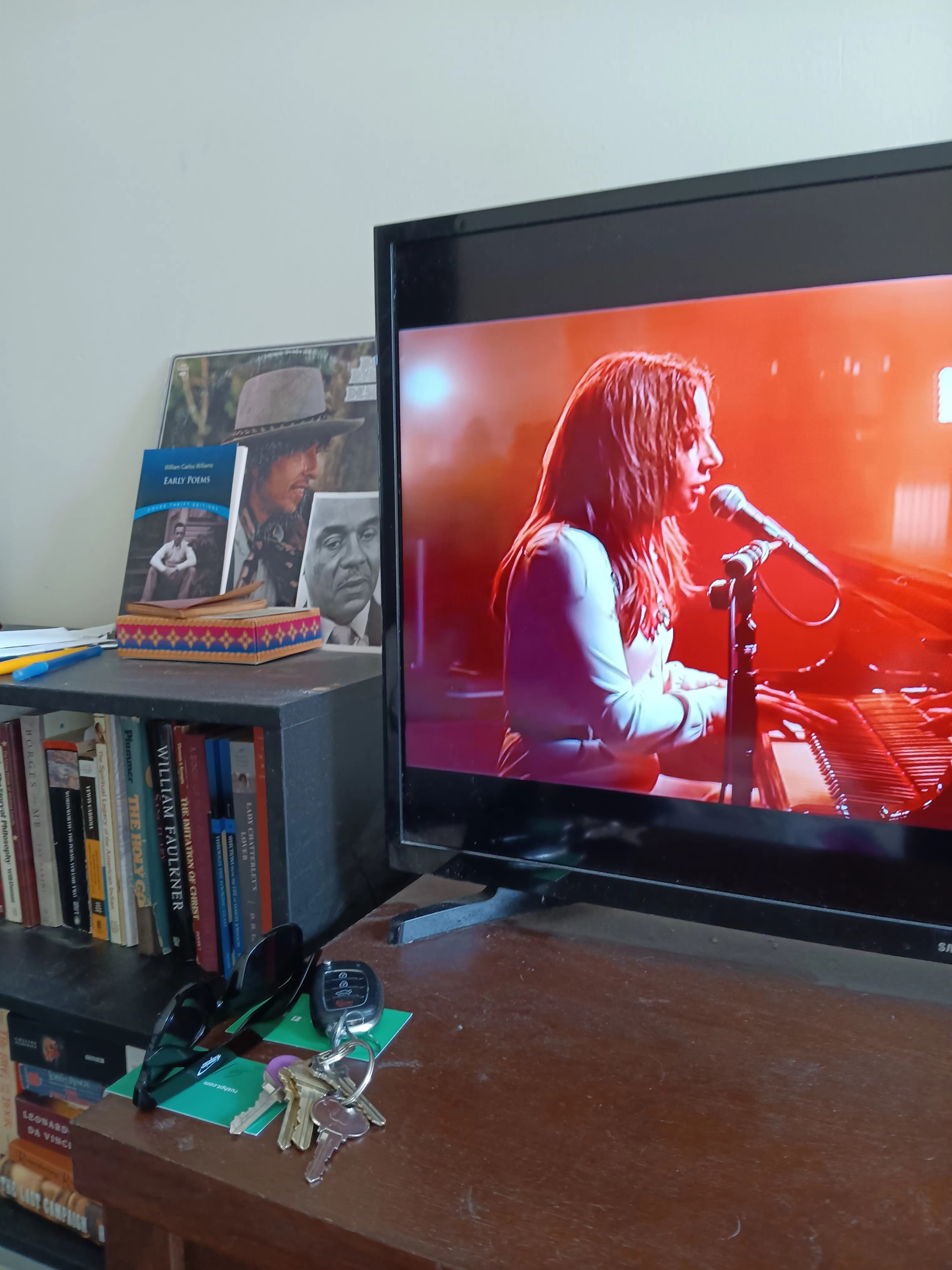
As Lester Bangs would’ve told us all too, were he here at the moment (but I’m sure he’s somewhere else), the attached musical performance is, without any doubt whatsoever at all, one of the greatest American musical performances of the twenty-first century: and probably of all time.
In this single performance, Lady Gaga joins the late Elvis, and opera singers, at the highest of high heights. Wow!
Notice that she doesn’t dance around while singing. That’s because you can’t dance when you’re singing this good.
But notice how she acts. Her gestures, expressions, movements are part of why this is such great a performance.
But this performance should be studied three ways. One: listening to just the music. Two: watching the video while listening to the music. Three: watching the video without the music.
You should also study, for sure, her beautiful backup singer, especially her eyes.
(And listen to the crowd.)
People like Lady Gaga can’t operate, at all, without people like her backup singer: and the crowd (the small crowd, that is).
Kafka wrote brilliantly (but every unpublished word that fell from his midnight pen was brilliant) about how Sancho Panza and Dapple are just as important as Don Quixote and Rocinante – if not more so.
This performance begins with these words (her eyes hidden in shadow beneath her cowboy hat): “My name is Lady Gaga. Tonight if you could just call me Joanne.”
Lady Gaga just had her first baby at the age of 40!
Congratulations, Gaga and Joanne, at every level I can possibly think of and imagine!
“The time will come when you’ll be blue.” – Hank Williams
It is hard to see someone crying (mostly genuine) tears over you even as you know they’re cheating on you (even though they won’t admit it to you) as you say, with great and utter finality, “I’ll see you around.” Your own tears do not appear in the moment; they appear, unannounced, years later, when you are long gone, somewhere else.
Willie Nelson, perhaps the greatest heir of Hank Williams of all time, used to cheat on all of his wives, all of the time.
And all of them would catch him at it. And the thing is, HE WOULD NEVER, NEVER, EVER admit it, not even when the women placed the red-handed evidence right in front of the Red-headed Stranger’s face.
And I know how that goes. It is called “acting” like nothing ever happened, and some of us are (just naturally) as good at that kind of acting as Marlon Brando was at the art kind of acting (and he is the greatest American actor of all time, alongside Marilyn). (Addiction is a great teacher of acting: “No, OF COURSE I haven’t been drinking again,” etc. etc. etc….)
The song, “Your Cheatin’ Heart,” is a song that has been said to literally DEFINE ALL OF modern American country music.
Hank dictated the lyrics to his fiancé, about his recently ex-wife, as they rode/drove in a car from Tennessee to Louisiana. The lyrics suddenly appeared before him, almost as in a dream, all in their full glory, and he just let them come out, while she wrote them down. When something like that is happening to a person like Hank, you don’t take time to criticize, IF you understand him at all, which she did. (Hank also died in a car not too long afterward – literally.)
His voice as he sings this song is powerful, brokenhearted, and hillbilly. The powerful and the brokenhearted are utterly raw and natural. The “hillbilly” is/was entirely an act, but a brilliant act, like a Shakespearean thing.
Hank was also one of the first people to take the cowboy hat out of the American West and move it on over to the US South. Now, cowboy hats are everywhere down there, like in Nashville (even though they kicked him out when he was alive). Yes, the cowboy hat thing is because of Hank, who sometimes called himself Luke the Drifter. And that is just one reason why (just one reason why) he really is the Shakespeare of American country music. Country music, along with the blues and folk, created rock and roll. Just one reason why Willie Nelson is great is because of how he combined “hippie” and “redneck” and turned them into something all-new.
When Ray Charles sings this song, his voice is sad, slow, sweet, stately, surrendering-to-the-moment, soulful: “truth and beauty,” to quote John Keats, who has a lot more in common with Ray and Hank than most people will ever know (or care to know). Just one reason why Ray Charles is great is because he could sing ANY kind of music with utter conviction, which is also Shakespearean.
“I love you, baby / but you gotta understand, / when the Lord made me / he made a ramblin’ man.” – Hank Williams
The song “Ramblin’ Man,” written and sung by Hank Williams, ends with these words:
“And when I’m gone /
And at my grave you stand /
Just say God’s called home your ramblin’ man.”
Hank was 29 when he expired in the back of a car being driven by a college kid he’d hired on the way to another gig in the middle of America.
Exhaustion, chloral hydrate, morphine, alcohol, amphetamines, nicotine, caffeine, probably a few other drugs, and very, very little food for a very, very long time can be said to be the direct cause/s of his death, i.e. his sudden heart failure in the middle of the night in the back of a car blasting across the American heartland.
Neil Young, who’s 80 now (the age Dolly Parton was when she passed on), and who had his own big-time drug and alcohol problems, and who is a direct descendant of Hank Williams, like Dolly, Leonard Cohen, and Bob Dylan, once said in a song, “It’s better to burn out than to fade away.”
Machine Gun Kelly (MGK) says in his song “27,” “They say I need to slow down, but I don’t know how.”
Those twelve words strike me as being one of the best explanations for the 27 Club I’ve ever heard.
The best singers do not sing only about themselves, just as the best writers do not write only about themselves – they sing and write about all of us, very often when it looks like (on the surface) they are writing or singing mostly about themselves, like Hank in “Ramblin’ Man.”
AND IT’S UP TO US TO MAKE THAT IMAGINATIVE CONNECTION, INSTEAD OF SITTING BACK IN OUR COMFY CHAIR WITH OUR EXTRA-LARGE BAG OF BUTTERED POPCORN AND TOSSING SPITBALLS AT THE ONE WHO IS TRYING SO MUCH HARDER THAN WE ARE.
And some real artists (everything in our world is either real or fake), when they live long enough, learn how to slow down – at least enough, for a while.
(The song “Ramblin’ Man,” as performed by Hank, is very close to a spoken word poem, which is probably why Sam Shepard loved the song so much and used it so often.)
In honor of these departed kids and others of their ilk, whether “famous” or not, HERE is a list of twelve members of the 27 Club. They weren’t all 27 exactly (at their passing). Some were 29, like Hank, or 26, like Mac Miller and Nick Drake, or 25, like Tupac Shakur. (8 of 12 were exactly 27.)
Hank Williams. Robert Johnson. Mac Miller. Tupac Shakur. Janis Joplin. Amy Winehouse. Brian Jones. Jimi Hendrix. Jim Morrison. “Pigpen” McKernan. Nick Drake. Kurt Cobain.
This week Saragun Springs celebrates the spirit of Dolly Parton through a celebration of the music of Hank Williams, because DP loved Hank Williams and because Hank Williams is the William Shakespeare of American country music.
Bill Maher said a lot of obnoxious, hypocritical things about Dolly when she died. His comments show that he, like everyone who laughed along with him that night, judges life through the material lens of the Golden Calf ($) only.
Dolly, I do believe, was different.
As a cultural figure in American life, she was the counterpart, in many ways, of Willie Nelson. Both artists cross boundaries almost like no one else.
Bob Dylan and Leonard Cohen are literary geniuses, but it cannot be said that either one of them reach “all” audiences in the way Dolly Parton or Willie Nelson do.
In their ability to be popular with (almost) everyone, Dolly and Willie are more akin to Elvis and Johnny Cash than to Dylan and Cohen.
There are many people who do not like Bob Dylan for a huge variety of reasons and, before he died, there were many, many more people who did not like Leonard Cohen either.
They thought Cohen was BORING and gloomy and confusing, IF they thought of him at all, which they rarely did.
(Cohen’s status changed radically with his comeback tour in 2008 – 2013 and then after his death.)
One of Dolly Parton’s favorite songs by Hank Williams is called “I Saw the Light.”
She performed it many, many times.
As with Robert Johnson, Hank’s music sounds old-fashioned at first; IF one is not listening carefully.
“I Saw the Light” is not just a Gospel song, and you do not need to “believe” in Jesus, or even God, to get a lot out of this song.
This song is about a privileged moment.
A privileged moment here does not mean what “privileged” means in the currently politically correct sense.
It means an epiphany, which is an intense, life-giving realization that doesn’t last forever but has strong echoes and reverberations.
Being “in the zone” is another way to put this in modern terms.
Wordsworth called all this and all these: “spots of time.”
They do not last.
But they leave a lingering resonance.
True and real artists cannot, and would not, ever, create anything at all, without privileged moments, epiphanies, being in the zone, having spots of time.
You can choose to take these spots of time to the next level and believe in life after death, like Dolly and Hank did and Bob Dylan does.
Where the white people live/d Jesus is depicted as a white guy and where the black people live/d Jesus is depicted as a black guy and in Japan he’s depicted as a Japanese guy and in India he’s depicted as an Indian guy and in Mexico a Mexican and for Native Americans he’s a Native American, and so forth. He’s the greatest shapeshifter who ever lived or ever will live. That’s just one reason why there are four canonical accounts (four perspectives) on his life none of which agree on all the details.
Michael Jackson, Elvis, The Beatles, Donald Trump, are NOT the most famous humans on the Planet and have never been the most famous persons on the Planet and never will be the most famous persons on the Planet, and not even close, although there are many (who are in the wrong on this) who have said they are the most famous persons on the Planet.
Jesus is the most famous person on the Planet. And he has been so for at least 1,500 years. His spirit was alive among humans long before he actually put feet on Planet Earth.
Sometimes I wonder why that is.
There’s something deeper going on here.
And just because we cannot see it doesn’t mean it isn’t there.
Dale Barrigar
And how about some bonus Hank from some of country’s Big Names
This week the hapless schmuck who sometimes calls himself D the D (which is a way of marking the passage of time, the shifting of personality, and the ongoing, never-stopping flow of human evolution) offers little more than quotations by another writer (at the end).
This is NOT because the Dale Barrigar guy behind the Drifter persona (character) has nothing to say, but because this week he has decided that only Saint John the Divine can say it better.
When he wrote the 12,000-word book REVELATION, John was an exile on the island of Patmos. In other words (as with Ovid, Dante, Dostoevsky, and too many others too count), they kicked him out and sent him away. When they sent Dante away, they said to him: if we see your face around here again, we will chop off your head and burn you at the stake. And they definitely meant it.
No wonder he went away and imagined them all in hell for the rest of his life (until he started writing about heaven when he figured out he was about to go there soon). He loved his home city and his home region and never saw it again. He started loving Beatrice instead, who he had seen in the flesh exactly two times, nine years apart, for less than one minute total. She inspired the most beautiful, heavenly, memorable dream he ever had in his life.
Us folks in the USA often cast stones at Russia because they’re always sending everyone to Siberia and we should indeed do so if we value human freedom at all.
But in the meantime, us Americans should also look around us a little bit, since we have our own AMERICAN SIBERIA that is more invisible but no less (usually) PSYCHOLOGICALLY traumatizing.
Psychological trauma, or damage to one’s brain and personality, causes physical pain and illness, too. But many people also often forget that struggle and trauma also (often) cause IMPROVEMENT in the one who undergoes the trauma; very often, that is, they become, and continue to become, a better person because of it.
In 2014, there was a guy in Chicago who lost his job because of TEACHER BURNOUT (after twenty years), wicked bipolar depression, and contentious disagreements about technology usage in the classroom (he was very much against it, and they were very much for it, and trying to force him into it) with the “powers that be,” then couldn’t find another job because of current conditions.
Eventually he tried everything else, including manual labor and clerical work in a book-binding warehouse. Then it was slaving away twelve hours a day as a vastly underpaid (making the equivalent of less than minimum wage in Illinois while being responsible for seventeen students including during the covid pandemic since the Catholic schools went back right away, at least half of the students having behavioral problems and three of them having medical conditions so serious that they required near-constant monitoring; one undersized kid’s lips would turn blue from a heart condition, another obese one would have a diabetic emergency, and a third would have what appeared to be seizures from his autism; there were three girls in the class who were like brilliant angels and a few other students who he stayed for), Catholic elementary school teacher. He left all the other jobs he attempted, including this one, only after literal mental and physical collapse: manic depression again, but also the impossible circumstances.
Since he had never been on Facebook because he hated it and its creator the moment it came out, all of the people who used to know him back in the old days thought he was either dead, or most likely in jail, or even more likely, the madhouse.
He was aware that most of the people who used to know him thought this about him, and a few people seemed way too comfortable telling him to his face that they thought it.
A decade of internal exile occurred (time slips away so fast), but during that time he also continued working on something else very happily in secret.
And he quietly turned himself (almost without knowing it) into someone who could, quite simply, do all the things he’d ever wanted to do.
In the meantime, there was one half-assed suicide attempt caused by hypomanic insomnia (three Adderall, nicotine-patch, caffeine-fueled days of no sleep) leading to total, stumbling, falling-down, not-thinking-straight, delirious exhaustion.
He was saved when he looked over and saw his Siberian Husky puppy sitting there looking at him in deep concern, which immediately made him drop the suicide idea he was half-pondering and rush over to comfort the dog instead.
He also had several other bipolar nervous breakdowns that were not job-related (a few of which did indeed land him in the hospital for a little bit), an ongoing battle with more substances than can be listed here, a stroke that culminated it all, and a war against anonymity that he ended up winning so successfully that he now embraces his anonymity and seeks to extend it indefinitely and as long as he can.
The handful of other authentic, genuine literary artists (not just writers, who are cheaper than a dime a dozen, and not even just good writers, who are amazingly rare) he knows, or knows of, in America have all had their own equivalent battles and wars (in their own ways) with AMERICAN SIBERIA.
“BLESSED ARE THEY WHO READ, AND THEY WHO HEAR THE WORDS OF THIS PROPHECY, AND KEEP THOSE THINGS WHICH ARE WRITTEN IN THEIR HEARTS: FOR THE TIME IS AT HAND.”
“I AM ALPHA AND OMEGA, THE BEGINNING AND THE ENDING, SAITH THE LORD, WHICH IS, AND WHICH WAS, AND WHICH IS TO COME: THE ALMIGHTY.”
“AND HE SAID UNTO ME: THESE SAYINGS ARE FAITHFUL AND TRUE: AND THE LORD GOD OF THE HOLY PROPHETS SENT HIS ANGEL TO SHOW HIS SERVANTS THE THINGS WHICH MUST SHORTLY BE DONE.”
“AND HE CARRIED ME AWAY IN THE SPIRIT TO A GREAT AND HIGH MOUNTAIN.”
When the world is a dark pit, and you find yourself locked up with lunatics. Sometimes, a person needs a slice of sunshine. So that’s what this series of photos will try to capture, but alas, it’s hard to catch a sunbeam.
Then again, I don’t need my baseball glove or butterfly net. Not when I have this magical weight around my neck. It’s left the dark room behind, this is true, but I have my own just in case.
I try to explain this alchemy, as if to a five-year-old or my giant German shepherd dog, to these folks on the ward, but they just cock their heads. I talk about apertures, f-stops, and blinking eyeballs.
No respondo, Ernesto just gazes away from me and talks to people who aren’t there. All of their heads turn, and I finally have an audience.
I’m free again, on Antabuse, so I’m back with the camera therapy of nature and sunshine. The technology that I couldn’t explain to them—resting in my hands. Like a thousand picture books.
The shutter is eager to slide over its mechanical eye, snapping pictures of the sun and everything under it, but you have to be careful taking so many pictures of God.
Ludwig Wittgenstein is buried in the Ascension Parish Burial Ground, in Cambridge, UK, not far from where I live. His grave attracts its share of that tiny subcategory of gravestone tourists who happen to be interested in philosophy. I’ve visited his grave on several occasions over the years.
The austerity of Wittgenstein’s gravestone (an unadorned, epitaphless slab flush with the lawn, bearing the simple inscription: LUDWIG WITTGENSTEIN 1889 – 1951) has always seemed to me a fitting token of the austerity of his thought.
Sometimes visitors place little tributes on the stone: flowers, a handful of coins, a pinecone, or even cupcakes. The most frequent tributes, however, are tiny toy ladders.
In the second-to-last paragraph of the Tractatus Logico-Philosophicus, Wittgenstein’s first book, he writes:
‘My propositions are elucidatory in this way: he who understands me finally recognizes them as senseless, when he has climbed out through them, on them, over them. He must so to speak throw away the ladder, after he has climbed up on it. He must surmount these propositions.’
Hence the miniature ladders on his grave.
He then concludes, rather haughtily:
‘Whereof one cannot speak, thereof one must be silent.’
This admonition possesses the irrevocability – and silence – of a tomb, as if it were possible to say all there is to say, to exhaust the totality of the sayable.
On one of my visits to Wittgenstein’s grave, I saw one of these ladders, a straight ladder propped against the urn-shaped flowerpot that sits at the head of the gravestone. And only on seeing it, did I realise that I’d always thought the ladder Wittgenstein writes about to be not a single straight ladder but a self-supporting double-sided A-frame ladder, that is, a trestle ladder. Why? Perhaps because I thought that with a trestle ladder, I could cross over senselessness in an orderly (a sensible) way: I’d climb one side of the ladder believing that Wittgenstein’s propositions have meaning, and then, having at last recognised their senselessness, I’d climb down safely, and much the wiser, on the other side. There you go. Job done. That way, sense and nonsense would remain neatly separated and there’d be no risky cross-contamination.
But as I now reread what Wittgenstein wrote, I realise that he doesn’t say to climb down the ladder. No, you must throw away the ladder––so to speak. Yes, so to speak. But that’s precisely the problem: what does it mean to speak so? Where do you end up once you’ve climbed out through, on and over Wittgenstein’s senseless propositions? Would you be standing on a thoroughly elucidated, stable platform? But how could a platform resting on senseless foundations be stable?
The more I think about it, the colder my feet get about throwing away that ladder. And perhaps a trestle ladder is not such a bad idea after all.
But by 1945, more than 20 years after the publication of the Tractatus, Wittgenstein had completed the final manuscript of his last book, Philosophical Investigations, in which he rejects his earlier grand claims about senselessness and his haughty admonition to be silent.
Now Wittgenstein says that our making sense of the world involves what he calls language games, and that although we can’t form a perfect picture of how the world is, we can stitch together a makeshift patchwork of family resemblances of the world we experience. It’s impossible to say all there is to say, not because our languages are somehow inadequate, but because language games are open-ended: their rules can change, the game board can shapeshift, and you can always play one more game. Even though I hardly understand what Wittgenstein is getting at here, the expressions ‘language game’ and ‘family resemblance’ suggest an altogether homier and more human-scaled world than that of the Tractatus.
And the miniature ladders that sometimes appear on Wittgenstein’s grave seem to me to embody this change of mind that he sought to justify in the Philosophical Investigations. It’s as if these little playful tributes were saying that we can only climb diminutive ladders of senselessness, piecemeal senselessness in a vast plateau of meaningfulness (mostly?) of our own making––so to speak.
“This malignity is renewed every day against man, as it is written, Psalm 37, 32: ‘The wicked watches the righteous, and seeks to slay him.’”
– Blaise Pascal
Blaise Pascal (1623 – 1662) was one of the most brilliant scientists and mathematicians who ever lived (he invented the calculator). Suddenly, toward the end of his life (and he probably did this because of intuitions that the end was coming, although it did not come immediately), he largely dropped science and mathematics and turned to religion instead.
He wrote a mostly secret book that was not fully published during his lifetime, and also was not published until almost a decade after his death.
The title now is Pensees. It’s a French word which means “Thoughts” in English.
All of the thoughts are about religion, per se.
But the thoughts are not only for so-called “religious” people.
These days, in places like the USA, Canada, and the UK, in so-called educated circles (which are very large, made up of millions of people), being “religious” is considered a badge of shame.
I myself used to share this attitude, for years.
But I grew out of it.
I realized long ago that I “grew out of it” because of enormous personal struggles and pain that “drove me against the wall,” so to speak. In other words, the equation became, for me: believe or die. A lot of that had to do with getting over my own alcoholism, which gradually, then suddenly, turned into the most extreme variety of alcoholism ever known to humankind on Planet Earth. I never went to A.A. (except twice) but I read many books about it and devised my own form of the exact same thing.
I’ve already promised myself that if I live to the age of 80, I can (maybe) start drinking and smoking (perhaps in moderation) again. Only twenty-one more years to go!
…
I’ve been fascinated with the Russian writer Feodor Dostoevsky ever since I first discovered him and his works in 1983, A.D., when I was an uncertain, shy, questing, and rebellious sixteen-year-old living in Quincy, Illinois, USA, a town along the Mississippi River twenty miles away from Mark Twain’s Hannibal and known for producing uncertain, shy, questing, rebellious sixteen-year-olds.
There was a reading class at the high school and the teacher had a hideous skin disease that made her hands and face look, almost, like she had leprosy.
She was also enormously overweight.
She was one of the most human, most understanding women, or people, that I’ve ever met, and ever known.
She didn’t make me do any of the things the other students were doing, and had to do.
She didn’t even make me show up on time.
I was late every single day.
And she let me be late.
All I had to do was read.
During that semester, I read all of the major works of both Dostoevsky and Tolstoy. That means all of it, all of their long novels, and all of their well-known stories too. (Both of them also wrote thousands of pages of nonfiction and correspondence, and I did not read this material at that time. Wow, their hands, and eyes, must have gotten tired.) I hung out with friends a lot, but also, I did not hang out with friends a lot, at all. I stayed home, alone, reading, not because I had nothing better to do, but because I wanted to.
I didn’t write papers on the material, either.
All I did was read. And occasionally she would ask me to sit with her and tell her about what I was reading while she drank her coffee. That was all.
Dostoevsky’s life always fascinated me as much as his writing did.
After joining a radical reading group, he was found out by the secret police and sent to Siberia for nine years when he was in his twenties.
First, the Czar staged a mock execution where he made Dostoevsky and the other prisoners literally face a firing squad and think that the rifles pointing at their faces and chests were about to go off, blowing them to Kingdom Come, immediately.
One of the prisoners, immediately, turned into a gibbering idiot and never recovered.
A horseman had ridden up at the last minute and informed the prisoners that they were being sent to Siberia for nine years, not executed. The whole thing was staged. And they were granted their reprieve at the very last second before they thought they were about to die. No joke!
They knew Dostoevsky was a writer who loved to read. The illegal reading group he’d been a member of read secret pamphlets about issues like freeing the serfs, which would happen soon anyway but was also unthinkable (for the Czar and others of his ilk) at the time.
“THEY” did Dostoevsky one favor. (Russians are very strange.)
As he lived his life in the Siberian labor camp for four years (his other five years in Siberia were as a common soldier) among murderers, rapists, gang-bangers, and thieves, they allowed him to read one book in the evenings.
That book was the New Testament.
He read the whole thing cover to cover so many times that, after the four years was over, he never had to read it again, because he had it memorized, for life. The former educated agnostic was never an agnostic again. The murderers, rapists, gang-bangers, and thieves around him, and the New Testament, put together, had changed his tune, BIG TIME.
All of his subsequent writings, like Notes from the Underground, Crime and Punishment, and The Brothers Karamazov, have to be read in this light, no matter what one’s religious beliefs are or are not. Both Sigmund Freud, and Albert Einstein, called The Brothers Karamazov the greatest novel ever written. With blurbs like that, from folks such as those, you can’t go wrong!
When Blaise Pascal dropped everything and turned to religion, he was doing so because he suddenly knew that he was going to die. Such things wake you up pretty fast, unless you are really (mentally, spiritually) just sleeping.
Blaise had always been a sickly, although also life-loving, person (many sickly people are very life-loving, often more life-loving than so-called healthy people, I’ve found). He had always known he was going to die. But suddenly he knew it in his heart, soul, bones, liver, limbs, fingertips, toes, and blood. It is called his “night of fire.”
There are some of us who can quietly accept the dissolution of their bodies and spirits and quietly accept that fact believing that nothing will happen after death. They believe that death is the end of everything, for everyone, always, everywhere. Maybe they are just tired, and want to go to sleep, period. And that is okay.
Even when I was a so-called educated agnostic like all the rest of the educated agnostics out there who throng the world (I’ve never been an atheist, or rather, not for very long), I had a very sneaking suspicion that death isn’t, as in IS NOT, the end. I was, and still am, enormously comforted knowing that Bob Dylan, Willie Nelson, Kris Kristofferson, Johnny Cash, Dolly Parton, and Hank Williams (aka Luke the Drifter), a half dozen of the smartest, most creative people I’ve ever heard of, all believe(d) the same thing/s, deeply and lastingly. They’ve encouraged me (almost) as much as the Bible has (although they were all encouraged by the Bible in the first place), and, as such, I think of them as comic, open-souled prophets as much as singers and songwriters.
Then again, my very first waking moments (that I can remember) told me that I had already been alive, somewhere else. It was a real dawning of consciousness and it had more to do with the “somewhere else” than it did with the “here and now.” It cannot really be put into words other than saying “it cannot be put into words” (so I won’t even try).
In the old days (as in during the nineteenth century and for the rest of human history before that), almost EVERYBODY believed these things. Even Charles Darwin, even Mark Twain. Although sometimes they also said they did not believe these things – like any rational, thinking person might tend to do now, sometimes.
Jack White sometimes says on stage before beginning a song, “I always feel like I’m in the right place at the wrong time.”
He also says, in the song “Seven Nation Army,” by the White Stripes: “Don’t want to hear about it. Every single one’s got a story to tell. Everyone knows about it. From the Queen of England to the Hounds of Hell. And if I catch you coming back my way, I’m gonna serve it to you. And that ain’t what you want to hear. But that’s what I’ll do.”
Jesus shouted out more than once at the people around him, including the disciples, “HOW MUCH LONGER DO I HAVE TO STAY HERE WITH YOU INCREDIBLE FOOLS!?” He never physically attacked anyone; but he verbally crushed people all the time, and tried to get away from them as much as he tried talking sense to them, sometimes. See the Gospels.
Pascal also quotes a Midrash from the Jews: “Better is a poor and wise child than an old and foolish king who cannot see the future.” This quote is both literal AND symbolic. It applies to literal kings and literal wise children; but also, it’s about SYMBOLIC wise children, and SYMBOLIC “evil kings,” like that ex-boss you hate/d so much, or the wife or husband or parent who’s always trying to lord it over you.
Stephen King is right. There are many evil clowns among us who are always watching, waiting, peering, peeking from the bushes with their pants down around their ankles – watching where they are not wanted, waiting where they are not needed nor required, with their greedy, fascinated, perverted, envious, covetous, delirious, red-rimmed eyes.
We do not need to look at the top of the pile to find evil.
Enemies surround us. All of us!
Some of us even within our own homes, until and unless we, somehow, escape.
No one knows why there is evil. I think not even Jesus, the human, and the smartest person who ever lived (see the Gospels before you say no), knew why. His intelligence was, among other things, the culmination of the Jewish prophets Joseph, Moses, David, Isaiah, Elijah, Jeremiah, John the Baptist, and the others. He could never have existed without them, as he knew and said. He knew the Bible (as it was written at that time) better than anyone else. See the Gospels.
Most of us (or maybe even all of us) don’t even know what evil really is!
Critical and Crucial Literary End Note: One of the best depictions of the life of the spirit, as it really is, that I’ve ever read, is in Leila Allison’s wildly imaginative short story “My Fair Wiccan,” as well as in her Feeble Fables of the Fantasmagorical and many others of her works. That is why (among other heartfelt reasons) I feel so honored to be her Co-Editor at SARAGUN SPRINGS!