“Then I turned to see the voice that was speaking to me.” – John, Revelation
“There’s a man goin’ ’round takin’ names / And he decides who to free and who to blame.” – Johnny Cash, “The Man Comes Around”
In the old days, you could hear the barbarians arriving at the gate out of nowhere.
And it might not have meant the whole world, but it meant that your world, was about to end: completely, and thoroughly: forever; which was tantamount, back then, to the whole world ending.
It’s happened thousands, or even millions, of times before, here on Planet Earth, to humans. The end comes. And it comes hard. And it comes fast. And it comes for good. That’s it: kaput! Lights out; the world you knew and thought would last beyond you is suddenly gone.
People always knew it could happen at any time. Even though we have nukes now and are capable of blowing up virtually the whole world, we could never be sure, under those circumstances, that the nukes got everybody.
It’s actually almost impossible that the nukes will get everybody, if there’s a nuclear war.
There will probably be at least some random groups of people, in the southern hemisphere among the mountains and jungles, for example, who survive.
Even if some celestial body, hurled by the hand of God, crashes into Planet Earth and wipes out all humans; even then; we would never know, individually, that the world was, for sure, over everywhere, for everybody.
Even if it were true, we wouldn’t know it.
The end will come.
We can be sure of that.
The threats we are facing now are legion, and so horrifying, if you stare them in the face, that it seems like the book of Revelation, which was one of Dr. Hunter S. Thompson’s favorite literary works.
The book of Revelation was written as a warning; and to give aid and comfort to the good people, the few good people, who live, who live now, who have lived before, and who will always live: until the end.
Charles Bukowski wrote this: “Goodness can be found sometimes in the middle of hell.”
Buk considered the society he was inhabiting at the time to be HELL.
It’s worth considering what he and others like him would think about our own day.
Would they suddenly think everything was great back in the time/s in which they lived which they thought were hell at the time? Would they suddenly think it was great then, and horrible now?
Buk also wrote this (probably drunk): “Slavery was never abolished, it was widened to include everyone.”
On this Sunday, October 26, 2025, the underground internet persona “The Drifter” asks caring Readers to consider the following passage from the book of Revelation, one of Hunter S. Thompson’s favorite literary works, in a metaphorical way.
And in a symbolic way.
Not in a literal way. It was never meant to be taken literally.
The metaphorical truth it tells is the truth.
“And the beast was captured. And with it the false prophet who in its presence had done the signs by which he deceived those who had received the mark of the beast and those who worshiped its image. These two were thrown alive into the lake of fire that burns with sulfur. And the rest were slain by the sword that came from the mouth of him who was sitting on the horse. And the birds were gorged with their [the evil people’s] flesh.”
(Co-Editor note: It is that time of year again, perhaps the best. “Seems odd that we should celebrate the macabre” is one of the dumbest lines I think I have ever heard. “Behold the beyond” is probably closer to the spirit and Spirits of this time of year. That, and the happy fact that Co-Editor DWB will be taking the controls for the rest of this fine month!–LA)
“All things are full of weariness; a man cannot utter it.”
– The Preacher, Ecclesiastes
“I don’t know just where I’m going / But I’m gonna try for the kingdom /
if I can.”
– Lou Reed, “Heroin”
When I was a graduate writing student in the Midwestern USA in the 1990s and early 2000s (I was a graduate writing student in the Midwestern USA for nine years) there was one book of contemporary fiction that was almost universally acclaimed by all the best students I came in contact with, from Kansas to Missouri to Iowa to Chicago and a few points not in between; and it was not Infinite Jest by David Foster Wallace, that son of Illinois.
The book was Jesus’ Son, by Denis Johnson.
Jesus’ Son is a collection of interlinked short stories with the same unnamed narrator (he has a nickname: Fuckhead) that rounds out at 160 pages. Infinite Jest is a novel that rounds out at over 1,000 pages.
It is my literary prediction, here and now, that Jesus’ Son, that slim, thin, small book, will last far longer than the fat, door-stopper tome of Wallace (and many other fat, temporary, door-stopper tomes that are currently seen as important literary works).
A triumph of brevity and concision, of saying the most in the fewest words (as opposed to piling on the words willy-nilly and ad infinitum), just like Edgar Allan Poe (the most famous American writer of all time, even more famous than Twain, although not while he lived) told American writers to do.
Kahlil Gibran’s The Prophet, a masterpiece that will be around as long as humans read, rounds out at 15,000 words. The book of Ecclesiastes is around 5,000 words.
In the old days, when Dickens and Dostoevsky and Tolstoy composed 1,000 page novels, these books were published one short chapter at a time, serialized over years.
A recent literary critic recently opined that probably no one has actually finished reading Wallace’s tome, however much they may claim to have liked it.
Wallace is a fascinating writer for other reasons. I’ll have more to say on him in future columns.
Denis Johnson died “suddenly,” at the age of 67, in 2017, of liver cancer, sort of in the manner of two of his heroes, Lou Reed and David Bowie.
Writer and critic William Giraldi said of Jesus’ Son that it’s about “transformative spiritual seeing,” that its sentences have “a deathless beauty that sings of possible bliss.” J. Robert Lennon said the book is about the main character and narrator’s “aspiration toward holiness.”
To some of us, that would sound odd, given the fact that the main character is a down-and-out, unemployed, couch-surfing heroin addict AND chain-smoking alcoholic who doesn’t even turn his friends in to the police when they commit murder.
But it isn’t odd. In fact the same could be said for many down-and-out addicts and alkies in the real world. And that is what Jesus’ Son is really about.
…
The stories in Jesus’ Son are set in Chicago, Seattle, Arizona, Iowa, and Missouri. Johnson went to college in Iowa and took classes from Raymond Carver, even though Carver was famous for not really teaching his classes much of the time because he was drunk in the bars with people like John Cheever instead.
And Johnson himself ended up being an alcoholic and drug addict for most of his twenties and thirties, until he supposedly cleaned himself up in later years.
He knew whereof he spoke, or wrote what he knew, which is what William S. Burroughs (and many others) said to do.
And Jesus’ Son is a collection of tales about the underbelly, and the underdogs, of vast America. They are the people nobody cares about, except God.
It’s about the losers, the lost, the law-fleers, the last-at-the-party people, the failures, the falling-apart ones, those who vote with their feet, the revelers, the hitchhikers, the road followers, the bus-riders, the drifters, the wanderers, the bar flies, the borderlines, the busted, the broken, the broken-down, the broken-hearted, the out-of-pocket, the homeless, the desperate, the derelict, the depressed, the disabled, the demented, and deformed, and defeated, the mad, the horrified, the hypomanic, the unemployed, the unable-to-be-employed, the collapsing, the incapable-of-handling-It, the addicted, the smokers and tokers, the insulted and injured, the drunkards, the hermits, the underground men, women, and children, the street peeps, the dispossessed, the outcasts, the outsiders, the invisible ones. And they are everywhere: especially in America.
And all these people are SEERS; and they all believe in Jesus – even those of other religions: because he’s the only one who can save them.
The only one. The only One. (“How high that highest candle lights the dark,” said Wallace Stevens.)
Johnson himself was a non-church-going believer in Jesus after almost dying from all his life experiences – many times.
…
Bob Dylan said of American pop music that it’s “not enough,” that it “isn’t serious and doesn’t reflect life in a realistic way.”
The “original vagabond” and scruffy Nobel prize winner said he vastly prefers folk music because “the songs have more despair, more sadness, more triumph, more faith in the supernatural, much deeper feelings.”
Cast your eyes over the fiction best-seller lists in America today and decide whether all those popular, cookie-cutter books are more like pop music or more like folk music, in Dylanesque terms.
Then ask yourself which you prefer, and why.
You don’t have to answer to anyone but yourself.
It’s the kind of thought experiment hardly anyone in America ever tries, these days. And THAT is the reason why this country is in the position it’s in right now.
This is written from Chicago on October 17, 2025. There were flash bomb midnight door crashing ICE raids against children in my neighborhood just the other day.
And the persons ordering and doing all of it call themselves Christians (except for the biggest cheese of all, who seems to know very clearly that he isn’t a Christian, no matter how much he sometimes tries to pretend, when he thinks it will benefit him).
…
Harold Bloom, greatest literary critic in the English Language since Samuel Johnson himself, Bloom, a writer as great as Hemingway, and maybe as great as James Joyce, too, wrote of the real Jesus: “Even among Jews he seeks only a saving remnant” (meaning while Jesus lived).
Bloom wrote: “So complex is his stance as a teacher that he could not survive institutional review in the US of today.”
Comments from the Drifter on a contemporary heir of Denis Johnson:
There is a fiction writer writing out of the great state of Indiana right now who can match Denis Johnson in very many ways, and, in some ways, Christopher J. Ananias can overmatch Johnson, especially when it comes to the depth of individual characterization.
Ananias has published a dozen stories on Literally Stories UK, and a few on Saragun Springs (as well as other places on the internet), which contain the same kind of immediate power, the same kind of tragedy and sense of humor, the same kind of genuine, realistic sympathy for the underdog, as Denis Johnson.
From the heart of the heart of the country, Ananias has quietly created a fiction-writing style that is an original hybrid and fusion of Raymond Carver, Anton Chekhov, and Stephen King.
Carver’s etched prose, Chekhov’s wide-ranging human knowledge, King’s intuitions about everyday horror that is sometimes hilarious, sometimes not, are all present in the work of CJA.
His prose is some of the most imaginative and vital being written in America right now.
He, like Johnson, like the Drifter, has had his share of troubles, dead ends, and addictions.
And unlike so many of us, he has learned from them, deeply and profoundly.
Watch out for this writer. And read his work.
I don’t know how, and I don’t know when, but I do know that this writer is a writer who deserves to gain the kind of audience he deserves to gain!
The corporate fiction-making machine these days latches on to a few “name” writers; and it pays them well to repeat themselves with the same cookie-cutter formulas; and it promotes what has already been done before (badly, and then badly again, many times); and it thinks the fat, fake-plot-driven, sensationalized, tv-influenced, Hollywood-rip-off, unrealistic (some fantasy writing is more realistic than much of what passes itself off as realism), novel is the way to go.
A writer like Ananias TELLS THE TRUTH, like Johnson, Carver, Chekhov, and like King (in his best work, which haunts practically all of us, whether we know it or not).
Ananias, like the Ananias who opened Paul’s eyes in the Book of Acts, is also a believer.
…
I offer just seven single-sentence examples of Ananias’ writing style. His work is filled to bursting with this kind of thing.
Like Denis Johnson’s, these sentences both do, AND do not, echo those of Raymond Carver. The notion, or magic trick, of both imitating, and NOT imitating, simultaneously, is how the best is written.
See Ernest Hemingway – Dashiell Hammett; William Faulker – Flannery O’Connor as examples; even as Hem did and did not imitate Twain; and Faulkner did, and did not, imitate Conrad. (Or as Shakespeare did, and did not, imitate Ovid and Plutarch. ETC…)
“This was the day I lost my soul and I suspect Stu did too, considering…”
I was walking Bucephalus, or Boo, my Siberian Husky, in a beautiful Illinois field one day recently (warm early October). The field was savannah-like, with three or four-inch-tall grass and oak trees spaced around in it.
Suddenly a deer ran up to us, stopped at a safe distance away, and stared at us.
Stared at us – with mixed curiosity and suspicion.
He was (I’m guessing) around one year old, maybe two.
He was a he (I know) because he had antlers.
Two small antlers sticking up on either side of his head, making him a spikehorn buck – a small one.
And he looked at us.
And Boo strained on his leash, wanting to chase the deer.
Suddenly the spikehorn went into motion, he LEAPT into beautiful, true motion.
And he ran all the way around us in a big circle through the grass, leaping, jumping, flying, deer-dancing, bouncing, as if putting on a show, until he got to the point where he’d started – and then he stopped again; and stared at us again: with suspicion, and curiosity (and as if asking, too, had we enjoyed the show).
Then he swung around and ran away into the distant woods.
And he reminded me of Woody – Woody Guthrie.
The nature of the deer is to flee; and fly.
The song “The Unwelcome Guest” is Woody’s Americanized retelling of the Robin Hood story from 1940, put to music by the band Wilco and the singer Billy Bragg on their great Mermaid Avenue collection from 1996.
Billy Bragg, Jeff Tweedy and Wilco turned beautiful, unpublished lyrics (found in a shoe box) by Woody into a song so beautiful it will break your heart every single time you listen to it, which should be (by rights) endless times.
I first heard the Robin Hood story when I was about five or so (or that’s when I remember hearing it), in Madison Heights, Michigan, USA, from my mother; and I wanted to be Robin Hood.
(And I would pretend to be him – among many, many others – while acting out – alone – endless games on the stage of my imagination).
Later the Robin Hood story was reinforced in my soul when I saw it dramatized upon the screen and read it in books, looking at the pictures. (But I liked my own version better.)
Stealing from the rich and giving to the poor has always been needed.
And has never been more relevant than it is today.
And I thought of the young, small, bold, curious, cautious spikehorn deer – fleeing and flying and soaring: voting with his feet, free: running away into the woods of the USA.
((End Note: Boo loves the way he sees his name written everywhere during Halloween Season.))
In the Moscow of 1939, ten years after Stalin had become dictator, LOUD KNOCKS on the door in the middle of the night were almost never a good sign – especially if you were a writer, and especially if you were a writer who was accused of “low productivity” because you refused to write works that followed the party line.
It usually wasn’t your friends coming ’round with a case of wine after the bars closed, looking for a place to continue the party.
More likely, it was four somber and silent NKVD, or Russian secret police, agents, arriving to take you where you surely didn’t want to go, unless you enjoyed brutal torture and an eventual complete “disappearance” from the world.
This time the writer was Isaac Babel, a Jewish short story writer from Odessa, Ukraine (it was Russia at that time), and his former friend Joseph was really mad at him for all his low productivity.
Babel called it “a new genre –the genre of silence,” which he had been developing and perfecting – because he was a real, true and deep, artist who just couldn’t bring himself to write the kind of drivel Jospeh Stalin told him to.
The four agents escorted Babel and his common-law wife Antonina to the car (wife number one was in Paris).
No one spoke as they rode toward the prison. Babel laughed a few times. Yes – he laughed, out loud.
The irony was that Russia had never ignored its writers and sent them to die in the gutter, like they do in America.
On the contrary, it was a land that worshiped its writers.
Writers in Russia were beyond what rock stars or movie stars were or are in modern America.
Writers were not just considered “writers” – the best of them were considered to be saints, sages, and spiritual leaders, as well as celebrities.
But now their fame could get them into an awful lot of trouble.
Terminal trouble, indeed.
At one point on the ride to the prison, Babel blurted out to Antonina, “I want you to take care of our child.”
She said, “I don’t know what will happen to me.”
It was the only time one of the agents spoke. Staring straight ahead, he said to her, “We have absolutely nothing against you.”
When they arrived at the prison Babel didn’t look back.
He said to her, “We’ll see each other again,” and was escorted into the prison.
And he disappeared for fifty years.
***
It was only in the 1990s that anyone found out exactly what had happened to Isaac Babel – one of Russia’s greatest writers of all time, a short story writer on a par with Chekhov, Guy de Maupassant of France, and O. Henry of America (who spent his last days poor, broke, in debt, drunk, and possibly on drugs, in a cheap hotel (“turn up the lights”), but at least free, or sort of free, in America), whose collections Red Calvary and Odessa Tales explore the worlds of the Soviet Army and Jewish gangsters respectively and later influenced such literary classics as the American Denis Johnson’s immortal short story collection, Jesus’ Son.
He was tortured for three days until he signed a false confession, stating that he was a terrorist.
Eight months later, after a false trial that lasted twenty minutes and for which the verdict had already been decided, he was executed by firing squad at 1:30 in the morning.
Then thrown into a mass grave.
***
All of the above is the kind of thing that ends up happening when a single, evil, foolish madman is allowed to run the world.
You would think we’d learned our lesson by now.
Such are the wages of ignorance.
***
There are many forms of Resistance.
Mr. William Shakespeare was very careful to make sure he didn’t get his head chopped off like Sir Walter Raleigh did in 1618, or terminally stabbed in the eye in a staged bar fight like his friend Christopher Marlowe had been in 1593.
***
I, The Drifter, have written this on the Jewish Day of Atonement in 2025. I ask forgiveness for my sins.
GOD BLESS THE WORLD.
Historical End Note: Joseph McCarthy left Guthrie alone in the 1950s because Woody was poor.
(Advice to Resisters from The Drifter: When you need to, hide out in an Underground that you light up yourself like Ralph Ellison’s Invisible Man.)
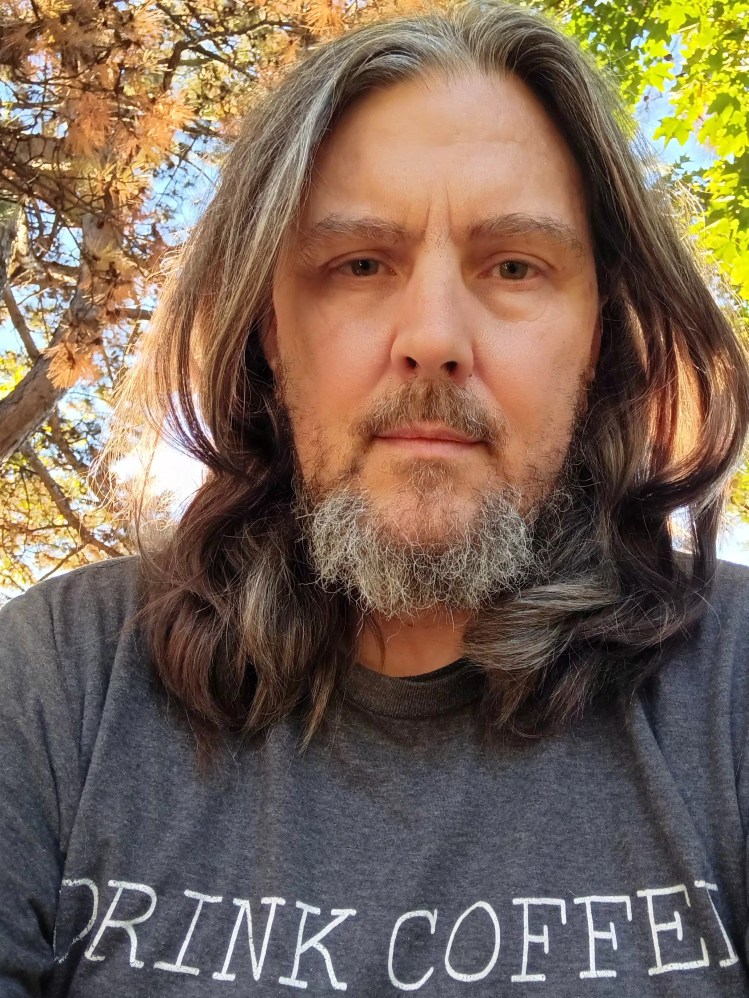
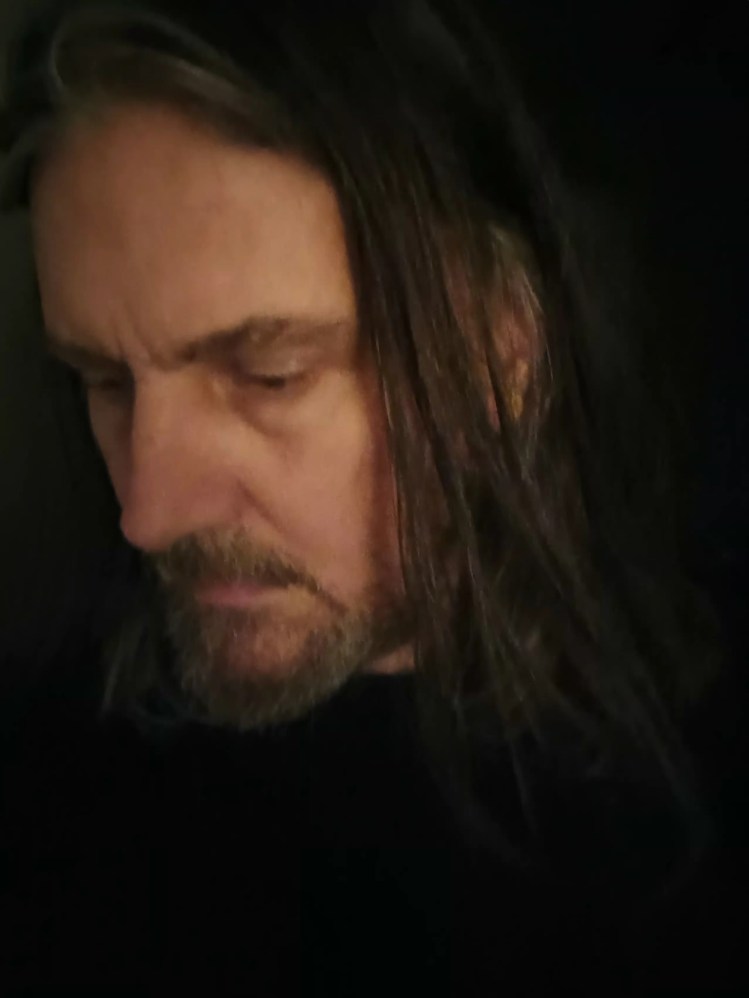
Today we take another trip through our gallery of images. These have been provided by our esteemed Co-Editor, Dale Williams Barrigar, who has a wonderfully crooked eye!–Leila
Let us bid fair September a fond farewell till next year and examine the upcoming month of October. Aside from being the month in which most people finally clean their AC filters and begin wearing tees beneath the Hawaiian shirts that we are loath to eschew due to our hitting the mini candies (available since August) more often than the gym, it is also the time of year in which darkness reigns supreme. At no other time of the rolling annum does darkness cast a wider spectrum. ‘Tis found in, and between, the Kitty Kat costumes worn by chocolate crazed three-year-olds and the brutal doings of Robb Zombie’s Firefly “fambly” (although some of us note little difference between the two mentioned classes). It is always a matter of taste, and whether you get your sugar from an endless binge of Three Musketeers or off constant jugs of hobo muscatel, do remember, constancy is key in October.
The month in the Springs will be the same as it has except on Halloween we will be making a Big Announcement regarding the future of this site, an announcement that will become official on New Years Day, which we hope will not be the same day that Hell is closed due to over capacity.
The word “we” means two things in SaragunSprings. In the human, earth-business sense it refers to the two Co-Editors, Dr Dale Williams Barrigar PhD and, myself, Irene Leila Allison, who has used ph paper in the past but to no memorable result and certainly to no degree worth mentioning beyond this post.
The second meaning of we includes the great many Fictional Characters (FC’s) of in and about the realm, chiefly Renfield, Dame Daisy Kloverleaf and so forth. Funny thing about the FC’s is I do not know if they resulted from insanity (on my part) or if they have come to rescue me from madness. Sadly, since it is neither illegal nor advisable to go mad in the United States, the question is likely to go unanswered long after the data is tallied. We is a flexible concept and we hope to see it expand after Halloween.
(And there now comes to mind a third “we”–the monochrome Dog Pack: Boo, Colonel and Bandit along with their various whispering attendants.)
This month, as before, throughout the summer, will feature guest writers, beginning with two from David Henson who makes his site debut day after tomorrow and on Friday. Then we will be blessed by the continuing wise observations of The Drifter every Sunday. And there are the usual thisses and thats we use to fill the empty spaces. But in months to come, Dale (and/or The Drifter) will be doing these little monthly roundups as much or even more so than I (even though he is learning that right now).
Oh yes, the open invitation to readers to send poetry and such to saragunsprings.com is still open, but after October things will be much tougher for good reasons to be divulged on Halloween (this is what we writerly types call “fanning the flames” of obscure repetition in hopes of starting a rumor, then, maybe, we hope, a frenzy). So if you are seeking an audience of several dozen lookers for no more effort than it takes to give away money on the street, now would be a good time to accept the offer.
As you may have noticed I am toying with calling Saragun Springs SaragunSprings. For some reason that second one has attracted my eye. No, that’s a lie. You see every time I type Saragun my keypad changes it to Sargun. I keep resetting it but it always creeps back. Still, let’s just say both are correct and wait and see which one finally gets over.
(Wonderful images provided by the Drifter and Drifter Boo)
What Would Abraham Lincoln Do Now?
September 27, 2025
In “the year of our Lord” 1909, Count Leo Tolstoy was one of the most famous humans on Planet Earth, by far.
He was a person who had survived into the twentieth century in a very vital way from another era, a man who had been born into the age of serfdom (or Russian slavery) in his own land and seen it fall (around the same time American slavery fell), a man who was as well-known then as Gandhi and Martin Luther King, Jr., would later become (and a man who had already corresponded with Gandhi, famously), a man who was known for educating, and attempting to free, the serfs on his own land before the national reforms came along, a man who had started a globally-known peace movement called Tolstoyism based on the real and true teachings of Jesus Christ taken directly from the Gospels, and a man who, if the world had listened to him back then, could have solved ALL of the world’s current problems today via the solutions he was offering at the time, a man so well-known and so accomplished that he deserved not just the Noble Prize in Literature (see the list at the end of this essay) but also the Nobel Peace Prize, like very few others in history (except, perhaps, figures like Bob Dylan, John Lennon, Bob Marley and Martin Luther King, Jr., all of whom could have been awarded the Literature prize as well as the Peace prize based on their work in both fields).
1909 was also the centenary of Abraham Lincoln’s birth. A reporter came to ask Tolstoy to write something about Lincoln for this event. He found the great, long-bearded, long-haired, physically frail and elderly man and writer too sick to rise from bed or pick up a pen for long, but somehow still able to think and talk just as clearly as ever.
Tolstoy surprised the world, just a little bit, by what he told the reporter that day, when he called Lincoln the greatest national hero and national leader of all time, a man who would, in a couple of centuries, make all other national heroes and leaders look like nothing compared to him. “Of all the great national heroes and statesmen of history Lincoln is the only real giant,” Tolstoy said.
Tolstoy listed “depth of feeling, greatness of character, and a certain moral power” as the qualities that made Lincoln so much greater than the other heroes and leaders. Tolstoy said, “His genius is still too strong and too powerful for the common understanding, just as the sun is too hot when its light beams directly on us.” He said that Lincoln’s “supremacy expresses itself altogether in his peculiar moral power and in the greatness of his character.” He said that Lincoln, “wanted to be great through his smallness.”
Tolstoy said of Lincoln: “He was what Beethoven was in music, Dante in poetry, Raphael in painting, and Christ in the philosophy of life. He aspired to be divine – and he was.”
***
America is on the verge of its next civil war, or is already in the beginnings of it.
Because this new civil war won’t be a “Civil War” with capital letters like the last one was.
It will be (for the most part) a much more insidious and secret affair, many or most of the battles playing themselves out within the battlefield of the human heart.
There won’t be huge lines of gray and blue soldiers blowing each other to smithereens across a river until kingdom come like the first time.
But there will be, and already is, great hatred involved, great contempt for one’s fellow human beings, great nastiness and moral decrepitude even among the youth of America, a great bitterness and a great belittling of each other, utter small-mindedness and small-heartedness on both sides as we stare each other down and hate each other’s guts and hope someone else will come along and do our sporadic killing for us, and then applaud when they do so while we execute them in return, smiling bitterly all the while and cursing the world in our hearts while taking responsibility for none of it.
So it’s worth asking, at this great and terrible point in American history, “What would Abraham Lincoln do if he were here now?”
After a lifetime (on and off) of studying Lincoln, both his life and his writings, from his home ground in Illinois, I believe I know the answer to this question. And I can break it down into three key points, very briefly.
Read on to find out.
***
ONE: He would rise above the fray. He would not take sides. He would try to look at the truthful aspects of both opposite points of view and leave all the lies and bad “information” lying in the dust. He would see it from everyone’s level, no matter who they are.
HE WOULDN’T BECOME PETTY WHEN THE GOING GETS TOUGH. AND HE WOULDN’T START THROWING STONES AT HIS NEIGHBOR, NO MATTER WHO THAT NEIGHBOR IS, OR WHERE THEY CAME FROM.
NO EXCEPTIONS.
TWO: He would resist the totalitarian impulse, which crushes genuine humanity, at all levels, but he would resist it within himself first.
He wouldn’t let himself be seduced by the urge to crush, or even think less of, those who are weaker than or “different” from himself.
As Kahlil Gibran said in The Prophet, “And if it is a despot you would dethrone, see first that his throne erected within you is destroyed.”
THREE:
HE WOULD LOVE. The tragic irony here is that anyone who can understand this third point is already doing it.
And the final tragic irony of this column is that Lincoln is no longer a hero for either side.
The Drifter on Tolstoy’s short works: Tolstoy is the author of two short stories and one small autobiographical nonfiction book that deserve to be studied by anyone on the Planet who wants to turn themselves into a better person during these horrible times.
“The Death of Ivan Ilyich” is about a man who discovers he’s held the wrong materialistic, selfish, Scrooge-like values his entire life, right before he dies. Ironically, it’s his illness and his approaching end that make him see the light and saves him (just in time).
“Master and Man” is one of the most life-affirming stories about self-sacrifice ever written. No spoiler alerts. But the horse in this story is more alive than the humans in almost everyone else’s fiction.
“A Confession” is an autobiographical nonfiction tale that influenced Mahatma Gandhi and Martin Luther King, Jr., as they developed and extended nonviolent resistance, just as Tolstoy himself had been influenced by Percy Bysshe Shelley and Henry David Thoreau before him.
Tolstoy suffered from Depression, the modern variety. This book shows you what it’s like if you’ve never been in it; and how to get out of it if you have.
(Images provided by The Drifter. Mighty Boo is considering you)
I first heard of the English poet, visual artist and freedom fighter, William Blake, friend of Thomas Paine, through James Douglas Morrison, but then again, there were many persons and things I first heard of through Jim Morrison that have had a lifelong influence on me, including the untamed German philosopher Friedrich Nietzsche and the vanishing French poet Arthur Rimbaud.
The first full-length biography of Jim was No One Here Gets Out Alive, by Jerry Hopkins and Danny Sugerman. I devoured this book a year after it came out in 1980 when I was 14 years old and living with my family near the Mississippi River in Quincy, Illinois, which is both Mark Twain and Abraham Lincoln country for anyone who’s awake enough, which is not most of us, but is a few of us.
I was 14 in 1981 so the book had been out for around a year when I first read it. It shows how young I was to think that I believed the book had been out for a long time back then, even though now a year seems like a day to me. And it also seemed, back then, as if Morrison had been dead forever, even though at that point it was only around a decade. A decade seems almost like nothing now in the face of so many additional years later.
In The Marriage of Heaven and Hell, William Blake wrote, “If the doors of perception were cleansed every thing would appear to man as it is, Infinite.” By this point, this must surely be one of the most famous quotations from English Literature of all time, a quotation that many and many more are familiar with in various guises and ways even though they have no idea what the original source of the quotation is.
A huge part of the fame of this quote has to do with Morrison’s band’s name, The Doors, but it also has to do with Aldous Huxley’s famous book The Doors of Perception, which is a long essay about hallucinogenic drug experiences (experiences which Huxley was to continue right up until the end, even taking the extraordinary step of consuming LSD on his deathbed). Morrison originally heard the Blake phrase doors of perception from Huxley’s popular book, but Jim later became intensely familiar with many of William Blake’s other works as well, as he was with that of Nietzsche, and Rimbaud, those two eternal rebels and voices of human freedom who originally inspired Jim Morrison more than any musicians ever did.
Because Jim was a poet from the start, and at the end of his life he’d grown so disgusted with the outward trappings of his manufactured musical fame that it literally sickened him, even though he also knew he’d won a kind of immortal glory through his writings and his work with The Doors who’d brought his writings to life.
William Blake’s 16-line poem “London,” first published by Blake himself with his own illustration in 1794, says that the streets and the river of the great city are “charter’d,” which means for sale and locked down in a place where everything is for sale, including the loyalties and sympathies of the human heart.
Blake talks about how there are “marks of weakness, marks of woe” in every London face he meets, and he talks about chimney-sweepers (little boys) crying and soldiers (little more than boys) sighing as their blood runs down the palace walls; and he throws out a sympathetic shout for the female prostitutes (many of them girls) who are everywhere in the city while also calling the institution of marriage, not a happily-ever-after, but a “hearse.” In short, this poem was and is about as radical as it’s possible to be, then and now.
This poem also contains another William Blake quotation almost as famous as “the doors of perception.”
In line 8 of the poem called “London,” Blake says: “The mind-forg’d manacles I hear.”
In five words, William Blake manages to capture and encapsulate the mental slavery Jim Morrison was waging holy (spiritual-only) war against in the 1960s, as well as the mental slavery that is coming to dominate our own day more and more with the rise of (or the return to) authoritarianism and corporate conformity all over the world.
“Mind-forg’d manacles” is a two-word phrase written in the 1790s by an Englishman who supported the American Revolution while also being a passionate abolitionist.
Blake also supported the rights of women. He taught his own wife how to read and write and worked with her as his artistic partner in an age when such things were exceedingly rare.
And he abhorred and spoke out about the destruction of nature by the industrial revolution in an age when almost no one understood what was really going on – except the poets, rebels and drifters.
A century and a half and more later, Jim Morrison became a receptor, and then a conduit, for the imaginative and rebellious worldview of William Blake as he did with Nietzsche and Rimbaud and the spirit of the Native Americans.
One thing the yin and yang means (in my interpretation of it) is that two completely opposite and seemingly antithetical things are always true at once in this world we inhabit.
In this case it means that everything has changed – and nothing has.
(The image of Happy Hounds provided by DWB and the hand of a Mystery Twin)
(Co-Ed note: The weeks vanish so quickly, but we can fill them with words as they pass as tithing baskets! Return tomorrow for the always fragrant, flagrant, virtuous, violet, hectic, heroic, melancholy, merciful, and more so and more so thoughts of our beloved The Drifter!–LA)