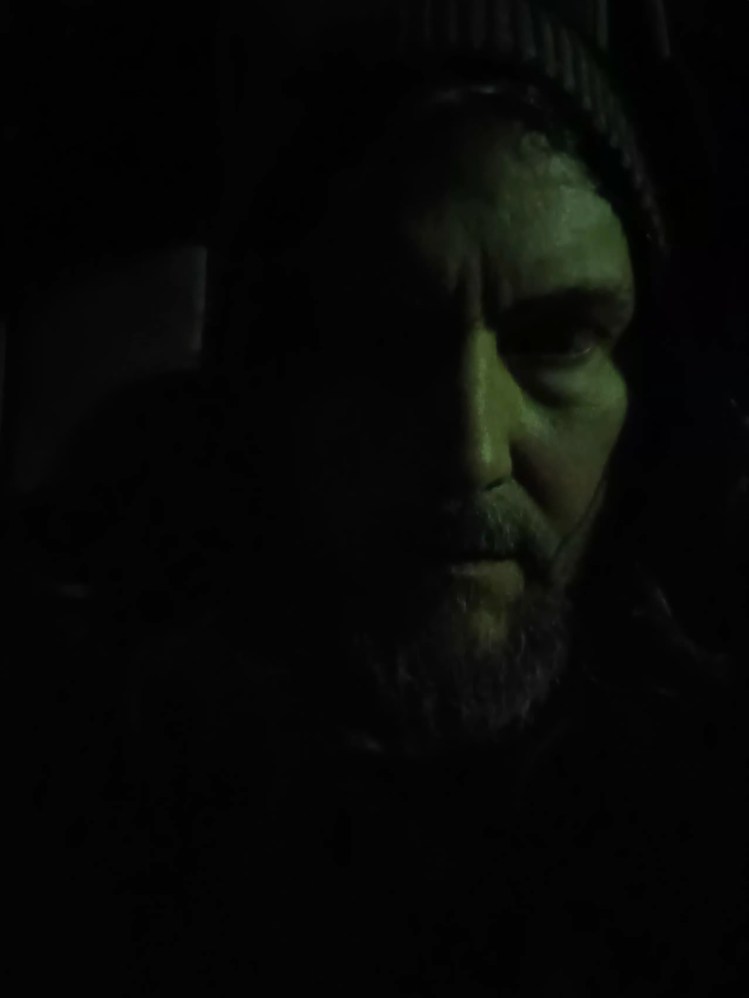
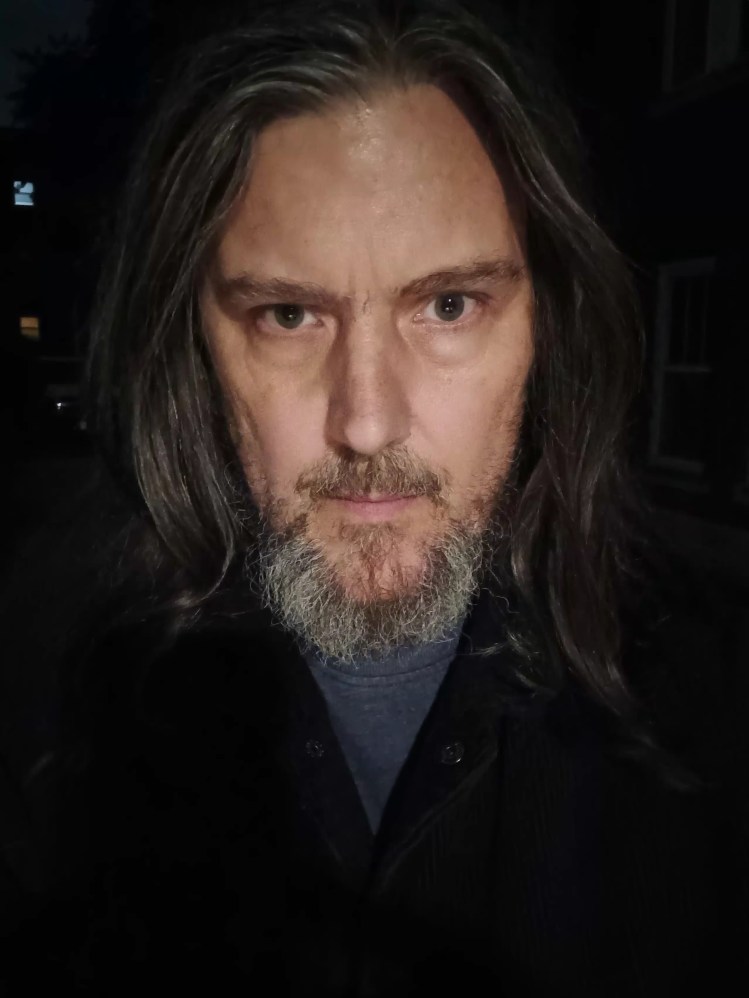
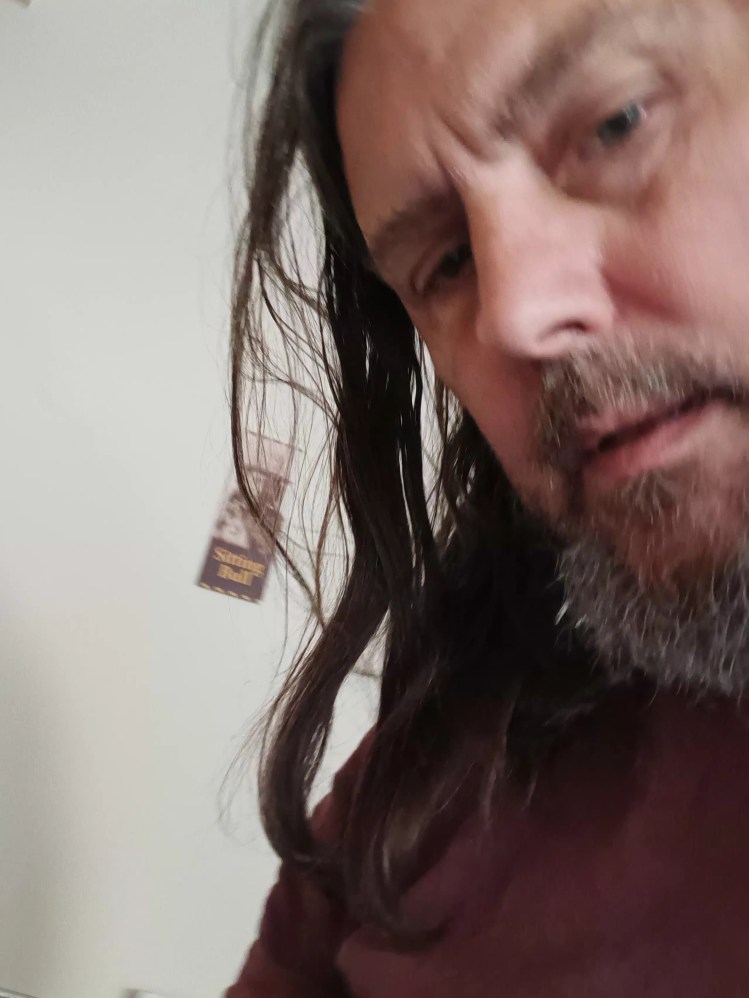
Drifter Self Portraits

(Images provided by the Drifter–Boo and Vincent)

I only show myself when the holy spirit of creation is upon me.

Or in its aftermath.

Or in the lead-up to it.

Or in some other form of extremity that embodies some sort of emotion that can be used for good in this world, if one looks hard enough, one way or another.

I have pictures of myself where I look one hundred and ten years old.

And not a healthy one hundred and ten, like Moses was when he died.

They say he was as strong and mentally acute at that age as he had been at forty. And that his sight and hearing were as strong as they’d ever been, too. But it didn’t stop him from dying.

Yes, I have pictures where I look bad old.

Beaten and broken, weary and bloated, or shriveled, wasted and worn, worn out.

I only keep these pictures for myself (for now), in the same way that Hamlet held up poor Yorick’s skull to his own (for now) living face and spoke to it.

A memory of the future, which is the definition of memento mori.

I started experimenting with drawn and photographic self-portraits in the 1980s, when I was in my teens.

I was partially glad when the Selfie came around, because it partially justified me, at least in the legend of my own mind.

Before that, even people who were otherwise on my side would sometimes make fun of me for taking “selfies” – before “selfie” was even a term, or a word.

But ever since there were cameras, there have been poets who have done this.

Walt Whitman, Philip Larkin, and Robert Johnson are only three examples.

I was raised in the Lutheran Church in Michigan; their religious art influenced me in enduring and subconscious ways that I can’t even diagnose in myself because they go so deep.

Other influences on my self-portraits include classic album covers, certain movie posters, author photos, and of course the classic self-portraits by the great classical artists.

I had a stroke at the age of 57 in the Year of Our Lord 2024.

After that point I started making self-portraits just to prove to myself that I was still alive – as alive as ever, or even more so.

I had one grandmother who remained youthful up until the very end, at 88. I had another grand who remained youthful until the age of 92 (and then her slow decline until “the end” at the age of 94).

I only make the self-portraits on my regular phone. No tricks. I’m no technologist. As in all art, spontaneity and selectivity are the keys. These, and dogged determination.

I got this phone three years ago. I’m 58 now. So I call all of these self-photos the 55 and Up Series. Almost everything else disappeared with the other phone.

I also make the pictures to taunt all my enemies, and all the people who left me in the dust when I didn’t want them to.

There were others who left me in the dust and I was okay with it: or even goaded them into doing so.

Signing off for now until next Sunday: “The Drifter.”

I Was Ten When Elvis Died By Dr. Dale Williams Barrigar

They called him fat and they called him a fool, but when he stepped behind the piano he was neither fat nor foolish.

He was Elvis, in South Dakota, in a small theater, about to sing another song, just a few weeks before he would fall to the floor in his bathroom back at Graceland and leave us for good – so suddenly.

And thereby catapult himself into the earthly realms where no one dies. Because now he’s the quintessential American, globally more famous than Abraham Lincoln, or maybe equally so.

(We say nothing of current people who may be more “famous” than either of them at the moment, because this kind of fame is only for the moment and will fade. In the annals of humanity, the good ones last longer than the bad except for the exceptions, like Hitler; and you really have to be bad to be as horribly bad as him.)

Before he sat down at the piano it was almost as if he was fat and a fool. He looked quite overweight although still more handsome than the most handsome movie star ever (because he was never really a movie star), and he was obviously high as hell on something, or rather not one something, but many somethings.

He was so high that he couldn’t talk right, not at all. He mumbled and muttered, he lost his train of thought, he shook his head to try and get it back, he laughed at himself up there on stage. He was high and jonesing for more at the same time, he was wired and wasted, he was surrounded by gigantic cups of ice and Coca Cola that he drank nonstop and to wash the pills down with (dozens or even hundreds of pills per day) (and he was fatter from the beverages than the sandwiches because eating interfered with the endless buzz of being him); he was high in the way that someone gets high who sees it almost as a duty and an obligation, certainly not a pastime or a hobby: he was so high that he was high as only ELVIS could be high: admirably high, utterly high, completely wasted, totally wired, and yet still walking around, telling the jokes, laughing at all. And about to sing another song.

And when he opened his mouth, the world suddenly knew (or only the parts of the world that live in South Dakota – for now) that Elvis was no longer a pop musician; he had left that behind him long ago. (“Don’t look back,” said Bob Dylan.)

Because now he was a CLASSICAL MUSICIAN. Now he was on the level of an opera singer, better than Pavarotti. Now he was someone who Beethoven and Mozart would hang out with. Now he had elevated his art into the highest levels of art that art can achieve, and his version of “Unchained Melody” was so good it made you want to compare it to (and I want to compare it to) the Mona Lisa or the Statue of David.

Elvis was fat and sometimes acting foolish; he was high as high gets when you can still walk around, and he couldn’t even talk right. But when he opened his mouth and began singing this one song, he truly belonged, and truly does belong, with the best of the best and the greatest of the greatest, not just in America, now, but in the world, anywhere, any time.

And then the song was over. And no one even applauded at first (before it exploded). But even the ordinary folk of the great state of South Dakota knew what had just happened.

Elvis had outdone himself. He had elevated himself, had increased his own greatness, had increased the greatness of art and the human race in the few minutes of one song.

His voice had been so powerful, so subtle, so nuanced, so loud, so ringing like a bell, so true, so lasting, so effecting, so mountainous and river-like, so sad, so tragic, so affirming, so massively grand, utterly great, and endlessly hopeful and emotionally pure and poetic that no one else who ever lived could sing that good, at least not what he did in that one song one time in South Dakota three weeks before he died.

Now they laugh at him as the fat fool a lot more than they celebrate him as the grand and great singer, the one true voice, the best of the best in the purity of American song. And that says a lot more about us than it does about him.

The rubes and the dupes and the snake oil sales folks all know who he is; but not one of them really knows who he is.

Only Elvis could have become ELVIS that way. Just as only you can become YOU in the way you need to.

Instead of laughing at him we should listen.

END NOTE: He was reading A Scientific Search for the Face of Jesus by Frank Adams when he died; the book was found not far from his body.

John Lee Hooker’s House Rent Boogie by Dr. Dale Williams Barrigar

“A man alone ain’t got no chance.” – Hemingway

Like all great story-telling, John Lee Hooker’s “House Rent Boogie” can make you feel much better about yourself, if you’re willing to meet Hooker half way.

In a nation filled, more and more, with what Noam Chomsky calls the “precariat,” or economically disadvantaged folks who live paycheck to paycheck, dwelling to dwelling, meal to meal, buzz to buzz, never knowing, as Henry Miller put it, when the chair will be yanked out from under their rear ends, and they will be tossed out into the street again, Hooker’s “House Rent Boogie,” also known as “House Rent Blues,” can offer solace and encouragement to many of us.

This kind of story-telling shows what story-telling is really for, which is helping the human species to make its way in this world while we struggle to survive our allotment of days here on the rapidly warming earth.

“House Rent Boogie” comes in different versions. Bob Dylan is famously, and rightly, known for reinventing his and other people’s songs as he travels the world like a modern-day Homer, the great Greek poet, but the great blues players and singers were doing this very same thing quite a while before Dylan came along, as he readily acknowledges. An original version of this story-song appeared some time in the early 1950s.

But the most entertaining, complete, and enduring version of the song, absolutely, one hundred percent, is the one that lasts for six minutes and twenty-four seconds, recorded in 1970, when Hooker was in his 50s. (He was born in 1912 or 1917 and lived until 2001.) This is, truly, one of the greatest blues performances of all time that we have a recording of. J.L.H. is the peer of the best of the best, from Bessie Smith and Billie Holiday to Muddy Waters, Howlin’ Wolf, Buddy Guy, and B.B. King.

(Buddy once followed my wife-at-the-time into the Ladies’ Room at a show in central Kansas in the 1990s while continuing to play his electric guitar the entire time, giving her his big smile in there before modestly retreating. I saw B.B. front row in central Illinois in the 1980s, and was blown away not just by his playing and voice, but by his PRESENCE. For some reason, I kept being reminded of Eisenhower pushing forward the Civil Rights Movement after Louis Armstrong called him a coward, which speaks very well of both men.)

“Precariat” is a combination of the words “precarious” and “proletariat.” “Boogie” means many things, including a fast, strong style of piano blues, a dancing to such music, a dancing to other music, and a way of escaping, literally or figuratively. Hooker’s complex story-telling uses the term in all of the above senses, as he explores and explodes what it’s like to be a part of the precariat in America or any other land, but especially in America, Land of the Almighty Dollar and Home of the Greedy.

The first line of the song is “I’m gonna tell you a story.” This is the talking blues, backed by electric guitar, harmonica, piano, bass, and drums. Hooker’s deep, mellow, profound, strong, confident, masterful, laughing, lamenting voice tells the tale of a man who’s lost his job. While he was employed and had a full wallet, the world was his friend and so were all the people in it. Now that he’s become down-and-out and busted, everyone has suddenly turned dismissive, sarcastic or apologetic as they resolutely turn away. It’s a tale that illustrates Scottish thinker Adam Smith’s “vile maxim,” which was that you shall care for, and worry about, no one but yourself.

Smith is one of the most misunderstood philosophers in the Western world, and he was virulently against adopting this maxim, but he saw how outrageously prevalent it was, especially in commercial and mercantile countries like Great Britain and America. In the Land of the Scam and the Home of the Selfish. John Lee Hooker, no less a philosopher, one who boils down his sense and experience of the world into a personal, satiric, universal narrative, gives the heartless human sphere the solid drubbing it deserves in this eternal song. As a black man in America who was in his 40s before the Civil Rights Movement came along, and who once worked as a factory janitor in Detroit, Michigan, among other such jobs, Hooker knows deeply about what he speaks and sings of.

Charles Mingus called his experimental autobiography, which he spent twenty years on and off writing, “Beneath the Underdog.” This phrase gives a taste of Hooker’s point of view in “House Rent Boogie.” Once your wallet goes in good old America, and you’re thrown back on nothing else but yourself and your wits, things can go bad very quickly, in the land where “the masters of man,” as Adam Smith called them, are perhaps more ruthless than in any other land before or since, or at least just as ruthless.

In 350 or so Hemingwayesque words, including realistic dialogue which Hooker acts out with his voice and punctuates, undercuts, and dramatizes with his electric guitar, his piano player, and his other musicians, who’s chiming, banging, bumping, and ringing away along with him is like the supporting characters in a Shakespeare play, this parable about being down-and-out says so much about the way we live now that it could have been created yesterday, instead of fifty-four years ago.

A recent story on the radio described the United States as a place where it’s “expensive to live and hard to get a job.” And the majority of jobs that are available are so crushingly boring and meaningless for many of us that it’s damn near deadly; or just plain deadly. In America, vast Tower of Babel, where language itself, humanity’s greatest invention, has been stolen and perverted by the politicians, preachers, mass media, ad people, and snake oil sales folks on tv and everywhere.

In the Land of the Avaricious and the Home of the Homeless, where real art and artists, and real thinking and thinkers, are not just rejected, ignored, mocked, and spat upon, they are sometimes even downright crucified, and certainly laughed right out of town. Henry Miller called his own version of this story “The Rosy Crucifixion.” Charles Bukowski wrote about it in almost every line he ever typed. Hooker too is rosy about his busted story, when he switches point of view and comments on himself, the main character, “He rocked on.” He rocked on, and kept going somehow, no matter what. Because this, thank God, is another strong strain in the American character. Perhaps the American Civil Rights Movement of the 1960s showed this strain as well as, or better than, anything else in our history.

In 1980, Hooker appeared in the Blues Brothers movie alongside the white black brothers, Belushi and Akroyd. He was in the Chicago street with his band in front of the Soul Food Café playing “Boom Boom Boom,” and his appearance lends the film the aura of an American reality that’s still ringing true like a bell forty-four years later, maybe more than ever now. And I seem to remember Hooker in the ‘80s and/or early ‘90s in music videos on MTV, wearing his shades with Pete Townshend and being the epitome of cool as much as Miles Davis himself ever was.

Some people in America know what cool is, and some don’t, as Norman Mailer pointed out in his essay “The White Negro” from 1957, originally published in “Dissent” magazine. Mailer’s essay was and is intensely controversial and provocative, probably wildly mistaken in many of its points, but also profound and utterly ground-breaking, praised by the likes of Eldridge Cleaver, and intensely engaged with by James Baldwin and Ralph Ellison. The average Soccer/football Mom, Soccer/football Dad, or Corporate Mom, Corporate Dad are a few who do not know what cool is, according to Mailer. Anyone who’s ever been on the street and all real artists are some of the ones who do know. Mailer’s hipster from the essay is an absolute precursor of hip-hop to the level of being prophetic, except for the crucial point that Mailer’s hipster wants NOTHING at all to do with the so-called American Dream, which Hunter S. Thompson rightly claimed was dead anyway no later than the mid-1970s, ushered out by none other than Tricky Dick himself, the sly old alcoholic precursor of all current want-to-be American dictators and authoritarians.

If Hooker, with his wide range, deep knowledge, and tales of American experience in over 100 albums recorded, is a kind of fragmentary or experimental novelist, as the great Chicago radio host and writer Studs Terkel told me the one and only time I ever met him for ten minutes in the early 2000s, then “House Rent Boogie” is one of his best chapters. Play it loud, and over and over and over. Play it loud, and don’t just listen. Study it.

Scottish farmer-poet, song master, and exciseman Robert Burns, up there right after Shakespeare as one of the most quoted and known writers in the world, is a precursor for all of the American blues poets, story-tellers and singers. Burns’ social justice sympathy extended even unto a mouse whose house, or nest, was wrecked by the plow. His heart and mind went out to the under-mouse as well as the underdog. In similar fashion, John Lee Hooker’s “House Rent Boogie” extends a hand to everyone who’s ever lost a job, lost a friend, lost a romantic partner, or been on the outside in any way. His song title “Teachin’ the Blues” tells us much about his intentions. He was a professor of life, like Muddy Waters and Howlin’ Wolf.

Hooker also has an album called “The Healer.”

Hooker was the Mississippi son of a popular sharecropping minister who thought the blues was the devil’s music. As such, he wouldn’t let his son play his guitar in the house. But Jesus of Nazareth himself was thought to be a devilish demon-conjurer by most of the leaders in his own society. A bunch of townspeople tried to throw him off a cliff one time long before he was finally crucified by the Romans. JC is the first and most profound precursor of the blues. Not only did he have sympathy for the underdog, he knew very much what it was like to be one. Just like John Lee Hooker.

Howlin’ Wolf: Moanin’ at Midnight by Dr. Dale Williams Barrigar

“You create yourself.”

– Ralph Ellison

If you want to get an idea of what it might have felt like to be near the Southern cottonfields of the United States prior to the Civil War, turn to your favorite music source, and play the song “Moanin’ at Midnight,” by Howlin’ Wolf, so often that it seeps into your bones and steeps your very soul.

Sam Phillips called “Moanin’ at Midnight” “the most different record I ever heard.”

Released as Wolf’s first single for Chess Records in Chicago in 1951, the B-side became much more popular for many years. It shows the way great art so often goes under the radar for months, years, decades, or centuries after its creation, and also how it so uncannily returns.

Chester Arthur Burnett of West Memphis became Howlin’ Wolf and moved to Chicago in 1953, which can thereby be named the first year of rock and roll.

In France, “Waiting for Godot” was premiering in a small theater to boos and gasps, reflecting the modern feeling of absurdity/ambivalent hope. “The Crucible” was opening in New York, reflecting the hysteria of the McCarthy hearings. Hank Williams, the cowboy Shakespeare, had just died in the back seat of his automobile on the way to yet another show. Charles Bukowski, Post Office employee and classical music expert, was 33. “Wise Blood,” by silent, brooding Flannery O’Connor, was one year old.

In “Moanin’ at Midnight,” in less than three minutes, with less than sixty words, and with one drum, one harmonica, one electric guitar, and one massive, utterly unique voice that could probably only come from a man who was six feet three inches tall and weighed 275 pounds, Wolf creates an artistic masterpiece that is also a human and historical document as valuable, in its own way, as the Mona Lisa.

The song is also a tale of terror that could only have been created by a black person in America before the Civil Rights Movement; and a story so universal it can rightly be said to belong beside one of Shakespeare’s sonnets, or one of Robert Burns’ haunting Scottish border ballads about the continuance of love after death.

The ringing telephone in the song’s lyrics reminds the reader/listener that paranoia, anxiety, and deathly fear cross all boundaries in time and space. The knocking on the door in the song, like the knocking at the gate in “Macbeth,” reminds the hearer that IT is coming for all of us one of these days, no matter your race, creed, color, gender, opinions, or bank account.

Howlin’ Wolf’s moaning, humming, singing, talking voice in this song is so absolutely, finally, terrifyingly, consolingly uncanny, that it cannot be accurately described in words. It only invites failure to attempt to do so. Henry Miller called music as an art form, “absolutely sufficient unto itself” because it “tends toward silence.” If you’re alive, Wolf’s voice will give you the chills, and thrills, give you goosebumps, and increase your heart rate all at the same time, conjuring up some feeling from childhood you’ve never been able to name or live down. Play it loud. Play it very loud. Over and over again.

At the age of 43, after time in jail and the army, Wolf drove to Chicago for the first time in his own Cadillac, having made money on the radio in the Memphis area. Like Muddy Waters, he eventually moved to the Chicago suburbs, where he lies buried. He ran with fast women. He intimidated dangerous men. He lived with pit bulls. He wasn’t a man to cross the color line, he was a man to explode it or pretend it didn’t exist, depending on his mood, or who he was staring down at the moment.

“Moanin’ at Midnight” is a song that is almost part of nature. He was channeling a world as much as he was conjuring up THE world and creating it all in a picture whose psychology is so deep and profound it’s downright Jungian. He didn’t know how to read, they say. But he knew everything there is to know about the human soul. He was as much Jesus-like teacher from the Book of Mark as devilish blues musician from the Deep South. He was a professor of the blues and of life itself. In the 1960s and 1970s, Wolf played more shows on college campuses than anywhere else. His teaching was deep and profound, filled with consolations, challenges, provocations, and indelible gifts.

Frederick Douglass, a writer and American visionary who makes a fourth with Walt Whitman, Herman Melville, and Mark Twain, wrote of the slave songs, “Those songs still follow me.” It was long after he had bested the slave-master in a physical fight and escaped to the north, where he would eventually meet in person, and influence, none other than Abraham Lincoln.

Douglass also wrote, “You have seen how a man was made a slave; you shall see how a slave was made a man.” In many ways a far too under-sung, and even unknown, American master, and hero, Howlin’ Wolf gets the last laugh as his voice, spirit, and genius live on.

The Rolling Stones: Memory Motel by Dr. Dale Williams Barrigar

“I hit the bottle, I hit the sack and cried.”

The Stones’ song, “Memory Motel,” from their 1976 album, “Black and Blue,” is an overlooked and underappreciated masterpiece. This story-song is well worth looking at and listening to again. And again and again. One of their very best works, it’s a shining, enduring example of the Anglo/English ballad tradition which was incorporated into the black American blues idiom and then re-worked again by white singers and groups like Elvis and Jerry Lee Lewis, and later on to the Stones, Led Zeppelin, Janis Joplin, Van Morrison, and Eric Clapton, leading to crucially important artists of today like Nick Cave; Lana Del Rey; Taylor Swift (“All Too Well (Sad Girl Autumn Version)”); Snoop Dog; Eminem; Bonnie “Prince” Billy; Conor Oberst (of Nebraska); and Wilco.

These cross-cultural exchanges, sometimes violently resisted by mainstream society, were moral acts which led to more than just rock and roll, bending the arc of the human universe toward greater justice by vastly increasing integration and racial equity throughout the world. Real music isn’t just music, from Bach, Beethoven and Mozart to now.

“Memory Motel” is a song which connects everyone by exploring the gnawing ache in the bones of lost love and the passing of time which all humans experience, no matter their race, creed, income levels or gender. In seven minutes and seven seconds, in a song recorded in Germany, the Stones tell the tale of a heartbreaking, breathtaking love affair starring a beautiful, hazel-eyed, long-haired, wild-haired woman who grabs the guitar from the hands of her man; drives a green and blue, broken-down pick-up truck; and sings genius songs in a bar in Boston. The narrator is an equally brilliant rock singer on the road. The setting a haunted motel on a remote seashore.

Shakespeare’s Juliet, Robert Burns’ Highland Mary, William Wordsworth’s Lucy, Keats’ Fanny Brawne, Mary Shelley, and Byron’s half-sister Augusta Leigh are all somehow drawn together in this intense mini-drama told in the idiom of the English blues.

Long-haired, unshaven, shirtless, piratical Richards, holding a Jack Daniel’s bottle and a cigarette, absconds on the guitar and only sings for most of this piece, which means he’s bringing everything he can to his vocals; while long-haired, unshaven, checkered sport coat-wearing, show-biz Jagger pounds the piano keys as if they were a typewriter and he were trying to write an entire Emily Bronte romance novel within one song (bottle of Jack Daniel’s next to his ankle and his red socks on).

Richards enters the song half way through as a third character in a shadowy performance worthy of Christopher Marlowe, Shakespeare’s rival, establishing an emotional threesome in the song’s situational dynamics that lends a profound layer to this public closet drama. His voice continually praises the intellectual and emotional uniqueness of this special woman, never expressing jealousy or anger, but sometimes grief at her loss. The mainstream cliches about Keith are completely undercut by his progressive feminist perspective and his depth of emotional expression in this autobiographical story performance, which is heart-breaking, realistic and long-enduring in human terms.

(Keith only sings co- or lead vocals on a double handful of Stones tunes. Almost every one of them is one of their best works.)

Richards co-wrote a fascinating, Hemingwayesque autobiography called “Life.” He was an obsessive reader of Byron at one point. The Byron who went around the higher levels of English society with gigantic dogs, a laudanum bottle, and sometimes a monkey (or a trained bear at college). Byron’s girlfriends and friends were collaborators, competitors, and rivals. One of his beautiful, regal, and intellectually intimidating ladies labeled him, the great lord, “mad, bad, and dangerous to know.”

“Memory Motel” implies this kind of tragic history, as surely as Mick Jagger read aloud portions of Shelley’s elegy for Keats, “Adonais,” in honor of Brian Jones. (Jones is a member of the eternal 27 Club. Keats was 25 upon dying. Percy Shelley was 29. Wordsworth was 80. At this writing, Jagger and Richards are 81 and 80, recently on tour here in Chicago, home of Buddy Guy, Muddy Waters and Howlin’ Wolf, and where the Stones recorded their second album sixty years ago in 1964.)

“I hit the bottle, I hit the sack and cried.”

As I grow older, every time I go back to my own Memory Motel, I hear more.

I had become a failed literature professor at the age of 52, because they took my job away. Also, another relationship had ended. I couldn’t bear to keep the photos of her and us, nor place them in the dumpster either. So I took one of the small, black-and-white, photo-booth photos of beautiful, genius, red-haired her from when we were on our trip to Nashville seeing a retrospective of Bob Dylan and Johnny Cash at the Country Music Hall of Fame. And I placed the photo deep in the middle of a library book which I put in the middle of a bunch of other library books I returned.

A librarian named Veronica called the next day and returned the photo to me.

John Lennon: The Revelator By Dr. Dale Williams Barrigar

“Marley was dead: to begin with.”

– Charles Dickens

John Lennon in his Pickwick glasses is like a character from a Charles Dickens novel, or much like Dickens himself in his concern for social justice and his endless sympathy for the literal, and figurative, orphan, outsider, and underdog.

Lennon can also fruitfully be compared to another English writer of the nineteenth century who rivals Dickens in staying power and popularity. Like Lewis Carroll and his beloved, living Alice, Lennon’s life was all about expanding the mind, and through the mind, the heart.

Lennon was crucified by his own fame in the form of one of his own fans. This early, dramatic death catapulted him to another level in the modern pantheon of heroes and secular saints, just as Van Gogh’s lonely death would eventually elevate him in the same way. Before Lennon was wrenched away from this earth in the literal sense, he created a body of work that yet remains here to be explored in order to uncover its true depth, importance, and hidden meanings. His simple, straightforward, and mysterious writing style will last a very long time, probably at least as long as Dickens and Carroll themselves.

Lennon’s work with Paul McCartney and the Beatles is, of course, a whole other universe unto itself. But perhaps it’s in Lennon’s solo work that we can most fully take the measure of the man and the evolving, never-resting artist (for the artist is working even while dreaming), and the continued meaning of his words and music for the world at large.

Lennon began to move decisively away from McCartney and into his work as a solo songwriter on the brilliant, fragmented, cohesive, novelistic, experimental, James-Joycean double record now known most widely as “The White Album.” In three songs especially from this album, Lennon stakes out his own territory as an emerging, Dylanesque solo artist.

“Happiness is a Warm Gun,” “I’m So Tired” and “Dear Prudence” set the stage for his eventual movement away from the Beatles as the 1960s ended and into his brilliant, solitary decade of the 1970s before the artistic crucifixion in 1980 ended it all at the age of 40 (the exact age when Kafka and Poe, two other short-form writers of worldwide importance who surely influenced Lennon (whether he read them or not), also died).

“Happiness” explodes the tired and worn-out conventions of song-writing. “Tired” laments weariness in general, and weariness with old, worn-out worlds. “Prudence” is an invitation to something new and dear.

In a double or triple-handful of classic songs from the coming decade of the 1970s, the last decade he would have left, Lennon expanded both his writing skills and his persona and stance as a democratic humanitarian, a worker for peace, justice, and love who has few equals in this regard. The writing reinforced the anti-authoritarian persona and personality, and the anti-establishment stance buttressed the writing at all levels. The wonder and the artistic miracle of it is that Lennon also never became an ideologue, a propagandist, or a politician.

He perhaps became a sloganeer at his worst moments. But he always managed to rise above it again to assert the power of pure writing, which made his art for peace that much more effective. It leads us back to Dickens, who in some senses seems to have created John Lennon. Lewis Carroll’s open-minded, exploratory writing also undermined authoritarianism, hatred, greed, and war, in a way that was so pure and effective it was almost invisible at times.

Paradoxically, the invisibility seeps into the culture and effects real change in a way that politics and politicians can only dream of. This is why Percy Bysshe Shelley, another English radical fighting the bad guys, thinking of John Milton, called true poets, “The unacknowledged legislators of the world.” The phenomenon undergoes changes in mode and method of action; but it never goes away. In indigenous cultures, the figure of the shaman, trickster, and medicine person carried and carries much of these responsibilities and burdens.

“Everybody’s Got Something to Hide Except Me and My Monkey” is another song written exclusively by Lennon which appeared on The Beatles’ “The White Album” and was an omen of things to come. A seeming piece of Lewis Carroll or Edward Lear nonsense writing, it’s crucial to note that the greatest nonsense wordsmithing is never about only nonsense, just as the best nursery rhymes are not only for children.

McCartney believed the song was about heroin usage. Lennon’s anti-establishment stance would take many forms in the era of Richard Nixon. One of these forms was Lennon’s belief, and life action, like Sigmund Freud earlier, that the individual should be free to use and explore drugs as s/he saw fit, without the government intruding its heavy, uncaring, impersonal hand. It started when Bob Dylan introduced the Beatles to marijuana in New York City. The sacred weed later led to LSD, and, for Lennon, cocaine and heroin usage. Ironically, in the era of the alcoholic, paranoid, pill-popping Tricky Dick, Lennon’s song was prophetic in very many other ways as well. All members of the Beatles had always been heavy cigarette-smokers and alcohol-drinkers. Their expansion into other drugs was a sign of the times as personal freedoms were skyrocketing.

And it also led to the song that is often cited as John Lennon’s first solo writing performance, completely free of Paul McCartney: “Cold Turkey,” a piece that was supposedly rejected by the band. Like all Lennon’s work, this story about withdrawing from opioid usage has only become more relevant with time as usage of this form of drugs has spread and become far more popular in the general population at large.

“Cold Turkey” introduces a desperate, naked, screaming, wailing, withdrawing Lennon backed by punk-rock guitar long before punk rock existed. Anyone who’s gone through this sort of withdrawal, or witnessed someone else going through it, or both, will instantly recognize the skin-crawling, nightmarish desperation of this personal hell on earth, which Lennon bravely shares in a forum that exposes his weakness for all to see, bringing confessional writing to another level in modern English.

Ralph Waldo Emerson pointed out that writers, musicians, and artists have always loved the buzz, whether it be from caffeine, food, alcohol, nicotine, or other drugs, walking, nature, or love. Teenaged Arthur Rimbaud, who influenced Bob Dylan so heavily, riffing on Charles Baudelaire, father of the cursed poets, codified this buzz-love in one of his “Seer” letters to a personal friend when he said that the purpose was an “intentional derangement of all the senses” (including the sixth sense) that led to higher forms of consciousness.

Charles Dickens’ Opium Sal from “Edwin Drood,” plus Dickens himself, and Carroll’s hookah-smoking caterpillar, also promoted this type of behavior, as did Freud with his endless cigar-smoking and cocaine experimentation and usage, or Beethoven, Goethe, Ben Jonson, and Shakespeare with their alcohol abuse. The flipside is the famous, eternal “27 Club,” almost all of whose members died so tragically young from alcohol, drugs or some combination of the two.

Lennon’s “Cold Turkey” compresses Samuel Taylor Coleridge, Thomas de Quincy, and William S. Burroughs, one of the original three beats, into a song both courageously ahead of its time and backward-looking toward a complex, complicated problem that has always been and always will be with us. This is not pop music as feel-good distraction or toe-tapping laughability. It’s high art that questions, challenges, and provokes, like a poem by Keats, Byron, or Shelley. The language is simple and direct in a modern, or Hemingwayesque, style. The sentiments about sickness are never-ending in this mortal world.

“Gimme Some Truth,” another absolute solo song-writing masterpiece from John, tackles Tricky Dick directly, and by name. Nixon hated Lennon and kept trying to get him thrown out of the United States. John, at a great, paranoid cost to himself and his mental health, refused to leave, as a statement of world-wide personal freedom. He wouldn’t let the biggest bully on the block, at the moment, tell him what to do. It was an act and effort on Lennon’s part that was meant as an example for all bullied people to follow, an act of consolation and encouragement for the world.

Dylan wrote a personal, public letter saying, “Let John and Yoko stay!” In “Gimme Some Truth,” John Lennon stands up for anyone who’s ever felt abused or lied to, which is the same thing, by a hypocritical authority figure, whether it be teacher, preacher, boss, corporate spy, president, parent or other politician. The satiric nonsense writing in this piece is a nursery rhyme turned spiritual sword used against the big, bad eggs in the nest, who have always been there, and still need to be pushed out.

In “Working Class Hero,” a related but also very different song which has had a profound personal meaning for millions of people, including many of the people I know personally, Lennon continues the theme but switches tone and mode. “As soon as you’re born they make you feel small,” has got to be one of the most devastating first lines ever penned in song, poem, or story. Lennon’s voice is somehow both monotonous and emotive at the same time as he continues to detail and outline the way society, and individuals, crush one another in this life for no real reason at all, unless it be for mere spite and general selfish nastiness.

Something of the savage misanthropy of Dr. Jonathan Swift for the way we do business these days, in the modern world, is embodied in this song. “Working Class Hero” eviscerates what people do to one another, adding up to one of the most tragic, heartbroken, angry, rebellious songs in the cannon. You wonder how it can be so very consoling in its utter despair, but it somehow is; no one but Lennon could have written this piece or any other of his idiosyncratic, idiomatic, universal laments or anthems to peace, love, and justice.

Because Lennon, like Dickens, Carroll, and Shakespeare himself, is the master of many more than one mode, and many of his songs from the 1970s have a whole-hearted, positive, and even religious quality, and vibe, that has endeared them and him to many more millions of people all around the globe, and continues to do so.

“Mind Games” is one of the very best and most iconic of these pieces. “Pushing the barrier, planting seed,” captures, in five words, Lennon’s lifelong project. “Soul power” says where and how Lennon wants to move the world. The “mind guerillas” are the rebels, the thinkers, the spiritual warriors, the people who refuse to go along with the mob, the crowd, and the herd, because what you don’t do is just as crucial and important as what you do, as Henry David Thoreau pointed out in both his life and work, moving to a cabin to live alone and penning “Civil Disobedience,” which massively influenced Tolstoy, Gandhi, and Martin Luther King, Jr.. The grail, the veil, and the Druid Dude in the song bring East, West, and indigenous together, today, tomorrow, and yesterday.

“Love is the answer, and you know that for sure,” Lennon sings and speaks, beautifully talking to the world. “I want you to make love, not war.” Like James Joyce’s Molly and Leopold Bloom, Lennon says that “yes is surrender.”

“Why is art beautiful?” asked Fernando Pessoa. “Because it’s useless. Why is life ugly? Because it’s all aims, objectives, and intentions.” In “Mind Games,” Lennon, like Pessoa, in a few extremely potent words and images, argues for the beauty of uselessness.

The upbeat and popular “Instant Karma! (We All Shine On)” is a gorgeous companion piece to “Mind Games.” A memento mori, or death-reminder, piece, this song is also a global manifesto that infuses the religious point of view, and religion itself, with new and lively meanings for people everywhere. “Better recognize your brothers,” Lennon says, like Jesus. “Everyone you meet.” It also bemoans the derisive laughter which the mob mentality always throws out at “fools like me.”

“Power to the People” and “Give Peace a Chance” create, or reinforce, great phrases that have entered the language in the manner of Shakespeare or Robert Burns, poet and ballad-collector. The progressive, anarchistic, half-Marxian nature of these manifesto pieces which call for enduring change have endeared Lennon to many in the public sphere, helping to shape and create his status as vast humanitarian, a friend to working people and the lower orders of the social hierarchy everywhere, much like Percy Bysshe Shelley.

In “Mother,” “My Mummy’s Dead,” and “Julia” (another solo song-writing effort from “The White Album”), Lennon leaves the public sphere and delves and dives, like Freud and Jung, deep within the subconscious nature of every individual human. The Dickensian status of the orphan is explored as we are all exposed as orphans in these songs. Julia haunts the hearer by her absence, as do the mother and father in “Mother.” Lennon said this piece was about “all the parents, alive or half dead.” John Donne’s tolling bells begin the best version of this song. “Father, you left me, but I never left you” is one of Lennon’s most heartbreaking lines. “So I, I just got to tell you, goodbye. Goodbye.”

“My Mummy’s Dead” is a partial adaptation of “Three Blind Mice,” the English nursery rhyme and musical round. This song is so deeply, profoundly child-like, its uniqueness is starling, if not shocking, as in some of the poetry of Lewis Carroll. This song is so personal it’s almost embarrassing, which makes it about as brave a piece of writing as there can be. Popular music has once again broken through to another level in Lennon’s hands in the simplest, widest, most universal terms.

In “God,” Lennon tells his listeners what he truly believes in as he also consoles his audience for the loss of the Beatles and the end of the dream in the 1960s. In “Watching the Wheels,” from a decade later, John explains his Thoreau-like, Emily Dickinson-like, monkish retreat from the world and all its aims, objectives, and intentions.

“Happy Xmas (War is Over),” co-written with his genius wife and life collaborator, Yoko Ono, is one of the most beautiful and serious Christmas songs ever penned. It somehow leads directly into “Imagine,” Lennon’s most famous song, inspired by Yoko, and also inspired by the gift of a Christian prayer book from a friend. This song is part of the reason Lennon is the most recorded song writer of all time, surpassing his nearest rival, Paul McCartney. It famously calls for a peaceful world without materialism, religion and God, but Lennon explains that it “means this thing about my God is bigger than your God.” This song is such a well-known, world-wide anthem that it makes the case for Lennon receiving the Nobel Peace Prize, if this award were given posthumously. Bob Marley, with “Redemption Song,” is a similar figure.

All the songs discussed in this essay, from around fifty years ago, more or less, sound exactly like they could have been made yesterday, or tomorrow. And almost all the songs talked about in this short paper are short. One of them is under one minute long. In 54 seconds, it manages to do more than a whole shelf full of albums by many another musical artist. The Mona Lisa, most famous painting in the world, focuses on a single, plainly dressed, unfamous woman, and it doesn’t even show her whole body. This kind of minimalism is a key (and a secret) to Lennon’s art.

According to a Wikipedia entry, the “tortured genius character” in fiction is characterized by “the burden of superior intelligence, arrogance, eccentricities, addiction, awkwardness, mental health issues, lack of social skills, isolation, other insecurities, and regular existential crises.” As a tortured genius character in real life, Lennon experienced and lived all of the above. To be a genius is to be misunderstood, said Ralph Waldo Emerson, who Harold Bloom called “the mind of America.”

After his mother’s sudden death when he was a teenager, Lennon drank and brawled for two years. He was later kicked out of college for these activities and other defiant behaviors. But Thomas Carlyle also pointed out that the true poet, thinker, and/or artist “can recognize how every object has a divine beauty.” Lennon lived, and expressed for all the world, this truth as well. In forty short, and long, years, he was able to give enough of himself so that if you know his work well, it’s like knowing a real person well: a best friend, forever.

Sam Shepard, on a level with Tennessee Williams and Eugene O’Neill, said (reflecting on himself) that the true artists are largely boring, or useless, to the average individual or the general population on the social level because the artist is always silently working within herself, and doing nothing else as much as possible, even in a room full of people.

Baudelaire said, “The true artist never emerges from himself.” What he creates is a different matter. Lennon’s songs emerged from himself, as in “Mind Games,” to enter our world and literally change it for the better, inspiring countless numbers of thinkers, artists, and rebels all over the globe, and permanently challenging the status quo until the world he envisioned in “Imagine” becomes a reality.

End note: The title of this essay was inspired by the a cappela Son House version of the classic folk/gospel song, “John the Revelator.” Just as I obviously recommend listening to and studying all of the Lennon songs discussed in this essay as an accompaniment to this reading, I recommend listening to, absorbing, and internalizing “John the Revelator” by Son House.

End note: I was informed of the passing on of Kris Kristofferson, another musical rebel at Lennon’s spiritual and artistic level, while writing the last paragraph of this essay on Sunday, September 29, 2024. Accordingly, my next work will be an essay exploring the life, work, and genius of Kristofferson.

Bob Dylan: Bard of the Old School by Dr. Dale Williams Barrigar

(Ed. Note: This week we are pleased to present works first published by our esteemed co-editor Dr. Dale Williams Barrigar in Literally Stories UK. The theme of the week is music. All through the weekend too. Dale has a wonderful way of injecting his passion and fresh insights into his work. I think you will agree–Leila)

“I’m Nobody! Who are you?” – Emily D.

“I is another.” – Rimbaud

Bob Dylan is a bard of the old school, and also of the school that never gets old.

Long after every single Hollywood movie ever made will be penned by androids, computers, zombies, vampires, and “AI,” scattered humans everywhere will still be searching out the work of Bob Dylan, whether to read or listen to it.

When Dylan released “Murder Most Foul,” his longest song, in the middle of the Covid Pandemic, he confirmed that he deserves a Nobel Prize.

With a terrifying title from Shakespeare, this long song and short fiction is a mini-novel about the Kennedy assassination. And all assassinations, and all murders ever committed, now and in the future. Almost as if to prove that he’s a poet and story-teller more than a musician, Dylan doesn’t even sing this song. He speaks it. He tells the tale like an ancient bard, maybe even going as far back as Homer.

Dylan is often compared to Shakespeare, and for good reason. It could be that a more apt comparison is with the older writer. Homer, like Bob, spent his life traveling from town to town and speak-singing his story-songs to the accompaniment of a stringed instrument. This image of Homer has been accepted for so long that it’s become a fact of fiction that tells the truth, as real as any other Greek mythology, from Zeus to Athena.

Dylan has always cited literary writers as some of his most important, if not his most important, influences. He claimed that “Blood on the Tracks” was inspired by Anton Chekhov’s short stories. He listed his two favorite writers as Emily Dickinson and Arthur Rimbaud. He read T.S. Eliot and James Joyce in high school. He resurrected Charles Baudelaire in “Idiot Wind.” He said that all writers and artists should read John Keats and Herman Melville.

He acknowledged Walt Whitman’s genius. He went to the grave of Jack Kerouac and read Kerouac’s poetry aloud with Allen Ginsberg. He wrote his songs on a typewriter. He created an absurdist book of prose poems, and he composed a memoir that isn’t his best work but is highly readable, filled with signs of the times, then and now.

Someone once compared Bob Dylan to Ernest Hemingway, another writer for whom Dylan has expressed his approval. Both writers diagnosed their times, and fought the wars of their times. While Hemingway went to Italy as an ambulance driver, Dylan went to Mississippi as a liberal Jew who stood out in an open field and sang Civil Rights protest anthems, surely as dangerous as Hemingway heading to the front as a non-combatant who wanted to help injured soldiers.

Bob Dylan has already entered the ranks of great American authors. When we look back at history, we see that there are millions of authors who did not deserve a Nobel Prize, and many authors who did deserve it who didn’t receive it. Harold Bloom, Flannery O’Connor, Ralph Ellison, Jorge Luis Borges, James Joyce, and Leo Tolstoy are a famous half dozen of these. A hundred years from now (yes we will still be here), Dylan will be seen as a writer who deserved such a prize, and then some. His humanity, and his ways of expressing it in English story-language that never gets old-fashioned, will last a very long time, even, or especially, as the rest of the mainstream world continues to become more robotic, inhuman and tyrannical.

The Sunday Drifter: From the Academy: No More Literature Here

(Images provided by the Drifter)

“Only the great masters of style ever succeed in being obscure.”

– Oscar Wilde

LITERATURE, in its pure form, says The Drifter, is no longer taught in American universities.

What we have instead is economic grievance (usually from people who are already wealthy) and identity politics (also from wealthy people) masquerading as literary theory.

The pure spirit of Literature has been crucified, in the American academy. It was dead and bleeding on the cross. Now Joseph of Arimathea has disappeared with the body.

Charles Baudelaire, the first poet of the modern city, anywhere (his city was Paris) used to pray to the spirit of Edgar Allan Poe, just like a Catholic prays to a saint. (Baudelaire was also Catholic, perhaps the most unique Catholic who ever lived, or one of them.)

If you told someone in American academia these days that you pray to a Literary Saint, the cynical crowd would suddenly rear its ugly head and laugh you right off campus immediately, from coast to coast and everywhere in between.

For me, the two greatest literary critics, ever (in the English language), are Dr. Samuel Johnson, and Dr. Harold Bloom. Johnson died in 1784, at the age of 75. Bloom died in 2019, aged 89.

Both of these titanic and gargantuan figures (and they were both gargantuan and titanic physically, as well as spiritually and mentally) have been wildly and consistently misrepresented in the popular press. Ideas they never had are attributed to them; stances they never took are assumed to have been their own; and their personalities, the most important thing about each of them, have been distorted beyond all recognition.

But the works and the good writings about each of these figures still remain, as well as the visual representations (from which you can learn entire worlds) and large collections of quotations about them by people who knew them well or just came into contact with them for brief periods.

One of my favorite works by Samuel Johnson is his first full-length book, the short biography The Life of Mr. Richard Savage, sometimes known as Life of Savage, and whose full title is An Account of the Life of Mr. Richard Savage, Son of the Earl Rivers (whether or whether not Savage was really the son of the Earl was one of the things about him that was always in dispute and a large contributor to his renown, or infamy, because he claimed he was, and the Earl claimed he wasn’t – loudly).

Savage was a famous minor poet, sometime actor, fulltime alcoholic conman, and all-around good guy who Johnson was friends with for a time. They roamed the London streets together at all hours, sometimes sleeping rough when they had to, starving and drinking and trying to make a living as Grub Street hacks (sometimes partially succeeding at the latter).

After Savage died, impoverished, alone, well-known, and alcoholic, Johnson wrote his life, thereby penning one of the first deeply psychological biographies ever committed to paper. One reason I love this book so much is because Savage reminds me so totally of a person I once knew, a very close friend, with whom I got into so much trouble at that time it has to be saved for another column.

Johnson also wrote a kind of nonfiction novella called Rasselas. This book was one of the very first Western explorations of Buddhism ever written, a fictionalized, Westernized account of the Buddha’s story almost as if filtered through the story of Muhammad.

Johnson himself, as a man, was such a strong and powerful abolitionist, before abolitionists even existed, that slaves in the New World ended up naming their children Rasselas after his great character. Johnson later adopted a black child as a single father after the death of his wife, raised the boy into manhood, and left him his money and name when he passed on. Such things were so unheard of in the 18th century that hardly anyone understood Johnson’s point of view at all. They didn’t know that he had moved beyond racism in an era when no one even knew what “racism” was.

Johnson was a multiculturalist (in the sense that he believed, like Jesus, that everyone should be included) not decades, but centuries, before such a thing existed with a name, and he didn’t just preach it, he lived it. And yet, the English Departments of the American academy now mostly accuse him of being an ultra-conservative “dead white male” who deserves to be ignored, forgotten, and even “canceled.”

Such thinking and behavior only give fuel to the rising and rabid fascist tide among us, a situation that is like a flood and a fire at once within human culture itself and thereby demands the mixed metaphors.

Harold Bloom has also, seemingly endlessly whenever he is discussed, been accused of being a so-called political conservative, even though he never was anything of the kind at all, and even was the exact opposite, more of an imaginative and creative, one-of-a-kind anarchist in his politics than anything else. (“Anarchist” in the sense of placing the highest possible value on human freedom, and human expression, itself; it has nothing to do with the practice of political violence, or rather believes the practice of violence should always be avoided because when you practice violence you’re not free.)

Born in 1930 in NYC, Bloom did his best work after the age of 50 (once Ronnie Rayguns took over), and perhaps his very best work after the age of 70, even though everything he did before 50 was the basis for all that came after, and led to it.

Five of my favorite books by Bloom are: How to Read and Why (2000); Genius: A Mosaic of One Hundred Exemplary Creative Minds (2003); Hamlet: Poem Unlimited (2003); The Anatomy of Influence: Literature as a Way of Life (2011); and Falstaff: Give Me Life (2017).

This last book, a true and deep classic in Shakespeare studies, a brief book that takes the reader on a lasting tour of all things Jack Falstaff, was written and published just a few years before Bloom passed on at the age of 89. In its late 80s, one of the most powerful human minds of our times appeared to be getting stronger than it ever had been, not less so.

Harold Bloom was like Oscar Wilde in the way he took nonfiction writing about literature and raised it to the levels of the very highest and best imaginative literature itself. Bloom said that William Shakespeare was his ultimate model, as opposed to any critical writers he’d ever known or studied (except for Samuel Johnson). As a writer, Harold Bloom was much closer to someone like Bob Dylan or Ernest Hemingway than he was to what we usually think of when we think of a “literary critic.” And he was a real and true harbinger for many directions imaginative writing will take in the future and is now taking even as we speak, inevitably (says The Drifter).

Crucial END NOTE from The Drifter, MFA, PhD: The Drifter’s name, “The Drifter,” is not influenced by, but is rather stolen directly from (in a sense), two names that Dr. Samuel Johnson called himself, when he himself wrote columns: The Rambler; and later: The Idler.

A Few More Crucial Note/s: Samuel Johnson’s prose style can strike the modern reader as outdated at first, but a good reader can catch up with him within the hour, and the struggle to do so can only be beneficial, since this is Johnson, and since nothing too easy is any good. Johnson is far more modern than almost any other writer of English prose of his era, his pal Boswell rivaling him in this. And often enough, his prose sounds exactly as if it were written yesterday, or tomorrow (these are his best bits, and they’re scattered everywhere throughout his vast, massive work).

Harold Bloom wrote a lot (a vast understatement), and he has entire, five-hundred-page books (among his early work) that are composed almost entirely in a stilted, bloated, airy, windy, jargon-filled prose that is still, despite itself, brilliant and unique almost all the time.

After the age of 50, at his own admission, he started to write for a more general audience outside of academia, including the reader he called the “incredibly intelligent child of any age.”

He did this for two reasons. One: he wanted to reach more people while he was still alive. Two: his skills had improved.

THE MOST IMPORTANT PART: Reading good works or otherwise genuinely engaging with good art of any kind keeps your mind, heart, and soul in a good place, so that, the more you do it, the better your own inherent goodness becomes. The opposite of this, just as powerful, is rotting your brain (and heart and soul) with meaningless trash.

Addendum: Roger Ebert is the Harold Bloom of the movies; Lester Bangs is a Bloom of rock and roll.

Stay tuned this week as The Drifter attempts to practice literary criticism upon modern popular music, but in a late-Bloom kind of style, not an early-Bloom style, i.e. jargon free and written for the incredibly intelligent child within all of us no matter what age.

Saragun Springs Presents The Drifter

Neighbors

Will will fulfil the treasure of thy love…”

– William Shakespeare

Mr. Friendly

An elderly Mexican man, about five feet tall, with a gigantic, huge, massive, perfectly white, and amazingly long, drooping mustache, and also wearing a gargantuan-sized sombrero and sometimes a poncho or sometimes just a bright red shirt with collar, depending on the weather, brown pants, and sandals in summer, cowboy boots in winter time…who roams and stalks through and across the streets, the sidewalks, the alleyways, the yards, the side lots, the vacant lots, the parks and parking lots of Berwyn, Illinois, USA, in all weathers…in the middle of the night, or the middle of the day, seemingly 24/7, 365, in rain, in too-hot heat, in blizzards, in nice weather, he walks, steadily and slowly, and never stops walking, not like he’s looking for anything, but more like he’s registering everything…

And sometimes when you pass him on the sidewalk he says, in clear and strong English, “Hello! Nice dog…” but more often he just keeps going, because there is something going on, in his mind, in his eyes, and in his soul…something he doesn’t need to share with anyone, but is also sharing, in the way he walks through his, and our, windy world…

And a woman, a beautiful, gorgeous, ravishing, rough-edged black woman, who always used to approach my car while I sat in the Burger King drive-through waiting for my food (I was teaching fifth grade at Saint Leonard Parish School at the time even though I’m not Catholic which is a long story unto itself and it seemed like I was always starving and had about twenty-three minutes to procure and consume my lunch which was often the reason for the convenient Burger King)…she was always alone, always working that parking lot, and would pop out of the bushes and say “Hey baby! How you doin’!?” as she walked up to the car…and we never shared anything but eye contact, fist bumps and dreams so that she knew by now (and knew it anyway) that I wasn’t about to become a customer but she always wanted to just say “HI!” anyway…and sometimes I wonder where she is now, and hope she’s okay.

And a white guy named Charlie. I was walking my Siberian Husky, Boo, along a near-Chicago suburban river trail when I looked up and saw a massive white bird skimming right by me over the river, and wondering what kind it was…Charlie, a medium-old (or an old middle-aged) man with a gigantic gray beard like Walt Whitman’s (or Herman Melville’s) zipped by me on some sort of automatic bike contraption and called out joyously, and exactly as if he’d read my mind, “WHITE HERON!” as he rode on past myself and Boo…Later we met up farther down the trail, and he struck up a conversation. “I’m supposed to be a biologist but that’s of micro-organisms…maybe I’ll just throw in the towel and look for white herons around here instead.”

Later as I was heading back to the car on foot with Boo, a gigantic, huge, massive, gargantuan-sized monarch butterfly flew straight toward me on the trail; it kept on coming, didn’t stop, flew straight at my eyes it seemed, then flew straight into my forehead before I could do anything, and bumped me directly in the middle of the forehead, paused there as if landing for a second, bounced off, glanced off, brushed my hair delicately, and, flapping his wings, flew off and away, over and above me, over and above my head, and away down the trail (where he veered off and disappeared into the summertime greenery)…

All these people and creatures are my neighbors…

Walt Whitman wrote, “You will hardly know who I am or what I mean, / But I shall be good health to you nevertheless, / And filter and fiber your blood.” (And no one else wrote like that in the 1850s.)

Such things as all these neighbors don’t change; have never changed; and will never change (or not for a very, very, very, very, very long time).

It’s we, us modern people, who have changed.

And why are we always in such a hurry to get nowhere important again?

And what are we missing when we never really stop to notice where we truly are (no matter where it is)?

Concluding Post-note by “The Drifter”: The Drifter, sometimes known as Dr. Dale Williams Barrigar, could say a lot more, and describe many more characters he’s met on his daily travels on foot and by car through his own neighborhoods, with or without (mostly with) his canine companion/s.

But he’s determined to let it rest for now. He can’t think of anything better to end on on this second Sunday of August, 2025, than the two questions he wishes to leave hanging in the air like the butterfly who bumped him in the forehead on purpose (he’s certain it was on purpose, and has something mysterious to do with natural energy, no matter what else anyone else thinks or doesn’t think about it) before it flew off on its merry way again.

Astonishing Natural Fact: The monarch butterfly lives a life that is, on average, four weeks long.

When we consider this astonishing natural fact in depth, it can serve as a symbol for the precious, precarious nature of EVERYTHING in this always-passing, ever-changing, never-to-return (that we know of so far) world.

Do it now while you’ve still got the time (whatever “it” is that’s eating at you), as long as you’re good, and as long as it’s difficult – and real.

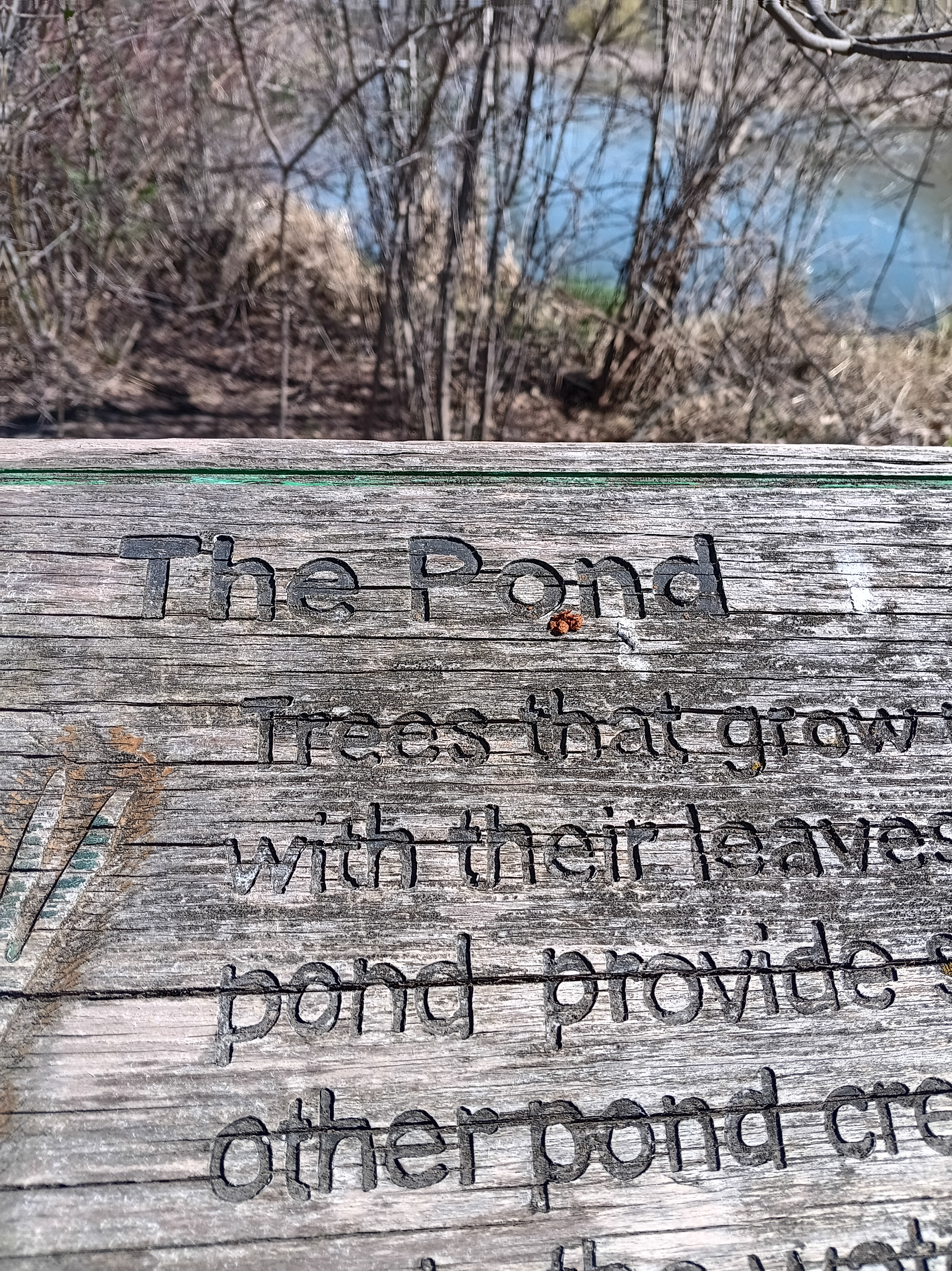
(Both images provided by The Drifter)

The Drifter

(both images provided by The Drifter)

Give Us This Day

“The bar was our altar.” – Caitlin Thomas

“There’s a slow, slow train coming – up around the bend.” – Bob Dylan

“This whole world’s gotta buy you a drink, man / Gotta take you to the edge and watch you throw it up / Every morning, I could give a damn what you did last night / Just tell me how far to kick this can…”

– Conor Oberst, “No One Changes”

“Christ’s religion is essentially poetry – poetry glorified.”

– Elizabth Barret Browning

The Drifter (myself) took his last drink of alcohol almost exactly twenty years ago from today: on August 5, 2005. (I write this on August 1, 2025.)

The story of my drinking, its history, its reasons and motivations, its progression, its hilarity, its adventures (many, many, and many more, including good company, bad company, and dangerous company), and the eventual fall into total addiction in my mid-30s (drinking hard liquor sometimes combined with red or white wine all day every day and never drawing a sober breath, plus other related problems like catastrophic depressions, weight loss, liver problems, heart problems, heart palpitations, malnutrition, emergency-room accidents, vicious, pain-filled, suicidal hang-overs, crushingly embarrassing behavior and psychological humiliations, near-death occurrences and much more, none of which were improved by also smoking two to four packs of Marlboro Lights per day along with the liquor) will be gone into in more detail in the near future in another column.

Because alcohol is a subject I still love to talk about, even though I haven’t had a single sip in almost twenty years.

For today, in honor of my drinking and in honor of all drinkers, addicted and not, and in honor of the one thing that has kept me sober perhaps more than any other, I will briefly explain what I think the Lord’s Prayer means.

This column is not for so-called “Christians Only.” Nor is it only for alcoholics who are looking to quit drinking. Nor is it only for ex-alcoholics who have already done so.

It is for writers and writer-friendly peoples everywhere, especially since writers are known to be, as a group, prone to drinking alcohol more so than the general population (which is a lot, especially in America, land of the binge drinker); and also for anyone interested in surviving this life (as long as possible) and living a good one while you’re here.

Because the Lord’s Prayer can even be said and studied by atheists vastly to their own enhancement at almost every single human level we can possibly imagine.

I do not presume (very far from it) to have the final answer/s about these words, unlike many of the pastors, priests, and ministers (so-called) afoot in America these days (not all, but many).

These are simply my (brief) reflections, today, on a prayer (a poem) that has saved my life.

I never could’ve gotten myself sober without this.

This column is also meant to defamiliarize the Lord’s Prayer in a personal way, so it can be renewed in at least a few of us.

(Disclaimer: This piece may sound a tiny little bit like a sermon in certain places (in the manner of John Donne) but it’s Sunday, after all…)

*

Our Father who art in Heaven: hallowed be thy name.

Thy Kingdom come.

Thy will be done, on earth as it is in Heaven.

Give us this day our daily bread.

And forgive us our trespasses, as we forgive those who trespass against us.

And lead us not into temptation.

But deliver us from evil.

For thine is the Kingdom, and the Power, and the Glory: forever and ever.

Amen.

*

In the first part of this poem, which is the first sentence, Yeshua (hereafter called Jesus in this work) was asking humans to do something.

He was asking them to acknowledge the eternal existence of something greater than themselves.

In so doing, not only the Creator of the Universe is worshiped. Humanity itself, including the speaker of the prayer, is worshiped.

He is our Father, after all. And He is in Heaven. By hallowing (making holy) his name, we make holy everything there is, including all the pain, all the death, all the suffering, all the murder, all the disease, all the killing, all the death, death, death, death.

We let it go (like saying “So it goes”), and give it back to Him. Jesus believed he was waiting to receive it. Walt Whitman later said, “All goes onward and outward; nothing collapses; and to die is different from what anyone supposes; and luckier.

In the second sentence of this poem, which is only three words long, Jesus asks for The Kingdom to come.

It’s key to remember, or point out, that elsewhere he said, many times, “The Kingdom is inside you,” when talking to a few of his small bands of disciples and followers on the lakeshore or in the hills. (The Book of Acts says there were “about a hundred and twenty” believers after his death; the first person to see him after he died was Mary Magdalene.)

When he says “Thy Kingdom come,” he means after death, yes. But he also means, and maybe more importantly, right now, and right here, while we are alive on the earth. And it isn’t outside you, it’s never outside you, it’s right in your guts, in your brain, and in your heart, like it was in Mary Magdalene’s. Or it should be.

In the third sentence of this poem, Jesus acknowledges that we are not in charge of ourselves and we do not necessarily create our own circumstances.

This sentence is about what we call in the modern world “acceptance.” Buddha and Muhammad had similar messages. We may be born blind or we may be born with a disease that will kill us before we reach the age of twenty. Such people are more beautiful, not less beautiful, than the rest of us.

In sentence four, it’s crucial to meditate on (think about) what he means when he says “this day” and “our daily bread.”

We are not supposed to hoard possessions or money like Scrooge, and we are not meant to live on the earth forever. If we have enough today it is enough; tomorrow, as he says elsewhere, has enough worries of its own. Worrying about the future is a sin, because it diminishes the present.

“Our daily bread” does not just mean food, although it also does mean food.

It also means whatever we need for today, like strength, endurance, imagination, courage, stick-to-itiveness, a purpose, a reason for being.

It’s also meaningful to isolate the phrase “give us this day.”

For sentence five, we need to define “trespass.” Trespass means SIN.

Too many modern people these days get salty when you tell them they are sinners. And too many people of the cloth (pastors, ministers, priests, etc.) have NO IDEA what sin really means, these days.

It is not the old-fashioned thing. This world is rampant with sin. The people in the White House in the USA are great examples of this.

Greed and not caring are sins. Getting drunk or “cheating” on your spouse are personal choices (maybe bad choices, but not necessarily “sins”). (And maybe the spouse being cheated on is too greedy of your own personal time; and maybe you getting drunk is sacrificing yourself for your own artistic inspiration; everything depends upon the context.)

Jesus also emphasizes what a profound, life-changing, freeing personal event it is when you forgive someone. Forgiveness is for the other person, but it is for you first. Also, we can’t expect mercy and compassion when we don’t give unto others.

Send out mercy and compassion and you’ll soon find it will come right back at you (“instant karma”).

An example would be giving an authentic smile (not a sales person’s smile) to someone on the street, instead of ignoring them. And they smile back, in a surprised and genuine way.

For sentence six one needs to define “temptation” and “lead us.”

In this sentence of the poem, is Jesus intimating that it is God Himself who leads us into temptation? If so, doesn’t that make God a bad person? And why would he want to tempt us into something that isn’t good? Did Eve eat the apple first because she was smarter and more adventurous than Adam, or because she was more underhanded? Does temptation mean a temptation to despair, which is nihilism and a lack of faith in life, which lead to greed and not caring because you have nothing better to do or focus on?

At this point in the prayer-poem, it’s time to really realize that part of one’s job in all this is thinking, and thinking deeply, and long and hard, over years, about what it all means.

And it is NOT something one shares with others, at least not in any overt kind of way (until, maybe, much later) but the thinking itself changes who you are, and it changes you for the better.

No exceptions.

Number Seven is the penultimate sentence of this poem-prayer, and it is not Number Seven for no reason, either. (Seven = Heaven.)

The last sentence was tacked on by Martin Luther (a personal hero of mine, and a person well worth reading about, whom Harold Bloom once called the most “important” person in the West since Jesus himself, although Martin also wasn’t perfect, like all of us) much later, and it deserves to stay where it is.

It’s very, very, very similar to what the Buddhists mean when they talk about attachment – being too attached to the things that are only of this world, which equals suffering for yourself, which equals suffering for others, which equals suffering in the world.

We should attach ourselves, instead, to the things that can’t be stolen by the thieves, or corroded by the rust. Instead of being outraged by what the thieves stole from you (whether it be the “white collar” thieves or the “regular” ones), attach your mind, heart, and soul to what they can’t get at. (Any other reaction is, again: sin.)

It’s up to us to decide what those things are for us – like Jacob wrestling with the angel.

“AMEN” means Let it be.

DRIFTING END NOTE: An example of a drinking adventure I had was the time I traveled to the White Horse Tavern in New York City which is the last bar Dylan Thomas ever drank in and where he consumed the oceanic quantities of liquor that helped kill him.

I went to the White Horse Tavern specifically to get spectacularly drunk in the manner of Dylan Thomas, in order to celebrate the roistering poet spirit of Thomas in a way that was living the life, not just writing about it. (And back then I was much better at living the life than I was at writing about it, although I was working and practicing at both, every single day of my life.)

And I managed to accomplish my goal. I did in fact get spectacularly drunk in honor of Dylan Thomas. My guess is that I drank at least six pints of dark beer backed up with at least one or two shots of whiskey per beer – plus nonstop Marlboro smoking – all on an empty stomach. (I never ate when I drank since drink was my food; not even a single mouthful.)

I had to be led out of the bar and back to my friend’s apartment by my drinking companions who were also spectacularly drunk (but a little less so than I, at least on that particular occasion).

I was a bit cautious that night because I didn’t wish to jinx myself and end up dead like Dylan Thomas.

(I will eventually of course, just like we all will: but not yet for any of us).