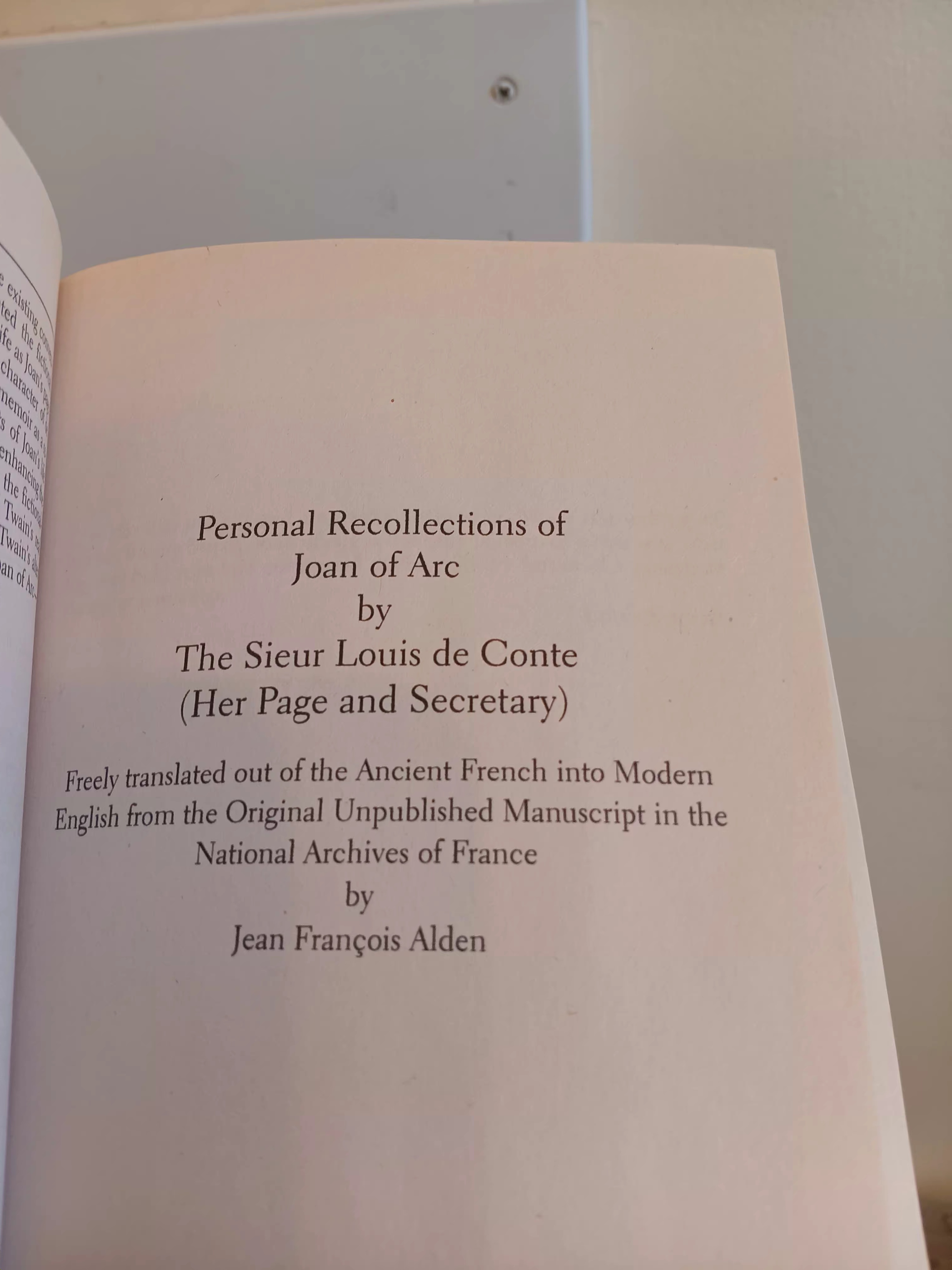
“Now the flames they followed Joan of Arc.” – Leonard Cohen
Intro Note: The Reader does not need to know anything beforehand about the historical personages discussed in this text. Everything the Reader needs to know (for the purposes of this) is explained within the text.
When I die, if I ever do, I would like it to be, somewhat at least, in the manner of Susy Clemens and Jack Donne. I shall explain who I mean and what I mean in a moment.
First I want to say, for the record, that perhaps I would rather go more like Arthur Schopenhauer, the great German hermit philosopher, at least as I imagine it (based on the facts).
He sat down for breakfast in his mid-70s, which back then would’ve been like late 80s, at least, today. When his housekeeper came back in with his coffee (he lived alone, except for his housekeeper and poodle) s/he saw the great philosopher sitting there calmly in his chair, at the breakfast table, eyes closed, a smile upon his lips. The philosopher loved his coffee and the aroma of it always perked him up. The caretaker knew that the lonely, solitary and proud Schopenhauer had passed on when he didn’t reach for his coffee. “They” now call him the most pessimistic philosopher who ever lived. In truth, despite all his solitude and struggles, or because of them, the man had at some point turned into one of the happiest people who ever walked the planet, even though he was blatantly rejected by his own mother in front of Johann Wolfgang Von Goethe himself. Schopenhauer could even compete with Buddha and Lao Tzu in that way. You can tell it from his late writings.
Suzy Clemens was Mark Twain’s oldest daughter. She was the one “most like him,” and the one he consequently fought with the most. She wrote a biography of her father when she was in her teens. She inspired some of his most memorable literary creations, if not some of his best work, such as his novel about Joan of Arc. He often compared Suzy to Joan and he almost felt like she was Joan reincarnated, and sometimes he even believed that literally (almost) she really was Joan, reincarnated. And she acted as a literary critic and editor for her father’s and for other’s works. She also wanted to be, and studied to be, an opera singer, which was like wanting to be a rock, pop, or rap singer today. She was often highly competitive with her father, believing that he could be (and often was) a windbag who took up too much air and too much space in the room. While everyone else was in awe of his overwhelming presence, she thought he was acting like a jackass at least half the time.
When the family left for Europe in 1896 (dad was big-time broke again and needed to make $ on a lecture tour), Suzy-Joan stayed behind, at the age of twenty-four. She contracted spinal meningitis. She spent her last days in a literal writing fever, creating a 46-page prose poem by hand that is terrifying, brilliant, and prophetic, by turns, and, with its stream-of-consciousness form, sometimes sounds like an early version of T.S. Eliot’s The Wasteland, which wouldn’t even be written for another two decades. She wrote so hard and so fiercely during her final days here on Planet Earth that her caretaker (even lots of poor people had “caretakers” back then) did not think Suzy was even aware of how sick she was. She wandered around the rooms of her parents’ mansion and she hung out in their gigantic bed, the bed posts of which were angels. She remembered playing in this bed with her younger siblings when they were kids. She wrote, and wrote, and wrote some more, until her feverish fingers were worn out, the disease she was suffering from literally driving her on. She was possessed, driven, totally focused, a laser beam of the heightened writing mind, lost in her own written world. Eventually, after a few days, she collapsed into a stupor, then into a coma. She passed out of this mortal coil while sleeping. She was gone before her family was able to return to her across the Atlantic. Mark Twain had many good times from then on until he himself passed away in 1910. But he was never the same. No: he was never the same.
It was often said at the time (and has often been said in the centuries since) that there were two John Donnes. The first one was Jack Donne, the young rebel, satirist, lover, partier, drinker, soldier, practical joker, scholar, wanderer, sometimes ragged “man-about-town,” and poet. The second was Dr. Donne, the Dean of St. Paul’s Cathedral, a center of London, great metropolis, largest city in the world at that time. Jack Donne did not want to become Dr. Donne, the Dean of St. Paul’s. But back then, when the King wanted you to do something, you did not say no. You could resist, if the King was fond of you, as this King was fond of John Donne. But in the end, you gave in to the wishes of the King or you had your head on a pike eventually instead. Donne was a survivalist, and he gave in to the King’s wishes eventually (after plenty of resistance). He didn’t want to end up like Sir Walter Raleigh or Christopher Marlowe, i.e. head removed or stabbed in the brain through the eye.
Later Donne realized that the King had been right about himself, and he himself had been wrong (about himself). Sometimes other people know us better than we know ourselves, even the King in some cases. Because Dr. Donne became famous in his own day as one of the greatest preachers not just England but all of Europe had ever produced. His sermons were hours-long, dramatic, driven, riveting affairs. Many men and some women gave hours-long, dramatic, driven sermons back then, but few were riveting like Donne’s were. He had attended the original productions of Shakespeare’s plays on a regular basis when Shakespeare still lived. Let me repeat that: Donne regularly attended the original productions of Shakespeare’s plays (such info as that requires pausing and brooding and marveling over, not glancing at it once, nodding the head, and back to scrolling the phone). Donne had learned the value and the techniques of the dramatic monologue and the now-famous soliloquy. His sermons became modern-day religious soliloquys that grappled with God as if God were not in the next room, but right there in front of him and everyone.
And everyone could tell, and knew, that Dr. Donne was dying as he climbed into the pulpit for the last time to deliver his final sermon. The fact that he was paler than a ghost, emaciated, and with hands trembling were just a few things that gave it away. This was also a man who’d recently posed for his own effigy, a statue that later disappeared into the basement of St. Paul’s before being returned to its pride of place a couple of centuries later. That is a cautionary tale about the reputations of great writers.
His last sermon was called “Death’s Duel.” In it, he ultimately extolled the figure of Jesus Christ, and said that if Christ could show us how to die, then the least we could do was die like he did, which meant (for Donne) bravely, fearlessly, or staring down the fear, conquering it. In certain gnostic texts, Jesus says, “It wasn’t ‘the real me myself’ who was crucified.” By this, he meant that there was something more in his spirit that rose above the mere body, far, far above the body. Socrates and Plato also believed the same thing.
Suzy Clemens and Dr. Donne both believed their illnesses were visitations from the Supreme Creator. Neither of them wanted to die, and they both struggled against it until their last breaths.
But also, for them, to them, and within them (this was what they believed), HE had finally arrived to take them home.
HER POEM: Suzy Clemens’ final, long, modernistic (before modernism existed) prose poem was partly addressed to a famous Spanish opera singer of the day, Maria Malibran, a figure who was very much akin to Lady Gaga, the best of Taylor Swift, and/or Amy Winehouse in our own day.
Here are seven sentences from Suzy’s (quite literally) death poem, a death poem that is riveting and even liberating, but not depressing. She wrote herself straight into the next life (or the eternal silence, whichever one prefers), literally; the lethal illness had been like an inspiriting drug:
“Greatness has no need of shunning.”
“She must give ear to these things not reluctantly but gladly.”
“They will inherit the greater darkness to come for this is retribution not vengeance.”
“She is a queen of God’s light but I am a queen of his darkness.”
“You cannot escape his creations.”
“The universe is united.”
“Love governs all thereby.”
Dale Barrigar


Dale
Strong admiration for both Donne and Suzy Clemens already. There should be a production of the Clemens’ family before death took everyone but the last daughter. The White Suit Sage myth is powerful, it affected the Ken Burns’ production.
Donne got a great seat at a great theatre. Fantastic writer, partier and admirer of sex.
According to Sam, Orion Clemens had a sweet death similar to Schlopenhauer. Orion woke with Big Ideas every day and passed happily at his morning table, quickly, still in throes, like Orson croaking at the typewriter.
Thank you again for another week of great work!
Leila
LikeLike
Hi Leila
You and I have many interests in common, both in a large, general way, and in a lot of small, specific ways. This makes for a lot of creative Springs energy on my part that inspires a lot of good work (well, for me, anyway), like all five essays this week.
Thanks for being such a reliable inspiration and such an understanding partner in a creative Springs partnership that just keeps on gettin’ better and better!
Dale
LikeLike
Dale,
Read this with great interest, especially the bit about Donne’s last sermon. Here was a guy who, judging by his poems, was a bit death-obsessed – an expert prior to the event. Thought I’d look up his sermon, but was dashed to discover that there are 160 surviving sermons, with Oxford Uni Press due to bring out a new edition with explanatory notes….. in ten volumes! But then I discovered that the last sermon was on youtube! Wow. thanks for this – mick
LikeLike
Hi Mick
The guy gave a lot of sermons! I wonder if the energy of doing so hastened his end, OR kept him going for longer than he would have otherwise? (or maybe a little bit of both…)
Thanks for the valuable info about his sermons and for your interest in general. His poems, too, are (of course), some of the greatest ever written in English. Perhaps in line it goes: Shakespeare, Milton, Wordsworth, Donne, Keats (?) or William Blake…
Dale
LikeLike