Farewell Old Year and Happy New Year From Saragun Springs: Six Limericks by Geraint Johanthan

Ed. Note: Nothing is better to read for entertainment value than the mighty limerick. And today we close out 2025 (a somewhat quiet, dweebish year that appears happy not to have secured a place of infamy) with six limericks, in two sets of three, by Geraint Jonathan.

No rest for the wicked, the wiccan or the wickered. We will return tomorrow…Leila

3 Limericks from Wales, by Geraint Jonathan

(For John Bilsborough R.I.P)

There was a fine man from Caersws

Who went for a bath in his boots

He splashed for a while

But his feet remained dry

And his wardrobe full of moth-eaten suits.

There was a man by the name of Harris

Who dreamed of dying in a garret in Paris

But getting to France

He’d no fucking chance

Being skint and with it embarrassed.

There was an old man of Kidwelly

Who’s spent his life watching the telly

And so it was b’there

His eyes became square

As did, most curiously, his belly.

3 Limericks from the North by Geraint Jonathan

There was a young man new to Morecambe

Who loved the sea air it was awesome

But talk of monsters

Seen out in the waters

While untrue he still swore that he saw some.

There was an old man from Carlisle

Who bore his teeth in the shape of a smile

Among further adventures

He misplaced his dentures

And his gums did the work for a while.

There was a fine fellow of Kendal

Who was thought to be quite sentimental

I don’t know about that

He said but did add

It’s less of the senti, more the mental.

nobody number one, by Geraint Jonathan

(And as promised last week, here’s the third poem this month by brilliant Geraint Jonathan-Leila)

he was supernobody

a provincial jack

big on words

loaded with them

styled himself half-life

spun a tired line in self-deprecation

& all the while no self there

played phantom

(with a nod to phantoms everywhere)

on the offchance

phantoms don’t play themselves

in the popular imagination

being too absent abstracted

altogether too phantomlike

the world seemed

& those in it seemed unaware of it

seemed unaware of it that is

supernobodies can spot these things

the faces in a face

the suffering animal’s laughter

the engendering of toads in a petty dispute

being nobody helps

(makes anyone possible)

& with a wife & three kids 80 miles north

there was nothing for it but robes & wigs

& swords & the art of being somebody else

the word-load heavy but the money good

nobody par excellence

one shakescene of a country

disguised as himself

provincial jack

big on words

The Odyssey of Ellison by Doug Hawley and Bill Tope

(Ed note-Gotta live dangerously. Here we go with another fresh one during this month of reruns. Enjoy-Leila)

Looking Back

Ellison stood in her lavish garden, staring across the expanse of hydrangea, bougainvillea and sundry other plants, at her husband of 20 years. He was standing over the BBQ grill, his usual place during the summer months. He wasn’t pretty, she thought. Nor was he tall nor particular fit, but he fit her well enough. She smiled.

Feeling himself under scrutiny, Dewey glanced back at his wife. Dewey thought, not for the first time, how lucky he had been to lock onto such a foxy lady as Ellison. Even now, more than two decades after they met, she was a sight for sore eyes. What was that smile about, he wondered. But then, Ellison often seemed to be lost within herself, tickled by what she saw. He turned back to the pork steaks.

The next thing Dewey knew, Ellison was at his side, doing provocative things to his backside.

“Hey, sailor,” she whispered.

Dewey grinned. “Can I interest you in some…grilled meat?” he said, then thought, wow, what an original line. “You wanna pork steak, Babe?”

“Um,” she murmured. “I’d prefer a wiener.”

“I’ll need to put some on,” said Dewey.

“I’ll take care of it,” she told him, and led him into the house.

Later, after they’d done unspeakable things to the other, they lay atop the mattress, talking.

“Are you happy with me, Ellison?” asked Dewey. “With us, I mean? Is there anything we’re missing?”

“Well, I’d prefer $10 million in our IRAs, but no, I’m happy enough. You?”

Dewey could have played it cool, but he decided to come clean. “Baby, I’m over the moon happy with you. In fact, happy doesn’t even touch the way I feel.”

“Aw,” said Ellison, leaning in for a kiss.

“Really,” he said. “You gave me two beautiful kids,” meaning Vin and Sugar, who were in their first year of college, half way across the country.”

“Well,” she said, “I do have a case of empty nest syndrome, you know? Seems the kids were always under foot, but now that they’re gone, I miss the hell out of them.”

They lay in silence for some time before Dewey said, “Do you wanna have another kid?”

Ellison said nothing.

Dewey shrugged, felt a little rejection, but decided to put the issue off until later. Then he heard Ellison’s soft snoring and realized she had not dismissed the idea after all. He smiled and thought back to where it all started…

Get Her Number, First

Dewey Mercer looked up at the new barista in his favorite Starbucks and noted with appreciation her slender hips, her cute face and the gorgeous auburn hair spilling down her back and shoulders. He had noticed her the last two times he’d been here, but had been too afraid to approach her. He wanted to ask her out; what to do? He thought for a second; his older brothers, Huey and Louie, always told him, “Either dazzle them with brilliance or baffle them with bullshit, man.” Nodding to himself, Dewey stared into her pale green eyes and stalked forward and stood before the pretty young woman. She looked to be about his age — 19. She glanced up, smiled, and asked, “Yes, how can I help you?”

Dewey’s mind spun. Brilliance or bullshit? he wondered wildly, momentarily at a loss. Then he gave it to her with both barrels: “The Double Ristretto Venti Half-Soy Nonfat Decaf Organic Chocolate Brownie Iced Vanilla Double-Shot Gingerbread Frappuccino Extra Hot With Foam Whipped Cream Upside Down double blended, One Sweet’N Low and One Nutrasweet, and Ice.” He gasped for breath.

She stared at him blankly for a moment, then blinked. “Would you like a cookie with that?” she asked. He shook his head no and she went about the process of preparing his Frankenstein drink. Dewey scowled; that hadn’t gone well; she took it in her stride and now he was on the hook for an expensive libation. After some minutes, the cute barista set the drink atop the counter and said, “$149.99 please.” It was Dewey’s turn to stare blankly and blink.

“Put it on my card,” he muttered, pushing his debit card forward. His Visa, of course, was stretched beyond its limit. She told him so. He hung his head. Now there was a crowd growing at the busy coffee shop. Deprived of their caffeine, they were turning ugly.

“C’mon, move the line,” someone behind Dewey groused.

“He ordered some freakin’ bogus drink and now can’t pay for it,” hissed another.

“Deadbeat!” seethed a third.

Feeling belabored and outnumbered, Dewey went for broke. “Could I…uh…have your number?”

She surprised him and smiled. “Are you asking me out?”

He smiled too. “Uh huh. I’m Dewey,” he said.

“I’m Ellison,” she confessed.

“I know, I read it on your name tag.” They both tittered.

“C’mon, get a room!” someone in line barked. “I want my latte!”

Ellison scratched out her number on a paper napkin and handed it over.

“I’ll call you, Ellison,” he promised, shoving the napkin in his pocket and turning away. That went well, he thought, smiling.

First Date

They met at Clarke’s Pub. Ellison’s expression indicating she was slumming. Dewey understood and asked “I can see you aren’t overwhelmed by where I took you. Why did you agree to this date?” He took a big drink of his beer.

“You aren’t good looking, you clearly don’t have money, so the only reason I could think of that you were so confident was that you were a great lover or stoned.”

Dewey turned red and blew beer out of his nose.

Ellison said “Maybe I said that wrong. Is it that you’ve got something great in your pants?”

Dewey had no more beer to expel out his nose, so he gathered his thoughts and said “Yes, I do have great taste in pants. I have ten pairs of great pants.”

Dewey and Ellison stared at each other and then broke out laughing. This time Ellison blew beer out her nose.

Coda

Dewey stood at the foot of the hospital bed, regarding the science experiment that was his wife. Tubes and wires and monitors and all the surreal accoutrements of hospice were onerous in their intensity.

Ellison’s oncologist entered the private room and walked up to the bed, tablet in hand. He had done his due diligence, thought Dewey, and even now, at the end, was playing his part. Finally he looked at Dewey.

“Is it the end, Doctor?” he asked, his voice coarse and scratchy.

“Ellison’s living will compels us to forgo heroic measures,” he replied.

Dewey nodded. “She didn’t want to lie on display, dying with no hope.”

“As of yesterday, we discontinued the meds, aside from the morphine. We still give her water, of course, and do what we can to make her comfortable, but the late stage medicines, the Belzutifan and the Welireg and the others, were withdrawn. It’s up to God now, Mr. Mercer.”

Dewey nodded. He cast his thoughts back two weeks, to just before Ellison entered hospice, to the last cogent conversation he’d had with his wife of 60 years.

. . . . .

“I want you to meet someone new, Dewey,” she said.

Dewey frowned. “Ellison, I’m 80 years old. I’m not interested in dating.”

“You know you’ll go crazy if you have to live in that big house by yourself,” said Ellison. “I…I don’t want you to be lonely, is all.”

Dewey heard her softly sobbing and quickly sat by her side on the bed. “You’ll be with my always, Ellison; I’ll never be alone.”

Ellison, obviously in pain, looked at her husband with a little smile and said, “You always knew what to say. You were never pretty, but you had a way with words. I want to sleep, Baby,” she said, and crawled under the covers.

. . . . .

As the heart monitor signaled Ellison’s flatlining, Dewey gave a start. The room was suddenly flooded with hospital workers. As Dewey stared helplessly at his wife’s corpse, a strong hand folded fingers over his bicep and a voice said,

“C’mon, Dad, let’s go home.” Dewey recognized his son’s voice and went with him from the room. Since his diagnosis of dementia, Dewey’s son, Vin, had bought a home on the same block as he and kept close tabs on his father.

That first night, alone in his strangely empty bed, Dewey thought back to his favorite Starbuck’s and the monster drink he’d ordered in order to score points with the woman he loved with all his heart for the next half century and more.

Ellison was hovering over the drink and contemplating Dewey’s rejected credit card. She asked him with a crooked half smile, “Do you want a cookie with that?”

Doug Hawley and Bill Tope

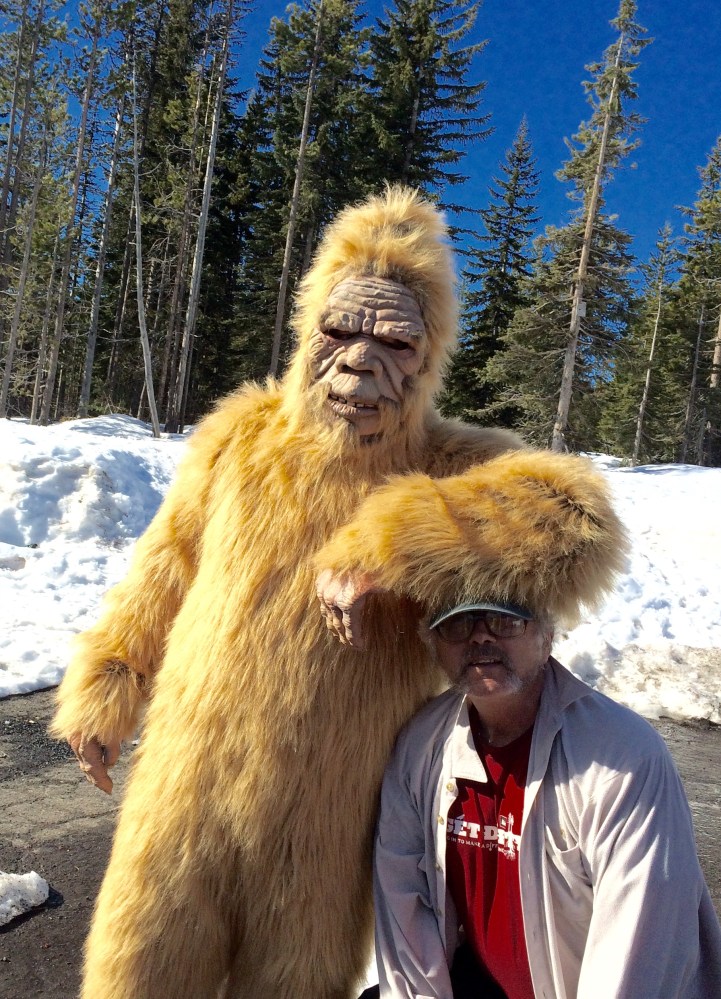
(Image provided by Mr. Hawley. He is assumed to be the shorter fellow)

The Drifter: Why Christmas Music in 2025 and Beyond?

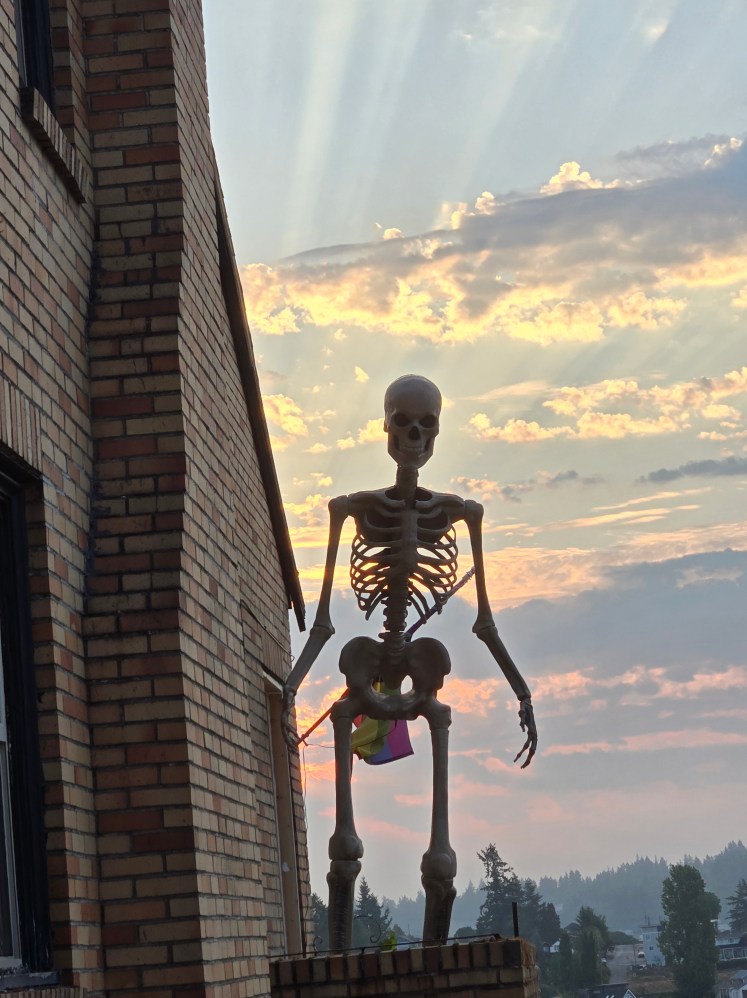
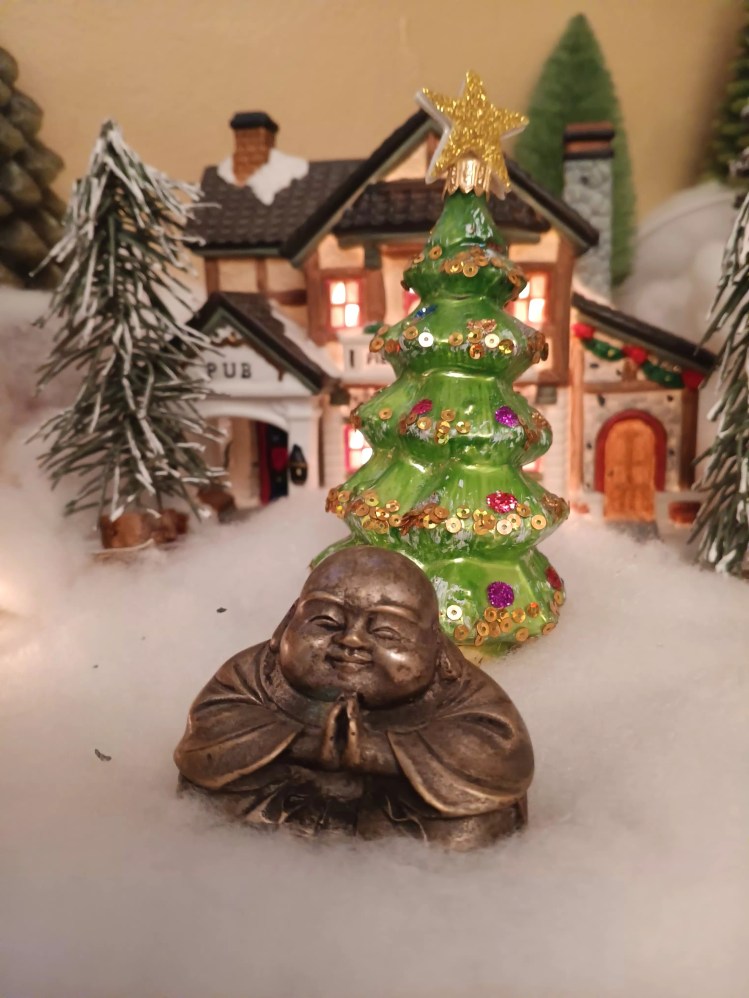
(All fine images by the Drifter)

In the Year of Our Lord 2025, many good-hearted folks can indeed be excused for being cynical about Christmas music.

So much of it (like so much else in our society) is used for nothing but Sell, Sell, Sell; and so much of it has a quality of sincerity which matches the sincerity of Amber Heard on the witness stand (sorry Amber).

But as Scrooge and the Grinch (among others) have eternally reminded us, the real spirit of Christmas is not meant to end on the day when the Christmas shopping is over.

The real spirit of Christmas is supposed to be about the way you live your life all the year ’round.

In this short little essay/column, The Drifter shall offer brief musings upon four Christmas songs that can be enjoyed and returned to all the year ’round.

The first song is “Samson in New Orleans,” by Leonard Cohen, from his 2014 album Popular Problems, a brilliant album all the way ’round.

Leonard was 80 when this record was released. His final, triumphant world tour had ended in 2013, but Leonard wasn’t finished making art, and he wouldn’t be finished making art until he was finished being here in the flesh in autumn of 2016 (and maybe he continues to do so elsewhere even now).

“Samson in New Orleans” is not an official Christmas song. But it should be thought of as one.

This song so much reminds me of John Milton’s great poem Samson Agonistes that it makes me think Cohen must’ve been familiar with Milton’s poem. If he wasn’t familiar with it, it was a familiar case of two great artists coming to the same idea on their own, a common phenomenon, which justifies Tolstoy’s famous quote about art’s core being about linkages, connections through time.

This song contains these lines: “The king so kind and solemn / He wears a bloody crown / So stand me by that column / Let me take this temple down.”

Leonard was a practicing Jew, but he also made a call many times for his people to remember that Jesus was one of their own. As such, he was a Christian in everything but name, as well as a Jewish Buddhist.

Listen to the song. It explains why we should follow the real Jesus, and what doing that really means.

When Bob Dylan released his Christmas album Christmas in the Heart in 2009, many people made fun of him. And indeed, much of the album was made in the spirt of Christmas fun. But some of it is deadly serious.

Dylan’s version of “Little Drummer Boy” is one such performance.

If you listen to this song in a highly advanced flow state, or with your favorite medicinal substances enhancing (not impeding) your imagination, it will take you back 2,000 years.

The song contains the line, “Little baby…I am a poor boy too.”

It reminds us that the real Jesus was nothing if not a law-breaker, a rule-smasher, a son of the lower classes who was smarter than everyone in the upper classes and who stood on the side of the downtrodden and oppressed his entire life, even though he could have easily joined the other side any time he wanted (which is the symbolism of the devil offering him the whole world if he would only bow down and kiss the devil’s feet – which, of course, he wouldn’t).

Like Cohen, Dylan is a Christian Jewish person or a Jewish person with an unbelievably deep feeling for Jesus.

He knows that one thing does not preclude, nor exclude, the other, and that goes for everyone.

(“All Religions Are One,” wrote William Blake over 200 years ago. You would have thought the human race might’ve caught up to him by now.)

Now that all the members of The Band are gone from the world (in the flesh, anyway), anything by them becomes that much more beautiful.

But “Christmas Must Be Tonight” has always been one of their most beautiful songs, a song so beautiful it brings sadness and joy, tears and quiet internal laughter, at the same time.

Rink Danko’s voice is gorgeous in this song. Robbie Robertson never wrote better lyrics.

Its first words are, “Come down to the manger, / See the little stranger…”

Everyone in The Band knew deeply why it’s appropriate to call Jesus “The Stranger.”

It’s a knowledge that has been lost by mainstream culture in the USA.

Finally, one more song, which, like “Samson in New Orleans,” is not an official Christmas song but should be seen (and heard) as one.

Toward the end of his life, Harold Bloom was asked to name his own personal favorite song of all time.

His answer was, “The Weight,” by The Band.

he-man, all-too he-man, by Geraint Jonathan

(We are blessed with another new item for this month–three actually by Geraint Jonathan. The first appears today, the second tomorrow and the third next week–Leila)

i said to her i said

unhesitating obedience is all i ask

taking what i say as gospel

hanging on to my every syllable

is all that’s required

apart from that

you’re free to do as i tell you i said

my good books are easy to be in

it’s wordy there for sure

but listen is an anagram of silent

& your silence is the best i’ve heard yet

& if you think that’s a riddle think again

that’s what i said i couldn’t’ve been clearer

but did she listen not a bit of it

so off i went

you’ve a vengeful nature she said

out of nowhere just like that

vengeful nature now is it i said

we’ll fucking see about that

A Few Christmas Words Worth Considering

By Dr. Dale W. Barrigar

In Mark 6, we can read the story that is sometimes called “The 5000.” In terms of word count, it’s the length of a modern flash fiction.

Five thousand people come out to hear him. They listen all day. At night they are tired, drained, elated, and far from home. And they are hungry.

His twelve disciples are distressed. The very pressing question on their minds is, “How the h-ll are we going to feed all these hungry people?”

The Teacher does not get upset. Bring me what you have, he says.

They collect what they have. It consists of a few loaves of bread and a few fishes.

The disciples are now even more stressed. How will this ever be enough for all these people? Utterly impossible. And he tells them that they are fools to get concerned.

He starts distributing the fishes and bread to all the hungry ones.

And it turns out that there is enough.

There is more than enough.

Everyone gets enough.

Everyone is able to eat until they are full, and satisfied.

In the space between the impossibility and the outcome lies “the miracle.”

No one really knows what happened in that space.

Jesus was not the only miracle-worker of his time. There were many such. They roamed the countryside, visited the towns, and drifted through the cities all the time.

He was not the only miracle-worker by a long stretch. Back then, it was “a thing” they did, kind of like indigenous peoples in other places would transform themselves through shamanistic rituals and the use of drugs like magic mushrooms or peyote.

The lesson of the story is what matters.

And the lesson is this.

There is enough.

There is more than enough for everyone.

Modern science has proved this many times over.

It is not a matter of producing enough food and shelter for everybody.

The earth can provide, even now, when the population is 8 billion and climbing.

It’s all a matter of how things get distributed.

And it’s all a matter of what people want.

If people’s wants remain simple, and real, and if we all share what there is, there won’t be any problems any more.

Or at least there wouldn’t be the kinds of problems we see now: war, disagreement, stress created by greed, conflict created by desire. All of these things are rampant everywhere right now, from East to West, from North to South, and all points in between.

But there is enough, both materially and spiritually.

How we choose to use what there is – that is the message of the story.

He is the great messenger. But so is the anonymous writer, called “Mark,” who wrote the book of Mark. And so are all the ordinary people who came out to hear him. And so are all the readers of good faith who have studied his works and words over the centuries, no matter what their specific beliefs on other issues (like the afterlife) are, or were.

(Socrates said, “I believe in the afterlife because it makes me feel better to do so. If it isn’t there when I’m dead I won’t know it.

The end.”)

Fang and Rags Wish You Merry Christmas

It should be a hanging offense to publish childhood pet memories at Christmastime.

If put to a vote I would surely cast an aye. But that only goes for the unforgivable Marley and Me type of things that some people need to both publish and read for no other discernable purpose than to ruin Kleenex and cause an overall state of weepy depression.

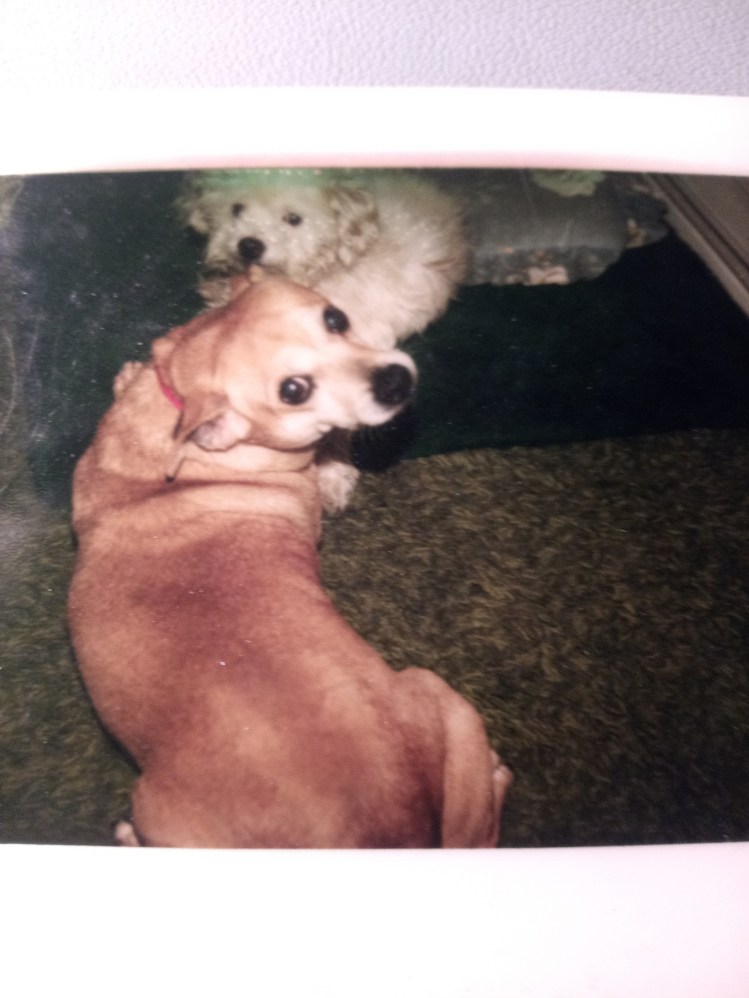
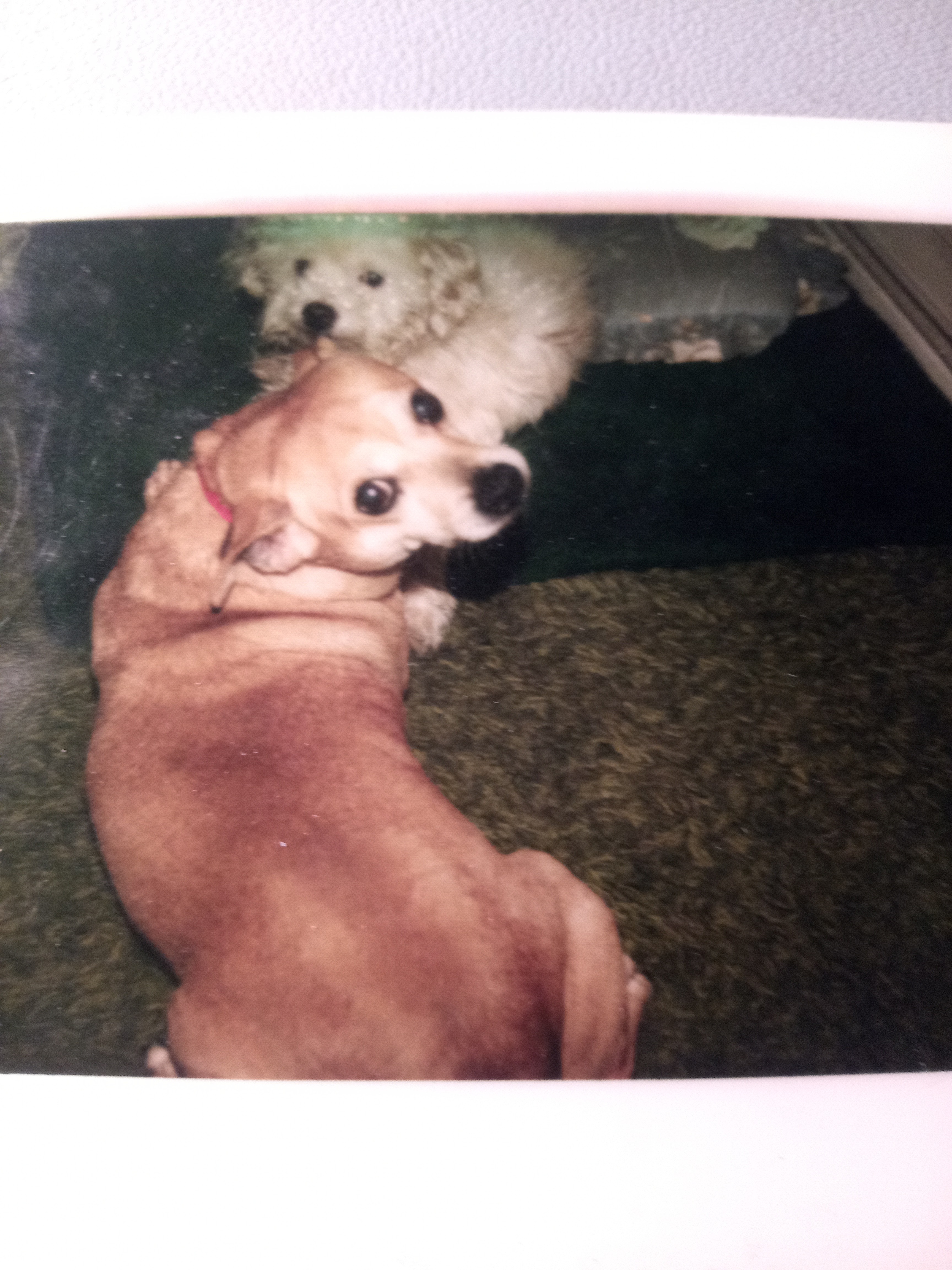
Perhaps disregarding sensible behavior, today I salute Fang and Rags, a canine tag team who took peculiar joy in destruction, which they routinely avoided punishment for by batting their brown eyes and sharing the innocent facial expressions (as seen in the photograph taken on a Polaroid land camera circa 1972 or 73). Fang is the brown Dachsund-Poltergeist mix, Rags the brief white ball of fluff. They both enjoyed long, spoiled lives from 1969 to 1986.

Every year, even in dotage, Fang attacked the Christmas Tree at least once, while Rags, usually more of a loud enabler than a man of action, rooted him on. It was both a source of vexation and even amusement (the smiles, however, seldom arrived before February). Nobody knew why it happened, nor did anyone bother to ask. Fang was amazingly powerful, Mighty Mouse like, and he often felt obliged to display his physical prowess, while yippy-yappy Rags had more of a role similar to that of a “Wrestling Manager.” (I have mentioned the boys’ brand of hooliganism in previous years, in other places, but it continues to remain worth remembering.)

So, to all whose trees are being toppled, packages urinated on and who exist in a constant state of unease, please remember to hold your temper and realize that you are experiencing your The Good Old Days.

Enjoy.

Merry Christmas from Fang and Rags, ever eternal at Saragun Springs.

Leila

Oh, and here is one of the boys’ favorite Christmas songs:

Amelia in Waiting

(Note: This really is an oldie. First written when Bill and Monica were an ugsome item in the White House, it has seen many changes over the years. I had high, high hopes for this once; it felt like it could have been something more, but never quite made it. I learned things are what they are destined to be–Leila)

The cataract sky saw not, yet watched; the wind moved not, yet listened; God spoke not, yet instructed. The day simply was and would be until the last mind summoned the strength to stop thinking about it. A low slung blotch of scuzzy radiance, which Amy assumed was the sun, slouched west within the ashes.

Amy gazed out the living room window. Only a double thickness of glass lay between her lungs and the poisons of an imagined alien atmosphere.

The cul-de-sac that had always been Amy’s home lay beneath the depthless sky. All around the remnants of happier times rotted like the crabapples that not even the crows would eat: Cheerful summer barbecue grills tucked under blue tarps held in place by cinder blocks; formerly lush and profuse gardens, now forlorn mudholes; abandoned toys sporting mossy growths, and what had gone unraked of the fiercely luminescent October leaves lay bunched in the gutters and storm drains.

Even at just sixteen, Amy knew this time of year well. It was the annual “Pause” that came over the well-fed cul-de-sac between the termination of Halloween festivities and the agreed upon going up of the Christmas lights on the Sunday of the Thanksgiving weekend. There was something affected and childish and selfish about this collective mood; something which Amy and her like-minded friends cleverly disparaged. With just enough education in their heads to make them annoying, the kids had wonked-up several alliterative titles for the event: The Morbid Malaise and the Enormous Ennui had been Amy’s contributions to that year’s gathering at the Round Table—but, alas, the others had favored the lowest common denominatorish, Poopy Pout.

The grandfather clock lashed four tones. This startled Amy out of her thoughts. Each chime had landed on her soul. Until that moment the grandfather clock had always been a benign friend that had never behaved rudely. Something about this feeling made Amy feel like a stranger in her own home.

She had purposely left the house still upon her arrival. Under normal circumstances, Amy felt ill at ease in places where darkness, silence and contemplation were the chief components. She had even gone to the extreme measure of turning off her cell—which, for Amy, was tantamount to plucking out an eye.

With a reluctant sigh, Amy performed her one and only chore; an action that she could be relied on doing about three times in five: she flipped the porch light on for her parents, who’d be home from work within the hour.

Amy’s bedroom lay adjacent to the living room and faced the cul-de-sac. Unlike the rest of the tidily kept house, her room was a disorganized mess which resembled an open archeological dig over-topped by a pop culture village. It was a mixture of the distant past and the oh-so-now. Here and there were fissures in the debris field that allowed forgotten toys and games from Amy’s deeper childhood to emerge like trilobites for the picking. Items such as realistically dead virtual pets and dogeared Pokemon cards lay intermingled with current issues of celebrity scandal sheets and the spent husks of no less than six cellulars—Oh, and there was a weird, fruity smell in the room too. Amy had theorized that the odor was caused by a known perfume spill interacting with the upending of an older fragrance. Theorizing on the subject was as close to doing something about it as she got.

The splay of the room was simple enough: bed, desk and stuff. The first two were constants, the third was ever-changing. Atop the various variables which are important to a young lady of Amy’s social status and economic circumstances, lay a smattering of pamphlets. She had gotten those that very afternoon. Amy had hurled the pamphlets at her room when she got home in vain hope that the accumulated ghosts of her childhood might do something about them. No such luck. In the feeble light cast by the perpetual gloaming, Folic Acid And You (a way too happy-clappy missive which extolled the virtues of the gross bean family) stood out like a missionary who had entered the jungle with a cross in one hand and a rifle in the other.

“No, no, no,” Amy hissed as she performed a backwards dive onto her bed. This was an ancient action of hers which sometimes toppled perfume bottles, and had recently earned her three stitches in her left elbow because Amy had forgotten about the (alleged) coffin nails Ty had given her on their first date. Amy had heard that some guys bring flowers and/or candy along for that sort of thing; but, alas, Amy was attracted to guys who saw the upside in gifting (alleged) coffin nails.

There was a row of school pictures starring, naturally, Amy, hanging below the crown molding in Amy’s room. The queue of ten portraits ran left to right and ranged from the first grade to Amy’s sophomore year in high school. Daddy had hung the first seven or eight, but toward the end of his conscription Daddy had cracked-clever forty times too many about the possibility of quicksand that she had to drop him from the portrait hanging team.

Lying in the gloom, Amy took stock of the Ghosts of Amy’s Past. Outside business transacted with the Tooth Fairy, Amys One through Three were basically the same person; slightly round in the cheek and grinning shyly, each of Amy’s earliest incarnations had bobbed bone-blond hair and had been installed in a jumper that had been designed to be girly and rugged at the same time. Four had a touch less fat in her cheeks and her hair had begun the long process of extracting what’s right about red from the sun and including such in its sheen; these trends progressed further in the faces of Five and Six.

To be frank, Six had been the final Amy to show her portrait taker a scintilla of respect. Six was the last Amy to grin shyly for the lens. Seven had concocted a goofy, off-kilter grin that suggested that she might have been high on something (which hadn’t been the case). And Eight, well she just flat out sneered at the camera. Amy recalled the photographer asking Eight if she really wanted to come off that way, and she also remembered him shrugging in a Okay-kid-I-don’t-give-a-shit way when Eight had replied, “Oh, yes indeedy.”

Nine had been high on something. A member of Amy’s coven had relieved her mother’s purse of excess Vicodin that Picture Day. Glassy-eyed and neither grinning nor sneering, Nine was the least there in the queue.

Something had gone wrong with Ten. Only Amy was aware of the problem. No one else looked beyond Ten’s neon pink hair or the mascara and foundation that had been laid on with a trowel (now, no one is suggesting that girls who look this way aren’t what they should be). No, what had gone wrong with Ten lay scattered throughout her face like a sky composed of cremated bones.

She shuffled herself up onto her elbows to get a better look at Ten. Unlike Seven through Nine, the expression on Ten’s face was honest (even snarly Eight had shone a little light in her eyes that told that she wasn’t as put out as she pretended to be). Yet there was a ruthlessness emanating from Ten which Amy couldn’t understand; an incipient hardness that had no business being in the face of a cul-de-sac kid. Nothing out of the ordinary had happened that Picture Day, but for the life of her Amy couldn’t remember the actual taking of her portrait—which was odd, for Amy never forgot anything about her life. Some persons are that way, you know; some persons who fail at turning a porch light on  twice in five can be the same kind of person who has total recall in regards to where they were, what they had worn and who said what about whom on a meaningless day that had come and gone so many ends of the world ago.

When Amy was four, she had stolen a cranberry off the table at the grocery store. She recalled expecting a flavor similar to the sugary concoction that came out of the can, and was unpleasantly surprised by a ferocious bitterness. This had happened on a Tuesday afternoon, right after preschool.

When she was seven, an ambulance came to take Amy’s former next-door neighbor, Mrs. Carlyle, away from the cul-de-sac for good. Until that July 23rd, a Thursday, Mrs. Carlyle had been a friendly pest who punctuated her every observation with a tittering laugh. Though Mom had tried to keep Amy from gawking at Mrs. Carlyle as the old lady lay on a gurney, it had been too late: Amy had seen the feverish, insane mania in Mrs. Carlyle’s face as well as getting a clear look at the horrible sores that covered her hellishly white fishbelly thighs. And there had been that wonderful, magical October Sunday morning, two years back, when a blanket of ground fog suddenly contained the head of a deer poking up like a submarine’s periscope at the treeline behind the cul-de-sac.

A voice spoke up from the mists of Amy’s mind as she lay in the increasing darkness. This voice was composed of the worst things in life. This voice had its own weird, fruity imagined smell; a breath which wasn’t the mingling of divergent off-brand perfumes forming a third, uneasy scent, but was the decaying stench given off by a car killed pet. The timbre of the voice matched the dusty click made by sun-broiled Scotch broom pods. And this voice gave birth to unwholesome visions such as “green-rimmed fiery pustules forming on fishbelly thighs” (that was written by Amy in her second discarded attempt at a diary, not by her author). Amy thought this the voice of Ten.

“You can still beg for a do-over,” Ten said. “It’ll be like the story you didn’t get in Lit class: ‘they let the air in.’”

There was something beguiling about Ten’s suggestion. Something practical. But the more Amy turned it over in her mind, the more she found herself thinking cold, reptilian thoughts; thoughts Amy equated with the suicide of the soul.

The grandfather clock spat out the half. A ghostly pattern cast by a set of headlights formed on the bedroom wall and slid away.

Amy rose off the bed and went to the full length mirror which was attached to her bedroom door. She stood sideways and ran her hands from her shoulders to her hips. She then laid her hands on her flat belly. An expression of horror formed in her eyes; it stood out like a flame in the twilight.

“No,” Amy said breathlessly. “No. The air is poison.”

A Christmas Rerun: Merry Christmas, Charleston Claws

This one has appeared around the Noel twice–originally on Literally Stories and last year on this site.

Far be in from me to prevent a possible tradition from setting in. Stranger stuff has happened. Not in bunches, but some.

There are famous fictional Cat names in this: Rhubarb, Toonces. Most of the others are named after demons, including “Amy” (no fooling). May all the roving fiends discover kindness, not just during the holidays but throughout their hectic lives.

Leila

Merry Christmas, Charleston Claws