This year is speeding along and here we are approaching the start of summer. I want to thank Dough Hawley for his work last month. His essays were wonderful and drew many views. And I also want to thank Dale Williams Barrigar, aka The Drifter (also a full Editor of this site); his weekly Sunday column has been a revelation as well as an obvious labor of love.
To begin the month, we will be running the “Christina Poems” by Dale–the first of five begins tomorrow and will run through Saturday. There will be various odds and ends by Yours Truly as the month steams forward (hopefully figuratively and not literally).
I spent half of June battling covid, which has further delayed progress on “You Remembered Everything.” I have it written, but I want it to be better. But I will publish the second book of Sarah and Tess called “Music” this month along with a long short (oxymoron?) called “Suicide Spoon,” which was written for and published by Hotch Potch Literature and Arts earlier this year. That was different for me because I stopped cold submitting last year. I want to thank Marco Etheridge for his labors in that project.
Once again, we extend an invitation for any of you to publish items (within reason) on the third week of this month–an ongoing theme which will end soon. Just send what you have to saragunsprings@gmail.com (previous month publishers are always welcome. The week is open, but we can divide the days between a few if needed).
As Dame Daisy says “Summerly summer rollingly rolls on.”
“Kerouac could write everything because he never forgot
anything.” – Bob Dylan
“I saw you this morning…in my secret life.” – Leonard Cohen
Scholars of literature always call Edgar Allan Poe the first writer in America who ever tried to make a living using nothing other than his own pen. And that is very far from true, very, very far from true.
Poe never tried to make a living in America using nothing other than his own pen. He always knew he would need another job, whether that was in the U.S. Army or as a low-wage wage slave working for other peoples’ publications where much of what he did as a “job” had absolutely nothing to do with his own creative writing, on the surface at least.
What Poe did try to do, and what he can be called “the first” at doing in many ways in America, was to try and live a truly literary life at every level, no matter what else he also needed to do in the meantime.
Every demeaning task, every humbling action, every humiliating circumstance in his life, and there were many millions of all the above, Poe tried to convert into something sacred that could be seen as serving the literary life he always made himself live for his own pride, even when it seemed impossible.
Poe never let himself forget he was a writer. He elevated it above everything else, above politics, above religion, above family, even; or rather he made it so much a part of his life that everything else, politics, religion, family, all grew out of his starting point, which was his commitment to writing as an art.
This profound innovation, which is more relevant now than it was 200 years ago when Poe made it, has had an endless series of influences on all the arts, not just writing, all over the globe, not just in the USA.
It probably caught fire in France first, when Charles Baudelaire, the first true poet of the modern city, took up the call that Poe had issued to the writers of the world.
Baudelaire identified so strongly with Poe that it’s said he would pray to Poe nightly, as if Poe were a saint. When we consider Charles Baudelaire’s Catholic background, this doesn’t seem nearly so crazy as it might appear at first glance to many of us.
In the religion Baudelaire was raised in, praying to saints was not only not frowned upon, it was encouraged. Baudelaire’s move, which was to make the Art-for-art’s-sake Edgar Allan Poe into his own private literary saint, was really only moving the material he was given at birth an inch or two to the right or left. It was the higher ideal of the truthful and imaginative writing life that Baudelaire was really placing on the pedestal, in the manner of his hero, and saint, Edgar Allan Poe.
Baudelaire wrote in the shadow of Victor Hugo, a writer as massive, deep and wide as Charles Dickens, but it is now Baudelaire, in his Paris Spleen, Flowers of Evil, and Artificial Paradises (hashish, laudanum, absinthe, and literature), who generally seems more modern to most poetry lovers.
Hugo the realist, as great as ever still, was of his own time. Baudelaire, following in the footsteps of Edgar Allan Poe, was for the future. Like Poe, he foresaw, and even lived in, the age when humans would become ghosts of themselves (for good and ill), the time when the new rule would be (and is): turn your own life into an art, or die, mentally, emotionally, spiritually, and even literally.
The life-as-art, art-as-life, consequences-be-damned credo and way of living was elevated perhaps even higher by Vincent Van Gogh, especially in his self portraits, or in Sherlock Holmes and Irene Adler, whose laser-like, scientific focus on artful truth-telling rises straight from the beautiful and terrifying mists of Poe’s profound innovation, where the responsibility for everything is placed squarely on your own doorstep, even, or especially, if you are a starving artist.
Here are four ways any and all of us can instantly start turning our lives into an art and an art form almost immediately. If you’re already doing these things, and I have no doubt that some of you are: then bravo for you. Keep it up, and spread the word!
ONE: Texting
Do not become the mental slave of your own (what I like to call) texting device. Never send a text that has been written for you by a robot, AI or other computer; and never send an emoji that has not been specifically selected by you to be extremely pertinent to the exact circumstances at hand.
If use emojis you must, feel free to do so: but be creative. Go deeper. Look for the ones that say what you really mean to say. And be sure you know what it is that you really mean to say. If you don’t really mean to say it, don’t just say it, blindly. This is you putting yourself out there into the world, and this is the inevitable way people communicate now, at this moment in history, for a million different reasons.
Texting is too easy to do, but it doesn’t have to be. Take the time to say what you really mean: or don’t say it at all. And when you choose silence, choose it for a very definite reason; know what that reason is; know why you are choosing to exercise your own silence; don’t just ghost people because you are bored – or lazy.
If the time has come for you to be quiet, know why you are doing it.
TWO: Emails
Be creative when you compose emails. Even be creative when composing emails if it’s in a situation where you are not supposed to be creative, or maybe especially then. If being creative will get you frowned upon and called onto the carpet, be as creative as you can possibly be, even unto the point of being shown the door by the robot-humans in charge eventually. Don’t dumb down your own language too much in order to be “safe” or in order to please your masters, and make sure your own individual personality-stamp goes out with every single communication you ever send. Even if you’re just telling someone you need them to do something for you by Tuesday. Or maybe especially then.
THREE: The “Comments” Section
Be very, very, very selective about what kinds of “Comments” sections you choose to engage with. And when you do find a good one and have chosen to engage with it, go all the way. Doing anything in life in a half-assed way is nothing more than a half-assed way of doing things. Make sure you’re not just shouting into the void by repeating the exact same things a million other people are also saying.
Choose wisely, and be selective, and make a full commitment; let your opinions shine forth only if they are genuine, original, dyed-in-the-wool personal opinions based on the reality of the world, not just group-speak mind-control thought-police regurgitations of the exact same thing everyone else is also saying ad infinitum.
Another way of putting it is this: be original. Always be original. If you can’t be original here, it’s OK: choose silence, and be original in a different venue where you feel like you’re on more solid ground.
Regarding size of audience, Jesus himself said this: “Where two or three are gathered together in my name, there am I in the middle of them.”
There was a reason why he emphasized the tiny numbers two or three, just as he limited his personal disciples to another tiny number, twelve. Jesus was the strongest advocate for individuality this Planet has ever known, which is why he is, by far, the most famous person who has ever lived, or ever will live. And he spent a lot more time walking away from the churches and marketplaces of his day than he did walking into them.
FOUR: Pictures of You
Do not use the camera on your phone to celebrate the American Religion, CONSUMERISM. Do not use the camera on your phone to advertise the dead animals or the vegan delights you are about to sink your teeth into (everyone needs to eat and digest) unless you can really make it artistic. Also, do not use your camera as a way to provide just another screen between you and the reality of the world. Instead, use the camera on your phone for the following three reasons.
One: To try and capture moments of beauty which are beautiful, or to create beauty by making something beautiful which people don’t usually think of as “beautiful.”
Two: To relate yourself to the real world around you by showing yourself and others “It” from new, original, and different perspectives. (This is called “Imagination.”)
Three: Use the camera on your phone as a form of SELF exploration.
Do not take selfies. Make self portraits. Even if the only one who ever studies them is you, this will make you an endlessly deeper and more original person in everything else you do and do not do (what we DO NOT do is just as important as what we do), IF you do this in the right way, which is to do it the way Socrates said to use the mirror: Look for yourself, and study the endless changes which are “you,” with fascination. (This is something Shakespeare did in his Sonnets.)
Most people are only terrified of death when they never really live/d first. Always start with yourself first. Move outward from there.
A NOTE on reading from The Drifter: What you take into yourself is just as important as what you put out into the world, and what you put out into the world will, inevitably, be massively influenced by whatever you have spent your time taking into yourself.
Watching a truly great movie is a much more artistic experience than reading a truly bad book.
But the act of personally reading good things will strengthen the mind (and hence the personality) in a more powerful way than anything else on Planet Earth. This has been true for thousands of years, and will remain true now until “the end” (whenever it comes).
Alexander the Great’s most prized personal possession was his copy of The Iliad. Abraham Lincoln spent more time reading Shakespeare and the Bible than he did studying war plans or political suggestions. Martin Luther King, Jr., was always reading good things. He never would’ve been able to write or think so well otherwise: and he knew it.
The poet William Blake was not joking when he said he wrote mostly for “children and angels.” Personally, my conception of Heaven also includes forms of reading. If I’m wrong about this, it’s highly doubtful I will be aware of it; so I’m going with this for now. (It’s also probably true that by “angels” Blake meant both literal angels, and saintly humans.)
If one fills one’s mind with trash, nothing but trash, and more trash, eventually (or sooner) the mind itself will become a trash dump. Right about then is when real and deep ignorance, cynicism, scorn for the good of the world, and nihilism begin to set in. (Many of these people are walking around and looking like respectable members of society, too; even as we speak.)
I’m sort of named after my dad’s favorite dog Duke. My mother thought Doug was a close, but more reasonable name. Now my male main characters are frequently named Duke. Our family had an early dog name Cocoa who died too soon. After that it’s been all cats. We got to witness the miracle of birth up close, and the sad act of a mother cat carrying her dead kitten after birth. Worse, since we had outdoor cats and lived on a busy street, many of them were hit and killed. I buried one in the backyard. I don’t remember the individuals much, but I know one was a calico called Sophie Hergenmergen.. Most if not all were female.
Much later live in editor Sharon’s sister had a cat named Frodo (not a fan of the name) she couldn’t keep, so we got our first of a long line of cats. Based on his ears and fangs, I converted him to Batface. He was one fine cat, with one big failing. While ball bearing he got into fights with other cats he turned tail, which was bitten, and spent time getting patched up at the vet. He may not have been much of fighter or a lover, so we got him fixed. We got him in Denver, and he traveled with us to Los Angeles and the Bay Area. He was an outdoor cat and would visit with the people that walked past the places where we lived. He was a cool cat. He decided to go live with other people for a while, but we retrieved him. We had this act which had him lying on his back on my arm held out level with my shoulder. While in California I woke up one morning to two Batfaces. On closer inspection I found out his doppelganger was a skinnier lookalike that had broken in. In the summer in Colorado, we’d let a moth in and trap it in a small room. When we let him in, he’d go in and get it, then come out with it in his mouth like and electric bowtie. He was a relaxed dude and friendly with people. In his last home, we started to keep him in the house, but I slipped up and let him out one night. He came back a couple of days later, beaten up. After I left town on business, I got the phone call that he had died. Couldn’t help but cry.
He was such a good cat, he was replaced by two – Pooch a gray tabby, and Boots who was mostly black, but had white feet and tie. After Pooch came home from the vet where she was neutered, he tried to mount her. After that she dominated him. If he was in a lap, she could kick him out if she wanted the lap. She also would meow us goodbye. I could trade “goodbye” to her “meow” for quite a while until she got tired of it. Both of them were indoor cats after losing Batface to his outdoor adventure. Boots had a heart problem and fell off our credenza dead one morning. Pooch lived to be twenty and a half and made moves with us until the place where we live now in Lake Oswego Oregon.
We were introduced to Orville (named after Orville Redenbacher of popcorn fame) because of his reddish/orange back. Orville would run ahead of us while we were walking and then fall on his back. I wonder about that cat behavior – isn’t it dangerous for the cat? Legend has it that he had roamed the neighborhood for years, and left his first home when it got a dog. This went on for a while, and then his people died. Because we had indoor cats that weren’t looking for another cat, he became our outdoor cat. We weren’t too surprised when he moved across the street. We were sorry to see him fade away in their yard.
Harriett, the hairy pet, lost her person and we were persuaded to take her in. She was one calm cookie. Other cats when carried up stairs always freaked, but she was cool. She was not very active, but good company. When she slept beside me, she would face the opposite direction. Was it my breath? She only lasted a couple of years.
We got Kitzhaber, formerly Honey, a little like we got Harriett. His person had dementia and couldn’t keep him. I had been calling him Kitz at a time our governor was John Kitzhaber, a bad governor. I decided Kitz would also be a bad governor so I called him Kitzhaber. Kitz liked editor better, but we got along sometimes. He was forced to be an indoor cat, something he tried to escape, and did at least a couple of times. He broke out of an upstairs window, rolled off the roof, and beat it. Later he was captured across the street in a raccoon trap. He spent a lot of time in editor’s lap. We got him to exercise some with a laser pen. A couple of years ago, he started to fade from a bad heart. We both have heart murmurs so we could bond over that. He also started leaving us dark torpedo shaped gifts outside his litter box. Before we had him put to sleep, I picked him up for the last time and he died. I think we won’t have another.
A recent president of the United States has been mislabeled a conservative. It could be because he claims to be a Republican which is supposed to be the conservative party.
I’ve heard that he ran as a Republican despite having been a registered Democrat because he knew he wouldn’t win as a Democrat in the unlikely event of him being so nominated. He is only loyal to himself.
Conservatives are states’ rights believers, but he will send in unwanted federal troops or nationalize state’s guard (Oregon, California) when he feels like it.
Conservatives stand for fiscal responsibility. He intends to produce many more trillions in deficit as he did the last time around.
Radical changes are not conservative. He has recklessly cut programs and workers with very little planning or thought. Other presidents have pruned government, but with care.
Tariff wars are not only against the conservative idea of buying where things are cheapest, but could easily cause a recession.
He is about as radical socially as any president has been:
Three wives so far. Plenty of adultery.
Paid big money for sex with a well known adult actress. She has dissed his male parts.
He has gold furniture where he lived. Definitely not conservative.
His current wife did damage to the White House grounds.
His association with Jeffrey Epstein and the “Grab them by the pussy” tape show someone who is not conservative or normal.
Stupidity, narcissism, and rage tweeting are not conservative characteristics, but they define him.
Dashiell Hammett is famous for The Maltese Falcon and the Thin Man Series. Not remembered today, but Red Harvest is an example of something different from him. It happens in Poisonville / Personville (fictionalized Butte Montana) where crime ran rampant in the street. Most crime stories and mysteries have involved a single bad guy or a small gang. Hammett was a leftist, but worked for the Pinkertons which were sometimes involved in strike breaking, which was an obvious conflict. Later in life he was jailed for his beliefs.
It was not a major story, but he wrote something which involved a suspect who was obviously guilty. Unlike most stories of the time, he was guilty. That was the twist.
He led an odd life. He was a Catholic who remained married to his only wife despite spending little time with her, partially due to his tuberculosis. He is known for helping the career of Lillian Hellman. Despite his tuberculosis, he served in both WWI and WWII.
The Maltese Falcon was filmed twice; the best known starred Humphrey Bogart. It was parodied in The Black Bird, a 1975 movie with George Segal. The Thin Man 1934 movie was followed by five sequels.
Hammett introduced his never named short pudgy Continental Op in early stories, the famous Sam Spade with the satanic face in The Maltese Falcon, and of course Nick and Nora in the Thin Man (Nick was not the thin man, it was the corpse).
P D. James (Dame Phyllis) like Hammett knew what she was doing. Her husband was an invalid and she worked in civil service to support the family and she understood courts. I had the good fortune to attend one of her book readings. She had two lead characters, Inspector Adam Dalgliesh and Cordelia Gray. Perhaps due to her background, like Ross MacDonald, her stories were more about the consequences of murder than finding the guilty party. She had a series featuring Dalgliesh on and a production of Death Comes To Pemberley on PBS. She was criticized for only featuring murders among prominent people. Her response was something like common crime is not interesting.
She had one variation from her crime stories which may have been based on the decline in sperm in western society. The Children Of Men posited that men no longer produced sperm. The elderly were encouraged to commit state sanctioned suicide because they were a burden without the young. JD Vance and others would have loved the plot. The race was on for a rumored pregnancy which might save the world. The unfortunate movie version concentrated on violence.
The Santa Teresa Ones
Ross MacDonald was born Kenneth Millar in Canada. His private detective Lew Archer is based in Santa Teresa (thinly disguised Santa Barbara California where MacDonald lived). His wife Margaret Millar was also a mystery writer. Lew Archer was his private detective, who was named Harper in The Moving Target, and The Drowning Pool starring Paul Newman. Newman thought the character’s name should start with an H after his success with Hud.
MacDonald’s stories were more mainstream literature than most mystery writers, and he wanted to do scholarly studies, but not much came of it. Like Dame Phyllis, his stories were not hard boiled but reached back to events in the past that erupted in the present.
MacDonald suffered criticism from John D. MacDonald, also a crime novelist, because a Ross story had a color in the title which was a John D. signature, and his name similarity. His life had its share of tragedies. His daughter died young, and MacDonald slipped into dementia later in life, which was doubly sad because of his gift with words. He never got a chance to write scholarly pieces.
Sue Grafton also lived in Santa Barbara, but her character Kinsey Millhone followed Ross MacDonald and was located in Santa Teresa. Millhone has a lot of mundane tasks like keeping her old VW going, eating at a local restaurant, and paperwork, but gets beat up and has sexual encounters like her male book PI brethren. Her series went through the alphabet “A is For Alibi” to “Y is for Yesterday”. Her disappointed fans never got to Z because she died after Y and forbad anyone to continue the series.
The Twisted Ones
Patricia Highsmith is known for “Strangers On A Train” and the Ripliad, her series about an immoral murderer Tom Ripley. She was an aggressive Lesbian, but tried conversion therapy, and didn’t seem to care for anyone. I may not be reading her books correctly, but they seem to have things happen without obvious emotion or motivation. The movie “Strangers On A Train” had a standard happy ending, whereas the book ended in a double murder. Her first work was in comics. She wrote many animal stories which she may have liked better than people. Much of her life was spent in Europe and she tried to smuggle snails under her blouse between countries. Late breaking coincidence – local burger stand has a Ripliad beer.
Jim Thompson was interested in abnormal psychology and may have been depressed. In early life he failed at employment in the oil industry. It may not connected to his writing, but he was an alcoholic and a leftist as was Hammett. His hard early life in Nebraska shows up in his books which were violent and featured people with no redeeming features (compare with Patricia Highsmith). He has been more popular after most of his books were written. I’ve seen and / or read:
The Killer Inside Me – Several killed at what was supposed to be a celebration
After Dark My Sweet – A femme fatale and murder
The Grifters – Twisted mother and son frauds
The Getaway – Starts off as a standard crime novel, ends in fantasy land south of the border.
Raymond Chandler
He was a drinker, lived in Nebraska for a while, and worked in the oil industry. Sound familiar? His protagonist was Phillip Marlowe. He would say “Marlowe, like the poet”. He learned about writing mysteries by reading them. He would patch together a novel from pieces of his short stories, which made the stories hard to follow. They had loose ends and might not clear up who did what. Women were usually the murderers.
His personal life was strange – despite his books, he was a prude who didn’t get married until late and then to a much older widow. He had criticized Ross MacDonald which probably caused MacDonald to write a character who married his mother, an implied criticism of Chandler.
He will always be remembered for “The Big Sleep”. “Farewell My Lovely”, “The Lady In The Lake”, and “The Long Goodbye” were all made into movies.
Note – This is patched together from books and movies from the authors, biographies of them, and other sources. Because the Men In Black have corrupted my memory, feel free to correct any of my error and comment or add to the narrative. I didn’t include pioneers in the field like Poe and Conan Doyle, or the newer writers – newer to me is the last forty years. This will be put into my blog, and it will be expanded and corrected as time permits.
I was never a long distance runner, but as a youth I thought that I was a good sprinter. Probably right about the former, wrong about the latter. Either way I never went more than a few miles under my own power until later in life. Sharon and I didn’t get much exercise in either Atlanta, or Louisville, our first two stops after living in Oregon and my short stay in Kansas.
When we lived in Denver from 1973-75 I did some longer hikes with significant elevation gains at altitude. We climbed an easy, uninteresting 14er (at least fourteen thousand feet high) mountain. Despite its reputation as a skier’s paradise, I only cross country skied once. Because of the short summers, there wasn’t weather for hiking. We did most of our exercise indoors at a gym, and I pumped iron.
Our next stop was Los Angeles. We would have a smoothie and walk to local Rancho Park with friend Rick. We got in some walking on the great area beaches. Non-sequitur – Brian Wilson, chronicler of beaches just died.
After our move to Marin County in the Bay Area, we walked more. Sharon walked to the ferry terminal to get to San Francisco during the later part of our stay there. There were lots of attractive walks in Marin and the East Bay. We could see Mt. Tam out our window and we took hikes on it.
Back in the Portland area I got more serious. A friend suggested that I do the Portland Marathon. I ended up finishing (mostly walk, some run) four. My best time was around 5’ 25” on my third, but in the fourth I lost interest and didn’t do another. I did some half marathons and shorter runs around the same time.
After we’d been in the Portland area for two months we joined Lake Oswego Hiking, and that has been our main outdoor exercise subsequently. Our hikes are mostly two to ten miles plus. There may be elevation gain up to three thousand feet, and some tricky trails. We go to the Mount Hood area, down the Willamette Valley, the Coast, Central Oregon, and Southern Washington. At one time we took buses for special hikes farther away. Two of our trips were around mountains in several trips. We went around Mt. St. Helens on the Loowit Trail and observed the results of the eruption. We could see areas of flattened trees and areas of regrowth. The route around Mt. Hood on the Timberline Trail showed places where the old trail had failed.
Outside of LO Hiking, I “climbed” the post eruption St. Helens a couple of times over snow. The snow cover avoids the boulders that would complicate the climb – it’s more hike than climb. I was surprised at the top – it isn’t a crater, a whole half of the mountain is gone. Looking from a safe place one could see a new peak emerging at the bottom.
Mt. Hood is about fifty-five miles away from our home. Several experienced climbers have died on the mountain, so I wouldn’t try to climb to the top, but I have gone to the top of Illumination Rock at about nine thousand feet a couple of times. It got its name years ago by having a fireworks display visible in Portland.
I’m glad of the many walking and running activities I did years ago, but now that I’m an octogenarian, four miles is the new seven miles, and I’ve cut back a lot.
I hope that the physical part of my life is a counterbalance to my intellectual side writing (suppressed giggle).
I want to thank Doug Hawley for accepting the open invitation to Saragun Springs. I would go to a lengthy introduction, but through his words, I feel, Doug does a great job introducing himself. There is a fine line between being a wise curmudgeon and a pain in the ass, and I find that Doug keeps (mostly) on the correct side of that divide. Of course you would not be reading this if I thought otherwise. We welcome you to his world beginning today and on through Friday.
Leila
Mr. Writer
Fran Leibowitz wrote an honest book in 1981 which told it as it is. Homosexuals are well over represented in the arts, not that there is anything wrong with that. They earned it with talent. That isn’t the point I want to make, but it does illustrate her honesty. Another thing she said (I may be paraphrasing, it’s been a long time) is that there is only one “ize” and that is fertilize. That’s a little overboard, but I hate to see “weaponize”. Does it mean “use as a weapon”, then say so. There are a couple of worse ones: “incentivize’ and “medicalize”. It is to ralph.
It really hurts when I see some variation on “Baseball is where (could be when) there are nine players on a field”, particularly by someone who is supposed to be a writer, or even literate. Ask anyone “Is baseball a location or a time?” Even many politicians know the right answer.
A couple of words are being changed for no good reason. Past tense of cast has been cast, but now I’m seeing casted. Google backs the old man on that one. “mike” has been the short form of microphone for years, now “mic”. Because the object is pronounced mike-ro-phone, I object. The pro audio industry backs me up according to Google.
As a certified fogey, I object to the verbing of nouns, and the nouning of verbs. I may be given a task, but I will never be tasked with. No one may approach me with a “big ask”. I might be amenable to a request. I could go on, but I’m sure you’ve seen enough.
A rogue’s gallery of clichés (being introduced by a cliché) which have become intolerable:
“Walk it back” for lied or mistaken
“Optics” for appearance
“Receipts” for proof or evidence
“At the end of the day” I welcome Morpheus, I don’t come to a conclusion
When I was an actuary, one of my jobs was to write insurance policies. The job was mostly assembling boiler plate, but our government overlords were concerned about readability for the poorly educated. In order to pass that hurdle one had to get a high Flesch score. Despite the name, it wasn’t the least bit sexy. Short sentences got high scores, sentences with clauses got low scores. Something like “Then” “he” “left” would get a winning number. I don’t know if Flesch affected books, but I think it is the reason newspapers started to break up sentences into choppy parts to prove readability. In order to reach the lowest level we get writing that keeps stopping at the wrong place. Clauses are evil; starting a sentence with a conjunction is divine according to the rule makers. I still believe that a period is a red light, not a green light, and will write for an educated reader.
Some people, perhaps someone from Literally Stories may disagree, but I hold out for “issue” meaning something debatable, not a sore back or a grammar error Using “issue” for mistake, error, or problem looks like weak tea to me. Call it what it is: Broken arm, not an arm issue.
As the president of the Society To Preserve Affect And Effect, I’d like to destroy the ubiquity of “impact”. An asteroid hits the earth, sure that’s an impact. I get sick from the flu, that’s the effect of a virus. Someone steals my license plate that affects me. “Impactful” is the evil child of impact.
“Community” and “actually” are two words which are frequently unnecessary, and in the case of “community” misleading. I live in Lake Grove which is a community. Scientists, Polish people, the disabled, and so many more that are labeled community show no characteristics of “community”. “Scientist” is a profession, “Polish” is a national group, and the “disabled” share a status. There is no difference between “scientists” and “scientific community” that I know. Community has become a pointless writing twitch and actually has been redundant for a long time, but still used. Compare “He went to school” and “Actually he went to school”. They say the same thing.
Periodically I see the advice: “Develop a brand.” I believe brands are for cereals and live stock. A writer with a brand is predictable and not that creative. It may sell books, but it stifles creativity.
Brevity is good. I don’t know if Stephen King included that in his book on writing, but if he did he’s not following his advice. I like to write with the economy of Hemingway. No metaphors, similes, or description of the furniture unless relevant.
As an uneducated writer, I ignore these two writing rules. Eschew adverbs, and show, don’t tell. It may happen, but I doubt that a reader who comes to “she drank thirstily from the faucet” concludes that he is reading a poorly written story, even if a lit professor objects. “Show don’t tell” works in graphic novels, but many people still read the Bible with all of its “tell not show”, and telling is an efficient way to provide information.
I know I’m fighting a losing battle, but it allows me to keep my curmudgeon badge.
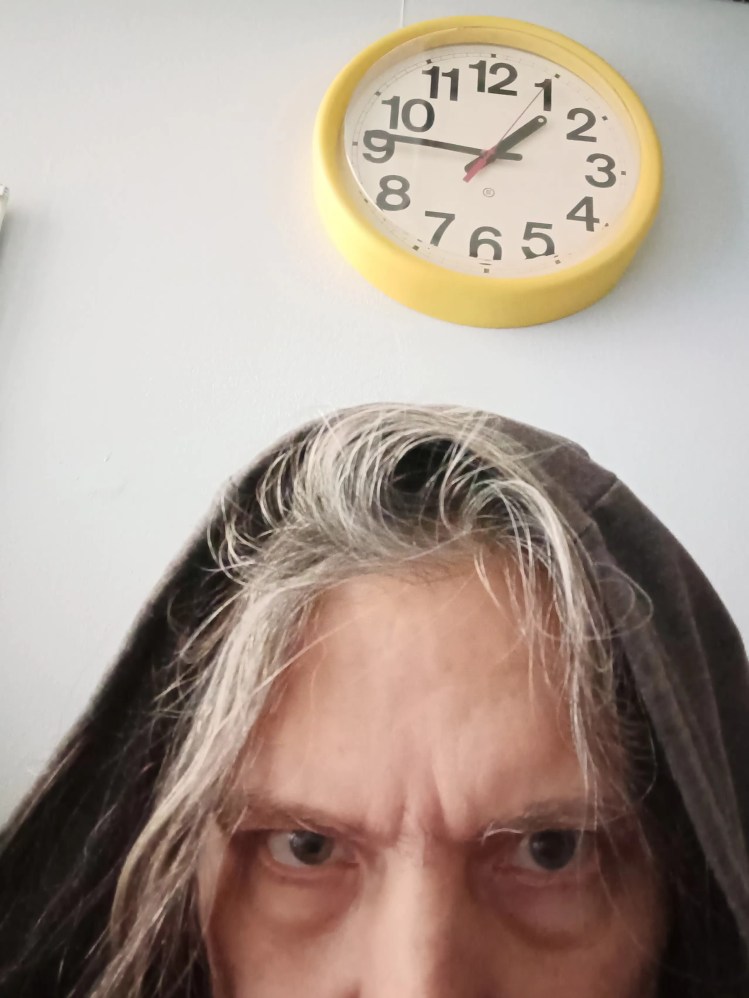
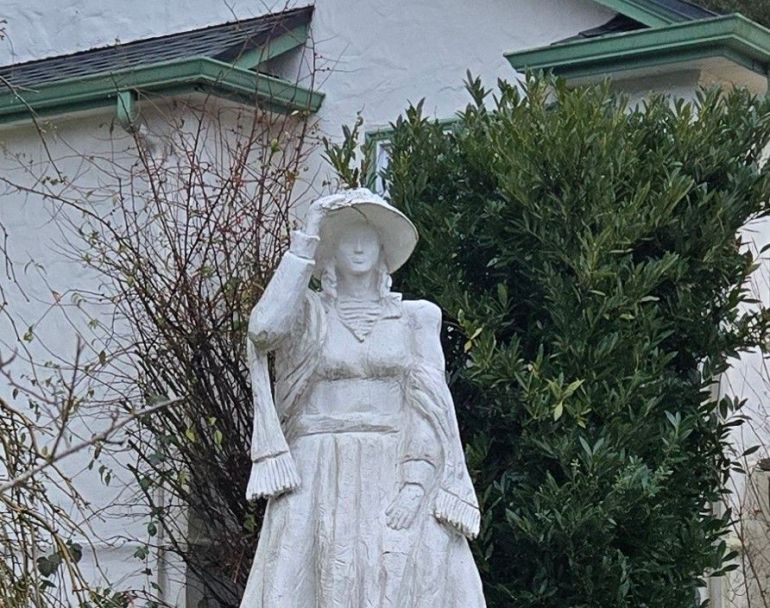
(Top image: Elina in Chicago 14 June; Second image: Tressa With Emma Lazurus Poem. Both supplied by the Drifter)
The Crowd and the Protest
“The shepherd enters through the gate.” – John, Chapter Ten
ONE
Sadly, the question might easily arise as to WHY anyone in their right mind would bother to fight for, or defend, the so-called “American Dream” any more, in this Year of Our Lord 2025.
The Gonzo journalist and prose master Dr. Hunter S. Thompson, in his prophetic mode, rightly proclaimed the American Dream dead and buried over fifty years ago, not too long after Tricky Dick got finished with his sad, partially unconscious, and certainly pathetic attempts to clownishly crown himself and end American democracy forever.
It seems to me that the American Dream has now become the most destructive lie and delusion the human race ever invented for itself, a vast, mass mental and spiritual health crisis and pandemic that has spread globally everywhere from here to India and all places in between, and has destroyed the human and humane spirits of, literally, billions of people all across the globe (although not everyone).
Because the so-called “American Dream” is nothing now in its very essence and core except a pixie dust mental disorder, a vast, sometimes-seemingly-all-consuming, LSD-like, schizophrenic delusion that is not based on Fantasy (the bad kind), but IS Fantasy the bad kind itself at every level.
Romance Fantasies, House Fantasies, Computer Fantasies, Car Fantasies, Shopping Fantasies, Political Fantasies, Property Fantasies, Robot Fantasies, Rocket Fantasies, Gambling Fantasies, Lottery Fantasies, Vacation Fantasies, Hero Fantasies, College Fantasies, Economic Fantasies, Flower Fantasies, Music Fantasies, Dancing Fantasies, Fame Fantasies, Job Fantasies, Retirement Fantasies, Revenge Fantasies, Drinking Fantasies, Drug Fantasies, Food Fantasies, Screen Fantasies, Sex, Power, and Money Fantasies have burned and buried the real minds and hearts of so many people walking, standing, sitting, or lying down on the globe right now that it’s really chilling and yes, even horrifying, when one thinks on it for more than two seconds before going back to casually scrolling one’s phone as the world burns.
So why fight for the American Dream? Because there’s another side to everything in this world: what the great Chinese poet, philosopher, drinker, and drifter Li Po called the Yin and the Yang.
Harold Bloom, the great American writer, voice and citizen, said many times that an American never feels free unless she or he is alone. And when an American is alone, they do always feel free (even if sometimes terrified, too).
That liberating essence, or core, of American democracy still exists, even though Sojourner Truth, Crazy Horse, Frederick Douglass, Thomas Jefferson, Daniel Boone, and John Wayne are gone (“The mountains have been my church,” said Wayne in his final movie). It means everything to the human mind, heart, spirit and soul all over the globe, is America’s one great contribution.
And that is why I will fight for it, in my own way, and in the spiritual warrior sense of the word fight. I, and many others.
TWO
We came up out of the subway tunnel and were instantly swallowed by the Chicago crowd. I was with my teenaged kids and a few of their friends. I could see the Picasso statue in the distance over the heads of the crowd. It was there, the statue the great Picasso gave to the city of Chicago for free, the one that looks like a horse’s head from a certain angle, a woman’s head with long hair from another angle, something else you had never really imagined before and can’t name, from another angle.
I’d spent a lot of time in the past sitting around in downtown Chicago and studying that huge metal statue. Now I was packed into the middle of so many hot, pressing, human bodies suddenly that I couldn’t even move, not right, left, front, backward or center. One of my daughters had been swallowed and pushed along by the crowd. We were all worse than sardines in cans right now. Suddenly I realized that if I had another stroke like I’d had last year, I would be in a very bad spot because there were angry, shouting, pressing, hot-blooded, hot-breathed, neck-veins-bulging, stinking, sometimes-perfumed, protesting people pressing all around me and there would be no medical assistance happening out here. I turned around again trying to find the stairs from where we’d come up from the subway so we could go back down, but it was already too late. We’d been sucked into the vast black hole of the hot, pressing crowd, literally even before we knew what was happening.
We kept talking to each other in the middle of the crowd as we tried to inch our way out of it. I instructed all these teenagers I was with to follow me, and trusted (no choice) that my other wildly intelligent daughter (they both are) would be able to fend for herself, but no one in the crowd was moving, they were all just standing there pressing upon one another (no room for anyone to even sit down, not that you would want to here), holding up signs, screaming slogans and chants, breathing their hot breath on the backs of one another’s necks, and I could feel the outraged intensity of every single one of their souls (it felt like) pressing down on my own personality, which was very quickly becoming nothing less than outraged at their outrage. Trying to keep it under control, trying to keep it under control…
There were very many angry and shady-looking people pressing in the crowd, folks trying to pull suitcases or carrying awkward-looking backpacks, all of the above large enough to carry explosives of course, folks dressed all in black with hands hidden in pockets large enough to carry pistols, folks hunched over with hoods over their heads and masks on their faces and sunglasses covering their eyes.
It was a vast ocean of bodies pressing over me and I realized I was about to panic perhaps because I was now having a bona fide LSD flashback right here in the middle of the crowd, actually triggered by the crowd, in fact. But I had to keep it together in order to lead my daughters and their friends to safety.
It had been my idea to come down here, after all. My kids and their friends instantly agreed. Then I remembered that I had been inspired by them during the George Floyd protests when it had been their idea to go to the protests before it had been mine. We were trying to inch our way along to escape from the crowd. Some people, obviously many people, do not get too claustrophobic in such conditions, because a lot of these protesters actually seemed to be enjoying themselves. But myself, my daughters, and our friends were not some of the non-claustrophobic ones. The kids call it “tweaking” these days. It’s when you’re losing your grip on things, feeling like you’re having an acid flashback, panicking or almost panicking, freaking out, in other words. I was now, officially, and internally, tweaking at every single level I could or couldn’t think of. I was able to hold it together for only two reasons.
One: in order to try and help my daughters and their friends (and myself) get out of this.
Two: I knew if I really started freaking out, it would be like throwing a flaming torch on top of a keg of gun powder.
I knew now, in my blood, how easy it is, and how fast it can happen, that people get trampled to death in a crowd like this.
THE CROWD is so terrifying and horrifying to some of us because it means a complete and total loss of individuality, and control, at every level.
The only place you can maintain your own self-control in conditions like this is within your own mind, and under these kinds of conditions, that is very hard to do, especially when an acid flashback, or whatever it was, is making every single nerve end in your body and brain feel like it’s on fire right out of the blue.
Thoughts of Buddha helped save me this time. His chubby ghost (to me he was chubby) appeared out of nowhere and wafted in front of my mind. It was his kind of mind control I turned to in these desperate circumstances. I was having an acid flashback in the extreme but the purposely recalled thoughts of the strength of Buddha’s mind helped me regain, and keep control of, my own mind. I turned around and all the kids I was with had vanished in the crowd, we had been separated, I couldn’t turn around, and I couldn’t find them. I kept on trying to worm and inch my way out of the crowd, trusting their safety to God, because it was the only thing I could do now.
THREE
During the worst moments of being suddenly caught unawares in the middle of THE CROWD like that, it felt like nothing short of being buried alive in the middle of the most vivid Edgar Allan Poe buried alive short story you’ve ever read, except you’re not reading the story at a safe distance, you are the character in the story who’s actually buried alive, worse than in a dream. For me, to suddenly have millions of anonymous bodies pressing all over mine without warning is one of the worst living nightmares I can possibly imagine. (I’m fond of keeping my distance, which is an essence of being a drifter.)
There are other nightmares just as bad, like maybe being stalked by a great white shark while out swimming in the ocean and you know he’s there but are still a mile away from shore. Only being buried alive for real could possibly be worse.
Losing contact with my kids in the crowd like that was even worse than the buried-alive feeling.
FOUR
It took me ninety (90) minutes to inch and worm my way out of the crowd. Ninety minutes that felt like nine months jammed down into a Siberian prison holding cell (because of the acid flashback/s).
When I finally broke free, onto famous State Street in Chicago, I looked up and there was the Van Gogh-like Muddy Waters mural on the side of the building I’d seen many times before. I had lost track of where I was in the downtown area, and had only been following my instincts to get out. And I got out. And I was free. And there was Muddy, one of my great and lifelong heroes, Muddy Waters, staring down at me. And we were both free.
I had to wait around for another thirty (30) minutes before my kids also broke free from the crowd.
But fifteen (15) minutes before that, I received the first text from them telling me they were OK.
FIVE
There is no doubt that I’ll continue to protest personality-crushing authoritarianism wherever it exists, whether that is at the “highest” business and political levels, or within the classroom or the workplace, or on the street corner, or within myself, or anywhere.
Next time, however, I shall be much more careful about how I approach THE CROWD. A word to the wise: The Crowd is bad. In the worst sense of the Word.
ADDENDUM from The Drifter
There are a million different ways to protest, of course, and attending a so-called “Protest” is certainly not the only way, although, as the American Civil Rights Movement showed, it is sometimes a necessary way. The famous “three and a half percent” rule, proved by social science, says you only need that amount of a nation’s population to resist and overthrow the lockdown of true authoritarianism, the kind where the jack-booted thugs are standing around armed on all street corners with their faces hidden and the little old lady you thought was your friendly neighbor just reported you to the secret police for something you didn’t do.
The following poem by Walt Whitman outlines another way to protest, just as profound, or more profound, than the other way.
Poets to come! orators, singers, musicians to come!
Not today is to justify me and answer what I am for;
But you, a new brood, native, athletic, continental,
Greater than before known,
Arouse! For you must justify me…
I am a man who, sauntering along without fully stopping,
Turns a casual look upon you and then
Averts his face,
Leaving it to you
To prove and define it,
Expecting the main things
From you.
“The Drifter” is drifting off for now in order to steady his nerves via a combination of medical, psychological, and spiritual advances. This world we currently inhabit will make you nervous if you’re alive; do what you need to; pursue the right kind of excess and eschew the wrong kind as much as possible.
“The Drifter” doesn’t know yet what the column will be about next Sunday in this “Postcards from the Drifter” Sunday series; what he does know is that he will be here.









 Saragun Springs