I was walking Bucephalus, or Boo, my Siberian Husky, in a beautiful Illinois field one day recently (warm early October). The field was savannah-like, with three or four-inch-tall grass and oak trees spaced around in it.
Suddenly a deer ran up to us, stopped at a safe distance away, and stared at us.
Stared at us – with mixed curiosity and suspicion.
He was (I’m guessing) around one year old, maybe two.
He was a he (I know) because he had antlers.
Two small antlers sticking up on either side of his head, making him a spikehorn buck – a small one.
And he looked at us.
And Boo strained on his leash, wanting to chase the deer.
Suddenly the spikehorn went into motion, he LEAPT into beautiful, true motion.
And he ran all the way around us in a big circle through the grass, leaping, jumping, flying, deer-dancing, bouncing, as if putting on a show, until he got to the point where he’d started – and then he stopped again; and stared at us again: with suspicion, and curiosity (and as if asking, too, had we enjoyed the show).
Then he swung around and ran away into the distant woods.
And he reminded me of Woody – Woody Guthrie.
The nature of the deer is to flee; and fly.
The song “The Unwelcome Guest” is Woody’s Americanized retelling of the Robin Hood story from 1940, put to music by the band Wilco and the singer Billy Bragg on their great Mermaid Avenue collection from 1996.
Billy Bragg, Jeff Tweedy and Wilco turned beautiful, unpublished lyrics (found in a shoe box) by Woody into a song so beautiful it will break your heart every single time you listen to it, which should be (by rights) endless times.
I first heard the Robin Hood story when I was about five or so (or that’s when I remember hearing it), in Madison Heights, Michigan, USA, from my mother; and I wanted to be Robin Hood.
(And I would pretend to be him – among many, many others – while acting out – alone – endless games on the stage of my imagination).
Later the Robin Hood story was reinforced in my soul when I saw it dramatized upon the screen and read it in books, looking at the pictures. (But I liked my own version better.)
Stealing from the rich and giving to the poor has always been needed.
And has never been more relevant than it is today.
And I thought of the young, small, bold, curious, cautious spikehorn deer – fleeing and flying and soaring: voting with his feet, free: running away into the woods of the USA.
((End Note: Boo loves the way he sees his name written everywhere during Halloween Season.))
In the Moscow of 1939, ten years after Stalin had become dictator, LOUD KNOCKS on the door in the middle of the night were almost never a good sign – especially if you were a writer, and especially if you were a writer who was accused of “low productivity” because you refused to write works that followed the party line.
It usually wasn’t your friends coming ’round with a case of wine after the bars closed, looking for a place to continue the party.
More likely, it was four somber and silent NKVD, or Russian secret police, agents, arriving to take you where you surely didn’t want to go, unless you enjoyed brutal torture and an eventual complete “disappearance” from the world.
This time the writer was Isaac Babel, a Jewish short story writer from Odessa, Ukraine (it was Russia at that time), and his former friend Joseph was really mad at him for all his low productivity.
Babel called it “a new genre –the genre of silence,” which he had been developing and perfecting – because he was a real, true and deep, artist who just couldn’t bring himself to write the kind of drivel Jospeh Stalin told him to.
The four agents escorted Babel and his common-law wife Antonina to the car (wife number one was in Paris).
No one spoke as they rode toward the prison. Babel laughed a few times. Yes – he laughed, out loud.
The irony was that Russia had never ignored its writers and sent them to die in the gutter, like they do in America.
On the contrary, it was a land that worshiped its writers.
Writers in Russia were beyond what rock stars or movie stars were or are in modern America.
Writers were not just considered “writers” – the best of them were considered to be saints, sages, and spiritual leaders, as well as celebrities.
But now their fame could get them into an awful lot of trouble.
Terminal trouble, indeed.
At one point on the ride to the prison, Babel blurted out to Antonina, “I want you to take care of our child.”
She said, “I don’t know what will happen to me.”
It was the only time one of the agents spoke. Staring straight ahead, he said to her, “We have absolutely nothing against you.”
When they arrived at the prison Babel didn’t look back.
He said to her, “We’ll see each other again,” and was escorted into the prison.
And he disappeared for fifty years.
***
It was only in the 1990s that anyone found out exactly what had happened to Isaac Babel – one of Russia’s greatest writers of all time, a short story writer on a par with Chekhov, Guy de Maupassant of France, and O. Henry of America (who spent his last days poor, broke, in debt, drunk, and possibly on drugs, in a cheap hotel (“turn up the lights”), but at least free, or sort of free, in America), whose collections Red Calvary and Odessa Tales explore the worlds of the Soviet Army and Jewish gangsters respectively and later influenced such literary classics as the American Denis Johnson’s immortal short story collection, Jesus’ Son.
He was tortured for three days until he signed a false confession, stating that he was a terrorist.
Eight months later, after a false trial that lasted twenty minutes and for which the verdict had already been decided, he was executed by firing squad at 1:30 in the morning.
Then thrown into a mass grave.
***
All of the above is the kind of thing that ends up happening when a single, evil, foolish madman is allowed to run the world.
You would think we’d learned our lesson by now.
Such are the wages of ignorance.
***
There are many forms of Resistance.
Mr. William Shakespeare was very careful to make sure he didn’t get his head chopped off like Sir Walter Raleigh did in 1618, or terminally stabbed in the eye in a staged bar fight like his friend Christopher Marlowe had been in 1593.
***
I, The Drifter, have written this on the Jewish Day of Atonement in 2025. I ask forgiveness for my sins.
GOD BLESS THE WORLD.
Historical End Note: Joseph McCarthy left Guthrie alone in the 1950s because Woody was poor.
(Advice to Resisters from The Drifter: When you need to, hide out in an Underground that you light up yourself like Ralph Ellison’s Invisible Man.)
(Wonderful images provided by the Drifter and Drifter Boo)
What Would Abraham Lincoln Do Now?
September 27, 2025
In “the year of our Lord” 1909, Count Leo Tolstoy was one of the most famous humans on Planet Earth, by far.
He was a person who had survived into the twentieth century in a very vital way from another era, a man who had been born into the age of serfdom (or Russian slavery) in his own land and seen it fall (around the same time American slavery fell), a man who was as well-known then as Gandhi and Martin Luther King, Jr., would later become (and a man who had already corresponded with Gandhi, famously), a man who was known for educating, and attempting to free, the serfs on his own land before the national reforms came along, a man who had started a globally-known peace movement called Tolstoyism based on the real and true teachings of Jesus Christ taken directly from the Gospels, and a man who, if the world had listened to him back then, could have solved ALL of the world’s current problems today via the solutions he was offering at the time, a man so well-known and so accomplished that he deserved not just the Noble Prize in Literature (see the list at the end of this essay) but also the Nobel Peace Prize, like very few others in history (except, perhaps, figures like Bob Dylan, John Lennon, Bob Marley and Martin Luther King, Jr., all of whom could have been awarded the Literature prize as well as the Peace prize based on their work in both fields).
1909 was also the centenary of Abraham Lincoln’s birth. A reporter came to ask Tolstoy to write something about Lincoln for this event. He found the great, long-bearded, long-haired, physically frail and elderly man and writer too sick to rise from bed or pick up a pen for long, but somehow still able to think and talk just as clearly as ever.
Tolstoy surprised the world, just a little bit, by what he told the reporter that day, when he called Lincoln the greatest national hero and national leader of all time, a man who would, in a couple of centuries, make all other national heroes and leaders look like nothing compared to him. “Of all the great national heroes and statesmen of history Lincoln is the only real giant,” Tolstoy said.
Tolstoy listed “depth of feeling, greatness of character, and a certain moral power” as the qualities that made Lincoln so much greater than the other heroes and leaders. Tolstoy said, “His genius is still too strong and too powerful for the common understanding, just as the sun is too hot when its light beams directly on us.” He said that Lincoln’s “supremacy expresses itself altogether in his peculiar moral power and in the greatness of his character.” He said that Lincoln, “wanted to be great through his smallness.”
Tolstoy said of Lincoln: “He was what Beethoven was in music, Dante in poetry, Raphael in painting, and Christ in the philosophy of life. He aspired to be divine – and he was.”
***
America is on the verge of its next civil war, or is already in the beginnings of it.
Because this new civil war won’t be a “Civil War” with capital letters like the last one was.
It will be (for the most part) a much more insidious and secret affair, many or most of the battles playing themselves out within the battlefield of the human heart.
There won’t be huge lines of gray and blue soldiers blowing each other to smithereens across a river until kingdom come like the first time.
But there will be, and already is, great hatred involved, great contempt for one’s fellow human beings, great nastiness and moral decrepitude even among the youth of America, a great bitterness and a great belittling of each other, utter small-mindedness and small-heartedness on both sides as we stare each other down and hate each other’s guts and hope someone else will come along and do our sporadic killing for us, and then applaud when they do so while we execute them in return, smiling bitterly all the while and cursing the world in our hearts while taking responsibility for none of it.
So it’s worth asking, at this great and terrible point in American history, “What would Abraham Lincoln do if he were here now?”
After a lifetime (on and off) of studying Lincoln, both his life and his writings, from his home ground in Illinois, I believe I know the answer to this question. And I can break it down into three key points, very briefly.
Read on to find out.
***
ONE: He would rise above the fray. He would not take sides. He would try to look at the truthful aspects of both opposite points of view and leave all the lies and bad “information” lying in the dust. He would see it from everyone’s level, no matter who they are.
HE WOULDN’T BECOME PETTY WHEN THE GOING GETS TOUGH. AND HE WOULDN’T START THROWING STONES AT HIS NEIGHBOR, NO MATTER WHO THAT NEIGHBOR IS, OR WHERE THEY CAME FROM.
NO EXCEPTIONS.
TWO: He would resist the totalitarian impulse, which crushes genuine humanity, at all levels, but he would resist it within himself first.
He wouldn’t let himself be seduced by the urge to crush, or even think less of, those who are weaker than or “different” from himself.
As Kahlil Gibran said in The Prophet, “And if it is a despot you would dethrone, see first that his throne erected within you is destroyed.”
THREE:
HE WOULD LOVE. The tragic irony here is that anyone who can understand this third point is already doing it.
And the final tragic irony of this column is that Lincoln is no longer a hero for either side.
The Drifter on Tolstoy’s short works: Tolstoy is the author of two short stories and one small autobiographical nonfiction book that deserve to be studied by anyone on the Planet who wants to turn themselves into a better person during these horrible times.
“The Death of Ivan Ilyich” is about a man who discovers he’s held the wrong materialistic, selfish, Scrooge-like values his entire life, right before he dies. Ironically, it’s his illness and his approaching end that make him see the light and saves him (just in time).
“Master and Man” is one of the most life-affirming stories about self-sacrifice ever written. No spoiler alerts. But the horse in this story is more alive than the humans in almost everyone else’s fiction.
“A Confession” is an autobiographical nonfiction tale that influenced Mahatma Gandhi and Martin Luther King, Jr., as they developed and extended nonviolent resistance, just as Tolstoy himself had been influenced by Percy Bysshe Shelley and Henry David Thoreau before him.
Tolstoy suffered from Depression, the modern variety. This book shows you what it’s like if you’ve never been in it; and how to get out of it if you have.
(Images provided by The Drifter. Mighty Boo is considering you)
I first heard of the English poet, visual artist and freedom fighter, William Blake, friend of Thomas Paine, through James Douglas Morrison, but then again, there were many persons and things I first heard of through Jim Morrison that have had a lifelong influence on me, including the untamed German philosopher Friedrich Nietzsche and the vanishing French poet Arthur Rimbaud.
The first full-length biography of Jim was No One Here Gets Out Alive, by Jerry Hopkins and Danny Sugerman. I devoured this book a year after it came out in 1980 when I was 14 years old and living with my family near the Mississippi River in Quincy, Illinois, which is both Mark Twain and Abraham Lincoln country for anyone who’s awake enough, which is not most of us, but is a few of us.
I was 14 in 1981 so the book had been out for around a year when I first read it. It shows how young I was to think that I believed the book had been out for a long time back then, even though now a year seems like a day to me. And it also seemed, back then, as if Morrison had been dead forever, even though at that point it was only around a decade. A decade seems almost like nothing now in the face of so many additional years later.
In The Marriage of Heaven and Hell, William Blake wrote, “If the doors of perception were cleansed every thing would appear to man as it is, Infinite.” By this point, this must surely be one of the most famous quotations from English Literature of all time, a quotation that many and many more are familiar with in various guises and ways even though they have no idea what the original source of the quotation is.
A huge part of the fame of this quote has to do with Morrison’s band’s name, The Doors, but it also has to do with Aldous Huxley’s famous book The Doors of Perception, which is a long essay about hallucinogenic drug experiences (experiences which Huxley was to continue right up until the end, even taking the extraordinary step of consuming LSD on his deathbed). Morrison originally heard the Blake phrase doors of perception from Huxley’s popular book, but Jim later became intensely familiar with many of William Blake’s other works as well, as he was with that of Nietzsche, and Rimbaud, those two eternal rebels and voices of human freedom who originally inspired Jim Morrison more than any musicians ever did.
Because Jim was a poet from the start, and at the end of his life he’d grown so disgusted with the outward trappings of his manufactured musical fame that it literally sickened him, even though he also knew he’d won a kind of immortal glory through his writings and his work with The Doors who’d brought his writings to life.
William Blake’s 16-line poem “London,” first published by Blake himself with his own illustration in 1794, says that the streets and the river of the great city are “charter’d,” which means for sale and locked down in a place where everything is for sale, including the loyalties and sympathies of the human heart.
Blake talks about how there are “marks of weakness, marks of woe” in every London face he meets, and he talks about chimney-sweepers (little boys) crying and soldiers (little more than boys) sighing as their blood runs down the palace walls; and he throws out a sympathetic shout for the female prostitutes (many of them girls) who are everywhere in the city while also calling the institution of marriage, not a happily-ever-after, but a “hearse.” In short, this poem was and is about as radical as it’s possible to be, then and now.
This poem also contains another William Blake quotation almost as famous as “the doors of perception.”
In line 8 of the poem called “London,” Blake says: “The mind-forg’d manacles I hear.”
In five words, William Blake manages to capture and encapsulate the mental slavery Jim Morrison was waging holy (spiritual-only) war against in the 1960s, as well as the mental slavery that is coming to dominate our own day more and more with the rise of (or the return to) authoritarianism and corporate conformity all over the world.
“Mind-forg’d manacles” is a two-word phrase written in the 1790s by an Englishman who supported the American Revolution while also being a passionate abolitionist.
Blake also supported the rights of women. He taught his own wife how to read and write and worked with her as his artistic partner in an age when such things were exceedingly rare.
And he abhorred and spoke out about the destruction of nature by the industrial revolution in an age when almost no one understood what was really going on – except the poets, rebels and drifters.
A century and a half and more later, Jim Morrison became a receptor, and then a conduit, for the imaginative and rebellious worldview of William Blake as he did with Nietzsche and Rimbaud and the spirit of the Native Americans.
One thing the yin and yang means (in my interpretation of it) is that two completely opposite and seemingly antithetical things are always true at once in this world we inhabit.
In this case it means that everything has changed – and nothing has.
(This was previously published by Literally Stories UK; both images were provided by the author. ‘Tis our pleasure this week to revisit works by our esteemed Co-Editor Dr. Dale Williams Barrigar)
I saw a little man riding a child’s bicycle in Berwyn, Illinois, outside Chicago, on the sidewalk, along Roosevelt Road.
He was carrying a guitar; this was the first thing that caught my attention.
The guitar was strapped over his back. But it was also slung down partly across the side of his body so he could cuddle it with one arm while he steered the bike with the other and pedaled the small pedals with his small legs.
This was a busy neighborhood, but anyone paying attention would surely notice that there was something special between this little old man and his guitar. He held it like it was an animal or a person. He held it delicately while he rode his bike down the sidewalk; he kept it close to him; and he held it with love.
It looked like a small classical guitar covered in road miles. The body of the guitar was red around the edges fading into orange with flower patterns on the pickguard. The strap that held it to his body was an old red one.
The neighborhood was busy, with cars steadily moving in both directions along Roosevelt Road. The famous music venue, Fitzgerald’s, was across the street and both sides of the road were lined with old brick apartment buildings and new corner smoke shops; tattoo parlors; bars; Italian ice and Italian beef restaurants; a bank; a gas station; and Euclid Square Park in the distance.
But the little old man with his guitar was riding the opposite way. Soon on Roosevelt Road, he’d be pedaling into urban devastation, a city’s almost-peopleless wasteland, unless he turned around.
He was small and he was old.
And it occurred to me that he looked much older than he probably was while also seeming much younger in the way he moved, an uncanny doubling.
His long, gray-brown, wiry hair fell all over his shoulders and half way down his back. His small bearded face was wise, wizened, and lean, with deeply sunken cheeks. He was small and old and covered in road miles like the bike and his guitar.
This little, homeless-looking man was not someone you would mess with because of his overwhelming presence no one was noticing.
And he held his guitar like a knight holds his lance; like a warrior carries his club; like a conductor wielding his baton; like a dog walker his leash; like a priest and his chalice.
He had a shocking presence as he steadily pedaled with his guitar down the sidewalk: if you were paying attention. He looked like he was going somewhere, or maybe just anywhere. He wore an old blue button-down shirt over an old white T shirt and he had blue shorts on that went past his knees.
His foot gear had once been white tennis shoes and he had rope bracelets covering both wrists. His skin was dark brown and wrinkled, permanently tanned by sun, wind and sky.
His nose was large and his hands were long, and his eyes were fiery, dark, black-circled, peering intensely and intently from under calm, or calmly troubled, brows. The backpack on his back spilled over from its pockets with plastic water bottles, handkerchiefs, bits of clothing, paper, pens, and other things.
And the little man disappeared into one of the city’s worst neighborhoods, pedaling on his child’s bicycle: carrying his guitar like a lifeline.
A few weeks later that summer, I saw him again. I was taking a stroll around Euclid Square Park with my Siberian Husky, Boo. Euclid Square is a large grassy green space surrounded by houses and trees and Roosevelt Road along one side behind another row of trees. He was sitting directly in the middle of the large, grassy field that was the center of the park. His bike lay in the grass not far away.
And he was sitting cross-legged in the grass in the middle of the park, playing his guitar.
I was too far away to hear well in the wind, but it was fascinating to watch this virtuoso working over his guitar from the corners of your eyes.
He played fast, he played slow, he rocked back and forth, and then he rolled, he rolled half forward as his hands kept flying all over the guitar.
I couldn’t hear it much, but he looked beautiful playing, like a wild man, like a magician: like an escape artist.
Soon I noticed that a friendly-looking old lady had become fascinated with his playing too. The smiling old woman was approaching him on foot across the grass. I saw her reach him, and I saw her bend down, and try to hand him some money, at least a few dollars because she had more than one bill in both of her hands.
But by now he had stopped playing. He had rolled into a little ball over his guitar which he was holding upside down. The man wouldn’t play any more, and he kept his head down, but he reached up and took the money from the old woman. She smiled and was happy and turned away to rejoin her party on the other side of the park.
As she walked away, I looked at the old guitarist.
He flung the money away from him, out across the grass. Both he and I watched the wind blow the bills away across the grass.
Then he looked around to make sure no one could hear him.
And he started playing again.
Notation: Picasso’s “The Old Guitarist” is in the Art Institute of Chicago.
“Call the roller of big cigars, / The muscular one…”
– Wallace Stevens
The American poet Wallace Stevens converted to Catholicism on his deathbed at 75.
The details are hazy because this was such a private event like everything in Stevens’ life, but it’s known for sure that he was periodically seeing a priest for a few months in the hospital before he passed on, and the priest said he converted at the very end. I don’t trust all priests (far from it) but I have a hard time doubting this one about this.
Because Stevens had been moving in this direction for a long time, too. For most of his life, he’d claimed he had no hard and fast faith in a personal God, and he didn’t attend church in a world where almost everyone did, but his attitude toward life had always been religious.
As religious as it gets, in many ways, in the modern world: the religion of poetry. The Religion of Poetry, the individual’s lyric cry that can be maintained against all odds in the world of modern mass society, the land of robotic humanity.
Stevens was the man who fought Hemingway on the nighttime docks of Key West, Florida, even though he was twenty years older, the man who turned down The New Yorker when they asked to publish some of his poems, the man who also turned down Life Magazine when they asked to publish some of his poems, and the man who refused to be a professor of poetry at Harvard when they offered him the job late in his life. Had he done even one of those things, he would have instantly become exponentially more “famous” than he ever was while he lived. And he knew it.
Because fame is a funny thing.
These days we say that the latest “star” of The Bachelorette tv series is famous. But such manufactured “fame” fades so fast we shouldn’t even call it fame, we should think of another word instead.
Or maybe we should just call real fame, the lasting kind that starts slowly and local and builds over decades and centuries, with peaks and valleys, dips and rises, GLORY.
And Wallace Stevens has his deserved share of glory now, in the American poetry pantheon, a true heir of both Emily Dickinson and Walt Whitman.
Stevens was a kind of Superman. During the day he was a businessman, an insurance lawyer who walked to and from work by himself and closed his door when he got there, a man who never drove a car and lived alone in his own house even though that house was also filled with a wife and daughter he almost never spoke to (until later when he became close with his daughter). At night he spent his late evenings drifting around his own large, fragrant, tree-filled Connecticut yard smoking cigars and drinking. The neighbors would see him there, the only one in the “respectable” neighborhood doing such. What they didn’t know was that he was also busy penning (in his mind) immortal poetry, this physical giant of a man.
It took me twenty-plus years of studying them (off and on) to truly understand Wallace Stevens’ trio of short poems “The Snow Man,” “Tea at the Palaz of Hoon,” and “The Man Whose Pharynx Was Bad.” These works were first published in Chicago’s Poetry Magazine in the early 1920s. They can be understood, sort of, on a first reading, but to truly plumb the depths of these short, vast works, a reader needs to return hundreds of times across a span of years. Harold Bloom convincingly called these three the heart and soul of Stevens’ work as poet and man. Liberation through words has never been so deep and so pungent since the Scriptures were written.
At the end Stevens finally decided (or became convinced) that life doesn’t end when life ends.
Bob Dylan, a Wallace Stevens-like figure in many ways, wrote (and he wasn’t joking), “Death is not the end.”
Walt Whitman wrote, “Death is different from what anyone supposes. / And luckier.”
(Images provided by The Drifter, and, I would like to think, Boo)
“I am an American, Chicago-born…” – Saul Bellow
Somewhere around the year 2017 A.D., when I was around fifty years of age, something happened to me that was so dramatic and traumatic it caused me to collapse that very day into a severe nervous breakdown right in the middle of the really bad nervous breakdown I was already having.
When I look back on those times now, sometimes I wonder how I even survived at all. And yet I did survive. And, lately, I even appear to be thriving.
The gas station involved in this story is what is known around here as a super-shady place.
Not as in shaded with lots of trees. There are no plants there at all, except the weeds sticking up through the cracks in the pavement.
Shady as in lots of shady people hanging around.
“Shady people” means folks who look like they just crawled out from the bottom of the barrel to look around at the world and get themselves some.
The people involved are of all colors, shapes, sizes, genders, sexual preferences, political persuasions and so forth.
The one thing they all seem to have in common is their shadiness.
“Disreputable” is a more fancy term for the same thing.
Turns out I looked a bit disreputable myself that day, at least to some folks, although I wasn’t quite aware of it in the way I maybe should have been.
This gas station is still there, on Roosevelt Road in the far West Side of Chicago, on the other side of Cicero (Al Capone’s hometown) and Oak Park (hometown of holy Hemingway and the great Frank Lloyd Wright) and right near Berwyn (humble home of yours truly).
The gas station sells gasoline and also other items. Like lots of hard liquor, cheap beer and hobo wine, sickening food loaded with horrible chemicals, countless amounts of smokable things, various sex toys and safe sex items like condoms randomly displayed in wide array all over the place, and, I was soon to learn, other things as well. It also has a “rest room” around the corner I’ve never had the courage to approach.
I wasn’t at this gas station because it was shady.
I was there because shady places generally don’t bother me too much (and even fascinate me when I’m in the right mood), and I was mostly there because I live in the area and I needed gasoline, and I didn’t have much money and this was the cheapest gasoline around.
At the time I was the proud owner of an ancient black mini-van, a vehicle that felt to me like a family member almost, I was that fond of her.
So I was standing there filling her with gas so I could continue drifting around town in that inimitable way I have.
(I haven’t been on an airplane in over twenty years and, for the record, flying on an airplane in any fashion is much worse for global warming than any kind of driving is: much, much worse. The driving I do is required for my artistic profession (and disposition), but I do limit it too, as much as possible, taking days off from driving and walking instead much of the time, etc. As well, I usually drive slowly, which also burns much less fossil fuel. This is to the future.)
I was there putting gas in my beloved black mini-van.
A shady-looking person suddenly walked right up to me – out of nowhere, as the saying goes.
Out of nowhere, suddenly, fast, and rapidly, too.
He was so shady-looking that I have to say he was a very scary-looking guy, who was also much bigger than me (even though I’m almost five feet eleven inches tall and weigh a hundred and ninety pounds).
I’ve been jumped before several different times in my life under various circumstances, and this guy made me nervous, bouncing up into my face like that.
But then I saw he was only asking for a small hand-out.
I had a few coins in my pocket, maybe a dollar’s worth, so I dug around, located these, and handed them to him because I now realized he looked hungry, very hungry.
My desert island book, other than The Bible, is The Imitation of Christ by the shady German monk Thomas a Kempis. And I remembered Jesus’ tale of The Good Samaritan. And that was why I handed him the money; even though I knew it wasn’t doing much, it was something.
At the time, you could buy an entire hamburger at McDonald’s for that amount of change, and this fellow was clearly hungry like he said he was.
If he were to spend the pittance on liquor or drugs instead, I figured he needed those as well. Looking as rough as he did, he probably needed more than one thing to help him make it through another day.
According to my private religion, turning my back on him would’ve been a sin.
He seemed happy to get the money even though it was such a small amount, almost overjoyed, actually.
But as he walked away I seemed to notice a strange glint in his one good eye and a weird twitch at the corner of his bleeding lip. He limped badly, was of indeterminate race, and was dressed in rags.
And I thought the matter had ended there.
The next thing I knew I was slammed up against the back of my van from behind so hard it would turn out that the bridge of my nose was broken, a scar that still shows on my face.
And I was slammed up against the back of my van so hard from behind that everything went black for a second and it took my breath away.
Until I came to again and realized with instantaneous horror, terror, and nightmare fear that my arms were pinned up against the back of the van by two gigantic, horrifically strong men, one on each arm on either side of me and neither of them in a good mood.
And I was literally pinned there, like the Christ, in the crucifixion position, standing with both of my arms pinned down straight out at my sides.
It turns out the two gigantic men were undercover police.
They had been watching me from their undercover vehicle the whole time, wondering what I was doing around here.
When they saw me hand the man the dollar in coins, they thought they saw him hand me something back.
When they rifled through my pockets, they found out that wasn’t the case.
But when they slammed me up against the back of the van like that, they thought I’d been purchasing crack cocaine, meth, opioids, whatever, from the man.
When they realized I hadn’t been doing so at all, and that I’d only been handing the fellow a dime, as the saying goes, they began to apologize so profusely that I almost instantly forgave them, even though I was still extremely angry at them and sometimes still get angry at them to this day, when I drive by that gas station.
They told me there were many, many gang bangers frequenting that area who carried assault rifles and machine guns in the trunks of their cars, pistols on their own persons, switchblade knives in their pockets, clubs beneath the seats of their low-riding vehicles, and so forth.
That was why they felt compelled to attack me from behind and slam me up against the van in the crucifixion position.
They were both well over six feet tall and huge as far as muscles go, each of them outdoing me by several sizes in that regard (gym rats, they call them). One of them was probably six feet four.
But they were sorry about what happened when they found out I was just out going about my regular, legal business.
And as they let me go on my merry way, they apologized again, slapped me on the back, and told me to have a nice day.
END NOTE: The Drifter continues to drift through some of the most dangerous neighborhoods in Chicago: fearlessly.
He does it because he’s an American and this is America.
“Galileo looked into the night / and learned the truth was an old lie /
And he sighed, knowing his fate: / If I write that again Someone will
tell the Vatican” – Irene Leila Allison
“The most beautiful thing we can experience is the mysterious. It is
the source of all true art and science.” – Albert Einstein
(Wonderful images provided by The Drifter)
INTRO NOTE, or Here We Go Again:
From The Drifter: The idea for this essay came as a flash of inspiration like a lightbulb going on in a tired brain, while driving around (drifting) on the West Side of Chicago during a dreary, weary day after reading Leila Allison’s enlivening poem “Tell the Pope to Buy a Telescope,” available on Saragun Springs; first date of publication Tuesday, August 26, 2025.
I.e. it was a weary, dreary day until reading the poem then being inspired by the poem to write this essay about it.
The Drifter suddenly pulled over near a vacant lot on the West Side, nodded to the old fellows smoking their bud around a trash can watering hole under a tree, then committed most of this essay to paper via a short-hand note-taking method in a language invented by none other than himself, readable by only himself, with colored pens on repurposed paper like old bills and advertising circulars.
It was like Leonardo da Vinci furiously working at his desks (he had more than one) in the middle of the night, long hair crazy-wild and fingernails long, dirty, and broken like Bob Dylan’s from digging up corpses for dissection and anatomical drawings the night before.
All that remained to do was draw it all together and translate it, somehow, into fairly readable standard English prose.
The results can be perused below; now or later or much later.
One of the first questions to ask when reading a poem (or anything) is, “What did the writer need to know in order to write this?”
Harold Bloom said that the main purpose for reading fine (and great, which is a cut above fine) imaginative literature was and is in order to augment one’s own consciousness.
Another word for “consciousness” here is PERSONALITY.
Another word/s for “augment” here is make it better.
And the answer to the question, “What did the writer need to know in order to write this?” these days is, all too often, “Nothing;” or, “Not much.”
Ralph Waldo Emerson, author of “The Shot Heard ’Round the World,” and whom Bloom called the Mind of America because of Waldo’s influence, both positive and negative, on all other subsequent American thinkers, whether they know it or not, said that a poem was “a meter-making argument.”
What Emerson meant by this (or one thing anyway) is that the “argument,” or reason-for-being, of a poem is what elevates its language, what calls for the poem to be written as a poem instead of in prose.
The “argument” here is NOT polemical, political, a run-of-the-mill opinion, or a straight-up “idea” like how to conquer the moon or invent a better way of doing something practical.
Poetry’s impracticability is another one of its essential features. If it was only about doing things it wouldn’t be poetry, or not poetry (which is thinking) at its highest levels.
Philip Larkin called the modern short poem, which is the most common form of poem now, “a single emotional spear-point.”
An emotional spear-point has to have a deep reason for being, or it can’t be itself.
PART TWO
Here are just a few of the things Irene Leila Allison needed to know in order to write her poem “Tell the Pope to Buy a Telescope,” according to this writer (The Drifter, aka Dale Williams Barrigar, MFA, PhD).
One: What it was like to be none other than Galileo.
Two: What the power dynamics were like in society during Galileo’s time. (He was born the same year as Shakespeare and lived 26 years longer than The Bard, to the age of 77, which would be more akin to 97 today.)
Three: What it is like to challenge authority with the pen (or the keyboard) in any age. (For this to happen, you need to challenge it with your mind and your life first.)
Four: What the power dynamics are like in society in any age.
Five: The subversive nature of true creativity (or creativity at its deepest levels) in any age, including Galileo’s, and our own.
Six: The price to be paid for being subversive in any age, whether it be in writing or in any mode, like any form of resistance, which is available and morally required (in different forms, depending on the person) of everybody. (Jesus himself was nothing if not a rebellious spirit, at least when it came to the goings-on in this earthly realm.)
This list could go on but the Drifter will stop with a round half dozen in order to give the reader time to think about this.
…
…
The seventh thing (7 = heaven) Leila Allison needed to know in order to write this poem was how to fit all of the above into the space of just over one hundred words.
Return to the half dozen items listed above, and then ponder knowing all that, and then ponder the magic of powerfully, clearly, and beautifully expressing all of the above in a third of the words Lincoln used for his Gettysburg Address.
Not a single syllable is wasted in Ms. Allison’s poem, much less a single word.
Words are reinvented in this poem, used so they can be understood by the reader but also torn out of their “normal” context and made new again.
Here is just one example.
Describing Galileo making his amazing discoveries that changed the entire human world while under house arrest, Ms. Allison says, “the spheres (and spears) remained.”
In five words, she’s boiled down one of the most profound humans and human projects of all time into a space that is tiny in terms of its actual size, and as gigantic as the entire universe itself in terms of its implications.
This is what true poetry is, saying so much in five words or less that entire pages, or even books, of prose could be written upon it and still not capture its essence.
And doing it all while being beautiful.
At this point, I urge any and all readers of this to seek out Ms. Allison’s poem “Tell the Pope to Buy a Telescope.”
The title sounds like it could have been come up with by James Thurber, Lewis Carroll, or Dr. Seuss (he was one of the most important American poets of all time, which is neither a joke nor an exaggeration), a sign of the light hands of the poet.
Because children, too, should be told about people like Galileo; and the intelligent child in all of us is what keeps us alive.
And after truly studying, and absorbing, this poem, you will know more about Galileo, the world, and the universe than, literally, entire book-length works about him or his times can tell you.
I only show myself when the holy spirit of creation is upon me.
Or in its aftermath.
Or in the lead-up to it.
Or in some other form of extremity that embodies some sort of emotion that can be used for good in this world, if one looks hard enough, one way or another.
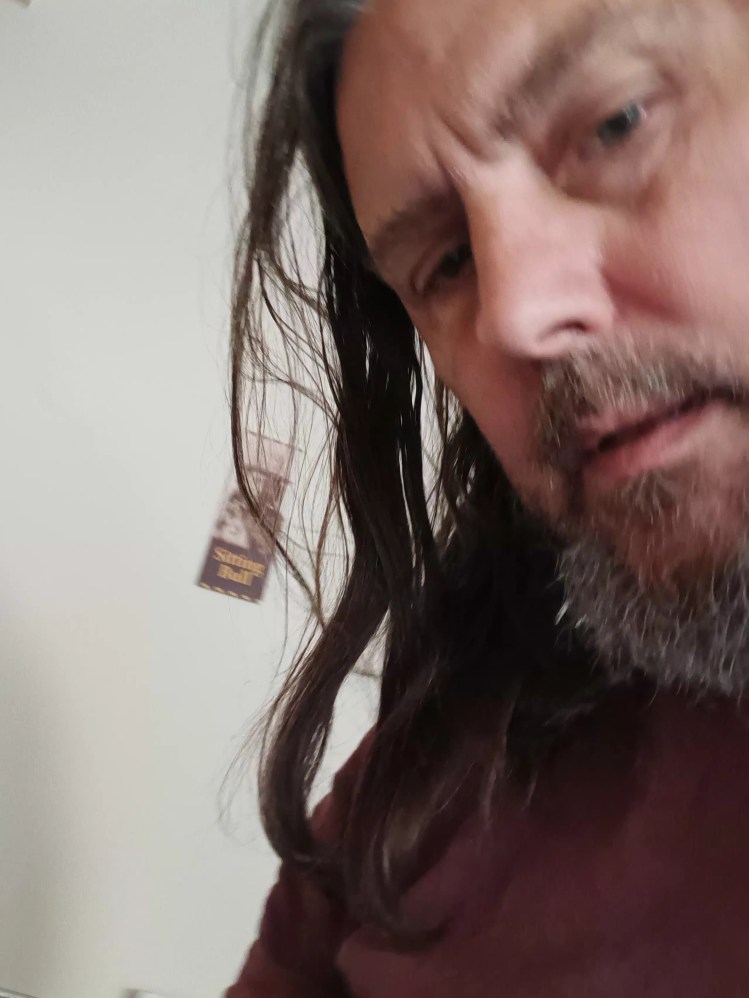
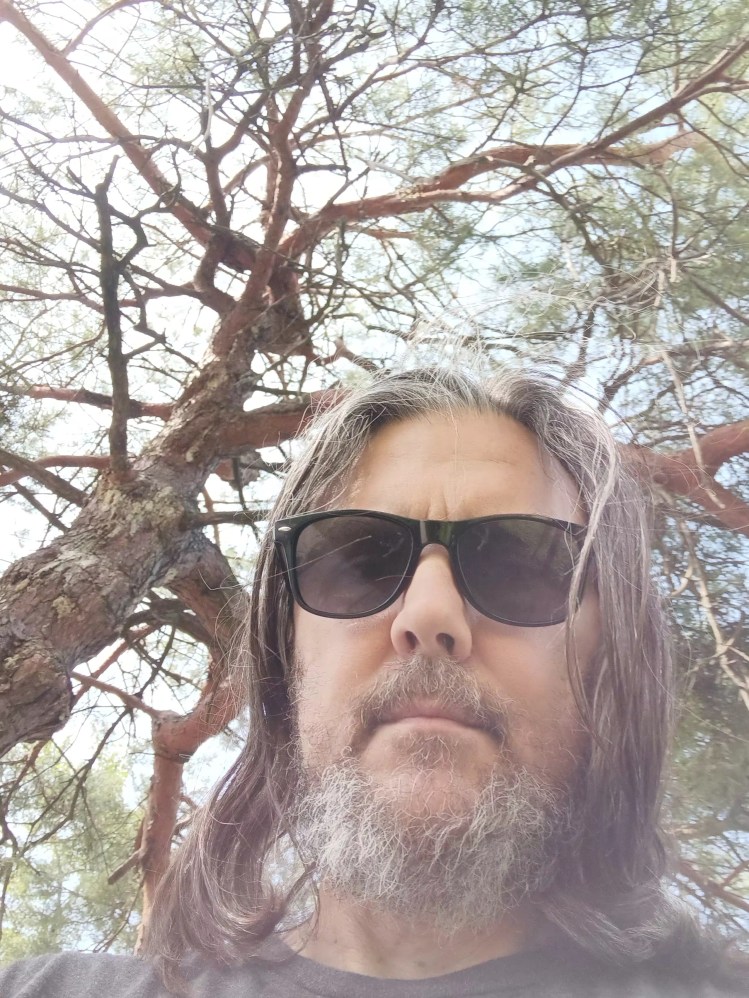
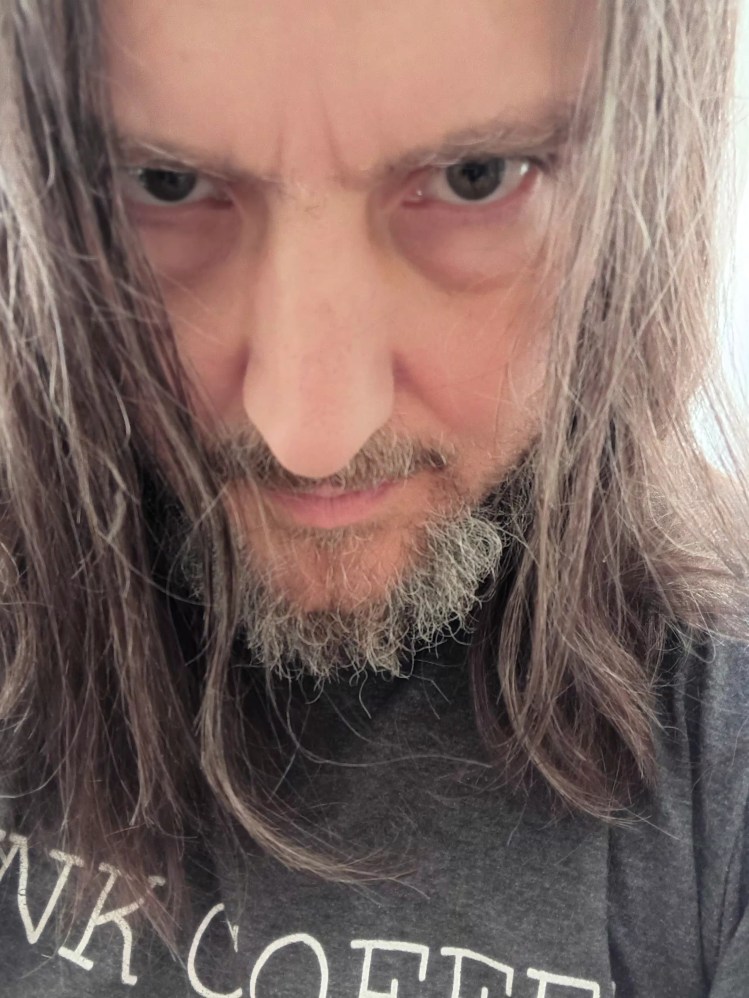
I have pictures of myself where I look one hundred and ten years old.
And not a healthy one hundred and ten, like Moses was when he died.
They say he was as strong and mentally acute at that age as he had been at forty. And that his sight and hearing were as strong as they’d ever been, too. But it didn’t stop him from dying.
Yes, I have pictures where I look bad old.
Beaten and broken, weary and bloated, or shriveled, wasted and worn, worn out.
I only keep these pictures for myself (for now), in the same way that Hamlet held up poor Yorick’s skull to his own (for now) living face and spoke to it.
A memory of the future, which is the definition of memento mori.
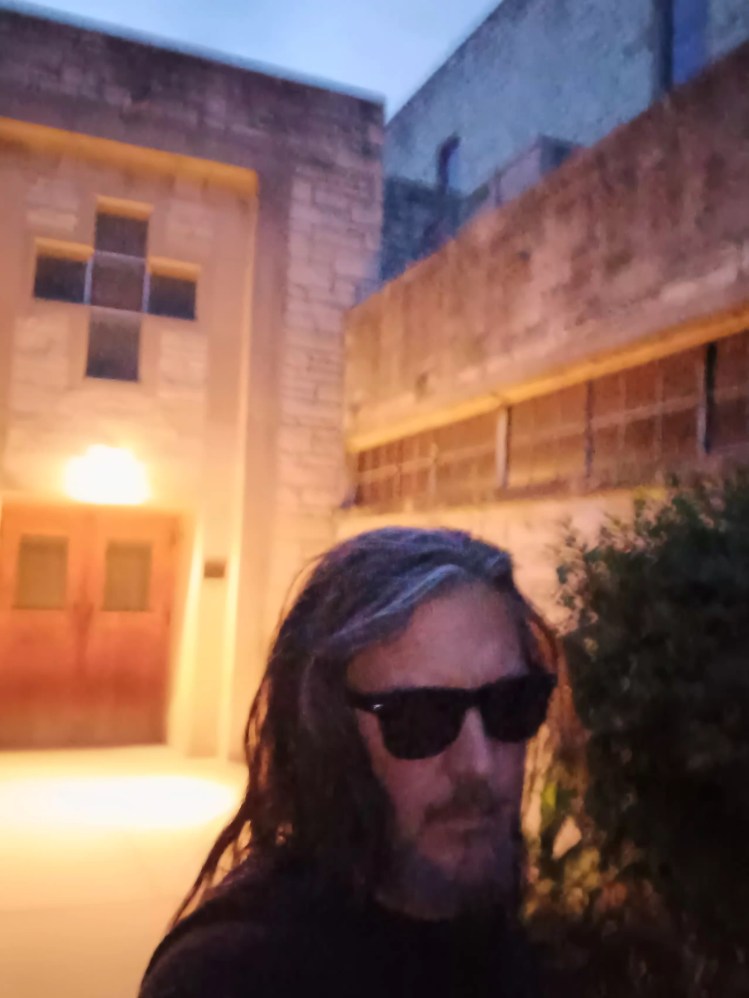
I started experimenting with drawn and photographic self-portraits in the 1980s, when I was in my teens.
I was partially glad when the Selfie came around, because it partially justified me, at least in the legend of my own mind.
Before that, even people who were otherwise on my side would sometimes make fun of me for taking “selfies” – before “selfie” was even a term, or a word.
But ever since there were cameras, there have been poets who have done this.
Walt Whitman, Philip Larkin, and Robert Johnson are only three examples.
I was raised in the Lutheran Church in Michigan; their religious art influenced me in enduring and subconscious ways that I can’t even diagnose in myself because they go so deep.
Other influences on my self-portraits include classic album covers, certain movie posters, author photos, and of course the classic self-portraits by the great classical artists.
I had a stroke at the age of 57 in the Year of Our Lord 2024.
After that point I started making self-portraits just to prove to myself that I was still alive – as alive as ever, or even more so.
I had one grandmother who remained youthful up until the very end, at 88. I had another grand who remained youthful until the age of 92 (and then her slow decline until “the end” at the age of 94).
I only make the self-portraits on my regular phone. No tricks. I’m no technologist. As in all art, spontaneity and selectivity are the keys. These, and dogged determination.
I got this phone three years ago. I’m 58 now. So I call all of these self-photos the 55 and Up Series. Almost everything else disappeared with the other phone.
I also make the pictures to taunt all my enemies, and all the people who left me in the dust when I didn’t want them to.
There were others who left me in the dust and I was okay with it: or even goaded them into doing so.
Signing off for now until next Sunday: “The Drifter.”
“Only the great masters of style ever succeed in being obscure.”
– Oscar Wilde
LITERATURE, in its pure form, says The Drifter, is no longer taught in American universities.
What we have instead is economic grievance (usually from people who are already wealthy) and identity politics (also from wealthy people) masquerading as literary theory.
The pure spirit of Literature has been crucified, in the American academy. It was dead and bleeding on the cross. Now Joseph of Arimathea has disappeared with the body.
Charles Baudelaire, the first poet of the modern city, anywhere (his city was Paris) used to pray to the spirit of Edgar Allan Poe, just like a Catholic prays to a saint. (Baudelaire was also Catholic, perhaps the most unique Catholic who ever lived, or one of them.)
If you told someone in American academia these days that you pray to a Literary Saint, the cynical crowd would suddenly rear its ugly head and laugh you right off campus immediately, from coast to coast and everywhere in between.
For me, the two greatest literary critics, ever (in the English language), are Dr. Samuel Johnson, and Dr. Harold Bloom. Johnson died in 1784, at the age of 75. Bloom died in 2019, aged 89.
Both of these titanic and gargantuan figures (and they were both gargantuan and titanic physically, as well as spiritually and mentally) have been wildly and consistently misrepresented in the popular press. Ideas they never had are attributed to them; stances they never took are assumed to have been their own; and their personalities, the most important thing about each of them, have been distorted beyond all recognition.
But the works and the good writings about each of these figures still remain, as well as the visual representations (from which you can learn entire worlds) and large collections of quotations about them by people who knew them well or just came into contact with them for brief periods.
One of my favorite works by Samuel Johnson is his first full-length book, the short biography The Life of Mr. Richard Savage, sometimes known as Life of Savage, and whose full title is An Account of the Life of Mr. Richard Savage, Son of the Earl Rivers (whether or whether not Savage was really the son of the Earl was one of the things about him that was always in dispute and a large contributor to his renown, or infamy, because he claimed he was, and the Earl claimed he wasn’t – loudly).
Savage was a famous minor poet, sometime actor, fulltime alcoholic conman, and all-around good guy who Johnson was friends with for a time. They roamed the London streets together at all hours, sometimes sleeping rough when they had to, starving and drinking and trying to make a living as Grub Street hacks (sometimes partially succeeding at the latter).
After Savage died, impoverished, alone, well-known, and alcoholic, Johnson wrote his life, thereby penning one of the first deeply psychological biographies ever committed to paper. One reason I love this book so much is because Savage reminds me so totally of a person I once knew, a very close friend, with whom I got into so much trouble at that time it has to be saved for another column.
Johnson also wrote a kind of nonfiction novella called Rasselas. This book was one of the very first Western explorations of Buddhism ever written, a fictionalized, Westernized account of the Buddha’s story almost as if filtered through the story of Muhammad.
Johnson himself, as a man, was such a strong and powerful abolitionist, before abolitionists even existed, that slaves in the New World ended up naming their children Rasselas after his great character. Johnson later adopted a black child as a single father after the death of his wife, raised the boy into manhood, and left him his money and name when he passed on. Such things were so unheard of in the 18th century that hardly anyone understood Johnson’s point of view at all. They didn’t know that he had moved beyond racism in an era when no one even knew what “racism” was.
Johnson was a multiculturalist (in the sense that he believed, like Jesus, that everyone should be included) not decades, but centuries, before such a thing existed with a name, and he didn’t just preach it, he lived it. And yet, the English Departments of the American academy now mostly accuse him of being an ultra-conservative “dead white male” who deserves to be ignored, forgotten, and even “canceled.”
Such thinking and behavior only give fuel to the rising and rabid fascist tide among us, a situation that is like a flood and a fire at once within human culture itself and thereby demands the mixed metaphors.
Harold Bloom has also, seemingly endlessly whenever he is discussed, been accused of being a so-called political conservative, even though he never was anything of the kind at all, and even was the exact opposite, more of an imaginative and creative, one-of-a-kind anarchist in his politics than anything else. (“Anarchist” in the sense of placing the highest possible value on human freedom, and human expression, itself; it has nothing to do with the practice of political violence, or rather believes the practice of violence should always be avoided because when you practice violence you’re not free.)
Born in 1930 in NYC, Bloom did his best work after the age of 50 (once Ronnie Rayguns took over), and perhaps his very best work after the age of 70, even though everything he did before 50 was the basis for all that came after, and led to it.
Five of my favorite books by Bloom are: How to Read and Why (2000); Genius: A Mosaic of One Hundred Exemplary Creative Minds (2003); Hamlet: Poem Unlimited (2003); The Anatomy of Influence: Literature as a Way of Life (2011); and Falstaff: Give Me Life (2017).
This last book, a true and deep classic in Shakespeare studies, a brief book that takes the reader on a lasting tour of all things Jack Falstaff, was written and published just a few years before Bloom passed on at the age of 89. In its late 80s, one of the most powerful human minds of our times appeared to be getting stronger than it ever had been, not less so.
Harold Bloom was like Oscar Wilde in the way he took nonfiction writing about literature and raised it to the levels of the very highest and best imaginative literature itself. Bloom said that William Shakespeare was his ultimate model, as opposed to any critical writers he’d ever known or studied (except for Samuel Johnson). As a writer, Harold Bloom was much closer to someone like Bob Dylan or Ernest Hemingway than he was to what we usually think of when we think of a “literary critic.” And he was a real and true harbinger for many directions imaginative writing will take in the future and is now taking even as we speak, inevitably (says The Drifter).
Crucial END NOTE from The Drifter, MFA, PhD: The Drifter’s name, “The Drifter,” is not influenced by, but is rather stolen directly from (in a sense), two names that Dr. Samuel Johnson called himself, when he himself wrote columns: The Rambler; and later: The Idler.
A Few More Crucial Note/s: Samuel Johnson’s prose style can strike the modern reader as outdated at first, but a good reader can catch up with him within the hour, and the struggle to do so can only be beneficial, since this is Johnson, and since nothing too easy is any good. Johnson is far more modern than almost any other writer of English prose of his era, his pal Boswell rivaling him in this. And often enough, his prose sounds exactly as if it were written yesterday, or tomorrow (these are his best bits, and they’re scattered everywhere throughout his vast, massive work).
Harold Bloom wrote a lot (a vast understatement), and he has entire, five-hundred-page books (among his early work) that are composed almost entirely in a stilted, bloated, airy, windy, jargon-filled prose that is still, despite itself, brilliant and unique almost all the time.
After the age of 50, at his own admission, he started to write for a more general audience outside of academia, including the reader he called the “incredibly intelligent child of any age.”
He did this for two reasons. One: he wanted to reach more people while he was still alive. Two: his skills had improved.
THE MOST IMPORTANT PART: Reading good works or otherwise genuinely engaging with good art of any kind keeps your mind, heart, and soul in a good place, so that, the more you do it, the better your own inherent goodness becomes. The opposite of this, just as powerful, is rotting your brain (and heart and soul) with meaningless trash.
Addendum: Roger Ebert is the Harold Bloom of the movies; Lester Bangs is a Bloom of rock and roll.
Stay tuned this week as The Drifter attempts to practice literary criticism upon modern popular music, but in a late-Bloom kind of style, not an early-Bloom style, i.e. jargon free and written for the incredibly intelligent child within all of us no matter what age.














 Saragun Springs