“Buck did not read the newspapers, or he would have known that trouble was brewing…” – Jack London, The Call of the Wild
I realized recently how much I love going outside when I couldn’t go outside.
I couldn’t go outside because I live in Chicagoland, and the other day we had, by far, the worst air quality in the world. The AQI was at nine hundred million billion zillion or some such number.
The air was truly toxic and as soon as you stepped outside, as soon as you stepped outside, you knew it.
It was like a yellow and grayish toxic fog of smudge filling the air everywhere that made your lungs burn. The dogs, too, started coughing. You literally could not stay outside unless wearing a mask, and last time I checked, dogs can’t wear masks, thus, you had to take them out quickly to do their business (if you have dog/s) and then right back inside.
It was wildfires from Canada, hundreds of miles away, that were causing this dystopian, toxic situation.
The smoke blew down from there to here, mixed with the city air and the 105-degree F “real feel” temperature, and created the toxic air.
Even the professional baseball games were canceled. All the Lake Michigan beaches (28 straight miles of free public beaches in the city of Chicago alone) were closed.
I am not a person who needs a mountaintop, a seashore, or a desert on a daily basis, although I have been known to travel to those kinds of places frequently in the past, and I go down to visit Lake Michigan pretty frequently. (Lake Michigan is 307 miles long and 118 miles wide at its widest, with a maximum depth of over 900 feet: i.e., an inland sea, connected to four other inland seas and forming the Earth’s largest fresh water system, or 20% of the world’s surface fresh water. There will be a lot of people trying to move to this area by the end of the century.)
But all I need on a daily basis is some trees (or even one tree), some flowers, some grass (or snow in winter), a few parks, or the local, humble forest preserves, which look modest and are actually filled to overflowing with such creatures as: frogs, toads, snakes, turtles, bees, beetles, butterflies, dragonflies, praying mantises, other insects, hawks, herons, ducks, geese, song birds, other birds, deer, coyotes, raccoons, opossums, squirrels, skunks, rabbits, river otters, muskrats, and even some beavers. And even the fish in the river must’ve been coughing during the latest Toxic-Sludge-Air Event. (Hemingway roamed this area as a teenager and John Wayne Gacy dumped bodies into this river 25 miles upstream which, to me, shows the best and the worst of humanity all coming together at the river.)
And when you can’t go outside, you start to get cabin fever. (Or: when I can’t go outside, I start to get cabin fever.)
Cabin fever usually denotes not being able to go outside because it’s too cold and there’s too much wind and snow; but now it also means not being able to go outside because when you do, it makes your eyes and your lungs burn, your hair and clothes smell like smoke, your healthy adult dogs cough, and the fact that it’s hard to breathe out there starts giving you the fantods (and the heebie-jeebies) because there’s an onslaught of toxic particles infesting your lungs and eyes – literally, seriously; like something out of an H.P. Lovecraft horror story (not exaggerating here) and that self-admitted weird guy could really make up some creepy stuff. Weird Tales, indeed.
If you start feeling like you’re in the middle of an H.P. Lovecraft short story and it’s real life, do something!
I suggest putting your mind above it all, like Jesus on the cross (even though there’s also a time to shout out, “Why have you forsaken me!?”).
Sitting Bull used to sit down in the middle of bullets whizzing all around his head, pack his pipe calmly, and sit there smoking his pipe, calmly, while all the bullets continued whizzing around his head.
No one knows why, but all the bullets missed, all of the times, except once when he was younger, and at the end.
And I realized that when I can’t go outside, I start to go insane.
Then we had a Noah’s Ark and the Rainbow moment here.
I woke up today and the sky was blue and clear, and the air was okay again, just like that: and the temperature was perfect enough at a “real feel” of just 90 degrees F.
When I was a little kid, about fifty years ago (I’m 59 now), 90 degrees F was VERY HOT and very rare.
Now it’s normal for a midsummer day here in the middle of the American Midwest in the middle of North America. Just like tornadoes and floods are much more common here in Illinois now, and in the wintertime we sometimes get a thing called “thundersnow” (thunder storms and snow simultaneously) which is a thing that did not even exist around here at all when I was a kid. The first time I saw it I was so flabbergasted and amazed that I felt like Moses on a mountaintop being shown the Burning Bush almost.
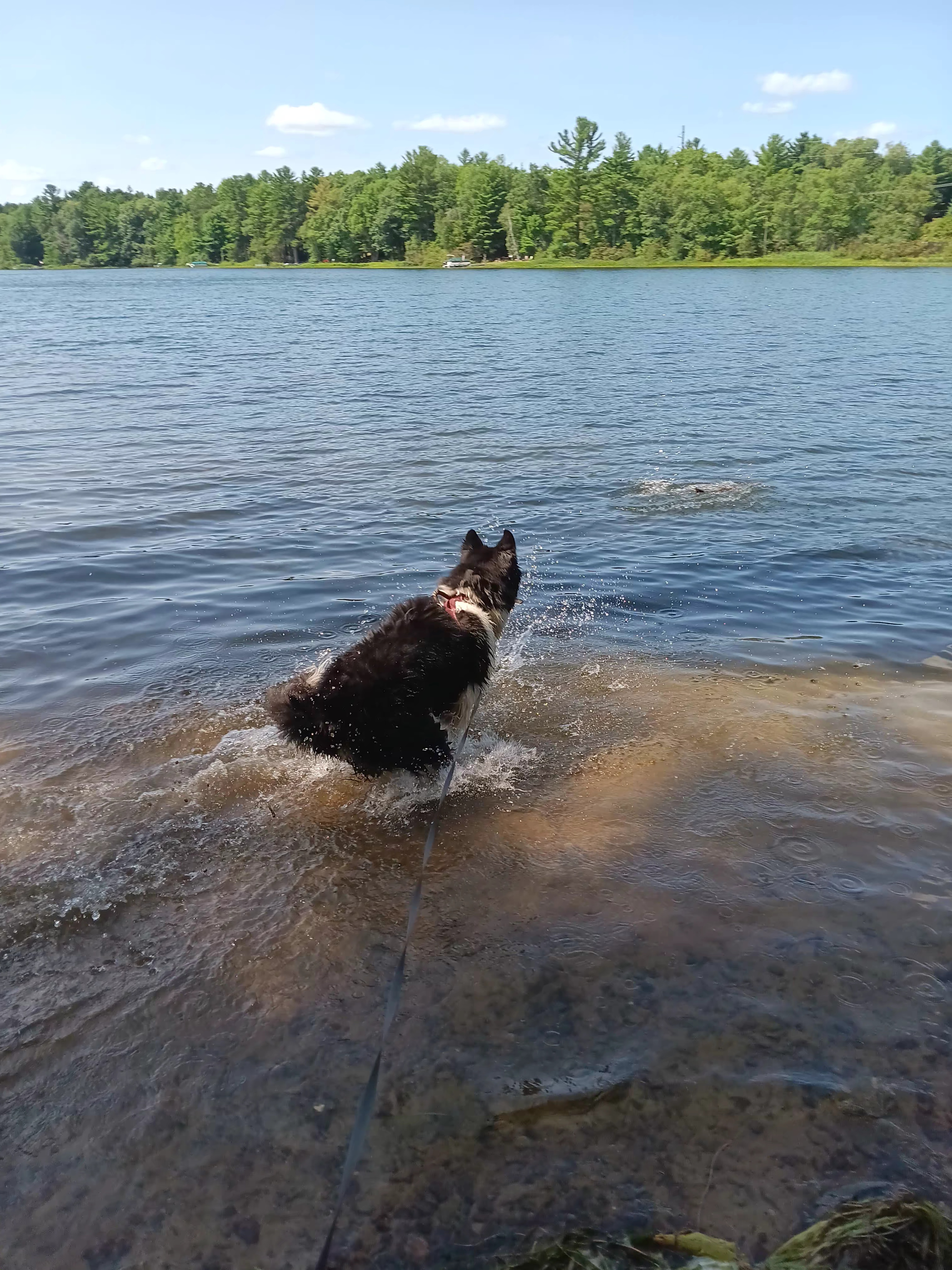
And I still love, as do my dogs, going outside.
Crucial Dog Notes: I have the dogs for a literal multitude of reasons, one of them being that I don’t get along with the vast majority of herd humanity very well on a face-to-face basis most of the time because they give me the fantods and the heebie-jeebies (the people I do get along with I get along with fine, and very well, usually) which is why I always appear to be running away from people or hiding and lurking behind doors, like Emily Dickinson; or faithfully wearing my sunglasses, like Lightnin’ Hopkins or Jeffrey Lebowski; and another of those huge, crucial reasons is that we all love going outside together so much.
END NOTE: The wildfire smoke is back today (but not as bad).
The American poet Ted Berrigan (1934 – 1983) said (wrote), “I don’t feel / a necessity for being a mature person in this world. I mean / all the grown-ups in this world, they’re just playing house, all / poets know that.”
Among other questions this beautifully plain-spoken quotation raises, it raises the question of what, or who, a (real) poet is.
A guy who (sometimes) calls himself “The Drifter” (because he synthesized Samuel Johnson’s “The Rambler” and “The Idler”) came up with an answer for this.
He broke it down into three simple parts (or things) – or requirements.
One: a modern poet cannot be, cannot be, CANNOT BE, a cheerleader for The System, not matter what system you mean.
The modern poet MUST BE, must be, must be, an outsider; in one form or another.
Wallace Stevens was a married insurance executive with a kid (and a house) and he still managed to live as one of the most profound lone wolves North America has ever seen. And when it comes to lone wolves, America is second to none.
Secondly, the poet must have an original vision. Many poets have been literally blind, starting with the very first known and named modern poet (in the West) of all, Homer.
Their inner visions were so intense and so original that they lost their outer sight.
That is what the Homeric myth of outer blindness and inner seeing really means.
Next, the poet must be able to say what they see.
Not to a billion-plus people all at once. Once it gets to that level (or even a million) poetry has turned into propaganda. Donald Trump used to be able to give some wickedly effective “poetry” readings about immigrants being snakes. But these readings were propaganda in the form of (simplistic) poetry; they were not “real” poetry.
The poet must be able to say what they see that no one else sees.
BEING A POET HAS ABSOLUTELY NOTHING TO DO WITH USING FANCY WORDS OR “PRETTY” VOCABULARY (although almost all good poets have a wickedly large vocabulary).
Real poetry is about ELEVATED LANGUAGE and the circumstances that rightfully call for elevated language; and that does not mean elevated language is pretty.
Elevated Language is often harsh; very plainspoken; savagely angry; obscene; heartbreaking; hilarious; haunting.
Elevated Language is always intense, but very-much oftentimes, intensity comes in a whisper.
Much or most of the best poetry is AWKWARD, at least until you get used to it. (Awkward, NOT “pretty.”)
And its intensity is often calm, quiet, whispering, mumbling, clipped, pungent, brief, startling, something on the wind over the waters: memorable.
Marlon Brando mumbling on screen in some of his best roles is kind of like poetry. He can do it so well you don’t even know he’s faking it: maybe because he wasn’t (quite) faking it (he was bringing it up from a real place inside himself).
An outsider with an original vision who can communicate that vision to at least one other person in words because the right words make you think and feel more deeply, privately (not publicly): that’s what a real poet is and what real poetry (and who a real poet) is.
My psychiatrist (who is employed at a very well-known and well-respected hospital and medical establishment in the city of Chicago) calls the time we are living in right now The Psychedelic Renaissance.
He calls this time that name because of all the research that is currently being done on what are known as “Magic Mushrooms” on the street. Magic Mushies, or psilocybin, are being researched right now as an effective treatment for a wide array of modern issues, including, but not limited to: treatment-resistant depression; Obsessive-Compulsive Disorder; adult ADHD; and Substance Use Disorder.
To those not in the know, it may sound ironic, and even ridiculous, to give someone who has been addicted to alcohol or opioids Magic Mushrooms instead; but, trust me, the difference between these substances is profound, and one important name for this kind of treatment is: “HARM REDUCTION.” I.e., taking a few Magic Mushes now and then might be beneficial, and is not deadly in the way a full-blown addiction to alcohol and/or opioids is deadly.
HOWEVER: lest anyone think that Magic Mushrooms are perfectly harmless and you can take as much as you want whenever you want, I offer a few examples (taken straight from life, and experience) to make you think again.
If you take too many Magic Mushes all at once, accidentally or on purpose, you can really, really get yourself into some big trouble. Number one, it raises your heart rate and can trigger strokes or heart attacks.
Number two: it can make you paranoid. It can make you very, very, very, very paranoid. It can make you so paranoid, if the dose is large enough, that you become, temporarily, psychotic, which means, totally out of touch with reality.
Taken every day in large doses over, say, a two- or three- or four-week period, a person can slowly, steadily start to become separated from “reality” in a very, very serious way, as in believing you are being watched by the police when you are not being watched by the police, or thinking that your neighbor is out to get ya.
(I am not saying I know these things from personal experience; but I know these things from personal experience.)
Magic Mushrooms have their street terminology, like all drugs. One term is: “hero dose.” It means taking a massive dose and going on a long, strange journey, or trip. Another term is: “micro dose.” It means taking a small, controlled dose, kind of like having a single cup of coffee instead of nine or ten cups of coffee, or a few puffs on a cigarette instead of the whole pack. A third term is really beautiful: “afterglow.” This is what happens when the hero dose or the micro dose starts wearing off, but is still “there.” This phase of the experience is, very often, the very best phase of all. And sometimes it lasts for days (on and off). Literally.
I have seen a grown man sitting on a couch weeping like a little baby and asking the people around him to call his mother because he “wanted his mommy,” even though mommy had been dead for twenty years. This man was not me (I only witnessed this) but damn and wow, did it make an impression.
I have also seen a teenager hiding her head in a bucket for over six hours while believing that “THEY” were at the front door and about to “get her,” because she took a massive “hero dose” accidentally and then freaked out so bad she literally went insane for a while.
Again, it wasn’t me that happened to but I witnessed it, up close and personal, and damn and wow, did it make an impression.
Magic Mushrooms are A DRUG. They are a much safer drug than ALCOHOL, the most dangerous drug of all, along with crystal meth, fentanyl, cocaine, etc. etc. They are a much safer drug than “the hard stuff.”
But if you think you can take as much as you want without losing your shit, you are wrong.
END NOTE/s: They also affect your balance and coordination and can make you fall down.
Never drive on these things unless you are Paul Newman!
The Editors of Saragun Springs (L and D, Seattle and Chicago, USA) share a mutual passion for William Shakespeare. We revere him for the same reason/s that almost everyone who likes him likes him: he’s the greatest single writer in the English language and everything that has been written in English since him has been massively influenced BY HIM, even if that particular writer is not familiar at all (on a personal level) with his work/s.
I could go on and on about Good Will, but I can’t say it any better than Ralph Waldo Emerson did almost two hundred years ago. The following 305-word quote (at the end of this little essay) is NOT a cut-and-paste. This quotation was typed out by hand, from memory, by me; and I checked the text afterward because I knew there would be a few mistakes (there were quite a few mistakes, which I have since corrected).
Anyone who reads, rereads, and studies, this quotation will have their mind stretched in the right kind of way, even if they’ve never heard of Shakespeare.
I was not able to type this thing from memory because I have a photographic memory. I have it memorized because of two things: repetition and concentration (I’ve read it a lot and I always concentrate deeply when I do: it is a form of meditation, and prayer).
Shakespeare cannot compete with the world’s best-selling and most well-known book (BY FAR), the Bible, when it comes to characters: and not even close; and he himself knew this very well.
Adam and Eve, The Serpent (Satan), Yahweh, Cain and Abel, Moses, Noah, David and Goliath, Solomon, Samson, Job, Jonah, Jesus, Mary, John the Baptist, Mary Magdalen, Peter, Judas, Herod, Pontius Pilate, the Good Samaritan and the Prodigal Son are now and will always be more well-known, globally, than any of Shakespeare’s characters.
(The Bible is the world’s greatest story collection, and I am speaking here of The Bible as literature. I also believe, personally, that the individual authors of the Bible were divinely inspired, very much so, each in their own very individual, very particular, very different ways.)
Some of Shakespeare’s most famous personages are: Hamlet, Falstaff, Cleopatra, Julius Caesar, and Romeo and Juliet (he did not actually invent any of them, which is also true of most of the Bible’s main characters and their authors, just as it is true of Rabelais and Gargantua, Goethe and Faust, Lord Byron and Don Juan, etc. etc. etc….).
I once heard two little kids running around on the sidewalk talking about Romeo and Juliet in Arabic.
I believe R and J are WS’s two most famous characters.
But even they cannot even come close to competing with Jesus and Mary (as characters; I also happen to believe, personally, that each of these were also holy; but my definition of “holy” does not match “the world’s” definition of holy, unless it is the Russian definition of such).
But Shakespeare added something new to the presentation of character that every single writer who has written in English since then, has been influenced by (to say nothing of his influence in other languages as well, like German, where he is, if anything, even better known than in English).
Now that I’ve blathered on for over 600 words, I leave you with the Ralph Waldo Emerson quotation. I would say, pay close attention to the title of this little article and the way it appears in the following quotation. Emerson wrote this quotation when the world thought Shakespeare was just a cheap entertainer. Emerson was among the first to see deeper on this issue (not the first, but among the first, which amounts to the same thing; because there are no “original” ideas):
“Some able and appreciating critics think no criticism on Shakespeare valuable that does not rest purely on the dramatic merit; that he is falsely judged as poet and philosopher. I think as highly as these critics of his dramatic merit, but still think it secondary. He was a full man, who liked to talk; a brain exhaling thoughts and images, which, seeking vent, found the drama next at hand…He is like some saint whose history is to be rendered into all languages, into verse and prose, into songs and pictures, and cut up into proverbs; so that the occasion which gave the saint’s meaning the form of a conversation, or of a prayer, or of a code of laws, is immaterial compared with the universality of its application. So it fares with the wise Shakespeare and his book of life. He wrote the airs for all our modern music: he wrote the text of modern life; the text of manners: he drew the man of England and Europe; the father of the man in America; he drew the man, and described the day, and what is done in it: he read the hearts of men and women, their probity, and their second thought and wiles; the wiles of innocence, and the transitions by which virtues and vices slide into their contraries: he could divide the mother’s part from the father’s part in the face of the child, or draw the fine demarcations of freedom and of fate: he knew the laws of repression which make the police of nature; and all the sweets and all the terrors of human lot lay in his mind as truly but as softly as the landscape lies on the eye. And the importance of this wisdom of life sinks the form, as of Drama or Epic, out of notice.”
The MOVEMENT in all sections of the poem is always to something new, from something that is fully defined. Progression, development, fulfillment, all in eighteen words.
The “dance” can be likened to what Nietzsche said about his hero Zarathustra, that his walk was a dance, that his walk was so lively that it recalled a dance and could be likened to a dance and that he danced that dance and walked that walk whether he was in town or out of it, once he had become himself, that is.
“Gentle Gaiety, Revelry, Radiance,” recalls Charles Baudelaire’s command to “Always be drunk! On wine, poetry, virtue, or what you will, but be drunk!” The wine itself isn’t important; the drunkenness is, an injunction which has inspired many august souls from Rimbaud to Dylan Thomas to William S. Burroughs and Bob Dylan. The wine itself (or the drugs, or the love) is never more than a means to an end.
And the end is THE MUSES, who are the ones with lovely hair.
Sappho and her cohorts all believed in the literal existence of “The Muses,” that is, they believed them to be gods, i.e. transcendent forces worthy of worship, eminently and ultimately worthy of worship, and therefore worthy of dying for, too, if that’s what it took.
They were only humans like us but because of what they believed and how they lived it, they may have been (among) the best of us.
END NOTE: Endless thank you/s to Mary Barnard (1909 – 2001), who made the translation of Sappho used in this commentary. Her translations possess an Emily Dickinson-like intimacy and idiosyncrasy which must also be contained, in a different way, in the fragments of Sappho.
(Note: Whether he be DWB, Dale Williams Barrigar, Dr. Dale Williams Barrigar or never seen at the same time as the Drifter, we are pleased to show work by Dale Barrigar!)
Hello! The Tao Te Ching says this:
“Greatness entails transcendence. /
Transcendence entails going-far. /
Going-far entails return.”
“Greatness” here is a you-choose type of situation.
Whether it be in dispensing the milk of human kindness, creating art that will outlive your own time, becoming the most passionate football or Taylor Swift fan who ever looked out over fields or stage, or any other area of endeavor, greatness is up to the one who wishes to become great, entirely. When the definition of “great” is in the right ballpark, then the wishing-to-become-great becomes already-in-itself an aspect of greatness. Not all of us, and probably not even most of us, will truly be able to reach our so-called goal/s here in this life. That is as it has been, as it should be, and as it ever shall be, too.
The important thing is to have a goal that is NOT an end-point destination. The important thing is to want greatness, and to live like it. And to not let them tell you otherwise. Or if they do tell you otherwise (and they will), not to believe them. Giving someone a silent stare and then turning around and walking away is the greatest rebuff I can ever imagine.
“Transcendence” here means to rise above your worst self here in this world (and all that entails). If you’re looking to get to heaven in the afterlife, it should console you to know that all the major religions say (in one way or another) that the way to get to heaven in the afterlife is to transcend your worst self here, in this life. It’s akin to what the great psychologist Carl Jung meant in a mostly secular sense when he talked about confronting, and mastering, your own dark side. And for Jung, such behavior also led to modern spiritual enlightenment.
“Going-far” can be seen in the phrase “going the distance,” which means finishing the fight, finishing the journey, NOT BEING A QUITTER. No Quitters Allowed. And there is nothing to quit from when you realize that your goal is the way you live your life every day, NOT a specific destination like winning a prize, making a million bucks, becoming “famous,” or any of the other ephemeral and illusory trappings that are pushed so hard by our Consumer/ist Society, where the Almighty Dollar is the one and only real religion. It simply isn’t true, at all, that only the rich and famous are worth anything.
What it means to “return” is up to you to decide. And the decision, once made, should never be final.
The word entail = that it has to be there, that it cannot not be there, and that if it is not there, the whole thing falls apart. And at that point, mere anarchy is loosed upon the world – your world, that is. Your own private world, which is where it all begins, and ends, now, yesterday, tomorrow, and forever. Never let The Algorithm tell you otherwise!
END NOTE: Thank you to Charles Muller for his wonderful translation of the Tao Te Ching (2005).
“If you want me again look for me under your boot soles.”
– Walt Whitman
“I am the man. I suffered. I was there.” – Walt Whitman
“A splendid old soul.” – Mark Twain on Walt Whitman
“Whitman is my daddy…Opulence is the end.” – Lana Del Rey
These are the words of Walt’s that first chilled my bones (when I was seventeen years old) (from “Crossing Brooklyn Ferry”):
“Closer yet I approach you, / What thought you have of me now, I had as much of you – I laid in my stores in advance, / I considered long and seriously of you before you were born. / Who was to know what should come home to me? / Who knows but I am enjoying this? / Who knows, for all the distance, but I am as good as looking at you now, for all you cannot see me?”
And these are some of the words I read aloud from the pulpit at my mother’s funeral twenty-seven years later (from “Song of Myself”):
“This grass is very dark to be from the white heads of old mothers, / Darker than the colorless beards of old men, / Dark to come from under the faint red roofs of mouths. /
“O I perceive after all so many uttering tongues, / And I perceive they do not come from the roofs of mouths for nothing. /
“I wish I could translate the hints about the dead young men and women, / And the hints about old men and mothers, / And the offspring taken soon out of their laps. / What do you think has become of the young and old men? / And what do you think has become of the women and children? /
“They are alive and well somewhere, / The smallest sprout shows there is really no death, / And if ever there was it led forward life, and does not wait at the end to arrest it, / And ceased the moment life appeared. /
“All goes onward and outward, nothing collapses, / And to die is different from what anyone supposed, and luckier.”
….
PERSONAL DECLARATION:
Today on this day that is the day that is one day before the 207th birthday of Walt Whitman, I hereby formally declare myself to be a BLOOMIAN critic, which means I follow Harold Bloom, although not in all things, which would have made perfect sense to Harold, who, like Ralph Waldo Emerson, never wanted anyone to follow him in all things. Bloom has done more to boost Walt Whitman’s reputation than any other critic in the late twentieth and early twenty-first centuries, by far.
The title of Walt Whitman’s book was/is so great that it matches Tolstoy’s WAR AND PEACE: LEAVES OF GRASS. His book itself is so great that it too matches Tolstoy, although in a different mode, the mode of poetry. (There is also a reason why they both had long white hair and long white beards.)
The other day I was observing my Siberian Husky mix, Boo, and I realized that he was individually sniffing every single blade of grass in the area in which he was standing in a field in northern Illinois outside Chicago. Let me repeat that: individually sniffing every single blade of grass. It was like Horton discovering a WHO! inside a clover, it was that mind-blowing.
Walt Whitman used to watch Abraham Lincoln walking around Washington during the Civil War. Lincoln knew who Walt was, and would nod to him, although they never spoke. But Whitman was studying Lincoln. Whitman was working, for free, as a volunteer nurse for both Northern and Southern soldiers in the hospitals of D.C. He saw the worst of the worst of the worst of the worst of the horrors of war (many, many times), and did things like write letters home for the incapacitated soldiers, hold them while they died, and write to their families (beautifully) after they expired. During this time, he was also working as a humble and lowly government clerk. He had numerous nervous breakdowns during this time, small and then large, and eventually a stroke at the age of 54.
Walt Whitman was very concerned with the way his beloved America would turn out. He lost much of his faith in the USA during the Gilded Age (named by Mark Twain). But he never lost all of his faith.
So let me say this:
There are many, and I mean many millions, of physically living human beings walking around among us now who have zero, and I mean zero (no), human emotion/s at all. They feel nothing but nothing (unless it’s a smoldering rage), and the occasional sneer (or a chuckle at someone else’s pain) is all they can muster. (See the President of the United States as well for this, as well as all of his henchmen and henchwomen.) (No wonder zombie and vampire movies are so popular.)
WATCH OUT!
There are also people walking around among us now who act like (or are) angels.
(Note–Bob Dylan’s 85th (!) is tomorrow. A Great many words have been written about him, but I feel that this essay by Dale, which first appeared in Literally Stories UK, is as fine as anything you will find in print!-Leila)
Bob Dylan is a bard of the old school, and also of the school that never gets old. Long after every single Hollywood movie ever made will be penned by androids, computers, zombies, vampires, and “AI,” scattered humans everywhere will still be searching out the work of Bob Dylan, whether to read or listen to it. When Dylan released “Murder Most Foul,” his longest song, in the middle of the Covid Pandemic, he proved every critic who’d ever said he didn’t deserve the Nobel Prize in Literature wrong.
With a terrifying title from Shakespeare, this long song and short fiction is a mini-novel about the Kennedy assassination. And all assassinations, and all murders ever committed, now and in the future. Almost as if to prove that he’s a poet and story-teller more than a musician, Dylan doesn’t even sing this song. He speaks it. He tells the tale like an ancient bard, maybe even going as far back as Homer.
Dylan is often compared to Shakespeare, and for good reason. It could be that a more apt comparison is with the older writer. Homer, like Bob, spent his life traveling from town to town and speak-singing his story-songs to the accompaniment of a stringed instrument. This image of Homer has been accepted for so long that it’s become a fact of fiction that tells the truth, as real as any other Greek mythology, from Zeus to Athena.
Dylan has always cited literary writers as some of his most important, if not his most important, influences. He claimed that “Blood on the Tracks” was inspired by Anton Chekhov’s short stories. He listed his two favorite writers as Emily Dickinson and Arthur Rimbaud. He read T.S. Eliot and James Joyce in high school. He resurrected Charles Baudelaire in “Idiot Wind.” He said that all writers and artists should read John Keats and Herman Melville.
He acknowledged Walt Whitman’s genius. He went to the grave of Jack Kerouac and read Kerouac’s poetry aloud with Allen Ginsberg. He wrote his songs on a typewriter. He created an absurdist book of prose poems, and he composed a memoir that isn’t his best work but is highly readable, filled with signs of the times, then and now.
Someone once compared Bob Dylan to Ernest Hemingway, another writer for whom Dylan has expressed his approval. Both writers diagnosed their times, and fought the wars of their times. While Hemingway went to Italy as an ambulance driver, Dylan went to Mississippi as a liberal Jew who stood out in an open field and sang Civil Rights protest anthems, surely as dangerous as Hemingway heading to the front as a non-combatant who wanted to help injured soldiers.
Dylan has already entered the canon of great American authors. When we look back at history, we see that there are many authors who did not deserve the Nobel Prize, and many authors who did deserve it who didn’t receive it (James Joyce, Leo Tolstoy, and Jorge Luis Borges are a famous three of these). A hundred years from now, Dylan will be seen as a writer who deserved this prize, and then some. His humanity, and his ways of expressing it in English story-language, will last a very, very long time, even, or especially, as the rest of the mainstream world continues to become more and more robotic, tyrannical and inhuman.
The forewarned Bonus Material
Happy Birthday Bob D a Prose Poem
I believe that the first two dorky looking guys to make being dorky looking guys cool were you and Buddy Holly. Can’t imagine Steve Reeves singing Peggy Sue on AM or Dash Riprock getting all Positively Fourth Street on the weird radio. Thank Zimmerman you have traveling angels on your side. Seems an obscenity that all that time flew by. But if I could play God and select people to have it all to do again, far off, in distant years, to clean up the future, amongst such I’d have you and Buddy headlining a cold winter night concert in Clearlake, Iowa. And I would replace the airstrip with a seven star hotel, a temporary home til just spring, inhabited by goatfooted balloonmen and bellboys, fey and wee.