Menopausal Male Bombshell by Michael Bloor

Alan had won second prize in a writers’ magazine poetry competition for his ‘Ballad of the Menopausal Male.’ The postman had just delivered the prize, a copy of The Chambers Thesaurus (5th edition).

As Alan hefted the thesaurus in his hand, he recalled that, in what used to be termed The Dark Ages, poets were feted and richly cosseted in the courts of Kings and Great Lords. When Gunnlaug the Worm-Tongue* (‘worm’ as in snake), the great Icelandic skald (= poet) was presented to the English king, Ethelred the Unready, Gunnlaug chanted four lines in praise of the king and was rewarded with a gold-thread-embroided, fur-lined cloak and was invited to spend the entire winter at the royal court.

Continue reading

Life with Angie by DC Diamondopolous

My sister Angie gives me outrageous material for my standup comedy. She’s a bona fide nut case, a paranoid schizophrenic, bipolar, manic depressive—you name it—Angie fits every disorder that isn’t wired to reality.

The voices inside her head tell her to run from anyone trying to help her—except me. I take my sister’s sorry existence, find the humor in it—in the loonies of my own mind—and make people laugh. Do I feel guilty? I’m half Jewish, half Catholic. Humor is my way of coping. Hell, I’m a female stand-up comic, and there’s no higher hurdle in show business.

Continue reading

Christmas To-Do List, Nick Botkin Edition by Yashar Seyedbagheri

(Editor note–We like to welcome Yash to the Springs. He holds the record for most stories published in one year at what I like to think of as , if not sister, but our cousin publication of Literally Stories UK. One read will tell you why he is so successful–Leila)

The to-do list stares at me, letters running across the page, like railroad tracks of responsibility.

Pick up sisters’ favorite wines. Nan likes Sauvignon Blanc. Colette worships Merlot; Nan is not drinking any fucking Merlot (sorry, Paul Giamatti, I know I plagiarized Sideways, but original words are stuck in my throat).

Continue reading

Class Reunion by Christopher J Ananias

(Ed note: Happy New Year to All! And although we have been up every day for several months, it is still a joy to announce our grand opening. Today we start the year with a wonder bit of work by Christopher J Ananias, who is also responsible for the header image–Leila)

from the bug eyes of isolation

put the trailer court into a paper sack

and drink it

thirty years of days, gone

classmates, like pickets

they want, (they say), to see me at the class reunion

an October affair

when the pink glories despair

I can’t recall their faces

no one to dismiss

surely they had the makings of which

hair lips teeth—smiles and such

no successful accolades

What can I give?

they don’t want to catch my limp

one more look over the yearbook

oh, heart jumping!

there’s Lori’s brown braids

and Ken’s grin

he passed the pot pipe—and more

frozen people on wooden bleachers

others marching with golden horns and blue pennants!

cheerleaders throwing stars!

teachers standing around

oh sadness!

what do they want with me?

I cannot face those faces

I’m on a suspended license

riding up in my junker with dog hairs

gray goatee and brown eyes, dodging

with a shuffling hunching

mortal coil nearly shucking

all these days of years, drinking

leaking me on the barroom’s floor

a living hole

should take a big step through yon skyward’s door

no kids’ picture to present

not even a surly seed

or his mother’s needs

just me

drinking foghorns of time

sleeping on cement slabs

bars and paper crosses

glued with mint toothpaste

Who could believe?

we were ever seventeen

bursting threads and heart seams

marching with golden horns and blue pennants!

one more look over the yearbook

The Odyssey of Ellison by Doug Hawley and Bill Tope

(Ed note-Gotta live dangerously. Here we go with another fresh one during this month of reruns. Enjoy-Leila)

Looking Back

Ellison stood in her lavish garden, staring across the expanse of hydrangea, bougainvillea and sundry other plants, at her husband of 20 years. He was standing over the BBQ grill, his usual place during the summer months. He wasn’t pretty, she thought. Nor was he tall nor particular fit, but he fit her well enough. She smiled.

Feeling himself under scrutiny, Dewey glanced back at his wife. Dewey thought, not for the first time, how lucky he had been to lock onto such a foxy lady as Ellison. Even now, more than two decades after they met, she was a sight for sore eyes. What was that smile about, he wondered. But then, Ellison often seemed to be lost within herself, tickled by what she saw. He turned back to the pork steaks.

The next thing Dewey knew, Ellison was at his side, doing provocative things to his backside.

“Hey, sailor,” she whispered.

Dewey grinned. “Can I interest you in some…grilled meat?” he said, then thought, wow, what an original line. “You wanna pork steak, Babe?”

“Um,” she murmured. “I’d prefer a wiener.”

“I’ll need to put some on,” said Dewey.

“I’ll take care of it,” she told him, and led him into the house.

Later, after they’d done unspeakable things to the other, they lay atop the mattress, talking.

“Are you happy with me, Ellison?” asked Dewey. “With us, I mean? Is there anything we’re missing?”

“Well, I’d prefer $10 million in our IRAs, but no, I’m happy enough. You?”

Dewey could have played it cool, but he decided to come clean. “Baby, I’m over the moon happy with you. In fact, happy doesn’t even touch the way I feel.”

“Aw,” said Ellison, leaning in for a kiss.

“Really,” he said. “You gave me two beautiful kids,” meaning Vin and Sugar, who were in their first year of college, half way across the country.”

“Well,” she said, “I do have a case of empty nest syndrome, you know? Seems the kids were always under foot, but now that they’re gone, I miss the hell out of them.”

They lay in silence for some time before Dewey said, “Do you wanna have another kid?”

Ellison said nothing.

Dewey shrugged, felt a little rejection, but decided to put the issue off until later. Then he heard Ellison’s soft snoring and realized she had not dismissed the idea after all. He smiled and thought back to where it all started…

Get Her Number, First

Dewey Mercer looked up at the new barista in his favorite Starbucks and noted with appreciation her slender hips, her cute face and the gorgeous auburn hair spilling down her back and shoulders. He had noticed her the last two times he’d been here, but had been too afraid to approach her. He wanted to ask her out; what to do? He thought for a second; his older brothers, Huey and Louie, always told him, “Either dazzle them with brilliance or baffle them with bullshit, man.” Nodding to himself, Dewey stared into her pale green eyes and stalked forward and stood before the pretty young woman. She looked to be about his age — 19. She glanced up, smiled, and asked, “Yes, how can I help you?”

Dewey’s mind spun. Brilliance or bullshit? he wondered wildly, momentarily at a loss. Then he gave it to her with both barrels: “The Double Ristretto Venti Half-Soy Nonfat Decaf Organic Chocolate Brownie Iced Vanilla Double-Shot Gingerbread Frappuccino Extra Hot With Foam Whipped Cream Upside Down double blended, One Sweet’N Low and One Nutrasweet, and Ice.” He gasped for breath.

She stared at him blankly for a moment, then blinked. “Would you like a cookie with that?” she asked. He shook his head no and she went about the process of preparing his Frankenstein drink. Dewey scowled; that hadn’t gone well; she took it in her stride and now he was on the hook for an expensive libation. After some minutes, the cute barista set the drink atop the counter and said, “$149.99 please.” It was Dewey’s turn to stare blankly and blink.

“Put it on my card,” he muttered, pushing his debit card forward. His Visa, of course, was stretched beyond its limit. She told him so. He hung his head. Now there was a crowd growing at the busy coffee shop. Deprived of their caffeine, they were turning ugly.

“C’mon, move the line,” someone behind Dewey groused.

“He ordered some freakin’ bogus drink and now can’t pay for it,” hissed another.

“Deadbeat!” seethed a third.

Feeling belabored and outnumbered, Dewey went for broke. “Could I…uh…have your number?”

She surprised him and smiled. “Are you asking me out?”

He smiled too. “Uh huh. I’m Dewey,” he said.

“I’m Ellison,” she confessed.

“I know, I read it on your name tag.” They both tittered.

“C’mon, get a room!” someone in line barked. “I want my latte!”

Ellison scratched out her number on a paper napkin and handed it over.

“I’ll call you, Ellison,” he promised, shoving the napkin in his pocket and turning away. That went well, he thought, smiling.

First Date

They met at Clarke’s Pub. Ellison’s expression indicating she was slumming. Dewey understood and asked “I can see you aren’t overwhelmed by where I took you. Why did you agree to this date?” He took a big drink of his beer.

“You aren’t good looking, you clearly don’t have money, so the only reason I could think of that you were so confident was that you were a great lover or stoned.”

Dewey turned red and blew beer out of his nose.

Ellison said “Maybe I said that wrong. Is it that you’ve got something great in your pants?”

Dewey had no more beer to expel out his nose, so he gathered his thoughts and said “Yes, I do have great taste in pants. I have ten pairs of great pants.”

Dewey and Ellison stared at each other and then broke out laughing. This time Ellison blew beer out her nose.

Coda

Dewey stood at the foot of the hospital bed, regarding the science experiment that was his wife. Tubes and wires and monitors and all the surreal accoutrements of hospice were onerous in their intensity.

Ellison’s oncologist entered the private room and walked up to the bed, tablet in hand. He had done his due diligence, thought Dewey, and even now, at the end, was playing his part. Finally he looked at Dewey.

“Is it the end, Doctor?” he asked, his voice coarse and scratchy.

“Ellison’s living will compels us to forgo heroic measures,” he replied.

Dewey nodded. “She didn’t want to lie on display, dying with no hope.”

“As of yesterday, we discontinued the meds, aside from the morphine. We still give her water, of course, and do what we can to make her comfortable, but the late stage medicines, the Belzutifan and the Welireg and the others, were withdrawn. It’s up to God now, Mr. Mercer.”

Dewey nodded. He cast his thoughts back two weeks, to just before Ellison entered hospice, to the last cogent conversation he’d had with his wife of 60 years.

. . . . .

“I want you to meet someone new, Dewey,” she said.

Dewey frowned. “Ellison, I’m 80 years old. I’m not interested in dating.”

“You know you’ll go crazy if you have to live in that big house by yourself,” said Ellison. “I…I don’t want you to be lonely, is all.”

Dewey heard her softly sobbing and quickly sat by her side on the bed. “You’ll be with my always, Ellison; I’ll never be alone.”

Ellison, obviously in pain, looked at her husband with a little smile and said, “You always knew what to say. You were never pretty, but you had a way with words. I want to sleep, Baby,” she said, and crawled under the covers.

. . . . .

As the heart monitor signaled Ellison’s flatlining, Dewey gave a start. The room was suddenly flooded with hospital workers. As Dewey stared helplessly at his wife’s corpse, a strong hand folded fingers over his bicep and a voice said,

“C’mon, Dad, let’s go home.” Dewey recognized his son’s voice and went with him from the room. Since his diagnosis of dementia, Dewey’s son, Vin, had bought a home on the same block as he and kept close tabs on his father.

That first night, alone in his strangely empty bed, Dewey thought back to his favorite Starbuck’s and the monster drink he’d ordered in order to score points with the woman he loved with all his heart for the next half century and more.

Ellison was hovering over the drink and contemplating Dewey’s rejected credit card. She asked him with a crooked half smile, “Do you want a cookie with that?”

Doug Hawley and Bill Tope

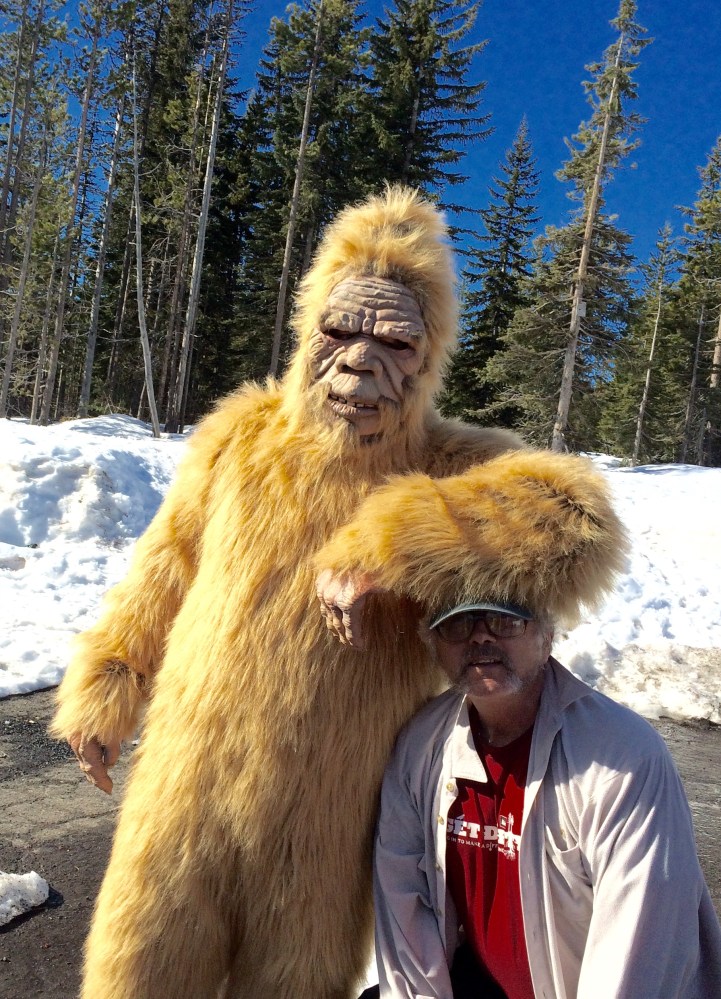
(Image provided by Mr. Hawley. He is assumed to be the shorter fellow)
he-man, all-too he-man, by Geraint Jonathan

(We are blessed with another new item for this month–three actually by Geraint Jonathan. The first appears today, the second tomorrow and the third next week–Leila)

i said to her i said

unhesitating obedience is all i ask

taking what i say as gospel

hanging on to my every syllable

is all that’s required

apart from that

you’re free to do as i tell you i said

my good books are easy to be in

it’s wordy there for sure

but listen is an anagram of silent

& your silence is the best i’ve heard yet

& if you think that’s a riddle think again

that’s what i said i couldn’t’ve been clearer

but did she listen not a bit of it

so off i went

you’ve a vengeful nature she said

out of nowhere just like that

vengeful nature now is it i said

we’ll fucking see about that

Whatever happened to solidarity by Michael Bloor

(Note–Not everything this month before we go public is a rerun; and today we bring you a fresh one by our friend, Michael Bloor–LA)

Andy and Davie were on their usual walk, along the banks of the Allanwater as far as the wooden footbridge, and then back again. They were discussing Scotland’s nail-biting victory last week over the Danes, sending the Scots to the World Cup Finals for the first time since 1998. Andy was English and had little interest in football, but he’d been deeply impressed by the tremendous, spontaneous upwelling of joy across the entire Scottish nation that the game had caused. Davie was trying to explain that it wasn’t just about the result, but the circumstances – the manner of the win. Three of the four goals were truly things of beauty. The match took place at Glasgow’s Hampden Park in front of a delirious home crowd, screened live and free-to-view in every home and every pub. It followed years and years of failure to qualify – some of the present team being unborn at the time Scotland had last qualified.

Andy nodded good-humouredly, but Davie could tell that he hadn’t yet got his point across. He tried again:

‘I was ten when I first started going to the football. In ‘The Boys Enclosure’ (admission: 9 pence – 5p. in new money). It was always packed solid, but you were always among friends, you roared, you booed, you sang, and when they scored you all swept forward like a mighty wave. Like I said, I was ten, and for the first time I felt a part of a whole. That was what Scotland felt when that lovely fourth goal hit the net in the last minute of extra time: it felt that we were part of a whole. It was a feeling of solidarity.’

‘OK, yeah, I’ve got it now, Davie. Solidarity: maybe I didn’t recognise it ’til you said it. Solidarity eh? I thought that had disappeared back in 1985.’

‘1985?? Ah, you mean Polmaise?’

[Polmaise Colliery, or the remains of it, lay just nine miles away. All through the year-long miners’ strike in 1984-85, the Polmaise miners never posted pickets at the mine gates to try to deter fellow miners from returning to work: they didn’t need to. They knew that Polmaise miners were all, to a man, solidly behind the strike. Polmaise was famous: they’d previously struck for 10 whole months back in 1938; they’d already been out on strike for a fortnight in 1984, before the national miners’ strike was declared. When the national strike was broken, a whole year later, and the union voted for a return to work, Polmaise, alone, stayed out for a further week.]

‘Yeah, I mean Polmaise. That was solidarity, Davie. I was there, you know, with the whole village at the gates to applaud the lads coming off the last shift, when the Thatcher government closed the pit two years later.’

‘Good for you, Andy. I understand: that was solidarity. So, instead, what would you call our nation of leaping hearts when the ref blew the final whistle at Hampden Park the other night?’

‘Maybe Communion? A transcendent thing, shared and remembered. ‘

‘Ah, like Archie Gemmill’s solo goal against the Dutch in the World Cup Finals in Argentina in 1978?’

‘Ha, if you like.’

‘OK, I’ll settle for communion over solidarity. By the way, do you know what William McIlvanney, your favourite Scots author, did when he got the publisher’s advance for his first novel?’

‘Beats me, Davie.’

‘He jacked in his teaching job in Kilmarnock and headed off to watch Scotland and Archie Gemmill in the 1978 World Cup Finals in Argentina.’

Andy smiled, but he was absorbed in watching a Dipper fossicking in the Allanwater shallows over at the opposite bank. Part of the attraction of Dippers is that, like Puffins, they are both comical in appearance and surprisingly successful in their daily tasks. Dippers are about the same size as a thrush, but black and definitely portly in appearance, with a big white bib under their chin. They are called ‘Dippers’ because they constantly bow and nod their heads up and down, like manic Victorian butlers. Yet these clown-like birds are surprisingly swift underwater swimmers and efficient finders of caddisfly larvae on the bottoms of rivers, lochs and burns.

Davie followed Andy’s gaze. ‘That Dipper looks perfectly happy on his own over there. Maybe we don’t really need communion with others?’

‘Ah, but he’s in communion with Nature.’

Nora in Five Acts by Leila Allison

Act One

Nora Lynn Manning was born in Tulsa, Oklahoma on 6 December 1941. Her parents, Arlene and Jay, were high school sweethearts who realized too late that they did not like each other all that much. Still, they chose to marry before Arlene began to show. Like so many hideously bad ideas, it was considered the “right thing” to do.

For Americans not named Jay Manning, the Japanese attack on Pearl Harbor, one day after Nora’s birth, was an infamous event. But those Americans hadn’t spent the last six months working nights at a gas station and arguing constantly with a perpetually petulant pregnant wife in a crappy apartment near the stockyards by day; the experience exposed a hitherto unknown silver lining in the prospect of going to war. So, Jay took advantage of his family being at the hospital and enlisted in the Army on the 8th. Then he promptly died in a bus crash on his way to Basic Training two days after Christmas (he was the only fatality in the accident). Some people are like that; they simply don’t have the wherewithal to outlast the second paragraph. It’s why God invented bus crashes.

Jay’s death did not weigh heavily on Arlene; oh, it made her sad, but she was grateful that her lack of tears was explained by “shock.” She thought she was enduring it all very well. But a reaction to her lack of a “proper” reaction germinated in her mind. A tremendous guilt took, like cancer. And from the tumor, insistent little voices, barely audible at first, rose in pitch and questioned her humanity.

But before the voices shouted down rational thinking, there was reality and an infant to deal with. Even after her mind turned on her, Arlene had sticktoitiveness. She moved in with her folks and got a Rosie the Riveter type of job. She also took stenography courses in the evening with an eye on earning a living once the war ended and the men returned. Arlene had all kinds of big plans. But in late 1944, she began to do odd things, such as stealing pepper shakers from restaurants. And then you’d catch her behaving like someone persecuted by invisible insects, which is a fair comparison to the swarms of voices that filled her mind. Two months after VJ day Arlene took a dive off Steel Bridge into an empty gulch. Along with some seventy odd pepper shakers was a two word suicide note: “I’m sorry.” They were two more children murdered by doing the right thing.

Not quite four when Arlene died, Nora had only mental snapshots of her mother; all in black and white. But for a few years she had a happy childhood living with her maternal grandparents, Ethel and Tom Anderson. (Her father’s parents, the Mannings, kept their distance; word was they somehow blamed Nora for their son’s death; a sort of sin she had inherited from Arlene. Fortunately for us, they had moved to Kansas and rate no further mention on account of being assholes.)

The only problem with the Andersons was a consumption pyramid composed almost entirely of lard fried foods, Pabst Blue Ribbon and Raleigh cigarettes (they collected the coupons, which was something that Nora did later as an adult). But they loved her and perhaps the only good times Nora had in life were in their care. But Tom dropped dead from a heart attack at fifty-three when Nora was nine and Ethel suffered a stroke the next summer; it didn’t kill her (she’d beat on for another six years), but disabled her to the degree that she spent the rest of her life in the care of an older sister, who had no room for a child. This resulted in Foster Care because no other relative came forward to claim Nora.

Maybe it is unkind to disparage the institution of Foster Care, after all the next Marilyn Monroe has to come from somewhere. But there was once a time when fostering was how some people augmented their income. They would bring in as many kids as possible and collect cash every month from the state for each one and use as little as possible on the children. Nora spent five and a half years working as a slave on a farm, ostensibly “raised” by the Ollsens (who never had fewer than six Foster kids). “That’s Ollsen with two L’s”–was what Delores Ollsen told everyone, like it was something special. “That’s Cow Cooze, with three O’s” was Nora’s estimation of Mrs Ollsen, a pushy loudmouth who often took her pick of stuff that had been sent to the children. Mr. Ollsen hardly ever spoke and Nora believed (correctly) that he saw no difference between children and livestock.

There are some seriously fucked up kids in foster homes, and the Ollsens sure knew how to pick em. They had one named Royce, who was a year older than Nora. He attacked and raped her when she was thirteen, while she was alone in the barn, feeding the Ollsen’s horse Topper. After it was over, Royce told her to keep her mouth shut, or he’d kill her. That woke something very dark and cold in Nora. She arranged to be alone in the barn again a few days later and made sure Royce saw her enter with Topper’s treat bag. Royce took the bait and the instant he arrived at Topper’s stall she whirled and blasted him in the head with a horseshoe she had stashed in her coveralls. One shot was all Nora needed.

Royce lay there, unconscious, bleeding like hell; she enjoyed seeing that. Although she was slightly disappointed to see Royce still breathing, she figured that maybe some good could come from that down the line. As planned, Nora fled the barn, and after making double-certain no one was around, she dropped the bloody horseshoe down the well. She then made herself feel the filthy shame and pain that being raped had caused so she could whip up some tears to shed when she ran crying into the house and told the Ollsens that Topper had kicked Royce in the head (no way Topper would be in danger; they liked him better than the kids; probably checked to make certain he hadn’t chipped a hoof first).

Upon the conclusion of her perfectly executed plan, Nora ran into the pasture and began to laugh and laugh until she nearly peed. She made certain that she memorized every detail of her victory, the angle of the sun, the breeze in her hair, all of it. Nora knew it was destined to be one of the happiest, most important moments in her life; a definer that would forever separate her from the weak.

Royce didn’t regain consciousness for twelve hours, and he was never quite the same after that. He could still work but he’d acquired a stammer and one side of his face appeared to be lower than the other. Nora didn’t give a shit if he told, but figured he wouldn’t, all things considered. Anyway, he said he couldn’t remember. Maybe so, but he sure gave Nora a wide berth after that. Every now and again at the supper table she’d gaze at him until he finally looked up. She’d smile, wink and mouth “whammo” then spear something off his plate, whether she wanted it or not, because it was his cost for breathing.

Act Two

Nora had common sense, but she was not strongly educated. She could read and write (most of that won while still with the Andersons), but was never allowed much time to do homework (the Ollsens grudgingly sent the kids to school because it was one of the very few foster parent requirements). Nora was able to see herself objectively. She understood that she was pretty and clever enough to do a whole lot better than the Ollsen’s farm, thus she began planning to get away from them and the dusty state of Oklahoma (which had hardly been good to her) long before she reached her majority. Running away was no good without someplace to run to. Marriage, however, would be the quickest ticket.

She found a nice enough, cute enough fella named Joe Hazzard working at the neighbor’s farm. After a few months of one way, insincere yet convincing wooing on her part, Nora eloped with Joe on 7 December 1957, the day after her sixteenth birthday.

At that time sixteen was a legal marrying age, as long as you had permission of your guardian. The Ollsens eagerly gave their blessing because, well, they had become a little afraid of Nora. Although nothing could be proven, they eventually suspected her involvement in the Royce affair. It didn’t seem coincidental that the girl’s confidence and cheerfulness should have grown vastly immediately after the boy’s downfall. Moreover, there was something about Nora that made her uneasy to be around. You couldn’t threaten her with a damn thing because of a queer light in her eyes that dared you to try; and if you dared ask her about anything, she’d just smile and wink, all disturbing like. Always smiling; always winking. Since they weren’t any further evolved than livestock, the Ollsen’s smelled danger on Nora, so they let her go. Besides, Foster kids could be had by the gross.

Nora didn’t love Joe Hazzard because she did not believe in love. But, again, he was cute and nice enough, and provided her with a cool sounding last name. She was not going to be all in for anything for the long haul. Ever since she could remember Nora knew she would die young. The certainty was always with her; it never scared her and in times of pain it was a comfort. Instead of waiting for the other horseshoe to drop, so to speak, Mrs. Nora Hazzard meant to grab as much life as she could.

Nora figured she’d have to put two years into the marriage before she could run away. Age eighteen was a magicland in her mind, tantalizingly out of reach. Until then, history tried to repeat itself; Joe took a job at an all night gas station in Norman, Kansas, where they settled because his car couldn’t go an inch farther; Nora got an assembly line job at a textile plant. But instead of stupidly “catching pregnant” Nora insisted on birth control (later in her brief life she became a firm advocate of the pill, which was not yet available in the late fifties). She gave Joe a “Free Pass” as long as he “suited up.” The last thing she wanted was a permanent connection with anyone, living or unborn.

Then Nora’s stars shone kindly, if only in the sky just once. Grandma Anderson passed when Nora was seventeen. A registered letter from an insurance company contained a check for five thousand dollars. Somehow the loot had passed through many hands that would have snatched it, but there it was. All hers. Nora was dumbfounded and grateful that the mailman hadn’t come when Joe was home. A new plan was hatched; Nora was extremely quick to adapt.

A few days later Joe came home and found that Nora had left him a goodbye letter, a thousand dollar passbook account in his name and her wedding ring. The letter was nearly as terse as her mother’s suicide note, but the message was clear: “It’s been a hoot, hon–but forever is an awful long time to spend together.” Joe knew that this day would come and didn’t look too hard for his wife. Besides, he too had found her a tad uneasy to be around.

Nora recalled the advice some dead guy gave people about heading west and figured it was as good a plan as any. After spending five hundred dollars on a solid used car and twenty on a necklace with a horseshoe charm on it that she just had to have, Nora headed west in a rambling Route 66 sort of way.

Act Three

Nora fell in love for the only time in her life in 1960, at Charleston, Washington. She had run out of west to explore due to the Pacific Ocean getting in the way. She tried Canada, but they wanted to know too much about her, so she turned south at the border and headed toward the Puget Sound that she had found to be like an enchanted fairyland, compared to Oklahoma.

Anyway, the state of Washington was a good enough place to stop; the car was used up and she was down to her last fifty bucks– earned from picking fruit in Oregon. Nora didn’t know if she was still married to Joe or not–she neither took action nor was served because she was pretty tough to find–so, she figured she probably was. But it came in handy when she wanted it to. When folks got too nosey Nora told them her husband got killed in a bus wreck in Bum-fucked Egypt while serving in the Army. But few people got nosey with Nora, because of the uneasiness she could create at will.

She sold the car to a junk dealer for twenty five bucks, took a room in a converted great house that had fallen on hard times and won a job working at a hardware store all in one day. She met a young woman who worked at the store and who also lived downstairs in the same building. A fellow sinner, one just as capable of creating unease: her name was Kaaren.

“Why two a’s?” Nora asked, thinking about Mrs. Ollsen, while they were seated in the nearby White Pig tavern. Neither were of drinking age, but pretty young women always attracted male customers, so any pretty gal who looked close enough to twenty-one was welcome.

Kaaren smiled and struck a match on the bar top. She lit a cigarette and leaned close and whispered, “Cos I fucking say so–wanna make something of it?” Then she playfully reached out and tapped the horseshoe charm on Nora’s necklace. “This means something, right?”

“Maybe.”

“Sure it does–you wear it everyday. Nobody wears the same nothing necklace everyday unless she’s a nun.” Kaaren was raised a ward of the Catholic church and openly shared her opinions on the subject of nuns.

And for the first time, Nora told the Royce story. No tears, all laughter. She never once considered telling Joe, but she knew that Kaaren would understand. She knew that there would be that right person to tell it to someday. Someone who’d understand with humor and a singular insolence that you find only in the one right person for you.

“Good thing Mr. Ed wasn’t there–the fucker would have ratted–”

The bartender brought two glasses of wine that they hadn’t ordered.

“What’s this about, Earl?”

“Guys at the second table–like you don’t know…Sure’d be nice if you’d hit the goddamn ashtray once in a while.”

Kaaren stood, raised her glass to the guys and whinnied like a horse. Then without looking away Kaaren poured her wine into the bar towel bucket, much to Earl’s annoyance.

Nora laughed and followed suit. Yes, she thought, I told the right person.

Act Four

We have arrived at the part of Nora’s story that some of you will not like much. But we should hope that there will be people who won’t like what happens to us, after the good parts have been told, when our stories reach the mandatory “The End.”

Nothing much happened to Nora after discovering love, except for a life that contained more humor than pain. How does one properly convey the passage of fourteen years with words? Which symbols does one use to make the connection? Imagine seeing snow for the first time at twenty-one. Think about five hour laughter filled all-night conversations at formica tables in avocado kitchens. Imagine speeding across the sky when it was still possible to live forever and plenty of time to hold onto foolish dreams that you know will fall apart upon touch. Maybe those images are good enough to know the second half of Nora’s story.

Then came the day when something inside her—something that perhaps wanted to avoid the shabby years of analysis and regret–threw a switch that released bad, hungry cells, which multiplied swiftly and created something that was too late to do anything about when the doctor finally let the light in.

Act Five

The fact that death comes for everyone is the only thing fair about it. When death comes suddenly from a poor decision on the freeway, it can be viewed as merciful; when it lingers in white hospital halls, indifferent to the task, then death is an unfair, lazy, cruel bastard. A life may be lived low, but death shouldn’t slouch. Nor does it compare with a cat. A cat follows her nature, death has choices.

And so it was for Nora, who lay dying of uterine cancer at thirty-three. She figured that death had to be a guy. She named him Roy.

“Roy’s coming tonight,” Nora said to Kaaren. It had been hours since she had last spoken. But Kaaren knew she’d come back because saying “No” to an enema shouldn’t be a person’s last words.

“Hi there,” Kaaren said.

“How am I looking?”

“Like Peter Cushing.”

Nora smiled. That’s what she loved about Kaaren. “Fuck you.”

Those were her last words; much better, poetic, thought Kaaren.

After it was over, Kaaren fastened the horseshoe necklace around her friend’s neck. Nora had given it to her when Roy became a sure thing.

“I can’t keep this. Show God your medal.”