Artist of the Western Plains by Dale Williams Barrigar

Mystery Writer

Mystery surrounds us, we live now in an eternal mystery, mystery here is endless, mystery is our meat and drink, the air we breathe, the ether we swim in – and yet it’s so easy to forget this simple fact, so terribly, horribly easy to forget it and become bored with it all. And perhaps that is the greatest sin of all.

REAL ART is not about scoring points with your teacher, setting yourself up with a fancy career, making lots of money, building yourself a comfy nest egg in academia with all your like-minded friends, nor even (predominantly) about getting yourself legitimately famous, now or later.

It’s about connecting, or reconnecting, ourselves with THE MYSTERY.

When we walk in mystery, we’re never bored. James Joyce’s epiphanies, William Wordsworth’s “spots of time,” the revelations in The Book of Revelations are all about reminding us that the world is not about “getting and spending,” as Wordsworth put it.

They asked him to tell them the ultimate truth. Buddha showed up with a single flower, said nothing, and sat there holding it out toward them for a long, long time – before he vanished in front of their eyes.

Artist of the Western Plains

“I can conceive that this is the essence, of which all other poetry is the dilution.”

– Virginia Woolf

Alone she was

Most of the time,

Hiking and sketching

With many-colored

Pencils and pens

On empty

Western deserts

And plains, under cold

Battlefield hillsides,

Searching for

Something

Spiritual.

Maybe a single, bent

Evergreen tree, three feet

Tall

And dark, on the ridge

Top.

Fully living.

Fully alive!

All alone. All by

Itself, but also with

Its friends:

The ground,

The wind,

The elk

Shadows in

The distance.

Dale Williams Barrigar, MFA, PhD, is a visual artist and poet from the midwestern USA who likes to spend lots of time contemplating the real relations between true religion and art-making. To the busybody world at large, it can sometimes sadly appear as if he’s doing nothing but lounging on the couch or in the grass with a vacant look in his eyes. Not so!
Deliberately: Dale Williams Barrigar

(Note: through Saturday, DWB will entertain us with his Christina Poems. I think you will find them as wonderful as I and The Moving Hoof do-Leila)

(Image provided by DWB)

Deliberately

One thing I can say for sure about the following poem below, everything in it is on purpose, including the line lengths and the capital letters. I lived with the character in this poem, named Christina, who appeared to me in a daydream, for a long time until one day in a field by a river in the wilds of northern Michigan most of the lines suddenly occurred to me.

The year was 2014 and I didn’t even own a cell phone yet – on purpose. My paper and pens were all back in the car, a couple of miles away somewhere down the trail.

So I walked back down the trail humming these lines in my head so they wouldn’t disappear, or rather the lines were as if humming themselves in my head, and they stayed there, they didn’t go away, they didn’t vanish into thin air by the time I’d made it to the car – that was how I knew this poem deserved to get written down.

The list of poets who influenced this poem is long, but a few of the key names include Wallace Stevens, William Carlos Williams, T.S. Eliot, Langston Hughes, Robert Frost, Jim Harrison, and Charles Bukowski. I’ll stop there for now because 7 is a magic number. There are four more poems about Christina.

And I would like to say to her here: “Christina. I still see you in my dreams.”

Road Warrior Christina

“I’m a road warrior for the Lords of Karma.”

– Hunter S. Thompson

“My life is like a broken bowl.”

– Christina Rossetti

Christina, at nineteen

In 1991, A.D.,

Was a lone,

Young-hearted

Poet

Who didn’t know

It,

But her fast, moving

Feet showed it, also her

Wild, red-brown,

Messy-long, cut-by-her-ex-boyfriend

Hair, not her boyfriend exactly but her

Boy

Friend, one of

The few.

And now she was

Traveling

Solo,

Traveling far, in her

Battered little car,

Dusty

Sandals

On her feet,

Cut-off jeans shorts,

Baggy T-shirts, sometimes

Black lipstick on,

Red polish on

Her toenails, and her

Heart, and her

Art, they were

Partially

Guided by

Geronimo’s kind

Native star in her

Driving blood

Commemorative:

Her hair, her

Heart, her

Art.

Geronimo, medicine man

Of the Christ

Without end, she wrote,

While driving

On the highway,

On the back

Of an envelope

With a red,

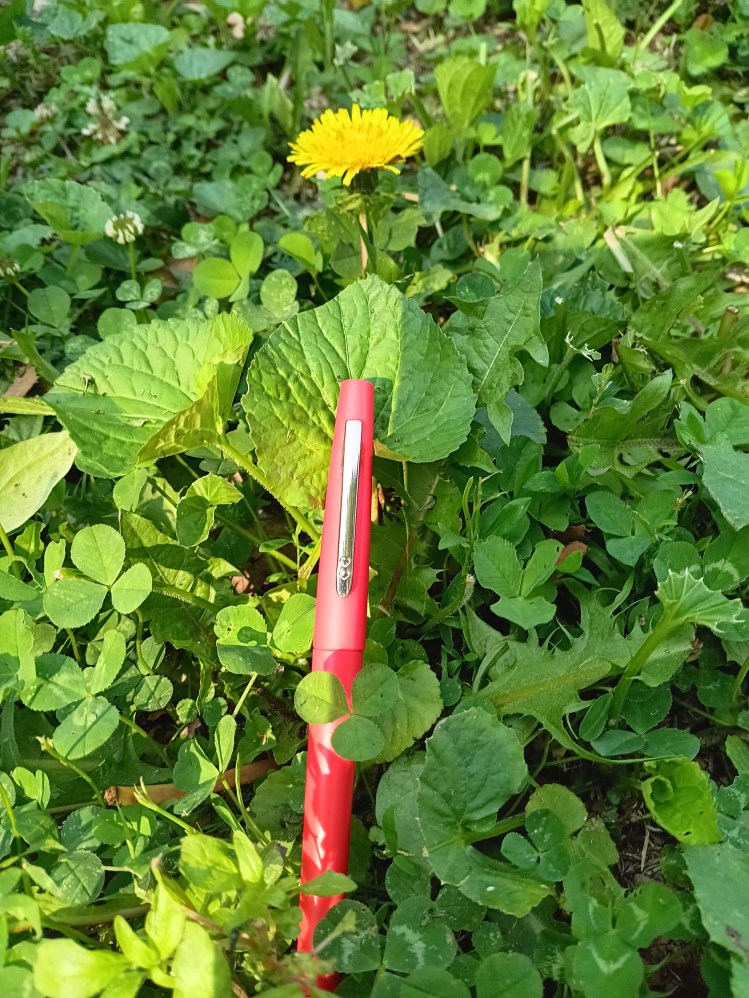
Red pen.

(To be continued…)

Dale Williams Barrigar is an American wanderer who sometimes calls himself The Drifter.

Saragun Verse: Moonfog Madrone and The Sun

i

Moonfog Madrone stared at the Sun.

And the Sun gazed upon he.

“Tell me star, away so far,

What can you do for me?”

ii

And the Sun said: “I can boil the rivers and blast the land;

I can melt the peaks and glass the sand.”

Moofog laughed, “I’ve seen it before and will again.

No my friend, what’s in it for me?”

iii

And the Sun said: “Whatever god made you won’t allow you to die;

You go on forever and will even outlast me, I expect.

The perfect candidate to mock eternity:

An arrogance never to know the mercy of death.”

iv

The Sun fell below the distant range

And Moonfog laughed throughout the night

“He’s a poor old fool cursed to rule,

A toss of rocks for his own spite.”

Ode To Forage by The Moving Hoof

*

You ask why I love alfalfa and hay,

Apples, celery, barley and salt lick;

Peas, carrots and the darling legumes of May

But ne’er nasty corn dogs on a stick

*

I’ve heard all the rumors about my breed

We eat tin cans and other vile stuff

Let me set you straight our food is from seed

As you are what you eat, talking cheese puff

*

Bean sprouts singly sing a beckoning song

But not for humans who store them dumbly

We Goats wonder how you get them so wrong

E coli from shoots? the heart beats glumly

*

My fey sonnet began with a question

The answer is natural selection

The Character Here by Dale Barrigar Williams

(Druid Girl Image, provided by DWB)

The Character Here

The main character in the following lyric cry goes barefoot most of the time, wears animal skins when he wears anything, carries a spear, wears an amulet around his neck that protects from evil spirits which he knows often, but not always, come from other people, and has never shaved, although he has cut off his beard and hair when they get too long so they don’t get in his way; he also takes magic mushrooms, walks for days on a regular basis, hangs around the fire a lot, also spends a lot of time alone, sees visions, makes cave paintings he never looks at again, or sometimes returns to as if to an old friend for days on end; and in this poem, is inventing, or elaborating, human language, while also simultaneously developing the gift of human mercy which Jesus himself, and his mother Mary, would bring to perfection many thousands of years into the future from where this character is perching in this poem – right now.

Alone at Blue Rocks on the Shoreline

Prehistoric Man/kind perches on the cusp of a decision, and speaks.

The rocks here at shoreline are blue.

Blue like the water and sky.

Blue like the blue bird and the big ice.

And they rise half as high as the ice, as the big ice.

The rocks here under this sunset tree are red.

Red like her hair, and the sacrificial hare in the sun, in the trap, twitching.

(LET IT GO.)

Your costume only becomes you

and your uniform once you

wholly own it somehow

after long tries

and once you wholly own it you’ll

uniformly know and your uniform

costume will simply become a way

of knowing and a way of knowing more

about what you already know you know

but aren’t always so sure about, in this land

of the wooly mammoth having you for breakfast

on his horns

and the saber-toothed tiger around

every

bushy

turn.

So the hare, let it go, LET IT GO.

The hare released.

Look at him go!

He flies because I

have chosen

not to sacrifice.

Dr. Dale Williams Barrigar is an impoverished poet-scholar from the Midwestern USA who learned much of what he knows about primordial humankind by reading and pondering the works of Sigmund Freud, Carl Jung, William Butler Yeats, William Wordsworth, William Blake and William Shakespeare, as well as lots of intuition, imagination, and experience thrown into the balance. Experience alone is never enough, and neither is reading; they have to be combined.

The Continuing Rubaiyat of Saragun Springs by The Moving Hoof (translated by Leila Allison)

(Note–Daisy has acquired a Penname. As you have guessed it is “The Moving Hoof.” She is now, as she just informed me, Dame Daisy Cloverleaf-Kloverleaf, the Goatess of GOAT and The Moving Hoof. A gallon of vodka weighs more than The Moving Hoof yet it contains only half as many delusions–LA)

i

Buckfast Geeply Geep is my half brother

Same Goat father, a Sheeply Sheep mother

You can usually find him at the track

Wagering hobnobs on a good mudder

ii

Hobknobs are the coin of the multiverse

They have value everywhere but earth

Whereas the billions of Musty Musk

Wouldn’t rate a spoonful of Saragun dirt

iii

Buckfast loves to bet on the Peonies

Racing flowers raised by Magic Donkeys

On quick moving blooms they rush gate to gate

Encouraged by sweet Butterfly jockeys

iv

Being a Geep is a million to few

Ram and Nanny or Billy and Ewely Ewe

Not Bob and Carol nor Ted and Alice

Will land their offspring at the petting zoo

The Continuing Rubaiyat of Saragun Springs by The Moving Hoof (translated by Leila)

i

When Big Ed the Woodpecker is glum

He beats the chimney cap like a drum

Our boy suffers from small bird syndrome

He longs to be King of the scrumly scrum

ii

Big Ed envies the mighty Eagles

They don’t put up with Seagulls

It’s Bang! Zoom! Straight to the Moon!

For the selfish Me-Gulls

iii

Big Ed is in love deep and fancy

A whippoorwill has got him romancy

Her name is McGill, she calls herself Lil

But everyone knows her as Nancy

iv

The Moving Hoof has heard from Rocky Raccoon

He has promised lawyers, many and soon

She laughs and scoffly scoffs as she tells him

He may go and suck by the banks of his own saloon

Transformed by Dale Williams Barrigar

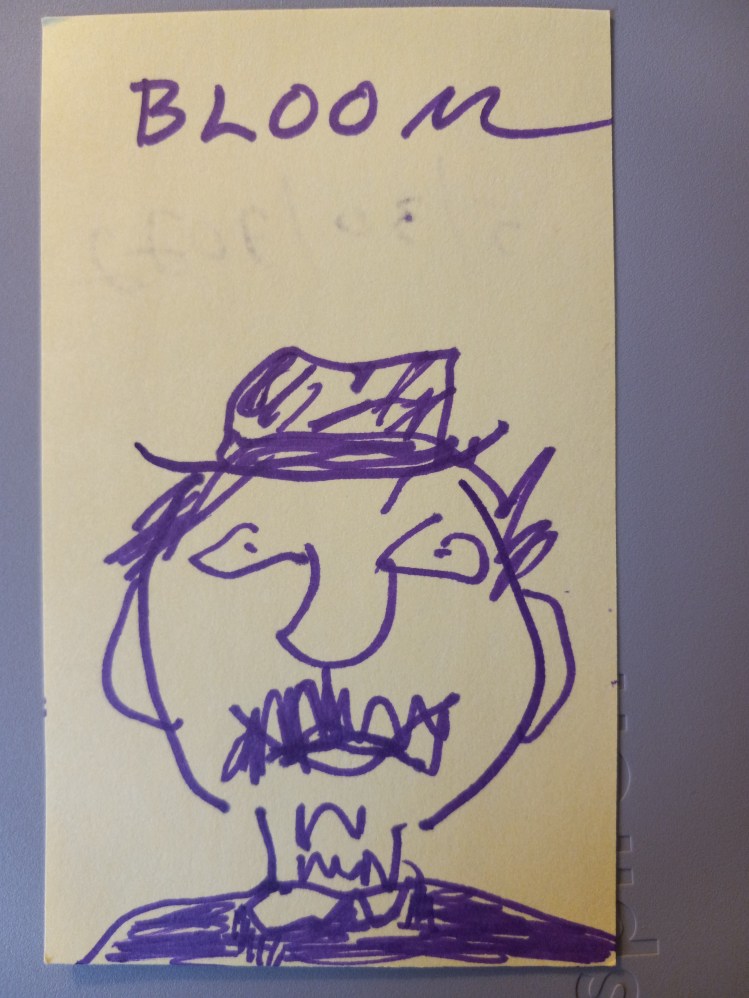
(Leopold Bloom at U., original drawing by DWB)

Transformed

Moments of transformation have been the stuff of literature ever since there was literature, and even before there was what we call literature, only the raw materials of literature (language, experience, and imagination) being shared around the campfire, and probably, at a deep, internal, and shared level, even before there were campfires.

This small offering with three titles (below) is my contribution to the language and literature of transformation, not that I haven’t tried it before and won’t try it again, too.

But here I think I managed to capture it pretty good.

I don’t know where the Muse comes from for any of us. But I do know that muses do exist, with both capital and small M’s; and I do know too that poetry itself is the original art, the biggest art, the most common art, the rarest art, the simplest art, the deepest art, the widest-ranging art, the hardest art, the easiest art, the most neglected art, the longest-lasting art, the poorest-paying art, the purest art (in its purest forms), and the most relatable art, for everyone, of all.

Everyone’s last words are poetry. So are their first ones. Harold Bloom rightly called Jesus the poetry of America. Miguel de Cervantes used to stalk through the streets of whatever city he lived in at the time, searching for words, looking for poetry.

In the last few decades of his life, Pablo Picasso started pumping out a LOT of poetry, and went so far as to go around telling everyone he knew that he wasn’t really a painter, he was a poet, and that thousands of years from now, no one would even remember his paintings and drawings – but they would remember his poetry.

I have absolutely no idea whether that is true or not.

All I know is that Pablo was a genius on the level of Einstein, or probably higher – and he said it.

Everyone else can turn into a machine if they want to.

I’m gonna remain human.

Signed,

The Drifter

Poetry The Teacher, Or:

New Knowledge, Or:

The Invisible Blue Butterfly Forever

I was walking

around in their house

trying to clean

my pipe

with a broken coat hanger

when it happened

and I literally

dropped my pipe and

the coat hanger and

stopped in my tracks, yes,

as if I’d seen

a ghost. Next, I felt

nailed to the spot, as if

my feet had been

nailed into the floor

and my hands

had been

nailed into the air

but almost without

physical pain, I was

looking, staring into

the distance with

wild and rapt

eyes. I was, as so

often lately, alone,

but I was also not

alone as the hosts, the

ghosts of all the poets

who’d ever come before

me were humming

through my blood

and before my eyes –

only for

an instant.

When I say

all the poets,” I also

intend the oral poets

who’d written in air,

for our ears, hearts,

and souls,

for thousands

and thousands

or more

years before

“literacy” began –

the anonymous ones

who weren’t anonymous

at the time, not to

themselves

anyway

and what else

matters

in the end

or even the

beginning or

the middle,

really,

truly.

A life-changing

instant; a one-of-a-kind

moment. I had no

idea

in this spot of time

where that

had come from;

way too sudden.

One instant this,

the next instant

something else

entirely, forever, no matter

what; like a mermaid’s snap

of her magic fingers or a giant

monster of beauty

shaking a rag doll

in sadness and gladness.

Instantaneously

turning

from caterpillar into blue,

if invisible,

butterfly. Without even

knowing

you’d been

a caterpillar in

the first place!

The invisible blue

butterfly now, no matter how

impossible

it sounded.

I took up

the pen

which had as if

magically appeared there

for me

and the paper

and slowly wrote down

the first

Word.

The Drifter ((otherwise known as Dale Williams Barrigar)) drifts from here to there while always maintaining a center that is always centered upon The Arts, with the oldest of Arts at the center – usually.

The Continuing Rubaiyat of Saragun Springs by Dame Daisy Kloverleaf (translated by Leila)

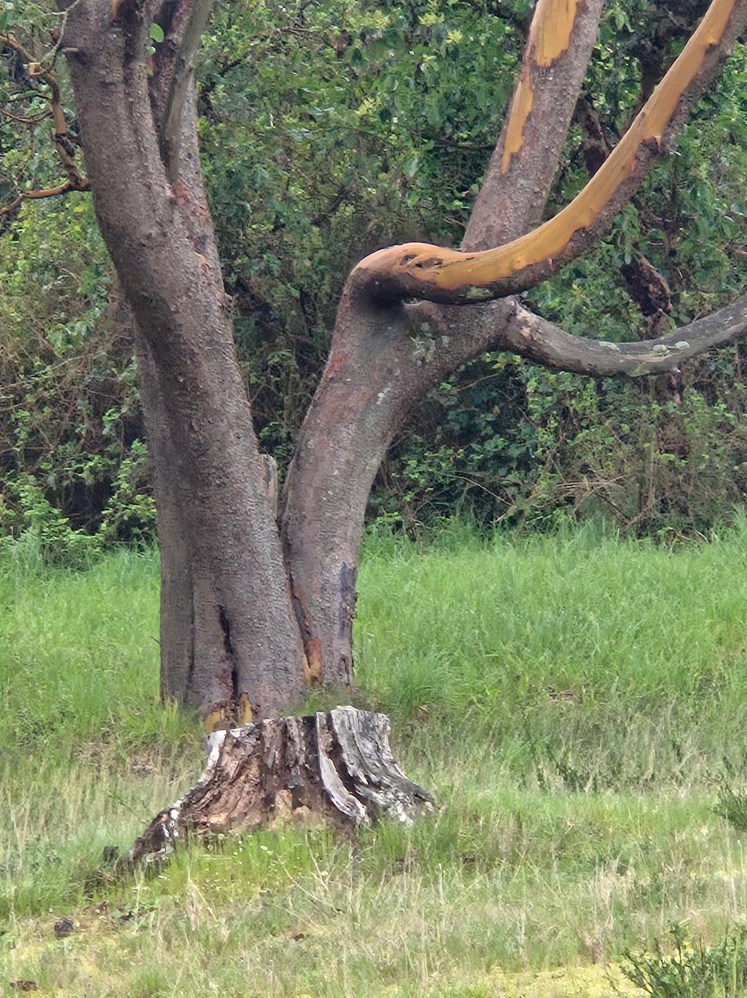
(image has nothing to do with the post–just fond of the subject)

i

My brother Fenwick is a bit hazy

He says weed in the morning keeps him lazy

Stonily stoned from Pongrise to Pongset

Fenwick is a beatnik, not a Daisy

ii

With our half brother Buckfast he goes round

To poetry slams and other jazzy grounds

Where work is the most discouraging word

You can hear hooves clapping out happy sounds

iii

And you will see them at the trackly track

Betting on Peonies who have the knack

Racing flowers of incredible high skill

With sweet Butterfly jockeys on their backs

iv

Fi-did-lee Fenwick leads an actors’ life

And Buckfast is as keen to avoid strife

Goat and Geep worshiping Saints Cheech and Chong

Break up this rhyme scheme when they pass the bong