Crime Fiction By Dale Williams Barrigar

Even if you

tell yourself you

don’t want to become a writer,

the truth is

you will have to become a hardboiled romance writer

of a different kind.

(There is more than one kind

of everything).

And what you will have to write

is your own life

(if you want to save

your own soul).

Or think of writing your life

as your own endless film trip

(not strip)

you are making, tragicomic.

Where work is play

and the play is your work

and you are usually more

of an antihero.

And you get to take all the things

you have been handed

by Life.

And create the script, and fall

in love.

And so you nurture it, love it, write it down.

Hide it under your bed

(when you have one), fix it when it

needs fixing.

Know it’s good at heart, in its heart, and keep it

that way.

Let it go.

But don’t ever let the it of it go.

Send it and get it sent

straight back at you

by the greatest editor

ever known

demanding ever more

difficult

and life-enhancing

corrections.

Life of an American Word Scholar: For the Incarcerated Writer, Future, Past and Present By Dale Williams Barrigar

“And I may dine at journey’s end

With Landor and with Donne.”

– William Butler Yeats

1: Now at the end and you know it.

2: Then, you find the stub of old pencil in a pants pocket.

3: And because you looked like a worn-out poet in some lights to a certain lonely soldier, she came on delicate tip-toes and gave you toilet paper, through the bars, with her long, deadly fingers, wearing nothing at all.

4: So now you blow her another kiss and wave her fondly away so you can begin to scrawl with your long, strong, starving hand.

5: Like the black, reaching, screeching, raven-filled tree branches at the shuddering culmination of earth’s last winter’s tale in the occupied village above your mind.

6: “…Not the end,” you write.

7: And you write it again and again.

A Nightly Poet Struggles to Say Goodbye to His Drama Queen Then Says It By Dale Williams Barrigar

Baby, this is not my choosing but I

got to go now and I

cannot be

put by

nor set aside for later.

Lady, I’ve got to go now, I’ve got to run,

I don’t know why or where, really,

and I definitely

do not have any idea

what the new road will be

holding.

But I got to fly

like a fucking arrow back then.

And I’ve got to go now, so I can fly again.

I was allowed to fly, back then, with the Word,

on the back of the laurel

wren, and in only this I cannot be, I will not be

put by.

Sweet Honey-pie, I’ve got to go now but no, I do not know

what you’ll do now

nor how you’ll get by.

I will be undone by all of this I know,

Female Deer, my

Dearest.

Now and far more later too, some day or suddenly.

And the road, it’s too long.

And the price of this midwestern song

is a red wheelbarrow

of sorrow.

Actress please stop

sighing

and don’t start

crying.

And try to remember me

in your prayers.

But not in your dreams of tomorrow

because life is still beautiful

but we

are the fallen sparrow.

Hemingway By Dale Williams Barrigar

(Image provided by DWB)

During the last fifteen

years of my life, when my mind

was mostly in Michigan even though

I wasn’t, I saved

way more small animals from my yard in Cuba

or Idaho than I killed any large ones somewhere

out in a field, whether sea fields or waving grain ones.

And nobody knows it.

I even took a hurt mouse to bed one time for a small spell.

A hurt mouse I found Faulkner the Cat about to kill.

When my wife was out all night making too many bad choices

again.

Took him to bed with me and fed the injured little fellow,

warm milk out of a bottle

drip by drop.

My own bottle there at hand on the nightstand by the Bible,

King Lear, rapier, dagger, tomahawk, paper airplanes,

pencils.

And the mouse got better.

And I, the great Hemingway, never reported any of this to the papers.

But the next day I was up for breakfast and wrestling

with grouchy circus lions down at the pier

to impress them, and got my arm

torn for my troubles

again.

At one point, the mouse sat on my chest

and he looked me right in the eye

almost as if to whisper, “Thank you.”

And he may have whispered

thank you.

I had a Juan Gris painting of a black Latin guitar player

above my bed back then.

In 1946, after she was gone for good,

when I predicted

rock and roll to Paco down here by where

the boat used to be and he,

he agreed with me.

The Dark Lonely Street by Christopher J Ananias

the dark lonely street

accompanies my staggering gait

with its nice little houses

judging me in their wake

The Lord’s steeple rises

I look with a hopeful bleakness

wanting to be a child again

loosed of the drunkard’s curse

greeted by a shadow’s, clink, clink

whipping around a dark cornice

Like the slash of a whip!

wrinkled up mouth, teeth, and no lips

a barking pious creature of contempt

a charging malevolence

ending its disdain in its chain

hating my low whiskey stink

pushed away from the Lord

into the doldrums of drink

I walk toward Jesus or further

draining my dandelion wine

alcohol robbing me

of everything dear

A lackluster career

of dreary consequence

seems to be my creed

a conflicting,

failing need

I hit the bottle like, life

after breadth and reach of town

finally, I make like coming around The Horn

I catch sail

to my mother’s home

to the enablement

of her generosity

I step light as lead

to my childhood’s room and bed

Christopher J Ananias

(Image by CJA)

Bulls by David Henson

They surround you

like mountains their shoulders

flanks like boulders

the way they tighten

your breath

strong as a

built like a

mean as a

balls like a

it’s all true

and too too close

don’t worry

about stepping in

those steaming piles or

the urine-soaked straw

don’t pay any mind

to the afterbirth hanging

from that cow’s

mouth keep your eyes

on those bulls

always remember

you’re not one

of those children

who can toss

their arms around

those nightmare necks

whisper secrets

from the corn

into those twitching ears.

(“Bulls” Originally appeared in Poetry Now (defunct) Issue 38, 1983. Print only. Not available online.)

David Henson

Her Husband Keeps the Swords by David Henson

Everywhere. At breakfast he’s taken one

from behind the bran in the cabinet

then poked holes in her over-easies

from three feet away.

She’s found blades

growing warm balanced

across lampshades; sparkling

like water in the shower stall;

in the dresser drawer, smoother

curves than she’s had for years,

he tells her.

One evening she sliced her toe

sliding between the covers

then dreamed all night

about her dog plunging

under the bed after a rolling ball.

He tells her everyone has to

have a hobby. She gives in

and every day while he’s at work

swallows swords like stiff drinks,

the sound of metal honing her teeth,

her body become a razor edge

which one day will greet him with open arms.

(This poem originally appeared in Pikestaff Forum (defunct), #7, Spring, 1986, print only. Not available online.)

David Henson

Forest Voices by John Davis

No reason the crescent moon

can’t scrape off pond scum

and see its face put on make-up

for its date with coyote,

wander hillsides before howling begins.

No reason at all.

No reason silence can’t

stand on its toes, sing

love songs to the cove that’s

so deep so alone by the shore

so ready for love.

No reason at all.

No reason that wind can’t

find a lover when daylight

has held its breath all night

waiting in a white dress

for a gentleman caller.

No reason at all.

No reason rain can’t explain

its sobriety to the river

that drinks all night never

leaves the party or stops dancing

but craves touch.

No reason at all.

No reason tree can’t lean

against the cold, stretch its limbs

around the ground that wants

to be held when stars

bend their light like violins.

No reason at all.

John Davis

(Image by DWB)

Sandra Again by Corey Mesler

Sandra never said she

loved me, not even the

night she sat on my lap

and we kissed so long

the room grew warm,

nor the night we lay

together and watched

an old western on TV.

When she died she was

my first death. I turned

out to be someone she

might have loved. This

is what I tell myself any

time her ghost appears,

wearing the daisy chain

Sandra forged in life.

Corey Mesler

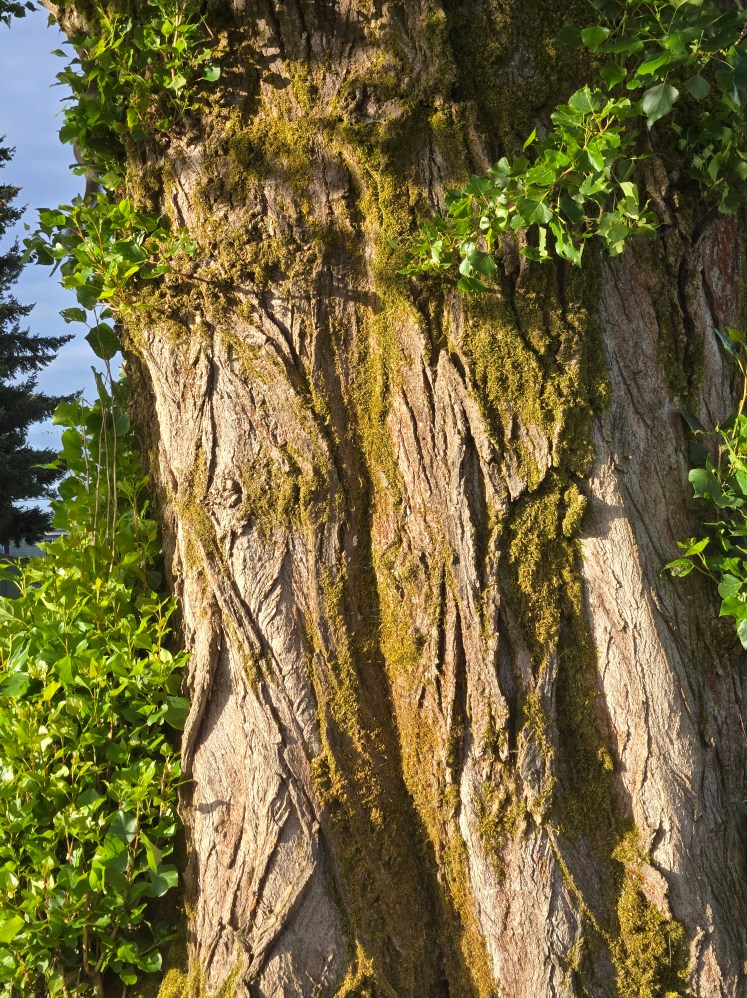
(Image of a pretty tree in Silverdale, Washington)

My Mother’s Last Tongue by Jonathan Chibuike Ukah

My father acquired a million bullet holes,

withered like a sick flower while standing,

struck by a swift lightning in the afternoon.

I asked him why our dog licked his wounds

and spat on his white jacket.

I asked him why the parrot flying overhead

dropped bags of excreta on his forehead

and he wore his shame like a retreating wind

across his shrunken, weathered face.

He went to several wars, including the war

where our village masquerades unveiled a threat

about the looming massacre of our women;

my father was among the few brave men

who carried cassava leaves like the women

and defeated the men bearing a thousand arms.

His alignment with bravery was so deep

that there could be no cleavage for weaknesses.

My father was not breathing; he was not speaking,

though standing was quite a shrill lament.

He stared at me with eyes like stones in a river,

like the sediments of sand in a ray of light,

bloodshot, dead strawberries and dried peaches.

He grabbed a piece of white paper

and scribbled the history of his death;

your mother has a sword under her tongue,

a sharp knife, a blazing blade, a spade

white like the spiked diamonds of alluvia,

when it cuts, it’s deep and raw, that death

cuts off many deserts to arrive on time.

The fish is swimming in a murky meadow

with the fevered flourish of a flushing effect.

It’s the flint of a stone, the cinder and the salt,

scraping the outer surface of my body,

leaving me raw, wet, naked and bony,

in the cravings of the sun or the consumption of air,

in the fire, eating up the dreams of our ancestors.

In the dream, crushing the heart into blackberries,

your mother’s tongue is a caterpillar and a grasshopper

dredging every blood, emptying every intestine

into vessels meant for ghosts and spiders,

where I wear dust and sand as a survival suit.

I was a butterfly buzzing around my father,

thinking of my mother’s tongue every day.

Jonathan Chibuike Ukah

(Image is a of a curious friend who lives in the Illahee Preserve in Kitsap County, Washington, USA)