Saragun Springs Proudly Presents The Sunday Drifter

The Mystery of Wallace Stevens

“Call the roller of big cigars, / The muscular one…”

– Wallace Stevens

The American poet Wallace Stevens converted to Catholicism on his deathbed at 75.

The details are hazy because this was such a private event like everything in Stevens’ life, but it’s known for sure that he was periodically seeing a priest for a few months in the hospital before he passed on, and the priest said he converted at the very end. I don’t trust all priests (far from it) but I have a hard time doubting this one about this.

Because Stevens had been moving in this direction for a long time, too. For most of his life, he’d claimed he had no hard and fast faith in a personal God, and he didn’t attend church in a world where almost everyone did, but his attitude toward life had always been religious.

As religious as it gets, in many ways, in the modern world: the religion of poetry. The Religion of Poetry, the individual’s lyric cry that can be maintained against all odds in the world of modern mass society, the land of robotic humanity.

Stevens was the man who fought Hemingway on the nighttime docks of Key West, Florida, even though he was twenty years older, the man who turned down The New Yorker when they asked to publish some of his poems, the man who also turned down Life Magazine when they asked to publish some of his poems, and the man who refused to be a professor of poetry at Harvard when they offered him the job late in his life. Had he done even one of those things, he would have instantly become exponentially more “famous” than he ever was while he lived. And he knew it.

Because fame is a funny thing.

These days we say that the latest “star” of The Bachelorette tv series is famous. But such manufactured “fame” fades so fast we shouldn’t even call it fame, we should think of another word instead.

Or maybe we should just call real fame, the lasting kind that starts slowly and local and builds over decades and centuries, with peaks and valleys, dips and rises, GLORY.

And Wallace Stevens has his deserved share of glory now, in the American poetry pantheon, a true heir of both Emily Dickinson and Walt Whitman.

Stevens was a kind of Superman. During the day he was a businessman, an insurance lawyer who walked to and from work by himself and closed his door when he got there, a man who never drove a car and lived alone in his own house even though that house was also filled with a wife and daughter he almost never spoke to (until later when he became close with his daughter). At night he spent his late evenings drifting around his own large, fragrant, tree-filled Connecticut yard smoking cigars and drinking. The neighbors would see him there, the only one in the “respectable” neighborhood doing such. What they didn’t know was that he was also busy penning (in his mind) immortal poetry, this physical giant of a man.

It took me twenty-plus years of studying them (off and on) to truly understand Wallace Stevens’ trio of short poems “The Snow Man,” “Tea at the Palaz of Hoon,” and “The Man Whose Pharynx Was Bad.” These works were first published in Chicago’s Poetry Magazine in the early 1920s. They can be understood, sort of, on a first reading, but to truly plumb the depths of these short, vast works, a reader needs to return hundreds of times across a span of years. Harold Bloom convincingly called these three the heart and soul of Stevens’ work as poet and man. Liberation through words has never been so deep and so pungent since the Scriptures were written.

At the end Stevens finally decided (or became convinced) that life doesn’t end when life ends.

Bob Dylan, a Wallace Stevens-like figure in many ways, wrote (and he wasn’t joking), “Death is not the end.”

Walt Whitman wrote, “Death is different from what anyone supposes. / And luckier.”

The Photography of Dale Barrigar Williams (aka, The Drifter) Vol. One

(The header image is a group shot of the Canine stars of this production: Colonel, Bandit and Boo)

Today and tomorrow pictures will be supplying their well known ability to say a thousand words, and then some. These are courtesy of The Drifter today and Christopher J. Ananias tomorrow.

If you are not shy, send us five images and we will be happy to give you a photo shoot day of your own. Standards of legality and good taste apply for those very few among you who need to be told such things–Leila

(Tressa, The Dog Whisperer)

(The Ongoing Legend of Boo and his high end reading materials)

(Sweet Miss Bandit)

(Gallant Colonel)

Dale and family love Dogs, and it shows that the feeling is mutual!

In Memory of 9-11-2001

Today we set aside the usual crash and thud of daily life in the Springs to remember the victims of 9-11, which, incredibly, happened twenty-four years ago today. Both myself and my friend and site co-Editor (no ranks here, we are both co-Editors) Dale have thoughts to share on this occasion. And we certainly invite everyone inclined to do so to contribute their own memories in the comments’ section.

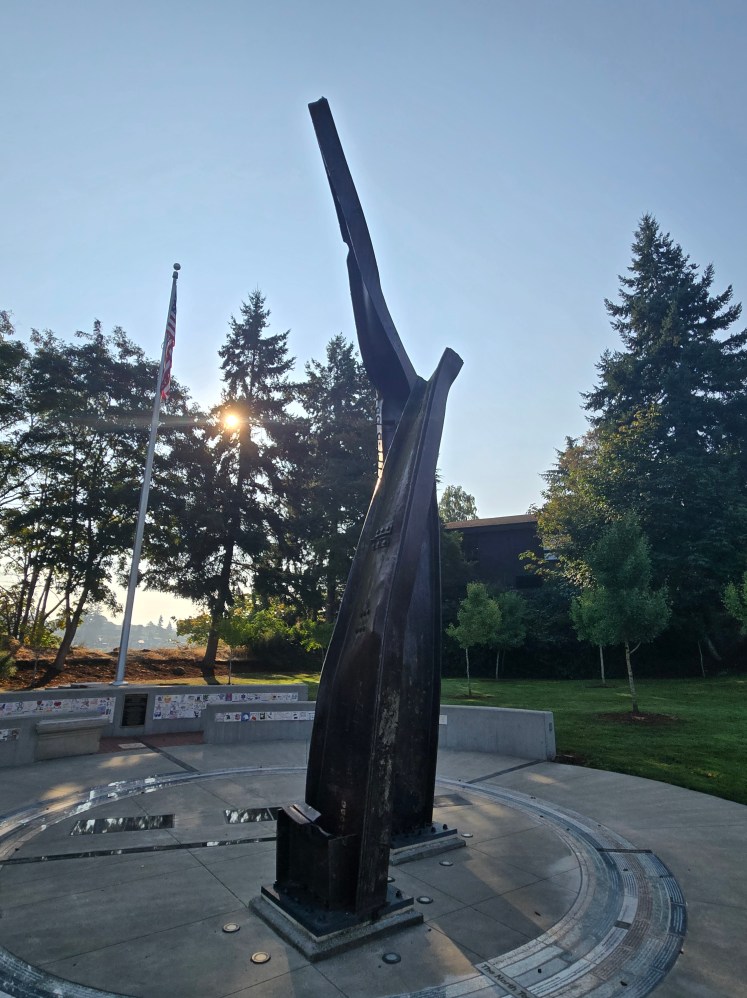
(I took the image at Evergreen Rotary Park in Bremerton, Washington USA on the morning of 10 September. Those are actual pieces of the WTC. Below this article is a picture that stands as proof that there is beauty in the world, if you know where to seek it.)

I happened to be at work for fifteen minutes when reports of the first plane striking the WTC came over the radio. For twenty minutes we, like most others, were hoping that it was an extremely unlucky accident since the sky in New York was as clear and empty as the mind of Paris Hilton, but knew better. Only the very dullest clung to immense false hopes when the second plane struck. In fact there is tape of a somewhat vacuous Fox reporter cautioning people against using the “T-word” after the second plane struck. (One thing that morning did was expose what terrible “journalists” morning show people are–save for Katie Couric, who had news experience. For the most part, it was a relief when the real news people soon took over.)

I also just happened to be working at The Seattle Times. Ha! Not as a reporter, but as the grill cook in the cafeteria (I am, after all, a writer). Still, I was chummy with many of the reporters, therefore I was ahead of the curve information and misinformation wise. I recall the false reports of the “car bomb” in D.C. and a few other falsehoods that slowly withered away as the real events unfolded. Little thisses and thats that still exist on the sound tracks of the day.

People have filled reams and reels about the day. My most vivid in person memory (since I lived and still live three thousand miles from NYC and DC and Pennsylvania) was coming home on the ferry that night and clearly seeing heavily armed military police along the fence at the Puget Sound Naval Shipyard. For a day or two we looked like everyday in Bosnia. And since the tenth anniversary the image in the header (of two pieces of the towers) has stood in a park about a mile from where I type this.

Regardless, I think it is our duty to remember 9-11 and Pearl Harbor and the murders of JFK, Dr. King and RFK as well as the moon landing, the fall of the Berlin Wall and the good things that still sometimes happen in the world. Instead of thinking “Oh, yeah, it’s 9-11” then return to googling Paris Hilton to see what middle age has done to her, it might be better to think about the victims and even send a prayer on their behalf, regardless of your personal feelings about doing such.

Leila

I now give the virtual mic to our friend The Drifter….

 The Song “On That Day” by Leonard Cohen

The song brings me to tears almost every time I revisit it.

This song is just over two minutes long, from Leonard Cohen’s 2004 album Dear Heather, an album that got slammed by many misunderstanding critics when it came out, but which for me is one of Leonard’s best works, something that proved Leonard was still at the very top of his artistic game at the age of 70 and which also presaged his amazing “comeback” that was still in the offing at that point, his epic, immortal late-years world tour of 2008 to 2013. 

(I saw Leonard live at the very beginning of that tour in Chicago in 2008, and again at the very end of that tour in Milwaukee in 2013, without knowing it would be the end. Both shows were equally stunning and one-of-a-kind Leonard.)  

“On That Day” by Leonard Cohen is a work against war.

Within the brief and compressed time frame of just over two minutes, Leonard creates an eternal-seeming, apolitical poem against all war told in his ancient voice, lifted up by angelic background singers, and taken aloft by the sounds of his timeless Wandering Jew’s harp. 

Leonard’s specific motive in creating this song was the memorializing of September 11, 2001, New York City.

9/11 is a scar within us all; even if we think it’s old news by now (and in America that is often the way we do think), we are wrong. Even those of us who weren’t alive at the time have been marked “forever” by that fateful day. 

At the time, a woman I was deeply in love with had recently informed me that we were over “forever” because she was pregnant with another man’s child.

My wife and I (who I also loved) were separated.

Another woman (who I also loved) and I were also separated, by 2,000 miles.

My mother had just been diagnosed with (incurable of course) dementia.

And a novel I’d spent years creating had been bombed out by every single agent and publisher it was sent to, even though it was sent under the recommendation/s of people who knew those agents and/or those publishers personally. (The number was around twenty.)

And then the Towers were taken down.

So for me, my love of women, my love for my mother, and my love for literature, somehow all connected, are connected in my mind, too, to this day.

Memorializing a public event should always have, within ourselves, a private element, a very personal and private element as strong, for us, as the public event itself.

It’s like how it used to be when everyone remembered where they were the day Kennedy was assassinated.

Remembering “where you were” is more than just what your physical location was.

It should also be about where you were mentally, emotionally, and spiritually in your life. 

You don’t need to go anywhere to do this; all you need is to become quiet within yourself wherever you are. 

In In Memoriam A.H.H., Alfred, Lord Tennyson said, “In words, like weeds, I’ll wrap me o’er, / Like coarsest clothes against the cold: / But that large grief which these enfold / Is given in outline and no more.”

(This image of beauty is of my Assistant at the park photo shoot. By name, Puck)

Leila and Dale and Puck

Saragun Verse Falstaff for God

(Today we honor old Fat Jack. The Drifter has kept him in my mind lately, so the old knight rates a poem. In fact I think that I can dedicate this to His High Rotundity as well as the co-Editor of Saragun Springs— LA)

(The Raccoon in the image is named Falstaff; a truly fitting individual)

i

Handmade gods do not laugh

Even when they employ a staff

Of dull scribes, Bob Hope funny,

He who bought bad jokes with Chrysler money

ii

Go through pages and seek jolly sages

And learn good Will penned the man for all ages

Tankards of ale, sack and wassails

Falstaff lives on after all else fails

iii

Prince Hal was a pal till power spread him nebulous

‘Twas crown and church made him lugubrious

Yet Jack kept laughing and blessed the saints of the doomed

Hallo Pistol, Nym, Bardolph, Drifter and Harold, may your keeness for-ever, Bloom

iv

Kings lose their humour when see good

In split heads, spilled guts and land by the rood

Yet Hal neither lived long nor richly

Nor was he guided home by gentle Dame Quickly

Saragun Verse: “That’s How Come”

(Image of the Messianic Squirrel, Manette, WA at sunrise)

i

On the tongues of angels devils dance

The right words are made but not by chance

If the truth and sound should ever meet

We’d hear “it’s cheaper to let them sleep on the street.”

ii

The keening of youth wears thin in time

Like hippy power ties sold in eighty-nine

The passion disease is easy to cure

With pots of gold and rainbow lures

iii

Sleep tidy in peace is the lucky sin

God loves you more is how it begins

Luxuriate in false security long and well

And but once heed the toll of the bell

iv

And as one hypocrite tells another

“The fault lies with our fathers and mothers”

Yet seldom do parents concede

When devils dance on the tongues of their seed

Versatur Circa Quid! Column Three, Courtesy of The Saragun Gazette by Judge Jasper P. Montague, Quillemender

(Note–I wanted his Judgeship to appear five times this week, but he refuses to show more than once. Not much you can threaten a ghost with, so, well, so be it–LA)

Greetings dolts!

Today we will explore the pervicacity of the ever resilient, yet meek Shadowghost. Before we do, however, I have a feeling that I should explain that pervicacity means stubborn and does not have anything to do with perversion. I believe that the modern world would do well with a vocabulary sheet. “Awesome”; “iconic”; “brand”–and for the sake of all that is intelligent, “ginormous” are not all one needs to describe the world. Moreover one should know the difference between effect and affect and venial and venal, that and which as well as who and whom. Whilst applying my trade I feel more like a red pencil than a Quillemender!

Versatur Circa Quid!

Shadowghosts are of the First Order of Spirits. They date back to the original ghosts who came about shortly after the first people died, many are eons of longevity. Shadowghosts are the original visual phantom; they lurked the cave walls and stone houses of yore and were often interpreted as being gods instead of the ghost of Grandpa, who departed doltdom for something much finer.

Versatur Circa Quid!

A several thousand year history combined with the standard for being a Shadowghost set not much higher than that for the Footfallfollower has resulted in a staggering amount of their kind. Any realm that hosts Shadowghosts has a supernumerary population of the Spirit because there are so terribly many of them. In the dolt idiom supernumerary means “a needless shitload.” Think of the situation in your pubs and ale houses in which males outnumber females ten to one, yet each fellow has drunk himself into an unsteady optimism, and you have something similar to the Shadowghost problem, which upon further reflection, is awfully similar to the dolt infestation.

Versatur Circa Quid!

To locate a Shadowghost requires a wall. Any small shadow (usually an orb) that passes on the wall without cause is likely a Shadowghost. The Spirit is highly territorial and will not share a wall with another Shadowghost, which is somewhat idiotic because multiple moving shadows would have a greater haunt value. This is where, my learned self believes, their meekness comes in. Shadowghosts are notoriously shy and that does not mix with possessiveness. No Shadow would dare to intrude on another, yet they claim a peculiar fierce bravado.

Still, they are stubborn about their name. There have been movements to remove the “G-word” from Spirit titles. The Shadowghosts have been very Bartleby on this, constantly stating “We would rather not.” For many “ghost” more than infers an article inferior to the original, which, of course is a matter of interpretation. As far as I am concerned it matters not, yet I do prefer the wonderful Quillemender moniker over “Gallghost”–”gall” meant iron gall ink, which has fallen into the historical scrapyard. It was a clunky name that failed to capture the majesty of my Spirit class.

Versatur Circa Quid!

If you locate a Shadowghost there is nothing to fear–in fact the tired axiom about him being more afraid of you holds truth. Still, it is kind to feign fright and avoid the room as much as possible. It gives them hope.

Until next week, dolts…

VCQ!

The Immortal Judge

Saragun Springs Presents: The Gas Station Incident by The Drifter

(Images provided by The Drifter, and, I would like to think, Boo)

“I am an American, Chicago-born…” – Saul Bellow

Somewhere around the year 2017 A.D., when I was around fifty years of age, something happened to me that was so dramatic and traumatic it caused me to collapse that very day into a severe nervous breakdown right in the middle of the really bad nervous breakdown I was already having.

When I look back on those times now, sometimes I wonder how I even survived at all. And yet I did survive. And, lately, I even appear to be thriving.

The gas station involved in this story is what is known around here as a super-shady place.

Not as in shaded with lots of trees. There are no plants there at all, except the weeds sticking up through the cracks in the pavement.

Shady as in lots of shady people hanging around.

“Shady people” means folks who look like they just crawled out from the bottom of the barrel to look around at the world and get themselves some.

The people involved are of all colors, shapes, sizes, genders, sexual preferences, political persuasions and so forth.

The one thing they all seem to have in common is their shadiness.

“Disreputable” is a more fancy term for the same thing.

Turns out I looked a bit disreputable myself that day, at least to some folks, although I wasn’t quite aware of it in the way I maybe should have been.

This gas station is still there, on Roosevelt Road in the far West Side of Chicago, on the other side of Cicero (Al Capone’s hometown) and Oak Park (hometown of holy Hemingway and the great Frank Lloyd Wright) and right near Berwyn (humble home of yours truly).

The gas station sells gasoline and also other items. Like lots of hard liquor, cheap beer and hobo wine, sickening food loaded with horrible chemicals, countless amounts of smokable things, various sex toys and safe sex items like condoms randomly displayed in wide array all over the place, and, I was soon to learn, other things as well. It also has a “rest room” around the corner I’ve never had the courage to approach.

I wasn’t at this gas station because it was shady.

I was there because shady places generally don’t bother me too much (and even fascinate me when I’m in the right mood), and I was mostly there because I live in the area and I needed gasoline, and I didn’t have much money and this was the cheapest gasoline around.

At the time I was the proud owner of an ancient black mini-van, a vehicle that felt to me like a family member almost, I was that fond of her.

So I was standing there filling her with gas so I could continue drifting around town in that inimitable way I have.

(I haven’t been on an airplane in over twenty years and, for the record, flying on an airplane in any fashion is much worse for global warming than any kind of driving is: much, much worse. The driving I do is required for my artistic profession (and disposition), but I do limit it too, as much as possible, taking days off from driving and walking instead much of the time, etc. As well, I usually drive slowly, which also burns much less fossil fuel. This is to the future.)

I was there putting gas in my beloved black mini-van.

A shady-looking person suddenly walked right up to me – out of nowhere, as the saying goes.

Out of nowhere, suddenly, fast, and rapidly, too.

He was so shady-looking that I have to say he was a very scary-looking guy, who was also much bigger than me (even though I’m almost five feet eleven inches tall and weigh a hundred and ninety pounds).

I’ve been jumped before several different times in my life under various circumstances, and this guy made me nervous, bouncing up into my face like that.

But then I saw he was only asking for a small hand-out.

I had a few coins in my pocket, maybe a dollar’s worth, so I dug around, located these, and handed them to him because I now realized he looked hungry, very hungry.

My desert island book, other than The Bible, is The Imitation of Christ by the shady German monk Thomas a Kempis. And I remembered Jesus’ tale of The Good Samaritan. And that was why I handed him the money; even though I knew it wasn’t doing much, it was something.

At the time, you could buy an entire hamburger at McDonald’s for that amount of change, and this fellow was clearly hungry like he said he was.

If he were to spend the pittance on liquor or drugs instead, I figured he needed those as well. Looking as rough as he did, he probably needed more than one thing to help him make it through another day.

According to my private religion, turning my back on him would’ve been a sin.

He seemed happy to get the money even though it was such a small amount, almost overjoyed, actually.

But as he walked away I seemed to notice a strange glint in his one good eye and a weird twitch at the corner of his bleeding lip. He limped badly, was of indeterminate race, and was dressed in rags.

And I thought the matter had ended there.

The next thing I knew I was slammed up against the back of my van from behind so hard it would turn out that the bridge of my nose was broken, a scar that still shows on my face.

And I was slammed up against the back of my van so hard from behind that everything went black for a second and it took my breath away.

Until I came to again and realized with instantaneous horror, terror, and nightmare fear that my arms were pinned up against the back of the van by two gigantic, horrifically strong men, one on each arm on either side of me and neither of them in a good mood.

And I was literally pinned there, like the Christ, in the crucifixion position, standing with both of my arms pinned down straight out at my sides.

It turns out the two gigantic men were undercover police.

They had been watching me from their undercover vehicle the whole time, wondering what I was doing around here.

When they saw me hand the man the dollar in coins, they thought they saw him hand me something back.

When they rifled through my pockets, they found out that wasn’t the case.

But when they slammed me up against the back of the van like that, they thought I’d been purchasing crack cocaine, meth, opioids, whatever, from the man.

When they realized I hadn’t been doing so at all, and that I’d only been handing the fellow a dime, as the saying goes, they began to apologize so profusely that I almost instantly forgave them, even though I was still extremely angry at them and sometimes still get angry at them to this day, when I drive by that gas station.

They told me there were many, many gang bangers frequenting that area who carried assault rifles and machine guns in the trunks of their cars, pistols on their own persons, switchblade knives in their pockets, clubs beneath the seats of their low-riding vehicles, and so forth.

That was why they felt compelled to attack me from behind and slam me up against the van in the crucifixion position.

They were both well over six feet tall and huge as far as muscles go, each of them outdoing me by several sizes in that regard (gym rats, they call them). One of them was probably six feet four.

But they were sorry about what happened when they found out I was just out going about my regular, legal business.

And as they let me go on my merry way, they apologized again, slapped me on the back, and told me to have a nice day.

END NOTE: The Drifter continues to drift through some of the most dangerous neighborhoods in Chicago: fearlessly.

He does it because he’s an American and this is America.

Daisy versus Billgits: The Third Conflict

(Ed note–Instead of escalating the poetry bombs, the two sides agreed to meet in my office for peace talks–LA–oh, the image has nothing to do with anything; just one hell of a big Chicken I met on the street)

Keith Richards has a face that can hold a three day rain. My brain was every inch as craggy due to a conspicuous hangover. Fortunately, a judicious amount of soft narcotics and energy drinks not only take off the edge, they can make things rosy…

I was typing the above passage when one of the four billigits intruded on my muse. They were in my office for peace talks with Daisy, who had yet to show.

“Are you about through?” he asked, all shitty, snippy, snitty and snotty-like. Dunno which one he was–they all look alike and the boys stopped wearing their name-tags long ago.

I looked away from my screen and glowered at him. I was not feeling rosy enough to prevent me from suggesting he attempt a physically impossible task when, ten minutes late, Daisy Kloverleaf finally trotted into my office. I knew she had been around for ages, but it is a necessary part of her personality to make others wait.

“You’re late, Moving Hoof,” one of the other billigits said. Also shitty, snippy, snitty and snotty-like.

“I got as many hoofs as you four have a-holes,” said Daisy, making her feelings astonishingly clear. Something in her voice told me she was in her “Dorothy Dickinson” personality. Daisy has many mental faces. Lucky for her that one is a psychiatrist, so she is able to treat herself. Anyway, Dorothy Dickinson is a combination of Dorothy Parker and Emily D. I could go on about a symbiotic synthesis of cynical, wisecracking urban verse and keen natural observations, but smart-ass poetess works just as well.

“Now, now,” I said. “Let’s not ruin the goodwill I feel ready to spring from this meeting.” I actually managed to say it without vomiting.

“Goodwill?” said a billigit. “Daisy just threatened to sodomize us with her hooves.”

“Hmmm, interesting delusion,” I said. “Which one are you?”

“Flounder,” he sneered, like a thirteen-year-old having a bad day.

“Better turn that attitude frown upside down Master Flounder or I’ll let Daisy give you that colonoscopy.”

Things were off to a bad start. But since this was meant to only be a short little production I asked the sides what would make them happy. After listening in glowering silence to violent fantasies, the parties finally suggested something they’re going to have to live with.

“I will never stop usingly using adverbs,” said Daisy.

“We will never stop complaining about it,” said the second billigit from the left.

“Sounds goodly good to me,” I said. I considered clapping the table with the gold gilt gavel on my desk. It was presented to my Great to the fourth grandfather Judge Jasper P. Montague, but that would wake him and he does not go well with hangovers.

Daisy trotted out of the room beaming the smile of triumph.

The billigits were stunned. Their little faces were quite angry.

“Daisy out ranks you guys,” I said. “Anyway, she did not injure or debase you, Daisy was just being her little bad Daisy self. Shit rollingly rolls downhill, boys. Deal with it.”

They flew out of my office quite shittilly, snippilly, snittilly and snottilly.

I sighed, “Leadership is a lonely hangover,” and fetched a jar of the blue pills.

Daisy versus the billigits: The Second Battle

(As noted yesterday, I expected a reply to Daisy’s scathing message to the billigits. I wasn’t wrongly wrong–LA)

i

o moving hoof you are so quick to huff

o’er such inconsequential puffy stuff

you and adverbs are a mixed potpourri

that reeks of one little miss me me me

ii

billigits fly high and we think divine

we soar in the straightest of guidelines

to add to the story is silly bold

the realm would be best if you did as told

iii

mothball weasel pinto flounder we four

punctuation and caps we do ignore

adverbs are the weeds of the written word

you abuse them the way flies use a turd

iv

o moving hoof with a spirit so sweet

why must you say hoofally bout your feet

have you gone around the bendly bend

from reality to deep insane pretend

(Well, that should pissilly piss the Goatess off. I expect her reply tomorrow–LA)