Music: Chapter Five

“Speakers,” I said. I had carried a cheap set of stereo speakers down the fire escape in a laundry bag and passed it to Tess from my perch on the first rung.

“Hope they work,” she whispered.

“Careful with those. Any signs?”

“I would say so, Sar-duh,” she replied.

“Kinda hard to say anything with a busted face– Get those in the house and I’ll be down with the rest in a minute.”

“What’s the magic word?”

“Rightfuckinnow,” I said as I began to climb back up the fire escape.

“The Moonlight Moving Company” often visited our building. It was usually engaged around the tenth of the month, which was the very last day you could pay or get eighty-sixed. Whenever we saw signs that the Roebeckes had been around on the eleventh, we figured someone had skipped, and that there might be something to gain from it.

When I had to look up “slattern” in the dictionary at school, Mrs. Roebecker instantly came to mind. She was married to an alcoholic handyman named Carl, whose neck was so coated with perma-dirt that it couldn’t support an atom more, and, according to a legend I more than half believe, later on came within a hair of being murdered by Mom at the Peetleweezer Tavern.

There was no such thing as a live-in manager of our building, or even a person you could call a landlord. A title company uptown owned it and most of the other tenements at the foot of T-Hill. You had to take your rent to the firm in person, and if there was a problem with, say, the plumbing or whatever, you had to call them to get a work order; didn’t need to live there long to understand the pointlessness of that activity.

What we got instead of professional plumbers or electricians were the Roebeckers, who lived in the West Park Section 8 housing development on T-Hill (the Rockcandyland of the poor). She was a hard worker, though a bit of a fellow thief, who cleaned vacant units, and when he wasn’t sober, he was efficient at maintaining the low standard of the building. His hands shook too much otherwise. Carl never had to worry about people hovering over him when he worked; he smelled so originally bad that there was nothing to compare it to–maybe like some kind of spicy food gone over, intermixed with stale beer, bad teeth, snot and unwiped ass. I doubt that anything else in the universe has, does or will reek the way Carl Roebecker did.

When we got home from school on the eleventh Tess or I went around to check for padlocks. If you didn’t pay by the fifth, you got the notice taped to your door on the sixth, and if still in arrears after the tenth, that’s when the padlock happened. All the doors were fitted for such an event–except ours because I’d pulled the rings out of spite. It was the next eleventh after her tenth birthday, May 1972, that Tess found a padlocked door with an eviction writ taped to it on the third floor; three doors had gotten notices on the sixth that month, just one got padlocked. Jesus H. Christ, you had to be awfully hard up not to make third floor rent. Third floor rooms shared a bath at the end of the hall and rented for maybe thirty-five or forty bucks a month. Carl must have had enough booze in his ichor to set the lock. Sometime soon, that afternoon, or the next morning at the latest, Mrs. Roebecker would be along to clean out the room in more than one sense.

The fire escape was slapped on due to city law. It ran up the side of the house sheltered by a large maple tree, and would have been perfect for burglars if it wasn’t the sort of place that even criminals felt pity for or lived in. It was the part of the day when people were either at work like Mom, or at the welfare or whatever. Anyway, although it was impossible to prevent detection if someone looked out a window or happened to come around the side, I really didn’t care about the risk, as long as I was the only one on the hook.

Moonlight Movers usually left stuff behind. Especially those who were one step ahead of the Law or child support duns. Naturally, they left shit behind for the most part–but sometimes there’d be useful items. Nearly all the long term residents owed a great deal of their furniture and lamps to Moonlight Movers. This guy had abandoned a cheap Montgomery Ward Stereo system. After Tess had discovered the padlock, I went up and peeked through the open window. Carl Roebecker was hardly Elliot Ness when it came to sealing a room. I climbed down and told Tess about the stereo and to fetch both laundry bags from our room. I looked around for signs of Mrs. Roebecker and found none.

Tess returned. “Had to dump some crusty towels outta yours.”

“And you’ll be picking them up, molecule,” I said. ”Gotta make two trips.”

Tess assumed her post. She could whistle like a steamed soul pressed through a crack in hell; if she sounded, it meant I’d have to double hurry.

There was other stuff in the room I could have boosted. Scattered tools, a cheap looking cowboy guitar with no strings or knobs, a large flashlight that didn’t look too beat and a new coffee pot, but other than the stereo and sixty cents I pocketed off an end table, I left the rest for Mrs. Roebecker. She never caught us, but I suspected that she somehow knew, and that it was all right as long as we didn’t take everything.

Halfway back down from my second trip, Tess whistled. I hustled, at any instant expecting to hear Mrs. Roebecker’s estrogen free voice. I jumped from the second rung, dropped four feet while doing my best to protect the turntable and tuner from slipping out of my grasp. Lucky for Tess I landed just fine. She was smiling.

“Sorry. False alarm.”

“Someday you’re gonna false alarm yourself into a coffin.”

“Har dee har har.”

Tess could “har dee har har” and “Sar-duh” with confidence. Despite my constant threats, not once during childhood did I ever strike her. I know how odd that sounds; older siblings have used their kid sisters and brothers as punching bags since the invention of family, and I had an especially bad temper. It’s not that Tess didn’t get to my last nerve–she did and often–but whenever I felt my anger rise to critical mass something in her eyes forgave me. I’d weaken and feel sorrowful and ashamed–and the Endless Now would take away the rest of my emotions. It was a hell of a defense mechanism.


Music: Chapter Four

Tess’s birthday landed during the school week, which was, for those with keen appetites for attention and acquisition, a good thing. Teachers would schedule a little party at the end of the day (no child’s birthday was kept secret), and there’d be the usual arrangement of cupcakes and kool aid waiting after the last recess, and a bit of dime store crapola to boot. Sugar often appeared in the classroom, but (not coincidentally) only at the end of the day.

Tess had a pair of distinct and contrary relationships with money throughout life. As a child you could trust her with holding the rent, yet as an adult every cent that wasn’t nailed down (and many that were) went into her veins or up her nose. So it was no surprise that despite all the improvised birthday cards and junk she was carrying that she hadn’t lost the fiver Mom had given her to buy the cake with on our way home from school.

“Hold this,” Tess said, handing me her bag of crap. She then produced the bill she had carefully folded and placed inside one of her socks. Nora’s gift that morning was a Mickey Mouse watch that Tess instantly took great pride in. She consulted the rat and told me she would be back out of the bakery in precisely two and a half minutes. I was not allowed inside anymore due to my tendency to talk back to Mr. Gavin’s countergirl.

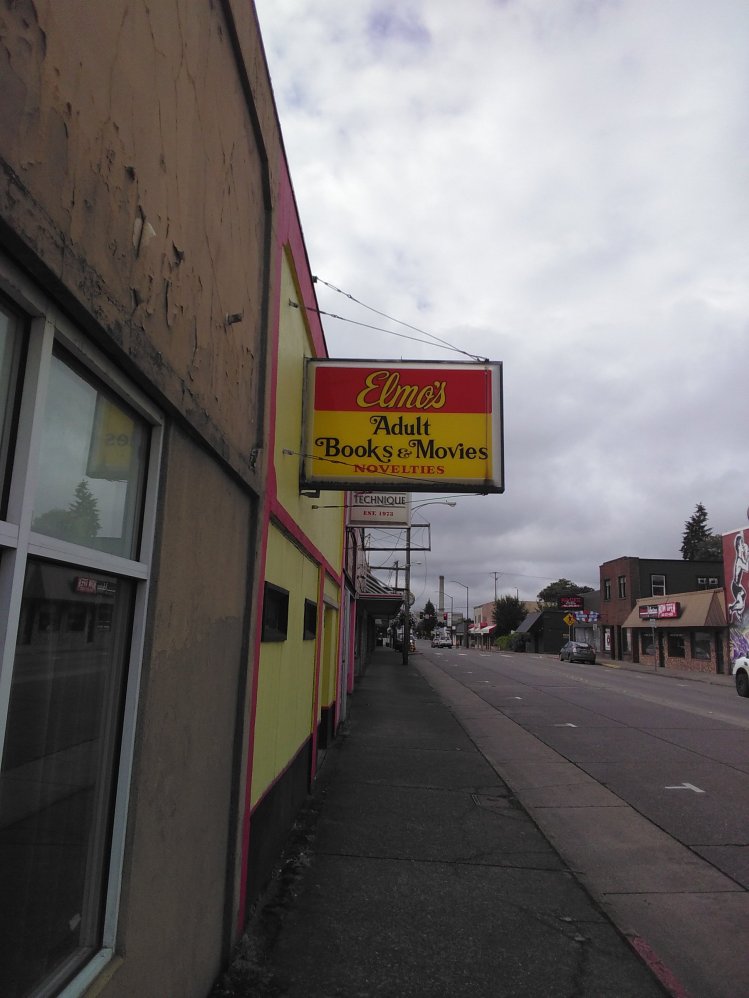
Gavin’s Bakery (“Home of the Pink Champagne Cake”) is still in business on North Callow, as it has been since 1957. Of all the businesses in that area of Charleston only Gavin’s and Elmo’s (est. 1948) remain. They are two blocks apart yet the divide was once much wider.

Callow Avenue ran south to north. A block and a half from our building, east to west running Sixth Street bisected Callow and continued up Torqwamni Hill and eventually terminated, as most American things must, at the freeway. Sixth also marked the end of the alley and briefly interrupted Wyckoff, which picked up again as North Wyckoff about a half mile away. There were such places as South Callow and WycKoff, once, but they were only a block long and ended at the shipyard’s south fence and the properties were bought out by the government sometime during the Reagan era in favor of Shipyard expansion.

Sixth also served as a boundary between the wholesome family oriented businesses you’d find on North Callow and the other kind of operations that stood on just plain Callow. On our side of Sixth there was old Elmo, the Graydons (and other food stamp laundering Mom and Pop’s), the state liquor store, various taverns (such as the White Pig), tattoo artists, drug houses, pawn shops and several massage parlors that were not exactly brothels but not exactly massage parlors, either. For years an illegal, yet long running Pan game was constantly on the move from one Callow back room to another; floating card games and craps-shoots were often objects of whack-a-mole police investigations that a few dollars tossed in the right direction affected in a desired manner.

Another thing about Tess was her rotten perception of time. It was just as screwy at any point in her life. If she told you she’d be somewhere at a given time or back in so many minutes it was a certainty that the time or interval mentioned would be the last to happen. Sometimes she’d be very early, but mostly she’d run late, never would she be on time; and sometimes not at all; especially if she smelled something like an intervention on the schedule.

I figured that two and a half minutes was a bold prediction destined for failure, so I went around the side and lit a cigarette. I was already five-ten, thus a casual glance didn’t betray my twelveness or create concern. The funny thing was that the people who did notice me and had something wrong to share usually had a butt going themselves. This blatant Do As I Say Not As I Do circumstance helped fuel my contempt and bad attitude. It was impossible to respect people who said stuff like “Watch your goddamn language.”

I rummaged through the sack and found myself thinking that it was a good thing that the world will always need criminals for the sake of police job security. The first grade spelling-level on the little cards devised by fourth graders (Charleston Elementary was not known as a cradle of tomorrow’s leadership) told me all I needed to know about the up and coming brainpower. And without consulting the name, you could always tell a girl’s handwriting from a boy’s; girls usually attempted cursive while the boys scrawled well enough for a ransom note. There were other things in it, including packs of gum, store bought cards and one of those cheap paddle ball toys I was good at but Tess could never get the hang of. Out of annoyance she’d tell me that I could play it because they were made for left-handers like me–a useless thing to make up some, in a special Ed sort of way, for the location of doorknobs and the way pencil sharpeners were set for righties. Unlike Mom, Tess’s lies had too many moving parts.

An old lady passed by. She was beating a cane on the sidewalk and did not look my way. I thought about how she was like me once, but instead of logically deducing what that said about my future, I got annoyed because I decided that she had let herself get that way by choice. She was heavily bundled even though it was nearly sixty out, yet the hem of her sensible old lady dress was visible below her long coat, and it got me thinking about Lydia the Jehovah’s Witness.

I’d been thinking a lot about Lydia over the past few months. Sometimes I found myself sneaking peeks at her during class. Sometimes I found myself wanting her to like me even though I’d never felt that way about anyone else. I guess this had been going on since the start of the school year and was invigorated by a weird little event that took place the day before the start of Christmas Vacation.

The only thing we knew about Jehovah’s Witnesses was their avoidance of celebrations. They did not observe birthdays or holidays. So whenever there was a little party at the end of the day, Lydia would be “Excused to the library to study quietly” after we’d come in from final recess. I’d seen it happen dozens of times over the years and never thought anything of it until that day.

“Yes, Sarah,” Mrs. Raker said, cautiously, upon noting my raised hand, after she had excused Lydia before the start of our sixth-grade Christmas party.

“How come you teachers always do that?”

“Excuse me, Miss Spahr?”

“How come you always wait till after recess to send Lydia to the library in front of everybody?”

Lydia was coming out of the cloak room with her stuff before heading down the hall to the library. I recall feeling like a cheat of some sort for making sure she heard me.

She was waiting in the hall, knowing that I’d just punched my ticket to the principal’s office, carrying yet another note. I knew the way.

“Thank you,” Lydia said. Then her light eyes darkened. “But I don’t need your help.” And she left me standing there.

Music: Chapter Three

“Happy birthday, molecule.” I said handing Tess the album, on the morning of April 20th, about a week after I’d bought it. I had no trouble hiding things from Tess, for she was extremely short and I was very tall. That situation often came in handy and never changed; she was always at least a head shorter. I’d stashed it on the top shelf in the bedroom closet, in the bag that held the Christmas lights.

As it also goes for basketballs, there’s no need to gift wrap an LP. It’s either that or a calendar.

Tess was almost as amazed by the receipt I’d taped to the album (in case it turned out to be a skipper) as by the present itself.

“You actually bought it?” she said, for Tess often spoke first and thought later. She was in the kitchen, eating her idea of breakfast–Cap’n Crunch with Crunchberries, straight out of the box.

This prompted a dark look from Mom, who was lurking hard by, shrouded by Winston smoke the same way Saturn has rings, but no comment. She was busy getting ready for work. Mom was tired of Welfare and owing Graydon so she got a job at Howell Hardware through Nora. She had been threatening to go to work for a long time. I figured it occurred to her that she may as well because it would hardly cut into her parental duties–like, say, making breakfast. To be fair, I honestly don’t recall ever seeing her eat anything before noon. And to be fairer still, she had actually wrapped the art supplies that were her presents to Tess.

“This is so cool,” Tess said, “Thank you, thank you.” She always said thank you twice when she meant it–once only to be polite.

The main cause of Mom’s lack of appetite was her Winston habit. She was good for three packs per day, and often opened a fourth, and washed them down with black coffee, RC Cola and loganberry wine. I can still see the succession of cigarette purses she owned, and the mere thought of them strikes my atrophied sense of nostalgia. She bought soft packs and removed the tops and would cram one plus a box of Black Diamond matches in the little purse. She also kept her money there. She pulled out a five and handed it to Tess. “I ordered a cake. Pick it up on your way home.” Gavin’s Bakery lay between school and our building; it irked me that Mom always gave the money for things to Tess, never me.

I grabbed the box of cereal from Tess and poured a bowl. Unlike her, I ate mine with milk. I opened the fridge and discovered that there was maybe an inch of milk in the carton. Even though I was the person who’d left it that way, the near empty carton along with the money thing placed me in a pissy mood; whenever that happened I had to fuck with it.

“I hear some mothers bake cakes for their kid’s birthdays,” I said, ostensibly to Tess

Mom would twitch her head the same way that Elsa Lancheseter did in The Bride of Frankenstein when you fucked with it . It was a strange movement so sudden that it appeared to finish before it began.

“Something wrong, Miss?” Mom’s head twitched twice more and she measured me with a gunfighter gaze.

That remark was, of course, expected. It seemed that we had been at war with each other since the time I punched her for trying to spank me at nine–which was about when Mom stopped speaking directly to me unless absolutely necessary. And I would have replied in a manner that suited the situation if not for the pleading look I glimpsed in Tess’s eyes. She always got anxious when Mom and I flared up. But the best I could do was shrug and shake my head no as I began to eat my mostly dry cereal. Mom knew how far “Miss” got under my skin and always leaned into it extra hard, as you might expect from a person who still bore a grudge against her twelve-year-old daughter.

Another twitch: “You sure about that, Miss? I’d hate for there to be something wrong with buying your little sister a birthday cake.”

I hated “something wrong” nearly as much as Miss, and neither as much as when she’d bring someone else into our war. I’m convinced that there are magic words that lead to matricide. And whenever Mom used Miss, something wrong and used anyone handy like a prop, I imagined hurting her, bad. Real bad.

Tess wouldn’t always have the luck of the timely interruption going for her, but Nora’s arrival at that moment wasn’t unexpected. We heard the familiar rumble of an engine out front. Without dropping her gaze, Mom unlocked the door. Nora was close enough to have the right to sort of knock on the door on her way in, which happened instead of a mother-daughter showdown.

“Hey, hey, hey,” she said, “Troy’s gotta stop for gas.” Troy was Nora’s boyfriend, and though not a Speck, he was illiterate, yet had served in the Korean War and worked at the shipyard, even though he could barely sign his name to his paychecks.

Mom dropped her gunfighter gaze and grabbed her coat off the sofa in the living room, and her keys, two packs of Winstons and some more matches off the counter. She drank some then dumped the last of her coffee in the sink and said, “Let’s go.”

“Wait a minute, hon,” Nora said. She ran over and kissed Tess on the check. “Happy birthday, kiddo.” She pulled a small gift wrapped package out of her pocket and handed it to Tess.

“Thank you, thank you,” Tess said. We used to call her Auntie Nora when we were small. But as we got older there was an awkward in between phase between that and just plain Nora, in which we avoided calling her anything.

“Go ahead and open it now, Kid,” Nora said, “I can’t make your party tonight.”

She filched a Crunchberry out of my bowl and popped it in her mouth. “These taste like shit without milk, sister,” Nora said to me with a wink.

I had to smile, unwittingly, or perhaps otherwise, Nora had zapped Mom a bit for me.

Although it can be energized no better than by cliches, I like to remember Nora as she was then, so young and alive. I tried to keep that in my head six years later, when uterine cancer had reduced her to sixty pounds, before killing her at thirty-four. It’s easy to intrude ominous visions that weren’t extant at the time on the past; and yet I recall often experiencing a vague inexplicable sadness about Nora, as I had then, long before she got sick. Probably a trick of the memory, spreading out a pain too big for one time to handle alone.

Music: Chapter Two

I half-seriously considered boosting the copy of the Beatles’ White Album I gave Tess on her tenth birthday. I didn’t care who made it; I didn’t care if it was a double record–Seven bucks for a four-year-old album was bullshit. I figured I could easily outrun the burly young clerk who looked like the only person working in The House of Values crazy enough to give chase. For if I did make the move, it would certainly come to that. Getting away unnoticed with an album was almost as dumb as trying to conceal a basketball under your sweater. But a little voice inside told me that it was bad luck to steal a birthday present when you have the money. So, I wound up buying the goddamn thing, but I did hook a Rocky Road bar at the register so I wouldn’t go away feeling like a complete chump.

Still, I walked home slightly unhappy about the situation. A new Speck had taken over the Elmo drops and he stayed until the dirty old bastard answered the bell. The loss of our source ended the picture business, which was probably for the best because one boy got pinched holding an especially vile group sex thing. If he had squealed the money his parents had laid out for braces would have been wasted. But he kept his mouth shut about us and said he found it lying in the street. It was a miracle we never got busted.

The seven dollars took a big bite out of my half of the savings we had stashed at Fort Oxenfree. But I got over it and planned to inform Tess that a shitty little school art project would no longer cut it come my birthday in November. Ironically, that was around the time in her brief life she’d begun to sketch and paint items that continue to sell for sums unimaginable during the era of Fort O. When she began the transformation from a camera to a prism. It’s a shame that money measures the beauty in things.

Charleston has changed little over the years. Although the House of Values bit it long ago, a Wal Mart sprouted in its lot like an atavistic wart sometime in the nineties. Unless replaced by yet another Shipyard parking garage, when a local business goes under it is replaced by a chainstore version of the same stripe. Except for the taverns. The ones that went under became parking garages. There once was a run of fifteen little dives in a six block radius downtown. Today there are three. All are “Sports Pubs,” which is the sort of shitty deal you get when the corner bar is gentrified out of its soul by hipster doofuses who like to pretend they are European bohemians. Rich fucks slumming.

It was exactly nine blocks from the House of Values to our apartment. Six north, three west. Maybe a ten minute walk. But Tess and I took the distance in far less time because, being kids, we had figured out as direct an A to B diagonal route possible through the yards and alleys. Which is precisely what I did after I’d bought the White Album.

I’ve never learned how to ride a bike. Tess had a bike, well sort of; it was a rusty third-hander, the type of thing you didn’t care if it got stolen. She had won it from the Church for memorizing verses during the Jesus phase. I felt bikes were a waste of time. The hilly topography of Charleston resulted in either a lot of pushing uphill or suicidal plunges down–you couldn’t go two blocks without running into a hill. But I excelled at running, hopping fences and trimming distances, and I had a mail man’s awareness of unfriendly dogs.

“Hey,” a slightly familiar voice called from behind as I cut behind a duplex whose yard was free of dog turds, which was a good sign.

I glanced back and recognized Lydia the Jehovah’s Witness. Her last name was Simmons, but we referred to her as Lydia the Jehovah’s Witness. She was a classmate of mine and the only kid in school my height. Lydia was standing in the doorway on the back porch, slightly obscured in shadows; and although she looked different from what she did at school, it was still clearly Lydia the Jehovah’s Witness. She was a loner. I had known her since second grade and the only time we had anything that resembled a conversation was the previous December–and that went strangely. Not a fight; not much of anything at all, yet enough for Lydia to often be near the surface of my mind.

“I didn’t know you lived here,” I said, slowing, but still in motion. It was April, and although the weather was calm for the moment I could tell that another brief spring tantrum was about to blow in off Philo Bay and I figured I’d better hurry. Yet I felt an odd little hitch in my stomach when I saw her; alien yet at the same time something I almost recognized.

“We just moved in, from up the street,” she said. “My mother doesn’t want people cutting through. She’s going to plant a garden.”

I swiftly took the fence, taking care to not bend the album, and turned to face her. “Oughta go to the pound and get a big ol’ retard of a dog. With rabies, if you can swing it. That’ll keep me out.”

She had followed me to the fence. A thin crooked smile insinuated in her face. She had intelligent pale eyes that did not work as well as they looked. She’d always worn a pair of goony kitty cat glasses, but not at that moment. Along with the specs, you always saw her dressed like an old woman with her nondescript hair tied back in a bun. Everyone figured Lydia looked like that because that’s what the Jehovah’s Witnesses wanted; she had no siblings for us to compare her to, so that was the consensus. She was wearing an old fashioned frock, but her hair was loose and long, and was relaxed enough to reflect brown. It was as though I’d interrupted the removal of her Lydia the Jehovah’s Witness costume, and that a real person lay beneath it all. I even saw a run of hitherto unknown freckles on the bridge of her nose that her glasses normally concealed.

“We have a weenie dog, Roscoe. But he’s sleeping now,” she said quietly, humor in her voice, the little crooked smile holding ready. She shifted her eyes left and right without moving her head, save for a tiniest between you and me nod, “I trained him to go for the Achilles–that’s the back of the heel, if you don’t know. Consider yourself warned.”

I wanted to wisecrack something back, something fancy and smart, up to the standard she was flying at, much higher than what you normally get from girls our age. Then something came to mind at the point I almost gave up. I laughed and said, “You look different without glasses –didn’t know Jehovah’s Witnesses were allowed to have freckles–say hi to Roscoe for me.” And I ran away, clutching Tess’s present close.

I was blushing. I had never blushed before. It felt like coming down with something.

Music: Chapter One by Leila Allison

(This Week is the Second Book of Sarah and Tess)

Music

Toward her end, Mom didn’t always get enough oxygen to her brain to support a personality. Some doctors blamed it on alcoholic dementia, others figured it was caused by a series of small strokes she had suffered beginning in her early seventies. I do not know enough about medicine to form a dissenting opinion based on science, but I knew Mom as well as anyone ever could, and her so-called dementia was an in and out thing like tides. Her vacuity usually came in when it was convenient to have it and went out when we were alone. I’m not saying that Mom always faked it because there were times when attempting to have a conversation with her was the same as talking to an infant or a dog–not even Mom was that good an actress–but I am certain she was not always as sick as she’d have other people believe.

I admired Mom, if nothing else. She lived her life as though it were a practical joke on the world; her own form of revenge for having been born.

Two weeks prior to Mom’s death from renal failure at what I thought was age seventy-eight, but apparently two years younger, she had traced back to two weeks into her hectic life, as it had been told to her by one of the few nuns she had respected at St. James. The preceding paragraph was culled from hours of Mom’s mumbling whilst on the morphine drip, but as it goes with world class liars like Mom, when they tell the truth you know it.

There was a note pinned to a blanket which contained a sleeping infant girl found by a priest inside St. James Catholic Church at Victoria, B.C. on 1 July 1943. According to the note the baby’s name was Karen Patricia (the surname was not provided). She’d been born on 17 June. The note explained that the alcoholic father had long vanished and that after “two weeks of the blues” the writer of the note (assumed to be the baby’s mother) had decided that either the child or she had to go over nearby Steel Bridge, she had decided that suicide was the better way to go. The RMCP was summoned and the body of a young woman was found lying in the dry gulch a hundred feet below the bridge. An autopsy revealed that she had recently given birth. An investigation, which involved a lot of local door knocking, revealed that the woman’s name was Susan Jones–nineteen, who would have been evicted for non-payment at the boarding house she had been staying at if not for the baby. “Jones” was thought to be as bogus as the dimestore ring the woman had passed off as her wedding band, and further searches of nearby hospital records yielded no further useful information, for all the recent mothers listed were still very much alive and kicking and in possession of their equally lively offspring.

She never explained (or didn’t remember why) she had emigrated to the United States from Canada In 1955. She was raised a ward of the church and was transferred from one Catholic orphanage in Victoria to another in Seattle, from which she ran away regularly and for keeps two years later. Soon after her escape, Mom added two years to her age and changed the spelling of her name to “Kaaren”–after an actress of the same name. She also changed Patricia to Hester (in honor of that one Canadian nun she liked) and Jones to Nelson, which was the surname of what’s now called an “enabler”–someone named “Marie,” whom Mom had met on the outside. Mom said Marie pretended to be her aunt, but never gave me the why or how of it–though she once claimed that Marie had been a girlfriend of her father’s–but that had to be a lie because she’d never learned his name.

Regardless, sixteen-year-old Karen Patricia Jones vanished permanently when eighteen-year-old Kaaren Hester Nelson married our father, Delroy Spahr, on 10 July 1959, four months before I was born. He was in the Navy and I’m guessing that having an obviously pregnant fiance aided in gaining Mom a new green card, identification that further cemented her fictions and a social security number. Apparently the Catholics were not queried, nor did they seem to be searching for Mom. I might have questioned the entire scenario if I hadn’t found her “lost” original green card hidden in the false bottom of a jewel box she had held onto for God knows how long, shortly after her death. Sure enough it belonged to a smiling twelve-year old girl named Karen Patricia Jones. And it was easy to tell that it was indeed her. Anybody else would have destroyed that bit of evidence, but I can just see Mom removing it and gloating over her deception late at night.

Mom was very pretty. Small and thin almost to the degree of lacking enough mass to cast a three-dimensional shape, but she was still most definitely a girl, and men liked her. She and I both had dark hair, brown eyes and high cheekbones. We looked very much alike for years, until I got too tall and jangly to pull off delicacies, like a guy.

And for whatever reason that beat look most people who spend their lives in poverty acquire (our Anna Lou and, to a lesser extent, Nora were prime examples of that) never stuck to Mom. Mainly it was due to her having uncommonly great teeth–which was extremely rare in our society. Years down the road smoking did create lines around her lips, like crazing in old pottery–yet the downtrodden eyes, slurred voice, obsequities to small powers and drag in the step never found her.

She had many talents, but being a parent wasn’t one of them. I might have liked her if she wasn’t my mother.

End Chapter One

Saragun Springs Presents The Drifter

(Image provided by the Drifter)

Seven Virtues of Studying the Great

“Goodness can be found sometimes in the middle of hell.”

– Charles Bukowski

This Sunday in honor of the American holiday weekend, The Drifter is offering a brief take on a vast topic. These are the opinions of The Drifter and perhaps are not set in stone; but at the same time, none of these suggestions originated with The Drifter himself. They drifted into his mind and through his keyboard via many other figures of the past who are smarter than The Drifter.

Thus, all who read this should know that The Drifter does take responsibility for this, but at the same time he’s doing nothing other than channeling the wisdom of the ages in the form of a brand-new vessel. Very little (or none) of this can be argued with in any rational way. All of it will peak your interest if you are interested in the creative arts AND/OR in the creative living of life (or both).

Now to the list. Seven is chosen because seven is a chosen number. There is a second list at the end which helps explain what The Drifter means by “the great.” Skip down to there if you wish to and come back to this afterward.

Seven virtues of studying the great:

One: You will learn how to do what you need to.

Two: You will come to understand how much it takes.

Three: Your own pain will be eased even as you come to a greater understanding of the eternal truth that “pain is the name of the game.”

Four: You will see how fun the game can be through the eyes of others who are related to you because they are also humans.

Five: When your enthusiasm wanes because of your energy levels (until it comes back again) you can lean on them.

Six: Not studying anyone will very surely and very shortly turn you into a kind of (unhealthy) human vegetable and one should always study the great first because they deserve it. They deserve it because they tried harder than the vast majority of the population (even while “not trying” like Buk said to).

Seven: What could be more worthy of our human study here on Planet Earth than the human and all it entails? (which in my case involves Siberian Husky and Pit Bull spirit dogs; look around you for your own spirit things because they are there).

List Number Two.

The following list is an example of what The Drifter means by “the great.”

In honor of the future-classic, cutting-edge short stories of Irene Leila Allison, the list is comprised of twenty American short story writers.

These are all Americans because I’m writing this on THE FOURTH OF JULY, 2025, A.D., and because I happen to be an American myself, straight from the heart of the heart of the country, as William Gass called it.

All of these short story writers are what is sometimes referred to as “passed on.” At other times referred to as “no longer among the living.”

These people still live. IF nowhere else (which I doubt) than among the literary immortals in the spirit world of the American pantheon.

Washington Irving.

Edgar Allan Poe.

O. Henry.

Shirley Jackson.

Eudora Welty.

Richard Wright.

Ralph Ellison.

Katherine Anne Porter.

Kate Chopin.

Flannery O’Connor.

Langston Hughes.

N. Scott Momaday.

Ernest Hemingway.

William Faulkner.

F. Scott Fitzgerald.

John Cheever.

Raymond Carver.

Barry Hannah.

Larry Brown.

William Gay.

“The Drifter” will return next Sunday with seven more philosophical reflections on the Arts or one more narrative exploration of an artist’s life based on personal experience. Thanks for putting up with this.

Solitude Equals Freedom by Dale Williams Barrigar

(image provided by DWB)

Solitude Equals Freedom

Harold Bloom, my spiritual mentor (if I had to choose, at gun point, just one, other than Jesus), rightly opined, over and over and over again (in the good way), that an American never feels free unless she or he is alone. Daniel Boone, Davy Crockett, and Johnny Appleseed all agreed with him; as did Chief Joseph, Crazy Horse, and Geronimo.

The following poem, about my beloved Christina, is the result of that unnerving, wonderful, and true formulation.

Fleeing with the Geese

“Sometimes she is a child within mine arms…” – Dante Gabriel Rossetti

Tedium alternating with

Ecstatic balloonings which

Collapse

So suddenly

Equals this

Teenaged life

(for a few more months)

Of mine…

But then again

There comes

A sudden feeling, seeing

These geese exploding with power in their

Winged

Freeness

Like Bucephalus

The young war horse

Terrified

Of his own

Shadow in Plutarch

Until

Alexander

Understands

Him and now he’s

Becoming fearless

Over cottonwood

Trees

And power lines

Of the Ragged Prairie

Land

In the ghosts

Of the geese.

The UFO

Filled with marvelous mystery

Monsters

Is

Coming down

Now

And the

Mastodon Bone Museum

Is unleashing its feverish

Dancing

Creatures

And there’s

One bar

Open

On the edge

Of the

Railroad tracks in this

Dying American town!

And I’ll

Be back

On the highways and

Byways tomorrow,

She intoned,

At the end

Of the

Summer,

In 1991, to

Her Homeric

Soul,

Her heart

Humming,

Her hair blown

So wild

And so free,

Shaking the dust

Off her feet, in

America

ALONE.

Dale Williams Barrigar is an American artist who loves to be alone.

Self Doubt by Dale Williams Barrigar

(image provided by DWB)

Self Doubt

If you don’t question yourself from time to time, or even frequently, even the things you love best, it can rightly be said of you by anyone who wishes to – that you’re an idiot. Not the saintly idiot variety that Dostoevsky so convincingly portrays in his fascinating novel The Idiot; but the kind whose personality is lacking in somehow massive ways; the kind with blinders on who thinks they know it all and has got it right about everything in this endlessly confusing, mysterious world.

None other than Socrates himself, probably the second or third smartest human who ever lived (if such things can be calculated that way, which they cannot, necessarily), after Jesus, and along with Buddha (and a few others who can match them), repeatedly pointed out that the smartest among the smart know first what it is that they don’t know.

I’ve seen too many bored and boring, gossiping, chattering, small-talking busybodies in this world who think they know it all so that I have to agree with him.

Dr. Kay Redfield Jamison, in her riveting, genius book Touched with Fire: Manic-Depressive Illness and the Artistic Temperament (devour it immediately if you haven’t already; the chapter on Lord Byron alone will blow you away if you’re awake) describes how the depressive side of the artist leads to the necessary self-critical moods that lead to artistic shaping of the highest variety. So: it’s all worth it: for the artist, anyway.

Christina, in the following poem, is lost in a low mood, a very, very low mood.

In the final poem of this series (scheduled to appear tomorrow), she gets out of it alive.

Alone

“…the better fortitude / Of patience and heroic martyrdom / Unsung.”

– John Milton

Gas gauge

Nearing empty

Now

And earlier

She pulled over and wrote

In kind, gentle

Violent

Desperation.

All the mileage and the empty

Credit cards. Maps, colors and lines,

Colors and lines, blurring

What’s left

Of my mind.

Roadside diners. Coffee cups. Rest stops.

Gas stations. More coffee stops. Pep pills, a downer from

Back home in Chicago. Throbbing Bob

Marley music. Bob Dylan – Street Legal. Hiding

Rasta baggies from charming

State troopers. And I’m lonely now

And I’m

Alone…

And she realized,

I’ve eaten almost nothing

But nut-containing candy

Bars washed down with water

Or tea three whole days!

In search of

These things

I don’t even know

About.

I’ve got

Blisters on my fingers from

Too many pencils and papers,

Eyes weary, and bleary, from

Reading, looking, seeing or driving

And I’ve been on the road now

I don’t know

How many days

And how many

Ways.

The end

Will come when

It will come

(Or should I hurry

It)

But it’s

Giving me the

Creeps now

(And my skin

Is crawling like

With mean, nasty

Bugs)

And I’m

Wondering

Seriously

If all this aloneness

Can be

Good for

My soul.

Dr. Dale W. Barrigar has suffered so many crushing, brutal depressions that he’s often considered throwing in the towel and leaping off the Mackinac Bridge, in honor of John Berryman and Hart Crane, but he’s always resisted – and always will resist (unless somebody pushes him). For Barrigar, daily doses of Depakote and various other sedatives and mood stabilizers (plus a few other things) do wonders for steadying the nerves, and do nothing to dampen his creativity even in the slightest. He looks forward to the day when, like Leonard Cohen, he ages so much that he can throw the pills away. Until then – you do what you need to do, whatever it is. This life will end soon enough for all of us – don’t take that leap, it will all get at least a little better tomorrow – he promises you.

In the Car by Dale Williams Barrigar

(image provided by DWB)

In the Car

People used to think I lived in my car, because I carried so many items around with me in it, items that shall be (and are) elaborated in the following poem. Truth was, I did sometimes live in the car, but mainly only the times when I got kicked out of other places, and also all those times when I was on the road in America.

People used to think I only went on the road in America because of my passion for Jack Kerouac. And it was true that I did go on the road because of my passion for Jack (Kerouac and Daniel’s); but there were many other artists who often superseded Kerouac in my mind and imagination as my inspirations: for years, Jim Harrison, the great poet, essayist, and fiction writer Jim Harrison of Michigan and Montana, was my primary inspiration, and the list is long of other American drifters who also inspired me for years. Many of them were musicians.

And while a passionate fan of music and musicians, and while I can pluck the guitar and plink on the piano and blow the harmonica and drum the drums a little bit when the moment is right, I’ve never been a musician, because I’m not a performer in that way. I’m a performer in other ways, but not that one.

The following poem is about a nineteen-year-old girl, because I used to be a nineteen-year-old boy with a (not-very-obvious-usually) feminine side (everyone has both masculine and feminine sides, as Sigmund Freud both pointed out, and proved), and also because I now have daughters who are both eighteen at the moment.

Sketch Books

“A wayfarer by barren ways and chill…” – Dante Gabriel Rossetti

And I’m still looking

At the ghost,

She wrote,

That isn’t even there

Beside me any more,

After all, since childhood

When it had been.

My

Haunt-eyed closet ghost; so later will I label those

The Haunt-eyed Ghost of Warrior Traveling the Sky

Sketch Books

As she tossed the sketch books

Into the trunk of the car

With the rest of the papers

And notebooks.

The battered traveling library

Was spilling

Over into the back

Seat. Books

Are everywhere, and under

And next to

My pillows

From home.

Two sleeping bags.

Long, heavy watchman’s

Flashlight

From Grandfather.

For night time reading

And protection. And

I’m living in my car,

On the road

In Arizona,

New Mexico, Utah, Colorado, Wyoming,

Montana, Idaho, Washington…don’t know

if I’ll ever go

Home!

D.W.B., sometimes referred to as The Drifter by none other than himself, has always had a penchant for moving from one place to another in a kind of restless, and sometimes listless, fashion, since this helps him to refrain from getting bored. He doesn’t take fancy vacations, or any vacations for that matter, but he does maunder from here to there on a daily basis – whistling in his soul.

Artist of the Western Plains by Dale Williams Barrigar

Mystery Writer

Mystery surrounds us, we live now in an eternal mystery, mystery here is endless, mystery is our meat and drink, the air we breathe, the ether we swim in – and yet it’s so easy to forget this simple fact, so terribly, horribly easy to forget it and become bored with it all. And perhaps that is the greatest sin of all.

REAL ART is not about scoring points with your teacher, setting yourself up with a fancy career, making lots of money, building yourself a comfy nest egg in academia with all your like-minded friends, nor even (predominantly) about getting yourself legitimately famous, now or later.

It’s about connecting, or reconnecting, ourselves with THE MYSTERY.

When we walk in mystery, we’re never bored. James Joyce’s epiphanies, William Wordsworth’s “spots of time,” the revelations in The Book of Revelations are all about reminding us that the world is not about “getting and spending,” as Wordsworth put it.

They asked him to tell them the ultimate truth. Buddha showed up with a single flower, said nothing, and sat there holding it out toward them for a long, long time – before he vanished in front of their eyes.

Artist of the Western Plains

“I can conceive that this is the essence, of which all other poetry is the dilution.”

– Virginia Woolf

Alone she was

Most of the time,

Hiking and sketching

With many-colored

Pencils and pens

On empty

Western deserts

And plains, under cold

Battlefield hillsides,

Searching for

Something

Spiritual.

Maybe a single, bent

Evergreen tree, three feet

Tall

And dark, on the ridge

Top.

Fully living.

Fully alive!

All alone. All by

Itself, but also with

Its friends:

The ground,

The wind,

The elk

Shadows in

The distance.

Dale Williams Barrigar, MFA, PhD, is a visual artist and poet from the midwestern USA who likes to spend lots of time contemplating the real relations between true religion and art-making. To the busybody world at large, it can sometimes sadly appear as if he’s doing nothing but lounging on the couch or in the grass with a vacant look in his eyes. Not so!