The Hands of the Poet by the Drifter

“Galileo looked into the night / and learned the truth was an old lie /

And he sighed, knowing his fate: / If I write that again Someone will

tell the Vatican” – Irene Leila Allison

“The most beautiful thing we can experience is the mysterious. It is

the source of all true art and science.” – Albert Einstein

(Wonderful images provided by The Drifter)

INTRO NOTE, or Here We Go Again:

From The Drifter: The idea for this essay came as a flash of inspiration like a lightbulb going on in a tired brain, while driving around (drifting) on the West Side of Chicago during a dreary, weary day after reading Leila Allison’s enlivening poem “Tell the Pope to Buy a Telescope,” available on Saragun Springs; first date of publication Tuesday, August 26, 2025.

I.e. it was a weary, dreary day until reading the poem then being inspired by the poem to write this essay about it.

The Drifter suddenly pulled over near a vacant lot on the West Side, nodded to the old fellows smoking their bud around a trash can watering hole under a tree, then committed most of this essay to paper via a short-hand note-taking method in a language invented by none other than himself, readable by only himself, with colored pens on repurposed paper like old bills and advertising circulars.

It was like Leonardo da Vinci furiously working at his desks (he had more than one) in the middle of the night, long hair crazy-wild and fingernails long, dirty, and broken like Bob Dylan’s from digging up corpses for dissection and anatomical drawings the night before.

All that remained to do was draw it all together and translate it, somehow, into fairly readable standard English prose.

The results can be perused below; now or later or much later.

One of the first questions to ask when reading a poem (or anything) is, “What did the writer need to know in order to write this?”

Harold Bloom said that the main purpose for reading fine (and great, which is a cut above fine) imaginative literature was and is in order to augment one’s own consciousness.

Another word for “consciousness” here is PERSONALITY.

Another word/s for “augment” here is make it better.

And the answer to the question, “What did the writer need to know in order to write this?” these days is, all too often, “Nothing;” or, “Not much.”

Ralph Waldo Emerson, author of “The Shot Heard ’Round the World,” and whom Bloom called the Mind of America because of Waldo’s influence, both positive and negative, on all other subsequent American thinkers, whether they know it or not, said that a poem was “a meter-making argument.”

What Emerson meant by this (or one thing anyway) is that the “argument,” or reason-for-being, of a poem is what elevates its language, what calls for the poem to be written as a poem instead of in prose.

The “argument” here is NOT polemical, political, a run-of-the-mill opinion, or a straight-up “idea” like how to conquer the moon or invent a better way of doing something practical.

Poetry’s impracticability is another one of its essential features. If it was only about doing things it wouldn’t be poetry, or not poetry (which is thinking) at its highest levels.

Philip Larkin called the modern short poem, which is the most common form of poem now, “a single emotional spear-point.”

An emotional spear-point has to have a deep reason for being, or it can’t be itself.

PART TWO

Here are just a few of the things Irene Leila Allison needed to know in order to write her poem “Tell the Pope to Buy a Telescope,” according to this writer (The Drifter, aka Dale Williams Barrigar, MFA, PhD).

One: What it was like to be none other than Galileo.

Two: What the power dynamics were like in society during Galileo’s time. (He was born the same year as Shakespeare and lived 26 years longer than The Bard, to the age of 77, which would be more akin to 97 today.)

Three: What it is like to challenge authority with the pen (or the keyboard) in any age. (For this to happen, you need to challenge it with your mind and your life first.)

Four: What the power dynamics are like in society in any age.

Five: The subversive nature of true creativity (or creativity at its deepest levels) in any age, including Galileo’s, and our own.

Six: The price to be paid for being subversive in any age, whether it be in writing or in any mode, like any form of resistance, which is available and morally required (in different forms, depending on the person) of everybody. (Jesus himself was nothing if not a rebellious spirit, at least when it came to the goings-on in this earthly realm.)

This list could go on but the Drifter will stop with a round half dozen in order to give the reader time to think about this.

The seventh thing (7 = heaven) Leila Allison needed to know in order to write this poem was how to fit all of the above into the space of just over one hundred words.

Return to the half dozen items listed above, and then ponder knowing all that, and then ponder the magic of powerfully, clearly, and beautifully expressing all of the above in a third of the words Lincoln used for his Gettysburg Address.

Not a single syllable is wasted in Ms. Allison’s poem, much less a single word.

Words are reinvented in this poem, used so they can be understood by the reader but also torn out of their “normal” context and made new again.

Here is just one example.

Describing Galileo making his amazing discoveries that changed the entire human world while under house arrest, Ms. Allison says, “the spheres (and spears) remained.”

In five words, she’s boiled down one of the most profound humans and human projects of all time into a space that is tiny in terms of its actual size, and as gigantic as the entire universe itself in terms of its implications.

This is what true poetry is, saying so much in five words or less that entire pages, or even books, of prose could be written upon it and still not capture its essence.

And doing it all while being beautiful.

At this point, I urge any and all readers of this to seek out Ms. Allison’s poem “Tell the Pope to Buy a Telescope.”

The title sounds like it could have been come up with by James Thurber, Lewis Carroll, or Dr. Seuss (he was one of the most important American poets of all time, which is neither a joke nor an exaggeration), a sign of the light hands of the poet.

Because children, too, should be told about people like Galileo; and the intelligent child in all of us is what keeps us alive.

And after truly studying, and absorbing, this poem, you will know more about Galileo, the world, and the universe than, literally, entire book-length works about him or his times can tell you.

FIND THE POEM, AND WORK TO LET IT FIND YOU.

From the West Side of Chicago:

Signed, The Drifter…

The Sunday Drifter: From the Academy: No More Literature Here

(Images provided by the Drifter)

“Only the great masters of style ever succeed in being obscure.”

– Oscar Wilde

LITERATURE, in its pure form, says The Drifter, is no longer taught in American universities.

What we have instead is economic grievance (usually from people who are already wealthy) and identity politics (also from wealthy people) masquerading as literary theory.

The pure spirit of Literature has been crucified, in the American academy. It was dead and bleeding on the cross. Now Joseph of Arimathea has disappeared with the body.

Charles Baudelaire, the first poet of the modern city, anywhere (his city was Paris) used to pray to the spirit of Edgar Allan Poe, just like a Catholic prays to a saint. (Baudelaire was also Catholic, perhaps the most unique Catholic who ever lived, or one of them.)

If you told someone in American academia these days that you pray to a Literary Saint, the cynical crowd would suddenly rear its ugly head and laugh you right off campus immediately, from coast to coast and everywhere in between.

For me, the two greatest literary critics, ever (in the English language), are Dr. Samuel Johnson, and Dr. Harold Bloom. Johnson died in 1784, at the age of 75. Bloom died in 2019, aged 89.

Both of these titanic and gargantuan figures (and they were both gargantuan and titanic physically, as well as spiritually and mentally) have been wildly and consistently misrepresented in the popular press. Ideas they never had are attributed to them; stances they never took are assumed to have been their own; and their personalities, the most important thing about each of them, have been distorted beyond all recognition.

But the works and the good writings about each of these figures still remain, as well as the visual representations (from which you can learn entire worlds) and large collections of quotations about them by people who knew them well or just came into contact with them for brief periods.

One of my favorite works by Samuel Johnson is his first full-length book, the short biography The Life of Mr. Richard Savage, sometimes known as Life of Savage, and whose full title is An Account of the Life of Mr. Richard Savage, Son of the Earl Rivers (whether or whether not Savage was really the son of the Earl was one of the things about him that was always in dispute and a large contributor to his renown, or infamy, because he claimed he was, and the Earl claimed he wasn’t – loudly).

Savage was a famous minor poet, sometime actor, fulltime alcoholic conman, and all-around good guy who Johnson was friends with for a time. They roamed the London streets together at all hours, sometimes sleeping rough when they had to, starving and drinking and trying to make a living as Grub Street hacks (sometimes partially succeeding at the latter).

After Savage died, impoverished, alone, well-known, and alcoholic, Johnson wrote his life, thereby penning one of the first deeply psychological biographies ever committed to paper. One reason I love this book so much is because Savage reminds me so totally of a person I once knew, a very close friend, with whom I got into so much trouble at that time it has to be saved for another column.

Johnson also wrote a kind of nonfiction novella called Rasselas. This book was one of the very first Western explorations of Buddhism ever written, a fictionalized, Westernized account of the Buddha’s story almost as if filtered through the story of Muhammad.

Johnson himself, as a man, was such a strong and powerful abolitionist, before abolitionists even existed, that slaves in the New World ended up naming their children Rasselas after his great character. Johnson later adopted a black child as a single father after the death of his wife, raised the boy into manhood, and left him his money and name when he passed on. Such things were so unheard of in the 18th century that hardly anyone understood Johnson’s point of view at all. They didn’t know that he had moved beyond racism in an era when no one even knew what “racism” was.

Johnson was a multiculturalist (in the sense that he believed, like Jesus, that everyone should be included) not decades, but centuries, before such a thing existed with a name, and he didn’t just preach it, he lived it. And yet, the English Departments of the American academy now mostly accuse him of being an ultra-conservative “dead white male” who deserves to be ignored, forgotten, and even “canceled.”

Such thinking and behavior only give fuel to the rising and rabid fascist tide among us, a situation that is like a flood and a fire at once within human culture itself and thereby demands the mixed metaphors.

Harold Bloom has also, seemingly endlessly whenever he is discussed, been accused of being a so-called political conservative, even though he never was anything of the kind at all, and even was the exact opposite, more of an imaginative and creative, one-of-a-kind anarchist in his politics than anything else. (“Anarchist” in the sense of placing the highest possible value on human freedom, and human expression, itself; it has nothing to do with the practice of political violence, or rather believes the practice of violence should always be avoided because when you practice violence you’re not free.)

Born in 1930 in NYC, Bloom did his best work after the age of 50 (once Ronnie Rayguns took over), and perhaps his very best work after the age of 70, even though everything he did before 50 was the basis for all that came after, and led to it.

Five of my favorite books by Bloom are: How to Read and Why (2000); Genius: A Mosaic of One Hundred Exemplary Creative Minds (2003); Hamlet: Poem Unlimited (2003); The Anatomy of Influence: Literature as a Way of Life (2011); and Falstaff: Give Me Life (2017).

This last book, a true and deep classic in Shakespeare studies, a brief book that takes the reader on a lasting tour of all things Jack Falstaff, was written and published just a few years before Bloom passed on at the age of 89. In its late 80s, one of the most powerful human minds of our times appeared to be getting stronger than it ever had been, not less so.

Harold Bloom was like Oscar Wilde in the way he took nonfiction writing about literature and raised it to the levels of the very highest and best imaginative literature itself. Bloom said that William Shakespeare was his ultimate model, as opposed to any critical writers he’d ever known or studied (except for Samuel Johnson). As a writer, Harold Bloom was much closer to someone like Bob Dylan or Ernest Hemingway than he was to what we usually think of when we think of a “literary critic.” And he was a real and true harbinger for many directions imaginative writing will take in the future and is now taking even as we speak, inevitably (says The Drifter).

Crucial END NOTE from The Drifter, MFA, PhD: The Drifter’s name, “The Drifter,” is not influenced by, but is rather stolen directly from (in a sense), two names that Dr. Samuel Johnson called himself, when he himself wrote columns: The Rambler; and later: The Idler.

A Few More Crucial Note/s: Samuel Johnson’s prose style can strike the modern reader as outdated at first, but a good reader can catch up with him within the hour, and the struggle to do so can only be beneficial, since this is Johnson, and since nothing too easy is any good. Johnson is far more modern than almost any other writer of English prose of his era, his pal Boswell rivaling him in this. And often enough, his prose sounds exactly as if it were written yesterday, or tomorrow (these are his best bits, and they’re scattered everywhere throughout his vast, massive work).

Harold Bloom wrote a lot (a vast understatement), and he has entire, five-hundred-page books (among his early work) that are composed almost entirely in a stilted, bloated, airy, windy, jargon-filled prose that is still, despite itself, brilliant and unique almost all the time.

After the age of 50, at his own admission, he started to write for a more general audience outside of academia, including the reader he called the “incredibly intelligent child of any age.”

He did this for two reasons. One: he wanted to reach more people while he was still alive. Two: his skills had improved.

THE MOST IMPORTANT PART: Reading good works or otherwise genuinely engaging with good art of any kind keeps your mind, heart, and soul in a good place, so that, the more you do it, the better your own inherent goodness becomes. The opposite of this, just as powerful, is rotting your brain (and heart and soul) with meaningless trash.

Addendum: Roger Ebert is the Harold Bloom of the movies; Lester Bangs is a Bloom of rock and roll.

Stay tuned this week as The Drifter attempts to practice literary criticism upon modern popular music, but in a late-Bloom kind of style, not an early-Bloom style, i.e. jargon free and written for the incredibly intelligent child within all of us no matter what age.

Post Cards From the Drifter: The Crowd and the Protest

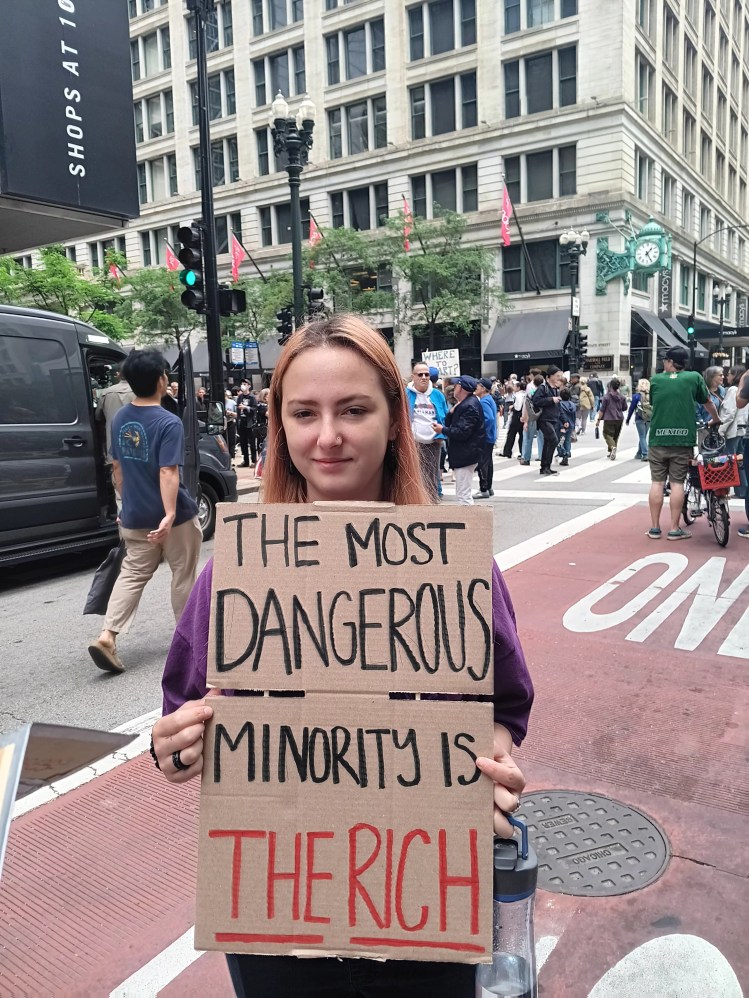
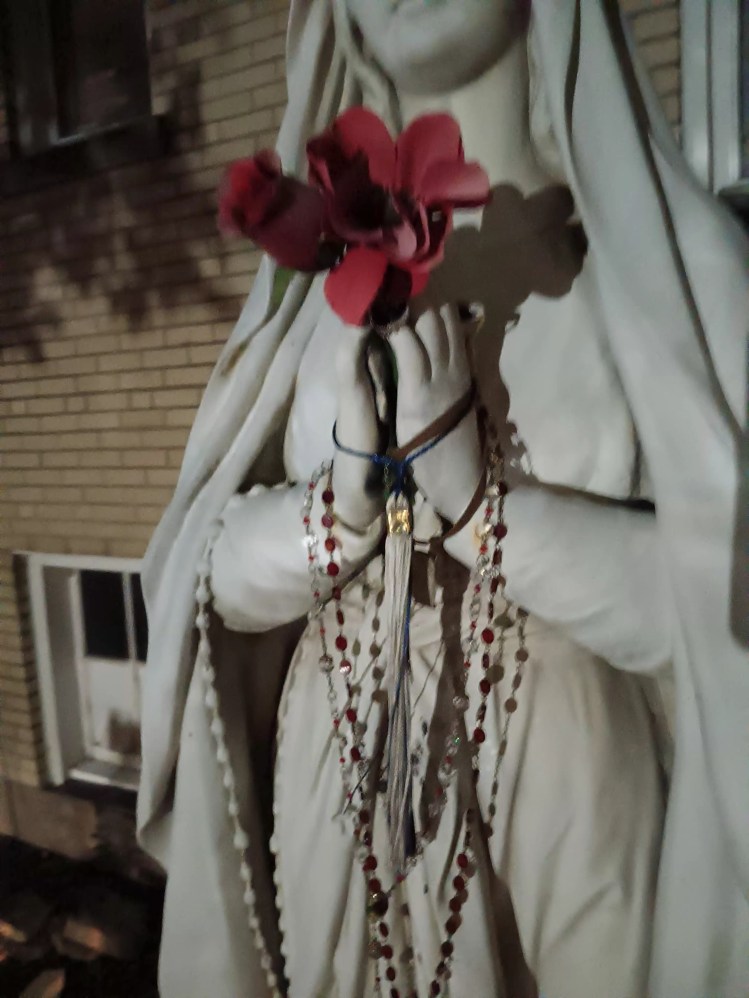
(Top image: Elina in Chicago 14 June; Second image: Tressa With Emma Lazurus Poem. Both supplied by the Drifter)

The Crowd and the Protest

“The shepherd enters through the gate.” – John, Chapter Ten

ONE

Sadly, the question might easily arise as to WHY anyone in their right mind would bother to fight for, or defend, the so-called “American Dream” any more, in this Year of Our Lord 2025.

The Gonzo journalist and prose master Dr. Hunter S. Thompson, in his prophetic mode, rightly proclaimed the American Dream dead and buried over fifty years ago, not too long after Tricky Dick got finished with his sad, partially unconscious, and certainly pathetic attempts to clownishly crown himself and end American democracy forever.

It seems to me that the American Dream has now become the most destructive lie and delusion the human race ever invented for itself, a vast, mass mental and spiritual health crisis and pandemic that has spread globally everywhere from here to India and all places in between, and has destroyed the human and humane spirits of, literally, billions of people all across the globe (although not everyone).

Because the so-called “American Dream” is nothing now in its very essence and core except a pixie dust mental disorder, a vast, sometimes-seemingly-all-consuming, LSD-like, schizophrenic delusion that is not based on Fantasy (the bad kind), but IS Fantasy the bad kind itself at every level.

Romance Fantasies, House Fantasies, Computer Fantasies, Car Fantasies, Shopping Fantasies, Political Fantasies, Property Fantasies, Robot Fantasies, Rocket Fantasies, Gambling Fantasies, Lottery Fantasies, Vacation Fantasies, Hero Fantasies, College Fantasies, Economic Fantasies, Flower Fantasies, Music Fantasies, Dancing Fantasies, Fame Fantasies, Job Fantasies, Retirement Fantasies, Revenge Fantasies, Drinking Fantasies, Drug Fantasies, Food Fantasies, Screen Fantasies, Sex, Power, and Money Fantasies have burned and buried the real minds and hearts of so many people walking, standing, sitting, or lying down on the globe right now that it’s really chilling and yes, even horrifying, when one thinks on it for more than two seconds before going back to casually scrolling one’s phone as the world burns.

So why fight for the American Dream? Because there’s another side to everything in this world: what the great Chinese poet, philosopher, drinker, and drifter Li Po called the Yin and the Yang.

Harold Bloom, the great American writer, voice and citizen, said many times that an American never feels free unless she or he is alone. And when an American is alone, they do always feel free (even if sometimes terrified, too).

That liberating essence, or core, of American democracy still exists, even though Sojourner Truth, Crazy Horse, Frederick Douglass, Thomas Jefferson, Daniel Boone, and John Wayne are gone (“The mountains have been my church,” said Wayne in his final movie). It means everything to the human mind, heart, spirit and soul all over the globe, is America’s one great contribution.

And that is why I will fight for it, in my own way, and in the spiritual warrior sense of the word fight. I, and many others.

TWO

We came up out of the subway tunnel and were instantly swallowed by the Chicago crowd. I was with my teenaged kids and a few of their friends. I could see the Picasso statue in the distance over the heads of the crowd. It was there, the statue the great Picasso gave to the city of Chicago for free, the one that looks like a horse’s head from a certain angle, a woman’s head with long hair from another angle, something else you had never really imagined before and can’t name, from another angle.

I’d spent a lot of time in the past sitting around in downtown Chicago and studying that huge metal statue. Now I was packed into the middle of so many hot, pressing, human bodies suddenly that I couldn’t even move, not right, left, front, backward or center. One of my daughters had been swallowed and pushed along by the crowd. We were all worse than sardines in cans right now. Suddenly I realized that if I had another stroke like I’d had last year, I would be in a very bad spot because there were angry, shouting, pressing, hot-blooded, hot-breathed, neck-veins-bulging, stinking, sometimes-perfumed, protesting people pressing all around me and there would be no medical assistance happening out here. I turned around again trying to find the stairs from where we’d come up from the subway so we could go back down, but it was already too late. We’d been sucked into the vast black hole of the hot, pressing crowd, literally even before we knew what was happening.

We kept talking to each other in the middle of the crowd as we tried to inch our way out of it. I instructed all these teenagers I was with to follow me, and trusted (no choice) that my other wildly intelligent daughter (they both are) would be able to fend for herself, but no one in the crowd was moving, they were all just standing there pressing upon one another (no room for anyone to even sit down, not that you would want to here), holding up signs, screaming slogans and chants, breathing their hot breath on the backs of one another’s necks, and I could feel the outraged intensity of every single one of their souls (it felt like) pressing down on my own personality, which was very quickly becoming nothing less than outraged at their outrage. Trying to keep it under control, trying to keep it under control…

There were very many angry and shady-looking people pressing in the crowd, folks trying to pull suitcases or carrying awkward-looking backpacks, all of the above large enough to carry explosives of course, folks dressed all in black with hands hidden in pockets large enough to carry pistols, folks hunched over with hoods over their heads and masks on their faces and sunglasses covering their eyes.

It was a vast ocean of bodies pressing over me and I realized I was about to panic perhaps because I was now having a bona fide LSD flashback right here in the middle of the crowd, actually triggered by the crowd, in fact. But I had to keep it together in order to lead my daughters and their friends to safety.

It had been my idea to come down here, after all. My kids and their friends instantly agreed. Then I remembered that I had been inspired by them during the George Floyd protests when it had been their idea to go to the protests before it had been mine. We were trying to inch our way along to escape from the crowd. Some people, obviously many people, do not get too claustrophobic in such conditions, because a lot of these protesters actually seemed to be enjoying themselves. But myself, my daughters, and our friends were not some of the non-claustrophobic ones. The kids call it “tweaking” these days. It’s when you’re losing your grip on things, feeling like you’re having an acid flashback, panicking or almost panicking, freaking out, in other words. I was now, officially, and internally, tweaking at every single level I could or couldn’t think of. I was able to hold it together for only two reasons.

One: in order to try and help my daughters and their friends (and myself) get out of this.

Two: I knew if I really started freaking out, it would be like throwing a flaming torch on top of a keg of gun powder.

I knew now, in my blood, how easy it is, and how fast it can happen, that people get trampled to death in a crowd like this.

THE CROWD is so terrifying and horrifying to some of us because it means a complete and total loss of individuality, and control, at every level.

The only place you can maintain your own self-control in conditions like this is within your own mind, and under these kinds of conditions, that is very hard to do, especially when an acid flashback, or whatever it was, is making every single nerve end in your body and brain feel like it’s on fire right out of the blue.

Thoughts of Buddha helped save me this time. His chubby ghost (to me he was chubby) appeared out of nowhere and wafted in front of my mind. It was his kind of mind control I turned to in these desperate circumstances. I was having an acid flashback in the extreme but the purposely recalled thoughts of the strength of Buddha’s mind helped me regain, and keep control of, my own mind. I turned around and all the kids I was with had vanished in the crowd, we had been separated, I couldn’t turn around, and I couldn’t find them. I kept on trying to worm and inch my way out of the crowd, trusting their safety to God, because it was the only thing I could do now.

THREE

During the worst moments of being suddenly caught unawares in the middle of THE CROWD like that, it felt like nothing short of being buried alive in the middle of the most vivid Edgar Allan Poe buried alive short story you’ve ever read, except you’re not reading the story at a safe distance, you are the character in the story who’s actually buried alive, worse than in a dream. For me, to suddenly have millions of anonymous bodies pressing all over mine without warning is one of the worst living nightmares I can possibly imagine. (I’m fond of keeping my distance, which is an essence of being a drifter.)

There are other nightmares just as bad, like maybe being stalked by a great white shark while out swimming in the ocean and you know he’s there but are still a mile away from shore. Only being buried alive for real could possibly be worse.

Losing contact with my kids in the crowd like that was even worse than the buried-alive feeling.

FOUR

It took me ninety (90) minutes to inch and worm my way out of the crowd. Ninety minutes that felt like nine months jammed down into a Siberian prison holding cell (because of the acid flashback/s).

When I finally broke free, onto famous State Street in Chicago, I looked up and there was the Van Gogh-like Muddy Waters mural on the side of the building I’d seen many times before. I had lost track of where I was in the downtown area, and had only been following my instincts to get out. And I got out. And I was free. And there was Muddy, one of my great and lifelong heroes, Muddy Waters, staring down at me. And we were both free.

I had to wait around for another thirty (30) minutes before my kids also broke free from the crowd.

But fifteen (15) minutes before that, I received the first text from them telling me they were OK.

FIVE

There is no doubt that I’ll continue to protest personality-crushing authoritarianism wherever it exists, whether that is at the “highest” business and political levels, or within the classroom or the workplace, or on the street corner, or within myself, or anywhere.

Next time, however, I shall be much more careful about how I approach THE CROWD. A word to the wise: The Crowd is bad. In the worst sense of the Word.

ADDENDUM from The Drifter

There are a million different ways to protest, of course, and attending a so-called “Protest” is certainly not the only way, although, as the American Civil Rights Movement showed, it is sometimes a necessary way. The famous “three and a half percent” rule, proved by social science, says you only need that amount of a nation’s population to resist and overthrow the lockdown of true authoritarianism, the kind where the jack-booted thugs are standing around armed on all street corners with their faces hidden and the little old lady you thought was your friendly neighbor just reported you to the secret police for something you didn’t do.

The following poem by Walt Whitman outlines another way to protest, just as profound, or more profound, than the other way.

Poets to come! orators, singers, musicians to come!

Not today is to justify me and answer what I am for;

But you, a new brood, native, athletic, continental,

Greater than before known,

Arouse! For you must justify me…

I am a man who, sauntering along without fully stopping,

Turns a casual look upon you and then

Averts his face,

Leaving it to you

To prove and define it,

Expecting the main things

From you.

“The Drifter” is drifting off for now in order to steady his nerves via a combination of medical, psychological, and spiritual advances. This world we currently inhabit will make you nervous if you’re alive; do what you need to; pursue the right kind of excess and eschew the wrong kind as much as possible.

“The Drifter” doesn’t know yet what the column will be about next Sunday in this “Postcards from the Drifter” Sunday series; what he does know is that he will be here.