A Life of Drama by Dale Barrigar Williams

A Life of Drama

His book

had become

its own living entity

unto itself. Every time

he thought it was

finished, and these times

were many, something else

was sure to change

again within a week

or so.

Among many other

gifts,

this book

had delivered

him

a life of drama.

This life

we live

is filled with

involuntary immediacy,

as Lou Salome

pointed out.

Now, with this book

in his life, every unexpected

arrival was a bigger

shock. Each departure

had a greater

reverberation. Words

between people

lasted longer

inside the mind.

Tiny details

took on looming,

symbolic

significance.

Every squirrel

he passed as he was walking

his pit bulls, then later his

Siberian Huskies, along the sidewalk;

every song playing

in the grocery store or from

a passing car;

every cloud;

every wind that blew

or door that slammed

shut;

every woman

laughing

down the street

and every man turning

the corner so you’ll never

see him again; was loaded with

spiritual significance.

The unseen

correspondences

that make up the real

layers and levels of

existence

had become

both

more meaningful, and

less important.

Everything

was important

beyond belief; and

nothing was, because

everything changes

and gets redeemed.

The religion of poetry, and he

suddenly

realized

it was a religion

that had become his,

left nothing

and everything

to chance.

Dr. Dale Williams Barrigar is a poet whose own poetry transformed his own life: suddenly, and then gradually. It’s good enough for him.

Elephant by Dale Williams Barrigar

(Image provided by DWB)

“A poet is a time mechanic.” – Jack Spicer

The poem sat

in the corner

staring at

his eyes

and heart

with the eyes

of a cat

and the body

of a lone

wolf.

Then it changed,

the poem, into

a dolphin,

trout,

gorilla,

shark,

monkey,

wild boar.

A horse,

then a camel.

A hawk,

peacock,

osprey,

owl,

sparrow,

eagle,

crow,

dove,

pigeon,

thrush,

another nightingale,

and now

an elephant.

It is undoubtedly the

(invisible)

elephant within

the room.

I can neither leave it

there

alone

nor take it with me;

the door

isn’t big enough.

Yet, I’m

in charge

of this elephant.

However, nobody

is really in charge

of this unseen

animal,

who is, truly, a creature

never really seen.

Its intelligence

and will-power

are incredible,

like a real

elephant.

But it remains

invisible, like my blue

butterfly, the one that

travels with me

everywhere,

hovering over

my shoulder.

And so

I toil, struggle, wrestle,

labor, study, save, caress,

create, rest, and renew,

daily. Daily life is

a struggle with It,

capital I, but I

struggling with the power

and the breath

in this way

am truly

my own reward,

every day and

every way.

William Carlos Williams

and Jack Spicer, the great

Jack Spicer,

were right.

A poet

is a mechanic

of time.

Dr. Dale Williams Barrigar is a poet whose own poetry transformed his own life: suddenly, and then gradually. It’s good enough for him.

Deliberately: Dale Williams Barrigar

(Note: through Saturday, DWB will entertain us with his Christina Poems. I think you will find them as wonderful as I and The Moving Hoof do-Leila)

(Image provided by DWB)

Deliberately

One thing I can say for sure about the following poem below, everything in it is on purpose, including the line lengths and the capital letters. I lived with the character in this poem, named Christina, who appeared to me in a daydream, for a long time until one day in a field by a river in the wilds of northern Michigan most of the lines suddenly occurred to me.

The year was 2014 and I didn’t even own a cell phone yet – on purpose. My paper and pens were all back in the car, a couple of miles away somewhere down the trail.

So I walked back down the trail humming these lines in my head so they wouldn’t disappear, or rather the lines were as if humming themselves in my head, and they stayed there, they didn’t go away, they didn’t vanish into thin air by the time I’d made it to the car – that was how I knew this poem deserved to get written down.

The list of poets who influenced this poem is long, but a few of the key names include Wallace Stevens, William Carlos Williams, T.S. Eliot, Langston Hughes, Robert Frost, Jim Harrison, and Charles Bukowski. I’ll stop there for now because 7 is a magic number. There are four more poems about Christina.

And I would like to say to her here: “Christina. I still see you in my dreams.”

Road Warrior Christina

“I’m a road warrior for the Lords of Karma.”

– Hunter S. Thompson

“My life is like a broken bowl.”

– Christina Rossetti

Christina, at nineteen

In 1991, A.D.,

Was a lone,

Young-hearted

Poet

Who didn’t know

It,

But her fast, moving

Feet showed it, also her

Wild, red-brown,

Messy-long, cut-by-her-ex-boyfriend

Hair, not her boyfriend exactly but her

Boy

Friend, one of

The few.

And now she was

Traveling

Solo,

Traveling far, in her

Battered little car,

Dusty

Sandals

On her feet,

Cut-off jeans shorts,

Baggy T-shirts, sometimes

Black lipstick on,

Red polish on

Her toenails, and her

Heart, and her

Art, they were

Partially

Guided by

Geronimo’s kind

Native star in her

Driving blood

Commemorative:

Her hair, her

Heart, her

Art.

Geronimo, medicine man

Of the Christ

Without end, she wrote,

While driving

On the highway,

On the back

Of an envelope

With a red,

Red pen.

(To be continued…)

Dale Williams Barrigar is an American wanderer who sometimes calls himself The Drifter.

The Character Here by Dale Barrigar Williams

(Druid Girl Image, provided by DWB)

The Character Here

The main character in the following lyric cry goes barefoot most of the time, wears animal skins when he wears anything, carries a spear, wears an amulet around his neck that protects from evil spirits which he knows often, but not always, come from other people, and has never shaved, although he has cut off his beard and hair when they get too long so they don’t get in his way; he also takes magic mushrooms, walks for days on a regular basis, hangs around the fire a lot, also spends a lot of time alone, sees visions, makes cave paintings he never looks at again, or sometimes returns to as if to an old friend for days on end; and in this poem, is inventing, or elaborating, human language, while also simultaneously developing the gift of human mercy which Jesus himself, and his mother Mary, would bring to perfection many thousands of years into the future from where this character is perching in this poem – right now.

Alone at Blue Rocks on the Shoreline

Prehistoric Man/kind perches on the cusp of a decision, and speaks.

The rocks here at shoreline are blue.

Blue like the water and sky.

Blue like the blue bird and the big ice.

And they rise half as high as the ice, as the big ice.

The rocks here under this sunset tree are red.

Red like her hair, and the sacrificial hare in the sun, in the trap, twitching.

(LET IT GO.)

Your costume only becomes you

and your uniform once you

wholly own it somehow

after long tries

and once you wholly own it you’ll

uniformly know and your uniform

costume will simply become a way

of knowing and a way of knowing more

about what you already know you know

but aren’t always so sure about, in this land

of the wooly mammoth having you for breakfast

on his horns

and the saber-toothed tiger around

every

bushy

turn.

So the hare, let it go, LET IT GO.

The hare released.

Look at him go!

He flies because I

have chosen

not to sacrifice.

Dr. Dale Williams Barrigar is an impoverished poet-scholar from the Midwestern USA who learned much of what he knows about primordial humankind by reading and pondering the works of Sigmund Freud, Carl Jung, William Butler Yeats, William Wordsworth, William Blake and William Shakespeare, as well as lots of intuition, imagination, and experience thrown into the balance. Experience alone is never enough, and neither is reading; they have to be combined.

Transformed by Dale Williams Barrigar

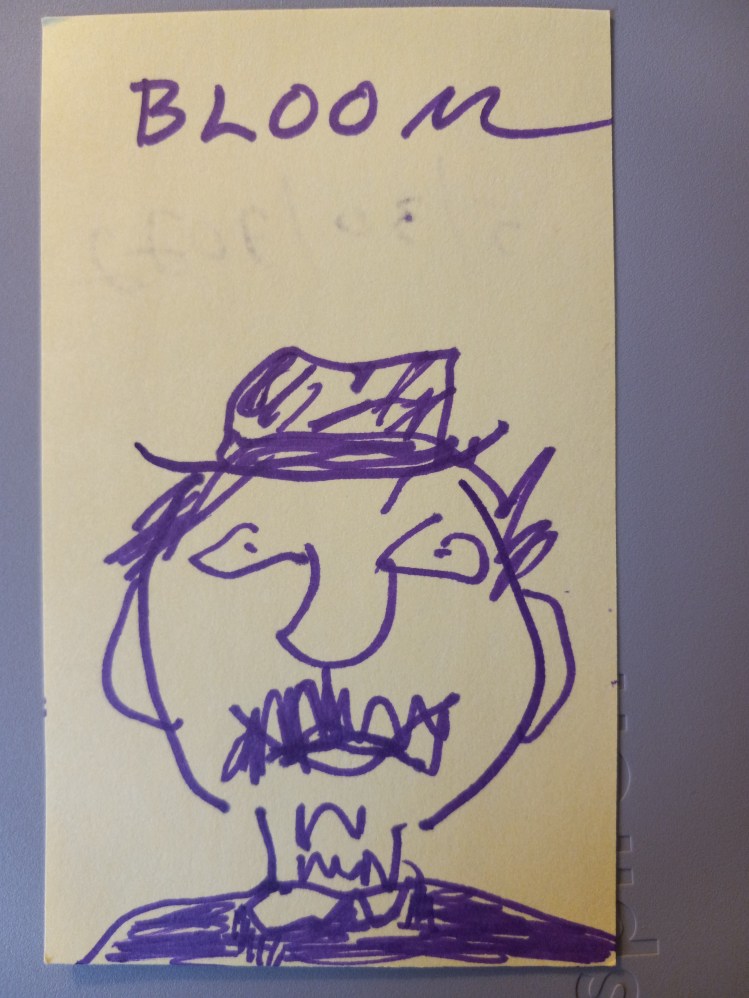
(Leopold Bloom at U., original drawing by DWB)

Transformed

Moments of transformation have been the stuff of literature ever since there was literature, and even before there was what we call literature, only the raw materials of literature (language, experience, and imagination) being shared around the campfire, and probably, at a deep, internal, and shared level, even before there were campfires.

This small offering with three titles (below) is my contribution to the language and literature of transformation, not that I haven’t tried it before and won’t try it again, too.

But here I think I managed to capture it pretty good.

I don’t know where the Muse comes from for any of us. But I do know that muses do exist, with both capital and small M’s; and I do know too that poetry itself is the original art, the biggest art, the most common art, the rarest art, the simplest art, the deepest art, the widest-ranging art, the hardest art, the easiest art, the most neglected art, the longest-lasting art, the poorest-paying art, the purest art (in its purest forms), and the most relatable art, for everyone, of all.

Everyone’s last words are poetry. So are their first ones. Harold Bloom rightly called Jesus the poetry of America. Miguel de Cervantes used to stalk through the streets of whatever city he lived in at the time, searching for words, looking for poetry.

In the last few decades of his life, Pablo Picasso started pumping out a LOT of poetry, and went so far as to go around telling everyone he knew that he wasn’t really a painter, he was a poet, and that thousands of years from now, no one would even remember his paintings and drawings – but they would remember his poetry.

I have absolutely no idea whether that is true or not.

All I know is that Pablo was a genius on the level of Einstein, or probably higher – and he said it.

Everyone else can turn into a machine if they want to.

I’m gonna remain human.

Signed,

The Drifter

Poetry The Teacher, Or:

New Knowledge, Or:

The Invisible Blue Butterfly Forever

I was walking

around in their house

trying to clean

my pipe

with a broken coat hanger

when it happened

and I literally

dropped my pipe and

the coat hanger and

stopped in my tracks, yes,

as if I’d seen

a ghost. Next, I felt

nailed to the spot, as if

my feet had been

nailed into the floor

and my hands

had been

nailed into the air

but almost without

physical pain, I was

looking, staring into

the distance with

wild and rapt

eyes. I was, as so

often lately, alone,

but I was also not

alone as the hosts, the

ghosts of all the poets

who’d ever come before

me were humming

through my blood

and before my eyes –

only for

an instant.

When I say

all the poets,” I also

intend the oral poets

who’d written in air,

for our ears, hearts,

and souls,

for thousands

and thousands

or more

years before

“literacy” began –

the anonymous ones

who weren’t anonymous

at the time, not to

themselves

anyway

and what else

matters

in the end

or even the

beginning or

the middle,

really,

truly.

A life-changing

instant; a one-of-a-kind

moment. I had no

idea

in this spot of time

where that

had come from;

way too sudden.

One instant this,

the next instant

something else

entirely, forever, no matter

what; like a mermaid’s snap

of her magic fingers or a giant

monster of beauty

shaking a rag doll

in sadness and gladness.

Instantaneously

turning

from caterpillar into blue,

if invisible,

butterfly. Without even

knowing

you’d been

a caterpillar in

the first place!

The invisible blue

butterfly now, no matter how

impossible

it sounded.

I took up

the pen

which had as if

magically appeared there

for me

and the paper

and slowly wrote down

the first

Word.

The Drifter ((otherwise known as Dale Williams Barrigar)) drifts from here to there while always maintaining a center that is always centered upon The Arts, with the oldest of Arts at the center – usually.

The Encounters (The Mantis Prays) by Dale Williams Barrigar

(Note–Moonfog wouldn’t appear today because he is moody. But, fortunately, Dale Williams Barrigar has rescued this Wednesday from emptiness and overall non-existence-Leila)

(Cool image provided by DWB)

The Encounters

      “What the white whale was to Ahab, has been hinted;

        what, at times, he was to me, as yet remains unsaid.” 

         – Herman Melville

I turned around and an exceedingly large, unbelievably green, and massively intimidating Praying Mantis had landed on the outside door handle of my door.

S/he had appeared there so suddenly it was as if s/he literally, magically appeared there, just materialized there, out of thin air, out of thin, thin air, or out of nothing.

And it was strange, because that door handle was the place I had been about to put my hand on one second ago. I had been unconsciously reaching out, planning on grabbing the handle, opening the door and entering my apartment – until I saw the massive Praying Mantis sitting there, perched on the handle, and utterly staring at me with an animal intensity which was unnerving at best, at least until I got a handle on things. This kind of animal is hard to brush off with a flick of the wrist. I almost literally couldn’t believe how BIG it was. Big, large, huge, and also gigantic, even gargantuan, at least in terms of a bug. 

Then I got a handle on things. And I realized how cool this was! It was like the time I’d been walking on a trail in Denali National Park in Alaska and I looked up and there was a lynx standing on a log staring at me with its incredibly green, intense, and wild eyes

A few old-timers in Alaska, both Native Americans and white folks, had already told me how very rare and unusual it was to see a lynx in the wild when I’d asked around a little bit about this in the bars of Anchorage and Fairbanks. Then I looked up and there was an f-ing lynx staring at me. It was one of the wildest and coolest moments I’ve ever had in a life filled, you could even say blessed, with lots of wild and cool moments. 

And now here was this Praying Mantis. Somehow, here in urban Illinois outside Chicago, this wildlife and nature encounter was just as intense and jarring and cool as the experience with the lynx in Alaska had been, even though the animal involved this time was a whole lot smaller. 

But if you’ve ever seen the eyes of a gargantuan Praying Mantis up close you know this thing can give you the chills on many levels (both good and bad). 

Their eyes are so similar to ours, and at the very same time so vastly different from ours, that anyone who’s even half awake will be freaked out by this – in both bad, and good, ways. 

I turned around again to take a picture and The Mantis was gone.

Notation: The following poem contains the scientific and cultural facts about The Praying Mantis researched after the fact of the above encounter, and all boiled down into an “awkward” and lyrical free verse style which intends to mirror The Mantis him- or herself in their incredibly uncanny, bug-like, alive, here-I-am-now selfness.

The Mantis Prays:

Written for Classical Guitar

The Mantis lays 

her eggs in fall.

Then she quietly dies.

The Mantis dives out of the air

to escape 

the haunting huntress bat.

And she sighs 

prior to dining

on the cricket’s hat.

In China they will tell you 

she is fearless.

And nothing can contain 

her spirit fair.

The eyeballs of The Mantis are 

black, and very there.

She lives 

through the air,

she hides in her own 

kind of cave.

The Mantis is a creature 

of myth

who we share this planet 

with.

She is as real as the day 

in your hair.

Her arms, legs, wings 

so greenly

and transparently 

going 

and glowing.

She lives for one year before

her race is run.

Maybe one year before

her day is done.

Only one year, before

she folds her wings, 

and tells

her eggs 

the way 

to find the sun.

Dale Barrigar, Doctor of Philosophy, is a Melville scholar from Chicago who also admires the lone wolf writer style which Melville perfected many, many decades ago in America, bestowing a future gift on all of us amidst his myriad worldly failures, which he knew he would.

Dale Williams Barrigar: Forever

(“Dog pack in a line”–image provided by DWB)

(Note from Leila–I want to thank Dale for classing up the place this week and assure everyone that you will see plenty more of him in the future; his next appearance is scheduled for 4 June, next Wednesday. Please check out his work, especially in his field of “Fictional Essay” which is not a contradiction, on Literally Stories UK.)

“All those flowers that you never grew – / that you

wanted to grow / The ones that were plowed under – /

ground in the mud – / Today I bring them back / And

let you grow them / Forever.” – Bob Kaufman

“I drifted down deep / In sleep on my open book. /

At once a marvelous vision took / My dreaming mind away…”

– Geoffrey Chaucer, The Book of the Duchess

“Hark how the Mower Damon sung, / With love of Juliana

stung!” – Andrew Marvell, “Damon the Mower”

“Nicodemus saith unto him, How can a man be born when

he is old?” – The Gospel According to Saint John

When Samuel Taylor Coleridge met William Wordsworth, he realized very

quickly that there was only one William Wordsworth, and there would only ever

be one William Wordsworth – forever.

***

Ted Berrigan’s tombstone says, “Nice to See You.” Ted also said in a poem,

“I don’t feel / a necessity for being a mature person in this world. I mean / all the

grown-ups in this world, they’re just playing house, all / poets know that.”

In another poem Ted said: “I’m only pronouns, & I am all of them, & I

didn’t ask for this / You did / I came into your life to change it & it did so & now

nothing / will ever change / That…”

***

Two American writers 2,100 miles apart in different towns at different

places and different locations both rescue the volumes Sandburg wrote about

Lincoln from dusty obscurity in the places they rescue them from, never knowing,

of course, that the other was doing this too, 2,100 miles away, until they find out

about it later. Carl Jung called such a happening synchronicity, and I call it literary

synchronicity, of the highest kind.

***

The following poem is written for the children still among us, or rather the

young inside at whatever age we are, like Bob Dylan’s album Christmas in the

Heart, all year long.

***

Hunter S. Thompson’s friend and occasional writing partner Warren Zevon

died two weeks after releasing an album called The Wind which opens with a song

called “Dirty Life and Times.”

In that song, Zevon says, “Now they’ll hunt me down and hang me for my

crimes / If I tell about my dirty life and times.”

***

This is a world

where things of lesser value,

made with lesser efforts,

all get equal time; and that

crushes the precious gems

down into the dust.

Two Siberian Huskies, the Foggy Haunted Deer,

and the Pitbull Sidekick in Foggy Illinois, 12/28/’24

Or: Dogs and Deer Poem

For Leila Allison

All three dogs in their harnesses strain and pull

against their leashes, they pull and strain toward

the deer herd as we walk together at Christmas

season, three black and white dogs, and I.

Boo, friendly pack leader, who almost

looks like a wolf, and he looks like a wolf,

and he looks like a wolf to most, now he

leaps high into the air at the end of his leash.

Colonel, friendly hunter, lean Sancho Panza, is

serious about this, it’s maybe he who’s pulling the

hardest, it’s maybe him who would go for the kill,

hardest, if he had to, and he may have to, but not now.

Bandit, civilized lady, the queen, or the princess

some days, depending on her mood, sticks close

by my side, not here to kill deer and none of us

are, in her own soul, she’s here to protect me.

Wreathed in the unseasonal fog that drifts two

antlered deer toward us, three who appear to be

mothers holding back the three or four fawns

disappearing, or blending into the heavy thorny

branches of Christmas season thick hedge row

desolation as I strain and pull the dogs along.

In Miller Meadow along far Roosevelt Road

in urban Illinois. In the parking lot, four old

black men huddled together smoking their bud

around a trash can fire, someone’s echoing laughter

is a small boon across the gloomy, grassy field.

On his death bed, James Joyce

finally asked the first and last question

that ever occurred to him in this world

out loud, why does no one understand.

Dale W. B. lives in the Land of Lincoln.

Epokha by Dale Williams Barrigar

(“Boo in broken chair by pile of books”-provided by DWB)

In the mid-1860s Feodor Dostoevsky published his prophetic, hilarious, tragic novella Notes from the Underground, or Letters from the Underworld, in his own magazine, Epokha, or Epoch, which he edited with his brother, Mikhail.

Epokha was a short-lived, monthly literary magazine which fell apart after less than two years due to the death of Mikhail, plus more of Feodor’s endless financial problems, never helped by his occasional crazed, maniacal gambling binges.

But Dostoevsky’s self-published novella has never fallen apart. This work takes its place on the vast stage of nineteenth century Western literature as one of the most profound, influential, lasting and memorable works created in that century of upheaval, horror, and beauty which produced so many grand, great and good works.

Dostoevsky had been converted from a skeptical, stoical agnostic into a believer by his time in the Siberian prison camps. He was sent there, after a mock execution which turned him into a full-blown epileptic for life, for reading and disseminating revolutionary literature. Not for planning to instigate a revolution, only for reading and passing on material which criticized the czar and the oppressive ways of Russian life.

Only one book was allowed in the prison camps. Dostoevsky was already extremely familiar with the Bible, just as all Russians of his place and time were. But in Siberia, when it became his only reading material, he went deeper, much deeper than he’d ever gone before.

It was the life and teachings of Jesus and his apostles as presented in the Gospels and the rest of the New Testament which converted Dostoevsky into a believer.

He read the life and stories of Jesus in the same way he’d read secular literature before he was sent to Siberia, which is to say as creative writing, in other words as ART.

Jesus said, Where two or three are gathered together in my name, there am I in the middle.

My poem “The Halloween Crow” is very much a take-off on Dostoevsky’s Notes from the Underground, since my poem is a kind of letter from the underworld from a narrator who has a lot in common with Dostoevsky’s underground man.

This poem contains the phrase “light of the body,” another quotation from Jesus.

The light of the body, in my poem, is the small flame of the seer, the truth-sayer, and the silent poet and while there are very few of us in the modern world, there are also many among us on another level.

Harold Bloom called it the “saving remnant.” Bloom wrote, “Even among Jews, that small, isolated race, Jesus himself seeks only a saving remnant.” Bloom, himself a Jewish genius, and not a believer in the divinity of Jesus, said that Jesus was the greatest genius who ever lived, smarter than all the other geniuses who ever lived put together.

Wallace Stevens wrote, “How high that highest candle lights the dark.”

This poem is based on a real incident and a real bird in a real place at a real time. The words, with no wordiness, are an effort to capture this experience.

Edgar Allan Poe, who also published most of his own work in magazines he himself edited, was one of Dostoevsky’s favorite writers. Poe’s mad monologists influenced Dostoevsky’s Underground Man, who in turn influenced Ralph Ellison’s Invisible Man, among other masterpieces, like Kafka’s “Metamorphosis” and The Stranger of Camus, Howl by Ginsberg and much of Nietzsche.

On his way to Siberia, Dostoevsky wrote in a letter to someone: “This is my last message to you. In sorrow, seek happiness.”

The HALLOWEEN Crow!

He sat high across the way from

me in my midwestern town.

He was perched on the old

pinnacle of the opposite, gloomy,

semi-urban apartment building

outside Chicago.

But only for a moment.

I saw him land there, sitting.

Then he swung, out toward me,

like he flew right to me from

across the street, Houdini in

black feathers toward my second-story

apartment window where I sat

in my broken chair, my Siberian Husky

Bucephalus beside me

dreaming of Mary.

I was in my chair, but flying.

I WAS IN MY CHAIR BUT

FLYING ONLY FOR A MOMENT

then with good old Mr. Edgar Poe Crow.

Check out the Halloween Bird, bro!

And we were flying together, both he

and I being so high together, flying

in that imaginary moment to where

the sky broke open (which happens

when you die).

And the shot thought was thought

like a thought shot through me:

the Christ-like

light of the body is seen as demonic

by these moneyed sinners.

He was flying right toward me

and for me.

Before he disappeared.

While waving goodbye, goodbye!

d.w.b.

D. Williams Barrigar lives in the rough-edged, blue-collar midwestern suburbs and sometimes the woods. His connection to the underground remains strong and proud. He assiduously avoids the affluent suburbs and all other locations whose well-manicured parks and lawns are almost invariably posted with uptight signs which declare: “No Dogs Allowed.” The underground allows, and celebrates, dogs. You get looked down upon a lot; but it’s also much easier to avoid surveillance, enough to maintain your sanity most of the time – in the underground.

Dale Williams Barrigar: Man of Sorrows

(“Likeness of Luke the Drifter”–provided by DWB)

I write this on May 4, 2025.

My mother passed away in May of 2011. I often used to listen to Townes Van Zandt’s classic song “Sanitarium Blues” on my way to and from the various dementia wards she was incarcerated in for the last six or so years of her 69-year-long life.

I visited her religiously multiple times per week for every single week she was in there.

She had a form of dementia which was not quite diagnosable in conventional terms. For me, she’d turned into a kind of silent saint who’d purposefully, but also not on purpose, removed herself from the madness beyond the walls, i.e. early twenty-first century USA.

She could see it all coming. She always knew who I was. I knew this from the way she always looked at me with a silent knowing which told me she knew exactly who I was.

In May of 2012, my (now ex-) wife was diagnosed with breast cancer two weeks after we (mutually agreed upon) split up.

In May of 2013, I was forced to cut off all contact with a very special friend, a red-haired, blue-eyed, brilliant Chicago stage actress who had offered me enormous consolation at one point but whose multiple personality disorders were no longer allowing me to be myself, as they say. Anyone who’s ever been deeply entangled with a partial (sometimes full-on) narcissist who also possesses histrionic, borderline, and occasionally substance use disorders, not to mention an endless talent for cheating on you and covering her tracks continuously even though you know something’s up anyway, will understand how horrible and draining such a relationship, and breakup, can be (including having to look over your shoulder at night for a while). (Perhaps truer words than these were never spoken: I do believe her, though I know she lies.” – Mr. Shakes.)

In May of 2014, I lost my job after a total of fifteen years working at the same place.

In May of 2015, I suffered a mental breakdown that was occasioned by a pill addiction that (accidentally) caught me in its grip.

In May of 2016, I was slammed with fresh waves of grief over the passing on two months earlier of my beloved dog, sidekick, assistant, friend, and family member, Cowboy Brown Barrigar.

In May of 2020, George Floyd was crucified on national TV, an event that shook me far deeper than I can even describe right now.

In May of 2024, I suffered a stroke at the age of 57. (Fully recovered now.)

I can’t remember right now what happened in May of ’17, ’18, ’19, ’21, ’22, ’23, etc., but somewhere in there, there was a pandemic and there are probably a few other tragic events I’m leaving out, but you get the picture.

And yet I still love the Merry Month of May. I love it for itself, and I love it because I love and appreciate all the months, and all the seasons, of the year. I love and appreciate them all because I don’t know which month I’ll be leaving this Planet during. I also never know how many more times I’ll be seeing the Merry Month of May roll around, so I want to appreciate this one just in case I happen to miss the rest of them.

My poem “Chicago Spleen” is a bounce-back poem, kind of like how the plants all bounce back in May in northern Illinois where I live. “Bouncing back” means not letting it get you down, whatever “it” is. It does NOT mean we do not sometimes EMBRACE our depression, horror, anxiety, and sadness. Pretending everything is A-OK when it manifestly is NOT ok can truly be a fool’s errand. On the other hand, when we consider the fact that this might be the very last time on Planet Earth we ever get to see whatever month we’re in at the time, it gives one pause and makes her or him wonder what’s really worth getting all upset about.

Herman Melville’s book-length poem CLAREL has probably been read in its entirety by less than fifty people, ever, on this Planet, and that’s no joke.

It ends with these lines: “And even death may prove unreal at last / and stoics be astounded into heaven.”

Notation: The title of my poem is a reference to Charles Baudelaire’s Paris Spleen, a small book, a thin, vast work that has a magical significance for me, AND for the protagonist of the following poem.

Chicago Spleen; or, The Christmas Decision

A writer decided to try and hammer

together her book once

and for all

on Christmas Eve

of 2013 CE.

When the decision hit,

for some reason she

looked over at

the clock

on the wall

of the bus station.

Okay. 7:46 P.M.

Central Time in the United States

of Illinois, 21st century

blues-return

style.

46

was her favorite

number.

She didn’t know

why then, but she knew

there is always a reason.

Every time she saw

that number,

she would think

it must be

something good, like

a positive warning

that something good

was coming even if

it never really came

or it had already been here

before that

even though you didn’t

know it – until

now.

She didn’t go running

around the streets telling

anybody about it.

She just thought it,

it sitting

quietly there

in her mind

because she

told herself

(out loud),

“I have trained

my mind.”

She also believed

(like so many others

of us) that 7

is a heavenly

number.

When she saw the “7:46”

of the digital wall clock flashing

at her, like a meaningfully

meaningless wink, her “I”

decided again to try

and commit to this.

Even though, or maybe

especially because,

she found herself

sitting in a bus station

by herself

on Christmas Eve.

Even if it makes her

die the deaths, the endless

deaths,

she thought

to herself.

Even if it makes me

die the death!

She told herself,

and the rear end of his bus,

as his bus

disappeared.

Dale W. Barrigar is a poet and shirt sleeves religious philosopher from Berwyn and Oak Park, Illinois, USA, where hover the ghosts of Frank Lloyd Wright and Ernest Heminway whose spirits are endless inspirations around every corner. Barrigar was transformed into a believer in miracles by the hard knocks of life.