Guest Writer: The Great Book of Angharad by Michael Bloor

(Note: I forgot to mention yesterday that this week features pieces Mick had published on sites that have since fallen into the ominous black hole that publishers do our best to avoid. Still, no longer is is not the same as never was; therfore this highly entertaining work was published by Occulum in 2017–Leila)

     They keep asking me why I did it. Then, as soon as I start to explain, D C Grainger butts in with: ‘Was this on the morning of June 11th?’ I deal with that and then D C Singh chimes in with: ‘Did you tell anyone that was where you were going?’ I struggle past that, and then as soon as I get to the bit about the Holy Spring, I see ‘em exchanging those ‘Has he escaped from the funny farm?’ looks. A dispiriting business for a university professor accustomed to a respectful audience. So I’m setting it all down on paper. And then I’m not telling the police another bloody word.

     I live in Scotland now, but most years I manage a visit to my mother’s country, the Welsh Borders. When I was a child, I used to spend every summer holiday in the Abergavenny house of my grandparents, Harry and Gladys Cecil. The little town is surrounded by seven hills, but for a child the hill that holds the greatest glamour is the Sugar Loaf (its Welsh name is Pen y Val), which looms over the north of the town. Every summer, I would pester Grandad Cecil to re-tell the story of how Buffalo Bill brought his Wild West Show to Abergavenny in the summer of 1903. Grandad had been one of the children in the audience when Buffalo Bill vowed to his audience that he would walk up the Sugar Loaf. And that’s just what he did the next morning, accompanied by half the adults and all the children of Abergavenny.

     Bear with me. I’m trying to explain that the mountain exerts a strange pull – even a hard-bitten old-timer like Buffalo Bill could feel it. It remains a big draw today and the most popular routes have carparks at the foot of them. For sentimental reasons I take a less travelled route, setting out from Deriside (where my grandparents lived), crossing the ford by Harris’s farm, round the foot of Rholben, and up St Mary’s Vale. Just like the Sugar Loaf/Pen y Val, St Mary’s Vale has both an English and a Welsh name. Granny Cecil said that the Normans conquered the broad lowlands, but the Welsh always held the hills, and the head of the Vale is known by its Welsh name Cwm Trosnant, which means the valley of the three springs. St Mary’s Vale starts out as a gentle valley covered in beech woods. In June, the leaves are a dizzying, iridescent green, squirrels dart up the towering grey tree boles and scold you – ridiculously – from the upper branches, the stream splashes over sandstone pebbles. Again, I’m telling you this because you need to understand the pull of the place.

     As you make your way up the Vale, it narrows and the great beeches give way to stunted oaks and thorn trees – you’ve crossed an invisible border into Cwm Trosnant. Near the head of the cwm, the path strikes off steeply to the right and the hidden summit of the mountain. Just a few metres onwards and upwards, the path passes by one of the three springs from which the cwm gets its name. It issues, cold as your fridge, from the roots of a thorn tree. As a child, sixty years ago, I often stopped to watch the mysterious welling of the waters out of the earth and into the light. I would dangle my hand in it, but I never drank from it, mindful of my mother’s frequent warnings of the dangers of polio – the great child killer of the 1950s. The springs of the Welsh hills were holy places, a source of wonder, even before the coming of Christianity. Hermit saints understood the mesmeric attraction of the springs and built their churches beside them. Even today, there’s an isolated, ancient church beside a spring a few miles from Abergavenny, where pilgrims still leave spring-side offerings. Sixty eight years old and no longer bound by my mother’s injunctions, on that June day I bent down and cupped my hands to drink.

     Bending down to the clear, bubbling water, tasting it on my parched tongue, I had a sensation of the world behind me being progressively suffused with brilliant light. As I lifted my head, I was entranced to see the cwm transformed. It was still a narrow upland valley, but instead of the bracken, thorns and stunted oaks, there was a miraculous pleasance. I say ‘pleasance’ rather than garden, because I knew instinctively that this was no modern landscape. There were roses, lupins and hollyhocks; the thorn above the spring had been replaced by an apple tree suffused with blossoms. It was as if I was in Tennyson’s ‘island valley of Avilion… fair with orchard lawns and bowery hollows’ where King Arthur was carried by barge after the Last Battle. Enchanted, I turned to see a woman in the middle distance, walking towards me. Her beech-green dress, which swayed about her body as she walked, was long and trailed among the daisies at her feet. Her red-gold hair was coifed above her brow but fell about her shoulders. Her face was solemn and ageless.

     She spoke to me in what I took to be Old Welsh (as a child, I learned Welsh from my mother), but I could make little of it. She switched to English, spoken clearly but with the punctilious correctness of a foreigner:

     ‘Well met, Michael, son of Mary, daughter of Henry. Long have I waited for you here beside the great spring of Taliesin Ben Beirdd. We are kin, you and I, because I am Angharad, wife of Sitsyllt ap Dyfnawl.’

     I knew the name. The slaying of Sitsyllt is a well-known piece of Abergavenny local history. In 1177, William de Braose the new Norman Lord of Abergavenny, invited around seventy leading local Welshmen to a Christmas feast in his Great Hall. Among them was Sitsyllt of nearby Castell Arnallt, a formidable warrior. As was the custom of the time, the Welsh nobles, surrendered their weapons before entering the dining hall. Once the Welsh were all assembled, they were set upon by de Braose’s men-at-arms and slaughtered to a man. The men-at-arms were then dispatched to Sitsyllt’s Castell Arnallt, which they destroyed and took Sitsyllt’s wife, Angharad, back to Abergavenny as a prisoner. Sitsyllt’s kin eventually anglicised their name to Cecil, my mother’s maiden name.

     ‘Those of Sitsyllt’s kin who drink at Taliesin’s spring receive the gift of true sight, but they are also honour-bound to strive to remedy the dishonour done to Sitsyllt’s house and name. Do you accept the obligation I shall lay upon you?’

     I nodded. I could scarce do otherwise.

     ‘Very well. I know you are a scholar; I give you a scholar’s task. Among the booty from the sacking of Castell Arnallt, the Normans took away my Great Book. The court of my brother, the Lord Rhys of Deheubarth, was the greatest centre of learning in all Britain: bards and sages, harpists and holy men were all welcomed there and competed in the recitation of the laws, the lineages, the ancient wisdom and the holy truths. By the bidding of my brother, I wrote down all that was good and true, and I bore that book as a love-gift to my husband, Sitsyllt. The Great Book has passed through many foolish hands since the Norman theft. Finally, a drunken sot of a clergyman willed it to his old college, Dodson College, Oxford.’

     She saw my look of surprise. ‘Yes, it lies in the library of your old college, unexamined and uncatalogued, stored as the bequest of the late Reverend Pugh. You must right the wrong and return the book to me, here on Midsummer’s Eve. Take this ring: when you come back with the book, throw the ring into Taliesin’s spring and I will return to you, with my thanks and the thanks of all our kin.’

     The ring was of a curious, twisted, gold-filigree design. It was too small to fit on my finger. I slipped it into my pocket and went back to the pub where I was staying. I checked the Dodson College website on the internet. I was dismayed to find that the college librarian was an elderly, retired party who had been a don in the college when I was an undergraduate there fifty years ago. A colourless individual who had adopted a pipe in lieu of a personality, but nevertheless possessed a certain capacity for mischief and fussy cantankerousness: his nickname was Gollum (I know, I know: first a gold ring and now Gollum turns up – where have you read this before?). I realised then and there that there would be no sense in appealing to the college authorities to restore The Great Book to the Cecils: I would simply be alerting the college to the fact that they had overlooked a valuable asset which they could flog off. Instead, I’d have to steal it, albeit knowing that I had justice and history on my side. I checked out of the Black Bull pub that evening and before ten o’clock I’d checked into a bed-and-breakfast in a village outside Oxford.

     I went for a reconnaissance the following morning. I was amazed to discover how little the college had changed. The library was still housed in the same cramped quarters and contained the same out-of-date texts, translations and bound periodicals. There was no space to store uncatalogued volumes. I guessed that they would have been dumped in the cellars. There were two different sets of cellars: the wine cellars beneath the dining hall appeared to have a formidable door and lock; the other cellars, in the same bloc as the library, had a neglected appearance and a simple clasp lock on a fragile-looking door – child’s play, I thought.

     I bought a jemmy and a powerful torch and waited for dark. I confess that I was rather enjoying myself. The college gates were no longer locked in the late evening, but the porters’ lodge still housed a night porter, so I decided to climb in using the same route that I’d used fifty years ago, via the bike sheds. This proved more difficult than I’d anticipated: the spirit was willing, but the flesh had withered. I sustained a nasty graze, a sprained ankle and a ripped jacket, but I got over. In contrast, the hasp on the cellar door was a breeze and came away like cobwebs.

     There was lighting in the cellar, but it wasn’t working: I hunted for a mains switch in vain. In the torchlight, the crowded cellar contents looked as a chaotic as an earthquake in Legoland: there were piles and piles of discarded furniture, tea chests filled with the abandoned possessions of past generations, some old lead piping, tied bundles of papers, ancient chemical apparatus, a battered croquet mallet… It seemed that, unless I was very lucky, the search would take more than one night. My dust allergy kicked in right away, but I stuck to the task. After an hour or so, I did come across an open tea chest full of books, but they proved to be the abandoned private library of past undergraduate, seemingly someone of my generation – I recognised ‘Zen and the Art of Motorcycle Maintenance’ and RD Laing’s ‘Divided Self’. Underneath it, was a closed tea chest, which I assumed contained more of the same, but when I jemmied it open I saw it contained hardback books from an older period. I flicked open the topmost book – a collection of sermons – and on the flyleaf I read ‘Ex Libris Reverend Augustus Pugh.’ Oh Joy.

     The Great Book of Angharad was right at the bottom of the chest. It was a massive thing that looked to have been re-bound at some point, with metal-edged leather covers and a clasp. I heaved it out the chest and opened it up at random – a foolish thing to do, because the eight-hundred-year-old pages were very brittle. Part of a page broke off as it was opened. I shut the book and closed the clasp, but not before I’d satisfied myself that the writing seemed to be in Old Welsh.

     ‘Well, well, if it isn’t Guy Fawkes!’ Two torches snapped on. In surprise, I dropped The Great Book back in the tea chest. I then dodged behind some derelict desks, deeper in the cellars, but the two police patrolmen quickly picked me out again. It seemed I’d been betrayed by my dust allergy: the night porter on his rounds had heard the sneezes, found the broken lock on the cellar door, and called the cops.

     The charges I was facing were ‘breaking and entering’ and ‘criminal damage’ – the college authorities claimed I’d destroyed the roof of the bike sheds. At first, I refused to say anything, beyond giving my name and address. But the duty solicitor at the station persuaded me to explain what I’d been doing in the cellar, saying it would look better in the magistrates’ court. So I told him. A few hours later, I told the same story to the two detective constables in the interview room. They plainly thought I’d lost a marble or two when I fell off the bike sheds, but they sent a constable round to the cellars to see whether there was indeed a big book in the bottom of the tea chest. He found Gollum, the librarian, there ‘checking whether there was anything missing or damaged.’ The tea chest was empty.

     Well, maybe I have lost a marble or two, DC Grainger and DC Singh. But how would you explain Angharad’s celtic ring, safely hidden in my washbag at the B&B? And it’s plain to me who has snaffled The Great Book. I sense a second family connection here: Gollum’s surname is ‘Pugh.’ I suggest you get a search warrant.

Michael Bloor lives in Dunblane, Scotland, where he has discovered the exhilaration of short fiction, with more than a hundred pieces published in Literally Stories, Everyday Fiction, The Copperfield Review, Litro Online, Firewords, The Drabble, The Cabinet of Heed, Moonpark Review and elsewhere (see https://michaelbloor.com).
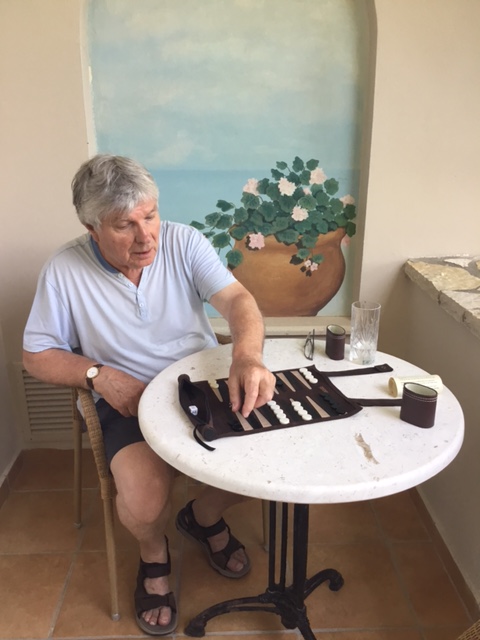
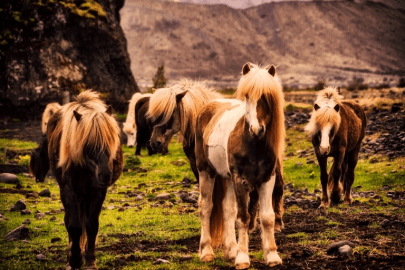
A Conversation at Pisgah by Michael Bloor

(This week Michael Bloor returns to the Springs. We are always pleased to run stuff by Mick. This one shows his wonderful ear for language-LA)

As I crested the ridge, I saw the figure in the middle distance, staring out eastward. I thought at first he was watching the hang gliders: Hatterall Hill, on the eastern edge of the Black Mountains of South Wales, is a favourite weekend haunt for these enthusiasts, if the winds are favourable. And the hang gliders cater for two kinds of spectators – those who admire the graceful and those who love the comic. I’m afraid I used to belong in the latter category, happy to eat my lunch watching these masochistic individuals launch themselves and their wings off the ridge and into the wind, only for the iron law of gravity to assert itself, so that man and machine would tumble into the bracken and scrub on the lower slopes of the hill. I never witnessed any of these poor souls coming to serious harm. Instead, they would laboriously disentangle themselves from their machines and the scrub, drag themselves back up the slope, lurch momentarily into space again, and then plunge earthwards once more, for my further entertainment. I would find myself wishing that my old Dad could have seen the show: slapstick was his favourite form of comedy.

However, familiarity has lately dulled my own appreciation of the hang glider spectacle and so I pressed on, past the Iron Age ditch and rampart, towards the summit of the ridge and its solitary occupant. The nearer I approached him, the more attractive he became: a sturdy guy of medium height, with a longish grey beard and tousled grey hair, a great cloak, negligently worn – he reminded me of photos of that eminent Victorian poet, designer, and revolutionary, William Morris.

Quickly, I confirmed my impression that he wasn’t studying the varying fortunes of the hang gliders. He was looking way out to the eastward, taking in a view of a verdant landscape that familiarity can never dull: the mile-after-mile-after-mile of patchwork, rolling, Monmouthshire and Herefordshire countryside – fields and woods and wandering streams, all miniaturised for a Giant’s delight.

He turned at my approach. I nodded. ‘A fine day and a fine view.’

He nodded in turn. I asked if it was his first visit to Hatterall Hill. The ridge attracts quite a few holiday walkers, being on a well-known, long-distance footpath, The Offa’s Dyke Path.

‘No sir, I am not a visitor to the hill. I dwell in its shadow, though I call it “Pisgah”, not Hatterall.’

The slightly formal speech and his clear enunciation made me think that English was not his first language: he was a native Welsh-speaker, a minority in this part of South East Wales. I recognised his Biblical reference too, having been raised as a Chapel-going Methodist, and I responded: ‘I understand. We are standing at Pisgah, and like Moses, I take it that you’re privileged to gaze upon The Promised Land, but you’ll never have it for your own?’

‘Correct, my friend. But perhaps you think my claim would be extravagant. Allow me to introduce myself, I am Owain Glyndwr, the last native Prince of Wales. The English know me as Owen Glendower. At one time, with my battle-hardened archers and men-at-arms beside me, I thought I could win back all those fair lands – fields, orchards, and pastures – snatched from us by the hordes of Saxons, Danes and Normans that bore down on my ancestors like plagues.’

I imagine that you will find it pretty odd that I didn’t, for one minute, think I’d met a mad man. On the contrary, I was attracted: he had far more than a famous name, he had bearing of a great man.

I knew a fair amount of the six-hundred-yearold Glyndwr backstory: after some very considerable early success, in battles and sieges, Owain’s revolt against English overlordship had eventually petered out. Despite a large reward being offered, he was never betrayed and Owain’s death was never announced. He simply disappeared and he has no known grave. Some authorities, I understand, have suggested that Owain, in defeat, went to stay quietly in his daughter’s and son-in-law’s house, a successor of which is still visible from this very hill.

I also knew that Owain was widely believed by his enemies to be a Mage, with esoteric knowledge and strange powers. I’m afraid that all I can truthfully repeat is that I didn’t take him to be mad. From the very first, I found him utterly believable, albeit six hundred odd years old.

He did not ask me to pledge my silence. And I feel a duty now to set down what I can remember of our conversation…

Glyndwr: ‘There was a time when all the land you see below us seemed about to fall to my arms. We had driven King Henry’s invasion force from the field at Stalling Down, nearly all Wales was under my control. I was crowned Prince of Wales as a direct descendent of Llewelyn the Great. I convened a Parliament at Machynlleth: we re-established traditional Welsh Law, and declared an independent Welsh Church. We drew up the Tripartite Indenture with Henry Percy (‘Harry Hotspur’), Earl of Northumberland, and Edmund Mortimer, claimant to the English throne. Percy and Mortimer would divide England between them. And all these Welsh Marches at our feet, all the lands west of the River Severn and the River Mersey would revert to the Principality.

‘If only Hotspur had brought his forces to join with mine outside Shrewsbury, instead of attempting (and failing) to defeat King Henry independently, then it might have all ended very differently.

‘So the chance, and the land, was lost. I was already long in years when the thieving and treachery of the occupying Norman overlords drove me at last, against my will, into revolt. So I was weary indeed, like Moses, when I came at last here to Pisgah.

‘But I am being discourteous, sir. I have seen you on Pisgah, more than once. Is your house nearby?’

I nodded: ‘I live down the valley in Abergavenny, Prince.’

Glyndwr: ‘Ah, Abergavenny. You will know that I seized Abergavenny castle and burnt the town to the ground. I burnt all the towns of the merchants that had grown up in the shadow of the castles of the Norman overlords. My own people counted their wealth in cattle, not in coin.’

‘I understand. You wished to return Wales to the world celebrated in the old songs of the bards. And you almost succeeded, Prince. Your skills as a commander were legendary. Your enemies called you a wizard, able to control the elements on the battlefield…’

He laughed deeply: ‘That was foolish talk of men who knew nothing of the weather lore in the Welsh mountains. But it is true that I had a fine library of many strange subjects before my enemies burnt it down. And the bards, like my old friend Iolo Goch, were welcome at my home with their tales of the old wisdom. In the old stories, did not the wizard, Gwydyon, fashion a living bride out of flowers for his nephew, Lleu? Summoning storms would have been a small matter to Gwydyon. The same old wisdom told that the greatest of the old heroes, Arthur among them, did not die. They are only sleeping. But, alas, much of that old wisdom was lost long before the Normans came to Wales.’

He was silent then, I hoped to draw him out a little further: ‘Much of it was lost, you say. But perhaps not all of it, Prince?’

Glyndwr: ‘Perhaps…’

He smiled, nodded, and turned to descend from the ridge. A sudden breeze ruffled his hair and beard. I knew better than to try to follow him.

Michael Bloor lives in Dunblane, Scotland, where he has discovered the exhilaration of short fiction, with more than a hundred pieces published in Literally Stories, Everyday Fiction, The Copperfield Review, Litro Online, Firewords, The Drabble, The Cabinet of Heed, Moonpark Review and elsewhere (see https://michaelbloor.com).

Agnostic Preview by Michael Bloor

(first published in Potato Soup Journal, July 5th, 2021)

(Ed Note–We hope you have enjoyed Michael’s return this week. We always do ourselves!–LA)

At first when I died, it was rather predictable. Beginning with that out-of-body-experience thing: I’m hovering, up near the ceiling, in the local Accident & Emergency Department, looking down on a rather battered and splattered me, plus an attendant nurse and junior doctor. Then it’s the dark-tunnel thingy, with a wee pin-prick of light that’s starting to get bigger and brighter, and bigger and brighter.

And then…. Pop! I’m in a largish, empty room with white walls. Now it starts to get different…

The white door opens and Leonard Cohen comes in. He consults his clipboard: ‘Hello, erm, Malcolm Barnstable? Welcome to the First Circle; I’m your guide. My name’s Cohen, Leonard Cohen. According to my records here, you were run over by a herd of dairy cows. We don’t get many of those.’

It took me a second or two to gather my wits. ‘Got you now: it’s Dante’s First Circle of Hell, for all those nice pagans. And you’re the stand-in guide for Virgil, as a fellow poet?’

‘That’s pretty much it, Malcolm. Call me Leonard, why dontcha? Virgil’s still knocking about. But, with the numbers coming in these days, he’s needing a helping hand. So Percy and I now do the English speakers.

‘Percy?’

‘Yeah, Percy Shelley. “My name is Ozymandias, King of Kings,” and all that.’

‘I see. Er, you’re not wearing laurel leaves on your brow?’

‘Nope, no leaves. They were offered, but I prefer the fedora – it’s kind of a trademark. But Percy wears the old laurel leaves. He said it was either that or some seaweed. You’re stuck with me because you’re down in the records as “agnostic.” If you’d been signed up as “atheist,” you’d ‘ve got Percy. You want your tour just now? Or would you like a spot of nectar first?’

I settled for the nectar, which I could definitely develop a taste for. As tactfully as I could, I asked about Leonard’s co-habitation of the Agnostic First Circle.

‘Yeah, yeah, I know. It’s true that, strictly speaking, I’m a Jewish Zen Buddhist, but that’s a pretty small constituency. And you might say that agnosticism is a central tenet of Zen Buddhist practice. Though if you had the inclination, I could nit-pick that one with you. After all, you’ll find you have plenty of time here for long discussions of abstract…’

And then: Woah! Oooff! Ouch! Suddenly, I’m back in Accident & Emergency.

Biography:

Michael Bloor lives in Dunblane, Scotland, where he has discovered the exhilaration of short fiction, with more than a hundred pieces published in Literally Stories, Everyday Fiction, The Copperfield Review, Litro Online, Firewords, The Drabble, The Cabinet of Heed, Moonpark Review and elsewhere (see https://michaelbloor.com).

Twenty-First Century Mr Chips by Michael Bloor

(first published in The Fiction Pool, September 9th 2017)

‘Hello. You have eight messages. First message, received Friday, May 20th at 6.30 pm…’

‘You dirty nonce! Messin’ with kids’ lives. I know where you live, you shit! I’ll be round to see you wi’ a pair o’ garden shears. Guess what for?’

‘Second message, received Friday, May 20th at 7.10 pm…’

‘Hello love. Where are you? Don’t tell me you’ve forgot again. I think those sleeping pills are making you a bit dopey. The meat’s spoiling. Lucky we both like it well done! Hoping to see you soon. I mean VERY soon. Lots of love, Lucy.’

‘Third message, received Friday, May 20th at 8.45 pm…’

‘Andy, it’s me. Your meal’s in the bin. Again. We can’t go on like this. I mean it.’

‘Fourth message, received Friday, May 20th at 11.52 pm…’

‘Still not pickin’ up, you nonce? We wuz discussin’ you in the pub. Someone suggested some petrol through the letter box. But I say: why spoil a perfeckly good ‘ouse? So we’ll still be bringin’ the garden shears. Thought you’d like to know.’

‘Fifth message, received Saturday, May 21st at 9.30 am…’

‘Andy, it’s Jonathan here. So sorry to call you on the weekend. But I wanted you to know that we had a school governors’ meeting last night. You’ll understand that I had to make the governors aware of the allegations against you. They agreed with me that we have only one possible course of action. I’m afraid that, in view of the seriousness of the allegations, you’ll be on gardening leave for the present. So please don’t show up on Monday. If you need to get in touch, it’s best that you do it through the Foundation’s solicitors. Sorry about that, but I’m sure you understand that the school’s good name has to be my first concern.’

‘Sixth message, received Saturday, May 21st at 7.20 pm…’

‘Well, I did think you’d at least have the decency to ring and apologise. I think, under the circumstances, we should cancel that holiday in France: you’ll probably forget to come to the airport.’

‘Seventh message, received Sunday, May 22nd at 2.15 pm…’

‘Andy, it’s Lucy. Are you alright? Came past and saw the curtains drawn. When you get this, please call back to let me know you’re OK.’

‘Eighth message, received Monday, May 23rd at 10.00 am…’

‘Mr Robertson, this is Detective Constable Brailsford here. I’m ringing on behalf of Detective Chief Inspector Williams. We wanted you to know that, following investigation, we believe the allegations that have been made against you are unfounded. The child who made the allegations has withdrawn them – they appear to have been malicious in intent. Off the record, I’d like to say that both my boys were previously pupils at the school and hold you in high regard. I’m sorry for the trouble that has been caused, but you’ll understand that, in the present climate, every such allegation or complaint has to be thoroughly investigated. If you’d like any further information, please feel free to ring me back.

‘You have no further messages.’

Biography:

Michael Bloor lives in Dunblane, Scotland, where he has discovered the exhilaration of short fiction, with more than a hundred pieces published in Literally Stories, Everyday Fiction, The Copperfield Review, Litro Online, Firewords, The Drabble, The Cabinet of Heed, Moonpark Review and elsewhere (see https://michaelbloor.com).

Chess Nuts by Michael Bloor

(first published in Potato Soup Journal, February 2nd 2022)

In the town chess club, the final of the annual Earl’s Cup competition was about to start, the finalists being Willie Anderson, the holder, and a new member, Archie Drummond. The club was a friendly, welcoming place, but there was a surprising coolness between Willie and the new member. Although Archie Drummond was indeed a new club member, he wasn’t new to the town, having been born and raised here before going away to spend his working life (profitably) in Hong Kong. Apparently, as young men, Willie and Archie had fallen out over a girl: there had been a memorable stramash in the Gents toilet at the old Mecca Ballroom. Forty-odd years on, one gathered that the ballroom bout was regarded by both parties as inconclusive.

Willie was setting the electric clock, with each player to make thirty moves in an hour, plus twenty minutes each to finish. Archie was studying the inscription on the solid silver cup, the oldest chess trophy in Scotland, presented to the club in memory of the Earl’s eldest son, Captain Albert Abercrombie-Smith, club champion 1876 & 1877, slain by Zulus at the Battle of Isandlwana, 1878. Silently, Willie showed the set clock to Archie for his inspection and was rewarded with a grunt of agreement. The traditional hand-shake at the beginning of the game was perfunctory in the extreme.

Other games were being played in the clubroom that night. But, as they ended one-by-one, the players clustered around the black-and-white battlefield where Willie and Archie were joined in silent struggle. The pawns clashed and fell, the knights leapt forward and fell back, the bishops obliquely threatened, the castles took up their defensive positions, and the overbearing queens stalked the board. The clock ran on, the moves became more urgent and the competition entered the endgame: the kings emerged from behind their defensive ramparts and began a dancing duel. A couple of stray pieces fell here and there, but to no clear advantage. With less than a minute left on his clock, Archie managed to force his last remaining pawn to the back rank, converting it to a queen. Unsportingly, Willie played on, hoping to avoid mate long enough for Archie to lose on time. Archie mated him with just three seconds left on his clock. The audience, hushed until that point, now erupted with exclamations, congratulations and rival theories of how alternative endings could have been contrived. In the hubbub, the customary concluding handshake was somehow omitted.

After a short delay, the club president presented Archie with the cup and a photo was taken for the website. Willie had left the room, but his prostate often required sudden temporary absences. The night was concluded and we all streamed out of the club. Archie Drummond bore off his cup in his BMW, like a Russian Prince in a horse-drawn midnight sleigh. Willie Anderson watched the tail-lights dwindle down the Kirkgate: ‘Weel, weel, he’s carried awa’ the cup, but I carried awa’ Dorothy, bless her.’

Biography:

Michael Bloor lives in Dunblane, Scotland, where he has discovered the exhilaration of short fiction, with more than a hundred pieces published in Literally Stories, Everyday Fiction, The Copperfield Review, Litro Online, Firewords, The Drabble, The Cabinet of Heed, Moonpark Review and elsewhere (see https://michaelbloor.com).

Commuting in Warsaw by Michael Bloor

(first published in The Flash Fiction Press, May 5th 2017)

Jenny Birkett was sitting in the bar with five fellow psychiatrists at an academic conference. A quiet middle-aged woman with quiet clothes and a gentle manner, it wasn’t unusual for her to take little part in professional chitchat. The discussion was about some remarks that the opening conference speaker had made in his plenary address. He had referred to a famous paper that the great Swiss psychotherapist, Carl Jung, delivered to the annual meeting of the British Medical Association in the summer of 1914, ‘The Importance of the Unconscious in Psychopathology’. At the time, Jung secretly feared that he himself was suffering from schizophrenia. Two days after he delivered his paper, the First World War broke out. In the middle of that collective European madness, Jung’s recovery was slow and painful: he later interpreted his initial disturbance as a precognition of the European slaughter.

The conference speaker had suggested that personal experience of mental illness could be valuable to psychiatrists in caring for their patients. The suggestion had sharply divided the group in the bar. Old Danny McCafferty, who knew Jenny better than most, noticed not just her quietness, but a clouded, troubled expression. Hesitantly, he asked her if she had an opinion. Jenny spoke so gently that they had to strain to hear her above the hubbub of the bar: ‘I don’t say that personal experience of psychiatric illness is going to be helpful to us in diagnosis or treatment. But there was an occasion when I felt sure that I was going mad and I’ll never forget the sheer anguish that I felt then. It’s got to be valuable for us to understand – to know from our own experience – the awfulness that our patients are living through. I hope it’s helped me to bring more compassion to my patients.’

There was a pause. Jenny reached for, and swigged, her dry white wine. She ran her finger over the wet ring her glass had left on the table. ‘I suppose, after a declaration like that, I owe it to you all to tell you what happened…

‘Nearly twenty years ago, I went to Poland on an EU exchange scheme. I learnt the language at my mother’s knee: she had fled Poland during the war. I spent six months in an academic psychiatric department in Warsaw and a Polish colleague, Darek, came to my unit in Edinburgh. I had his flat in Warsaw and he stayed in my cottage in Roslyn. You probably know that the ancient centre of Warsaw was painstakingly recreated after the destruction of the war. But most of the city’s population don’t stay in the chocolate-box city centre: they live in the countless high-rise flats in the suburbs. Like everyone else, I used to travel in and out to work on the bus, down long, long avenues of these post-war workers’ flats. A dreary journey.

‘One autumn evening of murk and rain, I was absorbed in an article I was reading and almost missed my stop. I scurried into the downstairs lobby of the flats and into the battered lift. Darek’s flat was on the eighth floor. There was no light on the landing and it was always a titanic struggle to locate and operate Darek’s battered door-lock. So it was a relief when, finally, the lock yielded. But once inside the flat, it always used to feel homely. The living room used to be lined with books in Polish and English – literature and philosophy, as well as medicine. Darek was evidently a polymath whose learning put me to shame.

‘But that night, when I switched on the light, I got a stupefying shock. The books and the book shelves were gone. So were the warm Afghan rugs and the rich red curtains.

‘I dropped my briefcase and almost collapsed myself. I sat down abruptly on a battered dining room chair (never previously seen) and, not daring to lift my eyes, stared at the unfamiliar scuffed lino at my feet. The lino was patterned with entwined pink roses on a green background: the thorns on the roses seemed unnaturally large. I struggled against the panic, tried to control my rasping breathing, and sought desperately for some rational explanation of the changes. Sought and failed: how could somebody (a relative of Dareks? a housing official?? the security police???) have entered the flat and, in a few short hours, completely refurnished it with this old tatt – this scuffed lino? In truth, I knew that nothing could explain the transformation of the flat. There had to be something wrong with my perception: I, a psychiatrist, was delusional. My eyes filled with tears; I have never known such pain.

‘I thought back to patients I had known, trying and failing to recall similar cases. And then I was mistrusting my recall, as I had already mistrusted my perceptions. Inexpressible wretchedness. My breathing was now quite out of control, my heart was banging like a gong. I felt faint and I got up to open the living room window, to breathe some cold air. As I stood at the window, struggling with the catch, I glanced out to the evening street below…

‘It was a different street.

‘And then, in a flash, I knew. This was a different street: it wasn’t Darek’s street and this was not Darek’s flat. Unknowingly, I had got off the bus at the wrong stop. Unknowingly, I had run through the rain into the wrong block of flats. Unknowingly, I had contrived with Darek’s key to open the shoddy lock to the wrong flat.

‘Such relief. But my understanding of my patients was changed utterly.’

Biography:

Michael Bloor lives in Dunblane, Scotland, where he has discovered the exhilaration of short fiction, with more than a hundred pieces published in Literally Stories, Everyday Fiction, The Copperfield Review, Litro Online, Firewords, The Drabble, The Cabinet of Heed, Moonpark Review and elsewhere (see https://michaelbloor.com).

The Visionary Librarian by Michael Bloor

(first published in The Copperfield Review, February 6th 2018)

January 1st, 1781. I do not fully know my reasons for setting down this record of past events. I have studied the works my great contemporary, David Hume, and I therefore no longer cleave to the kirk and to the faith of my fathers. Yet the purging of what others call my soul, penitence, and the striving for a moral life, they all remain a habit with me. Furthermore, I have a strong presentiment that I shall not live out this winter. These days of bitter chill may be my last opportunity to reveal my hidden crime and to state my case, not to the Maker in whom I no longer believe, but perhaps to my better self – the self who always seeks but never finds, who can carefully shape a principle but cannot always live by it. If others should find this manuscript after I am dust, may they read it and know that even a puir body can try to do his duty.

I have taught the school in the parish of Inverallan for thirty seven years and I trust I have discharged that duty honourably, though no Inverallan weaver’s or ploughman’s bairn has joined the ranks of David Hume, Adam Smith, William Robertson, and William Fergusson – the Philosopher-Kings of Edinburgh and all Europe. However, the Inverallan dominie has a further duty yet – a duty greater, I believe, than that of schooling the Inverallan bairns – I refer to my duty as Keeper of the Books. A hundred years since, the Inverallan laird bequeathed his library of two hundred volumes (together with a respectable sum for their upkeep) as a free library to all men and women who wished to borrow them. When the old minister, Mr MacKellar, informed me of my appointment and showed me the library that was to be in my charge, I could conceive of no duty under the sun that could be more pleasurable. I was not to ken then the rue that would come to me.

In the early years of my charge, Inverallan and the surrounding parishes were in a sorry state. The laird had declared for Prince Charles Stuart, and when the laird is for a cause then the tenants have little choice but to follow. Two score of men had marched off with the laird, my elder brother Alexander among them. Only three lads limped home. At first, we had good news of Alexander. It seemed that he had distinguished himself in the field at Preston Pans and, when the laird fell ill and was left behind in Edinburgh, Alexander took charge of the laird’s men on the march into England. On the retreat from Derby, Alexander was detailed to be part of the garrison the Prince left in Carlisle. After that we heard nothing. Cumberland’s army marched through our parish on their way to Culloden: they fired the laird’s castle and drove off all our cattle and our remaining horses.

It was in February 1752, a time of want and bitter cold, that I had more news. In the late evening there was a tapping at my window, but the pane was so frosted over that I could not see out. I took up my lantern and opened the door. A tall figure, muffled in a cloak stood before me. There was a bright moon, but his face was shadowed by his hat.

‘They tell me our parents are both dead.’ It was Alexander. I dropped the lantern; we embraced.

I fed him some porridge and spirits and studied him as he ate and drank. To my surprise, he seemed hardly changed, for all his seven-year absence. Only his rich, travel-stained clothes spoke of a difference. He told me bits and pieces of his story: it seemed that in the ’45 several men had died at his hands; more recently, he been in France in the service of the Stuarts, but Scots were no longer welcome there; he had used the last of his money to pay the ‘freetraders’ (as the smugglers are commonly called) to land him near Kirkcaldy; he had travelled to Inverallan only by night, there being a price on his head. But rather than talk over-much about himself, he had the charming ability to draw out the talk of others:

‘Well, Jamie lad, you’re quite the scholar now. I see on the table that “Lock’s Works” is your present study eh?’

‘Philosophy is only one of the subjects to be found in The Free Library, Sandy. There are books on geography, history, theology, and mathematics, translations of Ovid and Virgil, maps, collections of sermons…’

‘Yon is a strange conceit, is it not? to make a pile of your books, some of them doubtless worth a year of our faither’s labour. And then offer them up to any passin’ ploughboy that has a fancy for them?’

‘Each ploughboy, as you put it, must sign for each volume that he borrows. But Sandy, I don’t think you’ve grasped the wonder of the thing. They come here from their fermtouns and weavers’ cottages, limbs stiff after a hard day’s labour, walking miles through the sleet and the glaur. They carry back with them Shakespeare’s Sonnets to read by the ill light of their cruisie lamps. And that is their taste of Rhenish wine and honey cakes, their bed of goose down, their transport to Samarkand. With a book in his chapped hand, every ploughboy is an equal of the Duke of Argyll and the Marquis of Breadalbane. This free library is a growing light in a dark world, Sandy.’

‘Pish, Jamie. Your ploughboy is a duke’s equal (mention not that damned Argyll to me) in the alehouse, wi’ a tankard in his hand and a maid on his knee. What need of books, when you’ve left the schoolroom?’

In my eagerness to convince Alexander, I fetched the Borrower’s Register to show him. As he turned the pages, he murmured: ‘Well, well, Andra Comrie borrows Abercrombie’s Sermons. I thought him dead on the field at Falkirk.’ He turned to me: ‘Jamie, I have need to borrow a pile of your books… Indefinitely.’ I stared. ‘There’s a bounty on my head. I know of a vessel at the Broomielaw in Glasgow that will carry me to a new life in the Carolinas. For a price. Your books are as good as ready currency.’

My elder brother faded before my eyes and a simulacrum took his place. The brawling spirited lad I had idolised and run after was vanished like snow off a dyke. Now before me was the callous gallant who had left his parents to fret and go to their graves thinking him dead on a battlefield, who had fawned and intrigued for place and favour in foreign courts, and who had only returned briefly to his native Scotland to profit from, and ruin, his brother’s position of trust. Worst yet, he would pillage the free library – the library that is, and should remain, a hope and consolation in a wretched world.

Every schoolroom is a stage for the dominie to strut and strike a pose. It was now my turn to dissemble and fall in with Alexander’s plans. We made up his bed, despite his faint protestations (‘I’m an old campaigner, Jamie – the heather has oft times been bed enough for me’) and fixed that he would stay hidden with me the next day, departing in the dusk with his booty of sixteen books (more than he needed for his fare, I’ll warrant).

That next day, I watched him take the less-frequented moorland road. I marvelled at how he hardly bent his back, shouldering the coarse linen sack of books. When he was past the castle ruins, I grabbed my hat and walked over to the manse, to beg the loan of the minister’s mare (I was still a communicant in those days and a member of the kirk session). I then took the military road to Stirling. I had slow progress over the half-frozen snow and dawn was breaking when I reached Stirling Brig. Mares’ tails of mist were twisting over the River Forth, which Alexander had to cross to gain the Glasgow road. I had the Brig sentry call up the Sheriff’s Officer, an old pupil of mine, to whom (in confidence) I told my tale.

After resting the horse, I turned for home and only heard the end of the story a week later. Samuel Haldane, the Sheriff’s Officer, came by to return the linen bag of books. I sat him down at the fireside and poured him a glass. He told me that Alexander, as he’d surmised, had been too canny to try to cross the brig: Haldane had put a concealed watch on the upstream ford and his men had taken Alexander there by surprise. However, as the party were marching back to Stirling, Alexander had slashed at one man with a concealed dirk, broken away and ran for the river. Whether the pursuers’ musketry had been successful, or the cold of the river had overcome Alexander, Haldane was unable to say, but Alexander’s body was seen to be borne away by the current, down to the sea.

Haldane could see that his news had pierced me. He rose and laid a hand on my shoulder: ‘Mr Robertson, your brother Alexander was well-kent in all this countryside from Stirling to Crieff, even before The Rebellion. He was too wild a man for these New Times.’

Though Haldane’s words were some comfort to me, mine is nevertheless the sin of Cain. But I did not commit fratricide merely to repossess a bag of books. Rather, I would claim that I sinned for a great principle, the principle of free knowledge. I have served that principle (not always constantly, but as best I can) for thirty seven years. And, if I could still pray, I would pray that the light of Inverallan library would shine out across all Scotland and the whole wide world.

Biography:

Michael Bloor lives in Dunblane, Scotland, where he has discovered the exhilaration of short fiction, with more than a hundred pieces published in Literally Stories, Everyday Fiction, The Copperfield Review, Litro Online, Firewords, The Drabble, The Cabinet of Heed, Moonpark Review and elsewhere (see https://michaelbloor.com).

Fermain Bay by Michael Bloor

(first published in The Flash Fiction Press, January 5th, 2017)

(Ed note–We are ecstatic to welcome Mick Bloor back for another week; come back through this Saturday and we believe that you will like him as much!–LA)

A routine visit to the town library with my daughter. My pedagogic overtures rejected, I drift over to a display of new books. A shock: the photo on the dust-jacket of a book about the Channel Islands. It’s Fermain Bay, Guernsey. For years, I carried in my wallet just such a photo, taken from among the headland pines on a day of luminous light, looking down into the narrow sandy bay. On the dust-jacket, I can just make out tiny, scattered deck-chairs, once my summer-long responsibility.

The things you forget. The great Martello Tower, built to dominate the beach and deter Napoleon – forgotten. A mere stone obstacle to be skirted on journeys between my deck-chair store and Ginny’s beach café. An historic monument rubbed out and Ginny’s brown eyes and deft movements given Conservation Area status. The things you remember: our first kiss, when I couldn’t stop my knees trembling; how the smell of the pines gradually gave way to the smell of the sea on morning walks to work; the taste of fresh Guernsey milk. And there’s the bad stuff too: the café break-in when all the fags were stolen and the owner blamed me; my night at the police station – a brief episode, but a lasting after-taste of how it is to be the bewildered outsider, the stranger deemed suddenly to be the enemy. That summer was my passage into adulthood, backlit by the ‘vision splendid’ of childhood, but treading step-by-step into Man’s Estate.

Thirty-odd years have passed since that library visit, just as twenty-odd years had stretched between my Guernsey days and my discovery of the dust-jacket. A strange exercise, to sit and recall the time when the memory of Fermain Bay engulfed me like an incoming tide – the memory of a memory.

Biography:

Michael Bloor lives in Dunblane, Scotland, where he has discovered the exhilaration of short fiction, with more than a hundred pieces published in Literally Stories, Everyday Fiction, The Copperfield Review, Litro Online, Firewords, The Drabble, The Cabinet of Heed, Moonpark Review and elsewhere (see https://michaelbloor.com).

And Now For the Good News….by Michael Bloor

(We conclude this week’s run of tales by Michael Bloor on what happens to be his birthday. Anyone who has been reading knows why we hope to publish more of his work in the future. Happy Birthday Mick!)

Davie Millar paused in the middle of the Faery Bridge, leant on the rail and stared down at the Blackwater. Like a few other things in the town, the Faery Bridge was misnamed. When it was built, it was first called the Ferro-Concrete Bridge, but ferro-concrete had been an unfamiliar concept in the town a hundred years ago.

It was the autumn, and the total official number of UK Covid deaths (including Davie’s granny) had exceeded the Hiroshima bomb fatalities. But that wasn’t why Davie was so woeful: he was sorrowing because he was on his way to meet Big Andy McBride, the town loan shark. Big Andy was barred by the betting companies (Davie could guess why), so it was natural for Big Andy to ask Davie to put a bet on for him. Fifty quid at 25 to 1. Davie, of course, hadn’t been in a position to refuse. Big Andy’s piggy-pink eyes had narrowed slightly as he handed over the fifty quid. ‘Dinna mess wi’ me now, Davie. The last guy that did that wis left tryin’ to pick-up his broken teeth wi’ a broken arm.’

‘Nae worries, Mr McBride.’

It was Davie that was worried. Last night, he’d had just enough cash to take Melanie to the Bond film, but when she’d wanted a (ridiculously big) bag of popcorn, he’d had to break into Big Andy’s winnings. And once that terrifying Rubicon had been crossed, it had seemed a minor matter to blow quite a lot more of Big Andy’s winnings on a couple of rounds of drinks at the King of Prussia and a taxi home. Considering the risk that the events of last night were now posing to Davie’s life and limb, Melanie had proved disappointingly lukewarm. He had to face up to the likelihood that, compared to Seb, the lead guitarist in the regular band at the Abercrombie Hotel, Davie was running a poor second in Melanie’s affections..

Watching a couple of ducks fossicking about in the Blackwater shallows, half a dozen lame excuses of the dog-ate-my-homework variety ran through Davie’s head. He sighed, turned away from the rail and headed across the bridge towards the old mill. His granny had worked at the mill til it closed, like some much else, in the 1980s. Now the building had been converted into bijou flats. The closure and conversion had happened before he was born and he suddenly realised that he had no idea what the mill had produced before it produced Edinburgh commuters. All he could recall being told was that it used to produce a lot of dust, which had eventually killed his grandad. The recollection didn’t improve his mood.

His pace slowed as he headed up the hill to the council houses. He was surprised to see an ambulance parked beside Big Andy’s BMW. He stopped fifty yards away and watched as two ambulance men manoeuvred a stretcher into the back of their vehicle. Davie turned to a nearby neighbour: ‘Is that Big Andy on the stretcher?’

‘Aye, Covid. Serve the bugger right: never wears a bloody mask in the Co-op.’

As the ambulance lights dwindled in the distance, Davie turned back towards the Blackwater. By the time he’d returned to the Faery Bridge, he’d realised that the remainder of Big Andy’s winnings would be more than enough to buy that elderly Alfa Romeo saloon on the forecourt at Macrae’s Car Sales (the unique noise from the Alfa Romeo engine block was one of the sweetest sounds on Earth). Apparently, when Seb The Guitarist needed a car, he had to borrow his mummy’s Ford Fiesta.

And he could maybe make a few quid delivering for the Chinese take-away. The two ducks were now battling gamely upstream.

Biography:

Michael Bloor lives in Dunblane, Scotland, where he has discovered the exhilaration of short fiction, with more than a hundred pieces published in Literally Stories, Everyday Fiction, The Copperfield Review, Litro Online, Firewords, The Drabble, The Cabinet of Heed, Moonpark Review and elsewhere (see https://michaelbloor.com).

The Unsung Freedom Fighter by Michael Bloor

It was a shock when old Andy Baranov died. Sudden deaths are always a shock: it was a car crash – brake failure on the steep, winding descent of the Braeport, near his house in Dunblane. As well as a good neighbour, he was my favourite opponent at the chess club. Although over-the-board chatter is frowned upon, the club is a friendly place and we had become firm friends, continuing to play at each other’s houses during the summer months, when the chess club was closed. Naturally, I went to his funeral at the crematorium.

Gordon, the chess club president, was also at the crematorium; we sat together. Gordon was surprised that the service wasn’t at the Orthodox Church. I explained that, although Andy was the grandson of Russian refugees from the Bolshevik Revolution, the family weren’t members of the Orthodox Church. They had fled the revolution because they were social democrats, opponents of both the bolsheviks and the church-and-state czarist regime…

Gordon muttered, ‘OK, gimme the history lesson later.’

The service was pretty grim. Afterwards, Gordon and I felt obliged to accept the family’s invitation to the Drummond Arms for afternoon tea. I have a weak bladder (age-related) and was fiddling with my half-empty tea cup, wondering when I could decently leave, when Andy’s daughter, Sophie, came up to have a word. Gordon and I were giving her our condolences, but she cut us short. Addressing me, she said, ‘It’s Frank, isn’t it? I was hoping to catch you here, I have to travel back to London tonight. Dad wanted you to have this…’

She fished a book out of her capacious shoulder bag, handed it over, and moved on. The book was Harry Golombek’s account of the World Chess Championship, between V. Smyslov and M. M. Botvinnik held in Moscow in 1957*. Gordon and I stared at the book, rather underwhelmed. A hardback, with its original, but torn, paper cover. I turned a page or two: Andy hadn’t written anything on the inside of the front cover. The book recorded all those 1957 world championship games in the old descriptive notation. A simpler algebraic notation had been universally adopted in 1981: for example, a pawn move to the fourth square on the king file changed from ‘P-K4’ to the simpler ‘e4.’ Only a few old-timers like me were still familiar with the old notation. So the book had little intrinsic interest or value. Gordon shrugged and muttered, ‘Well, at least it’s a memento of Andy.’ I nodded, slipped the book in my jacket pocket and asked Gordon if he thought we might leave.

When I got home, I changed out of my suit because I was planning to go down to the allotments and and sow some peas. As I was hanging up my suit in the wardrobe, the jacket slipped off the hanger and fell on the floor. When I picked it up, Andy’s book (already forgotten) fell out of the pocket and landed, spread open, on the bedroom floor. I picked it up and noticed what I perhaps should have noticed before, namely that a folded piece of paper had been sellotaped to the inside of the spilled paper cover. I separated the folded paper from the cover and spread it out. It read as follows:

Dear Frank,

I write this in haste. If you receive this book from my daughter, it will be because I have died suddenly, possibly violently.

I know you are a supporter of Russian freedom (even though you are a misguided follower of Kropotkin, rather than Kerensky). I have left a memory stick, hidden in an old spectacle case, at the back of the chess club cupboard at the kirk hall. Please take the memory stick and catch the 10.10 to Glasgow from Dunblane on May 1st. Board the second carriage at the door nearest the engine and take the second seat on the left. Push the memory stick into the seat upholstery. Leave the train at Stirling. A friend will recover the stick and pass it on to those who can make most use of it. Please do this in the cause of Russian freedom and as a token of our long friendship.

With every good wish,

Andrei Baranov

Shit!

I was shivering, and not just because I was in my socks and underpants. ‘… a supporter of Russian freedom… a misguided follower of Kropotkin’?? As an undergraduate botany student sixty years ago, I’d read Kropotkin’s book, ‘Mutual Aid,’ a Pelican paperback, a scholarly corrective to the popular view of Darwinist evolutionary theory: Kroptokin had pointed out that evolution was not just a competitive struggle of all against all, there were plenty of examples of the importance for survival of co-operation both within and between species. I’d enthused about the book to Andy one night in the pub, after the club had closed. And I’d then been surprised when Andy told me that Kropotkin had been an anarchist revolutionary who’d escaped from the Fortress of St Peter and St Paul in Czarist St Petersburg, and had written ‘Mutual Aid’ in exile in a London suburb.

I didn’t think that having read Kroptkin’s book made me an anarchist. Similarly, I wasn’t a fan of President Putin (who is?), but to describe me as a devotee of Russian freedom was quite a stretch.

Why me, Andy? Why the hell pick on me?? OK, Andy and I were the only key-holders to the chess club cupboard. But as a 75 year-old retired botany lecturer, I was hardly a match for the Russian security services.

I struggled to think clearly. I poured out and drank the last of the bottle of Highland Park, left over from my birthday. Then I realised I was still in my underpants and put some more clothes on. May 1st was tomorrow. Logically, the first thing to do was to find the memory stick. When I stepped out the front door, I couldn’t help looking cautiously up and down the street. As I walked off to the kirk hall, a builder’s van suddenly pulled away from no.22. I spun around like a whirling dervish, but it simply drove past me, down to the Perth road. Truth to tell, I then went back home to change clothes, as I’d wet myself.

Pulling on another pair of jeans, I wondered if I shouldn’t try and pass this whole thing over to Andy’s daughter, Sophie. But she would be already on the train back to London, I didn’t have any contact details for her, and I knew from chats with Andy that his only child didn’t share his interest in family history and politics. The obvious people to deal with this were the British security services (not that popular opinion viewed them as a match for the Russian security services), but I imagined I could only contact them via the local police. And I knew I’d have a better case once I’d found the memory stick. I set out again for the kirk hall.

I got there just after five o’clock. The door was locked. I pressed the bell – no response. I pressed the bell again, for several seconds. A large, elderly lady appeared and wanted to know my business. I explained I needed to retrieve something from the chess club cupboard. As I said it, I could see that I ought to have dreamed up a story which implied an urgent and important errand. Did I mean the cupboard in the large meeting room? Yes, I did. The Kirk Presbytery were currently meeting in there to discuss the accounts: I would need to come back later. This was said in a tone that brooked no dissent. I went round the corner for a pint in The King of Prussia.

Fortified by the pint, another whisky, and a plausible cover story, I returned to the kirk hall half an hour later. I rang the bell and I rang it again. Then I realised there were no lights on. Damn it, of course, they’d all gone home. Befuddled, I stood for a minute outside the kirk hall.

A helmeted and black-leathered motor-cyclist rode slowly down the street, stopped and parked the bike twenty yards away, and started fiddling with some straps. I panicked and walked quickly away. I thought about heading for the police station, despite lacking the memory stick. But home was nearer. And in my panicky, befuddled state, home seemed safer.

Jeez, what a pig’s breakfast I was making of everything. I set the alarm, though I was sure I wouldn’t sleep a wink. But of course, as an exhausted 75 year-old, I slept like a baby til I woke up bursting for a pee, had a pee, and then slept like a baby again.

I was at the kirk hall at eight o’clock the next morning – I thought there might be a cleaner there. But the door wasn’t unlocked til just after nine, by the beadle. I explained I needed something from the chess club cupboard. He followed me to the meeting room, but seemed satisfied once I produced my key to the cupboard. There was a lot of stuff in there – chess sets, chess boards, chess clocks, score sheets, old minute books, old photos – but I found the spectacle case eventually. I put everything back, locked up, shouted my thanks to the beadle, and headed for the station.

Dunblane is a terminus for Glasgow commuter services. So the 10.10 train was empty when it drew up at the platform. I was the first person into the second carriage and bagged the second seat on the left. Four other people entered the carriage and I found myself scrutinising them as they entered and walked past me. I discounted a mother with a toddler, and an elderly lady with a walking stick, but I fancied that a powerfully built middle-aged man with a shaved head gave me an apprising look as he walked past. I was uncomfortable that he was sitting behind me, where I couldn’t see him, but I didn’t dare quit the designated seat.

As the train drew out of the station, I laid my raincoat beside me and, under the cover of the coat, pushed the memory stick into the gap in the upholstery. The ticket-collector arrived; he didn’t even look at me or my raincoat, just at my ticket. Then I got a shock: I’d completely forgotten the train stopped at Bridge of Allan before it got to Stirling. Several girl students came into the carriage and one of them came and sat opposite me. I felt sick, my mouth was dry and I couldn’t swallow.

She ignored me and sat swiping her phone.

The train pulled into Stirling station, where there were a score or more passengers waiting to board. I got up, picked up my raincoat, and noted that the memory stick was invisible, nestled in the gap in the upholstery. The shaved-headed guy also got off the train. I didn’t linger at the station for a return train to Dunblane, I headed straight for the taxi rank – an extravagance, but I would’ve given half my pension pot for a quick getaway. To my shame, halfway home, I had to ask the taxi driver to stop so that I could pee into a hedge.

A year’s gone by. I haven’t been on a bloody train since.

*H. Golombek, ‘World Chess Championship 1957,’ London: Macgibbon & Kee, 1957.

Biography:

Michael Bloor lives in Dunblane, Scotland, where he has discovered the exhilaration of short fiction, with more than a hundred pieces published in Literally Stories, Everyday Fiction, The Copperfield Review, Litro Online, Firewords, The Drabble, The Cabinet of Heed, Moonpark Review and elsewhere (see https://michaelbloor.com).