Solitude Equals Freedom by Dale Williams Barrigar

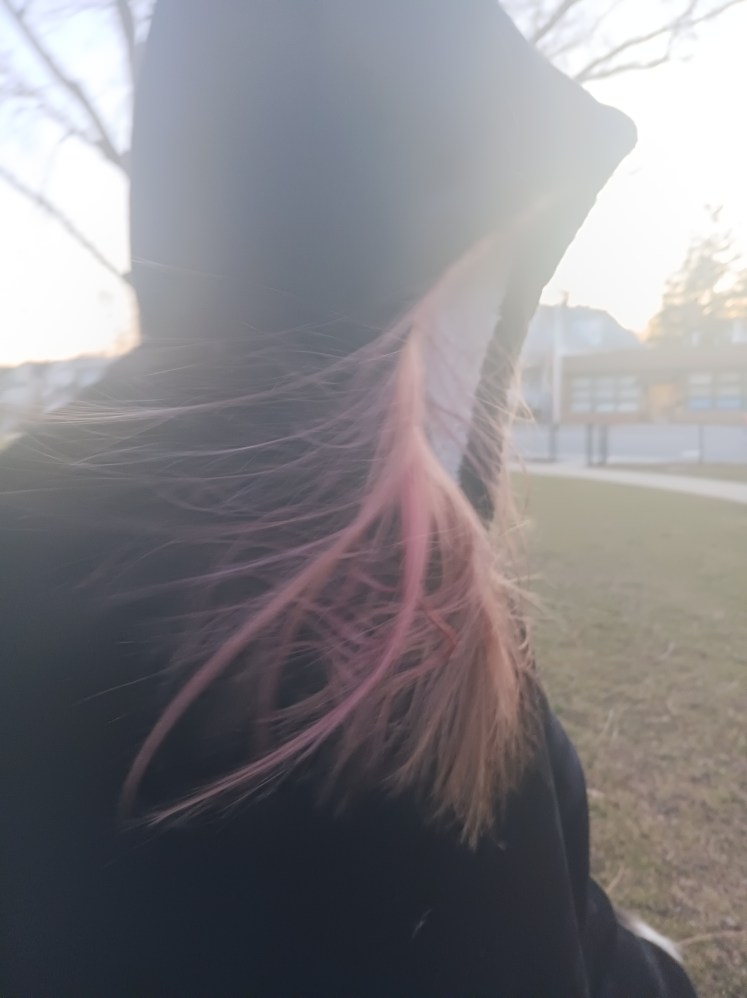
(image provided by DWB)

Solitude Equals Freedom

Harold Bloom, my spiritual mentor (if I had to choose, at gun point, just one, other than Jesus), rightly opined, over and over and over again (in the good way), that an American never feels free unless she or he is alone. Daniel Boone, Davy Crockett, and Johnny Appleseed all agreed with him; as did Chief Joseph, Crazy Horse, and Geronimo.

The following poem, about my beloved Christina, is the result of that unnerving, wonderful, and true formulation.

Fleeing with the Geese

“Sometimes she is a child within mine arms…” – Dante Gabriel Rossetti

Tedium alternating with

Ecstatic balloonings which

Collapse

So suddenly

Equals this

Teenaged life

(for a few more months)

Of mine…

But then again

There comes

A sudden feeling, seeing

These geese exploding with power in their

Winged

Freeness

Like Bucephalus

The young war horse

Terrified

Of his own

Shadow in Plutarch

Until

Alexander

Understands

Him and now he’s

Becoming fearless

Over cottonwood

Trees

And power lines

Of the Ragged Prairie

Land

In the ghosts

Of the geese.

The UFO

Filled with marvelous mystery

Monsters

Is

Coming down

Now

And the

Mastodon Bone Museum

Is unleashing its feverish

Dancing

Creatures

And there’s

One bar

Open

On the edge

Of the

Railroad tracks in this

Dying American town!

And I’ll

Be back

On the highways and

Byways tomorrow,

She intoned,

At the end

Of the

Summer,

In 1991, to

Her Homeric

Soul,

Her heart

Humming,

Her hair blown

So wild

And so free,

Shaking the dust

Off her feet, in

America

ALONE.

Dale Williams Barrigar is an American artist who loves to be alone.

The Drifter: One Holy Reason to Love

One Holy Reason to Love

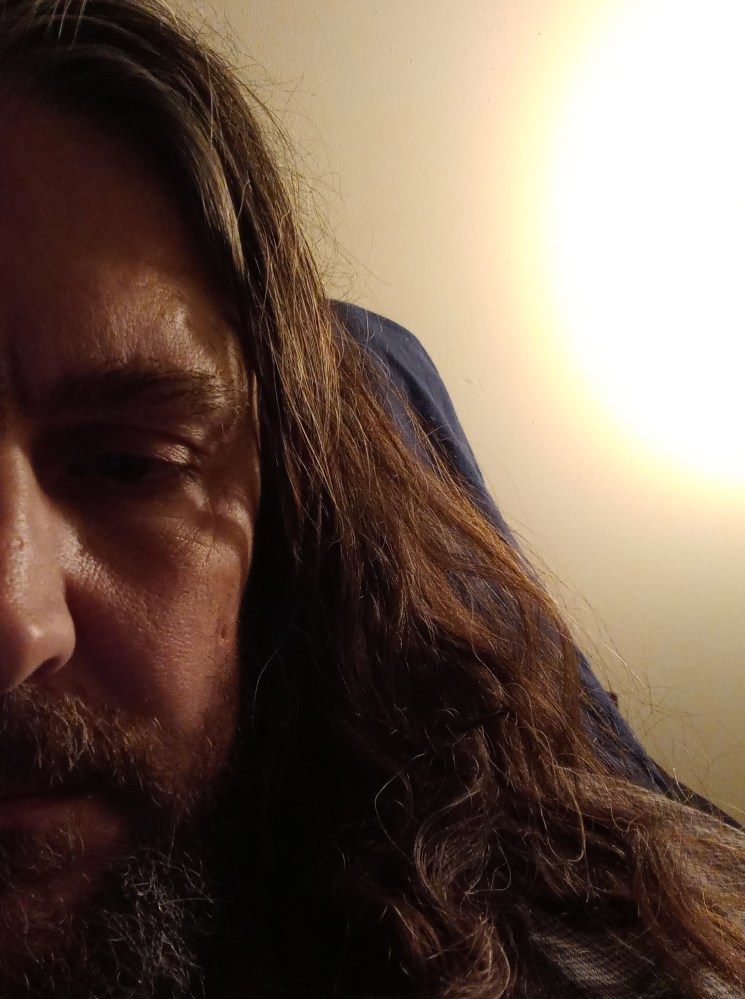
(Image provided by The Drifter)

“Kerouac could write everything because he never forgot

anything.” – Bob Dylan

“I saw you this morning…in my secret life.” – Leonard Cohen

Scholars of literature always call Edgar Allan Poe the first writer in America who ever tried to make a living using nothing other than his own pen. And that is very far from true, very, very far from true.

Poe never tried to make a living in America using nothing other than his own pen. He always knew he would need another job, whether that was in the U.S. Army or as a low-wage wage slave working for other peoples’ publications where much of what he did as a “job” had absolutely nothing to do with his own creative writing, on the surface at least.

What Poe did try to do, and what he can be called “the first” at doing in many ways in America, was to try and live a truly literary life at every level, no matter what else he also needed to do in the meantime.

Every demeaning task, every humbling action, every humiliating circumstance in his life, and there were many millions of all the above, Poe tried to convert into something sacred that could be seen as serving the literary life he always made himself live for his own pride, even when it seemed impossible.

Poe never let himself forget he was a writer. He elevated it above everything else, above politics, above religion, above family, even; or rather he made it so much a part of his life that everything else, politics, religion, family, all grew out of his starting point, which was his commitment to writing as an art.

This profound innovation, which is more relevant now than it was 200 years ago when Poe made it, has had an endless series of influences on all the arts, not just writing, all over the globe, not just in the USA.

It probably caught fire in France first, when Charles Baudelaire, the first true poet of the modern city, took up the call that Poe had issued to the writers of the world.

Baudelaire identified so strongly with Poe that it’s said he would pray to Poe nightly, as if Poe were a saint. When we consider Charles Baudelaire’s Catholic background, this doesn’t seem nearly so crazy as it might appear at first glance to many of us.

In the religion Baudelaire was raised in, praying to saints was not only not frowned upon, it was encouraged. Baudelaire’s move, which was to make the Art-for-art’s-sake Edgar Allan Poe into his own private literary saint, was really only moving the material he was given at birth an inch or two to the right or left. It was the higher ideal of the truthful and imaginative writing life that Baudelaire was really placing on the pedestal, in the manner of his hero, and saint, Edgar Allan Poe.

Baudelaire wrote in the shadow of Victor Hugo, a writer as massive, deep and wide as Charles Dickens, but it is now Baudelaire, in his Paris Spleen, Flowers of Evil, and Artificial Paradises (hashish, laudanum, absinthe, and literature), who generally seems more modern to most poetry lovers.

Hugo the realist, as great as ever still, was of his own time. Baudelaire, following in the footsteps of Edgar Allan Poe, was for the future. Like Poe, he foresaw, and even lived in, the age when humans would become ghosts of themselves (for good and ill), the time when the new rule would be (and is): turn your own life into an art, or die, mentally, emotionally, spiritually, and even literally.

The life-as-art, art-as-life, consequences-be-damned credo and way of living was elevated perhaps even higher by Vincent Van Gogh, especially in his self portraits, or in Sherlock Holmes and Irene Adler, whose laser-like, scientific focus on artful truth-telling rises straight from the beautiful and terrifying mists of Poe’s profound innovation, where the responsibility for everything is placed squarely on your own doorstep, even, or especially, if you are a starving artist.

Here are four ways any and all of us can instantly start turning our lives into an art and an art form almost immediately. If you’re already doing these things, and I have no doubt that some of you are: then bravo for you. Keep it up, and spread the word!

ONE: Texting

Do not become the mental slave of your own (what I like to call) texting device. Never send a text that has been written for you by a robot, AI or other computer; and never send an emoji that has not been specifically selected by you to be extremely pertinent to the exact circumstances at hand.

If use emojis you must, feel free to do so: but be creative. Go deeper. Look for the ones that say what you really mean to say. And be sure you know what it is that you really mean to say. If you don’t really mean to say it, don’t just say it, blindly. This is you putting yourself out there into the world, and this is the inevitable way people communicate now, at this moment in history, for a million different reasons.

Texting is too easy to do, but it doesn’t have to be. Take the time to say what you really mean: or don’t say it at all. And when you choose silence, choose it for a very definite reason; know what that reason is; know why you are choosing to exercise your own silence; don’t just ghost people because you are bored – or lazy.

If the time has come for you to be quiet, know why you are doing it.

TWO: Emails

Be creative when you compose emails. Even be creative when composing emails if it’s in a situation where you are not supposed to be creative, or maybe especially then. If being creative will get you frowned upon and called onto the carpet, be as creative as you can possibly be, even unto the point of being shown the door by the robot-humans in charge eventually. Don’t dumb down your own language too much in order to be “safe” or in order to please your masters, and make sure your own individual personality-stamp goes out with every single communication you ever send. Even if you’re just telling someone you need them to do something for you by Tuesday. Or maybe especially then.

THREE: The “Comments” Section

Be very, very, very selective about what kinds of “Comments” sections you choose to engage with. And when you do find a good one and have chosen to engage with it, go all the way. Doing anything in life in a half-assed way is nothing more than a half-assed way of doing things. Make sure you’re not just shouting into the void by repeating the exact same things a million other people are also saying.

Choose wisely, and be selective, and make a full commitment; let your opinions shine forth only if they are genuine, original, dyed-in-the-wool personal opinions based on the reality of the world, not just group-speak mind-control thought-police regurgitations of the exact same thing everyone else is also saying ad infinitum.

Another way of putting it is this: be original. Always be original. If you can’t be original here, it’s OK: choose silence, and be original in a different venue where you feel like you’re on more solid ground.

Regarding size of audience, Jesus himself said this: “Where two or three are gathered together in my name, there am I in the middle of them.”

There was a reason why he emphasized the tiny numbers two or three, just as he limited his personal disciples to another tiny number, twelve. Jesus was the strongest advocate for individuality this Planet has ever known, which is why he is, by far, the most famous person who has ever lived, or ever will live. And he spent a lot more time walking away from the churches and marketplaces of his day than he did walking into them.

FOUR: Pictures of You

Do not use the camera on your phone to celebrate the American Religion, CONSUMERISM. Do not use the camera on your phone to advertise the dead animals or the vegan delights you are about to sink your teeth into (everyone needs to eat and digest) unless you can really make it artistic. Also, do not use your camera as a way to provide just another screen between you and the reality of the world. Instead, use the camera on your phone for the following three reasons.

One: To try and capture moments of beauty which are beautiful, or to create beauty by making something beautiful which people don’t usually think of as “beautiful.”

Two: To relate yourself to the real world around you by showing yourself and others “It” from new, original, and different perspectives. (This is called “Imagination.”)

Three: Use the camera on your phone as a form of SELF exploration.

Do not take selfies. Make self portraits. Even if the only one who ever studies them is you, this will make you an endlessly deeper and more original person in everything else you do and do not do (what we DO NOT do is just as important as what we do), IF you do this in the right way, which is to do it the way Socrates said to use the mirror: Look for yourself, and study the endless changes which are “you,” with fascination. (This is something Shakespeare did in his Sonnets.)

Most people are only terrified of death when they never really live/d first. Always start with yourself first. Move outward from there.

A NOTE on reading from The Drifter: What you take into yourself is just as important as what you put out into the world, and what you put out into the world will, inevitably, be massively influenced by whatever you have spent your time taking into yourself.

Watching a truly great movie is a much more artistic experience than reading a truly bad book.

But the act of personally reading good things will strengthen the mind (and hence the personality) in a more powerful way than anything else on Planet Earth. This has been true for thousands of years, and will remain true now until “the end” (whenever it comes).

Alexander the Great’s most prized personal possession was his copy of The Iliad. Abraham Lincoln spent more time reading Shakespeare and the Bible than he did studying war plans or political suggestions. Martin Luther King, Jr., was always reading good things. He never would’ve been able to write or think so well otherwise: and he knew it.

The poet William Blake was not joking when he said he wrote mostly for “children and angels.” Personally, my conception of Heaven also includes forms of reading. If I’m wrong about this, it’s highly doubtful I will be aware of it; so I’m going with this for now. (It’s also probably true that by “angels” Blake meant both literal angels, and saintly humans.)

If one fills one’s mind with trash, nothing but trash, and more trash, eventually (or sooner) the mind itself will become a trash dump. Right about then is when real and deep ignorance, cynicism, scorn for the good of the world, and nihilism begin to set in. (Many of these people are walking around and looking like respectable members of society, too; even as we speak.)

The Character Here by Dale Barrigar Williams

(Druid Girl Image, provided by DWB)

The Character Here

The main character in the following lyric cry goes barefoot most of the time, wears animal skins when he wears anything, carries a spear, wears an amulet around his neck that protects from evil spirits which he knows often, but not always, come from other people, and has never shaved, although he has cut off his beard and hair when they get too long so they don’t get in his way; he also takes magic mushrooms, walks for days on a regular basis, hangs around the fire a lot, also spends a lot of time alone, sees visions, makes cave paintings he never looks at again, or sometimes returns to as if to an old friend for days on end; and in this poem, is inventing, or elaborating, human language, while also simultaneously developing the gift of human mercy which Jesus himself, and his mother Mary, would bring to perfection many thousands of years into the future from where this character is perching in this poem – right now.

Alone at Blue Rocks on the Shoreline

Prehistoric Man/kind perches on the cusp of a decision, and speaks.

The rocks here at shoreline are blue.

Blue like the water and sky.

Blue like the blue bird and the big ice.

And they rise half as high as the ice, as the big ice.

The rocks here under this sunset tree are red.

Red like her hair, and the sacrificial hare in the sun, in the trap, twitching.

(LET IT GO.)

Your costume only becomes you

and your uniform once you

wholly own it somehow

after long tries

and once you wholly own it you’ll

uniformly know and your uniform

costume will simply become a way

of knowing and a way of knowing more

about what you already know you know

but aren’t always so sure about, in this land

of the wooly mammoth having you for breakfast

on his horns

and the saber-toothed tiger around

every

bushy

turn.

So the hare, let it go, LET IT GO.

The hare released.

Look at him go!

He flies because I

have chosen

not to sacrifice.

Dr. Dale Williams Barrigar is an impoverished poet-scholar from the Midwestern USA who learned much of what he knows about primordial humankind by reading and pondering the works of Sigmund Freud, Carl Jung, William Butler Yeats, William Wordsworth, William Blake and William Shakespeare, as well as lots of intuition, imagination, and experience thrown into the balance. Experience alone is never enough, and neither is reading; they have to be combined.

Column 1 Dale Williams Barrigar: The Other Side

(Note–I am certain that this will be the first of a great many enlightening Sunday columns for Dale in the Springs. He has the talent and determination; therefore the sky is the limit!–Leila)

The Other Side

Study yourself frequently in the mirror, without vanity.

It is a profound self-portrait.” – Socrates

“…Before I am old / I shall have written him one / Poem maybe as cold / And passionate as the dawn.” – William Butler Yeats

“The bird that flies in front of you is not for no reason.”

– Chingachgook

In September of 2024, I saw the 91-year-old Willie Nelson walk out onto a stage somewhere outside Chicago and wave at the large crowd in the seats and spread out farther back all over the green, sprawling hills of this midsized stadium.

You could see Willie pretty clearly from where I was on the hills with my family, and you could see him even more clearly on the screens that were elevated above the stage like they are everywhere now.

Great waves of goodhearted cheers and applause went up from the crowd in spontaneous honor of iconic Willie. My guess is that Willie always receives that kind of welcome, except not quite so enthusiastic and dramatic as now – because it was well known in Willie Land that Willie had almost passed out of this mortal sphere – again – recently.

And yet now here he was – again – standing on the edge of the stage holding Trigger (his guitar) and waving with great strength, resilience, friendliness, and Willie-style openness at this hugely appreciative – even tearful in some cases as I looked around – Illinois crowd.

Four months earlier, my humble self had also come very close to biting the dust of this mortal world, not for the first time, so the reappearance of Willie this way held a certain magic for me, especially since he is a lifelong hero of mine.

At the age of 57, in May of 2024, after a sleepless night previously, then staying up all day (no naps), arguing for several hours with everyone around me about all sorts of things (we’re all a bit bipolar or more), and then after lots of excessive celebratory activities with my kids on my ex-wife’s birthday, I suddenly found myself sitting in a chair alone a bit before midnight, completely unable to speak. (I had been thinking about calling out to one of my kids about something even though we’d already been talking to each other all day long.)

Not only was I unable to speak.

I was even unable to think of a single word, at any level of my mind, no matter how hard I awkwardly tried, and kept on desperately trying – and this was after a lifetime of words, words, words, and the Word, obsessive, nonstop reading and writing, life as an English teacher in college, and the ability to speak so rapidly and for so long, at times, that I’d been known to talk nonstop for 24 hours, or more, to a lucky few (and generous) souls (who must’ve spent a lot of time tuning me out, as well, during those interminable, adrenaline-fueled, sometimes chemical-fueled, half-mad monologues about anything and everything under the sun).

(It was like the tale of the apostle Paul talking all night long, until one of his listeners fell asleep, and then fell out of the window. Paul was able to pull it off and save the young man’s life only because of the faith of everyone around him.)

I couldn’t think of even a single word.

And suddenly I very much, and very deeply, realized the fact that – I couldn’t think of even a single word!

My mind was a blank vaster and whiter, and more elusive, than Moby Dick.

My daughters walked into the room together (twins).

I tried to rise from the chair.

I collapsed and hit the deck very hard – but when I heard the fear in their voices, something helped me bounce right back up again.

Amid the confusion, terror, and total horror, worse than what Mr. Kurtz talked about perhaps, of not being able to find the words, something had buoyed me up – when I heard my daughters’ sweet voices in fear and dread for me.

After an ambulance ride with some chill kids who looked like they were about sixteen years of age doing everything they could to help me out, I found myself in the emergency room staring into a screen hanging above me, where the distorted face of a concerned doctor with technological eyes like Lex Luthor, and pale, dark, glistening skin, was weirdly informing me (his mouth seemed to be going every which way), in his echoing, distorted voice, through the screen, that I was in the middle of having a stroke.

That was the moment when I realized it felt like the White-Light Fingertip of God Himself had reached out earlier, out of nowhere (or out of air – out of thin, thin air) and TOUCHED ME on the brain (or in the brain) in a very biblical way.

I knew now that this was some kind of wake-up call.

Twenty-three years before, in September of 2001, two weeks after the terror attacks on the Twin Towers, I’d fallen on a switchblade knife while doing tricks with it in the yard in the middle of the night after a long day (and night) of drinking.

I’d almost killed myself with a switchblade (and not on purpose). The feeling of being stabbed (perhaps especially by yourself) is almost impossible to describe.

The horrific irony there was that two weeks before the Towers were brought down, I’d been doing nothing other than standing on top of one of them with a close writer friend from Brooklyn and looking down, in awe, at the skyline of Manhattan.

September 11, 2001, means many things to all of us, and different things to every one of us, whether we were alive at the time or not.

To me, 9/11 will forever be tied up with that bizarre, drunken, fateful incident, in which I fell on the switchblade knife in a drunken, manic, and exhausted glee, and almost killed myself without meaning to; and the time two weeks before the Towers were brought down, when I had stood, literally, on top of one of them.

(Falling on the knife like the Towers had fallen.)

(Stabbed in the side like Him.)

When I arrived at the hospital after the knife accident and took the rag away from the wound in my side to show the nurse, great gouts of blood literally SPAT and SHOT out of my body and SPLATTERED all over the wall – straight out of the worst horror movie ever made, so much so that the nurse immediately ran from the room in terror to go get a doctor – and somehow I survived.

And not only did I survive the stroke as well; but I also began somehow to THRIVE, very quickly after it ended.

When the stroke came, I’d just been starting to emerge from a wicked, vicious, six-months-long melancholia, one of the worst in my life in a life of long, horrible, periodic depressions.

After I had the stroke, after I “woke up” in the hospital, I realized that the depression was gone – it had vanished; had lifted; had disappeared, like the morning mist suddenly going away off the face of a beautiful lake.

One moment you look and it’s there – then when you turn around again, it’s just gone.

I had a lot of bad habits before the stroke which contributed to it (none of which shall be gone into here for various reasons).

But it also turned out that I had something going on with an artery in the right side of my neck, a small but very significant abnormality that had caused the stroke, something so rare that only less than three hundred, three hundred, cases, have ever been documented.

It required an endless-seeming series of tests to discover the problem, then surgery to take care of it.

In the middle of the surgery, I left my body.

I didn’t die – but I, quite literally, left my body and wandered around the surgery room (my spirit did), watching the surgeons, doctors, and nurses perform their work, but mostly watching myself, lying there on the table.

I was studying myself very closely while hovering in and among the people who were working on me.

And I realized that there were and are two me’s, one of whom resides solely in this body made of dust, this mortal coil – and one of whom does not.

That brings me back to Willie. I don’t recall all the circumstances off the top of my head, but I do know that he’s almost died before many times.

And I do know that this summer, so far anyway (which is way more than enough), he’s back out on tour – at the age of ninety-two.

Every moment we breathe on this side of the Grim Reaper’s scythe is another chance at living our lives to the fullest, maybe for the last time here.

One thing I know for certain – we will all find out what happens to us, even if that is only peaceful sleeping (which I doubt) – on the other side.

Sign-off: “The Drifter” is bowing out for now, off to walk his sidekicks and assistants, two Siberian Huskies and one Pit Bull whose names shall remain anonymous in this place (for now), in a local forest preserve outside Chicago along the Des Plaines River, where Hemingway used to hunt as a kid, and John Wayne Gacy used to dump bodies; an area filled with deer, coyotes, foxes, birds of prey, snakes, river otters, and lots of other wild creatures, including more than a few of the humans who hang out there.

“The Drifter” shall re-emerge next Sunday with a plunge into his personal relationship with the life and work of Bob Marley, as well as wild tales from his honeymoon with his ex-wife all over the island of Jamaica in the Year of Our Lord, 1994 (thirty-one years ago at the age of 27).

The title of next week’s column is (unless it gets changed) “Jamaican Flashbacks Extraordinaire.”

Transformed by Dale Williams Barrigar

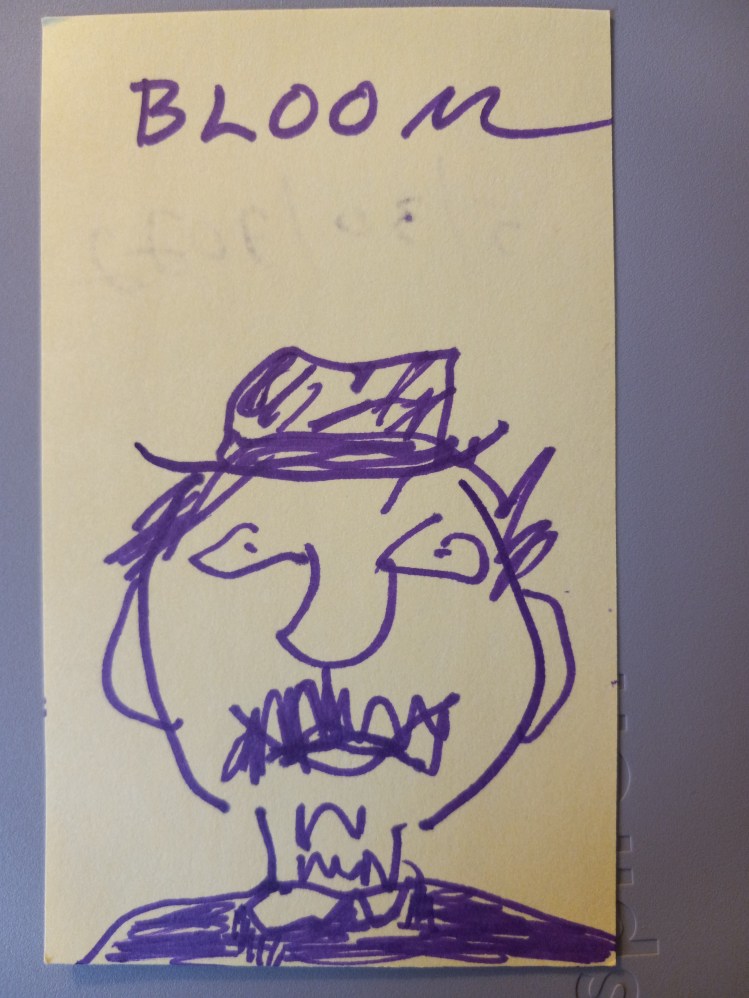
(Leopold Bloom at U., original drawing by DWB)

Transformed

Moments of transformation have been the stuff of literature ever since there was literature, and even before there was what we call literature, only the raw materials of literature (language, experience, and imagination) being shared around the campfire, and probably, at a deep, internal, and shared level, even before there were campfires.

This small offering with three titles (below) is my contribution to the language and literature of transformation, not that I haven’t tried it before and won’t try it again, too.

But here I think I managed to capture it pretty good.

I don’t know where the Muse comes from for any of us. But I do know that muses do exist, with both capital and small M’s; and I do know too that poetry itself is the original art, the biggest art, the most common art, the rarest art, the simplest art, the deepest art, the widest-ranging art, the hardest art, the easiest art, the most neglected art, the longest-lasting art, the poorest-paying art, the purest art (in its purest forms), and the most relatable art, for everyone, of all.

Everyone’s last words are poetry. So are their first ones. Harold Bloom rightly called Jesus the poetry of America. Miguel de Cervantes used to stalk through the streets of whatever city he lived in at the time, searching for words, looking for poetry.

In the last few decades of his life, Pablo Picasso started pumping out a LOT of poetry, and went so far as to go around telling everyone he knew that he wasn’t really a painter, he was a poet, and that thousands of years from now, no one would even remember his paintings and drawings – but they would remember his poetry.

I have absolutely no idea whether that is true or not.

All I know is that Pablo was a genius on the level of Einstein, or probably higher – and he said it.

Everyone else can turn into a machine if they want to.

I’m gonna remain human.

Signed,

The Drifter

Poetry The Teacher, Or:

New Knowledge, Or:

The Invisible Blue Butterfly Forever

I was walking

around in their house

trying to clean

my pipe

with a broken coat hanger

when it happened

and I literally

dropped my pipe and

the coat hanger and

stopped in my tracks, yes,

as if I’d seen

a ghost. Next, I felt

nailed to the spot, as if

my feet had been

nailed into the floor

and my hands

had been

nailed into the air

but almost without

physical pain, I was

looking, staring into

the distance with

wild and rapt

eyes. I was, as so

often lately, alone,

but I was also not

alone as the hosts, the

ghosts of all the poets

who’d ever come before

me were humming

through my blood

and before my eyes –

only for

an instant.

When I say

all the poets,” I also

intend the oral poets

who’d written in air,

for our ears, hearts,

and souls,

for thousands

and thousands

or more

years before

“literacy” began –

the anonymous ones

who weren’t anonymous

at the time, not to

themselves

anyway

and what else

matters

in the end

or even the

beginning or

the middle,

really,

truly.

A life-changing

instant; a one-of-a-kind

moment. I had no

idea

in this spot of time

where that

had come from;

way too sudden.

One instant this,

the next instant

something else

entirely, forever, no matter

what; like a mermaid’s snap

of her magic fingers or a giant

monster of beauty

shaking a rag doll

in sadness and gladness.

Instantaneously

turning

from caterpillar into blue,

if invisible,

butterfly. Without even

knowing

you’d been

a caterpillar in

the first place!

The invisible blue

butterfly now, no matter how

impossible

it sounded.

I took up

the pen

which had as if

magically appeared there

for me

and the paper

and slowly wrote down

the first

Word.

The Drifter ((otherwise known as Dale Williams Barrigar)) drifts from here to there while always maintaining a center that is always centered upon The Arts, with the oldest of Arts at the center – usually.

Saragun Springs, Latest Triumph

(Dale Williams Barrigar has big news to deliver. I for one am looking forward to hearing from the Drifter–Leila–The image provided by DWB)

Thirty-eight Years

I have wanted to write a weekly column ever since I first heard of Charles Bukowski and his Notes of a Dirty Old Man thirty-eight years ago in 1987.

I first heard of Bukowski himself through Roger Ebert’s television review of the 1987 film Barfly, for which Bukowski typed (his word) the script. And congrats to Mickey Rourke and Faye Dunaway for having done a wonderful, memorable job in the lead roles. (Buk supposedly didn’t like Mickey as Buk but I think that’s because he wouldn’t have liked anyone as himself or his alter-ego-persona.)

I lived in Chicago at the time and was aware that Roger was sitting somewhere else in Chicago and he was talking about this raw, experimental, underground writer I’d never heard of. God bless you too, Roger Ebert, for all the things you taught me through the television back in those days. I never agreed with everything you said, but I learned volumes, and you were always an inspirational figure and your ghost shall haunt my new weekly column in a number of ways, on one level especially because I still live in Chicago, your home turf, and you are inescapable in that way.

After I heard about Bukowski from Ebert, I ran out the next day to my local bookstore. In those days, many of us did that a lot. I lived within easy walking distance, literally, of at least half a dozen bookstores back then.

I bought all the books by Buk which they had, and devoured (almost literally) them all before I saw the movie. One of the books was Notes of a Dirty Old Man.

My column, at least for a while, shall have this title: Postcards from the Drifter. This column, while influenced by Buk, will not include regular graphic descriptions of sex, one reason being that I’ve been celibate for over a decade. I subscribe to the famous quote by Carl Jung: “When the body is silent, the soul speaks.” I don’t know if this condition will last for the rest of my life or not, but for now it seems to work out wonderfully for me.

SO my column shall not have lots of graphic physical sex descriptions like Buk did. BUT it WILL have lots of personal revelations, and confessions, like the kind I just made in the above paragraph.

I’m a drifter because I never sit still, metaphorically and symbolically, and sometimes literally. But any good drifter needs to have a solid center. You can’t just shift your personality for the latest political winds so you can make lots more money when you’re already loaded. To be a good drifter means to have a solid center that will keep you grounded while you’re drifting.

My center is THE ARTS. I’ve been obsessed with the arts since kindergarten when I decided I wanted to be a painter, and was influenced by all the religious art around me at the Lutheran school I attended in Michigan. Before that, I had also been obsessed with The Arts, I just didn’t know it.

So my weekly Sunday column will focus on two things: personal confessions of a universal nature that will be useful for the few, and reflections and deep recommendations on the arts that will include thoughts and other ideas about writers, painters, musicians, filmmakers, actors and actresses, and other artists, like those who are artists of life itself.

I don’t seek now, and have never sought, vast quantities of drone readers, casual and/or transactional. Instead, I seek the few who can understand me in this dehumanized and dehumanizing world.

My first column will be about the stroke I suffered last year at the age of 57, what caused it (as far as I know) and how I was able to almost miraculously recover from it so fast (at least some of the doctors have told me it was almost miraculous). This column will also include a description of a knife incident that left me bedridden in my youth for a while, and a true description of leaving the body (not dying, just leaving the body) during surgery.

This column could never have happened without Irene Leila Allison. Everything I write now, including all of the above, is written for her first. This will continue to be true from now until my dying day. This is because I’ve never found another artist (except for my kids) who gets me in the way she does. She is my inspiration; and then it’s meant to move on outward from there, to all of her readers on this wonderful and inspiring site called SARAGUN SPRINGS.

I hope you can join us starting soon for these weekly columns called POSTCARDS FROM THE DRIFTER. It promises to be highly interesting if nothing else.

Sincerely,

The Drifter

The Encounters (The Mantis Prays) by Dale Williams Barrigar

(Note–Moonfog wouldn’t appear today because he is moody. But, fortunately, Dale Williams Barrigar has rescued this Wednesday from emptiness and overall non-existence-Leila)

(Cool image provided by DWB)

The Encounters

      “What the white whale was to Ahab, has been hinted;

        what, at times, he was to me, as yet remains unsaid.” 

         – Herman Melville

I turned around and an exceedingly large, unbelievably green, and massively intimidating Praying Mantis had landed on the outside door handle of my door.

S/he had appeared there so suddenly it was as if s/he literally, magically appeared there, just materialized there, out of thin air, out of thin, thin air, or out of nothing.

And it was strange, because that door handle was the place I had been about to put my hand on one second ago. I had been unconsciously reaching out, planning on grabbing the handle, opening the door and entering my apartment – until I saw the massive Praying Mantis sitting there, perched on the handle, and utterly staring at me with an animal intensity which was unnerving at best, at least until I got a handle on things. This kind of animal is hard to brush off with a flick of the wrist. I almost literally couldn’t believe how BIG it was. Big, large, huge, and also gigantic, even gargantuan, at least in terms of a bug. 

Then I got a handle on things. And I realized how cool this was! It was like the time I’d been walking on a trail in Denali National Park in Alaska and I looked up and there was a lynx standing on a log staring at me with its incredibly green, intense, and wild eyes

A few old-timers in Alaska, both Native Americans and white folks, had already told me how very rare and unusual it was to see a lynx in the wild when I’d asked around a little bit about this in the bars of Anchorage and Fairbanks. Then I looked up and there was an f-ing lynx staring at me. It was one of the wildest and coolest moments I’ve ever had in a life filled, you could even say blessed, with lots of wild and cool moments. 

And now here was this Praying Mantis. Somehow, here in urban Illinois outside Chicago, this wildlife and nature encounter was just as intense and jarring and cool as the experience with the lynx in Alaska had been, even though the animal involved this time was a whole lot smaller. 

But if you’ve ever seen the eyes of a gargantuan Praying Mantis up close you know this thing can give you the chills on many levels (both good and bad). 

Their eyes are so similar to ours, and at the very same time so vastly different from ours, that anyone who’s even half awake will be freaked out by this – in both bad, and good, ways. 

I turned around again to take a picture and The Mantis was gone.

Notation: The following poem contains the scientific and cultural facts about The Praying Mantis researched after the fact of the above encounter, and all boiled down into an “awkward” and lyrical free verse style which intends to mirror The Mantis him- or herself in their incredibly uncanny, bug-like, alive, here-I-am-now selfness.

The Mantis Prays:

Written for Classical Guitar

The Mantis lays 

her eggs in fall.

Then she quietly dies.

The Mantis dives out of the air

to escape 

the haunting huntress bat.

And she sighs 

prior to dining

on the cricket’s hat.

In China they will tell you 

she is fearless.

And nothing can contain 

her spirit fair.

The eyeballs of The Mantis are 

black, and very there.

She lives 

through the air,

she hides in her own 

kind of cave.

The Mantis is a creature 

of myth

who we share this planet 

with.

She is as real as the day 

in your hair.

Her arms, legs, wings 

so greenly

and transparently 

going 

and glowing.

She lives for one year before

her race is run.

Maybe one year before

her day is done.

Only one year, before

she folds her wings, 

and tells

her eggs 

the way 

to find the sun.

Dale Barrigar, Doctor of Philosophy, is a Melville scholar from Chicago who also admires the lone wolf writer style which Melville perfected many, many decades ago in America, bestowing a future gift on all of us amidst his myriad worldly failures, which he knew he would.

Dale Williams Barrigar: Forever

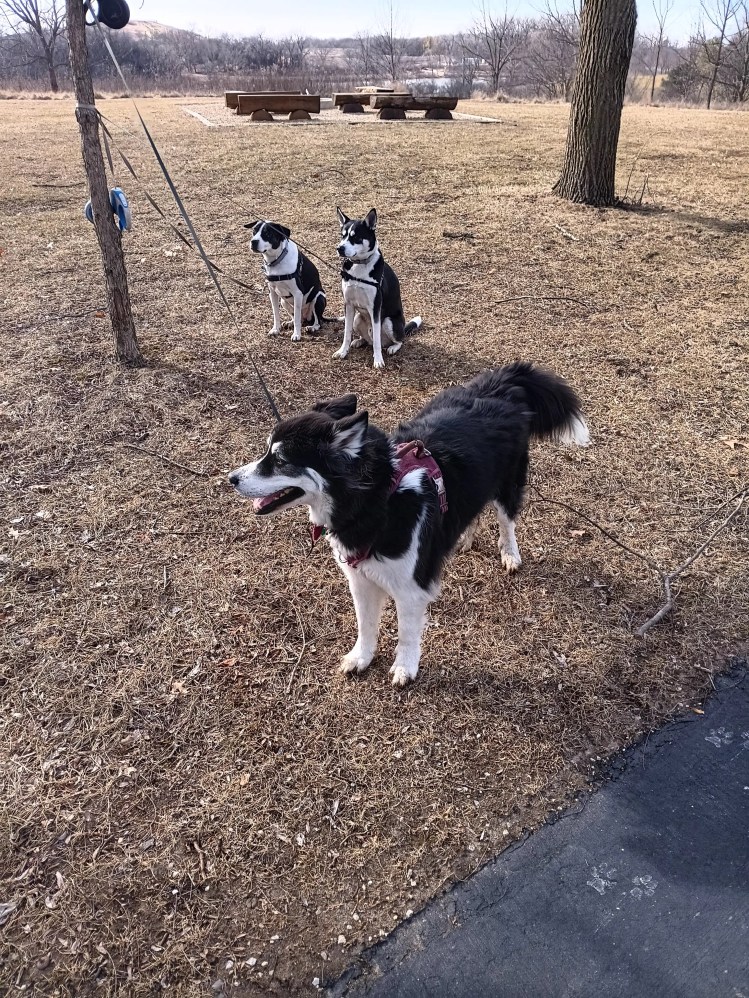
(“Dog pack in a line”–image provided by DWB)

(Note from Leila–I want to thank Dale for classing up the place this week and assure everyone that you will see plenty more of him in the future; his next appearance is scheduled for 4 June, next Wednesday. Please check out his work, especially in his field of “Fictional Essay” which is not a contradiction, on Literally Stories UK.)

“All those flowers that you never grew – / that you

wanted to grow / The ones that were plowed under – /

ground in the mud – / Today I bring them back / And

let you grow them / Forever.” – Bob Kaufman

“I drifted down deep / In sleep on my open book. /

At once a marvelous vision took / My dreaming mind away…”

– Geoffrey Chaucer, The Book of the Duchess

“Hark how the Mower Damon sung, / With love of Juliana

stung!” – Andrew Marvell, “Damon the Mower”

“Nicodemus saith unto him, How can a man be born when

he is old?” – The Gospel According to Saint John

When Samuel Taylor Coleridge met William Wordsworth, he realized very

quickly that there was only one William Wordsworth, and there would only ever

be one William Wordsworth – forever.

***

Ted Berrigan’s tombstone says, “Nice to See You.” Ted also said in a poem,

“I don’t feel / a necessity for being a mature person in this world. I mean / all the

grown-ups in this world, they’re just playing house, all / poets know that.”

In another poem Ted said: “I’m only pronouns, & I am all of them, & I

didn’t ask for this / You did / I came into your life to change it & it did so & now

nothing / will ever change / That…”

***

Two American writers 2,100 miles apart in different towns at different

places and different locations both rescue the volumes Sandburg wrote about

Lincoln from dusty obscurity in the places they rescue them from, never knowing,

of course, that the other was doing this too, 2,100 miles away, until they find out

about it later. Carl Jung called such a happening synchronicity, and I call it literary

synchronicity, of the highest kind.

***

The following poem is written for the children still among us, or rather the

young inside at whatever age we are, like Bob Dylan’s album Christmas in the

Heart, all year long.

***

Hunter S. Thompson’s friend and occasional writing partner Warren Zevon

died two weeks after releasing an album called The Wind which opens with a song

called “Dirty Life and Times.”

In that song, Zevon says, “Now they’ll hunt me down and hang me for my

crimes / If I tell about my dirty life and times.”

***

This is a world

where things of lesser value,

made with lesser efforts,

all get equal time; and that

crushes the precious gems

down into the dust.

Two Siberian Huskies, the Foggy Haunted Deer,

and the Pitbull Sidekick in Foggy Illinois, 12/28/’24

Or: Dogs and Deer Poem

For Leila Allison

All three dogs in their harnesses strain and pull

against their leashes, they pull and strain toward

the deer herd as we walk together at Christmas

season, three black and white dogs, and I.

Boo, friendly pack leader, who almost

looks like a wolf, and he looks like a wolf,

and he looks like a wolf to most, now he

leaps high into the air at the end of his leash.

Colonel, friendly hunter, lean Sancho Panza, is

serious about this, it’s maybe he who’s pulling the

hardest, it’s maybe him who would go for the kill,

hardest, if he had to, and he may have to, but not now.

Bandit, civilized lady, the queen, or the princess

some days, depending on her mood, sticks close

by my side, not here to kill deer and none of us

are, in her own soul, she’s here to protect me.

Wreathed in the unseasonal fog that drifts two

antlered deer toward us, three who appear to be

mothers holding back the three or four fawns

disappearing, or blending into the heavy thorny

branches of Christmas season thick hedge row

desolation as I strain and pull the dogs along.

In Miller Meadow along far Roosevelt Road

in urban Illinois. In the parking lot, four old

black men huddled together smoking their bud

around a trash can fire, someone’s echoing laughter

is a small boon across the gloomy, grassy field.

On his death bed, James Joyce

finally asked the first and last question

that ever occurred to him in this world

out loud, why does no one understand.

Dale W. B. lives in the Land of Lincoln.