Saragun Verse: Witch Field

i

There was a lovely field up for sale

Greed over beauty often prevails

Yet came a Witch who cast a spell

And the field vanished behind a veil

ii

It is still where it was of course

But now resides in dimension twenty four

It is now as safe as a field should be

For Pheasants and lives born of green

iii

Money cannot rise above

The standard hubbub of sniff and grub

Tis a wormy, diseased and phallic thing

A reverse parasite to whom the host clings

iv

Therefore the field is no longer for sale

The realtor may as well peddle pain in hell

For the world is never ugly at peace

In silent repose we are free to dream

You Remembered Everything Chapter Two

During Holly and Emma’s strange meeting, Irene Allison was at home sitting on a porch swing and drinking a can of PDQ Pilsner. Irene looked much younger than her twenty years because she was neither quite five feet tall nor a hundred pounds. It was a pretty night, maybe sixty, and not humid as it usually gets during summer in the Pacific Northwest.

Irene’s house stood at the crest of T-Hill, directly across the street from New Town Cemetery. Despite its location, little could be seen of the cemetery from the porch due to the quick drop of the hillside. Holly and Emma were no more than a hundred yards away, but since that was mostly downhill from her, they could have been on Mars for all Irene knew.

Unlike the dilapidated rows of war time duplexes, it was a clean, albeit aging, two-bedroom, single level working class home built by Irene’s paternal great grandparents prior to the Great Depression. It resembled a hundred others in Charleston save for a veranda that ran the length of the front of the house. Irene always thought that there was something southern and To Kill a Mockingbird about the veranda. A large porch swing to the left of the front door was the veranda’s main feature; Irene sitting on it during fair weather was often the swing’s main feature.

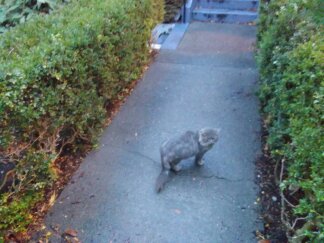
Irene had one ear trained on the baby monitor she used to listen in on her grandmother. It was stationed on the wide rail of the veranda. Hard circumstances and bad luck made Irene responsible for the well being of another human being even though she believed that she was not particularly able to manage herself. The weight sat uneasily. Over the past five years her life had been little more than about death; everyone she loved had a lifeline as long as that of a Bronte sister. Even the cat, Sir Jack Falstaff, whom Irene had known since the dawn of her memory, was sixteen.

As a diversion, Irene, again, wondered how a can of five-year-old PDQ Pilsner could still be fresh and fizzy. It was better to think about that than dwell on another lonesome night of her youth taking the big swirl down, then upbraiding herself for her selfishness.

PDQ was the lowest of the three local budget beers (said to be brewed from the “mysterious waters of Saragun Springs”). Each can featured a picture of “Pie-Eyed Peety the PDQ Pilsner Pigeon.” Peety was a toon in a porkpie hat, who smoked a cigar and held (an apparently bottomless) can of PDQ in one wing; he had been touting the swill since the 40’s. No matter how he was positioned, Peety’s head was always surrounded by six (Irene had counted) popping bubbles that inferred (along with his “pied” eyes) a state of extreme intoxication. There were uptight snowflakes who protested an insolently drunk pigeon being PDQ’s mascot. They said it was designed to attract kids to drinking, cigarettes, premarital sex, critical thinking and all the other stuff people would rather do than take direction from uptight snowflakes. Irene believed that it was a hypocritical society that begat useless snowflakes who made more noise about cartoon beer mascots than they did about people dying in doorways that caused people of all ages to flee reality. Regardless, none of that solved the prolonged freshness mystery.

These philosophical thoughts were interrupted at 12:17:09 A.M., the precise time of Holly More’s death at the foot of the cemetery’s great maple tree. The baby monitor squawked and Irene heard a female voice say “You remembered everything, darling,” at a volume well beyond the capacity of the cheap speaker, which, like Mr. More, died that instant. This was accompanied by a bright flash of light inside the cemetery. As Irene dashed from the porch through the house, she expected to hear thunder, but it never came. She turned the light on in Gram’s room and saw nothing out of order; Gram was sound asleep courtesy of one of the many pills she was prescribed for a litany of woes, including insomnia. All Irene got for the effort was a peeved yawn from Falstaff, who was curled at the foot of the bed.

Irene turned the light off and quietly closed the door. She never felt so alone.

But that feeling vanished when she heard Lauren Thommisina Lemolo’s ancient Dodge Colt pull into the Allison’s driveway. Only official people called her Lauren, to everyone else she was “Tommy.” Although she had been distracted that night, Irene usually knew that Tommy was on her way long before she arrived. The Colt made several strange noises (audible at about a half mile) that distinguished it from all other contraptions in Irene’s knowledge. Mainly, it was a combination of the loosely geared manual transmission and heavy exhaust pushed through the ragged tailpipe that caused a singular, hiccupping whurrwhirring sound. The Colt constantly threatened suicide but never got around to it. Tommy figured that it was waiting for the worst possible moment to do so.

“Oh goody, you broke out the urine,” Tommy said, bounding onto the porch, met by Irene. She was twenty-one, a year older and a foot taller than Irene. Always athletic, Tommy moved like a dancer even though she had a prosthetic attached at the knee of her left leg.

“You see a flash of lightning about a minute ago?” Irene asked as she handed Tommy a can from a bucket near the swing. “Looked like lightning hit the graveyard, but no thunder.”

“Lightning–on a night like this? Must be the pee talking.” Tommy then held her can of PDQ high as though it were a chalice. “I’m telling you there’s a Nobel prize kind of scientific mystery here to be solved–how can a beer brewed bad not go flat. Tellin’ you there’s money in this.”

For a fleeting second something hitched in Irene’s mind. She saw Fallstaff lying on the porch swing–confused, she began to think “didn’t I just see…” but it vanished before completion. As far as Irene was now concerned he had always been on the swing.

Tommy sat on the swing and nuzzled the old boy. “How ya been fatso?” She touched his nose with her beer and won an expression that suggested he needed to sneeze but had forgotten how. Not all that long ago Tommy and Irene would watch him hunt and eat moths on the porch. He hadn’t done much of that for the last two years or so. The shit you miss.

Irene remembered the noise the baby monitor made. She picked it up and shook it. Something rattled. “Fried,” she said. “When the lightning–or whatever happened, I heard a voice over this thing–real loud–now it’s cooked.”

Tommy took it from her, also rattled it, fiddled with the volume controls. “Wow, it is spent–you can smell the wires. What did the voice say?”

Irene sat beside her, she was about to answer but the words had also vanished. “Dunno–can’t remember. I took off thinking it was Gram, but she’s out completely. Must be a blown transformer–good thing it wasn’t ours.”

Although both Irene and Tommy were too smart to buy the lame transformer theory, neither of them felt compelled to explore why there would be a transformer inside a cemetery; nor why the lights were still on; nor how a transformer blew out a wireless monitor and nothing else. It simply felt better to let it go. Natural. Besides, there were two other monitors that came with the set; by the time Irene returned from fetching one from the kitchen, the topic was completely forgotten.

“How was she tonight?” Tommy asked, already knowing, lighting two cigarettes. She gave one to Irene.

“Same–how was work?”

“No breaking news there,” Tommy said. “Made a whole nine bucks in tips–one fucker left a quarter–but we stayed open all the way to 11:45–numb-nuts about peed himself worrying about closing fifteen minutes early on a Monday night.” Tommy waitressed at WJ’s Bar and Grill; on busy weekends she easily cleared fifty, sixty bucks a night in tips, even after cutting in the bussers. “Numb-nuts” was WJ’s assistant manager–Irene thought his real name might be Andrew–something with an A. She had never met numb-nuts, and still six months shy of twenty-one, she had only seen WJ’s from the outside. But she had formed a mental picture of the place, the workers and even numb-nuts based on Tommy’s colorful descriptions.

Tommy told Irene she could get her a job at WJ’s, but that was before the State “hired” Irene as Gram’s live-in caregiver. It’s a hell of a world; children and grandchildren having to take pay for something they had been and felt obliged to do for free. Yet even though the house was paid for, expenses were fairly low and Gram had both social security and her pension, there ‘s always the property taxes and increasing prices, more money is always needed. Still, it made Irene feel like dirt; like a sponge; like one of those awful people you hear about on the news whose neglect causes bedsores and whose greed raids the accounts. This made Irene so over the top scrupulous that it might have looked suspicious if anyone cared. It also seemed to her that the State needed a patsy just in case something went wrong.

Grandpa Henry and Gram were children of the Great Depression. Even though they were literally kids back then, they had been taught to buy all you can of something when it goes on sale. That sort of thinking led to things like thirty-one flats of PDQ in the garage, upon Grandpa Henry’s death five years earlier. One summer, when it got hot enough in the garage for some of the cans to explode, Grandpa Henry installed air conditioning (since discontinued), thus negating the money saved from buying in bulk. Two years of subtle mourning passed before Irene began to drink it. At a rate of six to ten a week (even with Tommy’s help) there were still nine cases in the garage.

Of course it hadn’t always been that way. There had been boisterous times, good times, alive times. But those things vaporized when Grandpa Henry collapsed in the kitchen from a heart attack when Irene was just shy of fifteen; the following month, Tommy’s mother died unexpectedly in her sleep. The “unexpectedly” part went away when an emptied bottle of hydrocodone and a note were located on her nightstand.

Irene was with her grandfather when he died, unable to do anything more than to cry and beg him to hold on till help arrived. Gram had been at work and Irene was in her room studying when she heard a crash and a thud in the kitchen. She found him lying on the kitchen floor in a puddle of Four Freedoms vodka. Although her grandfather was no stranger to losing consciousness, he rarely passed out that early in the day.

“I’m calling 911, please please please don’t die.”

But he did die. He died without regaining consciousness, in her arms, shortly before the ambulance arrived. In the intervening years, Irene had found the good in her grandfather’s sudden death. He had been spared the torture inflicted on Gram.

Death was taking the long way to Gram. Until she turned sixty-five she’d been strong and healthy–in defiance of her own tableau of evil habits. But Elsbeth Allison suffered her first stroke not five months after Grandpa Henry died. In itself, the stroke was no big deal. But it served as an opening bell for Gram’s season in hell.

Within three years, there was very little that was not wrong with Gram. She had diabetes, gout, emphysema, kidney disease, an enlarged heart, plus a liver “Harder than a twelve year-old whore’s upbringing,” so Gram had said, because she used to say stuff like that, prior to her brain no longer getting enough oxygen to sustain a personality. She had still managed to remain a funny human being until spring. Then she went away. The situation almost caused Irene to pray to the God she did not believe in to end Gram’s suffering until she realized that if God did exist, then he was the fucker responsible for pain.

Naturally, Gram had begun to live in the past because her present was shit and the future didn’t have plans for her other than the continuation of shit until she died. And despite the B.S. Irene had heard about miracles, she knew Gram wouldn’t be getting better because there was no better for her to get back to. Her equipment was shot beyond repair.

Gram, Irene’s Gram, never bitched about the situation. But the thing in the back bedroom complained full time about everything. Whiney, petulant, dumb as a post and certainly not the sort of person Gram would have liked, the doppelganger of Elsbeth Allison lived on for no apparent good reason. Still, every now and then old Gram would resurface, but the occasions were becoming steadily infrequent. Thus Irene was in the not so unique position of mourning the passing of someone while that person (in the technical sense) still lived.

All such facts went into causing a hell of a surprise when Gram came out of the house and asked Tommy for a cigarette.

End Chapter TWO

The Rubaiyat of Saragun Springs: Part Three by Dame Daisy Kloverleaf, Translated by Leila Allison

(Mr. Andy Hisster essays the role of “Tawny Joad”)

i

Peggy the Flying Horse took to the clouds

And sought one where kin are not allowed

She loved her Willie and muley mule twins

But her delicate moods were trending down

ii

Married to a donkey mother of two

She wanted quiet like a grift wants fools

To sell swamp clouds to, like that Tawny Joad

The Guru Tabby and all around tool

Iii

Why a Tabby was way up in the air

Is a question the Hoof finds fairly fair

Why the hell not she retortly retorts

You find tools in high places mon frere

iv

Peggy zipped past Tabby Joad and said hi

Odd seeing a nine-liver in the sky

Others would fall with such sins on their souls

Yet Cats excel at phony alibis

The Rubaiyat of Saragun Springs: Part Two by Dame Daisy Kloverleaf, Translated by Leila Allison

i

Tawny Joad “advises” the billigits

A guru Tabby Cat endowed with wit

Tawny is also a sociopath

As are all Cats when you get down to it

ii

Money is the cause of all discontent

Tawny says condenming every cent

Only guru Tabbys should havely have it

It guarantees it will be wisely spent

iii

On meowchat websites and cracknip dens

Asked the Moving Hoof’s moving penly pen

The path to enlightenment takes many turns

Replied the Tabby son of spendy zen

iv

A fool and what I like are soon parted

I do not deny nor feel down hearted

For those I’ve relieved of treasurely treasure

Life is about Cats and the outsmarted

(To any offended Cats: Getly get over it.)

The Rubaiyat of Saragun Springs: Part One by Dame Daisy Kloverleaf translated by Leila Allison

(Author’s note: The idea of a set schedule is a flexible one in Saragun Springs.  Thus later often comes early and early comes later. And although Dame Daisy announcingly announced a fall debut for her rubaiyat,  she has provided a three day sample, which we will run this week–Leila)

i

Into the realm was born Buckfast the Geep

His finer half Goatly the rest mere Sheep*

Snipes and Jackalopes some say are real

As Bucky Geep who drinks like an Eel

ii

Bucky Geep is a football hooligan

His gets in rows just like a fooligan

Son of a Billy and a Ewely Ewe

Saturdays spent hooves deep in beer and spew

iii

The billigits tried to tame the rascal

Bucky you will not live in a castle

Or win a Geeply Geepette, a saint

If you continue to don war paint

iv

Buckfast listened to the billies’ patter

But to our boy it seemed too dear a matter

To give over the scrum and live beside

A ruminant Nanny with herded eyes

(*It is important to remember that Daisy is a Goat. All Sheep complaints should be addressed to Miss Kloverleaf–LA)

You Remembered Everything by Leila Allison: Chapter One

The Dow Lady

Near Midnight, 1 July 2014

Holly More lay dying, slumped against a maple tree inside New Town Cemetery. He’d found the idea of committing suicide inside a graveyard amusing. There was something awfully barn door during the cows about it he liked. Something almost tidy, yet mystically symbolic, unlike life. But he supposed that, like everything else he imagined, it had been done before.

His departure was going as planned except for one nagging fact: “Why am I still alive?” Except for his eyes, Holly couldn’t move, not the slightest twitch; the immense hot-shot he injected knocked him out immediately, but he had awakened, which should have been impossible. And yet there he was–again–thinking coherently despite the power of the dope–Still, smack always made things right; it even eased the possibility that Holly had entered a weird junkie eternity. As long as it didn’t wear off he was all for it.

But Holly knew he was alive. He felt a slight breeze against his face, the tree, hard and uncomfortable against his back, the tubing still tight on his right biceps; and he heard the rustling of the night creatures around him. But despite this unexpected return to consciousness, Holly knew that he wouldn’t, couldn’t live much longer. Not with the load he’d delivered to his system. He figured that this must be a brave, futile last stand by his brain against Death. Nice try, but he knew that the laws of science would soon prevail; he was a goner; if a team of doctors began working on him that very instant it wouldn’t change the outcome.

Even though it was a moonless night, Holly could see clearly; the headstones and abundant trees had emerged from the cover of darkness. Nothing glowed in the spectral sense, but it was as though each item had shunned the night. Very strange. He then gazed at the stars through the narrow openings between the trees. And Holly remembered when stars had names. Mizar, Aldeboron, Vega. His father was keen on astronomy and he had passed the interest on to his only child.

A sadness, a keen sense of loss similar to looking up names on facebook and instantly watching faces age many years since they were last seen, came over Holly–a pain underscored by feeling like a dissipated Rip Van Winkle, returning as a stranger and not at all welcomed by the past or the future. Another hurtful reminder of what he wasted and would never get a second chance at repairing. The sadness was a good one and it dared the heroin to do something about it. But trustworthy heroin had no patience with sadness, and it had the innate ability to locate the beauty in lament and convert the coldest, ugliest, guiltiest and loneliest shit into art, which made the sufferer holy. It was, of course, a lie, but it was a hell of a good one.

Anyway, it was too late for anything else but death. He would go never knowing if there were children like him on other worlds wondering the same about him as he had in the backyard long ago. And it didn’t matter–just another pretty forlorn color for the canvas. And although death was taking its sweet-ass time, this still being alive anomaly had its upside. So Holly flowed along, going wherever, whenever the junk took him until it took him for keeps.

And the places it took him:

Holliday James More loved women, but his relationships with them unfailingly led to trouble. He used to complain about his unerring gift for choosing the worst possible lover; late in the game, however, he admitted that the women who were attracted to him had the same personality defect.

The contrary mixings began early. At five, Holly fell under the malevolent spell of his “Step Cousin” Vicki, who was three years older. In a “holy shed” at his step aunt and uncle’s house down the road, Vicki convinced Holly that he and his mother would go to hell because they hadn’t been baptized (even though she had no idea whether they had been or not). She told him it was too late for baptism, but she could help them out if he were to take “ministry” from a Good Christian such as herself. Vicki explained that heathens were not allowed to pray, but she would be happy to pray to God on their behalf. In return for this service Holly became Vicki’s personal slave. Keeping this arrangement a secret from his mother and obedience were vital components of the deal; it was the only hope that Holly and his mother had or they would be left behind on Judgement Day.

Behold a typical ministry session:

Whenever Holly failed to be all the slave Vicki thought he should be, she’d lead him up into the holy shed and “pray for his sin.” The shed was constantly dark and creepy, no matter the time or season. And the atmosphere was enhanced by Vicki’s little girl voice. It sounded wrong, plain evil, when she said stuff like, “Dear Lord and Father–Don’t know what to do about Holly. He won’t mind me like he promised. For his sin, maybe you ought to do something to his mom. She lives at 1321 Farragut Street…”

Here, Holly would break and promise to do better.

Fortunately, Step Cousin Vicki was only in office for about ten months. In the space of seven years, Holly’s somewhat unstable mother was married to six different men including Holly’s father, who vanished one day and did not return until after his mother’s death when Holly was nineteen. During that time he had met all sorts of “step relatives” who were as temporary as rainbows or the flu (depending on how you looked at things). Funny thing was that he and mom never lived outside of Torqwamni County (mainly in Charleston), and yet once a Step was removed from office Holly never saw that person again.

Except for Cousin Vicki.

Twenty some odd years down the line he had a one nighter with a woman he had met in a bar. Upon waking in her bed the next morning, he recognized the faces of Step Aunt Claudia and Step Uncle Jim and Vicki in a picture that had to be taken around the time he had known them on the nightstand. Vicki was still sound asleep–she had called herself Tori the night before, but hearing a common name like Vicki wouldn’t have mattered to Holly; but he did question why she hadn’t hung up on his odd name for a guy. Probably too hammered, he thought as he gathered his clothes. This was followed by a much worse idea, Maybe she knew?

This situation, which happened often in Holly’s twenties and thirties, usually caused him to experience an overwhelming sense of shame. Once he had woken in a strange bed and heard a baseball game on a TV in another room. He remembered Saturday morning baseball games and the feeling that overwhelmed him was as vile as a dream of being buried alive.

Usually he did his best to beetle off as quickly as possible. He had an animal sense that allowed him to wake first and avoid the uncomfortable aftermath. Once, late in the game, he woke too late and saw a horrified look in his temporary lover’s face: “Dear God, I fucked that howler?” But he was pretty good at getting out ahead of that. The clearset memory he had of the blur of dalliances was that it seemed each and every last woman had a dollar store scroll of “Footsteps” hanging on her bathroom door.

Holly had no intention of waiting for Vicki to wake so they could reminisce. Rather pleased with himself, and not at all depressed, Holly whispered “Forgive her father, we hath sinned,” as he dressed and snuck out of her house. In a fit of inspiration, Holly happily peed on the wall of a small shed beside her garage…

And…

…toward the end of the third grade Holly was certain that he was going to die from a burst appendix. He sat third in his row and whether it be by coincidence or the hand of God, the two kids who sat in front of him had emergency appendectomies. One in October, the other shortly after Christmas Vacation.

“You’re next, slice, slice,” Roxanne Passinetti whispered in Holly’s ear at lunch the day after Mrs. West informed the class that Lonnie Mars (who had a face looked as though it had been drawn by Dr. Suess) would be absent for a while due to the same surgery that had made Yvonne Lassiter a star earlier in the term. To make certain that Holly knew what she meant, Roxanne underscored her comment with the slash of an imaginary knife. At nine, Roxanne was already a stunning beauty, but as evil as Pol Pot. No worldlier than he was under Vicki’s command, “You’re next” began to mess with highly gullible Holly’s mind. He began “checking” himself, rubbing his right side so often that it did get a little sore, which also caused the older kids to accuse Holly of playing with himself.

Two things played out to be true: Holly’s appendix was his for keeps; and there was no chance in hell that he’d ever go to bed with Roxanne Passenetti who grew up to be a wealthy supermodel-looking heart surgeon…

…then there was the time he made a fool of himself jumping up and down on an ant log to impress Kim Stuart, just to have every fire ant on Earth run up his pant legs…

And…

…smiling and waving at the pretty girl he recognized from the Subway store just to realize, too late, she was smiling and waving at some guy standing behind him…

…the look on Susan’s face the moment she stopped loving him…

…The Sheriff’s pant leg hiking up and exposing a diabetic scab on his shin as he got out of his car the day the world ended…making eye contact with a toddler in a playpen in a drug house…waking the next day certain that everything in the world had died except him because he had found a way to fuck that up too…

Holly found himself still at his place against the increasingly uncomfortable tree, still high, curiously, still alive. A tiny spark of fear flashed in his mind; he knew what happened to junkies found passed out on public property. But the thought was trivial, nothing more than a reflex.

His past had flashed across his consciousness. It all dropped simultaneously, yet some vignettes lingered for closer inspection, most others blazed by without note. These recollections spanned the entirety of his life save for the darkness of infancy, and, surprisingly, did not always feature his failures with females. At the same time he was aware that he was dying from a deliberate overdose at the foot of a maple tree in New Town Cemetery. The clichés were true: Life is short and it does pass before your eyes at the end, you remember everything…

Then he saw her, in real time. A woman emerged from behind an oak tree. She approached slowly then knelt in front of Holly. Holly tried to summon the energy to speak but could not, she placed a shushing finger to her lips and smiled. All his life he had been searching for a smile like hers; it made sense that he should find it now.

Considering the possibility of a hallucination, Holly remembered the legend about the “Dow Lady,” and that New Town was supposedly her cemetery.

Like the names of stars, the Dow Lady legend was something he had forgotten a long long time ago, and yet it came to mind instantly upon seeing her; there was something about her that could not be; he couldn’t place a finger on it, but she appeared to be inserted and not a part of reality. And yet the world that contained them was perfectly normal; the breeze still caressed his face, the fucking tree was still digging into his upper back and he also could hear the drone of late night traffic on the nearby Corson Street Bridge.

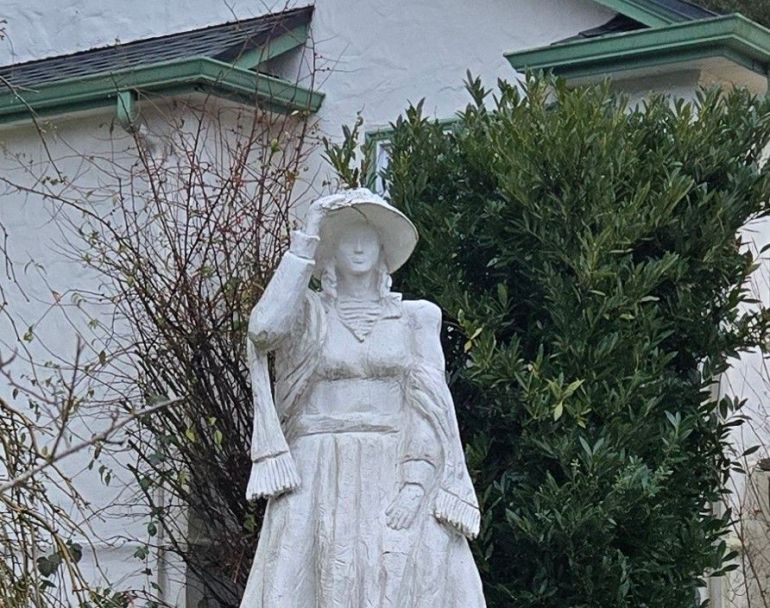
Regardless of who- or whatever she was, the Dow Lady had a lot going for her. Her hair was dark red, what artists called Titian, and was drawn back and worn in a single thick braid, which was looped once around her neck and still had enough length to hang down her back. She was wearing an immaculate white nape to toe dress, something right out of the 19th century–like in pictures of English tea parties, except she wasn’t wearing a hat. He couldn’t see her feet and her hands were bare. Holly reckoned that she had lived long ago, which was puzzling because Holly knew that the Dow Lady had died during World War II. Still, since when must a hallucination make sense?

“What a wonderful face,” thought Holly. Not exactly a movie queen beauty, she was maybe thirty and had fair-skin, a faded splay of freckles and active, intelligent, friendly eyes that were the same color as her hair; her cheekbones were set high, like a cat’s, yet her overall face was shaped in an oval. The whole thing came together beautifully with her fantastic smile; the slightest hint of an overbite gave her smile a leaning forward, just-between-us quality, and it was the kind of smile that manages to personalize itself for its recipient. Holly was certain that no other person ever got the smile she had given to him, nor would he ever see what she showed to others. This reminded him of the bittersweet feeling of falling into unrequited love. Still half-heartedly supporting the hallucination fantasy, he cast about his mind for the face his imagination had kicked upstairs up to play the role of the Dow Lady.

Holly’s fading subconscious called out from the deepest chasm in failing his mind and told him that it was not responsible for this vision; for what it was worth, Dow Lady or otherwise, this was, well, is.

The Dow Lady held her silence and warm gaze, but she eventually glanced at the needle, moving only her eyes, then back into his. She shrugged in a c est sera sera sort of way and her expressive face conveyed It looks like you really did it this time.

Her name was Emma Withe, and she was no more the mythical Dow Lady than she had been Cleopatra. Still smiling, knowing his time had come, Emma took both of Holly’s hands in hers. She had attended death many times; yet each one had its own singular dignity. Life may vulgarly halt by, but death never slouches. Holly was surprised to feel warmth, yet her touch vibrated with a subdued electric pulse that hinted at great power. Holly finally passed out and thought no more. Emma held his hands for a long moment, listening. From holding them she knew that his hands had once played the guitar; effortlessly gave something called “the Vulcan Salute”; caressed and struck; created and destroyed. Lived.

Emma laughed. She was not pleased by the event but at a strange sound she needed to hear that confirmed they had done well. Emma leaned forward and whispered “You remembered everything, darling” and kissed Holly on the mouth at the last beat of his heart.

End Chapter One
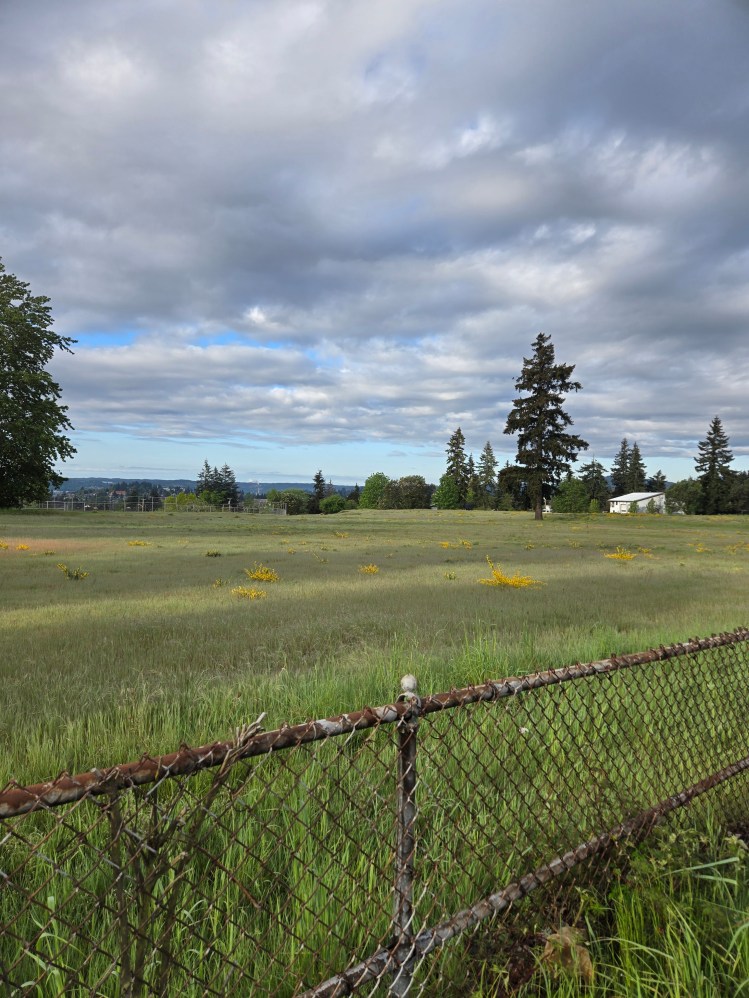
You Remembered Everything by Leila Allison

Introduction

This merry month sees the beginning of a serialized novel by yours truly–or unruly. Today, the prologue for You Remembered Everything heralds the arrival of the book itself. The novel is written through chapter three and just to place an extra element of fear in my life, it will be written as we go along week to week.

As to not interfere with Guest Writer’s weeks (the last week of the month), Every installment will appear on Saturday, starting with Chapter One this Saturday the tenth, and every Saturday thereafter, for months to come (twenty chapters are planned). Unlike the missive in January, these are full chapters sometimes reaching five-thousand words, but usually about half that many. The material being adapted comes from a source of nearly 400,000-words.

This is also an adaptation of the original material in the serialized story I referred to as “You Will Remember Everything.” It was published by Literally Stories, part by part, several years ago, as related yet stand alone stories. Obviously, this version will bear a resemblance to that, but rest assured the two narratives differ greatly and soon.

Leila

Prologue

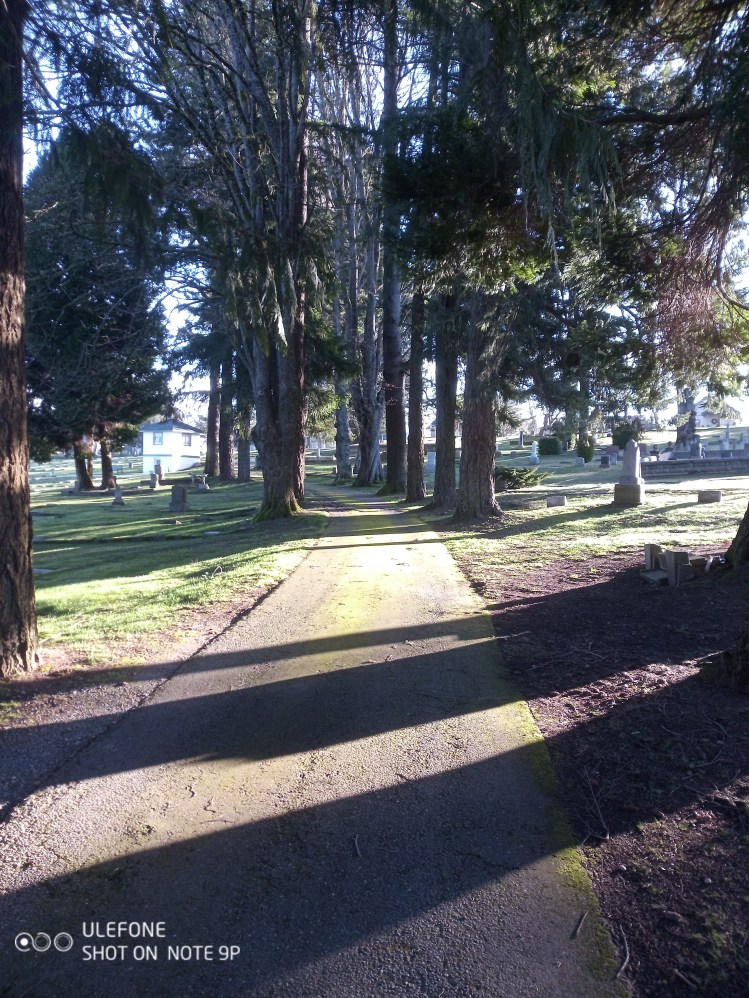
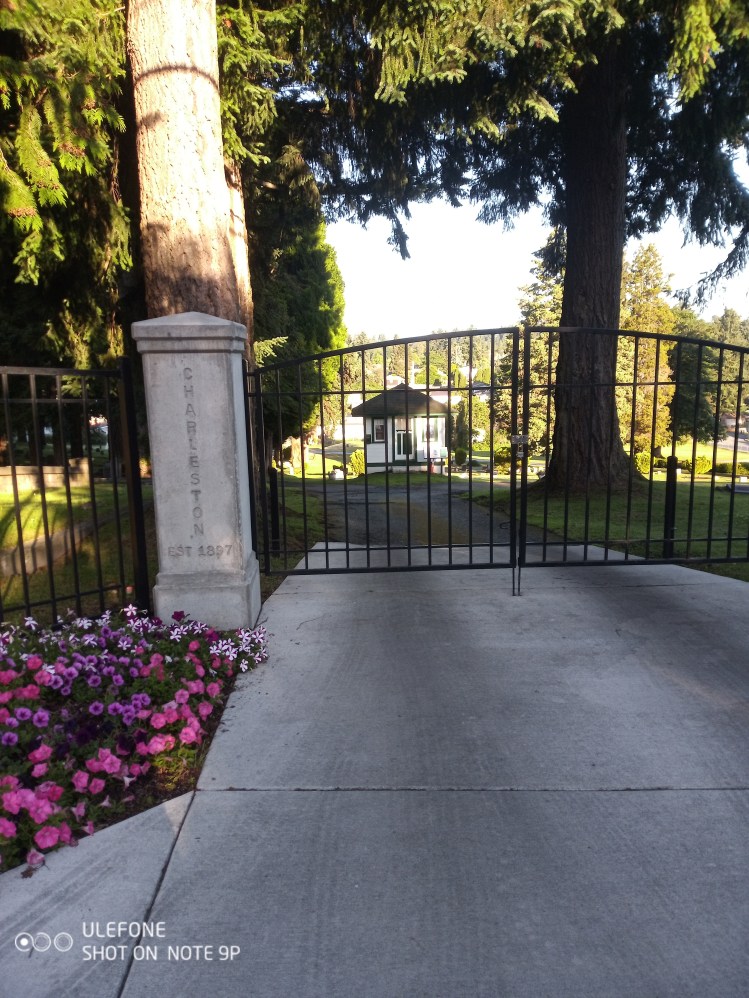
Charleston’s New Town Cemetery is seated in the west face of Torqwamni Hill, and no matter the season the quick fall of the slope and a thick line of adolescent Douglas firs at hillcrest combine to delay the cemetery dawn by a hundred yards or so. New Town’s a pretty place; the winding paths are lined with fragrant, non-fruiting cherries and delicate Japanese maples; on clear days the Olympic Mountains fill the western horizon with their beautiful yet icy indifference, and there is an abundance of old fashioned, winter-weary tombstones just begging to be charcoal-etched by artists and the sentimental at heart. A very handmade wood sign attached to the main gate informs would-be visitors that the cemetery is open from dawn to dusk. It’s been observed by the wise that dusk almost always finds its way to New Town just before the start of Happy Hour at the nearby White Pig Tavern.

Continue reading

The Merry Merry Month O’ May in Saragun Springs

May in the Springs is inspired by Tom Sawyer getting kids to white “warsh” the fence for him. Thus, being incredibly lazy, I have opened a new feature in the Springs. Every fourth week of the month is open for guest posters who wish to be exposed to at least forty subscribers (we are among the meek who will inherit the Earth, Wind and Net someday).

Friend Dale Williams Barrigar will be appearing on the week of the 26th-30th. For others who wish to fill a week with poetry or various odds and ends, I say go ahead and send those to saragunsprings@gmail.com Now I am not publishing a journal or anything of the such, I am fully occupied by Literally Stories UK. But as stated, I am pretty lazy, and I appear to be attracted to stuff that has the potential for shame,  despair, and disaster.

Still, I feel awkward telling obviously intelligent people the following: I will not post hateful, pornographic, libel suit beckoning, plagiarized stuff; nor touts, ads, or anything straying far past three-thousand words. Brevity is the soul here, and poetry the favored soul.

May is spoken for–but June is free.

Leila

send the nobel directly to dame daisy kloverleaf, c/o saragun springs, the multiverse

Dear readerly readers, with the bonus rubaiyat section published  in March I have faithfully translated One hundred quatrains of what was at one time billigits’ gibberish in twenty-fively installents of four.

To equal Omar’s hundred from ninety six, I shall nowly now republish the bonus because everyone in the world, save two, missed it the first time.

There will be more rubaiyats in the future–but the next one will be the Rubaiyat of Dame Daisy Kloverleaf, coming sometime this fall (unlike the wee-winged ones, I like capital letters and punctuationally punctuation marks).

You’re welcome.

Dame Daisy Kloverleaf (soon a Nobel Laureate)

The bonus repeat:

i

willie told the billies a tale deep in gin

about a donkey legend named uncle finn

finn was a humble jackass of no note

but when times got tough he busted the wind

ii

finn flew deep into the darkness of hell

he went in and kicked satans belly bell

yet his legendary tasks had gone unknown

until this magic donkey had to tell

iii

people said finn could not do such bravery

donkeys are useless save in slavery

but after many kicks to the scoffers heads

the people admitted their knavery

iv

spread the story across this land of sin

of the bravest donkey that’s ever been

and may all the knaves say out of respect

you’re a better ass than i uncle finn

the rubaiyat of the billigits: part twenty-four (translated by dame daisy cloverleaf) document

i

the billigits live little lives serene

yet i must stifle an evilmost scream

as they mince frolic and gambol too sweet

i resist punching my hoof through the screen

ii

rhyme schemes and ten beats are doing me in

so many better words fail to win

and those soggy syllables weigh me down

them soft to the tongue like being and been

iii

i will be a magic goat (rose and thorn)

and soar far above life’s punch in the horn

and prance and caper and do whatever

it takes to make it big like capricorn

iv

yet i take solace in my workly work

even though i must machete through the jerks

soonly saint of the adverbs I shall be

long before we see peace on earthly earth