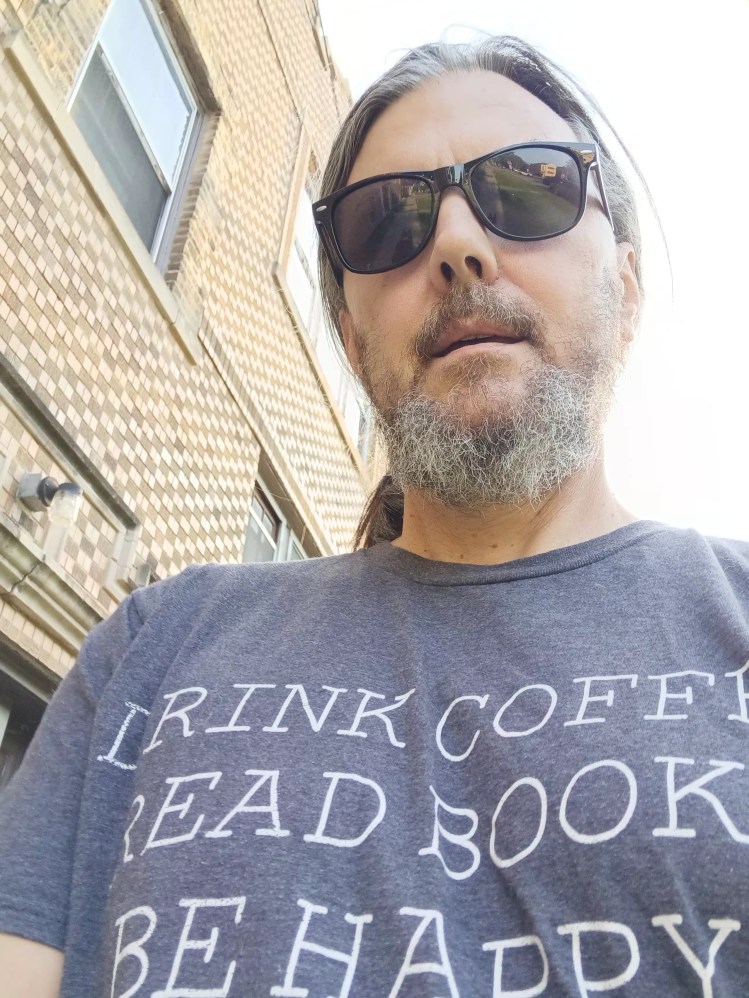
Roughing It by Dr. Dale Williams Barrigar

(Co-Ed note. Both images provided by DWB –Oh, to have Boo’s energy! Today we revisit Dale’s piece about America’s Shakespeare, the great Mr. Clemens/Twain, which was first published by Literally Stories UK. Sam had the same level of education as the Bard, but he’s is not detracted by his own legion of fatuous Baconites.–LA)

“Twain is America’s Shakespeare.”

– Leila Allison (2nd Co-Ed note–see, what did I just tell you!)

From the ages of twelve until sixteen, I was raised on the banks of the Mississippi River.

I first got truly intoxicated via alcohol on the banks of the river. (Alcohol would later become a major passion, until I had to give it up.)

I first tasted cigarettes on the banks of the river. (Same.)

I first tasted the sacred ganja (weed), too, on the banks of the Mississippi River. (Also a major passion, not given up so far as of this writing, except in the smoking form; medical edibles are stronger and more long-lasting anyway…)

I first held the hand of a girl on the banks of the river.

I knew a boy who was raped, robbed, and murdered by two other boys, who I also knew, brothers, who people called “white trash,” his body dumped into the river.

I was first shot at on the banks of the river (the one and only time so far, although a few people have threatened to do so since then, both those with guns and those without, women and men) which is a long and involved story all unto itself.

We lived a couple of miles inland. My friends and I would go down to the river whenever we could, which was frequently. Exactly like Huck Finn and Tom Sawyer (which I didn’t know at the time), my friends and I would sneak out of our parents’ houses at night, sometimes out of the window exactly like Huck, to go roaming around our small-town world under cover of dark, in the night, the fabulous night, when the ghosts, the angels, the wild animals, and the beautiful mermaids swimming in the foamy river waves come out, or you wonder if you’ve seen them at least.

We sometimes passed the Lincoln-Douglas Debate statue on our way down to the miles-wide river. One time, some friends of mine climbed all over the statue, which I didn’t do, not because I wasn’t a climber, I was a climber, of trees, cliffs, bridges, public buildings, water towers, fences, and sometimes up and down the outside walls of my parents’ house when getting in and out of the window at night without them knowing.

I didn’t climb on the Lincoln statue because I respected Honest Abe, and what he stood for, too much. I’d first learned about him back in Michigan from Mrs. and Mr. Murphy, our next-door neighbors, who had three framed photos alongside one another on their mantle above the fireplace in the early 1970s: Lincoln, John. F. Kennedy, and Martin Luther King, Jr.

When we moved to Illinois, I was instantly aware that we were entering the Land of Lincoln because of them. His leftover presence or memory bathed the whole land for me in a sort of immortal or legendary aura, or glow. He was the reason I would join the Blue Devil high school wrestling team here in Illinois, because I knew Old Honest Abe himself had been a wrestler, an individual who took on the bad guys even then (in my mind they were the bad guys).

One of my earliest memories is of crossing the river, in a car, on a bridge. We still lived in Michigan then and were on a family trip to the West. Dad was driving, and mom was pointing out the window, explaining why the river was so legendary.

The deep country in that part of Illinois surrounding America’s largest river is a mythological land that is yet or again unknown to many, but one day may become much more central to America again (despite its being in the center), because of all the fresh water it contains.

Hilly, extremely rural, filled with cliffs, ridges, forests, prairies, cornfields, eagles, deer, wild cats, wild dogs, and hogs, a place where you can easily get lost for hours on the back roads and not see another single human soul, a land of tiny, sleepy villages at crossroads with one person sitting in a chair on a porch maybe, mysterious isolated farm houses and barns back by themselves in the hollows, and small family cemeteries on hilltops like something out of “Wuthering Heights,” an area where the people almost seem to speak with a deep southern accent, a remote, vast region bordering the unconquerable river that few tourists or outsiders ever venture to or stop at, but where you can sometimes see travelers like hobos wandering up and down the lanes or waiting with their bottles and bags to jump a train, this part of Illinois still has an aura about it that conjures up an American past straight out of a Mark Twain story, large-haired, large-eye-browed, large-mustachioed, cigar-chomping, corncob-pipe-holding, whiskey-swilling, covered-in-newspaper-ink, laughing uproariously, raging Mark Twain.

While we visited Hannibal, Missouri, Twain’s home town, many times, like everyone else in the area, I never read Mark Twain’s stories, essays or novels when we lived along the river. In a fit of homesickness not long after we moved to Chicago when I was sixteen, I picked up “Huckleberry Finn” on a lonely summer afternoon and was suddenly transported back to the river country, where my best friend had been black, just like Huck and Jim. Their escape down the river forever after would stand for the longing for, and movement toward, freedom in my mind.

William Dean Howells called Samuel Langhorne Clemens, aka Twain, “the Lincoln of our literature.” Lincoln, Twain and THE LAND equaled THE RIVER in my mind, the strong brown god, as T.S. Eliot from Saint Louis, Missouri, called it, and the river itself equaled freedom, the cardinal virtue in the U.S. of A.’s finest idealist notions of itself. ILLINOIS, the middle of the country and the middle of nowhere, is America itself, boiled down.

As another great and legendary, iconic Middle American, Robert Zimmerman, aka Bob Dylan, has it about his youth in Minnesota: “Songs, to me, were more important than just light entertainment. They were my preceptor and guide into some altered consciousness of reality, some different republic, some liberated republic.”

“FREEDOM!” as Mel Gibson’s version of William Wallace, eternal Scottish rebel, a hero to both Twain and Lincoln, hollers out with his last echoing breath at the end of “Braveheart,” a great and overblown film, defying both the king and the mob, and even something else, like death itself.

Americans are good at escaping, or they used to be, just like me and my friends used to escape the comfort of our homes to go roaming where the edge of the world could be found. As Huck says at the end of his book, which he wrote himself, “I reckon I got to light out for the Territory ahead of the rest…” Now we inhabit the territory of The Mind, and lighting out means keeping your brain (and spirit) as free as possible from the disease of modern life, even (or especially) when they’re coming to get you.

Twain himself had become a kind of early conscientious objector, when he defected from the Confederate army after his very first taste of real violence, which he documents in “The Private History of a Campaign that Failed,” and “Roughing It.”

“I knew more about retreating than the man that invented retreating,” he says about his decision to bow out of the army, avoid the carnage he now knew was coming for sure, and soon, and flee to the West.

“In this country, on Saturday, everyone was struck dumb, and saw at first only deep below deep, as he meditated on the ghastly blow,” Ralph Waldo Emerson wrote in the immediate aftermath of Lincoln’s assassination.

The paradoxical actions and reactions regarding freedom of Mark Twain and Abraham Lincoln, one running for his life, then writing about it, as an example to all of us about how you can escape the system if you try; the other refusing guard and accepting the death he knew was coming for him like it had come for so many (and which comes to all of us late or soon), and which had been shown to him in a dream…are both embodied in trips they took down The River. Lincoln saw slaves on the auction block after a raft trip down The River to New Orleans, and told a friend, “If I ever get a chance to hit slavery, I’ll hit it hard.” Fifty years later, Twain went back into the past and wrote a story about a small “white trash” white boy and a good-hearted, good-looking, and wise, black man becoming the best of friends, all by themselves, at the bottom of society, on a raft trip down The River.

“The brown god / is almost forgotten / by the dwellers in cities,” as T.S. Eliot knew; but “the river is within us…”

Visiting Bill Burroughs by Dr. Dale Williams Barrigar

(Ed. Note–actually, Co-Editor note. Both images provided by DWB as we enter day two of some of his fine past works. This originally appeared in Literally Stories UK. It is good to keep things alive in this hectic globe of online publishing, a world covered by multiple layers of ether. The only way that this format can develop a history is to quickly acknowledge and keep a light trained on its past. LA)

It was a time when creative writing programs in the midwestern United States still contained edgy idealists, at least some of them. I don’t know what the writing programs here are like now.

A good creative writing class is, of course, always a bit of a performance. This is true for both the teacher, and the students. Everyone plays their role on an alternating basis.

As a teacher, some time around 2010, I began to notice a shift in my audience.

In another never-ending department meeting, the “head” called the shift “corporate.”

She said it was destined to only get worse.

The shift involved incessant cell phone usage, but also something else that was wordless and indefinable. I didn’t last long in such a climate. Pretty soon they had my head on a platter.

But back in the ’90s, I’d been a student, not a teacher.

I left Chicago for graduate school in Kansas with my now-ex-wife not long after the suicide of Kurt Cobain. His death was announced while I was watching MTV, drinking beer, smoking cigarettes, and reading in the middle of the night. It meant more than a lot to me, because he was almost exactly my age and I was a huge fan. I’m an even bigger fan now, almost exactly thirty years later.

There were practical reasons for choosing Wichita, Kansas, as my destination. But another huge reason was the fact that William S. Burroughs also lived in Kansas, a couple of hours up the road, in Lawrence, an old abolitionist town and still an artistic and liberal enclave with a university. I believed Norman Mailer when he wrote that William S. Burroughs was, truly, a genius of the English language and the written word, somewhat in the manner of Dr. Jonathan Swift.

The writing program at Wichita State University involved taking half creative writing, and half literature classes. So I spent my time studying Chaucer, Shakespeare, Dickens, and Dr. Johnson and Boswell, as well as delivering pizzas to pay the bills and writing endless short stories, prose poems, and book reviews for the local paper that kept pouring out of me and were both inspiring (to myself) and completely in the realm of juvenilia.

But I felt myself getting better at writing every day. And I knew William S. Burroughs was just up the road, a literary giant, a continual, tantalizing presence and inspiration. My intention ever since moving to Kansas had been to visit him, even if only for a few minutes. But I always put it off and kept dreaming about it, aways planning to go and never taking off.

I’d already been on numerous literary pilgrimages throughout the United States. My focus had been on visiting the place and the spirit of the person, instead of the actual author, because most of them were dead. A list can be found at the end of this tale, for those interested in desert island lists. (I’ve been on even more literary pilgrimages since then, including Canada for Leonard Cohen and Mexico for Gabriel Garcia Marquez.)

My three years as a graduate writing/literature student at Wichita State University were almost up. My writing had improved (even if it was still juvenilia), and I’d moved on from delivering pizzas to teaching classes in the department. But I still hadn’t visited William S. Burroughs up the highway a couple of hours in Lawrence. Then the moment came.

I was sitting in a favorite dive bar in a poor side of town on the other side of the tracks with two of my favorite folks in the world. Cocktails we regularly shared together in those days included cocaine, LSD, opioids (no needles), hash, plus two to four packs of Marlboros a day per person, all in the spirit of John Lennon, Rimbaud, Coleridge, Thomas de Quincy, and Burroughs, but tonight we were only drinking: whiskey, beer, tequila (and tobacco smoking). All three of us were taking turns playing the audience at our bar table and “writing in air,” as James Agee called it.

One of my friends suddenly suggested that we get in his car right now and visit Old Bill. Merle Haggard, Willie Nelson and Janis Joplin were playing on the juke box because we kept feeding the coins in for them. We talked about it for about ten minutes, then purchased supplies: pints of Jack Daniel’s and packs of cig’s for the road from the barman behind the bar. That kind of take-out was legal, and not even frowned upon, in the Kansas of those days.

The three of us were in my friend’s Mustang headed to Lawrence. These were two of the closest people to me in my life. One of them I was even closer to, because I was madly in love with her, as well as being a best friend. Our driver had done significant time in prison due to shooting a rival in the leg and other issues, years in the past. He was also a true genius of the underground, someone who could recite entire long passages from “On the Road,” “Howl,” “Song of Myself” and William Blake at will and from memory and would do so frequently in the bars of Wichita. If he wasn’t getting it right, he was making it up, which was even more impressive.

My favorite William S. Burroughs short story is “The Junky’s Christmas.” In this piece, Burroughs, the great sinner, is transformed into a kind of grizzled yet benevolent grandfatherly figure who narrates a tale about a down-and-out junkie who gives away his last shot to a lost soul on Christmas day before being astounded into heaven, as Melville wrote of stoics when they die at the end of his very, very long poem Clarel, a work that perhaps fifty people, or less, have ever read end to end. And that means fifty people ever in the history of humanity, not just who are alive now. If anyone is alive now who’s read this entire poem, I wish to hear from you.

We asked around in the college bars of Lawrence. They told us where Burroughs’ house was. We continued drinking in the bars into late, late in the night, celebrating Old Bill in his home town. We didn’t finally head out to Burroughs’ place until after the bars had closed down.

We found his house, but he wasn’t home, or was sleeping, or wouldn’t answer the door; and who could blame him; we knew he was elderly, so we didn’t try long, but we were on hallowed ground, if only for a few moments.

On the way back to Wichita, the car ran out of gas on a stretch of the Flint Hills Highway that didn’t have any towns, exits, or gas stations on it for a length of seventy miles. A state trooper drove my friend thirty miles down the road and back again to pick up gas while my other friend and I waited in the car and watched the sun come up over the great, tall-grass prairie hills. The state trooper never mentioned the drinking. There were still antelope on the hills in those days and may they remain there forever. We watched a herd of them running by and beyond us into the distance. This sight was true beauty, as only wild animals in the middle of nowhere can be.

William S. Burroughs died on the day I finished graduate school in Kansas. The next day, I moved back to Chicago to enter the Program for Writers at the University of Illinois Chicago, which had been co-founded by Paul Carroll, one of the editor/writers who first published Burroughs and was almost prosecuted by the U.S. government for doing so. Allen Ginsberg had passed on four months before. This synchronicity meant nothing, absolutely nothing, to anyone on this planet except me. And I think it was better that way because it wasn’t something I could’ve shared at the time in the right way, even though I tried.

Old Bill had told and written many stories in his life, in many different forms, and his life itself was a great American story, not without tragedy, of course. Burroughs, who could be more than a tad prickly, always insisted that the purpose of his famous cut-up technique was not artistic, but spiritual, mystical, and magical. The cut-ups brought him messages he needed to know about life, not facts but mysteries.

He didn’t believe in what we call “death,” or “accidents,” especially after the death of his wife, Joan, who had also been his best friend, probably even more than she was his wife.

Robert Browning said, speaking of the afterlife, “Never say of me that I am dead.” I never met William Burroughs in person, but that was never the point.

Postscript.

Alabama: Barry Hannah; Alaska: Jack London; California: John Steinbeck, Henry Miller, and Gary Snyder; Colorado: Hunter S. Thompson; Florida: Zora Neale Hurston, Wallace Stevens and Ernest Hemingway; Georgia: Flannery O’Connor, Harry Crews and Carson McCullers; Idaho: Ernest Hemingway; Illinois: Abraham Lincoln, Saul Bellow, Carl Sandburg, Richard Wright, Ernest Hemingway, and Gwendolyn Brooks, who I met in Chicago and who I plan to write about soon; Iowa: Flannery O’Connor and Denis Johnson; Louisiana: William Faulkner (New Orleans); Massachusetts: Emily Dickinson, Nathaniel Hawthorne, Ralph Waldo Emerson, Henry David Thoreau, Herman Melville; Michigan: Ernest Hemingway, Jim Harrison and Robert Hayden.

Minnesota: Bob Dylan, Sam Shepard, F. Scott Fitzgerald and Louise Erdrich; Mississippi: William Faulkner, Richard Wright, Larry Brown, and Eudora Welty; Missouri: Mark Twain; Montana: James Welch and Thomas McGuane; Nebraska: Willa Cather and Malcom X; New Hampshire: Robert Frost; New Jersey: William Carlos Williams and Walt Whitman; New Mexico: D.H. Lawrence; New York: Herman Melville, Walt Whitman and Norman Mailer; North Carolina: Thomas Wolfe; Ohio: Sherwood Anderson; Oklahoma: Ralph Ellison and Woody Guthrie; Oregon: Ken Kesey; South Dakota: Black Elk; Tennessee: James Agee, Cormac McCarthy, and Martin Luther King, Jr.; Virginia: Thomas Jefferson; Washington: Raymond Carver; Wisconsin: Aldo Leopold, John Muir and Lorine Niedecker.

Saragun Springs Presents: The Gas Station Incident by The Drifter

(Images provided by The Drifter, and, I would like to think, Boo)

“I am an American, Chicago-born…” – Saul Bellow

Somewhere around the year 2017 A.D., when I was around fifty years of age, something happened to me that was so dramatic and traumatic it caused me to collapse that very day into a severe nervous breakdown right in the middle of the really bad nervous breakdown I was already having.

When I look back on those times now, sometimes I wonder how I even survived at all. And yet I did survive. And, lately, I even appear to be thriving.

The gas station involved in this story is what is known around here as a super-shady place.

Not as in shaded with lots of trees. There are no plants there at all, except the weeds sticking up through the cracks in the pavement.

Shady as in lots of shady people hanging around.

“Shady people” means folks who look like they just crawled out from the bottom of the barrel to look around at the world and get themselves some.

The people involved are of all colors, shapes, sizes, genders, sexual preferences, political persuasions and so forth.

The one thing they all seem to have in common is their shadiness.

“Disreputable” is a more fancy term for the same thing.

Turns out I looked a bit disreputable myself that day, at least to some folks, although I wasn’t quite aware of it in the way I maybe should have been.

This gas station is still there, on Roosevelt Road in the far West Side of Chicago, on the other side of Cicero (Al Capone’s hometown) and Oak Park (hometown of holy Hemingway and the great Frank Lloyd Wright) and right near Berwyn (humble home of yours truly).

The gas station sells gasoline and also other items. Like lots of hard liquor, cheap beer and hobo wine, sickening food loaded with horrible chemicals, countless amounts of smokable things, various sex toys and safe sex items like condoms randomly displayed in wide array all over the place, and, I was soon to learn, other things as well. It also has a “rest room” around the corner I’ve never had the courage to approach.

I wasn’t at this gas station because it was shady.

I was there because shady places generally don’t bother me too much (and even fascinate me when I’m in the right mood), and I was mostly there because I live in the area and I needed gasoline, and I didn’t have much money and this was the cheapest gasoline around.

At the time I was the proud owner of an ancient black mini-van, a vehicle that felt to me like a family member almost, I was that fond of her.

So I was standing there filling her with gas so I could continue drifting around town in that inimitable way I have.

(I haven’t been on an airplane in over twenty years and, for the record, flying on an airplane in any fashion is much worse for global warming than any kind of driving is: much, much worse. The driving I do is required for my artistic profession (and disposition), but I do limit it too, as much as possible, taking days off from driving and walking instead much of the time, etc. As well, I usually drive slowly, which also burns much less fossil fuel. This is to the future.)

I was there putting gas in my beloved black mini-van.

A shady-looking person suddenly walked right up to me – out of nowhere, as the saying goes.

Out of nowhere, suddenly, fast, and rapidly, too.

He was so shady-looking that I have to say he was a very scary-looking guy, who was also much bigger than me (even though I’m almost five feet eleven inches tall and weigh a hundred and ninety pounds).

I’ve been jumped before several different times in my life under various circumstances, and this guy made me nervous, bouncing up into my face like that.

But then I saw he was only asking for a small hand-out.

I had a few coins in my pocket, maybe a dollar’s worth, so I dug around, located these, and handed them to him because I now realized he looked hungry, very hungry.

My desert island book, other than The Bible, is The Imitation of Christ by the shady German monk Thomas a Kempis. And I remembered Jesus’ tale of The Good Samaritan. And that was why I handed him the money; even though I knew it wasn’t doing much, it was something.

At the time, you could buy an entire hamburger at McDonald’s for that amount of change, and this fellow was clearly hungry like he said he was.

If he were to spend the pittance on liquor or drugs instead, I figured he needed those as well. Looking as rough as he did, he probably needed more than one thing to help him make it through another day.

According to my private religion, turning my back on him would’ve been a sin.

He seemed happy to get the money even though it was such a small amount, almost overjoyed, actually.

But as he walked away I seemed to notice a strange glint in his one good eye and a weird twitch at the corner of his bleeding lip. He limped badly, was of indeterminate race, and was dressed in rags.

And I thought the matter had ended there.

The next thing I knew I was slammed up against the back of my van from behind so hard it would turn out that the bridge of my nose was broken, a scar that still shows on my face.

And I was slammed up against the back of my van so hard from behind that everything went black for a second and it took my breath away.

Until I came to again and realized with instantaneous horror, terror, and nightmare fear that my arms were pinned up against the back of the van by two gigantic, horrifically strong men, one on each arm on either side of me and neither of them in a good mood.

And I was literally pinned there, like the Christ, in the crucifixion position, standing with both of my arms pinned down straight out at my sides.

It turns out the two gigantic men were undercover police.

They had been watching me from their undercover vehicle the whole time, wondering what I was doing around here.

When they saw me hand the man the dollar in coins, they thought they saw him hand me something back.

When they rifled through my pockets, they found out that wasn’t the case.

But when they slammed me up against the back of the van like that, they thought I’d been purchasing crack cocaine, meth, opioids, whatever, from the man.

When they realized I hadn’t been doing so at all, and that I’d only been handing the fellow a dime, as the saying goes, they began to apologize so profusely that I almost instantly forgave them, even though I was still extremely angry at them and sometimes still get angry at them to this day, when I drive by that gas station.

They told me there were many, many gang bangers frequenting that area who carried assault rifles and machine guns in the trunks of their cars, pistols on their own persons, switchblade knives in their pockets, clubs beneath the seats of their low-riding vehicles, and so forth.

That was why they felt compelled to attack me from behind and slam me up against the van in the crucifixion position.

They were both well over six feet tall and huge as far as muscles go, each of them outdoing me by several sizes in that regard (gym rats, they call them). One of them was probably six feet four.

But they were sorry about what happened when they found out I was just out going about my regular, legal business.

And as they let me go on my merry way, they apologized again, slapped me on the back, and told me to have a nice day.

END NOTE: The Drifter continues to drift through some of the most dangerous neighborhoods in Chicago: fearlessly.

He does it because he’s an American and this is America.

I Was Ten When Elvis Died By Dr. Dale Williams Barrigar

They called him fat and they called him a fool, but when he stepped behind the piano he was neither fat nor foolish.

He was Elvis, in South Dakota, in a small theater, about to sing another song, just a few weeks before he would fall to the floor in his bathroom back at Graceland and leave us for good – so suddenly.

And thereby catapult himself into the earthly realms where no one dies. Because now he’s the quintessential American, globally more famous than Abraham Lincoln, or maybe equally so.

(We say nothing of current people who may be more “famous” than either of them at the moment, because this kind of fame is only for the moment and will fade. In the annals of humanity, the good ones last longer than the bad except for the exceptions, like Hitler; and you really have to be bad to be as horribly bad as him.)

Before he sat down at the piano it was almost as if he was fat and a fool. He looked quite overweight although still more handsome than the most handsome movie star ever (because he was never really a movie star), and he was obviously high as hell on something, or rather not one something, but many somethings.

He was so high that he couldn’t talk right, not at all. He mumbled and muttered, he lost his train of thought, he shook his head to try and get it back, he laughed at himself up there on stage. He was high and jonesing for more at the same time, he was wired and wasted, he was surrounded by gigantic cups of ice and Coca Cola that he drank nonstop and to wash the pills down with (dozens or even hundreds of pills per day) (and he was fatter from the beverages than the sandwiches because eating interfered with the endless buzz of being him); he was high in the way that someone gets high who sees it almost as a duty and an obligation, certainly not a pastime or a hobby: he was so high that he was high as only ELVIS could be high: admirably high, utterly high, completely wasted, totally wired, and yet still walking around, telling the jokes, laughing at all. And about to sing another song.

And when he opened his mouth, the world suddenly knew (or only the parts of the world that live in South Dakota – for now) that Elvis was no longer a pop musician; he had left that behind him long ago. (“Don’t look back,” said Bob Dylan.)

Because now he was a CLASSICAL MUSICIAN. Now he was on the level of an opera singer, better than Pavarotti. Now he was someone who Beethoven and Mozart would hang out with. Now he had elevated his art into the highest levels of art that art can achieve, and his version of “Unchained Melody” was so good it made you want to compare it to (and I want to compare it to) the Mona Lisa or the Statue of David.

Elvis was fat and sometimes acting foolish; he was high as high gets when you can still walk around, and he couldn’t even talk right. But when he opened his mouth and began singing this one song, he truly belonged, and truly does belong, with the best of the best and the greatest of the greatest, not just in America, now, but in the world, anywhere, any time.

And then the song was over. And no one even applauded at first (before it exploded). But even the ordinary folk of the great state of South Dakota knew what had just happened.

Elvis had outdone himself. He had elevated himself, had increased his own greatness, had increased the greatness of art and the human race in the few minutes of one song.

His voice had been so powerful, so subtle, so nuanced, so loud, so ringing like a bell, so true, so lasting, so effecting, so mountainous and river-like, so sad, so tragic, so affirming, so massively grand, utterly great, and endlessly hopeful and emotionally pure and poetic that no one else who ever lived could sing that good, at least not what he did in that one song one time in South Dakota three weeks before he died.

Now they laugh at him as the fat fool a lot more than they celebrate him as the grand and great singer, the one true voice, the best of the best in the purity of American song. And that says a lot more about us than it does about him.

The rubes and the dupes and the snake oil sales folks all know who he is; but not one of them really knows who he is.

Only Elvis could have become ELVIS that way. Just as only you can become YOU in the way you need to.

Instead of laughing at him we should listen.

END NOTE: He was reading A Scientific Search for the Face of Jesus by Frank Adams when he died; the book was found not far from his body.

John Lee Hooker’s House Rent Boogie by Dr. Dale Williams Barrigar

“A man alone ain’t got no chance.” – Hemingway

Like all great story-telling, John Lee Hooker’s “House Rent Boogie” can make you feel much better about yourself, if you’re willing to meet Hooker half way.

In a nation filled, more and more, with what Noam Chomsky calls the “precariat,” or economically disadvantaged folks who live paycheck to paycheck, dwelling to dwelling, meal to meal, buzz to buzz, never knowing, as Henry Miller put it, when the chair will be yanked out from under their rear ends, and they will be tossed out into the street again, Hooker’s “House Rent Boogie,” also known as “House Rent Blues,” can offer solace and encouragement to many of us.

This kind of story-telling shows what story-telling is really for, which is helping the human species to make its way in this world while we struggle to survive our allotment of days here on the rapidly warming earth.

“House Rent Boogie” comes in different versions. Bob Dylan is famously, and rightly, known for reinventing his and other people’s songs as he travels the world like a modern-day Homer, the great Greek poet, but the great blues players and singers were doing this very same thing quite a while before Dylan came along, as he readily acknowledges. An original version of this story-song appeared some time in the early 1950s.

But the most entertaining, complete, and enduring version of the song, absolutely, one hundred percent, is the one that lasts for six minutes and twenty-four seconds, recorded in 1970, when Hooker was in his 50s. (He was born in 1912 or 1917 and lived until 2001.) This is, truly, one of the greatest blues performances of all time that we have a recording of. J.L.H. is the peer of the best of the best, from Bessie Smith and Billie Holiday to Muddy Waters, Howlin’ Wolf, Buddy Guy, and B.B. King.

(Buddy once followed my wife-at-the-time into the Ladies’ Room at a show in central Kansas in the 1990s while continuing to play his electric guitar the entire time, giving her his big smile in there before modestly retreating. I saw B.B. front row in central Illinois in the 1980s, and was blown away not just by his playing and voice, but by his PRESENCE. For some reason, I kept being reminded of Eisenhower pushing forward the Civil Rights Movement after Louis Armstrong called him a coward, which speaks very well of both men.)

“Precariat” is a combination of the words “precarious” and “proletariat.” “Boogie” means many things, including a fast, strong style of piano blues, a dancing to such music, a dancing to other music, and a way of escaping, literally or figuratively. Hooker’s complex story-telling uses the term in all of the above senses, as he explores and explodes what it’s like to be a part of the precariat in America or any other land, but especially in America, Land of the Almighty Dollar and Home of the Greedy.

The first line of the song is “I’m gonna tell you a story.” This is the talking blues, backed by electric guitar, harmonica, piano, bass, and drums. Hooker’s deep, mellow, profound, strong, confident, masterful, laughing, lamenting voice tells the tale of a man who’s lost his job. While he was employed and had a full wallet, the world was his friend and so were all the people in it. Now that he’s become down-and-out and busted, everyone has suddenly turned dismissive, sarcastic or apologetic as they resolutely turn away. It’s a tale that illustrates Scottish thinker Adam Smith’s “vile maxim,” which was that you shall care for, and worry about, no one but yourself.

Smith is one of the most misunderstood philosophers in the Western world, and he was virulently against adopting this maxim, but he saw how outrageously prevalent it was, especially in commercial and mercantile countries like Great Britain and America. In the Land of the Scam and the Home of the Selfish. John Lee Hooker, no less a philosopher, one who boils down his sense and experience of the world into a personal, satiric, universal narrative, gives the heartless human sphere the solid drubbing it deserves in this eternal song. As a black man in America who was in his 40s before the Civil Rights Movement came along, and who once worked as a factory janitor in Detroit, Michigan, among other such jobs, Hooker knows deeply about what he speaks and sings of.

Charles Mingus called his experimental autobiography, which he spent twenty years on and off writing, “Beneath the Underdog.” This phrase gives a taste of Hooker’s point of view in “House Rent Boogie.” Once your wallet goes in good old America, and you’re thrown back on nothing else but yourself and your wits, things can go bad very quickly, in the land where “the masters of man,” as Adam Smith called them, are perhaps more ruthless than in any other land before or since, or at least just as ruthless.

In 350 or so Hemingwayesque words, including realistic dialogue which Hooker acts out with his voice and punctuates, undercuts, and dramatizes with his electric guitar, his piano player, and his other musicians, who’s chiming, banging, bumping, and ringing away along with him is like the supporting characters in a Shakespeare play, this parable about being down-and-out says so much about the way we live now that it could have been created yesterday, instead of fifty-four years ago.

A recent story on the radio described the United States as a place where it’s “expensive to live and hard to get a job.” And the majority of jobs that are available are so crushingly boring and meaningless for many of us that it’s damn near deadly; or just plain deadly. In America, vast Tower of Babel, where language itself, humanity’s greatest invention, has been stolen and perverted by the politicians, preachers, mass media, ad people, and snake oil sales folks on tv and everywhere.

In the Land of the Avaricious and the Home of the Homeless, where real art and artists, and real thinking and thinkers, are not just rejected, ignored, mocked, and spat upon, they are sometimes even downright crucified, and certainly laughed right out of town. Henry Miller called his own version of this story “The Rosy Crucifixion.” Charles Bukowski wrote about it in almost every line he ever typed. Hooker too is rosy about his busted story, when he switches point of view and comments on himself, the main character, “He rocked on.” He rocked on, and kept going somehow, no matter what. Because this, thank God, is another strong strain in the American character. Perhaps the American Civil Rights Movement of the 1960s showed this strain as well as, or better than, anything else in our history.

In 1980, Hooker appeared in the Blues Brothers movie alongside the white black brothers, Belushi and Akroyd. He was in the Chicago street with his band in front of the Soul Food Café playing “Boom Boom Boom,” and his appearance lends the film the aura of an American reality that’s still ringing true like a bell forty-four years later, maybe more than ever now. And I seem to remember Hooker in the ‘80s and/or early ‘90s in music videos on MTV, wearing his shades with Pete Townshend and being the epitome of cool as much as Miles Davis himself ever was.

Some people in America know what cool is, and some don’t, as Norman Mailer pointed out in his essay “The White Negro” from 1957, originally published in “Dissent” magazine. Mailer’s essay was and is intensely controversial and provocative, probably wildly mistaken in many of its points, but also profound and utterly ground-breaking, praised by the likes of Eldridge Cleaver, and intensely engaged with by James Baldwin and Ralph Ellison. The average Soccer/football Mom, Soccer/football Dad, or Corporate Mom, Corporate Dad are a few who do not know what cool is, according to Mailer. Anyone who’s ever been on the street and all real artists are some of the ones who do know. Mailer’s hipster from the essay is an absolute precursor of hip-hop to the level of being prophetic, except for the crucial point that Mailer’s hipster wants NOTHING at all to do with the so-called American Dream, which Hunter S. Thompson rightly claimed was dead anyway no later than the mid-1970s, ushered out by none other than Tricky Dick himself, the sly old alcoholic precursor of all current want-to-be American dictators and authoritarians.

If Hooker, with his wide range, deep knowledge, and tales of American experience in over 100 albums recorded, is a kind of fragmentary or experimental novelist, as the great Chicago radio host and writer Studs Terkel told me the one and only time I ever met him for ten minutes in the early 2000s, then “House Rent Boogie” is one of his best chapters. Play it loud, and over and over and over. Play it loud, and don’t just listen. Study it.

Scottish farmer-poet, song master, and exciseman Robert Burns, up there right after Shakespeare as one of the most quoted and known writers in the world, is a precursor for all of the American blues poets, story-tellers and singers. Burns’ social justice sympathy extended even unto a mouse whose house, or nest, was wrecked by the plow. His heart and mind went out to the under-mouse as well as the underdog. In similar fashion, John Lee Hooker’s “House Rent Boogie” extends a hand to everyone who’s ever lost a job, lost a friend, lost a romantic partner, or been on the outside in any way. His song title “Teachin’ the Blues” tells us much about his intentions. He was a professor of life, like Muddy Waters and Howlin’ Wolf.

Hooker also has an album called “The Healer.”

Hooker was the Mississippi son of a popular sharecropping minister who thought the blues was the devil’s music. As such, he wouldn’t let his son play his guitar in the house. But Jesus of Nazareth himself was thought to be a devilish demon-conjurer by most of the leaders in his own society. A bunch of townspeople tried to throw him off a cliff one time long before he was finally crucified by the Romans. JC is the first and most profound precursor of the blues. Not only did he have sympathy for the underdog, he knew very much what it was like to be one. Just like John Lee Hooker.

The Rolling Stones: Memory Motel by Dr. Dale Williams Barrigar

“I hit the bottle, I hit the sack and cried.”

The Stones’ song, “Memory Motel,” from their 1976 album, “Black and Blue,” is an overlooked and underappreciated masterpiece. This story-song is well worth looking at and listening to again. And again and again. One of their very best works, it’s a shining, enduring example of the Anglo/English ballad tradition which was incorporated into the black American blues idiom and then re-worked again by white singers and groups like Elvis and Jerry Lee Lewis, and later on to the Stones, Led Zeppelin, Janis Joplin, Van Morrison, and Eric Clapton, leading to crucially important artists of today like Nick Cave; Lana Del Rey; Taylor Swift (“All Too Well (Sad Girl Autumn Version)”); Snoop Dog; Eminem; Bonnie “Prince” Billy; Conor Oberst (of Nebraska); and Wilco.

These cross-cultural exchanges, sometimes violently resisted by mainstream society, were moral acts which led to more than just rock and roll, bending the arc of the human universe toward greater justice by vastly increasing integration and racial equity throughout the world. Real music isn’t just music, from Bach, Beethoven and Mozart to now.

“Memory Motel” is a song which connects everyone by exploring the gnawing ache in the bones of lost love and the passing of time which all humans experience, no matter their race, creed, income levels or gender. In seven minutes and seven seconds, in a song recorded in Germany, the Stones tell the tale of a heartbreaking, breathtaking love affair starring a beautiful, hazel-eyed, long-haired, wild-haired woman who grabs the guitar from the hands of her man; drives a green and blue, broken-down pick-up truck; and sings genius songs in a bar in Boston. The narrator is an equally brilliant rock singer on the road. The setting a haunted motel on a remote seashore.

Shakespeare’s Juliet, Robert Burns’ Highland Mary, William Wordsworth’s Lucy, Keats’ Fanny Brawne, Mary Shelley, and Byron’s half-sister Augusta Leigh are all somehow drawn together in this intense mini-drama told in the idiom of the English blues.

Long-haired, unshaven, shirtless, piratical Richards, holding a Jack Daniel’s bottle and a cigarette, absconds on the guitar and only sings for most of this piece, which means he’s bringing everything he can to his vocals; while long-haired, unshaven, checkered sport coat-wearing, show-biz Jagger pounds the piano keys as if they were a typewriter and he were trying to write an entire Emily Bronte romance novel within one song (bottle of Jack Daniel’s next to his ankle and his red socks on).

Richards enters the song half way through as a third character in a shadowy performance worthy of Christopher Marlowe, Shakespeare’s rival, establishing an emotional threesome in the song’s situational dynamics that lends a profound layer to this public closet drama. His voice continually praises the intellectual and emotional uniqueness of this special woman, never expressing jealousy or anger, but sometimes grief at her loss. The mainstream cliches about Keith are completely undercut by his progressive feminist perspective and his depth of emotional expression in this autobiographical story performance, which is heart-breaking, realistic and long-enduring in human terms.

(Keith only sings co- or lead vocals on a double handful of Stones tunes. Almost every one of them is one of their best works.)

Richards co-wrote a fascinating, Hemingwayesque autobiography called “Life.” He was an obsessive reader of Byron at one point. The Byron who went around the higher levels of English society with gigantic dogs, a laudanum bottle, and sometimes a monkey (or a trained bear at college). Byron’s girlfriends and friends were collaborators, competitors, and rivals. One of his beautiful, regal, and intellectually intimidating ladies labeled him, the great lord, “mad, bad, and dangerous to know.”

“Memory Motel” implies this kind of tragic history, as surely as Mick Jagger read aloud portions of Shelley’s elegy for Keats, “Adonais,” in honor of Brian Jones. (Jones is a member of the eternal 27 Club. Keats was 25 upon dying. Percy Shelley was 29. Wordsworth was 80. At this writing, Jagger and Richards are 81 and 80, recently on tour here in Chicago, home of Buddy Guy, Muddy Waters and Howlin’ Wolf, and where the Stones recorded their second album sixty years ago in 1964.)

“I hit the bottle, I hit the sack and cried.”

As I grow older, every time I go back to my own Memory Motel, I hear more.

I had become a failed literature professor at the age of 52, because they took my job away. Also, another relationship had ended. I couldn’t bear to keep the photos of her and us, nor place them in the dumpster either. So I took one of the small, black-and-white, photo-booth photos of beautiful, genius, red-haired her from when we were on our trip to Nashville seeing a retrospective of Bob Dylan and Johnny Cash at the Country Music Hall of Fame. And I placed the photo deep in the middle of a library book which I put in the middle of a bunch of other library books I returned.

A librarian named Veronica called the next day and returned the photo to me.

John Lennon: The Revelator By Dr. Dale Williams Barrigar

“Marley was dead: to begin with.”

– Charles Dickens

John Lennon in his Pickwick glasses is like a character from a Charles Dickens novel, or much like Dickens himself in his concern for social justice and his endless sympathy for the literal, and figurative, orphan, outsider, and underdog.

Lennon can also fruitfully be compared to another English writer of the nineteenth century who rivals Dickens in staying power and popularity. Like Lewis Carroll and his beloved, living Alice, Lennon’s life was all about expanding the mind, and through the mind, the heart.

Lennon was crucified by his own fame in the form of one of his own fans. This early, dramatic death catapulted him to another level in the modern pantheon of heroes and secular saints, just as Van Gogh’s lonely death would eventually elevate him in the same way. Before Lennon was wrenched away from this earth in the literal sense, he created a body of work that yet remains here to be explored in order to uncover its true depth, importance, and hidden meanings. His simple, straightforward, and mysterious writing style will last a very long time, probably at least as long as Dickens and Carroll themselves.

Lennon’s work with Paul McCartney and the Beatles is, of course, a whole other universe unto itself. But perhaps it’s in Lennon’s solo work that we can most fully take the measure of the man and the evolving, never-resting artist (for the artist is working even while dreaming), and the continued meaning of his words and music for the world at large.

Lennon began to move decisively away from McCartney and into his work as a solo songwriter on the brilliant, fragmented, cohesive, novelistic, experimental, James-Joycean double record now known most widely as “The White Album.” In three songs especially from this album, Lennon stakes out his own territory as an emerging, Dylanesque solo artist.

“Happiness is a Warm Gun,” “I’m So Tired” and “Dear Prudence” set the stage for his eventual movement away from the Beatles as the 1960s ended and into his brilliant, solitary decade of the 1970s before the artistic crucifixion in 1980 ended it all at the age of 40 (the exact age when Kafka and Poe, two other short-form writers of worldwide importance who surely influenced Lennon (whether he read them or not), also died).

“Happiness” explodes the tired and worn-out conventions of song-writing. “Tired” laments weariness in general, and weariness with old, worn-out worlds. “Prudence” is an invitation to something new and dear.

In a double or triple-handful of classic songs from the coming decade of the 1970s, the last decade he would have left, Lennon expanded both his writing skills and his persona and stance as a democratic humanitarian, a worker for peace, justice, and love who has few equals in this regard. The writing reinforced the anti-authoritarian persona and personality, and the anti-establishment stance buttressed the writing at all levels. The wonder and the artistic miracle of it is that Lennon also never became an ideologue, a propagandist, or a politician.

He perhaps became a sloganeer at his worst moments. But he always managed to rise above it again to assert the power of pure writing, which made his art for peace that much more effective. It leads us back to Dickens, who in some senses seems to have created John Lennon. Lewis Carroll’s open-minded, exploratory writing also undermined authoritarianism, hatred, greed, and war, in a way that was so pure and effective it was almost invisible at times.

Paradoxically, the invisibility seeps into the culture and effects real change in a way that politics and politicians can only dream of. This is why Percy Bysshe Shelley, another English radical fighting the bad guys, thinking of John Milton, called true poets, “The unacknowledged legislators of the world.” The phenomenon undergoes changes in mode and method of action; but it never goes away. In indigenous cultures, the figure of the shaman, trickster, and medicine person carried and carries much of these responsibilities and burdens.

“Everybody’s Got Something to Hide Except Me and My Monkey” is another song written exclusively by Lennon which appeared on The Beatles’ “The White Album” and was an omen of things to come. A seeming piece of Lewis Carroll or Edward Lear nonsense writing, it’s crucial to note that the greatest nonsense wordsmithing is never about only nonsense, just as the best nursery rhymes are not only for children.

McCartney believed the song was about heroin usage. Lennon’s anti-establishment stance would take many forms in the era of Richard Nixon. One of these forms was Lennon’s belief, and life action, like Sigmund Freud earlier, that the individual should be free to use and explore drugs as s/he saw fit, without the government intruding its heavy, uncaring, impersonal hand. It started when Bob Dylan introduced the Beatles to marijuana in New York City. The sacred weed later led to LSD, and, for Lennon, cocaine and heroin usage. Ironically, in the era of the alcoholic, paranoid, pill-popping Tricky Dick, Lennon’s song was prophetic in very many other ways as well. All members of the Beatles had always been heavy cigarette-smokers and alcohol-drinkers. Their expansion into other drugs was a sign of the times as personal freedoms were skyrocketing.

And it also led to the song that is often cited as John Lennon’s first solo writing performance, completely free of Paul McCartney: “Cold Turkey,” a piece that was supposedly rejected by the band. Like all Lennon’s work, this story about withdrawing from opioid usage has only become more relevant with time as usage of this form of drugs has spread and become far more popular in the general population at large.

“Cold Turkey” introduces a desperate, naked, screaming, wailing, withdrawing Lennon backed by punk-rock guitar long before punk rock existed. Anyone who’s gone through this sort of withdrawal, or witnessed someone else going through it, or both, will instantly recognize the skin-crawling, nightmarish desperation of this personal hell on earth, which Lennon bravely shares in a forum that exposes his weakness for all to see, bringing confessional writing to another level in modern English.

Ralph Waldo Emerson pointed out that writers, musicians, and artists have always loved the buzz, whether it be from caffeine, food, alcohol, nicotine, or other drugs, walking, nature, or love. Teenaged Arthur Rimbaud, who influenced Bob Dylan so heavily, riffing on Charles Baudelaire, father of the cursed poets, codified this buzz-love in one of his “Seer” letters to a personal friend when he said that the purpose was an “intentional derangement of all the senses” (including the sixth sense) that led to higher forms of consciousness.

Charles Dickens’ Opium Sal from “Edwin Drood,” plus Dickens himself, and Carroll’s hookah-smoking caterpillar, also promoted this type of behavior, as did Freud with his endless cigar-smoking and cocaine experimentation and usage, or Beethoven, Goethe, Ben Jonson, and Shakespeare with their alcohol abuse. The flipside is the famous, eternal “27 Club,” almost all of whose members died so tragically young from alcohol, drugs or some combination of the two.

Lennon’s “Cold Turkey” compresses Samuel Taylor Coleridge, Thomas de Quincy, and William S. Burroughs, one of the original three beats, into a song both courageously ahead of its time and backward-looking toward a complex, complicated problem that has always been and always will be with us. This is not pop music as feel-good distraction or toe-tapping laughability. It’s high art that questions, challenges, and provokes, like a poem by Keats, Byron, or Shelley. The language is simple and direct in a modern, or Hemingwayesque, style. The sentiments about sickness are never-ending in this mortal world.

“Gimme Some Truth,” another absolute solo song-writing masterpiece from John, tackles Tricky Dick directly, and by name. Nixon hated Lennon and kept trying to get him thrown out of the United States. John, at a great, paranoid cost to himself and his mental health, refused to leave, as a statement of world-wide personal freedom. He wouldn’t let the biggest bully on the block, at the moment, tell him what to do. It was an act and effort on Lennon’s part that was meant as an example for all bullied people to follow, an act of consolation and encouragement for the world.

Dylan wrote a personal, public letter saying, “Let John and Yoko stay!” In “Gimme Some Truth,” John Lennon stands up for anyone who’s ever felt abused or lied to, which is the same thing, by a hypocritical authority figure, whether it be teacher, preacher, boss, corporate spy, president, parent or other politician. The satiric nonsense writing in this piece is a nursery rhyme turned spiritual sword used against the big, bad eggs in the nest, who have always been there, and still need to be pushed out.

In “Working Class Hero,” a related but also very different song which has had a profound personal meaning for millions of people, including many of the people I know personally, Lennon continues the theme but switches tone and mode. “As soon as you’re born they make you feel small,” has got to be one of the most devastating first lines ever penned in song, poem, or story. Lennon’s voice is somehow both monotonous and emotive at the same time as he continues to detail and outline the way society, and individuals, crush one another in this life for no real reason at all, unless it be for mere spite and general selfish nastiness.

Something of the savage misanthropy of Dr. Jonathan Swift for the way we do business these days, in the modern world, is embodied in this song. “Working Class Hero” eviscerates what people do to one another, adding up to one of the most tragic, heartbroken, angry, rebellious songs in the cannon. You wonder how it can be so very consoling in its utter despair, but it somehow is; no one but Lennon could have written this piece or any other of his idiosyncratic, idiomatic, universal laments or anthems to peace, love, and justice.

Because Lennon, like Dickens, Carroll, and Shakespeare himself, is the master of many more than one mode, and many of his songs from the 1970s have a whole-hearted, positive, and even religious quality, and vibe, that has endeared them and him to many more millions of people all around the globe, and continues to do so.

“Mind Games” is one of the very best and most iconic of these pieces. “Pushing the barrier, planting seed,” captures, in five words, Lennon’s lifelong project. “Soul power” says where and how Lennon wants to move the world. The “mind guerillas” are the rebels, the thinkers, the spiritual warriors, the people who refuse to go along with the mob, the crowd, and the herd, because what you don’t do is just as crucial and important as what you do, as Henry David Thoreau pointed out in both his life and work, moving to a cabin to live alone and penning “Civil Disobedience,” which massively influenced Tolstoy, Gandhi, and Martin Luther King, Jr.. The grail, the veil, and the Druid Dude in the song bring East, West, and indigenous together, today, tomorrow, and yesterday.

“Love is the answer, and you know that for sure,” Lennon sings and speaks, beautifully talking to the world. “I want you to make love, not war.” Like James Joyce’s Molly and Leopold Bloom, Lennon says that “yes is surrender.”

“Why is art beautiful?” asked Fernando Pessoa. “Because it’s useless. Why is life ugly? Because it’s all aims, objectives, and intentions.” In “Mind Games,” Lennon, like Pessoa, in a few extremely potent words and images, argues for the beauty of uselessness.

The upbeat and popular “Instant Karma! (We All Shine On)” is a gorgeous companion piece to “Mind Games.” A memento mori, or death-reminder, piece, this song is also a global manifesto that infuses the religious point of view, and religion itself, with new and lively meanings for people everywhere. “Better recognize your brothers,” Lennon says, like Jesus. “Everyone you meet.” It also bemoans the derisive laughter which the mob mentality always throws out at “fools like me.”

“Power to the People” and “Give Peace a Chance” create, or reinforce, great phrases that have entered the language in the manner of Shakespeare or Robert Burns, poet and ballad-collector. The progressive, anarchistic, half-Marxian nature of these manifesto pieces which call for enduring change have endeared Lennon to many in the public sphere, helping to shape and create his status as vast humanitarian, a friend to working people and the lower orders of the social hierarchy everywhere, much like Percy Bysshe Shelley.

In “Mother,” “My Mummy’s Dead,” and “Julia” (another solo song-writing effort from “The White Album”), Lennon leaves the public sphere and delves and dives, like Freud and Jung, deep within the subconscious nature of every individual human. The Dickensian status of the orphan is explored as we are all exposed as orphans in these songs. Julia haunts the hearer by her absence, as do the mother and father in “Mother.” Lennon said this piece was about “all the parents, alive or half dead.” John Donne’s tolling bells begin the best version of this song. “Father, you left me, but I never left you” is one of Lennon’s most heartbreaking lines. “So I, I just got to tell you, goodbye. Goodbye.”

“My Mummy’s Dead” is a partial adaptation of “Three Blind Mice,” the English nursery rhyme and musical round. This song is so deeply, profoundly child-like, its uniqueness is starling, if not shocking, as in some of the poetry of Lewis Carroll. This song is so personal it’s almost embarrassing, which makes it about as brave a piece of writing as there can be. Popular music has once again broken through to another level in Lennon’s hands in the simplest, widest, most universal terms.

In “God,” Lennon tells his listeners what he truly believes in as he also consoles his audience for the loss of the Beatles and the end of the dream in the 1960s. In “Watching the Wheels,” from a decade later, John explains his Thoreau-like, Emily Dickinson-like, monkish retreat from the world and all its aims, objectives, and intentions.

“Happy Xmas (War is Over),” co-written with his genius wife and life collaborator, Yoko Ono, is one of the most beautiful and serious Christmas songs ever penned. It somehow leads directly into “Imagine,” Lennon’s most famous song, inspired by Yoko, and also inspired by the gift of a Christian prayer book from a friend. This song is part of the reason Lennon is the most recorded song writer of all time, surpassing his nearest rival, Paul McCartney. It famously calls for a peaceful world without materialism, religion and God, but Lennon explains that it “means this thing about my God is bigger than your God.” This song is such a well-known, world-wide anthem that it makes the case for Lennon receiving the Nobel Peace Prize, if this award were given posthumously. Bob Marley, with “Redemption Song,” is a similar figure.

All the songs discussed in this essay, from around fifty years ago, more or less, sound exactly like they could have been made yesterday, or tomorrow. And almost all the songs talked about in this short paper are short. One of them is under one minute long. In 54 seconds, it manages to do more than a whole shelf full of albums by many another musical artist. The Mona Lisa, most famous painting in the world, focuses on a single, plainly dressed, unfamous woman, and it doesn’t even show her whole body. This kind of minimalism is a key (and a secret) to Lennon’s art.

According to a Wikipedia entry, the “tortured genius character” in fiction is characterized by “the burden of superior intelligence, arrogance, eccentricities, addiction, awkwardness, mental health issues, lack of social skills, isolation, other insecurities, and regular existential crises.” As a tortured genius character in real life, Lennon experienced and lived all of the above. To be a genius is to be misunderstood, said Ralph Waldo Emerson, who Harold Bloom called “the mind of America.”

After his mother’s sudden death when he was a teenager, Lennon drank and brawled for two years. He was later kicked out of college for these activities and other defiant behaviors. But Thomas Carlyle also pointed out that the true poet, thinker, and/or artist “can recognize how every object has a divine beauty.” Lennon lived, and expressed for all the world, this truth as well. In forty short, and long, years, he was able to give enough of himself so that if you know his work well, it’s like knowing a real person well: a best friend, forever.

Sam Shepard, on a level with Tennessee Williams and Eugene O’Neill, said (reflecting on himself) that the true artists are largely boring, or useless, to the average individual or the general population on the social level because the artist is always silently working within herself, and doing nothing else as much as possible, even in a room full of people.

Baudelaire said, “The true artist never emerges from himself.” What he creates is a different matter. Lennon’s songs emerged from himself, as in “Mind Games,” to enter our world and literally change it for the better, inspiring countless numbers of thinkers, artists, and rebels all over the globe, and permanently challenging the status quo until the world he envisioned in “Imagine” becomes a reality.

End note: The title of this essay was inspired by the a cappela Son House version of the classic folk/gospel song, “John the Revelator.” Just as I obviously recommend listening to and studying all of the Lennon songs discussed in this essay as an accompaniment to this reading, I recommend listening to, absorbing, and internalizing “John the Revelator” by Son House.

End note: I was informed of the passing on of Kris Kristofferson, another musical rebel at Lennon’s spiritual and artistic level, while writing the last paragraph of this essay on Sunday, September 29, 2024. Accordingly, my next work will be an essay exploring the life, work, and genius of Kristofferson.

Bob Dylan: Bard of the Old School by Dr. Dale Williams Barrigar

(Ed. Note: This week we are pleased to present works first published by our esteemed co-editor Dr. Dale Williams Barrigar in Literally Stories UK. The theme of the week is music. All through the weekend too. Dale has a wonderful way of injecting his passion and fresh insights into his work. I think you will agree–Leila)

“I’m Nobody! Who are you?” – Emily D.

“I is another.” – Rimbaud

Bob Dylan is a bard of the old school, and also of the school that never gets old.

Long after every single Hollywood movie ever made will be penned by androids, computers, zombies, vampires, and “AI,” scattered humans everywhere will still be searching out the work of Bob Dylan, whether to read or listen to it.

When Dylan released “Murder Most Foul,” his longest song, in the middle of the Covid Pandemic, he confirmed that he deserves a Nobel Prize.

With a terrifying title from Shakespeare, this long song and short fiction is a mini-novel about the Kennedy assassination. And all assassinations, and all murders ever committed, now and in the future. Almost as if to prove that he’s a poet and story-teller more than a musician, Dylan doesn’t even sing this song. He speaks it. He tells the tale like an ancient bard, maybe even going as far back as Homer.

Dylan is often compared to Shakespeare, and for good reason. It could be that a more apt comparison is with the older writer. Homer, like Bob, spent his life traveling from town to town and speak-singing his story-songs to the accompaniment of a stringed instrument. This image of Homer has been accepted for so long that it’s become a fact of fiction that tells the truth, as real as any other Greek mythology, from Zeus to Athena.

Dylan has always cited literary writers as some of his most important, if not his most important, influences. He claimed that “Blood on the Tracks” was inspired by Anton Chekhov’s short stories. He listed his two favorite writers as Emily Dickinson and Arthur Rimbaud. He read T.S. Eliot and James Joyce in high school. He resurrected Charles Baudelaire in “Idiot Wind.” He said that all writers and artists should read John Keats and Herman Melville.

He acknowledged Walt Whitman’s genius. He went to the grave of Jack Kerouac and read Kerouac’s poetry aloud with Allen Ginsberg. He wrote his songs on a typewriter. He created an absurdist book of prose poems, and he composed a memoir that isn’t his best work but is highly readable, filled with signs of the times, then and now.

Someone once compared Bob Dylan to Ernest Hemingway, another writer for whom Dylan has expressed his approval. Both writers diagnosed their times, and fought the wars of their times. While Hemingway went to Italy as an ambulance driver, Dylan went to Mississippi as a liberal Jew who stood out in an open field and sang Civil Rights protest anthems, surely as dangerous as Hemingway heading to the front as a non-combatant who wanted to help injured soldiers.

Bob Dylan has already entered the ranks of great American authors. When we look back at history, we see that there are millions of authors who did not deserve a Nobel Prize, and many authors who did deserve it who didn’t receive it. Harold Bloom, Flannery O’Connor, Ralph Ellison, Jorge Luis Borges, James Joyce, and Leo Tolstoy are a famous half dozen of these. A hundred years from now (yes we will still be here), Dylan will be seen as a writer who deserved such a prize, and then some. His humanity, and his ways of expressing it in English story-language that never gets old-fashioned, will last a very long time, even, or especially, as the rest of the mainstream world continues to become more robotic, inhuman and tyrannical.