“The love of money is the root of all evil.” – Paul the Apostle
“A good column makes you want to argue with it.” – Charlie Rose
“Yes!” – Norman Mailer
(All images provided by the Drifter)
The idea and outline for this column arrived in what I can only call a night vision as I lay in bed half dreaming and half waking or in some other similar liminal state. Each little section of this essay/column appeared fully formed in my mind as if it were being placed there by the gentle hand of someone not myself who had suddenly appeared in the room (where I was alone), someone far outside of me who had arrived from another side of an unseen universe on an errand only to bring this little thing my way. After this messenger’s job was done, after all the pieces had been indicated and almost as if “written down” in my mind, the being who’d brought the goods vanished into air, into thin air, as utterly silently as s/he had come. When I awoke, I did nothing else but write down what I was told to write down. Following is the result. (It’s the message of this piece, and not the quality of the writing in this piece, which is the most important thing. And any quality the writing has, has been created by the pressure of the message. The being also told me how to write this first paragraph…)

…
There’s something called “kick-in time.” It’s the amount of time it takes for a work of art to truly reach the honest reader, viewer, or hearer after one’s first contact with it. Different things kick in differently for different people. The greatest works of art, like Shakespeare’s best plays, kick in repeatedly over decades throughout one’s life and never stop kicking in every time they are returned to. Other things kick in and stay with you for a while and later they begin to fade away. Some pieces of art, like Leonardo’s Mona Lisa, do not kick in immediately. Almost everyone on the Planet who sees the Mona Lisa for the first time as a young person CANNOT TELL, at all, what the hell is so great about it. It looks so unassuming, so ordinary, so “normal,” so utterly boring even, that very few young people understand this painting (reproductions of it) when they see it at first. They’re told it’s great and they might even believe that on some level since the authorities are ordering them to believe it, but they have absolutely no idea WHY that is so. Yes indeed. It takes many, many years for the Mona Lisa to “kick in.” After that, it will keep on kicking in for the rest of your life, once you understand it, every time you return to it (vast stretches of time away from it are also key to fully grasping some of its mysteries).
…
I was nineteen years of age the first time my favorite poet (other than Emily Dickinson) kicked in for the first time. I’d been trying to read his various works for at least five years by that point. I had already read and understood much of Melville’s novel MOBY DICK by that point, and while I knew Whitman was great, and was utterly fascinated by the photographs of him for some reason (as with those of Abraham Lincoln and Frederick Douglass), none of his writing had quite kicked in with me yet.
Suddenly “Song of Myself” swept me away in such an uncanny way that I literally felt like I was lifted out of my body while reading the poem. I was literally stunned by the time I finished. Forty years later, this memory is still one of the most vivid memories I have from all life, and it was one of the most profound experiences I’ve ever experienced.
This long, self-published poem by Whitman has repeatedly been called the single greatest American poem of all time, and it’s hard to think of another poem that could even come close to knocking it off that pedestal, not even “The Wasteland.” Ralph Waldo Emerson, whom Harold Bloom called “the mind of America” because of Waldo’s profound impact on American thought, life, writing, politics, and religion, said of Whitman’s poem that it was “the greatest piece of wit and wisdom America has yet produced.” Emerson was including everything, including items by Thomas Jefferson and Ben Franklin. No one has surpassed Whitman since then (in poetry), and it’s hard to see how anyone ever will.
About a year later, while I was reading “Crossing Brooklyn Ferry,” I found these lines:
“Closer yet I approach you, / What thought you have of me now, I had as much of you, I laid in my stores in advance – I considered long and seriously of you before you were born. / Who was to know what should come home to me? / Who knows but I am enjoying this? / Who knows, for all the distance, but I am as good as looking at you now, for all you cannot see me? / …Great or small, you furnish your parts toward the soul.”
Twenty-five years later, I read those lines aloud at my mother’s funeral.
…
Whitman is capable of entering anywhere in “Song of Myself.” From a speck of sand to the farthest star, from the lowliest peasant, pauper or slave to the highest queen and king or the rest of the “nobility,” and everyone in between, from the most orgiastic experiences (including orgasm, masturbation and every kind of sex you can think of) to the most horrible death throes, from the most serene feelings of peace to the most turbulent out-pourings of distress or violence, the most beautiful physical form and the most deformed (which he makes seem beautiful), everything and anything, all that is, was or ever will be (seemingly) human and non-, old Walt easily, clearly, grippingly catalogues it all, somehow, in 1,333 lines broken into 52 short sections.
The term FREE VERSE does not just mean that he eschews rhyme and meter. It means he is FREE to do anything in his poem. Thomas Wentworth Higginson, Emily Dickinson’s friend, said of Walt’s poem, “It is not a great shame that he wrote it – only that he didn’t burn it afterward.” Higginson was one of the more liberal readers of his time. Another famous writer of the time actually threw his copy of the poem into the fire. To say that Whitman had a “bad reputation” (kind of like the Charles Bukowski of his day) is understatement.
Whitman’s ultimate theme is UNITY. Everything is connected. The most up-to-date physics in the beginning of the twenty-first century have only confirmed the insights old Walt had (surging through his body and brain) a hundred and seventy years ago.
In his prose book DEMOCRATIC VISTAS Walt also predicted that the love of money above all else (not money itself) would be the downfall of America.
…

Minnesota poet, scholar, editor, translator, prose writer, pacifist, activist, and shaman/teacher Robert Bly was someone whose genius could compete with Walt Whitman’s, even if he couldn’t beat him.
Bly thought the following lines were the most beautiful lines in American Literature:
“I wish I could translate the hints about the dead young men and women, / And the hints about old men and mothers, and the offspring taken soon out of their laps. / What do you think has become of the young and old men? And what do you think has become of the women and children? /
They are alive and well somewhere, / The smallest sprout shows there is really no death, / And if ever there was it led forward life, and does not wait at the end to arrest it, / And ceased the moment life appeared. /
All goes onward and outward, nothing collapses, / And to die is different from what anyone supposed, and luckier.”
…
Gripping DRIFTER PHOTO NOTES, MUSICAL NOTES, HISTORICAL NOTES, and More (What the Core of the Message Is):
Walt the Wanderer was also a New York bar hound in the middle part of the journey.
One of these four photos shows one of the Drifter’s old watering holes in Al Capone’s old hometown of Cicero. Still joyously serving customers after all these years, now with bars on the windows.
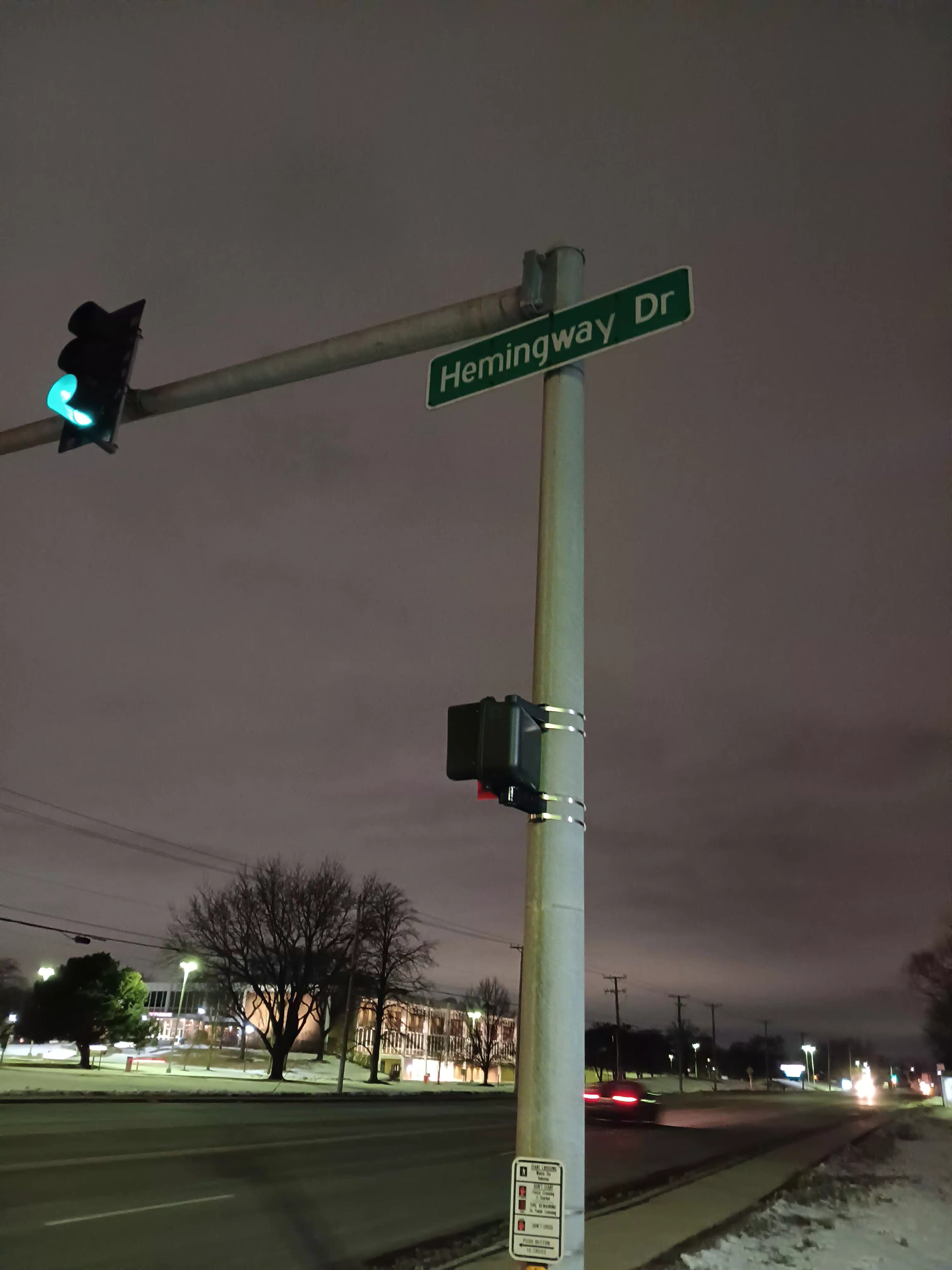
The street photo is on the campus of the Drifter’s kids’ current college, Triton. They also attended Hem’s high school. The mascot of that school is the Siberian Husky. The yearbook cover for the Drifter’s kids’ senior year showed a Siberian Husky wearing a stocking cap and asking, “Where’s Hemmie?”
Harold Bloom has an utterly brilliant essay in which he proves that Whitman’s line, “I am the man, I suffered, I was there” (about the Civil War and all life) is the source not just for Hemingway’s writing style but for his whole life.
(The essay is so brilliant that Bloom wrote it again across decades at least ten times (changing little)).
Whitman had a stroke at the age of 53, never married, and lived from 1819 until 1892, almost all of it except for a few months in the New York area and then Washington, D.C. during the Civil War. Like Lincoln, his hero, he never traveled abroad.
He was a volunteer nurse during the Civil War. He worked, for free, in Washington, D.C. with both Union and Confederate soldiers. He did things like hold the soldiers while they were dying and sit by their bedsides trying to give as much aid and comfort as possible while they struggled to get through the most hideous wounds imaginable. He also helped them write letters home, and he wrote the letters home to the families after his patients had passed on. Most of the people dying or missing limbs (or recognizable faces) were 25 years old or less, often much less.
Hemingway was never a soldier. He was an ambulance driver who got blown up at the age of eighteen (200 shrapnel wounds in the legs) while saving someone else’s life by dragging them out of the line of fire.
Bob Dylan’s eight-minute-long song “’Cross the Green Mountain” is Walt Whitman on the Civil War brought to music. No one will ever be able to do it better, but all American musicians should try something with Whitman, whether Civil War-related or not.
Lana Del Rey has succeeded in capturing a different aspect of Walt in her song, “I Sing the Body Electric” (title and chorus by Walt, brilliant lyrics by Lana). (“Elvis is my daddy, Marilyn’s my mother, Jesus is my bestest friend…”)
FINALE Note (For Now); or, the Crux of the Message:
President Obama recently gave the best advice I can think of in a crisis, Whitmanic advice: “Don’t sit around waiting for someone to come and save you.” Jesus said the same: “The kingdom is within you.” The essential advice is: “SAVE YOURSELF (look inside).” Beyond that, exactly what saving yourself means will be very different for every single human on the Planet (and it might drastically effect what happens after we are no longer on this Planet in physical form).
Dostoevsky and Bonhoeffer both proved that saving yourself can be done even in front of a firing squad – even when imprisoned by the Nazis.
“Nero can kill me but he can’t harm me.” – anonymous Stoic philosopher
The Drifter

 Saragun Springs
Drifter
This reads extremely fast, manic even. That, aside from the worthy subject, is a great point about your style. The striving need to get across, the urgency, the conviction.
Of all inanimate things, money has a personality breathed into it. A gold and green false god. A murderer, whose fake kindness is not denying a little of itself to the needy. A terrible thing thst gives power and unequal votes to the undeserving. Paul was right “the love of money” is evil. Unthinking things cannot be evil in the same way a baseball bat is not a weapon until that choice is made.
Another great column. The picture of the sky is beautifully forboding.
Leila
LikeLike
Leila
Thanks for this description of my writing style. I just want to add that the semi-fragmentary, hopping-from-one-thing-to-another aspect of it is understood by me. A deliberate choice, because it’s part of the urgency (and there’s unity behind it, too). Those who have had to engage with me in person know that my speaking style is often (sometimes) Manic, too. Fortunately for them, it also comes with extremely long, extended stretches of saying nothing at all, almost unto the point where they start wondering what’s wrong with me (nothing is, and everything is). The Twins are two people who are never bothered by any of this. Probably because they are so much like me.
You nailed it, the words “the love of” in the Paul quote are what’s important. There are enough resources in the world right now to make sure everyone has enough – easily. It’s the eternal struggle for those resources that fuels the violence, both happening and incipient. To say that capitalism has gotten out of control is the understatement of understatements. It’s gone back to the law of club and fang in the jungle on a massive scale. And China and Russia are just as bad. Even worse in some ways, but not as bad in others. (One thing no one in the USA understands about Russia is that many of the average people there think it’s OK. No one starves, free health care, lots of holidays, etc. Just keep your mouth shut and go about your business. Not saying I would ever want to live there but they are cartoonishly demonized by us like we are by them.) Chilling. And foreboding!
Dale
Gnosticism talks about “the archons.” They, perhaps, are the ones keeping the world in chains (through their effect on humans)…
LikeLiked by 1 person
Dale,
Wonderful that this came to you fully formed in a dream, like Coleridge’s ‘Kubla Khan.’ As just a Brit, you gave me a much better understanding of Walt Whitman. I suspect that to truly grasp Whitman you have to be an American, just as it’s said that to truly appreciate Pushkin you have to be a Russian. Come to think of it, there’s maybe something in that Whitman/Pushkin parallel: they are both poets of parallel countries – huge, wild, extreme.
Enjoyed this and learned a lot. mick
LikeLiked by 1 person
Hi Mick
I think you know that I’m something of a Swedenborgian (just partially) and the coming-to-me-in-a-dream aspect of this felt like a Swedenborgian event, it truly did. The Coleridge connection you made is also brilliant!
You definitely have something there re: one country cannot fully understand the greatest poets of another country.
(Shakespeare may be the great exception in this as he is in all others…)
Then again, in a paradoxical kind of way, England has been so much better at understanding modern American poets than Americans have been. Robert Frost, T.S. Eliot, Ezra Pound, William Wantling, and dozens more: all were understood, and embraced, by England first and better…Back in the day, Whitman himself (and Herman Melville) were better known in England than they were over here.
Thanks to you and to England! (from the USA)…
Dale
LikeLiked by 2 people
Ha, you’re surely too generous, Dale. My thanks to America for giving a home (and some happiness) to WH Auden, surely the UK’s greatest C20th poet. Would he have written New Year Letter in Britain? I doubt it.
bw Mick
LikeLike
Hello Drifter
The dream quality of your writing is like the prophet listening to the whisper of a higher power.
This kicking in phenomenon is a great observation. I immediately clicked on the Mona Lisa. I do this a lot while reading your columns, reading poets or other artists you mention, while I’m skipping back and forth. It turns into a great interactive session of reading and contemplating what I have learned.
That’s what is so engaging about your work. A kind of inter-activeness between your work and their work and the reader. All very enlightening. I can feel the value of what you write yourself kicking in every-time. Like my eyes are sharpening and the mind is shrinking down into a microscope so as not to miss something.
I hadn’t noticed the landscape behind the Mona Lisa. Is it Rome? She seems like the most mysterious person to ever live, besides some of the prophets. Like a prophet herself.
Great pictures! The bar could be like Denis Johnson’s “The Vine. “Some of the most terrible things that had happened to me in my life had happened in here.” But he was always there with people like “Wayne, or Jack Hotel.” These bars of our youth mean something…
The picture of your dogs in the background is pretty wonderful! They are no doubt special beings.
Beat! Beat! Drums! by Whitman is one of my favorites. Very powerful. It gets into your head and this phenomenon of “kicking in” is as real as can be! I like to read it over and over to feel those rushing loud words to war. It could have been written the same day Bush and his advisers swindled everyone into war with Iraq.
Great way to end with “Save yourself.” The drumbeat of the survivor from their first steps onto the playground. Where corruption does abide.
CJA
LikeLiked by 1 person
Ananias
The Gnostics believed in something they called (in their own languages) “secret knowledge.” It was (and is) the knowledge that only a few people (relatively speaking) will ever be able to understand, because only a few people have the ability to understand it (only a few have done the work necessary for understanding it), and only a few are willing to get off their asses and make the effort.
An essay like this does not address itself to the world at large, because the author of this essay knows (by now) that the world at large WILL IGNORE THIS because it can’t understand it (and doesn’t want to bother trying).
So, imagine how grateful I feel for the few who can and do understand it.
The description you gave today about how you engage with my essays will be carried by me to the grave! It’s worth everything!
Real culture still exists underneath the mass culture (or in the margins of it) and the Gnostics also believed that it isn’t necessary for everyone to understand the secret knowledge. In fact, if too many came along, the effect would be ruined.
The secret knowledge doesn’t reach everyone who’s alive, but IT IS passed on and on, down through the generations…and it NEVER goes away (unlike the fluff and blab of the mass culture which blows away before tomorrow)…
D
LikeLiked by 1 person