The Crossed Star of Bethlehem, Chapter Five: Time and Chance Happenneth to All Gods

Chapter Five

Holly spots a lucky omen far downhill: every backlit tree in a row of poplars along a stretch of the Port Washington Narrows is clasped like hands in prayer, except one. A single, stunted, sloppily unfurled poplar, unloved in shadows, holds the luck. It watches out for the others; it allows them to be confidently pretty by giving the eye something less to compare them to. “Unpoplar,” as Ogden Nash might’ve put it.

The golf course trees, however, don’t say much of anything to Holly. Coddled elms and hand-fattened maples protected against the harsh November winds that howl down the Narrows like steamed souls passing through cracks in hell, have little in the way of luck. They might as well be painted onto the surface of the eye. Stage prop trees.

“Are you ever going to hit the goddam ball?” Beth calls out. She had purposely sent her turn into the bunker because, well, just because.

“It could a cerebral hemorrhage,” says Fran, who is sitting in a golf-cart and smoking a joint. “He looks like a froze-up rock lizard.”

Beth concentrates her large and expressive eyes on Fran. “I hope the oxygen’s off while you do that,” she says. “I’d hate to explain two corpses to the cops.”

Fran pats the canister that lies beside her like a little dog that has gone to sleep. “’No worries,’ as everyone who ought to be worried most says nowadays,” Fran says. “Who better to trust with combustibles than a stoned old lady?”

“Tell me, Bethlehem,” Holly says, “why do your shots always end up in the worst possible places?” He then kicks the ball and a considerable amount of sand onto the fairway.

“Because you didn’t think of it first, reptile,” Beth says. She brings a match off her left boot-heel and lights a cigarette. “Consider it unlucky.”

The idea for golf had been concocted that morning in the nicotine and THC miasma of Beth’s house (where Fran now stays). Holly, a non-smoker, had once again observed that the atmosphere in the living room resembled what the air must be like on Neptune. “All right, Your Anus,” Beth had said, “maybe we ought to take Frannie out for some fresh air.” Upon hearing this exchange, Fran said, “Let’s go golfing. I want one last chance at beating the fourth green at Tor-Hill.”

Holly is fifty-six, Beth a year older. Even though both are plenty young, neither one have set foot on a golf course before today. Until a year ago, and even in her late seventies, Fran could have easily wiped the Torqwamni Hill Tribal Golf Course with her “students.” She was as fine an athlete as the city of Charleston has ever produced, but cancer has steadily robbed her of her physical grace. The oxygen canister became necessary a month ago; and, perhaps more telling, Fran’s dependence on morphine is no longer a concern to her physician. She’s allowed to take her pills “as needed,” and her refills are no longer the subject of dispute. “It’s a part of the process,” Fran, a former nurse whose mind remains as keen as ever, had recently said to Beth. “They watch you until it no longer matters to the law. Oh, I know how cold it sounds—but you should remember that an oncologist’s calendar is full of dying old patients. I mean, yes, we are all people, but unless it touches you personally, you’ve got to be detached to do your job right. And you could even say that the end-gamers have your back when it comes to protecting your immortal soul; dotty codgers have a way of crossing-up meds—It‘s not suicide if you’ve confused the green with the blue.”

They had decided to play a round as one person. Holly and Beth were to somehow get the ball onto the green where Fran would sink the putt. Although every rickety rise Fran takes out of the golf cart causes Beth’s heart to drop underground and wonder why she has allowed such a ridiculous event to come to fruition, she has to admit that she hasn’t seen Fran this happy in a long time.

Fran’s happiness withstanding; it has taken three hours and only God knows how many strokes for the threesome to arrive at the fourth fairway. Since that is the green Fran wants to at long last tame, the three of them have agreed to quit at four holes.

“What’s so funny, Hollister?” Beth asks. She had been aiming the ball at the squirrel-infested, bushy rough along the fairway, but had accidentally hit the first realistic-looking golf shot that either she or Holly had brought into the universe. The ball travelled sixty feet or so by air then bounced a similar distance onto the green and eventually stopped rolling twenty feet shy of the flag.

“I was thinking how you can’t help but do the right thing if given enough time,” Holly says. “You’ve always been kinder than you aim to be.”

Beth considers a verbal retort, but decides that The Finger is good enough.

“Look at that shitty break, would you,” Fran says. She raises a shaky palm and tilts it to the left. “I’ve pissed away a good sixty strokes here over the years because I’ve never beat the curve. I nearly wrapped this two-hundred-dollar putter around that spruce after a thirty-foot putt just hung on the lip. A damn breeze would have dropped it—oh, but hell no—God just let the ball hang there. It would still be doing so if I hadn’t launched the fucking thing into the pond.”

Holly and Beth help Fran out of the cart and follow her to the ball, then step back. While Fran takes her time to line up the putt, Beth begins to speak in a hushed, golf announcer whisper:

“Saint Frances of Rome Mary Josephine Bauer Bowers—confirmation name, Bernadette, is likely on her own here at the fourth green due to her continuing blasphemy and profanity directed at God and His mysterious ways.”

“Why should this time be different?” Fran says. “God doesn’t golf, my little star.”

A long list of the items that God also doesn’t do takes shape in Beth’s mind. But those vanish into the ether when she spies a pair of teenage girls clad in soccer uniforms passing by. Beth assumes that they belong to the nearby middle school, and that they’re most likely taking a shortcut. Her fantastic eyes aren’t just for show; they work well, and she easily reads “Stoppage-fucking- time” mouthed by one to the other, followed by a titter of giggles. The comment had obviously been directed at Fran.

How’s that, Miss Metaphor? Has someone played her full ninety and is waiting to hear the final whistle blow? It could very well be that she’s been carrying a yellow since the first half and yet continues to snipe at the ref, not giving a rat’s ass one way or the other that He’s notoriously touchy and quick to draw the red without a legit reason, Beth thinks. “Do you French your foster father with that mouth?” is what she says, loud enough to get it across to the kids.

The girls are no more than eleven, and both of their faces turn red with embarrassment and they scurry off into the tamed trees. Beth often regrets her mouth. Just a couple of little kids drying their wings, she thinks. It doesn’t help to discover that Fran and Holly are staring at her.

“Let’s beat them up for their lunch money,” Beth says. “We’ll buy a turkey. A person could easily roast a turkey in the time it takes some people to line up a putt.”

Fran smiles and shakes her head. Then she makes a facetious show of wetting her finger and checking the wind.

Holly smiles at Beth. “I saw a lucky omen in an unpoplar,” he says.

Throughout the fifty-plus year run of their extraordinary friendship, Holly has given Beth thousands of reasons for her to doubt his sanity. When they were children together on Corson Street, he often claimed that sadness creeps into late afternoon shadows the same way high pressure follows the low. He also saw hope and kindness in shriveled blackberries that lay among their plump and juicy “brothers and sisters” because the failed berries had selflessly improved the beauty of their siblings. Unlucky shadows; fortunate blackberries; and such things contain a special foretelling that heralds the sway of human events.

Beth trains her eyes on Fran. Nowadays, every time she looks at Fran without first steeling herself to do so, her heart breaks a little more. Fran and Holly are the only two persons alive whom Beth cannot recall first meeting. They seem to her as old as breathing and just as necessary. And I want her to die before the thing she becomes at night kills my sweet memories of her, Beth thinks, laying words to a selfish and scared and frustrated emotion she feels when Fran awakens a screaming brute in the wee-hour darkness. It’s an ugly little thought; but according to Holly’s way of seeing things, it will serve an altruistic purpose.

Beth sidles up beside Holly and takes his hand. Fran at last strikes her putt. The putter and ball combine makes the good click that happens only when the function is performed properly.

All three watch the immutable path of the ball, which approaches the cup at a long and steep angle.

“If this goes in,” Holly says, “she’ll live to see Christmas.”
The Crossed Star of Bethlehem, Chapter Four: The Bard of Oracle Park

Chapter Four

Oracle Park has one tree. It’s a little non-fruiting cherry that seems nervous because cherry trees usually grow in numbers. They typically line parkways and chatter amongst themselves like a backstage gaggle of pink-clad chorus girls. By itself, however, a cherry tree seems fretful. Now, a lone wolf oak is expected—for it has a greedy nature that sucks up the best of the soil and hastens the death of the grass around it. But not the cherry; they are used to sharing resources as though they are swapping garters and smoking off the same cigarette. One suspects that without intervention the little cherry in Oracle Park may die of anxiety, or from overdosing on too much sunshine and minerals. If this one survives, it will most likely grow to cast an uneasy shadow.

Holly More sits on Oracle Park’s only bench and does his best to assure the little cherry that everything will be all right. “Come spring, I will bring you a sister,” he says. He’d do so now, but there’s an omen against it: For three days running, the annual eastern Washington lowland wildfires have caused the sun to rise as bloody as Antares. Besides, it’s August, and Holly has always had it in his head that August is an unlucky month in which to sow. “No, we have to wait ‘til spring,” he says. “It’ll be all right. Come winter, you’ll sleep. Having a sister to awaken to will give you something to dream about.”

Holly is a poet, and being such, he has great sympathy for trees: they do so much for people and seldom get more than the axe and poems in return. Poems for, yet on, murdered trees, Holly thinks. He considers writing this in the notebook he has in his back pocket until he remembers what the notebook is made of (the cherry seems agitated enough as it is). Moreover, the idea seems to have come from without, not within—which means he is certain that he’s either read or heard the phrase before. “Too obvious,” he whispers. “Probably first writ the same week verse got invented.”

Most people confuse Oracle Park with a bus stop. Officially nameless, it’s little more than a vacant lot that has had a few dollars thrown at it; and considering its location in Charleston, Washington’s impoverished Torqwamni Hill neighborhood, it’s the type of place at which dime-bags and “rental cuddling” may most likely be purchased after sundown. In Holly’s mind there is only one of everything that exists in Oracle Park: one tree; one bench; one trash can; one swing set; one hedge; one sky, one poet. Being an artist, Holly is attuned to such things, and he has the enviable ability to ignore the facts that contradict his muse. He believes that no poetic image holds up upon too much examination—or under further introspection. After all, there is more than one living thing in the park—billions, if you factor in bacteria. But that too is all right: Poetry is a distilling process; it transforms plentiful pretty lies into single drops of unadulterated truth.

Holly is fifty-six and has achieved a face that’s Albert Einstein via Keith Richards—booze, mostly. Half a lifetime ago, he had been good looking in a fragile sort of way. He had had high cheekbones, which had served as lofty perches for a set of mated blackbird eyes; a smile that had gotten him out of most of the trouble it had caused, and as a serious actor who had studied at the prestigious Cornish Institute of the Fine Arts, he had developed a melodious voice that can still get across from a whisper all the way to the back row. But the same old story that has felled bigger talents dropped Holly, as well. Again—booze, mostly. That and his devouring need to hop from bed to bed, as though there was a Nobel Prize for such an activity waiting for him at the end, combined to kill his theatrical ambitions while they were still in utero.

An impossible bed enters Oracle Park. Holly watches the steady approach of his lifelong best friend and “patron,” Bethlehem Shelby. She is a neatly kempt, small woman who is a year older than Holly but appears much younger. Even though both of them know that Beth is the only reason why Holly isn’t dead, or in jail, or living out his days as an “Almost Person” beneath the Alaskan Way viaduct in nearby Seattle, theirs is an equal, symbiotic relationship in which no advantage may be gained (nor ever used) from ephemeral qualities—such as money and sobriety. Beth has a genius for higher mathematics, which has made her a fortune, and though quick witted, she has never been especially creative. Holly is creative to the point of raising the suspicion of mental illness (he believes in omens and an inner “oracle” that travels with him from place to place); yet when it comes to practicality, he’s someone who could drive a lemonade stand into bankruptcy. Together Holly and Beth form a third person, who is comfortable in silence, and who has the odd knack of speaking frankly in the most round about method possible.

Late summer is Beth’s least favorite time of the year; the air feels unclean, and she can always pick up on a note of affected melancholy in the song of the goldfinch—a perfunctory, rehearsed trill , that sings of a mythical winter that no goldfinch sticks around to see.

Even though it’s only a park in the most technical sense (someone from the city empties the trash once or twice a year), Oracle Park has a fine view of the Port Washington Narrows, which separates East and West Charleston. The Narrows communicates with Philo Bay, which in turn is a subject of the Puget Sound, which eventually leads to the Pacific Ocean, then the world. When they were children, Holly and Beth would sit on the dock at the Philo Bay boat launch and dip their bare feet in the perpetually frigid bay. She’d imagine children sitting on a dock across the globe in Japan, dipping their toes in what was essentially the same body of water.

As always, Beth’s smoking a cigarette. And just as always, her initial remarks to Holly do not match the affection she displays for him in her ineffably large eyes. “Sir Hollyhock,” she says, calling him by the nickname she has had for him (when peeved with him) since their shared childhood on Corson Street, “I’ve been looking for you. Your goddam cell is dead again. I really ought to tie a bell around your neck.”

“The world would be better off with some things uninvented, Woodsy,” Holly says. “Come spring,” he adds, with a motion toward the cherry, “I’m giving this tree a little sister.”

A briefest trace of an ancient annoyance transits Beth’s expressive eyes upon hearing “Woodsy,” but she lets it go. She sits down beside Holly on the bench and glances at the tremulous cherry tree. “That will involve physical labor,” she says, “as in digging a hole, lifting, planting, and making certain that the crows don’t take the sapling apart for their nests. I don’t see you and farming working out well. Still, that bell around your neck might scare off the crows.”

“I aim to do good,” Holly says. “You’ve got to get your senses fouled and hands dirty to do good. Those townies that stretch yoga pants and don pink tutus and go on weekend ‘fun runs’ for the benefit of the unwashed and diseased, think they do good, but they are only being nice. There’s nothing wrong with being nice—you ought to try it sometime, Woodsy—but nice isn’t good. Nowadays, however, I think you are learning that on your own. And you didn’t even have to plant a tree.”

It takes an agile mind, a lockdown memory, and patience to make sense of Holly. Fortunately for Beth, she has the first two qualities to the nth, and enough of the last to get by. Most people think that Holly is bottle-blown, or, at best, desultory; but Beth knows better. Throughout his life, Holly has always sidled up to what is really on his mind through endless, quite often mystifying asides. Before, during and after his long run with drunkenness (which he suddenly and startlingly gave up on without withdrawal or regret three years ago), he has been a verbal puzzle. This happens to the degree that Beth would wonder how he ever got himself across to other people if she didn’t already know that he didn’t bother. About ten years ago Holly went down to The Temple of the Dow Lady Emporium on Corson Street and had two laminated cards made. When he is feeling particularly antisocial, Holly carries them in his back pocket, tucked inside his always present notebook. The most used card has YES on one side, and NO on the other. The second card, the “special card,” caused perpetually composed Beth to laugh until she cried when she first saw it: I’M MUTE. NOT DEAF. AND I DON’T KNOW SIGN LANGUAGE, EITHER—EXCEPT ONE EXPRESSION I’LL DISPLAY IF YOU KEEP TALKING TO ME.

“Isn’t it funny how we’ve come full circle?” Beth says. “When we were kids I’d look for you up here on the hill, first. After I grew up I had to sift through the vile contents of the taverns and whorehouses to get a line on you. I guess finding you up here nowadays must be indicative clean living—that, and the bald fact that you’ve become as useless, down there, as a Tickle Me Elmo doll.”

Holly’s return smile reminds her that it’s time to send him to the dentist for a snugger set of dentures. “You’re getting less touchy about ‘Woodsy,’ Beth,” he says. “It used to take just one to win an ugly reply. Now I’ve got to do it twice. You’ve become better, almost nicer, if not yet good about Woodsy—maybe even quite wise.”

“As wise as an owl?” Beth asks. “As wise as Smoky the Bear’s pal, Woodsy Owl? As wise as ‘give a hoot, don’t pollute’?” Then mostly to herself she mutters, “And the shitty thing about it was that I did look like that goddam cartoon owl.”

“Have you ever heard Poems for, yet on, murdered trees, as a title, or in verse?” Holly, in a typical show of suddenly veering off one subject into another, asks.

Beth brings a kitchen match off the bench and lights a fresh cigarette. Not one to not give a hoot and pollute, Beth lays the butt of her previous cigarette and the spent match inside a tin she carries with her for such purpose. Whenever she is alone, or with Holly, her voice often drops into a thoughtful purr. “Nope,” she purrs. “But it sounds as worn to the cord as one of your old girlfriends. You’d do as well with ‘There once was a tree from Nantucket.’”

”It’s neither nice nor good,” Holly sighs.

“Your Aunt Frances—you do remember your Aunt Frances, don’t you?—thinks that your last book of verse is pretty good. She’s also stunned to see that you’ve actually sold a nice amount of copies of it.”

Holly blinks, and Beth knows that she has caught him off his guard. I guess I’ve jumped the subject on him, the poor dear, Beth thinks. Serves him right for the Woodsy cracks.

The “Aunt Frances” mentioned is currently Beth’s housemate and she’s at the White Pig Tavern watching baseball, nursing a long Mai Tai, trading friendly insults with the human ossuary who owns and runs the joint, and is “gacked to the nines”—albeit in a ladylike fashion—on prescribed marijuana and morphine, which dim the pain caused by terminal cancer. Fran is considered Holly’s aunt in the most stretched kind of way. He’s the son of the sister of Fran’s late husband’s first wife, yet Fran knew Holly long before she had met her husband to be. Fran was closer than a friend or a sister to Beth’s late mother, Harry, and through that relationship she had met and had developed affection for Beth’s little “tag-along” boyfriend, twenty years before she had married Ray Bowers.

“Death is lucky, Bethlehem, the best of the good,” Holly says softly. “The omens and oracle stand for it.”

Beth takes a thoughtful drag off her cigarette. She then gives Holly a playful nudge of the elbow, and a quick blink of a smile. Between You and I, even though its title is possibly as threadbare as the line about murdered trees, is her favorite poem written by Holly. It describes the soul of their mutual knowing, which isn’t composed of mostly secrets, but of an innate understanding of one another’s secret selves. Beth knows about the omens and the oracle that has actual sway in Holly’s beliefs and decisions. And he is the only one who understood early that Beth isn’t gay, as everyone else (Fran and her mother, included) believes, nor is she straight, nor an omnivore, nor even asexual in the strictest sense. A long time ago, after a clumsy, almost perfunctory sexual overture had threatened to extinguish their closeness, something that has always stuck with Beth had clicked in Holly’s mated blackbird eyes. “Oh, Jesus, Beth, I’m sorry. You are love.”

“I need your help with to do good by Fran,” she says.

“I know.”

She reaches out and takes his hand in hers. She again glances up at the little cherry tree. “A few months back, right after Harry died, I considered removing the urn of a jack-off who had been a bastard to her a long, long time ago from the cemetery; I even filched his temporary marker, but nothing else has come of it, yet.

Holly reacts to this as if Beth had told him she had chosen Kung Pau chicken over pizza for dinner last night; for in the run of their give and take relationship, she isn’t the only one who has to make allowances for peculiar thinking processes.

“Oracle draws a blank on that, Bethlehem; it requires further introspection.”

“Maybe, you’re right about the cherry tree,” she says, “maybe we ought to bring a little sister. Better to get cited for planting on city property than arrested for grave robbing.”

“Come spring,” he says.

“Come spring.”

The Crossed Star of Bethlehem, Chapter Three: God’s Secret Name

Chapter Three

“Fran,” Beth says, “do you know that tall people do not live as long as short people? It’s a scientific fact, and most likely why basketball has never caught on in Okinawa.”

Fran, who is exactly one foot taller than Beth, leans on her custom made left-handed putter, takes a thoughtful pull off a joint, exhales a stream of sticky smoke, and says, “Gulliver should have stomped you little creeps out when he had the chance.”

Continue reading

The Crossed Star of Bethlehem, Chapter Two: Saint Frances Everlasting

Chapter Two

Charleston’s White Pig Tavern became legal at the end of Prohibition. Built on the outskirts of town along an old wagon trail later to be named Corson Street, and not far from the Philo Bay docks of the Puget Sound Naval Shipyard, the Pig began as a “gentlemen’s club” whose sawdust floor often collected the blood and teeth of erudite scholars whose learned observations ran contrary to those of their colleagues. The need for shipyard labor during the Second World War caused Charleston to double in size; soon thereafter, the foot of the town’s rough and tumble, blue collar Torqwamni Hill district took shape around the Pig and Corson Street. For generations the Pig was where the hard hats met when the 4:20 whistle blew, and also the spot they took their girlfriends and wives to on Friday and Saturday nights.

Continue reading

The Crossed Star of Bethlehem, A Novella, Chapter One

Chapter One

“’Don’t move’? ‘Stay put’? Best mark thy lollipop-hole, Mouthy Munchkin, lest I break a ruby slipper off in your—“

Last Words, Wicked Witch of the East (Harriet Shelby’s Epitaph)

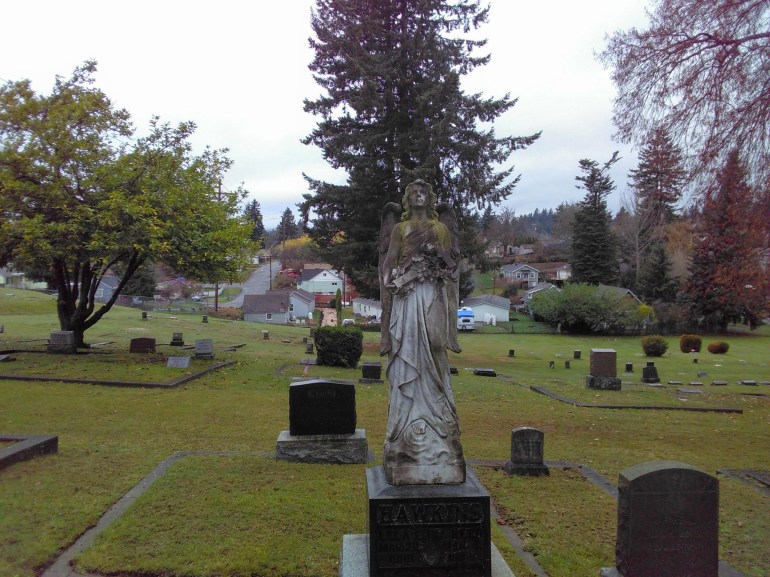
Twice in the past six years, Torqwamni County has mass-buried the ashes of indigents in New Town Cemetery at Charleston, Washington. After a year has gone by, unclaimed bodies are cremated at the taxpayers’ expense; one by one black plastic urns accumulate on the back shelves in the coroner’s office. A time once was when a church or a charity (or even a coroner’s office employee) saw to the proper burial of the ashes. Sadly, dying isn’t as cheap as it used to be; and scattering the ashes of a stranger at a state park (as allowed by law) seems more like taking out the trash than anything else. Right now there would be forty-nine urns whiling away amongst the unused this and that of the Torqwamni County Coroner’s Office, if a child hadn’t lighted the way.

Continue reading