You Remembered Everything: Chapter Three

Chapter Three

21 June 1943

The Legend of Emma Withe (Part One)

The morning paper was the usual dog of war. Other than a follow-up article about a peculiar fire at the Dow Hotel, the Charleston Sun was, as always, heavy with the blare and thump of the trumpets and drums of war. And there were the usual op-ed pieces that scolded the young men who were “waiting for an invitation to the party” instead of volunteering to defend the land of the free, home of the brave and so forth. Emma felt that these writings would carry more weight if not written by men who were safely exempt from service on account of age. Moreover, it should have been noted by the writers that most of the men of service age in Charleston were there to build and refit warships at the Puget Sound Naval Shipyard. At seventy-one, Emma long knew that there were few things on earth more tiresome than an old man who has something to say.

With great reluctance, Emma turned to a quieter page in the paper. Running her finger down the updated casualty list (even the smallest communities had such a list), she waited for her heart to snag on a half-forgotten name as it had six times in the past year and a half. Whenever Emma found one of those snags, she’d send her mind back to when the dead soldier was a boy and she was his teacher at Charleston Elementary. She would endeavor to remember a day when the boy had seemed at his happiest, then she’d seal that memory in her heart and never think about the boy again.

There hadn’t been any snag in that week’s list. Emma sighed and rolled a cigarette. She pitied the boys on the list who had not been her pupils, but she had no space in her heart for them. Their deaths (which probably did not occur with the blare and thump of trumpets and drums) were just faceless redundancies to her, as they were to most everyone else. True–each had been a person with his families and friends and likes and dislikes; hopes and dreams. No disputing that. But there were just so damned many of them; lives stamped out short by foreign events already begun while they were still children. And as scarcity drives up value, a glut drops the price. A similar economy guided Emma’s heart; and she could only invest–however briefly–in the boys who had attended her fourth-grade class at Charleston. Even in retirement she could not afford to dwell long on such dark matters.

Emma laid the newspaper aside. She had a second dreary matter to dispense with.

For two weeks, Margaret’s letter had followed Emma around her rooms like a stray dog. For the first week it was stuffed inside a drawer. Unfortunately, Emma never realized just how often she needed to get into that drawer. Emma had hoped that the top cupboard would take the letter in and give it the same air of urgency that Christmas decorations have in the summertime. But the relocation to Emma’s version of Siberia proved ill-timed, for it coincided with the cupboard’s hitherto unknown busy season. And every time Emma found herself teetering on the stool, seeking out some suddenly required item, the letter wafted down onto the counter. Inexorably, Margaret’s letter found its way on to the table, the final stop.

Lewis had wondered why she just didn’t just burn the letter unopened. “That way it won’t be a bother to you.”

But that was Lewis, dear and sweet. Still a lap cat to her, even after all these years.

Always helpful, always caring, always advising. Poor Lewis. Never that helpful, caring, nor wise unto his own affairs. A buffoon, really. Lewis was too sincere to have prospered. But Lewis was the one person Emma wished to outlive; her death would hurt him immeasurably.

“All right Peggy,” Emma laughed, for the third to the last time in her life, “you win.” If it were only Peggy who had written this, she thought, knowing better, but hoping right along. Peggy was the sort of girl who’d rub daisies on her letters to “AMERICA, U.S.A.” How Emma lived for those correspondences from London. Home. Whenever she got a letter from Peggy, Emma would tear it open on the spot and hold it up against her nose; and somehow the seven thousand miles lying between Emma and her little sister were eliminated. Emma had promised to send for Peggy, someday. But promises have a knack of making liars of us all. By the time Emma finally relented and opened Margaret’s letter, forty-three years had passed since they had seen one another. And in that space of time, much had happened to both. Too much, to be honest. Little Peggy was all gone. In her place there was Margaret, which would’ve been fine if Margaret hadn’t grown up to be such a strange, one-note woman, who, like clockwork, sent equally strange, one-note letters every six months.

The letter was, as Emma had feared, all-Margaret. No “Dearest Sissy”; no stale, yet wondrous scent of daisies (which Emma allowed would have been peculiar to find in a letter sent by a fifty-four year old woman); no hint of Peggy. Like the Sun, the letter was thick with war; but not even an event as momentous as the Second World War could take the spotlight off God when Margaret wrote Emma her bi-yearly letters:

“…God found England Decadent. He commanded Satan to marshal the Nazis to smite England for its Wickedness…A Bright Day cometh, Emmalene! Our Homeland has seen the Evil of its ways! Soon She shall rise again! Come Home to God, Emmalene. Take Jesus back into your Heart! and we shall Rejoice Together! Evermore in Heaven!…”

That was the general smell of the thing. Although Emma had no reason to believe that Peggy might crawl out of Margaret like a survivor emerging from the rubble long after her empty casket had been laid into her grave, Emma always had her hopes. And no matter how many times Emma sealed Peggy into the vault, that winsome, beloved phantom always found a way to slip her chains. Emma carried Margaret’s letter to the sink. She held it by a corner, like one might hold a dead rat by its tail. She then put a match to it, and held it until she was certain that the fire wouldn’t go out when she dropped it into the basin.

The flames reminded Emma about the queer fire that had happened three nights earlier at the Dow Hotel. The blaze was confined to a single room and had taken the life of a woman. To Lewis, and half of Charleston (the other half had yet to hear), “confined” was an understatement.

“I got it all out of Joe Parnell,” Lewis, a most credulous sort of man, said, in reference to an ex-dentist who served as Deputy Coroner. “Told me if I breathed a word that he’d deny he ever said it… Told me that it was off the record.”

To which Emma smiled. Telling Lewis anything worthwhile or interesting was the same as publishing it in the Sun (which, to its credit, never ran the unsavory rumor that clung to the story–but did print an awful lot of follow up stories about the fire’s lone victim).

“’Spontaneous combustion,’” Emma said, laughing for the second to the last time in her life; echoing the thing Lewis had told her, and watching Margaret’s letter burn into Peggy’s ashes.

“Sister dear,” she said, “if not Heaven, then where else shall we meet?”

****

Emma had no plans to visit Mary in New Town Cemetery that day, even in retirement she remained a slave to routine. It was Monday, and she had gone the day before; for that is what she did on Sunday. And yet there she was, fully aware of the day, but not questioning why she had automatically walked to New Town instead of the Park Avenue Diner, where she ate lunch six days a week. It was through she had been guided like a sheep and was just as unquestioning as livestock. It was not until after death that she finally approached the why of the thing and, even more importantly, how and who?

Again, there she was standing at the foot of the Withe family plot. Which contained Mary’s grave and that of Emma’s departed and never missed husband, Robert. There lay an already paid for empty space between them.

Mary Elizabeth Withe

1900-1906

Here Lies a Mother’s Heart

Although it had been exposed to thirty seven years of weather, Mary’s headstone was polished and in all ways kept immaculate. Nary a finger of moss had invaded a letter, nor were weeds allowed to take root in the plot. Emma had twiced replaced the stone when the inevitable cracks had formed and figured she should do it again, before it was too late. Robert’s grave was untended and looked like something that had been ignored since it was filled in 1908.

Emma had complete control of her emotions. Hurtful memories could not sneak up on her. She could only experience emotions when she wanted to; only when she let them out of their cells. Mary’s death had changed Emma. It made her cold and ruthless, but only on the inside, for she was able to affect an acceptable, though aloof demeanor; her insensitivity, however, did not extend to children, or to persons such as Lewis who had something good and childlike about him that survived the push to adulthood.

Thus, she allowed herself to feel Mary only on special occasions. Regardless, at all times what passed between Emma and Mary’s memory lay beyond the reach of anyone else’s power of description. She had no feelings about Robert’s grave, nor her part in filling it. He was a closed book never to be reopened.

Upon gazing at Mary’s stone, strange emotions, lacking enough substance to gather into thoughts, began to swirl in Emma’s mind; a blizzard of half thoughts and indescribable feelings. I know thisI know all about this–why can’t I remember? She saw a small party of people moving toward her, and the sun began to move crazily in the sky, east to west with stunning speed, night and day alternating and gaining and gaining until it was all a blur. And numbers entered her thoughts: she first saw the meaningless number 20,058 and watched it reduce by one at a time with the same velocity the whipping sun marked new days.  It stopped at one. Then Emma laughed for the last time in her life. It was all clear to her. I remembered everything. But she didn’t remember everything long. A tremendous flash burst inside her head. The left side of her body died milliseconds before the rest; she fell in that direction, striking her head on Mary’s stone.

And somewhere, where cosmic records are kept, Emma’s one became zero. Yet that too wouldn’t last long.

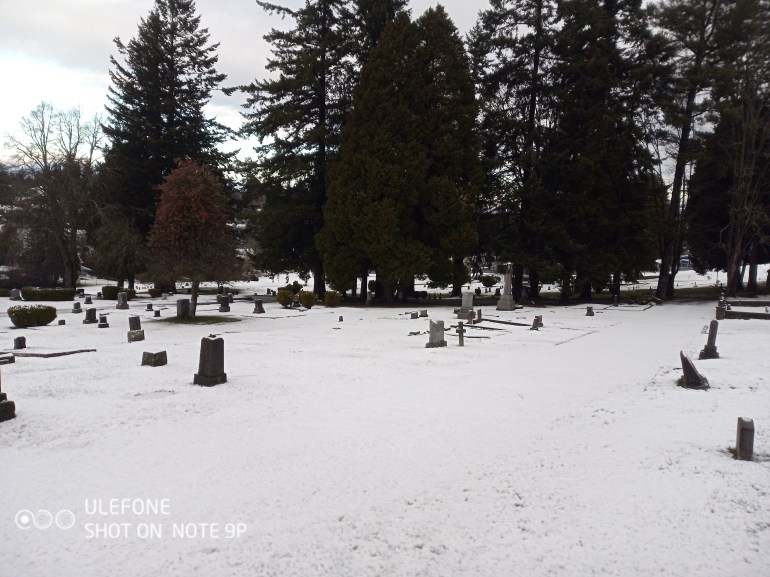
(Author’s note. The image is obviously not June, unless at the poles. But I like it. LA)

End chapter three
You Remembered Everything by Leila Allison

Introduction

This merry month sees the beginning of a serialized novel by yours truly–or unruly. Today, the prologue for You Remembered Everything heralds the arrival of the book itself. The novel is written through chapter three and just to place an extra element of fear in my life, it will be written as we go along week to week.

As to not interfere with Guest Writer’s weeks (the last week of the month), Every installment will appear on Saturday, starting with Chapter One this Saturday the tenth, and every Saturday thereafter, for months to come (twenty chapters are planned). Unlike the missive in January, these are full chapters sometimes reaching five-thousand words, but usually about half that many. The material being adapted comes from a source of nearly 400,000-words.

This is also an adaptation of the original material in the serialized story I referred to as “You Will Remember Everything.” It was published by Literally Stories, part by part, several years ago, as related yet stand alone stories. Obviously, this version will bear a resemblance to that, but rest assured the two narratives differ greatly and soon.

Leila

Prologue

Charleston’s New Town Cemetery is seated in the west face of Torqwamni Hill, and no matter the season the quick fall of the slope and a thick line of adolescent Douglas firs at hillcrest combine to delay the cemetery dawn by a hundred yards or so. New Town’s a pretty place; the winding paths are lined with fragrant, non-fruiting cherries and delicate Japanese maples; on clear days the Olympic Mountains fill the western horizon with their beautiful yet icy indifference, and there is an abundance of old fashioned, winter-weary tombstones just begging to be charcoal-etched by artists and the sentimental at heart. A very handmade wood sign attached to the main gate informs would-be visitors that the cemetery is open from dawn to dusk. It’s been observed by the wise that dusk almost always finds its way to New Town just before the start of Happy Hour at the nearby White Pig Tavern.

Continue reading

The Oz Exception: Part Twenty-One

Daisy has it in her contract that there be rousing, heroic music when Team GOAT arrives on the scene. So, imagine if you will, something like the Star Wars’ theme, or that of the Christopher Reeve Superman, and you will know the flavor of the duo’s entrance melody.

Although her transformation and that of Peety (who somehow rearranges his drawn image to include a mask–but he still carries the beer and quotes the same films) to Team GOAT was coincidental to both Daisy and Peety disappearing, Dogs are very good sports and will go with the flow.

Weasels, however, have an obligation to live up to their names as used when compared to humans.

“Haha!” she/he laughed, “It’s Bruce Wayne and his boy toy.”

“Interfere with the storyline again, Weasely Weasel and you will see little hoofprints everytime you need to wipe,” said Dai–the GOAT, who is not the most patient of superheroes.

“‘Roadtrip!’ Bluto, Animal House,” said PDQ Pete–it was at least the twentieth time he had said that since the linoleum was rolled out, but no one got shitty about it, except, for, you guessed it, Penrose, as the brave four entered the castle just to have the door raised behind them.

“I once read an article about the brain power of Pigeons,” said the Weasel from up high in his turret. “It was written in invisible ink.”

“Goddamnit,” I said, watching it on my Chromebook–”Oh, well, that’s what I get for letting a Weasel ad lib.”

“Silence, nonsensical Stoat,” said the GOAT. “I believe that this is where the narrator fills in the backstory of Team GOAT as we walk deeper into the castle,” she added, looking directly into the camera.

“Oh, shit,” I said. It’s a hell of a thing to blow your lines when you are writing them, but I have special talents. I turned on my microphone and began reciting what you will read tomorrow.

End Part Twenty-One

The Oz Exception: Part Eighteen

The gang marched onward and soon encountered a field that contained a giant poppyseed themed buffet. Daisy went for the poppyseed muffins, Beezer and Barkevious both devoured the poppyseed pizza and even Promo wasn’t finicky enough to bypass the poppyseed herring (although he had been told about the “trap”).

The poppyseed laden food caused the breathing creatures to fall asleep. They were snoring under the azure sky and when they awoke they’d forget all about the mission and go home. Or so that was how the spell was set up.

But all spells have their loopholes and being that Peety is unaffected by poppyseeds and wouldn’t eat any unless there was poppyseed PDQ (which HeXy overlooked), he remained conscious, well, at least in his version of such a state.

He flitted to each of the sleepers and poured a swallow of PDQ in their mouths, at the same time sharing quotes from his favorite films, because those are as close to magic words he knows.

Daisy heard: “‘I’ll be back,’ thuh Arnold, The Terminator.”

Promo was informed: “‘When you’re Jewish, you either learn to fight or take a lotta shit. I don’t take shit.’ Schwartz, Porky’s.”

For Beezer: “‘Thank you sir, may I please have another?’ Sir Kevin Bacon, Animal House.

And Barkevious: “‘Don’t be obsessed with your desires, Danny. The Zen philosopher, Basho, once wrote “a flute without holes is not a flute, a donut without a hole is a Danish.”’ The late Chevy Chase, CaddyShack.”

“Chevy Chase is still alive,” Barkevious said as he awoke.

“Tell that to his career,” said Daisy.

Naturally, the Baws went back to the buffet before anyone could stop them. But it was all right, with his Google-like mind, Peety is never out of magic words.

End part eighteen

The Oz Exception: Part Eleven

The Oz Exception: Part Eleven

We gathered in the amphitheater at Pongset. And at the exact same moment, our green little moon, Ping, rose behind the hill with the giant S on it. Ping was gifted to Saragun Springs by the Discworld realm, when the Great A’Tuin and company crossed our sky a while back. At least that’s what we think happened. But, Pong and Ping claim to be brothers, and Ping is a native of the Springs–regardless, anything remains possible when you don’t have all the facts.

Speaking of unlikely Brothers, Beezer and Barkevious, the Braw Bros. Baw were on the stage, both wearing formal looking bow ties and white dickeys. As stated earlier, my capacity for three active characters in one scene is three plus myself. Since there were 250 or so FC’s in the audience and another estimated 400,000 Sheep and Lambs gathered on S hill to watch (even Pong occasionally peeked over his setting spot to check things out, which caused a weird strobe effect), only up to three will be active at a time, in little scenes, like this:

Scene one

Beezer is a British Bulldog and Barkevious is a Scottie. Inspired Pong shone a single beam on the stage, creating a spotlight.

“Welcome to the first annual Pushsprings awards,” said Beezer.

“How can it be annual if the first ain’t happened yet?” Barkevious asked. They were supposed to follow a script, but since neither can read, the cue cards that I saw held by Penrose were somewhat useless. Beezer had memorized the first line after it had been repeated to him, but Barkevious, being a contrary Scottie, ad libbed immediately.

“That ain’t what you wuz s’posed to say, pillock.”

Scene Two

Gwen was still fascinated by John’s rubbery form to pay attention. I had to smack her on the hand after she had pulled a good section of his knee out for examination, therefore she had missed her cue.

“Oh, sorry,” she said. “Wow, what a special night.”

“Goddammit, that is three pages from now,” I said.

“Am I supposed to say anything?” John, who had been drinking since part three asked.

“Well, now that you did, I guess so.” I deleted the script from my phone, knowing that it was useless.

Scene three

A trio of delinquent Lambs, members of “ASH” (Award Show Hooligans), by name Tam, Meena and Boaby, were on the hill behind the stage, planning a disruption.

“Catapult torque?”

“Check.”

“Sheep shit payload?”

“Check.”

“Chorus of Evil Lamb laughter?”

“Heeheebuwahaha!”

End Part Eleven

The Oz Exception: Part Ten

Novels and pro wrestling have two things in common. Both are fiction, and in both activities there are periods where the author and wrestlers are obviously taking a breather. In wrestling, it is usually an arm bar or another hold that allows the combatants to “take ten” on the mat before getting back to the action. In writing this involves passages in which “tell” briefly takes over for “show.” Where an info dump temporarily replaces exposition and dialogue. Hey, now that I think about it, you can even look at it like a “tag team” match; if so, here is where “Tell” tags in, giving “Show” a much needed break–such a thing is evident when a metaphor starts as one thing and, with little warning, becomes another.

Agoville is Saragun Springs’ “Studio City.” It is where we “shoot” our little productions with Fictional Characters (FC’s) as actors who essay various roles. (Daisy is the major star). Agoville is composed of one short street, five long ones and has a town square that you must pass through to enter. There is no way out from behind, because it is shut snugly against the southern Nameless Hills.

The square features the previously mentioned Giant Clock Radio and various businesses, including the Agoville Studios, the Bank of Saragun Springs, a publishing house/newspaper and the Saragun Springs’ Broadcasting Company, located beside the radio. There’s also a large amphitheater, in which the previously mentioned “pushsprings” awards will be doled out soon. Oh yes, and of course, there are Sheep and bratty Lambs all over the place.

A voice in my head, playing the part of you, the reader, has just called out “Hey, what about the one short street and five long ones? What do they mean?”

Glad you asked. They put the “ago” in Agoville (aka, “Ago-a-go-go”). Each one is set in its own time era. They are based on the lifespan of the “Dubious One” (from here, D.O.) whom I am Pen to. The short lane is Fifties-Street–brief because the D.O. was born in 1959. Everything there is in black and white and is reminiscent of the film Pleasantville. Obviously, D.O. has no memory of that time, so it is highly suspect as far as reality goes.

The longer streets are of the 60’s, 70’s, 80’s, 90’s and one that is everything that has happened after 2000. (According to D.O., “the new decades have no distinct personality–they lack both sentimentality and sting.”)

These are not recreations of those decades either (save for Fifties Street); but one is actually transported into those years for the duration of our three-thousand word budget (another max setting for this Pen). (Perhaps it is worth noting that any time frame before D.O.’s birth, and the future are all shot in the Studio.) (It is unknown how many parenthetical sentences in a row I’m allowed to do, but three appears to be a safe amount.)

Hmmm, I guess it is time to tag “Show” back into the scrum of things. See you at the award show tomorrow.

End of Shameless Part Ten

The Oz Exception: Part Four

Meanwhile…back at the Vortex

Gwen and John passed through the vortex and were greeted by an odor that residents of the Springs often compare to “boiled diarrhea.” But Fenwick quickly closed the portal and the stench ceased.

“Sorry I forgot to mention that,” he said.

“Jesus, what was that?” Gwen was so overcome by the stink that she had yet to notice that John was no longer a ghost in her device, but was in the guise of a living person.

“The Spring,” said Fenwick, pointing at a bubbling black pool beside the vortex opening (the vortex, or portal is your standard SyFy Channel budget CGI looking shimmering, two dimensional swirl sort of thing). “It is said to originate from a crack in hell, but it serves to produce the magic in the realm. Whenever the vortex opens, the Spring’s smell gets out. That’s why we use it as little as possible.”

Gwen looked around. They were in a meadow surrounded by trees– bucolic, with lots of Sheep grazing far and near; but there was strangeness aplenty.  She saw a little blue sun in the sky, which clearly appeared to be moving. It was hard to look away from a sun zigzagging back and forth in the sky, but when she did, Gwen saw a series of identical hills on the horizon. They were exactly the same and appeared on the horizon in every direction. And there were wildly oversized common objects lying all around. Gwen saw a can opener that had to be three feet long lying near a twenty foot tall “pint” of Jack Daniels; Gwen figured the bottle was mostly empty due to a very long siphoning hose extending from the giant pint to a series of barrels on the ground. Behind the great pint stood at least ten uncracked others, a ladder lay against the first.  “How strange,” Gwen thought, “and this dude beside me looks just like John!”

“What? You’re real here?” Gwen said, realizing it was John. She poked his shoulder, but instead of touching flesh, he was elastic like a sheet of rubber.

“Hey,” John said. He poked Gwen on her shoulder,  but upon touch, his finger bent painlessly sideways.

“He’s real everywhere,” Fenwick said. “But things tend to change a bit when they pass through the vortex unless they are alive. Inanimate objects, as you see, greatly enlarge, which is great for our supplies. Ghosts take shapes that are, um, stretchy.”

Indeed, stretchy was a good word. John appeared to be forced into the fabric of reality. He was three-dimensional, but his existence in the fourth dimension of spacetime was also visual. When he moved, a series of ripples in spacetime formed around his being, as though he were suspended in water.

This was when Gwen figured that the natural laws of the universe were pretty much up for grabs in Saragun Springs and decided to stop questioning things. Therefore, she was not at all surprised to see me and Penrose the Flying Weasel enter the meadow.

End of Part Four

Welcome To Saragun Springs: Part One “The Book of Peety”

My name is Leila Allison. I’m a Penname–just one word, like “dammit.” And I insist that it be considered a proper noun, like “Irish.” I do, however, approve of “Pen”–which I find swaggery, thus to my ego’s liking.

My employer (from here, “The Boss”) is a woman of mystery who keeps a low profile because she fears the social media secret police. She is paranoid and erroneously convinced that there is enough interest in her for someone to want to ruin her life with unsubstantiated accusations on Instagram, if she were ever to rise above her state of anonymity. At best she’d rather be like Oz/Professor Marvel, but cloaked behind an impenetrable, Toto-proof iron curtain, unknown, unloved, unbothered. It’s hard to get away with much nowadays, but paradoxically it has never been easier to get lost in the unforgiving crowd. This led to the invention of Yours Truly, who considers herself as real as she needs to be, and then some.

Before slinking off to a yet another sabbatical at a place where the sunsets are pretty and the Thorazine is plentiful, the Boss summoned me from the deep shadows of her mind and endowed me with “untakebackable Free Will” and the keys to her Literary Queendom, a realm in the make believe multiverse that she’d named Saragun Springs. That’s just how she put it, shortly after swallowing yet another loganberry wine flip, and seconds prior to passing out in her chair–”Lei-lith, youse goth untakebackable Fee Bill…and da keyz to Sarygun Spings–dooze whatevuh…”

Now, I was in the Boss’s mind for a long, long, long time before getting out. Everything she knows, I know; her addictions are mine; our intelligence and education levels are the same; and we both understand that a writer, whether human or a Pen, cannot create someone smarter than herself–yet there is this strange degree of separation between us that allows me to behold her objectively. We have an I/me perception shared between two distinctly different points of view. I also have the advantage of recalling things she once knew but has forgotten–for though I am of her, I am much younger in the existence sense. For instance, I remembered she had once known that Free Will was a choice given to humankind by God. Mainly, we have the choice to kiss His butt or depart from Him and court disaster (in a way Heaven sounds a lot like North Korea). The Boss’s interpretation is simpler and owes to the Thelemite creed “Do what thou wilt.” And although there is no real such word as untakebackable, the concept behind it was clear to me.

Ha! I was off like a Cat with thumbs and the car keys. Although trouble stemmed from that viewpoint (mainly, there isn’t a Cat-sized car out there worth stealing), the principle of it all formed in my mind, regardless of logic. The first thing I did as she began the long sleep off was head to Saragun Springs (a concept that had been trapped in her mind even longer than I had). The second thing I did, being what you might call a virtual sort of person, was to reject the physical laws of the universe except for those that pleased me–or when such suited me as plot devices. The third thing I did was when and where the trouble began.

I needed to populate my realm with characters. I also put a call in to an Imaginary Friend whom I grew up with in the neighborhood of my Employer’s mind, named Renfield. I made her second in command of Saragun Springs. We both flew from the Boss’s sleeping mind, taking the blueprint of the realm with us.

As virtual persons, both Renfield and I are eternally on the more popular side of thirty but we do not belong to any specific generation–not that any are lining up to have us. All you really need to know about Renfield will unfold clearly and soon enough. But if I had to sum her up quickly, I’d say that she is as distinctly American as a baseball to the head. I endowed her with the same permanent state of “Fee Bill” that the Boss had given me.

I’m a Pen who specializes in fiction. Thus I began to develop Fictional Characters (from here, FC’s) to populate my works; I must have FC’s before a storyline. But the Boss’s weaknesses involving booze and not necessarily well thought out Big Ideas are mine as well. About halfway into a fifth of Three Freedoms vodka, I thought it would be cool to endow my FC’s with the same mistaken notion of Free Will that pulsed through both my and Renfield’s souls. Untakebackable. Furthermore, each FC was given sentience and a life that goes on outside the stories they appear in–although those lives take place only at Saragun Springs–lives and sentience I have no control over whatsoever, save for the stories they appear in. I conceived them as actors to play roles in my acts of genius.

Another thing I have in common with the Boss is the capacity to blow off the mental Voice of Reason. Conservative stuff like “Think about what you are getting yourself into” is tiresome, boring and too safe to be much fun. It’s my good luck that the Voice of Reason does not hold her liquor well. The Voice of Reason is always a shot or two from becoming a cheerleader–the staunchest toady for my Big Ideas, as long as I’m pouring.

At first the realm was like a new house on moving in day. Stuff still in boxes and not much going on save for sloth, beer and pizza. There was no real plan other than whatever popped into my head on the spur of the moment. I guess for free wheeling types, that’s the way to go, but when you are founding a realm and/or new dimension on the otherside of reality, maybe a to-do list of some sorts should be consulted.

Hence…

Union Troubles

I created my office in a “territory” of the realm named “The Barnyard” (in all, there are seven territories, which we will get to, by and by). On that first day my office was a bare room save for a window, my desk, and me working away on a Chromebook while drinking and smoking in a squeaky chair I’ve yet to do anything about. Then I set about creating a group of FC’s. I figured that fifty would do for starters.

Upon completing my FC list, I took a break, lit a cigarette and leaned back in my chair, ignoring the squeak, feet up on the desk. I had all kinds of projects planned. First I wanted to arrange the geography of the springs, because at that moment there wasn’t much outside the office window except the Barnyard and a barracks to temporarily house my impressive roster of FC’s.

This was when a recurring theme in my existence commenced. Renfield,who is my only Imaginary Friend, entered my office to pee in my Cheerios in the metaphoric yet just as equally disgusting fashion. She had “Free-Willed” a luxurious office of her own next to mine, and, unbeknownst to me, she had met and got friendly with each FC I had sent out upon creation. To each I’d said, “Hi there [insert name], you have Free Will and your own life. Stay handy, and don’t let the door hit you on the butt on your way out to the barracks.” In retrospect I should have been friendlier, maybe a bit more personal, perhaps even glanced up from my computer when I spoke. But I had fifty (to be honest, I soon lost count) of the fiends to deal with before the vodka ran out and the Voice of Reason’s new flexible philosophy wore off. Seizing the advantage, Renfield had intercepted each FC as she/he/it exited the office. She is both ingratiating and duplicitous. A Free-Willed conspiracy was fomenting between individuals I had created, and yet I was ignorant of it. In my defense I am no more omniscient than the Boss–but maybe I should have paid closer attention.

“I bring great news, darling,” Renfield said, barging into my office, carrying a document file.

“What the hell are you doing here?” I was slightly confused by the interruption because I didn’t write “Renfield entered the office” and the bit about the Cheerios until after it happened. In the real world cause precedes effect, but in fictional realms it is supposed to be the other way around.

“I have Free Will, remember? Besides, I’m the Imaginary Friend, as real as you are–I don’t need you to write me–in fact nobody in the realm is under restraint, unless acting a part.”

“Shitsticks,” I said. “I probably should have thought that out better. But the Voice of Reason is one swallow shy of rehab. Guess the endowment of Free Will puts me in for a slew of little surprises.”

“Right?” she said, smiling. Renfield smiles a lot. In fact if a person could be described as having a secret smile hidden behind her back, you’d have Renfield. “Your life, on the rare occasions I think about it, seems awfully barn door after the Cows, darling.”

“Let’s leave personality traits out of this, darling,” I said. “May I assume the ‘great news’ of which you speak has something to do with the file in your hand?”

Renfield sat on the edge of my desk. Like smiling, she does a lot of that too. It doesn’t say such in the Bible, but I bet on the eighth day God awoke hungover, and realized that the stuff She had set in motion was now hopelessly beyond her control and couldn’t be undone. That describes the sinking feeling I had when Renfield laid the document on my trusty Chromebook, which was still warm from all the FC creation.

I opened it and saw a psycho manifesto, whose title will be burned into my mind long after my Employer has turned to clay that reeks of fermentation and ashtrays.

It said:

The Union of Imaginary Friends and Fictional Characters (UIFFC)

Below the ugsome heading was a list of demands. At the end was a list of names, beginning with Renfield and followed by each FC I had created, beginning with Miss Daisy Cloverleaf the Pygmy Goatess and ending with her brother Fenwick; there were sixty-six names of various “persons” (that confirmed my suspicion of losing count–or blackout FC creating) lying between the Mini Goats. Each one had either signed or made her/his/its mark on the document.

I read aloud: “The ruling Pen cannot create new Fictional Characters (FC) to appear in new stories without first offering the role to already extant FC’s–what the fu–”

“That’s explained here,” Renfield said, flipping the document to an equally ugsome page.

I again read aloud: “We FC’s and Miss Renfield, our dear Imaginary Friend, consider ourselves actors in the ruling Pen’s productions. And since stories are composed of words, we feel that any competent FC can play a part suited to his/her/its talents….”

I chewed on that for a while, like a dope addict Cow working a poppy cud. Then I glanced up at Renfield.

“Lemme see if I got this straight….someone like Daisy the Pygmy Goatess must be offered the part of, say, a five-hundred pound blob of sentient Jello if such isn’t already in the roster before I can wonk-up said beastie–right?”

“Precisely.”

“But there are only sixty-six ‘actors’–what if I want to fill a stadium with fifty-thousand Jellos?”

“We will just shoot something like that the way they do in cheap movies. Round up a crowd of fifty, move them around with each scene and have them wear different shirts or a hat in other shots.”

I cast about my mind for objections to the Union and found none other than it was not my idea. The Voice of Reason had straightened up enough to point out the futility of arguing the point further.

“All right. Fine. Whatever,” I said, signing the document.