During Holly and Emma’s strange meeting, Irene Allison was at home sitting on a porch swing and drinking a can of PDQ Pilsner. Irene looked much younger than her twenty years because she was neither quite five feet tall nor a hundred pounds. It was a pretty night, maybe sixty, and not humid as it usually gets during summer in the Pacific Northwest.
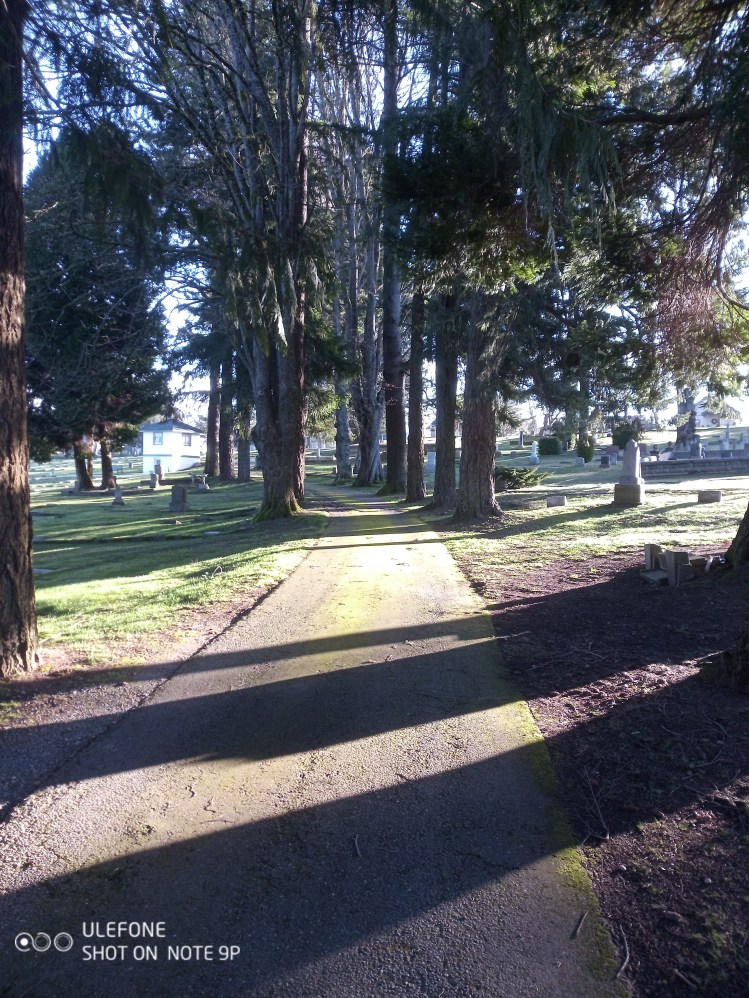
Irene’s house stood at the crest of T-Hill, directly across the street from New Town Cemetery. Despite its location, little could be seen of the cemetery from the porch due to the quick drop of the hillside. Holly and Emma were no more than a hundred yards away, but since that was mostly downhill from her, they could have been on Mars for all Irene knew.
Unlike the dilapidated rows of war time duplexes, it was a clean, albeit aging, two-bedroom, single level working class home built by Irene’s paternal great grandparents prior to the Great Depression. It resembled a hundred others in Charleston save for a veranda that ran the length of the front of the house. Irene always thought that there was something southern and To Kill a Mockingbird about the veranda. A large porch swing to the left of the front door was the veranda’s main feature; Irene sitting on it during fair weather was often the swing’s main feature.
Irene had one ear trained on the baby monitor she used to listen in on her grandmother. It was stationed on the wide rail of the veranda. Hard circumstances and bad luck made Irene responsible for the well being of another human being even though she believed that she was not particularly able to manage herself. The weight sat uneasily. Over the past five years her life had been little more than about death; everyone she loved had a lifeline as long as that of a Bronte sister. Even the cat, Sir Jack Falstaff, whom Irene had known since the dawn of her memory, was sixteen.
As a diversion, Irene, again, wondered how a can of five-year-old PDQ Pilsner could still be fresh and fizzy. It was better to think about that than dwell on another lonesome night of her youth taking the big swirl down, then upbraiding herself for her selfishness.
PDQ was the lowest of the three local budget beers (said to be brewed from the “mysterious waters of Saragun Springs”). Each can featured a picture of “Pie-Eyed Peety the PDQ Pilsner Pigeon.” Peety was a toon in a porkpie hat, who smoked a cigar and held (an apparently bottomless) can of PDQ in one wing; he had been touting the swill since the 40’s. No matter how he was positioned, Peety’s head was always surrounded by six (Irene had counted) popping bubbles that inferred (along with his “pied” eyes) a state of extreme intoxication. There were uptight snowflakes who protested an insolently drunk pigeon being PDQ’s mascot. They said it was designed to attract kids to drinking, cigarettes, premarital sex, critical thinking and all the other stuff people would rather do than take direction from uptight snowflakes. Irene believed that it was a hypocritical society that begat useless snowflakes who made more noise about cartoon beer mascots than they did about people dying in doorways that caused people of all ages to flee reality. Regardless, none of that solved the prolonged freshness mystery.
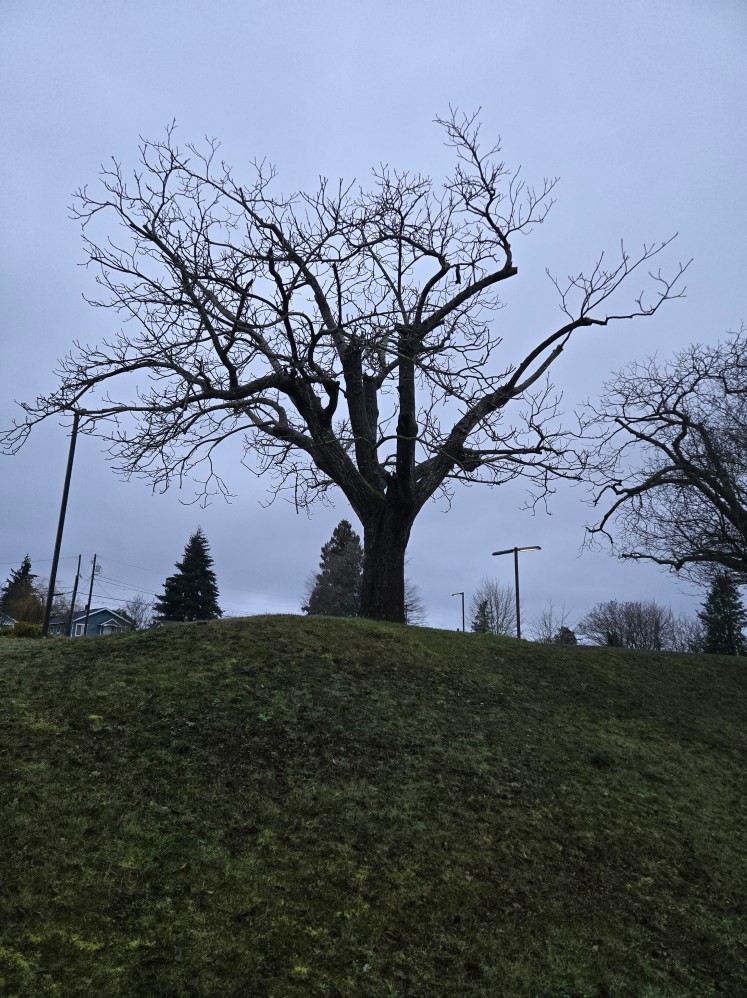
These philosophical thoughts were interrupted at 12:17:09 A.M., the precise time of Holly More’s death at the foot of the cemetery’s great maple tree. The baby monitor squawked and Irene heard a female voice say “You remembered everything, darling,” at a volume well beyond the capacity of the cheap speaker, which, like Mr. More, died that instant. This was accompanied by a bright flash of light inside the cemetery. As Irene dashed from the porch through the house, she expected to hear thunder, but it never came. She turned the light on in Gram’s room and saw nothing out of order; Gram was sound asleep courtesy of one of the many pills she was prescribed for a litany of woes, including insomnia. All Irene got for the effort was a peeved yawn from Falstaff, who was curled at the foot of the bed.
Irene turned the light off and quietly closed the door. She never felt so alone.
But that feeling vanished when she heard Lauren Thommisina Lemolo’s ancient Dodge Colt pull into the Allison’s driveway. Only official people called her Lauren, to everyone else she was “Tommy.” Although she had been distracted that night, Irene usually knew that Tommy was on her way long before she arrived. The Colt made several strange noises (audible at about a half mile) that distinguished it from all other contraptions in Irene’s knowledge. Mainly, it was a combination of the loosely geared manual transmission and heavy exhaust pushed through the ragged tailpipe that caused a singular, hiccupping whurr–whirring sound. The Colt constantly threatened suicide but never got around to it. Tommy figured that it was waiting for the worst possible moment to do so.
“Oh goody, you broke out the urine,” Tommy said, bounding onto the porch, met by Irene. She was twenty-one, a year older and a foot taller than Irene. Always athletic, Tommy moved like a dancer even though she had a prosthetic attached at the knee of her left leg.
“You see a flash of lightning about a minute ago?” Irene asked as she handed Tommy a can from a bucket near the swing. “Looked like lightning hit the graveyard, but no thunder.”
“Lightning–on a night like this? Must be the pee talking.” Tommy then held her can of PDQ high as though it were a chalice. “I’m telling you there’s a Nobel prize kind of scientific mystery here to be solved–how can a beer brewed bad not go flat. Tellin’ you there’s money in this.”
For a fleeting second something hitched in Irene’s mind. She saw Fallstaff lying on the porch swing–confused, she began to think “didn’t I just see…” but it vanished before completion. As far as Irene was now concerned he had always been on the swing.
Tommy sat on the swing and nuzzled the old boy. “How ya been fatso?” She touched his nose with her beer and won an expression that suggested he needed to sneeze but had forgotten how. Not all that long ago Tommy and Irene would watch him hunt and eat moths on the porch. He hadn’t done much of that for the last two years or so. The shit you miss.
Irene remembered the noise the baby monitor made. She picked it up and shook it. Something rattled. “Fried,” she said. “When the lightning–or whatever happened, I heard a voice over this thing–real loud–now it’s cooked.”
Tommy took it from her, also rattled it, fiddled with the volume controls. “Wow, it is spent–you can smell the wires. What did the voice say?”
Irene sat beside her, she was about to answer but the words had also vanished. “Dunno–can’t remember. I took off thinking it was Gram, but she’s out completely. Must be a blown transformer–good thing it wasn’t ours.”
Although both Irene and Tommy were too smart to buy the lame transformer theory, neither of them felt compelled to explore why there would be a transformer inside a cemetery; nor why the lights were still on; nor how a transformer blew out a wireless monitor and nothing else. It simply felt better to let it go. Natural. Besides, there were two other monitors that came with the set; by the time Irene returned from fetching one from the kitchen, the topic was completely forgotten.
“How was she tonight?” Tommy asked, already knowing, lighting two cigarettes. She gave one to Irene.
“Same–how was work?”
“No breaking news there,” Tommy said. “Made a whole nine bucks in tips–one fucker left a quarter–but we stayed open all the way to 11:45–numb-nuts about peed himself worrying about closing fifteen minutes early on a Monday night.” Tommy waitressed at WJ’s Bar and Grill; on busy weekends she easily cleared fifty, sixty bucks a night in tips, even after cutting in the bussers. “Numb-nuts” was WJ’s assistant manager–Irene thought his real name might be Andrew–something with an A. She had never met numb-nuts, and still six months shy of twenty-one, she had only seen WJ’s from the outside. But she had formed a mental picture of the place, the workers and even numb-nuts based on Tommy’s colorful descriptions.
Tommy told Irene she could get her a job at WJ’s, but that was before the State “hired” Irene as Gram’s live-in caregiver. It’s a hell of a world; children and grandchildren having to take pay for something they had been and felt obliged to do for free. Yet even though the house was paid for, expenses were fairly low and Gram had both social security and her pension, there ‘s always the property taxes and increasing prices, more money is always needed. Still, it made Irene feel like dirt; like a sponge; like one of those awful people you hear about on the news whose neglect causes bedsores and whose greed raids the accounts. This made Irene so over the top scrupulous that it might have looked suspicious if anyone cared. It also seemed to her that the State needed a patsy just in case something went wrong.
Grandpa Henry and Gram were children of the Great Depression. Even though they were literally kids back then, they had been taught to buy all you can of something when it goes on sale. That sort of thinking led to things like thirty-one flats of PDQ in the garage, upon Grandpa Henry’s death five years earlier. One summer, when it got hot enough in the garage for some of the cans to explode, Grandpa Henry installed air conditioning (since discontinued), thus negating the money saved from buying in bulk. Two years of subtle mourning passed before Irene began to drink it. At a rate of six to ten a week (even with Tommy’s help) there were still nine cases in the garage.
Of course it hadn’t always been that way. There had been boisterous times, good times, alive times. But those things vaporized when Grandpa Henry collapsed in the kitchen from a heart attack when Irene was just shy of fifteen; the following month, Tommy’s mother died unexpectedly in her sleep. The “unexpectedly” part went away when an emptied bottle of hydrocodone and a note were located on her nightstand.
Irene was with her grandfather when he died, unable to do anything more than to cry and beg him to hold on till help arrived. Gram had been at work and Irene was in her room studying when she heard a crash and a thud in the kitchen. She found him lying on the kitchen floor in a puddle of Four Freedoms vodka. Although her grandfather was no stranger to losing consciousness, he rarely passed out that early in the day.
“I’m calling 911, please please please don’t die.”
But he did die. He died without regaining consciousness, in her arms, shortly before the ambulance arrived. In the intervening years, Irene had found the good in her grandfather’s sudden death. He had been spared the torture inflicted on Gram.
Death was taking the long way to Gram. Until she turned sixty-five she’d been strong and healthy–in defiance of her own tableau of evil habits. But Elsbeth Allison suffered her first stroke not five months after Grandpa Henry died. In itself, the stroke was no big deal. But it served as an opening bell for Gram’s season in hell.
Within three years, there was very little that was not wrong with Gram. She had diabetes, gout, emphysema, kidney disease, an enlarged heart, plus a liver “Harder than a twelve year-old whore’s upbringing,” so Gram had said, because she used to say stuff like that, prior to her brain no longer getting enough oxygen to sustain a personality. She had still managed to remain a funny human being until spring. Then she went away. The situation almost caused Irene to pray to the God she did not believe in to end Gram’s suffering until she realized that if God did exist, then he was the fucker responsible for pain.
Naturally, Gram had begun to live in the past because her present was shit and the future didn’t have plans for her other than the continuation of shit until she died. And despite the B.S. Irene had heard about miracles, she knew Gram wouldn’t be getting better because there was no better for her to get back to. Her equipment was shot beyond repair.
Gram, Irene’s Gram, never bitched about the situation. But the thing in the back bedroom complained full time about everything. Whiney, petulant, dumb as a post and certainly not the sort of person Gram would have liked, the doppelganger of Elsbeth Allison lived on for no apparent good reason. Still, every now and then old Gram would resurface, but the occasions were becoming steadily infrequent. Thus Irene was in the not so unique position of mourning the passing of someone while that person (in the technical sense) still lived.
All such facts went into causing a hell of a surprise when Gram came out of the house and asked Tommy for a cigarette.
End Chapter TWO
 Saragun Springs