Music: Chapter One by Leila Allison

(This Week is the Second Book of Sarah and Tess)

Music

Toward her end, Mom didn’t always get enough oxygen to her brain to support a personality. Some doctors blamed it on alcoholic dementia, others figured it was caused by a series of small strokes she had suffered beginning in her early seventies. I do not know enough about medicine to form a dissenting opinion based on science, but I knew Mom as well as anyone ever could, and her so-called dementia was an in and out thing like tides. Her vacuity usually came in when it was convenient to have it and went out when we were alone. I’m not saying that Mom always faked it because there were times when attempting to have a conversation with her was the same as talking to an infant or a dog–not even Mom was that good an actress–but I am certain she was not always as sick as she’d have other people believe.

I admired Mom, if nothing else. She lived her life as though it were a practical joke on the world; her own form of revenge for having been born.

Two weeks prior to Mom’s death from renal failure at what I thought was age seventy-eight, but apparently two years younger, she had traced back to two weeks into her hectic life, as it had been told to her by one of the few nuns she had respected at St. James. The preceding paragraph was culled from hours of Mom’s mumbling whilst on the morphine drip, but as it goes with world class liars like Mom, when they tell the truth you know it.

There was a note pinned to a blanket which contained a sleeping infant girl found by a priest inside St. James Catholic Church at Victoria, B.C. on 1 July 1943. According to the note the baby’s name was Karen Patricia (the surname was not provided). She’d been born on 17 June. The note explained that the alcoholic father had long vanished and that after “two weeks of the blues” the writer of the note (assumed to be the baby’s mother) had decided that either the child or she had to go over nearby Steel Bridge, she had decided that suicide was the better way to go. The RMCP was summoned and the body of a young woman was found lying in the dry gulch a hundred feet below the bridge. An autopsy revealed that she had recently given birth. An investigation, which involved a lot of local door knocking, revealed that the woman’s name was Susan Jones–nineteen, who would have been evicted for non-payment at the boarding house she had been staying at if not for the baby. “Jones” was thought to be as bogus as the dimestore ring the woman had passed off as her wedding band, and further searches of nearby hospital records yielded no further useful information, for all the recent mothers listed were still very much alive and kicking and in possession of their equally lively offspring.

She never explained (or didn’t remember why) she had emigrated to the United States from Canada In 1955. She was raised a ward of the church and was transferred from one Catholic orphanage in Victoria to another in Seattle, from which she ran away regularly and for keeps two years later. Soon after her escape, Mom added two years to her age and changed the spelling of her name to “Kaaren”–after an actress of the same name. She also changed Patricia to Hester (in honor of that one Canadian nun she liked) and Jones to Nelson, which was the surname of what’s now called an “enabler”–someone named “Marie,” whom Mom had met on the outside. Mom said Marie pretended to be her aunt, but never gave me the why or how of it–though she once claimed that Marie had been a girlfriend of her father’s–but that had to be a lie because she’d never learned his name.

Regardless, sixteen-year-old Karen Patricia Jones vanished permanently when eighteen-year-old Kaaren Hester Nelson married our father, Delroy Spahr, on 10 July 1959, four months before I was born. He was in the Navy and I’m guessing that having an obviously pregnant fiance aided in gaining Mom a new green card, identification that further cemented her fictions and a social security number. Apparently the Catholics were not queried, nor did they seem to be searching for Mom. I might have questioned the entire scenario if I hadn’t found her “lost” original green card hidden in the false bottom of a jewel box she had held onto for God knows how long, shortly after her death. Sure enough it belonged to a smiling twelve-year old girl named Karen Patricia Jones. And it was easy to tell that it was indeed her. Anybody else would have destroyed that bit of evidence, but I can just see Mom removing it and gloating over her deception late at night.

Mom was very pretty. Small and thin almost to the degree of lacking enough mass to cast a three-dimensional shape, but she was still most definitely a girl, and men liked her. She and I both had dark hair, brown eyes and high cheekbones. We looked very much alike for years, until I got too tall and jangly to pull off delicacies, like a guy.

And for whatever reason that beat look most people who spend their lives in poverty acquire (our Anna Lou and, to a lesser extent, Nora were prime examples of that) never stuck to Mom. Mainly it was due to her having uncommonly great teeth–which was extremely rare in our society. Years down the road smoking did create lines around her lips, like crazing in old pottery–yet the downtrodden eyes, slurred voice, obsequities to small powers and drag in the step never found her.

She had many talents, but being a parent wasn’t one of them. I might have liked her if she wasn’t my mother.

End Chapter One

INRI: Chapter Five

I waited outside the church for Tess, I knew she wouldn’t leave early since it was now up to her to protect Mom’s credit at Graydon’s. Everywhere we ever walked seemed to be a mile from home and though there were shortcuts they always came with an extra hill to climb. Too many weirdos afoot to let Tess walk home alone.

There was a little store across the street. “Don’s Market” was the only business on Anoka Avenue. It was run by a Korean couple who didn’t bother to change the name when they bought the store and adjoining house from old Don, who went to Arizona to die. We never lifted from little stores because they were the proprietors’ livelihoods. This was not altruism, for unless you had the bad luck of landing a real asshole, a supermarket clerk would only chase you only so far– until the fact that they’d get paid anyway kicked in. And no supermarket was rumored to have a loaded shotgun stashed below the cash register. Mom and Pop outfits tended to equate five finger discounts with felonious behavior. So, extremely aware that I was being watched, I bought two cans of coke with honest cash earned via school porn sales. I crammed the cokes into my front pockets, crossed the street back to the Presbyterian church and climbed a maple tree that stood in the far corner of the parking lot, which gave me a view of the church’s front door. It was quiet and hot, and I could hear the cracking of Scotch broom pods that only my ears were particularly attuned to.

Coke cans in one’s pants pockets interfere with skillful tree climbing. But I’d reached the nook where the trunk split in twain about ten, fifteen feet up or so without much difficulty. Good News Club was scheduled for an hour. I didn’t have a watch but I figured that there might be forty-five minutes of tree-sitting in my immediate future. I extracted the cokes and placed the one I bought for Tess in a small notch in one of the main branches, tapped the top of mine and pulled the tab, which I automatically placed in my pants pocket for Tess’s art projects. I’d once heard that tapping the top of a can prevents carbonated eruptions–which, of course, is bullshit–but like removing a cigarette from a freshly opened pack and putting it back in upside down for luck (as long as it’s smoked last) it’s something I still catch myself doing to this very day, here on the down side of life.

From my vantage point I saw Dumbo and his mother leave the nearby Catholic church. Dumbo’s Mom, Mrs Holman, was a patient widow of somewhere between fifty-five and sixty–Dumbo was around thirty, but as it goes with people afflicted with his condition, his face wasn’t marked by time. They passed on the walk and did not see me.

A lot of the kids in the neighborhood used to tease Dumbo. Called names. Threw rocks. They did it because they were scared of what he was. I never did, but I didn’t do anything to stop it, either. Tess would. She’d stand up to the others and tell them that Dumbo can’t help being the way he is. No one dared to flip Tess shit because I was her sister, so they laid off when she was around–which, in a sense, meant that I had helped to improve his situation.

I climbed higher in the tree, leaving my soda next to Tess’s. I gained another ten feet because I could; I was skinny yet as powerful as a boa constrictor. When I was alone I didn’t stay in one spot long because it gave the inexplicable sadness that had recently begun its lifelong chase a chance to find me.

There was a pack of Old Gold and a box of matches in the rolled cuff of my right sock. Concealed by my pants, I kept the pack on the inside of my ankle to prevent smashing it. I’d started smoking at nine but didn’t become completely addicted until I was in high school. Mom was a Winston chainer, but I didn’t boost hers unless I had no other choice. Our organic disdain for each other extended to the brand we smoked. The world took place in a nicotine haze. There was no such thing as smelling it on you.

One of the things about Mom I envied was her ability to bring a match off any surface. She could strike one anywhere like Clint Eastwood in a spaghetti western. Said she learned it at Catholic school. She also learned how to roll a cigarette with one hand, deal cards from the bottom of the deck, palm tips off tables and how to change raisins to wine. Not like she told us any of it besides the match part, but Mom sometimes got loose with her tongue while sipping loganberry flips and yakking on the horn with Nora. She was also under the odd impression if she lowered her voice in a confidential manner while on the phone that we wouldn’t make a special effort to listen. We got a lot of information that way.

I was getting good at bringing a match myself. Though hitting one off a dry tree bark was hardly a trick. I lit my smoke and took a long look at the Catholic church I had seen Mrs. Holman and Dumbo exit. It stood at the end of Anoka and had that impressive look you see in mental institutions and prisons.

Although there were a bunch of Christian churches atop Holy Hill on Anoka, It was easy to see who had the most money. The Presbyterian church was an old building, kept clean by volunteers and its white paint job was regularly maintained. But it had no grounds to speak of and there was a definite sag to the building that I also noted in the Baptist Church that most of the colored people attended. It too was extremely clean, but there were cracks in the concrete foundation and their bell tower was missing a few shingles. Not so with the Catholics. Closely followed by Mormons on the east side of town, the Catholics had the cushiest operation going.

They had two blocks all to themselves, and unlike the others did not rent the property. One block was shared by the rectory house, which looked like a mansion to us, and the school, whose students ran from kindergarten age to 8th grade, and yet every kid had to dress in the same uniform. And there were nuns and priests all about in flowing garments that gave the whole place a magical aura present at no place else in Charleston. They had actual grounds covered with green grass, hedges and rose bushes, all maintained by a paid staff of gardeners.

The immense brick church was across the street. I glanced at the cross atop the bell tower and immediately understood to the last atom of my being that there was nowhere near enough happiness on earth for everyone; nor a just afterworld that ends pain and evens the score–unless nothingness counts as fair. And no matter what gods we might suck up to, Tess and I were born to live lives just as third rate as Mom’s. Just more hole in the wall people living hole in the wall lives.

INRI: Chapter Four

Charleston would not exist if not for the Puget Sound Naval Shipyard. At least it would not be as much as it is. Located between Bremerton and Port Orchard Washington (two other places that have the same condition of existence) on Philo Bay. Charleston, like Rome, is a city of hills.

Torqwamni Hill stands higher, but “Holy Hill” is a close second. It is marked by an impressive pile of bricks that is the Catholic church and school complex, which can be seen from just about everywhere in town. But the pope doesn’t stand alone. The crest is topped by Anoka Avenue, which runs about six blocks north to south and is heavy with religion. The Lutherans, Methodists, Baptists, Seventh Day Adventists, and a Synagogue were up there when Tess and I grew up–since, a Mosque and Sikh Temple have joined the fun–but the Buhddists, Iglesia Del Cristo and Mormons built on the other side of town. And there was the Presbyterian Church at which “Good News Club” was held on Wednesday afternoons.

Most communities had the decency to run Good News Club apace with the school year; but Charleston was an especially godless town so Good News ran year around. Turned out that all the Christian churches (except the despised Catholics, who had their own thing, and didn’t like the competition, either) were in on it and took turns hosting what’s best described as a booster shot of Sunday School–just in case the urge to since rebounded by mid-week. Not that Tess or I knew anything about Sunday Sunday School–we’d never set foot in a church of any kind before, but that was the gist of Good News.

And there we were on Wednesday. Tess was sparkling and pretty in one of the two school dresses that still fit her. While I was in my “uniform”–jeans and white tee shirt for summer, cords and sweater for school. The Charleston school system had announced that girls no longer needed to wear dresses to school, we just had to be clean. A new era had dawned. The high school even erected a “smoke shack” for the students–so they wouldn’t sneak off into the woods behind the school and set the bushes on fire. Those were forward thinking times.

It was we because Tess had lucked into an easy way to get me to come along. Her charm had nothing to do with my attendance; she had found a brand new Swiss army knife just lying there in a parking lot on Saturday–ten times the quality of any we had ever found in a vehicle and not the sort of thing stores made easy to take. The little witch seized the opportunity to trade it for me accompanying her to Good News–and not to ditch at any time unless it was her idea.

The meeting room was in the clean, well lit basement. About half the size of a regular classroom, the walls were that faux knotty pine paneling you could not get away from in the seventies. There were three rows of folding chairs facing a lectern that had a portable blackboard behind it.

“Bet they serve shortbread cookies,” Tess said.

“And lemonade that looks like pee.” I replied.

The defining theme of the room, surprise, was Jesus. Although the sober Presyterians had hung only one picture of the Lord on the wall, it was big and inescapable. Tess whispered that he looked like George Harrison with John Lennon colored hair; I thought he looked constipated. Seems to me there was a copy of the Ten Commandments hanging somewhere, as well as a poster containing the Lord’s Prayer, but I really don’t remember. I do recall that there were no plaster crosses, Madonnas or anything else that could be interpreted as a “graven image”–none of the stuff you see in a Catholic home.

The other kids ranged in age from seven to thirteen. They were the usual assortment of scrubbed goody-goodies and spazzes that I associated with obedience. Some had been hit with the Jesus stick so long that they radiated auras void of individuality.

Tess was a social chameleon who blended everywhere; I always appeared to be up to something and my reputation caused far more people to talk about me than to me.

Some people are addicted to the idea of belonging to something bigger than themselves. Maybe joining teams and clubs that require you to attend meetings when you’d rather be elsewhere are just in the blood. Could be we all are supposed to feel that way and I may be a freak for never wanting to belong to any structured environment by choice. Early on I spied a certain amount of butt kissing expected in every organization from the Brownies on up to Heaven. Something about hierarchical set ups smelled wrong–especially those that gathered children to exalt a higher power of some sort. And although nothing like it happened at our local Good News, history shows that an inordinate amount of sex perverts are attracted to mentoring opportunities.

But my aversion to such things ran deeper than my views on secret handshakes and participating in bake sales–and even deeper than the universal hate of pedophiles. For I’ve always known that giving myself to anyone or anything else other than Tess and her memory would diminish my devotion.

Mrs. Graydon and an old biddy (whose name I never learned) in support hose that concealed monumentally swollen ankles, ran the meeting, which was scheduled for two sharp. It was still a few minutes before the hour when Mrs. Graydon and the biddy entered, both carrying platters of shortbread cookies that the Thriftway bakery sold for a quarter per dozen–or free–if your hands were fast enough. One of the spazzes got excited over the cookies. Even Jesus can’t take some people anywhere.

Mrs. Graydon saw what I was wearing and it shitted on her attitude. She approached and whispered just loud enough for everyone to hear, “Susan, I thought I told your mother that we wear our Sunday best for the meeting.”

I don’t recall ever having respect for adults. The minute I was fast enough to outrun them and big enough hit back with meaning, whatever fear I had for them dried up–but I did have the sense to avoid the I Don’t Give a Fuck hardcases that inhabited our neighborhood; the guys who observed no standards when it came to victims. I used to think there was something wrong with me–for example, right then, her ugly moon face hovering near mine, I wanted to bury the main blade of the Swiss knife I had in my pocket deep into Mrs. Graydon’s neck just to see the look on her face. Fortunately for her, I had some measure of impulse control, and foresaw consequences not worth the experience.

“This is what I wear on Sunday.”

Tess just sat there and gazed at me with I told you so eyes. The other kids had that jackal shine in their faces–which comes when a grown up is on a kid’s case but you are not the kid in trouble; a perverted twist of the sympathetic heart, which knows all about the being on the spot feeling but enjoys watching the screws put to somebody else for a change.

This was where Mrs. Graydon could have ended it with a reminder to dress properly in the future. I’d hate to think what a stone bitch she might have been without the Lord’s guidance, because she didn’t let it drop. She pushed.

She sighed and shook her head. Mrs. Graydon savored the little moments of power that entered her life and seized every opportunity to play the Big Shot. Like the rest of us in our neighborhood, she couldn’t help being born poor anymore than she could help coming out stupid and ugly. But she could have helped the cheap little meannesses that flowed from her frustration, she could have pulled back and not do her best to embarrass people in order to feel better about herself.

“All right, Susan–we have charity dresses upstairs in the office–follow me–”

“My name is Sarah,” I said.

I had been saving that for the two years or so the cow had got it wrong. For a don’t fuck with it moment that had finally arrived. Mrs. Graydon didn’t have enough inside to take being wrong even about the smallest stuff without it fucking with her in some deep and reachable only by regression hypnosis sort of way. It has always pained me that so many of the people who practically beg for a beating can’t take a punch. The hurt little expressions in their secret faces, that show for just a second, make me feel as though I’m stomping an infant to death. And for a second it appeared that she was going to challenge me for knowing my own name.

Before Mrs. Graydon could bounce back, I stood and handed the Swiss knife to Tess.

“No deal.”

I left and that was the end of my relationship with organized religion.

INRI: Chapter Three

We lived in a basement apartment in an immense old house on the Wyckoff side of the alley that should have razed after the War. It stood five floors with an attic just above Dumbo’s place. Built for a rich family at the turn of the century, it had fallen on hard times and was converted into apartments during the Depression. The place was always threatening to burn itself down but never got around to it; the overloaded fuses were constantly blowing and you often caught a whiff of a smoldering mattress wafting through the halls because everyone smoked in bed. Our unit had three rooms and a bath–the rent was something like fifty bucks a month. There was only one (often rain-swollen) door, which opened into the kitchen. Being mostly underground the place was a cave and the walls sweated no matter the weather; but it was fairly cool in the summer.

It got too hot to hang out in Fort Oxenfree so we went home and were surprised to see Mom seated at the kitchen table talking on the phone, most likely with her best friend Nora. She usually disappeared on the weekend, ostensibly leaving us under the guardianship of perpetually Percodan gacked Anna Lou, who lived a few blocks up the road; she’d call once in a while but seldom dropped by. If it was early in the month there’d be a five dollar bill under the toaster, sometimes food stamps we sold for half value–but mostly we were left to our own devices.

“Let me call you back, hon–double trouble just blew in.”

This was around the time when Mom had stopped speaking directly to me unless absolutely necessary, or was pissed off enough to do so. Tess had the charm of ten and served as our go between.

“Hiya Mom,” Tess said.

“Hi yourself,” Mom said, cradling the phone. “Goddam old bat Graydon came by a while ago. Said she looked out her window and saw you two lift a bunch of empties from behind the store this morning.”

Mr. and Mrs. Graydon ran the little store in our neighborhood. He had one arm and she was a Jesus freak. Both were as plump as old Elmo and continuously sweaty no matter the season; Mr. Graydon must have had the cardiovascular systems of a tin of Crisco; he was perpetually in recovery from his latest heart attack.

We never boosted anything from inside the store, nor was Graydon’s a prime source for returnables. But those bottles, all with a nickel bounty on their heads, were just lying there in the shadows, screaming “Steal me!” Which we did, first thing that morning. (I later suspected funny business: no one ever told us to give the bottles back or inquire about them in any way. This made me wonder if Mrs. Graydon had set a trap; though planning such would have pushed her limited brain power to the max, she was the sort of person who’d do such a small, shitty thing.)

“Oh, Mom,” Tess laughed, “we didn’t know they belonged to the store.” Unlike Mom, Tess told convoluted, outrageous lies that not even a mental defective like Dumbo would buy. Yet her lies were like TV wrasslin’–you knew it was bullshit but you played along anyway. “We thought someone must’ve left them there by accident.”

I was nosing about in the fridge. I found a Nesbitt’s orange soda that I opened by holding the edge of the cap against that of the counter and giving a good whack with my palm. Unlike the nasty tiki punch, it was cold and I drank half in one swallow then gave the rest to Tess. “Miz Graydon’s soft in the head,” I said to the room in general. “She thinks my name is Susan.”

“Good thing they go by numbers where you’re headed,” said Mom, sufficiently pissed to speak to me.

For a second I almost told her about it. All of it. The Elmo’s business, the shoplifting and the breaking into cars. Tess was a blue-eyed strawberry blonde who resembled the man in the photo album we were told was our father. Although I already had six inches on Mom, we had the same dark hair and eyes, startlingly identical faces and similar personalities. And neither of us liked that–it intruded on our individuality. For decades, she and I successfully explored each other for the evil we knew was in our own hearts. And we were pretty close in age, for she was married and a mother while only a teen. If it was just me I’d have fucked with it, but there was Tess to consider.

Yet I had to say something.

“Maybe you can stay home and we’ll attend church as a family tomorrow.”

It was still another few months before we began swinging at each other. I’m pretty sure something would have happened then if Tess hadn’t been able to defuse the bomb.

Sensing danger, Tess wrapped her arms around Mom’s shoulders from behind, kissed her on the cheek, nuzzled her ear and offered her a drink of orange soda. “We’re sorry Mama,” Tess laughed, “puleeze don’ give us to the cath-lick orph-nage with the mean nuns.”

It was funny to watch Mom, who, next to lying, took pride in her ability to manipulate people (mostly men) get played herself, utterly ignorant that it was happening to her. She was as smart as she was shrewd and amoral, but it was as though her atrophied sensitivity and subdued credulity gathered only for Tess–who could innocently and, eventually, ruthlessly, play Mom like a fifth ace.

A sinister smile appeared on Mom’s face. She had something to play herself. She never smiled like that unless she held the advantage.

“No orphanage,” she said, “but I did agree to send you guys to some Christer thing the Graydon biddy runs called ‘Good News.’”

Before I could protest, Mom raised her voice, just a touch. What she said next was both the best and worst in Mom; it still rings fresh in my mind after more than fifty years.

“I woulda told any other Christer to fuck off. But since Graydon lets us have credit, and since you guys prefer eating to starving at the end of the month, you can go till the check comes.”

Religion was one subject on which I had respect for Mom’s point of view. She’d been born in Canada, was orphaned and became a ward of the Catholic Church. For reasons never made clear until the end of her life, Mom was “shipped” to the United States. She ran away from Saint James Academy in Seattle for good at seventeen (although much, much later, she confessed that her actual age was two years younger), got married soon after, had me at eighteen and was a widow with two kids at twenty–and learned late, like so many, that she wasn’t cut out to be a mother because she didn’t like children. Though Mom habitually embroidered the Dickensian details of her war with the nuns, the soul of the experience sounded true enough. One thing was for certain, the great hostility she had for all things Christer was unimpeachable.

Still, Mom wasn’t an idiot. She knew Tess would do as told, but my attendance hinged on Tess’s strange ability to get me to do things I would not normally do. I don’t think Mom cared much as long as one of us went; she figured it would be enough to shut Mrs. Graydon up, thus protecting our account. Besides, a potential fifty percent Spahr sister conversion was better than a reasonable Christer would hope for.

INRI: CHAPTER TWO

Religion briefly entered our lives, uninvited, six weeks earlier (about three before school started) during the dirty month of August in which the grass is thick with hoppers and Scotch broom pods crack and let loose their dusty spawn. We were hiding in the bushes on a Saturday afternoon, waiting…

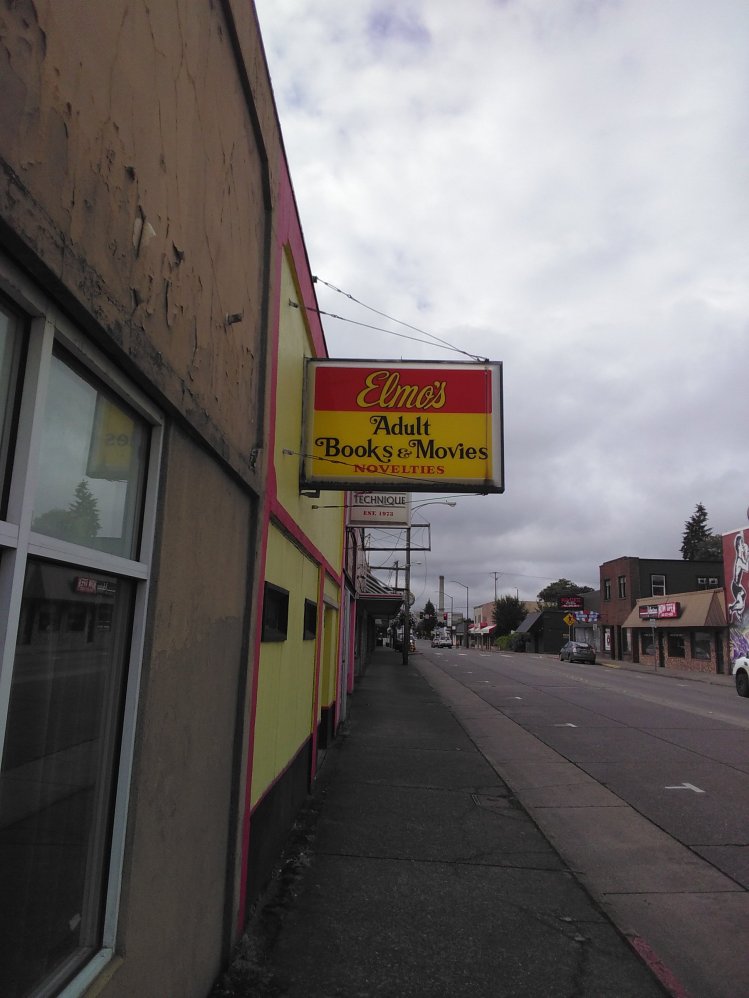
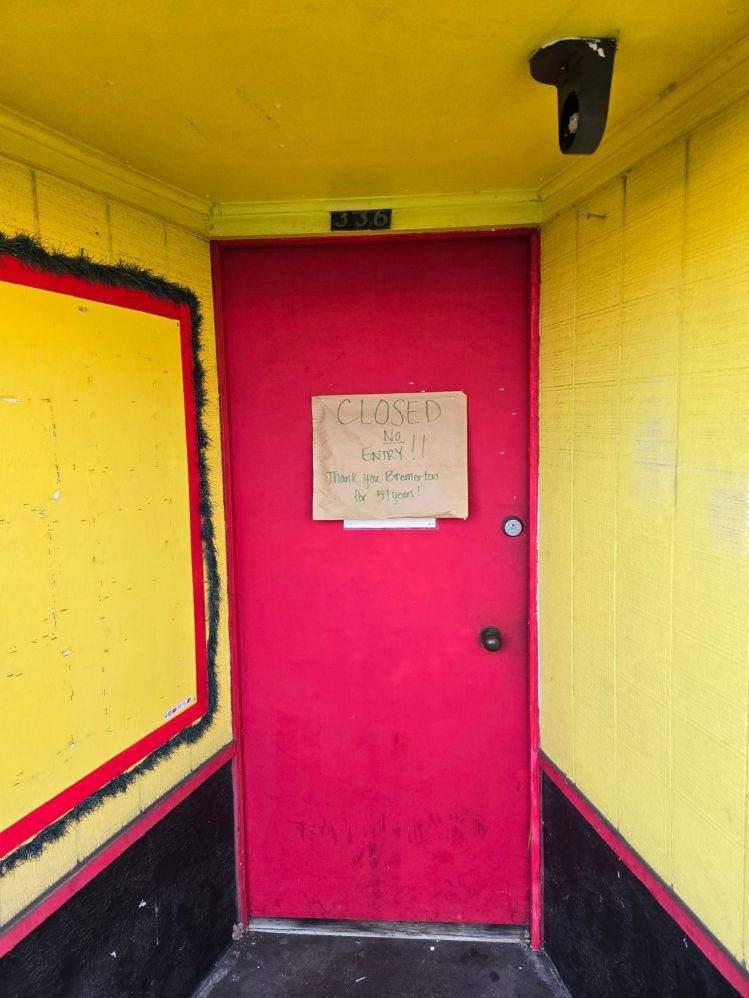
A Richard Speck-type in a primered Ranchero stopped and dropped three stacks of jackrags in the alley behind Elmo’s Adult Books and rang the bell. This happened every other Saturday, like visitation rights. Sometimes the Speck waited for old Elmo to waddle back, sometimes he’d drive off before the fat fuck unlocked the back door. It was one of the times the Speck drove off first. Tess stood lookout, and I dashed from our side of the alley, snatched a bundle, and got back under cover with seconds to spare. Then it was off to Fort Oxenfree, leaving Elmo a little poorer.

We moved as silently and swiftly as Indian scouts toward Fort Oxenfree. The alley ran about a mile and bisected Callow Avenue and Wyckoff Street. The Wyckoff side of the alley lay at the foot of Torqwamni Hill (forever “T-Hill”), and stood fifteen to twenty feet higher than Elmo’s and the other trashy businesses along Callow. It was a verdant bluff choked with brambles, weeds, struggling dogwoods, ivy, and switchgrass so riotously out of hand that it topped six feet in some places. Tess and I had created a secret world in the bluff, and as we made our way through the paths we had previously formed in the foliage, our feet automatically adjusted to the varying slant of the ground as though we were biped mountain goats.

Fort Oxenfree lay about a hundred and fifty yards south of Elmo’s, directly behind the White Pig Tavern. This meant we had to cross “the gorge,” which was the only relatively bald spot on our route, yet it was partially concealed by a peeling madrone which grew sideways and at a weird angle out of the bluff. Tess deftly crossed the short chasm, which stood over a good long drop, by using the exposed roots of a hemlock for handholds. I hurled the bundle across the gorge, she stopped it with her foot and I crossed even more quickly than she had.

A noisome swirl of portly bluebottles greeted us upon our arrival at “Fort O.” They were attracted by a recent explosion in a flat of Shasta tiki punch, which Tess had left in the sun. Soon there would be yellowjackets.

“Your pets missed you.”

“Hardee har har.”

We had selected the site for Fort O because you’d need a Sherpa to find it. It was a wildly overgrown flat spot we’d knocked down to about the size of a jail cell. It lay at the highest point in the bluff, atop an old stone wall gone over to blackberries and feral primroses. The front and the far side of Fort O were protected by a very long and sticker-bush laden fall to the concrete below. Entry from the bluff required a five foot climb up the side of the stone wall and through a trapdoor that Tess had made sticks and switchgrass. No friendly way in from behind, either. The alley side of Wyckoff Street was mostly a redundant series of vacant lots overwhelmed by Scotch broom, discarded washing machines and tires–as well as a seemingly sentient network of hiding, grabby ground brambles that would wrap around your ankles if you forgot to lift your feet, and goddamn stinging nettles that raised such hell with your skin that you never overlooked them twice. The Jesus of that kind of vacant lot lay behind Fort Oxenfree. It was such a shitty and hazardous little hellfield that not even the stew bums dared to flop in it.

I dropped the bundle and heard the typical Saturday afternoon din of the Pig below. Our vantage point behind a wall of switchgrass placed us about fifty feet from and twenty above the Pig. As always, drunken Specks bellowed and roared, and their pig-like women squealed and roared–all of it accompanied by the unsatisfying twunk of misstruck cue balls and a steady flow of C&W music coming from the jukebox.

Tess sang along in her sweet little girl voice:

“I turned twenty-one in prison,

Doin’ life without parole–

No one could ever steer me,

But Mama tried, Mama tried…”

We’d hit Elmo’s in preparation for the upcoming school year. The boys at Charleston Elementary were by and large sick perverts to begin with, but even more so when they hit ten; it was like some kind of alarm went off in their pants. Dirty pictures sold well and for a good price in the playground; Elmo’s wares were as disgusting as it got.

“Looky here,” Tess said, showing me the latest issue of Sweet Cocksucker, after we opened the bundle. “Must be a fiver here for sure.”

“Let’s bag ‘em for now,” I said. Which was exactly what we did. We wrapped them in polyurethane and packing tape, then placed the waterproofed booty inside the cache. Although Fort O was nothing special, the three-by-three square cache hole was. We’d dug it out that spring and reinforced it with planks, and waterproofed it with the same never ending roll of polyurethane we had boosted from behind Minder’s Meats.

What made the cache special was the cover Tess had connived from discarded bamboo and endless blades of switchgrass. There wasn’t as much as a screw or a nail in it. Using what she found lying around, she’d somehow created a dead match with the ground, as she had with the trapdoor. She’d also designed a system of “drapes” in the grass wall between us and the alley, which involved pulling strings to get and keep a view of the alley instead of using your hands, but wouldn’t open so wide as to blow our cover. Just nine, Tess had already long displayed superior artistic and mechanical talents–Not that it mattered to the fossilized fuckheads who ran the City of Charleston school systems. Girls who made the mistake of getting born around 1960–welfare brats to boot–had yet to experience much in the way of Women’s Lib. Besides, the district produced more felons than intellectuals, and we’d both realized early all you had to do was show up and do a minimal amount of work to pass to the next grade. A lot of tax money is fed to hopeless causes.

Tess opened a can of tiki punch that had been properly stored (It had to be piss warm, at best; my stomach clenched at the thought of it). She saved the ring top in a baggie with many others. Years later she gave me a stunning hippy art Statue of Liberty created from a thousand or more ring tabs. She’d painted each of them an outrageous color, and had meticulously looped them together over the course of hundreds of hours. Told me it was Janis Joplin singing into the torch. People offer me money for it all the time. I always say no.

Fort O faced east, which allowed us to luxuriate in the afternoon shade cast by Torqwamni Hill, listless from our labor and the heat, shooing bluebottles.Tess drank that stomach-turning tiki punch, sang along with the juke, and kept sneaking peeks at the Pig through the drapes because she found entertainment in the frequent sight of a Speck taking a leak in the alley (I later learned that the heads were one seaters–so you saw a lot of that). I began to fiddle with the slingshot I had reluctantly accepted in trade for a copy of Juggs during what you might call our “End of School Sale.”

I was three months shy of twelve; I’d get my first period for Christmas. Yet throughout that last year of my childhood something had already begun changing in my mind. It was a feeling especially keen during the progression of late summer afternoon shadows; a causeless anxiety underscored by the incessant cracking of broom pods in the quiet moments; a forlorn certainty that all was lost though hardly begun.

And there were times when I’d look at my gifted little sister and feel guilty about what I was doing to her.

I had plenty to feel guilty about. You see, every last thing–from the dirty magazines right on to the can of tiki punch Tess was drinking was stolen, even the returnable soda and beer bottles we had hidden in the grass because there were too many for the cache had been lifted from one place or another. If something could be boosted from a loading dock or a car in our little realm, we had it up there at Fort Oxenfree. Besides a substantial amount of hardcore porn, we had filled empty pickle jars with parking meter change we cleaned out of car ashtrays, some folding money, endless amounts of penny candies and gum lifted from a dozen different stores, several packs of cigarettes, lighters, a box of shotgun shells, sunglasses galore, prescription pills, lids of grass. We also had a bunch of cameras we didn’t know what to do with because we weren’t old enough to pawn stuff. Tess got the notion to “Robin Hood” them. We’d walk around and stick them in front of doors and in mailboxes of the shittiest looking places. We even left one for Mom and Anna Lou. They both pawned theirs.

And shoplifting was a scream. We’d dress for school and go into a store downtown (never shit in your own yard), and while Tess charmed the clerk, I’d get after everything that wasn’t nailed down and shove it in my pockets and underwear. Then we’d buy some stuff to make it look good. Alas, even the slingshot had been paid for with stolen titties. Only an incredibly gross 14-inch dildo that somehow oozed out of Elmo’s and just lay there in the alley had been gained in an honest finders-keepers sort of way. (I eventually tossed that beaut through the open window of my teacher’s car and hid in the bushes for the payoff.)

And it was all my idea.

If discovered and linked to us, the contents of the cache (especially the dope and porn) probably meant two tickets to the Mission Hill Academy for Girls. My guilt figured that I had it coming, but since none of it had been Tess’s idea, and since I was supposed to protect her, I figured I’d better try to do something.

“Tess?”

“Huh?”

“If we ever get busted, you don’t know shit about the stuff in the hole.”

“Half’s mine, Sarah.”

“I’m not sayin’ it’s not,” I said. “Just sayin’ if Mom or the cops or some other fucker we can’t do nothing about comes round and has a look in the hole, then there’s hell to pay. Just act like you know nothing about it. Let me do the talking. Don’t be such a molecule.”

Tess sometimes got shitty about being called a molecule, even though she heard it plenty. She handled the situation by fetching at least six Bazooka Joe’s from the cache and sticking them in her mouth. So gross. She sucked on them until they got soft enough to chew. That was her way of making certain she could give me the silent treatment. Pink drool dribbled down her chin.

I sighed. So much for the high road. Anyway, it must’ve sounded pretty cheap coming from me. There was something people saw in me that was different from “just a girl.” I was tall, strong and as unnecessarily violent as I needed to be. Some called me “Psycho” behind my back, but I didn’t discourage it because it added weight to the “Tell and I’ll kill you” I dispensed at the end of every porn transaction.

Tess never stayed mad at me long. Even when the years came that saw me extract her from one shithole squat to drag her to rehab for the God-only-knows-how-manyieth time, she’d be quick to forgive me. I’d strong-arm her to the car and she’d be screaming just how much she hated my faggot guts, and that for a hummer she could have my dyke cunt raped and murdered. Then she’d cry and promise it would be different this time. And I’d say my lines, those sincere there for you words that were never enough.

She tapped me on the arm, trying not to choke on the wad of gum in her mouth because she was laughing. I was rooting through the cache for a handful of the thousand or so shooting marbles we got hung with that spring (marbles as a game was always around, but sometimes it rose to a faddish level as it had that April. We stole untold dozens of bags from several drug stores and sold them at half price. Couldn’t give the fucking things away come May). I had gotten real good with the slingshot and could take a blackberry off its stem from twenty yards.

“What?” Then I saw.

Tess had parted the grass to check on the wild side of life and sure enough there was a Speck urinating behind the Pig. There were an inordinate amount of Specks in Charleston. All were skinny creeps who brylcreemed their hair into a pomp as though it was still 1950-something; and they had boney faces and small muddy eyes that conveyed an overall dullness of mind. Still, even a Speck usually had the decency to piss on the wall, but he was facing us. It wasn’t the first dick we’d ever seen. On the top floor of our building was a grown man yet forever a child with Down syndrome who lived with his aged mother. He’d see kids, and if his mother wasn’t around, he’d ask “Wanna see my elephant?” His name was Eddie but we called him Dumbo. Sometimes there was talk about sending Dumbo away to a “special school.” But that never happened partly because he never touched anyone and mainly because he was retarded.

“I’ll shoot him in the weiner,” I said, taking aim with the slingshot.

A horrified expression raced with consent to fill Tess’s face. She was that way. Her eyes and face were extremely expressive and often contained contradictory messages vying for control.

I was just playing around–I’d no more shoot the Speck in his elephant than yell out our secret location. For I may have been antisocial but I wasn’t reckless; I reckoned that even a Speck could figure out where the shot had come from. But Tess would have done it; she wasn’t big on thinking ahead.

INRI: Chapter One

-1-

Tess nagged me into visiting our father’s grave. She said it was the sort of thing that daughters should do. While she arranged a handmade wreath composed of daisies, bluebells, buttercups and dandelions on his tombstone, I stood there and felt stupid–thus more inclined to be a pain in the ass than acting the part of a dutiful daughter. Naturally, I had to get on her case about the inclusion of dandelions:

“Those are weeds, molecule.”

“So? People don’t grow the other stuff on purpose, either, Sar-duh.”

He died when I was two, shortly after Tess’s birth, thus destined to be just another smiling ghost in the family album and little more than the source of our surname. It never occurred to us to visit his grave, or even ask where it lay. But that changed on the first day of the 1971-72 school year, when at ages eleven and nine, we finally learned how he’d filled his grave. Suicide. One of Tess’s subnormal classmates had teased her about not having a dad. Said ours shot himself in the head in order to keep from knowing us–Tess especially.

“Tell me, fucker, or else,” I informed that kid, after school, in the playground, my arm locked around his neck, my knee in the small of his back, his face inexorably inching closer and closer to a mound of freshy squeezed dogshit. He told me he’d overheard his parents talking about it. I believed him because people are uncommonly truthful when faced with a high-end or else. Still, he got a bit anyway for making Tess cry–and for being stupid enough to think she wouldn’t tell me and that nothing bad would happen if she did.

Our mother was a word class liar, once in a lifetime. She capitalized on the specious notion that true sounding things are brief. “He had an accident” was her go to fiction about our father’s death on the very few occasions we brought it out. Nary a syllable more. Though characteristically terse, it depended more on a look in her eyes that told us not to fuck with it than brevity to get over. Quizzing our only other living relative, a pill head “aunt” from his side, would have been useless because Anna-Lou knew better than to cross Mom; and Mom’s best friend Nora would have just blown us off and reported our curiosity. Although it appeared to be common knowledge in some circles, Tess and I vowed to keep that we knew a secret. For me it was something I could use to fuck with it at leisure; my sister’s reasoning is harder to explain.

Tess had a secret word for the beauty she saw flashing in ugliness, like panning for gold in shit creek. I don’t recall the first time I heard her say Dreampurple, but it must have been around 1969 or ‘70–certainly no later than that time in ‘71. So, it made sense that she’d see the Dreampurple in self murder. Mom was big on labeling the things she didn’t understand about Tess us “phases.” If Mom had known about the wreath laying business she would have attributed it to yet another of Tess’s passing fancies with the same certainty she had that I’d wind up in Hell via the Washington State Women’s Corrections Center at Purdy.

At the time Tess was going through a Jesus phase. But it burned off like summer fog because you have to seek the Lord, whereas brutal reality never stops until it has killed you. It took me a long time before I realized that there was a difference between Tess’s phases and that which she held in Dreampurple esteem; Mom never got it, though sharp, for her it all added up the same. She didn’t know that the phases were temporary while the Dreampurple was for keeps. Naturally, I figured that Tess had nagged me into going to New Town Cemetery due to a newly found infatuation with Heaven. I went along because sometimes it was the only way to get her to shut up about a Big Idea.

I still wonder why flowers look natural on graves. You’d think that the two items are so far apart as concepts that they would clash in the mind. Conditioning, I suppose; the result of long term exposure to a tradition that’s formed a mental link in the species. Tess had arranged the wreath so it made a circle around the words etched on his small, rectangular cement tombstone:

DELROY DEAN SPAHR

1935 1962

I almost felt something when I looked at his shitty little poorman’s grave–a tiny cement square, not even made from natural stone, already cracking, certain to give away his name only after a few winters had leaned on it. It seemed to me that a life should add up to more than a name and two dates–all that time being a someone marked only by a small empty space between cold numbers. And the missing dash between the years you normally see on tombstones bothered me. It felt as though he’d been slighted in a way that I took personally.

This thinking didn’t go well with my baseless fear of the long shadows of late September afternoons. There’s something about September that’s death already; something that the shadows uncover rather than conceal. Ever since winter I’d been experiencing shocking, sudden mood drops; these had no triggers and are best described as an instantaneous switch from my familiar tone of thoughts to a cold, certainty that the universe and everything in it, like our parents and us, was already dead, and had been for a long time, if not always.

For the first few years of my Endless Now, I found that I could talk my way from it–even shake it off and pretend it hadn’t happened.

“I don’t want to be here,” I said. “If you’re gonna say a prayer, say it so we can go.”

Don’t think so,” Tess said in a voice that weighed more than a nine-year-old kid should have to carry. She’d only say “Don’t think so” when something was over. Don’t think so items hadn’t passed the Dreampurple test.

Jesus might have walked on water, but he’d sunk for Tess. Christianity assayed fool’s Dreampurple. Nothing ever got a second chance at the test.

End Chapter One. Chapter Two on Monday

You Remembered Everything: Chapter Three

Chapter Three

21 June 1943

The Legend of Emma Withe (Part One)

The morning paper was the usual dog of war. Other than a follow-up article about a peculiar fire at the Dow Hotel, the Charleston Sun was, as always, heavy with the blare and thump of the trumpets and drums of war. And there were the usual op-ed pieces that scolded the young men who were “waiting for an invitation to the party” instead of volunteering to defend the land of the free, home of the brave and so forth. Emma felt that these writings would carry more weight if not written by men who were safely exempt from service on account of age. Moreover, it should have been noted by the writers that most of the men of service age in Charleston were there to build and refit warships at the Puget Sound Naval Shipyard. At seventy-one, Emma long knew that there were few things on earth more tiresome than an old man who has something to say.

With great reluctance, Emma turned to a quieter page in the paper. Running her finger down the updated casualty list (even the smallest communities had such a list), she waited for her heart to snag on a half-forgotten name as it had six times in the past year and a half. Whenever Emma found one of those snags, she’d send her mind back to when the dead soldier was a boy and she was his teacher at Charleston Elementary. She would endeavor to remember a day when the boy had seemed at his happiest, then she’d seal that memory in her heart and never think about the boy again.

There hadn’t been any snag in that week’s list. Emma sighed and rolled a cigarette. She pitied the boys on the list who had not been her pupils, but she had no space in her heart for them. Their deaths (which probably did not occur with the blare and thump of trumpets and drums) were just faceless redundancies to her, as they were to most everyone else. True–each had been a person with his families and friends and likes and dislikes; hopes and dreams. No disputing that. But there were just so damned many of them; lives stamped out short by foreign events already begun while they were still children. And as scarcity drives up value, a glut drops the price. A similar economy guided Emma’s heart; and she could only invest–however briefly–in the boys who had attended her fourth-grade class at Charleston. Even in retirement she could not afford to dwell long on such dark matters.

Emma laid the newspaper aside. She had a second dreary matter to dispense with.

For two weeks, Margaret’s letter had followed Emma around her rooms like a stray dog. For the first week it was stuffed inside a drawer. Unfortunately, Emma never realized just how often she needed to get into that drawer. Emma had hoped that the top cupboard would take the letter in and give it the same air of urgency that Christmas decorations have in the summertime. But the relocation to Emma’s version of Siberia proved ill-timed, for it coincided with the cupboard’s hitherto unknown busy season. And every time Emma found herself teetering on the stool, seeking out some suddenly required item, the letter wafted down onto the counter. Inexorably, Margaret’s letter found its way on to the table, the final stop.

Lewis had wondered why she just didn’t just burn the letter unopened. “That way it won’t be a bother to you.”

But that was Lewis, dear and sweet. Still a lap cat to her, even after all these years.

Always helpful, always caring, always advising. Poor Lewis. Never that helpful, caring, nor wise unto his own affairs. A buffoon, really. Lewis was too sincere to have prospered. But Lewis was the one person Emma wished to outlive; her death would hurt him immeasurably.

“All right Peggy,” Emma laughed, for the third to the last time in her life, “you win.” If it were only Peggy who had written this, she thought, knowing better, but hoping right along. Peggy was the sort of girl who’d rub daisies on her letters to “AMERICA, U.S.A.” How Emma lived for those correspondences from London. Home. Whenever she got a letter from Peggy, Emma would tear it open on the spot and hold it up against her nose; and somehow the seven thousand miles lying between Emma and her little sister were eliminated. Emma had promised to send for Peggy, someday. But promises have a knack of making liars of us all. By the time Emma finally relented and opened Margaret’s letter, forty-three years had passed since they had seen one another. And in that space of time, much had happened to both. Too much, to be honest. Little Peggy was all gone. In her place there was Margaret, which would’ve been fine if Margaret hadn’t grown up to be such a strange, one-note woman, who, like clockwork, sent equally strange, one-note letters every six months.

The letter was, as Emma had feared, all-Margaret. No “Dearest Sissy”; no stale, yet wondrous scent of daisies (which Emma allowed would have been peculiar to find in a letter sent by a fifty-four year old woman); no hint of Peggy. Like the Sun, the letter was thick with war; but not even an event as momentous as the Second World War could take the spotlight off God when Margaret wrote Emma her bi-yearly letters:

“…God found England Decadent. He commanded Satan to marshal the Nazis to smite England for its Wickedness…A Bright Day cometh, Emmalene! Our Homeland has seen the Evil of its ways! Soon She shall rise again! Come Home to God, Emmalene. Take Jesus back into your Heart! and we shall Rejoice Together! Evermore in Heaven!…”

That was the general smell of the thing. Although Emma had no reason to believe that Peggy might crawl out of Margaret like a survivor emerging from the rubble long after her empty casket had been laid into her grave, Emma always had her hopes. And no matter how many times Emma sealed Peggy into the vault, that winsome, beloved phantom always found a way to slip her chains. Emma carried Margaret’s letter to the sink. She held it by a corner, like one might hold a dead rat by its tail. She then put a match to it, and held it until she was certain that the fire wouldn’t go out when she dropped it into the basin.

The flames reminded Emma about the queer fire that had happened three nights earlier at the Dow Hotel. The blaze was confined to a single room and had taken the life of a woman. To Lewis, and half of Charleston (the other half had yet to hear), “confined” was an understatement.

“I got it all out of Joe Parnell,” Lewis, a most credulous sort of man, said, in reference to an ex-dentist who served as Deputy Coroner. “Told me if I breathed a word that he’d deny he ever said it… Told me that it was off the record.”

To which Emma smiled. Telling Lewis anything worthwhile or interesting was the same as publishing it in the Sun (which, to its credit, never ran the unsavory rumor that clung to the story–but did print an awful lot of follow up stories about the fire’s lone victim).

“’Spontaneous combustion,’” Emma said, laughing for the second to the last time in her life; echoing the thing Lewis had told her, and watching Margaret’s letter burn into Peggy’s ashes.

“Sister dear,” she said, “if not Heaven, then where else shall we meet?”

****

Emma had no plans to visit Mary in New Town Cemetery that day, even in retirement she remained a slave to routine. It was Monday, and she had gone the day before; for that is what she did on Sunday. And yet there she was, fully aware of the day, but not questioning why she had automatically walked to New Town instead of the Park Avenue Diner, where she ate lunch six days a week. It was through she had been guided like a sheep and was just as unquestioning as livestock. It was not until after death that she finally approached the why of the thing and, even more importantly, how and who?

Again, there she was standing at the foot of the Withe family plot. Which contained Mary’s grave and that of Emma’s departed and never missed husband, Robert. There lay an already paid for empty space between them.

Mary Elizabeth Withe

1900-1906

Here Lies a Mother’s Heart

Although it had been exposed to thirty seven years of weather, Mary’s headstone was polished and in all ways kept immaculate. Nary a finger of moss had invaded a letter, nor were weeds allowed to take root in the plot. Emma had twiced replaced the stone when the inevitable cracks had formed and figured she should do it again, before it was too late. Robert’s grave was untended and looked like something that had been ignored since it was filled in 1908.

Emma had complete control of her emotions. Hurtful memories could not sneak up on her. She could only experience emotions when she wanted to; only when she let them out of their cells. Mary’s death had changed Emma. It made her cold and ruthless, but only on the inside, for she was able to affect an acceptable, though aloof demeanor; her insensitivity, however, did not extend to children, or to persons such as Lewis who had something good and childlike about him that survived the push to adulthood.

Thus, she allowed herself to feel Mary only on special occasions. Regardless, at all times what passed between Emma and Mary’s memory lay beyond the reach of anyone else’s power of description. She had no feelings about Robert’s grave, nor her part in filling it. He was a closed book never to be reopened.

Upon gazing at Mary’s stone, strange emotions, lacking enough substance to gather into thoughts, began to swirl in Emma’s mind; a blizzard of half thoughts and indescribable feelings. I know thisI know all about this–why can’t I remember? She saw a small party of people moving toward her, and the sun began to move crazily in the sky, east to west with stunning speed, night and day alternating and gaining and gaining until it was all a blur. And numbers entered her thoughts: she first saw the meaningless number 20,058 and watched it reduce by one at a time with the same velocity the whipping sun marked new days.  It stopped at one. Then Emma laughed for the last time in her life. It was all clear to her. I remembered everything. But she didn’t remember everything long. A tremendous flash burst inside her head. The left side of her body died milliseconds before the rest; she fell in that direction, striking her head on Mary’s stone.

And somewhere, where cosmic records are kept, Emma’s one became zero. Yet that too wouldn’t last long.

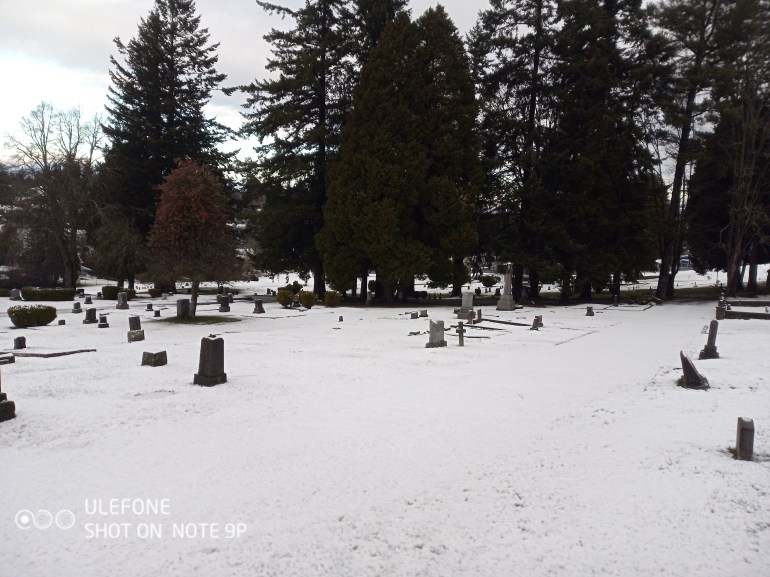
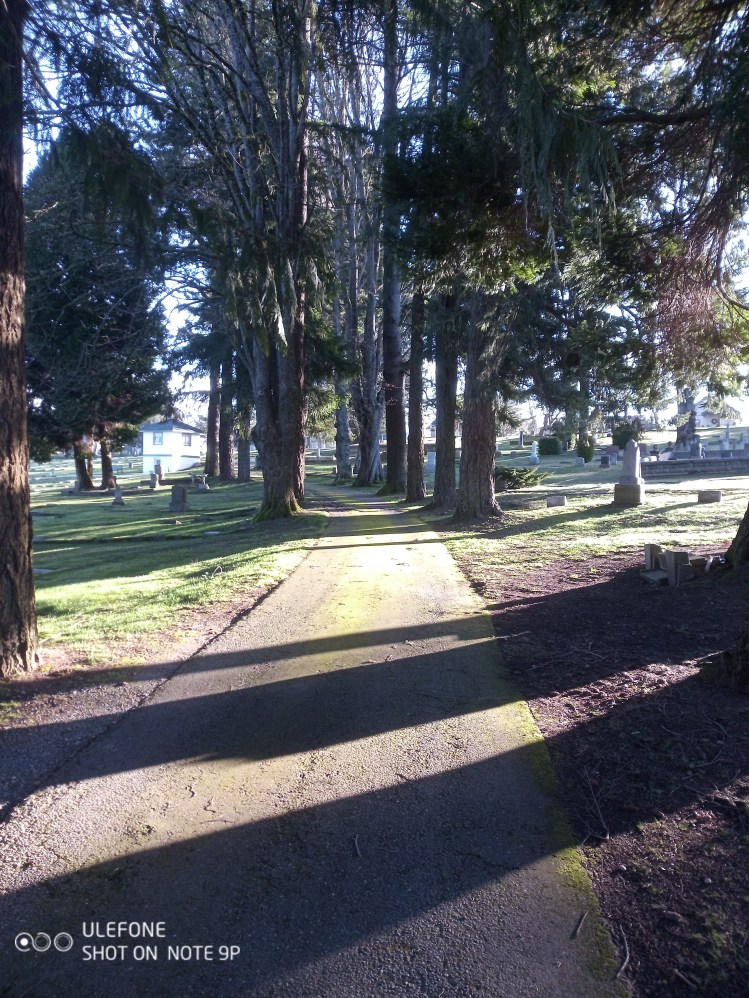
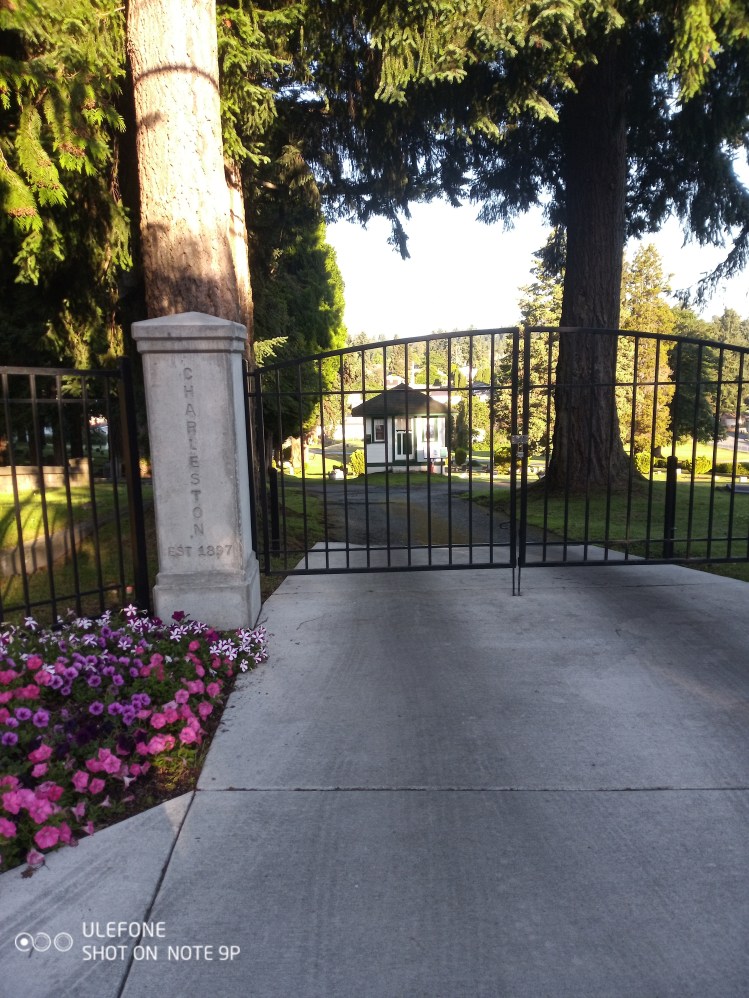
(Author’s note. The image is obviously not June, unless at the poles. But I like it. LA)

End chapter three

You Remembered Everything Chapter Two

During Holly and Emma’s strange meeting, Irene Allison was at home sitting on a porch swing and drinking a can of PDQ Pilsner. Irene looked much younger than her twenty years because she was neither quite five feet tall nor a hundred pounds. It was a pretty night, maybe sixty, and not humid as it usually gets during summer in the Pacific Northwest.

Irene’s house stood at the crest of T-Hill, directly across the street from New Town Cemetery. Despite its location, little could be seen of the cemetery from the porch due to the quick drop of the hillside. Holly and Emma were no more than a hundred yards away, but since that was mostly downhill from her, they could have been on Mars for all Irene knew.

Unlike the dilapidated rows of war time duplexes, it was a clean, albeit aging, two-bedroom, single level working class home built by Irene’s paternal great grandparents prior to the Great Depression. It resembled a hundred others in Charleston save for a veranda that ran the length of the front of the house. Irene always thought that there was something southern and To Kill a Mockingbird about the veranda. A large porch swing to the left of the front door was the veranda’s main feature; Irene sitting on it during fair weather was often the swing’s main feature.

Irene had one ear trained on the baby monitor she used to listen in on her grandmother. It was stationed on the wide rail of the veranda. Hard circumstances and bad luck made Irene responsible for the well being of another human being even though she believed that she was not particularly able to manage herself. The weight sat uneasily. Over the past five years her life had been little more than about death; everyone she loved had a lifeline as long as that of a Bronte sister. Even the cat, Sir Jack Falstaff, whom Irene had known since the dawn of her memory, was sixteen.

As a diversion, Irene, again, wondered how a can of five-year-old PDQ Pilsner could still be fresh and fizzy. It was better to think about that than dwell on another lonesome night of her youth taking the big swirl down, then upbraiding herself for her selfishness.

PDQ was the lowest of the three local budget beers (said to be brewed from the “mysterious waters of Saragun Springs”). Each can featured a picture of “Pie-Eyed Peety the PDQ Pilsner Pigeon.” Peety was a toon in a porkpie hat, who smoked a cigar and held (an apparently bottomless) can of PDQ in one wing; he had been touting the swill since the 40’s. No matter how he was positioned, Peety’s head was always surrounded by six (Irene had counted) popping bubbles that inferred (along with his “pied” eyes) a state of extreme intoxication. There were uptight snowflakes who protested an insolently drunk pigeon being PDQ’s mascot. They said it was designed to attract kids to drinking, cigarettes, premarital sex, critical thinking and all the other stuff people would rather do than take direction from uptight snowflakes. Irene believed that it was a hypocritical society that begat useless snowflakes who made more noise about cartoon beer mascots than they did about people dying in doorways that caused people of all ages to flee reality. Regardless, none of that solved the prolonged freshness mystery.

These philosophical thoughts were interrupted at 12:17:09 A.M., the precise time of Holly More’s death at the foot of the cemetery’s great maple tree. The baby monitor squawked and Irene heard a female voice say “You remembered everything, darling,” at a volume well beyond the capacity of the cheap speaker, which, like Mr. More, died that instant. This was accompanied by a bright flash of light inside the cemetery. As Irene dashed from the porch through the house, she expected to hear thunder, but it never came. She turned the light on in Gram’s room and saw nothing out of order; Gram was sound asleep courtesy of one of the many pills she was prescribed for a litany of woes, including insomnia. All Irene got for the effort was a peeved yawn from Falstaff, who was curled at the foot of the bed.

Irene turned the light off and quietly closed the door. She never felt so alone.

But that feeling vanished when she heard Lauren Thommisina Lemolo’s ancient Dodge Colt pull into the Allison’s driveway. Only official people called her Lauren, to everyone else she was “Tommy.” Although she had been distracted that night, Irene usually knew that Tommy was on her way long before she arrived. The Colt made several strange noises (audible at about a half mile) that distinguished it from all other contraptions in Irene’s knowledge. Mainly, it was a combination of the loosely geared manual transmission and heavy exhaust pushed through the ragged tailpipe that caused a singular, hiccupping whurrwhirring sound. The Colt constantly threatened suicide but never got around to it. Tommy figured that it was waiting for the worst possible moment to do so.

“Oh goody, you broke out the urine,” Tommy said, bounding onto the porch, met by Irene. She was twenty-one, a year older and a foot taller than Irene. Always athletic, Tommy moved like a dancer even though she had a prosthetic attached at the knee of her left leg.

“You see a flash of lightning about a minute ago?” Irene asked as she handed Tommy a can from a bucket near the swing. “Looked like lightning hit the graveyard, but no thunder.”

“Lightning–on a night like this? Must be the pee talking.” Tommy then held her can of PDQ high as though it were a chalice. “I’m telling you there’s a Nobel prize kind of scientific mystery here to be solved–how can a beer brewed bad not go flat. Tellin’ you there’s money in this.”

For a fleeting second something hitched in Irene’s mind. She saw Fallstaff lying on the porch swing–confused, she began to think “didn’t I just see…” but it vanished before completion. As far as Irene was now concerned he had always been on the swing.

Tommy sat on the swing and nuzzled the old boy. “How ya been fatso?” She touched his nose with her beer and won an expression that suggested he needed to sneeze but had forgotten how. Not all that long ago Tommy and Irene would watch him hunt and eat moths on the porch. He hadn’t done much of that for the last two years or so. The shit you miss.

Irene remembered the noise the baby monitor made. She picked it up and shook it. Something rattled. “Fried,” she said. “When the lightning–or whatever happened, I heard a voice over this thing–real loud–now it’s cooked.”

Tommy took it from her, also rattled it, fiddled with the volume controls. “Wow, it is spent–you can smell the wires. What did the voice say?”

Irene sat beside her, she was about to answer but the words had also vanished. “Dunno–can’t remember. I took off thinking it was Gram, but she’s out completely. Must be a blown transformer–good thing it wasn’t ours.”

Although both Irene and Tommy were too smart to buy the lame transformer theory, neither of them felt compelled to explore why there would be a transformer inside a cemetery; nor why the lights were still on; nor how a transformer blew out a wireless monitor and nothing else. It simply felt better to let it go. Natural. Besides, there were two other monitors that came with the set; by the time Irene returned from fetching one from the kitchen, the topic was completely forgotten.

“How was she tonight?” Tommy asked, already knowing, lighting two cigarettes. She gave one to Irene.

“Same–how was work?”

“No breaking news there,” Tommy said. “Made a whole nine bucks in tips–one fucker left a quarter–but we stayed open all the way to 11:45–numb-nuts about peed himself worrying about closing fifteen minutes early on a Monday night.” Tommy waitressed at WJ’s Bar and Grill; on busy weekends she easily cleared fifty, sixty bucks a night in tips, even after cutting in the bussers. “Numb-nuts” was WJ’s assistant manager–Irene thought his real name might be Andrew–something with an A. She had never met numb-nuts, and still six months shy of twenty-one, she had only seen WJ’s from the outside. But she had formed a mental picture of the place, the workers and even numb-nuts based on Tommy’s colorful descriptions.

Tommy told Irene she could get her a job at WJ’s, but that was before the State “hired” Irene as Gram’s live-in caregiver. It’s a hell of a world; children and grandchildren having to take pay for something they had been and felt obliged to do for free. Yet even though the house was paid for, expenses were fairly low and Gram had both social security and her pension, there ‘s always the property taxes and increasing prices, more money is always needed. Still, it made Irene feel like dirt; like a sponge; like one of those awful people you hear about on the news whose neglect causes bedsores and whose greed raids the accounts. This made Irene so over the top scrupulous that it might have looked suspicious if anyone cared. It also seemed to her that the State needed a patsy just in case something went wrong.

Grandpa Henry and Gram were children of the Great Depression. Even though they were literally kids back then, they had been taught to buy all you can of something when it goes on sale. That sort of thinking led to things like thirty-one flats of PDQ in the garage, upon Grandpa Henry’s death five years earlier. One summer, when it got hot enough in the garage for some of the cans to explode, Grandpa Henry installed air conditioning (since discontinued), thus negating the money saved from buying in bulk. Two years of subtle mourning passed before Irene began to drink it. At a rate of six to ten a week (even with Tommy’s help) there were still nine cases in the garage.

Of course it hadn’t always been that way. There had been boisterous times, good times, alive times. But those things vaporized when Grandpa Henry collapsed in the kitchen from a heart attack when Irene was just shy of fifteen; the following month, Tommy’s mother died unexpectedly in her sleep. The “unexpectedly” part went away when an emptied bottle of hydrocodone and a note were located on her nightstand.

Irene was with her grandfather when he died, unable to do anything more than to cry and beg him to hold on till help arrived. Gram had been at work and Irene was in her room studying when she heard a crash and a thud in the kitchen. She found him lying on the kitchen floor in a puddle of Four Freedoms vodka. Although her grandfather was no stranger to losing consciousness, he rarely passed out that early in the day.

“I’m calling 911, please please please don’t die.”

But he did die. He died without regaining consciousness, in her arms, shortly before the ambulance arrived. In the intervening years, Irene had found the good in her grandfather’s sudden death. He had been spared the torture inflicted on Gram.

Death was taking the long way to Gram. Until she turned sixty-five she’d been strong and healthy–in defiance of her own tableau of evil habits. But Elsbeth Allison suffered her first stroke not five months after Grandpa Henry died. In itself, the stroke was no big deal. But it served as an opening bell for Gram’s season in hell.

Within three years, there was very little that was not wrong with Gram. She had diabetes, gout, emphysema, kidney disease, an enlarged heart, plus a liver “Harder than a twelve year-old whore’s upbringing,” so Gram had said, because she used to say stuff like that, prior to her brain no longer getting enough oxygen to sustain a personality. She had still managed to remain a funny human being until spring. Then she went away. The situation almost caused Irene to pray to the God she did not believe in to end Gram’s suffering until she realized that if God did exist, then he was the fucker responsible for pain.

Naturally, Gram had begun to live in the past because her present was shit and the future didn’t have plans for her other than the continuation of shit until she died. And despite the B.S. Irene had heard about miracles, she knew Gram wouldn’t be getting better because there was no better for her to get back to. Her equipment was shot beyond repair.

Gram, Irene’s Gram, never bitched about the situation. But the thing in the back bedroom complained full time about everything. Whiney, petulant, dumb as a post and certainly not the sort of person Gram would have liked, the doppelganger of Elsbeth Allison lived on for no apparent good reason. Still, every now and then old Gram would resurface, but the occasions were becoming steadily infrequent. Thus Irene was in the not so unique position of mourning the passing of someone while that person (in the technical sense) still lived.

All such facts went into causing a hell of a surprise when Gram came out of the house and asked Tommy for a cigarette.

End Chapter TWO

The Crossed Star of Bethlehem: Chapter Eight: a whistle for the goatfooted balloonman

Chapter eight

Today, quicksilver March clouds hug Torqwamni Hill in a multilayered embrace composed of soft kisses and the murmured promise of a twisted-shank thrust below the sternum and into the heart. Both may be interpreted as acts of affection. And it is Tennyson who claims that spring is when young men think of love; yet nothing the Lord says expands well on what the young ladies make of the situation. Perhaps this is because it is less poetic, and concerns what passes from mothers to daughters on the subjects of cows and the price of milk.

Continue reading

The Crossed Star of Bethlehem, Chapter Seven: The Inescapable Touch of Sunset

Chapter Seven

The atavistic avatar dropped from space:

“I did it only to see the look on our face.”

1

On his way across the short overpass that unofficially connects Corson Street to Torqwamni Hill, Holly glances down at a small house below. It’s an ugly little fist-like rental that had gone up during the Second World War—as had countless others of its kind in Charleston. Like the caw of a crow or a bit of dandelion fluff getting stuck to your cheek, this house exists only in the moment you share with it. Yet nearly thirty years gone by, the same house had once unclenched and gave Holly a touch of honesty; thus it had it had earned in his mind its own small history.

Although subsequent tenants never draw the sun-yellowed Venetian blind that covers the house’s only large window, Holly knows that the living-room lies behind it. And he recalls a long gone summer night when, half drunk, he had crossed the overpass and saw three obese people (two women, one man) watching TV. All three were sitting in worn-out easy chairs too small for their rotund shapes, and each one had an immense Corning ware bowl of popcorn balanced on his and her lap. There had also been an equally portly little Chihuahua-mix that made successful rounds from bowl to bowl. It was obvious from the strong family resemblance that the oldest woman was the mother and that the other two were brother and sister. All had that flickering dimness of eye-light you see in the faces of people whose intellects hover between that of the “slow” and the mentally disabled (or “retarded,” which, as a proper pronoun, has gone the way of “Negro.”).

Even though Holly had been well-oiled by Happy Hour schooners sucked down at one of the nearby local shitholes, something poignant and everlasting accompanied him from there on. Although these were the type of people he’d lay silent scorn upon while watching them power-waddle toward the bus, this catching a glimpse of how it goes behind their veil had caused him pain. There was nothing sentimental or phony about what he had felt; yet every attempt at putting words to it failed to recreate the emotion. In time he realized that you cannot effectively describe an emotion until the emotion has ceased. It’s a good life lesson; invaluable to a poet.

Holly stops on the sidewalk, re-adjusts his heavy backpack and gazes into the west. Although the pewter clouds are thick and look pregnant with snow, the timer he always carries in his pocket has alerted him to the coming sunset. He always observes sunset even when it’s not visible. Down on Corson Street, the steady hum of Christmas Eve traffic speaks of a world in which the relative motion of the sun is irrelevant. An endless stream of headlights form halos in the frigid gloaming. Gloaming, now there’s a chestnut for you, Holly thinks. Yet within his insolence he knows that all things have souls in spite of their own indifference. This too is a good life lesson; it makes a poetry matter. He turns and moves east. Onward to Bethlehem.

2

Bethlehem Shelby hates Christmas. When the topic comes up, normally well-spoke Beth (who only curses here and there for a little spice) instantly falls into a coarse verbal assault on the subject; for her it is “Fucking-Christmas,” and she is seldom heard to refer to it as anything else—save for “Freaking-, Frigging- or Effing-Christmas” on the rare occasion when the sensitive type is present. No, no one hates Christmas more than Beth; and that goes for you and you and you and the Grinch and Scrooge, as well.

Christmas also happens to be Beth’s birthday. This year she turns fifty-eight. Although she is candid about her age throughout the year, and is not considered particularly vain by those few who know her, she refers to this circumstance as “That Goddam-Fucking-Christmas-Birthday.” Here, no euphemisms are substituted for the profanities; and if you happen to be the sensitive type, well, that’s just how it goes.

Although crass commercialization and the way goddam “Black Friday” won’t stop getting bigger until it is held on December, 26th annoy the holy hell out of Beth, it’s the memory of her widowed, working-class mother, Harry, skipping lunches and in all ways scrimping on herself from September on to make sure Beth got presents under the tree and something “special” for her birthday that had begun this hate. She also remembers crying into her pillow for only God knows for how long when, at thirteen, she had been informed of this situation by Harry’s best friend Fran, after Beth had launched into Harry the way thirteen-year-old girls will do—even those who have an IQ of 160 and are already working on their Masters in Mathematics. Although Beth is considered a decent human being, the only two things she hates more than Christmas are crying and feeling guilty. And not at all helping matters is the way her Holly knows about this serious business, yet continues to find her attitude toward the holidays as funny as the actions of that fierce and murderous little bunny in Python’s Search for the Holy Grail. Never a year passes without this little joke going up like a fucking-Christmas stocking.

Currently more peeved with Holly for again being late for their trip to the hospice than she is with the Season, Beth stands at the window and gazes out. The sun has just gone down and she knows that Holly is observing the event as though he were a goddam Inca priest. The silver sky has taken on a pinkish hue, which is indicative of snow. Beth lights a cigarette. Snow for fucking-Christmas, she thinks. Doesn’t God know He’s dead?

3

There are few clocks and calendars to be found in the rooms at the Catholic Hospice of Charleston. Nor is there a division of day and night that isn’t controlled by a switch. This matters little to the residents, for the mindless exist in a state of absolute now that requires no measurement, and the thinking dead live almost entirely in the past.

Fran is as exceptionally strong as a hospice patient can get. She is also a favorite of the nuns and the staff because she had once been an ER nurse who had later worked in geriatrics. She still thinks and speaks coherently and has yet to degrade to the point where soiling the bed doesn’t bother her. Of all the things she has lost or is losing the ability to do, Fran has steadfastly held onto using the toilet. Every time this goes her way, she prays extra hard for death to come, as to let her go out with this much dignity intact.

Fran should be dead by now. She has outlasted her original “expiration date” by two years since her original cancer diagnosis, yet nothing about this survival has had anything to do with advances in medicine. God’s will, she thinks without irony. She had insisted on leaving Beth’s house for the hospice on the Monday after Thanksgiving; she had figured that it would “be a short drive to Heaven from there”; but nearly a month has gone by, in which time Fran has heard the bell toll in the courtyard seven times. Donne was right: you must hear the chimes as your own, as others must accept yours as theirs.

A lifelong, progressive Catholic, Fran often sends God ironic prayers, but no matter what horrors befall her and the world, she has kept her faith as diligently as she has held her toilet. Perhaps a bit slack with the Sunday attendance during baseball season, Fran has never missed Christmas Mass, and this year has been no different. Although it is only Christmas Eve, time is a precious commodity at the hospice. Mass is held in the chapel on the hour every hour, and will be through tomorrow. It’s brought to the beds of those too fragile to be moved.

There are few private rooms that have windows in the hospice. But, in life (and, yes, in death and the church), if you’ve got the money you can die in a private room that has a window. Fran is seated in the expensive rocking chair that wealthy Beth (who had also “bought” the room) had given her as an early Christmas present (nearly all Christmas presents are of the “early” variety at the hospice). She is fully dressed and is wearing shoes for what she knows will be the last time in her life. She doesn’t want Bethlehem or Holly to find her lying in bed when they come by tonight, even though she’d very much would like to lie down. She looks out the window, which faces west. She spies a snow flurry spiraling down from the aluminum sky in the weak light of the winter sunset. Snow for Christmas.

4

Christmas 1958

Behold Harriet Shelby lying in her hospital bed. Harry’s a big-eyed pretty little thing who looks remarkably fresh for someone who had given birth to a daughter just two hours ago. She’s gazing out the window as the first flakes of snow drift down from the oddly back-lit salmon-colored sky. Snow for Christmas, she thinks. God lives.

Harry loves Christmas and snow, and this time both are a thousand times better than ever because she is seeing things through the recently discovered filter of morphine. At twenty, Harry has never had anything stronger than an aspirin. Just a little splash in a needle changes things so.

An equally young, extremely tall and wholesome young woman wearing a candy striper uniform appears in the doorway. She is carrying an almost comically large black purse, and she makes a great show of looking left, right, down and up before entering the room.

“Jesus H.,” Harry says. “Who the hell are you looking for, Frances—Santa?”

“You know goddam well who,” Fran says on her way over to the bed. “If Bull Nurse catches me giving you this stuff, I’ll be on bedpan duty till Valentine’s Day.”

“I didn’t know that nurses and stripers did that sort of thing,” Harry says with a highly affected shudder as she snatches her purse from Fran.

“Who do you think does it, Harriet, the Bed Pan Fairy?”

“Why yes,” Harry says, “I do think that—Oh, did you see Dan and the horde on their way out?”

“Hardly anyone else in this part of the joint—you’re the only mother in the entire ward,” Fran replies. “Your folks look elated, Dan seems sort of dazed…I suppose it won’t matter if I tell you there’s no smoking in bed?”

“Nope,” Harry says as she fetches her Winstons and a box of Red Devil matches out of her purse. Fran pulls the ashtray out of the bottom drawer of the nightstand. Harry brings a match off the stand’s top and takes a heavy drag off her cigarette. Fran suddenly breaks out a first magnitude smile.

“What’s the gag, Frannie?”

“Oh nothing,” Fran says as she motions Harry to lean forward. Fran sits down on the bed behind her closest friend and she begins to weave Harry’s long dark hair into a French braid. “I was just thinking about you having to change loaded diapers for the next eighteen months or so. It makes me feel good inside to think that Harry, real good—Holy shit! When did it start snowing?”

“Just now,” Harry says. “I really oughtn’t be giving you this,” she adds as she fishes a small gift-wrapped box from out of her purse. “Not with that wisecrack and all this volunteering at the hospital and reading to old people and all the other selfless Christly stuff you do. You make me look real bad, Saint Frances, when you do that sort of thing. We both know I was selfish, but really, was there a reason to put it out there in neon?”

Fran opens the package. It’s a charm bracelet. Somewhere deep inside, Fran knew that this was coming. Upon the passing of their mutual friend, Elsbeth Allison, that spring, only days after Harry’s death, Ellie’s granddaughter had told the tale of how her grandmother had been visited by Harry’s ghost in her final dreams and that there had been a charm bracelet involved.

Current day Fran stirs in her rocker. Her faith allows her to believe in such visions. She lets the happy dream go on without question.

5

Neither Beth nor Holly drive. Beth has never learned how, and Holly gave it up after he no longer could convince himself not to get behind the wheel while drunk (oddly, he never had an accident nor had he ever been cited for anything other than driving on expired license tabs). Beth’s inability is a longer story; boiled down it involves some kind of hitch in her powerful mind that doesn’t allow a “by the seat of the pants” sort of thinking to usurp what should be a mechanical process only. She does better in the abstract than she’d ever do merging on the highway.

They rely on cabs. Beth is such a fine and well-paying customer of Burl’s Taxi that she never has to wait longer than fifteen minutes for a hack, even on Christmas Eve in what is becoming a driving snow storm.

For a while they ride together in the backseat, in silence. The cabbies know Beth to be friendly, but not overly conversational. The only sounds are that of the car’s wipers and fucking-Christmas music on the radio.

“How was the sunset?” Beth asks, finally ending the Silent Treatment she had laid on Holly after he had arrived nearly forty-five minutes late. “Do we need to stop for a sack of goat blood, Inca priest?”

“They don’t keep time at the hospice, Bethlehem,” he replies. “As Harry would have said, ‘that’s awfully barn door after the cows.’” Holly winces. He usually doesn’t regret flipping Beth shit; it’s what they do—give and take. But regardless of Beth’s disdain for the holidays, this is the first Christmas she has spent without Harry and Fran and sometimes Ellie coming over to the house and getting squishy on wine while watching It’s a Wonderful Life. He almost apologizes, but he squeezes her hand instead.

“Will it be tonight?” Beth says with the purr she speaks in only when talking to herself or Holly.

Holly doesn’t answer the question directly, but Beth knows he soon will. She never looks too hard at it, but under certain circumstances had during the better than the fifty years they have known each other, Holly often sees the future.

“Ellie Allison once told me that ‘A life is the gift you get after the dream has died,’” Beth purrs. “I never knew what she meant by that until this year. You know how she’d get all philosophical around her third loganberry flip. I just thought it was another bit of drunken horseshit; but I know better now. “

“You’ve always known,” Holly says. “I recall that flick in which Marlene Dietrich told Orson Welles that he had no future—‘it’s all used up.’ But that doesn’t go for us just yet, Bethlehem. Come spring we’ve got a tree to plant and a grave to rob.”

She smiles and asks the cabbie if she may light a cigarette. It’s against the law, but he doesn’t mind.

“And the question remains,” Beth says as she brings a match off her thumbnail.

“Yes,” Holly says with a sigh. “It will happen tonight.”