All Hail Boots The Impaler: Chapter Four

(Today we conclude our look at the ongoing saga)

Nixxy-Smonnix

Of all the wonderful Gorth creations the Traveller might be the best. Technically biological life created through artificial means, Travellers are the Gorth’s emissary to other worlds. Spaceborn and essentially immortal, Travellers best resemble a two dimensional silver veil about two meters square, but they too often contract into tiny orbs as do the probes. Travellers cannot directly “speak” to anyone save for probes, whom they also must speak through when time comes to make Contact. Infinitely wise and capable of opening several consciousnesses at once, Travellers are likely to become the most advanced lifeform in the galaxy, if they aren’t already. (Travellers are considered female because “it” is an impolite pronoun and “he” is being used.)

But even the brightest can be hoodwinked.

It was fitting that Mimi and the Traveller were both thirty light years (give-take) from Earth yet in different directions. It symbolically underscored both their personal views, which left Earth, figuratively and literally in the middle. Still, as it goes with people, both were a little more wrong than they would admit, but none of that was writ in stone.

The Traveller knew something was “off” about the probe who sent her both an unannounced message and a tractor beam that attached her to one human mind the instant the communication arrived. The Mighty Probe only needed a millisecond to attach the beam. If Traveller knew it was coming she could have avoided it. But once locked, Traveller knew that she was going to go to Earth no matter how she felt about it.

Travellers have varying personalities and names of their own choosing. Her name was Callie; not really but it will have to do. Callie had tremendous humour and was not quick to lose her patience. Therefore she was bemused and amused by the transmission: WE HAVE DISCOVERED A WORLD AND REQUIRE YOUR PRESENCE. NOW, PIG FARMER! This was signed, YOUR MASTER, THE MIGHTY PROBE.

Three contacts back, the residents of the world, which lay five centuries in her past had a word for a condition that rarely yet sometimes developed in their own AI’s, a treatable dementia they named “nixxy-smonnix.” Callie had never encountered “space happiness” in a probe before, but in the universe anything could happen.

But that notion went back burner after she had traced the probe’s recent history (all things Gorth are at a Traveller’s disposal, a constant history, whose arrival is a lot like a sacred mystery). There was nothing in the probe’s past to suggest trouble (oh, he occasionally expressed the typical resentment for Travellers, but they all did that). Interestingly, however, this probe had briefly gone offline recently, about sixty light years away. It was as though it had exited the universe one place and returned at another much farther away than it should have been. Moreover, Callie saw that the region it had vanished in was mainly inhabited by the Krell. You needn’t the brain power of a billion minds to see the two plus two of the situation. The equation was made even simpler after Traveller examined the data that the probe thoughtfully included in his transmission. It told a tale of a burgeoning, lively, artistic world that was still too shabby around the edges for Contact. And yes, they had split the atom first, which was not as much a concern to Callie as it was to most other Travellers.

But none of this was as important as the introduction of the consciousness of one Holliday James More in her mind. Callie “experienced” Holly moment by moment, starting with the night of Bokay,  but being multi-conscious, she could also have her own thoughts. She saw what he saw, felt his various pains and even allowed herself to dabble in his drunkenness, which, in one form or another, existed everywhere. Callie knew his past as incorrectly as he recalled it, but, unlike Holly, she had the ability to access the memory banks in his brain for accurate pictures. But individuals are not built by accuracy. She regretted that she could not communicate with him. She understood that he had a vague awareness of her and had accepted it.

The measurement of time means little to the everlasting, but it is understood because it means everything to short-lived creatures like Holly More. It would take thirty-two of his years for her to reach him, and, of course, The Mighty Probe, whom she was dying to speak too (but the little bastard had disconnected his link to her after he’d sprung the booby trap). Considering the strong element of self destruction in his personality, she figured there stood a good chance that this young man would be dead well before her arrival. But the beam, Callie knew, was of the sort that consulted “time bubbles”–those subatomic conscious cells left over from the Big Bang. Not even she knew how they worked, but many items regarding the future, mainly the existence of certain living beings, could be gleaned from such. Another sacred mystery. Apparently, or at least as Callie assumed, this Holly person would still be around when she got there.

In the meantime, all she could do was enjoy the ride.

End Chapter Four: End Part One.
All Hail Boot the Impaler Chapter Three

(Note: Yes, this was once a stand alone short for those five or six people who recognize it–LA)

“Elbows With Fishes”

-1-

Holly More first got drunk at the reasonably late age of eighteen. On a late summer Saturday night in 1977, he dropped in on a pair of college classmates who shared a shithole studio apartment at the base of Seattle’s Capitol Hill. The roomies extolled the virtues of “Bokay” apple wine, which sold for sixty-nine cents a bottle. Ritzy nectars such as Boone’s Farm, T.J. Swann and, Allah-forbid, Lancer’s were too fancy-pants pricewise for students who earned $2.10 an hour at Work Study jobs. That left MD 20/20, Night Train, Thunderbird and Bokay. Since the first three were what the Pioneer Square bums drank, the guys went with the Bokay. Holly later found out that Bokay was the wine of last resort amongst the Pioneer Square bums.

“Elbows with fishes,” said one of the guys, named Brandon, as a toast. It was an in-joke taken from an Anthropology prof who always went to great pains to remind his students that all peoples share humble origins. “We’re all just fishes with elbows.” Brandon liked the soul of the phrase better the other way around. It was just something he said–His catchphrase, same sort of thing as his roomie Jerry’s annoying habit of calling other guys “honey” even though in all other words he made his heterosexuality indisputable public knowledge.

The Bokay tasted like gasoline. Holly might have spat it out if that hadn’t been the same moment that the string The Mighty Probe had sent to the Earth hadn’t fixed to his mind and opened a one way link from him to Traveller thirty-two light years away in the direction of Sagettarius. Of course, it wouldn’t have mattered if he had rejected the wine. Holly’s DNA made alcoholism a mortal lock. Anyway he kept it down, drank more and “got wasted” as such was marked in the idiom of his society. And although he was not actively aware of the connection, he understood that something wonderful had just happened to him. Holly thought it was the Bokay.

“Holy Jesus, fuckin shit’s awful,” Holly gasped, yet he was already lifting his glass for more.

“You get used to it, honey,” said Jerry.

“Same way the damned get used to hell,” said Brandon. “Elbows with fishes, gentleman. Let’s have some fun.”

And it was fun. Few of life’s pleasures are fun the first time round. Even at last dispensing with one’s virginity is a greater source of worry than it is anything else. But there ain’t nothing like that first hit. Ain’t nothing like watching those legendary doors of perception iris open; ain’t nothing like falling through the looking glass; ain’t nothing like “discovering” a mountain that was already old news to the local Indians back when the world was new.

About three glasses into the night, Holly found himself deeply in love with Farrah Fawcett. He seldom watched television and didn’t know anything about Charlie’s Angels. But he knew beauty when he saw it. And there she was, a radiant goddess in a one piece red bathing suit, smiling like a quasar in what time has judged the greatest cheesecake poster in all human history (“iconic” as said by persons who have no idea what iconic really means). In 1977 that poster was everywhere you found males best described as guys. Couldn’t walk into a wall that didn’t have one. But Holly never paid the poster much mind because Farrah was one of those rare persons too perfect to fantasize about–he figured that his slouchy self esteem would throw up its hands in despair and say “Yeah, right” if he dared to “invite” someone like Farrah Fawcett to his mental theatre. Yet the strengthening Bokay urged Holly to look into it.

There was nothing, or at least little, sexual about this. Although that might prompt the “Yeah, right” response from the reader, it was true. Both Farrah and Holly had amethyst eyes, the sort you find in a Siamese cat. Her paper and print eyes met Holly’s and he fell into a memory. He was very young in the memory; he’d just once again awakened from the dream in which there was no anxiety, no pre-schizophrenic mother making oatmeal in the kitchen, no cramps in his belly caused by an urgent need to pee. Although he had had the dream countless times between ages six and eleven, he could never remember it. But he knew every time it had again happened due to the great emptiness he felt upon its departure and his unhappy return to an existence that was harshly over-lighted, mindlessly noisy and seemingly dedicated to tending to one little pain just to immediately contract another. Something in this woman’s eyes spoke of that dream; he could almost remember… “something from ahead–a memory from tomorrow…”

But fucking Jerry clumsily killed off Holly’s musing. “You’re sweety’s nippin’, honey,” he said, filling Holly’s glass. “I’d do her the favor in a pinch, but I’m partial to brunettes,” he added, motioning at a poster of comely Linda Ronstadt in a cub scout’s uniform. Beside her, Stevie Nicks was lying flat on her stomach atop a corvette.

“Had a dyke sociology major come by once to borrow a book,” Brandon chimed in. “Called us chauvinistic swine–you know, the typical hairy-pit patter, after she got a load of the posters. Told her these girls posed for these of their own free will and for a pretty penny to boot, no doubt. Told her I thought that none of them were dumb enough to think that they were agreeing to do something that was going to hang in the fucking Lourve.”

Holly had wanted to punch Jerry for the interruption, but he wasn’t a fighter. And just prior to taking the tipping point swallow of wine, after which such things didn’t matter anymore, he wondered what in hell possessed him to drop in on these guys. When Holly was five, his father did the old “going to the store for a pack of butts” routine and hadn’t been seen (or missed) since. Holly grew up without a male presence in his life, which had been far from unusual in the neighborhood he grew up. Maybe he didn’t hate men as much as he always felt uncomfortable around them–even “guys” like these two, who were men in only the technical sense. Holly wasn’t gay–far from, but his only real friends were female. The best friend he’d have for life often told him “You’re a lesbian trapped inside a man’s body.” He used to think that was a joke, but in time he had to wonder.

As life needs death to give it meaning, Saturday Night needs the same from Sunday Morning.

-2-

Holly woke the next morning still seated in a beanbag chair which had begun to spin sometime after midnight. There was this nasty dampness which spread from the crotch of his jeans to his lap. He’d either peed his pants for the first time since he was a baby or had vomited pure alcohol on himself in his sleep. Holly found the vomit theory the least disgusting of the two, so he went with it, even though he did not need to urinate.

Few things are more forgiving than a healthy eighteen-year-old body. Alas, few things need forgiveness more than Bokay fortified apple wine–as well as the decision to willingly imbibe it. It’s called intoxication for a sound reason. Regardless, Holly’s eighteen-yearishness had already shrugged off most of the poison whilst he slept, and he’d be rid of the lingering after effects much the same way the summer sun dismisses fog well before noon. Yet there was something else, a purity of pain which clung to his mind and stayed on longer, a hushed indescribable sadness; a prophecy unveiled.

A grotesque yellow light shone through holes in the drawn shades. It made everything it touched ugly and infected. Jerry was snoring face down on a rescue sofa held together by stains and stenches. Brandon was either dead or passed out in a lawn chair across the room. So moveless had Brandon been that an unsmoked cigarette which had ashed from tip to filter was in his hand. The ash curled slightly forward at the top, yet held steady. They say in baseball you’ll see something in every game that you’ve never seen before. The same can be said about the world of drunkenness: Although Holly never smoked (which placed him in a tiny minority), he remembered that ashed cigarette for life, and not once did the trick ever repeat itself.

And that ruthless yellow light peered into Holly’s memory of the night before. That was, and always would be, the worst part. Even after years of experience tantamount to worldliness accumulated in his being, he never got over a drunk’s tendency for the astonishingly casual spilling of dark secrets. On that first Saturday Night, he had spoken freely of his mother’s suicide to guys whose names he had a hard time keeping straight–an off-limits topic he steadfastly avoided sharing with the few people he’d loved for life. What felt like freedom, had in fact been a cheap escape, fool’s gold put to words and music. And those tears he had shed were just a part of the act; tears that were dishonest and shameful accomplices in a naked grasp for attention. In time Holly came to embrace Fitzgerald’s definition of dissipation: “the act of turning something into nothing.”

Holly rose and tied the windbreaker he had worn the night before around his waist to conceal the stain. Before going, he approached the Farrah Fawcett poster that had almost revealed the only secret worth knowing just a few hours before. She remained every inch smiling perfection–so flawless that it somehow detracted from her perfection. Yet her eyes still spoke to him, this time not of was and when, but of a strangely attractive disquiet within; a certain philosophy that had patiently waited until conditions were met. Holly understood. Despite the gray ugliness of the morning he liked the way Bokay made him feel.

“I know what you’re thinking,” he whispered, gently tapping Farrah’s forehead. “Elbows with fishes.”

And at a point much farther away than the wildest rovings of the foot-freest of angels, someone listened and understood.

End Chapter Three

All Hail Boots The Impaler Chapter Two

Chapter Two

The Mighty Probe

The Krellic string left the sleeping probe just shy of the Moon. His automated systems kicked on and eventually placed him at a point away from the Earth just beyond the farthest of the worlds’ primitive satellites. When he awakened, seconds later at Earth, on what most of the inhabitants called 13 and 14 August 1977, the Krell’s programming instantly enhanced his personality.

No longer a humble “it” probe that dutifully served the Gorth and was a second class citizen compared to the Traveller, he became a male named The Probe, a long oppressed slave who’d finally had it with his masters, and, even more so, with “walking boss” Traveller. Although there were a quarter million probes and thousands of Travellers, Mimi had made him and his nemesis singular. She also deleted all ties he had with other probes and Travellers. She also selected male for his gender because her small study of the planet informed her that it was still guided by ancient instincts that were slow to dissolve.

Now the definition of self confidence, The Probe made an initial scan of the Earth and laughed. “Just the shithole I’ve been looking for.” And he was all smiles and sunshine inside when he thought about the “special beam” attachment he’d be sending to “asshole” (Traveller). The smiles and sunshine inside increased while The Probe digested the data from the blue world below.

One of the key components to the alteration of the probe’s personality had been a command that kept him from looking too hard at certain things–mainly anything that had to do with the Krell. Mimi knew that her little jest could easily fall apart if he began to compare the present to the past or located something in her actions that ran contrary to the probe’s fundamental programming. He knew about her but did not think about her in relation to the present. A simple deflection sub-program fixed that.

The new and improved Probe easily hacked the satellites and devoured the planet’s crude radio and television transmissions. In intelligent mammal lifeforms there are only so many possible languages; these tend to repeat themselves, not in symbols per say but in context. The Probe was equipped to understand languages of the seven types of intelligent life (so far located) in the galaxy. He was neither confused by context nor easily surprised.

In an effort to cut back on all the blather, The Probe eventually selected a single television station in the planet’s northern hemisphere for serious examination: KXKVI Channel 14 in Seattle, Washington, USA. On the day of 13 and 14 August 1977, non-affiliated KXKVI broadcast six straight hours of something called “Superstar Wrestling.” Other than noting that the Nuclear Age had already begun on Earth and yet there was virtually no sign of integrated circuit technology, what aired that day on KXKVI only bolstered The Probe’s certainty about his plan.

Superstar Wrestling that won his heart. It was something new that existed only in this world. The Probe understood it was not “real” but was a strange theatre that most people looked down on (or so those people claimed). Probe was all in for wrestling and happily discovered that it was broadcasted from all over the world. After listening to several wrestler interviews (the best featured Lumberjack Luke who called the audience a bunch of “pig farmers”) he began to refer to himself as The Mighty Probe. At the end of the show, he quit KXKVI and began the “mark protocol.”

According to The Mighty Probe, the Traveller was thirty-two light years away. Although the string beam would reach her instantly, Traveller was the same as an organic lifeform and could not go faster than light speed. The time frame of thirty-two years meant nothing to the Probe or Traveller, who had been in service for tens of thousands of centuries, but for the stunningly short-lived creatures on the world below it was a long time. The deal was the same for Traveller, who, despite being kidnapped, would experience even far less time due to relativity. Still, it pleased The Mighty Probe that his actions were dictated to her by him and that she had no choice but to obey. Lovely word, obey, as long as one is on the right side of it.

For one brief moment, “probe” almost resurfaced as he marked the beam. The return to a mundane task almost caused his former self to reconsider the situation. But Mimi protected the project from that sort of thing with an image of Traveller laughing at the silly probe. She knew that probes had a much bigger grievance against Travellers than they had ever admitted to. Actually it was more of a hunch, but a good one.

He imagined Traveller laughing at him, daring to  call The Mighty probe a pig farmer. Oh fuck no! The precaution worked even better than Mimi had dared to dream. And it was The Mighty Probe who laughed as he finished preparing the loaded beam, bounced it off Earth, “caught it” and flung it to Traveller.

The beam was merely information, much like an email, but it came without the usual announcement, which allowed the tractor beam concealed within the millisecond it needed to latch onto Traveller before her reaction system could do anything about it (a sort of spam filter). And also within the beam was a link to the consciousness of a single human being. Trickery is almost unheard of in space, this made the whole affair (which the Mighty Probe believed was his idea) especially tasty.

Upon completing his task, the Mighty Probe settled down to watch more wrestling, which went well with the glow of his magnificence.

On a side note, of interest only to Earthlings, radio waves were shredded from the beam when the back end of the string snapped shut, way the hell out, about two light days from where he had launched the thing. If he had set it to snap where he was the entire planet would have run like a bell due to space warpage. All that came back was a normal, meaningless “leakage” of radio waves that replicated the coordinates. And although little came from it, The Mighty Probe would later be pleased because his actions had caused the famous “Wow! Signal.”

End Chapter Two

All Hail Boots the Impaler: Chapter One

“Qeete Mik Vee Vee”

(Co-Editor Allison Note: The next four days will include four installments of another ongoing member in the SaragunSprings’ “boatyard”–to borrow a phrase from Mark Twain. The installments are complete, but like the rest of the universe, the greater statement is an ongoing process–LA)

-1-

Long before humankind formed its first society, the oldest of the two super-races in our galaxy (the closest the human tongue can get to their name is “Gorth”) sent a system of probes and Travellers into space to search the stars for intelligent life. It is very inconvenient for a ten meter, 600 kilo Gorth to space travel, so they go with the probes and Travellers. Still extant, there are close to a quarter million probes out there, who outnumber the Travellers a thousand to one.

A probe is a highly compressed Artificial Intelligence about the size of a dime, and is correctly considered life. Despite “his” tiny mass, a probe has far more computing power than all the Earth’s devices combined, and, when necessary, is able to manufacture certain complex structures from whatever raw materials are at hand . A Traveller is a subatomic AI created by the almost infinite compression of thought, who has almost no power to interfere with matter other than in communication, yet there is no end to a Traveller’s ability to think and imagine. The concept of the probe, though impressive, is commonplace in the galaxy, but the invention of the Traveller still remains the highest known technological triumph ever achieved by any race at any time.

The probe/Traveller dynamic is simple enough in theory yet complicated in application. A probe’s job is to sniff out burgeoning technological civilizations and then, after certain Gorth standards have been met, relay the information to the nearest Traveller, who will decide whether or not the located civilization is worthy of Contact, which is made by a Traveller only, and whose judgment the Gorth trust without reservation. Grossly oversimplified, you could say that theirs is a bird dog/hunter sort of thing.

Alas, does any bird dog worth his or her kibble begrudge the hunter for claiming the spoils? Who knows. But within the probe/Traveller relationship lies a subtle resentment: probes (although not to the same degree as a Traveller) think and feel and have opinions and complaints of their own. And the two things they dislike most involve “thoughtlessness” and “insensitivity” on the part of the Gorth and the Travellers: “How come our race isn’t considered a proper noun?” and “How come Travellers get all the glory after we have done all the work?” have never been answered to probekind’s complete satisfaction, and remain the topics of probe internal chatter. And even though the Gorth and the Travellers believe they go to special pains to let the probes know that they are both loved and appreciated, they do so with what is often interpreted as a patronizing attitude. This issue, however, had never got in the way of the bigger picture–or such had been the case until Earth year 1977.

1977 is when a prank/lesson hatched by a member of the second oldest super race in our galaxy (we’ll call them the “Krell”) occurred. The Krell and Gorth have never been hostile toward each other during their several million year long friendship, yet they are extremely competitive with each other even though both consider such behavior unworthy of the other. Describing the dynamic of the long interaction between the two super-races would kill billions of bytes and yet never get to the soul of the matter. Let’s just say that neither is ever wrong about the other and let it lay there. Sometimes, this competitiveness between the two super-races results in interesting behavior.

It is also worth noting that the divergent types of life that the Gorth and Krell are often get in the way of things. Gorth are extremely conservative immense home dwelling aquatic mammals (they have Gortha-formed many watery worlds) whose time reference is extremely slow to unfold; it takes them days just to complete a thought, whereas the Krell are joyfully hyperkinetic insect-like beings who love space travel, a good joke, meeting people, and interesting behavior in general. The two species seldom communicate face to face, which often leads to the interesting behavior (almost always exhibited by the Krell) .

So it came to pass that in Earth year 1977, a Krell scientist named Mimi (for real), and on her own accord, mind you, decided to pull/teach a little prank/lesson on/to the Gorth. Along with her scientific prowess Mimi was also an excellent space pilot. While in her single Krellic ship studying several nearby star systems that contained intelligent life at the quadrant outpost she was stationed, her sensors detected a Gorth probe only a few thousand kilometers away. In the vastness of space such an occurrence happening was one in billions upon billions. But there it was.

Of all the qualities in the Universe, the Krell admire humor most. And whenever a serendipitous event such as bumping into a Gorth probe comes along, the first thing a Krell thinks is “Qeete mik vee vee”–which, basically, means, “I’ve just got to.” For the longest time this Mimi had fantasized about such an opportunity and was momentarily dumbfounded that such an unlikely event should come to pass. But her amazement didn’t last long enough to allow the probe to scoot out of range. Mimi hacked into the probe’s sleep command and activated it. After that it was merely a case of bringing “him” on board.

Naturally, the Gorth don’t talk about the little glitch in probe personalities, but everybody knew it, especially the Krell. The first thing Mimi did to the slumbering probe was enhance this quiet resentment to a level just shy of a manic obsession. This was accomplished by changing the typically meek probe’s personality to that of  someone best described as “The Probe.”  She supercharged his self image fully aware that the sudden, dramatic boost in his personality would make The Probe a Take Charge sort of fellow, thus more than a little unpredictable (an attractive quality for your basic Krell), but a hell of a lot more entertaining than he probably was.

Yes, upon waking he would become the only Probe that mattered. Perhaps the only Probe period, not just another Gorth peon. Acting quickly Mimi also altered the pre-Contact beam that a probe bounces off a new world and sends to the nearest Traveller upon the discovery of a “suitable” civilization. She also installed a “locking beam” attachment of her own invention; a one time thing that would latch onto whatever lucky Traveller when it opened the incoming message from the probe. None of the alterations would hurt the probe (or Traveller) in any way–in fact, they would improve the quality of probe’s existence upon their flowering–and hopefully that too of the Traveller.

It’s difficult to plainly describe the thought processes of an essentially eternal, double-brained person who vaguely resembles a three meter long cross between a grasshopper and a kangaroo–for a person like that is most likely to think differently than, say, a human being. But it can be truthfully said that the motivation for Mimi’s actions lay in an age-old philosophical disagreement between the two super-races, namely the point that a burgeoning species is worthy of contact. The Gorth bar for it is very high–unattainable, according to the Krell. Privately, the Krell (who require only the presence of high art and humor in a species to make Contact) consider the Gorth snobs and quite possibly bigots because the Gorth tend to only make Contact with “our kind of people.”

It didn’t take long for Mimi to complete the changes. Nor did it take long for her to choose which world she would aim him at. For several days she had been studying a carbon class life planet known only to its inhabitants (and Mimi) as “Earth.” The Earth lay some thirty light years away, thus the radio signals picked up and deciphered by Mimi had originated in 1947–which was an extremely interesting time in human history. Never before had she discovered a burgeoning, high art, absurdly humorous technological species so early in its development–and it had just split the atom, which the Krell found extremely exciting. These “people” also had a singular quality that amazed her–according to the translations of certain radio broadcasts, human beings enjoyed being frightened to the extent that they invented improbable “monsters” as though just being alive wasn’t scary enough. Mimi had already recommended Earth for Contact to the Krellic embassy, it would take a century before an envoy could get there. She figured that her liitle experiment would be long finished before Earth’s Ðay of Days would dawn.

Although many of the thirty-year-old signals from Earth were highly preoccupied with the possibility of a nuclear doomsday, Mimi figured that that sort of thing (which almost never happens) wouldn’t happen to a species so enamored with scaring itself to death. Earthlings, however, were most definitely not conservative Gorth Contact material. This made the Earth the perfect place to send the Probe. But for her plan to work, regardless of her vast time precept, she desired expediency in case they did blow themselves to atoms.

Biological life cannot pass through the string door and come out intact. The lightspeed limit still holds for organic creatures. Still, the useful string door is an ideal conduit for sending supplies, information, robots and even sentient AI’s, like, say, a Gorth probe, across space. The only problem with wormhole-like structures such as the string door is that they often lose integrity after a couple hundred light years or so and can give out and dump whatever cargo they carry to their points of failure. (Until the invention of the “pre-confirmation” signal there used to be a lucrative salvage business based on the retrieval of prematurely dumped goods; the Krell were the leaders in this field.)

What follows is a gross oversimplification of what happened, but it holds enough truth to accurately describe the Krell’s actions: Mimi powered open a fairly short dimension door (commonly called a “string”) and shot the still sleeping probe through it to Earth like a spit wad blown through a straw. Upon exiting, she programmed it to begin braking and head toward Earth. As it goes with essentially quantum-based actions, the conformation signal preceded the launch. And no matter how many times Mimi saw that, she always greeted that little peculiarity with a bemused and very human-like tilt of her anvil-shaped head. She smiled after the door winked out of existence. No doubt there’d be some sort of long-winded, passively snotty communication from a Gorth pettifog coming her way down the line because she had done nothing to conceal her actions. Mimi already knew her reply to that: “Qeete mik vee vee.”

(End Chapter One)

Music: Conclusion

We seldom brought people to our apartment. It was an automatic thing, neither spoken about nor a source of shame. Mainly the place was one we’d rather not be at and weren’t as much as possible. I don’t recall asking Lydia to come over, she just sort of followed us as we all spoke excitedly about the altercation and got our stories straight if such were needed. But I figured, correctly, that the Jody would claim he had fallen or something other than admit to having his assed thoroughly kicked by a grade schooler, off company property. Still, it was a very very  long time before either Tess or I went back to the House of Values.

“Who plays?” Lydia asked when she saw the guitar Tess had repaired.

“Sarah,” Tess said.

“Do not, not a lot yet anyway,” I said. And I felt a slight blush on my cheeks. Sometimes I’d fiddle with the thing when the radio was on and managed to match the bass line to songs. Tess had copied chord diagrams from a library book and instructions on how to tune the damn thing. I’d gotten to the point where I could do basic first position major chords without causing that damn buzzing sound.

Lydia picked it up and strummed a G chord. She then twisted a couple of Tess’s homemade nobs (which involved plastic and screws) and played a fairly sweet sounding G to D to C. “That’s all you really need to know to start,” she said.

“Didn’t know Jehovahs played the guitar,” Tess said, for she always said stuff like that. Even as an adult she’d say whatever popped into her head. Some people thought she did so without examination; but it really was her way. Yet there was never anything snide about her attitude, in some ways she was always a child.

“Or wore coveralls,” I added.

“Sure they do,” she said. “I was helping my mother in the garden, earlier–was thinking about getting more seeds at the House of Values–Can’t garden in school clothes. I’m allowed to have music, freckles too.”

Lydia smiled on “freckles.” I’d never seen her smile before. She had what used to be called a “mannish” face and it was also on the thin and long side. She had pretty eyes, high cheekbones and great teeth–but each quality appeared to be on its own, too far spread, without support from the others. But when she smiled the distances closed and rare beauty bloomed. Over the years to come I’d get to know that smile through a wide series of events–including many disasters.

Naturally, Tess saw Dreampurple in Lydia’s smile. Tess was a shelter for hopeless dreams and unlikely causes. They were invisible to all save her. And of the five top life changing sentences I’ve heard, she probably spoke at least three of them.

Looking back that next moment returns with eidetic clarity. Even the fight at the foot of the bank is sepia toned and affected by memory. But the time that had lain between Lydia’s first smile and what Tess said often returns to me as though it were right now. I can feel the soreness in my wrists where the pig had pinned them; I see Tess and Lydia in the slanting late afternoon sunlight, all of us sitting on my bed, Lydia quietly picking an A minor chord on strings I’d boosted from Cates’ Music a week or so earlier; and I can smell the moldy sweat of our plaster walls that were always damp even in late summer. My mind contains at least three other similarly, continuously fresh vignettes, but most of them are painful and only come to mind when I’m too happy about something.

The scene always ends the same. Tess says “You guys are going to start a band.”

The End

Music: Chapter Seven

“Hey! Stop!” A voice yelled from behind, about two seconds after we exited the store.

The dumb fucks always did that. Always with the “Stop!”; it was one of those actions that was both helpful and irritating at the same time. And it meant only one thing.

“Run!”

Tess didn’t need to be told twice. And we were off, as only gazelles and shoplifters our age could be off. We tore across the House of Values parking lot, both consciously resisting the temptation to look back. But I had caught a quick glimpse of our pursuer reflected in the back window of a station wagon. It was the chunky young clerk who’d been giving me the weather eye for weeks. Nineteen, maybe twenty-two, he looked like one of those testosterone driven freaks who was always looking for an easy chance to play hero, to be the tough guy. Maybe he needed to make up for successfully avoiding Vietnam–you saw a lot of that in guys his age at the time.

Never look back. Just run like hell and get off the property as fast as you can and get into the lots,” I’d more than once instructed Tess before going on our little “shopping” trips.

The people who worked at the chain stores would only chase you to the end of the property–always figured that was universal company policy. And few ever committed that far; unlike Mom and Pop, House of Values’ employees were going to get paid anyway. Yet every so often you drew a John fucking Wayne. And if your luck was very bad, sometimes a samaritan would try to help the chaser out–but they were easy to avoid if you ran directly at them–people think that sort of thing over and almost always opt for the better part of valor.

Our retreats, though simple, were well planned. If whoever was in pursuit could still be heard chugging along behind once we reached the end of the store’s property, we’d split up then dash into the lots and back alleys of Charleston, which we knew as well as the rats, hide our loot in predetermined drop holes (fuck giving up swag you had to run for), meet up at Fort Oxenfree, then double back for the goods later.

“Split!”

Tess veered left and timed a run between a pair of cars headed opposite directions on Fourth Street. She deftly avoided both to the extreme annoyance of the drivers and my cardiovascular system, but it would delay Mr. Man Asshole, if he chose to chase her. Once across the street Tess vanished into a wildly overgrown lot like a ghost through a keyhole, much to my relief. She was as gone as Moonlight Mover. But I decided to take measures to prevent the fuckhead from going after her, for she was much smaller and slightly slower than me–predators and would-be tough guys always go for the easier kill.

Instead of blazing across the street, completely aware that I hadn’t lost an inch of a hundred foot lead (that, to its credit, refused to stretch), I stopped, picked up a stone and hurled it at the guy who, sure as shit, had chosen Tess’s trail. He was sort of running in place waiting for cars to pass. That changed when the rock hit his ankle, I had a good arm. The black deep set eyes in his pig-like face shone at me with hate. I recall thinking “Something’s gone wrong in there.” But I didn’t give a rip, he was already sweaty and I was fresh and could run him to Hell if I wanted. Although I knew that Tess was already clear, just to make certain, I laughed, flipped him off with both hands and yelled, “Catch me if you can, Jody-boy!”

Due to the shipyard, Charleston was a military town and “Jody-boy” was a mean thing to be called in wartime. And being called that by a kid put an hitherto unknown kick into the clerk’s pace–who stopped being a clerk the instant he was off company property. But I didn’t care. I mockingly skipped backwards, maybe five steps, then bolted across Fourth, passing closely in front of the Hull Street bus passing by in that brief opening between the honk of the horn and application of the brakes.

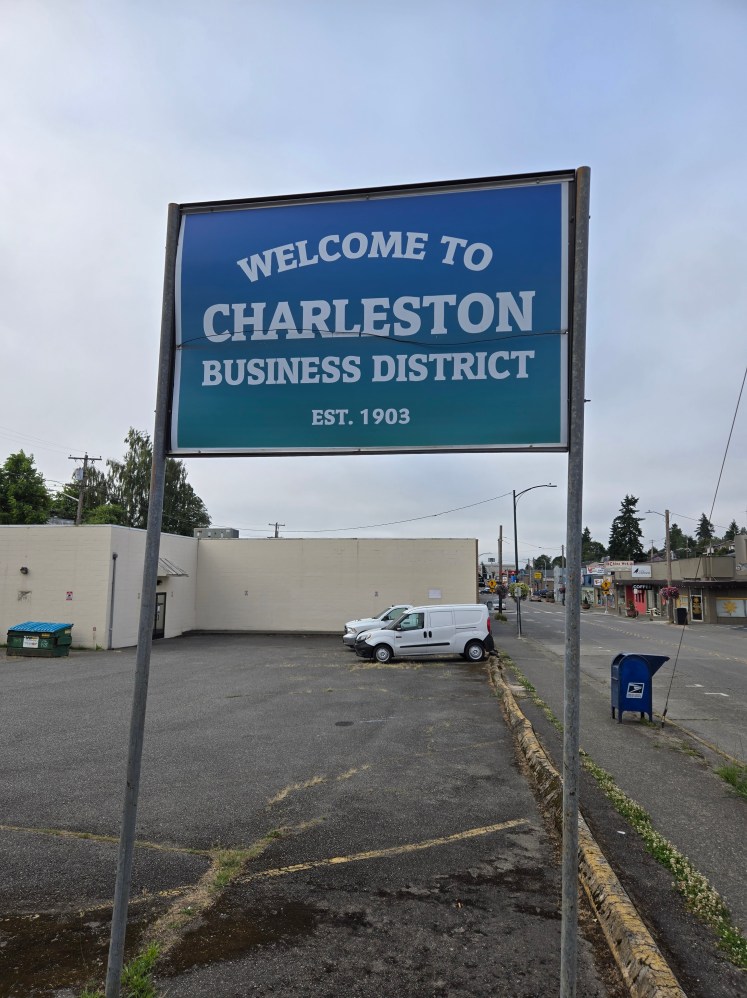
Downtown Charleston in the seventies was a busted smile sort of place. One block would be perfectly reasonable looking, with a run of tidy businesses in it, while the next might contain shuttered shops or ruins being slowly swallowed by the ever flourishing weeds and the grow anywhere trees of heaven. Again, due to the yard, Charleston had been a boomtown during the Second World War, but it was never designed to be the permanent residence of sixty-thousand as the population had swelled from 1942 to 45. After the bomb was dropped the population shrank back down to its prewar level of twenty-thousand and has held it ever since. This emptied plenty of lots and shuttered dozens of shops. Tess and I were frequent explorers of forgotten territories.

I entered a lot located about fifty yards east on Fourth from the one Tess had vanished into. It was late spring, and it had rained earlier for the first time in a couple of weeks, which caused a moldy, earthy smell, sorta like bed bugs, sorta like the odor that often wafted up from the sink-traps in our apartment, no matter how much bleach we poured down the drain. The little trees of heaven and omnipresent Scotch brooms were heavy with moisture and I was careful to avoid snatches of brambles that tried to wrap around my ankles by lifting my feet high as I rushed across the lot aiming for a bluff that lay ahead in a clearing across Fifth Street at the end of the lot. I had already planned on dashing across the street, scramble up the twenty-foot, damn near vertical rise, take the fence at the top and be gone with or without sharing further witticisms. It would be over– there was no easier way up and out that didn’t require a good five minute walk in either direction on Fifth Street.

It’s a myth that you run faster when angry. It takes energy to sustain rage, and the fuel has to come from somewhere. A part of me was disappointed to hear the Jody-Boy (as I thought of him) blundering through the thatch-life behind me, falling further behind. I figured that he might be running out of steam and close to giving up.

I cleared the lot and took the first nineteen feet of the bluff that led to safety, but slipped on the wet switch grass and fell hard just before I was able to take the fence. I slid halfway back and, naturally, that’s when the fucker exited the brush. He had a face like a pig and his work shirt was untucked and appeared to be torn. A weird sort of exhilaration overcame me, so close to being caught.

I laughed, scrambled to my feet but slipped a second time and he was on me.

“Fucking little cunt!” he screamed and pinned my arms down. His face was off the boil and filled with madness and I felt that I could feel what might have been a hardon as he lay against me and moved his piglike face close to mine. God knows what would have happened if Tess hadn’t hit him in the back of the head with her fist.

Over the years I’ve often wondered what the statutes of limitations for a twelve-year-old assaulting an adult. Tess didn’t injure the fuckhead, but I sure the hell did. Her blow took him by surprise and I slipped my left hand out from his greasy grasp and punched him in the throat. Hard. His hands went up like Kennedy’s in the Zapruder film, just before the kill shot. Tess and I were able to push him off of me. I kicked him in the balls and wanted to kill him with a piece of rebar I saw lying in the grass. After a couple of sturdy rebar whacks to his side, the fuck you cunt went out of his attitude and he was blubbering, which made me angrier.

“Fuck you and your fucking boner,” I hissed, fixing to hit him again. Tess grabbed my arm but that wouldn’t have been good enough if Lydia hadn’t yelled for me to stop; she appeared at the top of the bluff, behind the fence. Like out of a dream.

Seeing her clad in denim overalls stunned me. And watching her take the fence with ease and sliding down the bank, landing on her feet was, frankly, a beautiful thing.

She looked me in the eye and calmly placed her hand on the rebar and shook her head no. Tess said we ought to be going. The pig was getting himself together; some people can’t get beat enough. Still, leaving was the best idea.

Music: Chapter Six

The earliest memory I have that can be linked to a known date is the Kennedy assassination, which occurred just after my fourth birthday in 1963. I certainly have what feel to be older visions, of faces and mental snapshots of rooms and such, but nothing verifiable. This means we were too young to have gotten infected with the original strain of Beatlemania. I was two and a half years older than Tess and held only fuzzy memories of their arrival three months after JFK (mainly, I recalled a stupid cartoon show, voiced by pretend Beatles). Save for Mom’s kitchen radio eternally set on “Kountry KAYO,” music was never a big part of our lives until Tess located the Dreampurple beauty in the sixties. It was like her to support a dream that died because it had died, to root through the cold ashes of torched martyrs for moods and glimmers. Tess in all ways was all about the beautiful loser. It made sense that big winners like the Beatles had to break up before she could like them. Still, she once told me that she didn’t trust the Beatles “all the way” until Lennon was killed. I understood.

Albums used to come with cool stuff in them; you’d almost always get a poster from the big acts (Cheech and Chong released one that had a giant rolling paper in it). The White Album came with a montage poster, but I can barely remember it because Tess never fixed it to the wall, for she liked to read the lyrics that were printed on the back, and it eventually went wherever such things go after a time. But I have the four pictures that were also included memorized. Paper reprints of 11 by 8 color headshots of each Beatle. I can close my eyes and see them: Paul needs a shave, John looks unhappy about posing, George conveys a desire to be taken seriously, and Ringo appears to be high on something.

Although Tess was already too human to live long, she was still a ten-year-old girl who did stuff like tack pictures of the Beatles to the wall by her bed. (But, inconsistent with ten, she was smart enough to tape each picture to a piece of cardboard first then tack them up because our basement walls were never completely dry.)

“Kiss your hippy boyfriends night-night yet?”

Har-har-dee har har, Sar-duh.”

We used to have a kiddie record player that Tess had received for Christmas a couple years before. It was actually pretty good for 45’s by silly bubblegum acts such as the Ohio Express, Archies and 1910 Fruitgum Company–but was plain dumb-looking with a serious piece of music on it. Plus the needle had dulled to the sharpness of a carrot stick and the speaker was not much better than that of a clock radio.

We hid the system we’d claimed in the closet until every last scrap Mrs. Roebecker later left in the hall after cleaning out the room had mysteriously vanished. I once saw a time lapse film of what happens to a dead whale on the ocean floor and recalled the Moonlight Moving Company. I noticed that the coffee pot, flashlight and cutlery never saw the hall. I also noticed that the end table I had scooped the change off of debuted in our front room soon after; Mom knew a thing or two about the Moonlight Movers herself. Tess also visited the third floor and brought back the guitar I’d seen earlier.

“You forgot something,” she said.

“I didn’t,” I said. “It’s busted. That’s why nobody wants it.”

“No, it’s not. Just needs strings and a little help with the pegs, that’s all. I’m gonna fix it up and you are going to learn how to play it.”

There was something dreampurple in that statement that didn’t get me to agree, but almost as magically prevented me from getting too bitchy about it. “Sure,” I said. “Then I’ll get a job with Loretta Lynn. Then Hee Haw.”

As it had been evident in her work at Fort O, Tess had a good dose of mechanical intelligence along with her artistic genius. Although what she eventually did with the guitar was a triumph, Tess was almost as impressive in her ability to quickly set up the “Realistic” brand stereo. It worked, well, sort of, but was coated with greasy dust and was rapidly declining the way inexpensive electronics will when neglected. She cleaned it and connived an effective antenna for the radio; she also eliminated a weird buzzing noise from one of the speakers and removed the dials and used a paper clip to clean the gunk that prevented them from working smoothly. The turntable was a mess, and if it had been up to me, it would have been tossed. But Tess took it apart as far as it allowed itself to be taken down and the reassembled device and the damned thing worked as it should–though she could do nothing about the needle other than replace it.

And we’d listen to the radio at night as we lay in bed. Mostly it would be KJR the Top 40 station, but on Friday and Saturday nights we tuned in The Weird Radio on FM. “Calbert of the Night” would play songs that KJR never would. Stuff like “Taxi” by Harry Chapin, early Bowie cuts, Leonard Cohen, and entire sides of albums by people I’d never heard of. Something wonderful was born inside me then. Nostalgia can be a form of spiritual cancer, but I’d certainly give anything I have to hear the music the way I did then. It was then that I understood the world was a big place and contained infinite possibilities, another view somewhat corroded by time.

Mom never said shit about the stereo system or the guitar or anything about the conspicuous amounts of candy or oddball shit we had lifted from stores. There were plenty of things she might have said shit about that got no further than the arch of her brow or a dark gaze. She wasn’t a dummy, of course she knew–probably figured she’d have done the same herself. I sometimes wondered if things might have turned out differently if we had the sort of mother who’d routinely turn our room out like a prison guard while we were in school. But I stopped wondering about it long ago. Some things are hardwired in us to the extent that they must play out a certain way.

Call it destiny.

(Part Seven on Monday. Tomorrow the Drifter will come in from the road and tell you things you ought to know–LA)

Music: Chapter Four

Tess’s birthday landed during the school week, which was, for those with keen appetites for attention and acquisition, a good thing. Teachers would schedule a little party at the end of the day (no child’s birthday was kept secret), and there’d be the usual arrangement of cupcakes and kool aid waiting after the last recess, and a bit of dime store crapola to boot. Sugar often appeared in the classroom, but (not coincidentally) only at the end of the day.

Tess had a pair of distinct and contrary relationships with money throughout life. As a child you could trust her with holding the rent, yet as an adult every cent that wasn’t nailed down (and many that were) went into her veins or up her nose. So it was no surprise that despite all the improvised birthday cards and junk she was carrying that she hadn’t lost the fiver Mom had given her to buy the cake with on our way home from school.

“Hold this,” Tess said, handing me her bag of crap. She then produced the bill she had carefully folded and placed inside one of her socks. Nora’s gift that morning was a Mickey Mouse watch that Tess instantly took great pride in. She consulted the rat and told me she would be back out of the bakery in precisely two and a half minutes. I was not allowed inside anymore due to my tendency to talk back to Mr. Gavin’s countergirl.

Gavin’s Bakery (“Home of the Pink Champagne Cake”) is still in business on North Callow, as it has been since 1957. Of all the businesses in that area of Charleston only Gavin’s and Elmo’s (est. 1948) remain. They are two blocks apart yet the divide was once much wider.

Callow Avenue ran south to north. A block and a half from our building, east to west running Sixth Street bisected Callow and continued up Torqwamni Hill and eventually terminated, as most American things must, at the freeway. Sixth also marked the end of the alley and briefly interrupted Wyckoff, which picked up again as North Wyckoff about a half mile away. There were such places as South Callow and WycKoff, once, but they were only a block long and ended at the shipyard’s south fence and the properties were bought out by the government sometime during the Reagan era in favor of Shipyard expansion.

Sixth also served as a boundary between the wholesome family oriented businesses you’d find on North Callow and the other kind of operations that stood on just plain Callow. On our side of Sixth there was old Elmo, the Graydons (and other food stamp laundering Mom and Pop’s), the state liquor store, various taverns (such as the White Pig), tattoo artists, drug houses, pawn shops and several massage parlors that were not exactly brothels but not exactly massage parlors, either. For years an illegal, yet long running Pan game was constantly on the move from one Callow back room to another; floating card games and craps-shoots were often objects of whack-a-mole police investigations that a few dollars tossed in the right direction affected in a desired manner.

Another thing about Tess was her rotten perception of time. It was just as screwy at any point in her life. If she told you she’d be somewhere at a given time or back in so many minutes it was a certainty that the time or interval mentioned would be the last to happen. Sometimes she’d be very early, but mostly she’d run late, never would she be on time; and sometimes not at all; especially if she smelled something like an intervention on the schedule.

I figured that two and a half minutes was a bold prediction destined for failure, so I went around the side and lit a cigarette. I was already five-ten, thus a casual glance didn’t betray my twelveness or create concern. The funny thing was that the people who did notice me and had something wrong to share usually had a butt going themselves. This blatant Do As I Say Not As I Do circumstance helped fuel my contempt and bad attitude. It was impossible to respect people who said stuff like “Watch your goddamn language.”

I rummaged through the sack and found myself thinking that it was a good thing that the world will always need criminals for the sake of police job security. The first grade spelling-level on the little cards devised by fourth graders (Charleston Elementary was not known as a cradle of tomorrow’s leadership) told me all I needed to know about the up and coming brainpower. And without consulting the name, you could always tell a girl’s handwriting from a boy’s; girls usually attempted cursive while the boys scrawled well enough for a ransom note. There were other things in it, including packs of gum, store bought cards and one of those cheap paddle ball toys I was good at but Tess could never get the hang of. Out of annoyance she’d tell me that I could play it because they were made for left-handers like me–a useless thing to make up some, in a special Ed sort of way, for the location of doorknobs and the way pencil sharpeners were set for righties. Unlike Mom, Tess’s lies had too many moving parts.

An old lady passed by. She was beating a cane on the sidewalk and did not look my way. I thought about how she was like me once, but instead of logically deducing what that said about my future, I got annoyed because I decided that she had let herself get that way by choice. She was heavily bundled even though it was nearly sixty out, yet the hem of her sensible old lady dress was visible below her long coat, and it got me thinking about Lydia the Jehovah’s Witness.

I’d been thinking a lot about Lydia over the past few months. Sometimes I found myself sneaking peeks at her during class. Sometimes I found myself wanting her to like me even though I’d never felt that way about anyone else. I guess this had been going on since the start of the school year and was invigorated by a weird little event that took place the day before the start of Christmas Vacation.

The only thing we knew about Jehovah’s Witnesses was their avoidance of celebrations. They did not observe birthdays or holidays. So whenever there was a little party at the end of the day, Lydia would be “Excused to the library to study quietly” after we’d come in from final recess. I’d seen it happen dozens of times over the years and never thought anything of it until that day.

“Yes, Sarah,” Mrs. Raker said, cautiously, upon noting my raised hand, after she had excused Lydia before the start of our sixth-grade Christmas party.

“How come you teachers always do that?”

“Excuse me, Miss Spahr?”

“How come you always wait till after recess to send Lydia to the library in front of everybody?”

Lydia was coming out of the cloak room with her stuff before heading down the hall to the library. I recall feeling like a cheat of some sort for making sure she heard me.

She was waiting in the hall, knowing that I’d just punched my ticket to the principal’s office, carrying yet another note. I knew the way.

“Thank you,” Lydia said. Then her light eyes darkened. “But I don’t need your help.” And she left me standing there.

Music: Chapter Three

“Happy birthday, molecule.” I said handing Tess the album, on the morning of April 20th, about a week after I’d bought it. I had no trouble hiding things from Tess, for she was extremely short and I was very tall. That situation often came in handy and never changed; she was always at least a head shorter. I’d stashed it on the top shelf in the bedroom closet, in the bag that held the Christmas lights.

As it also goes for basketballs, there’s no need to gift wrap an LP. It’s either that or a calendar.

Tess was almost as amazed by the receipt I’d taped to the album (in case it turned out to be a skipper) as by the present itself.

“You actually bought it?” she said, for Tess often spoke first and thought later. She was in the kitchen, eating her idea of breakfast–Cap’n Crunch with Crunchberries, straight out of the box.

This prompted a dark look from Mom, who was lurking hard by, shrouded by Winston smoke the same way Saturn has rings, but no comment. She was busy getting ready for work. Mom was tired of Welfare and owing Graydon so she got a job at Howell Hardware through Nora. She had been threatening to go to work for a long time. I figured it occurred to her that she may as well because it would hardly cut into her parental duties–like, say, making breakfast. To be fair, I honestly don’t recall ever seeing her eat anything before noon. And to be fairer still, she had actually wrapped the art supplies that were her presents to Tess.

“This is so cool,” Tess said, “Thank you, thank you.” She always said thank you twice when she meant it–once only to be polite.

The main cause of Mom’s lack of appetite was her Winston habit. She was good for three packs per day, and often opened a fourth, and washed them down with black coffee, RC Cola and loganberry wine. I can still see the succession of cigarette purses she owned, and the mere thought of them strikes my atrophied sense of nostalgia. She bought soft packs and removed the tops and would cram one plus a box of Black Diamond matches in the little purse. She also kept her money there. She pulled out a five and handed it to Tess. “I ordered a cake. Pick it up on your way home.” Gavin’s Bakery lay between school and our building; it irked me that Mom always gave the money for things to Tess, never me.

I grabbed the box of cereal from Tess and poured a bowl. Unlike her, I ate mine with milk. I opened the fridge and discovered that there was maybe an inch of milk in the carton. Even though I was the person who’d left it that way, the near empty carton along with the money thing placed me in a pissy mood; whenever that happened I had to fuck with it.

“I hear some mothers bake cakes for their kid’s birthdays,” I said, ostensibly to Tess

Mom would twitch her head the same way that Elsa Lancheseter did in The Bride of Frankenstein when you fucked with it . It was a strange movement so sudden that it appeared to finish before it began.

“Something wrong, Miss?” Mom’s head twitched twice more and she measured me with a gunfighter gaze.

That remark was, of course, expected. It seemed that we had been at war with each other since the time I punched her for trying to spank me at nine–which was about when Mom stopped speaking directly to me unless absolutely necessary. And I would have replied in a manner that suited the situation if not for the pleading look I glimpsed in Tess’s eyes. She always got anxious when Mom and I flared up. But the best I could do was shrug and shake my head no as I began to eat my mostly dry cereal. Mom knew how far “Miss” got under my skin and always leaned into it extra hard, as you might expect from a person who still bore a grudge against her twelve-year-old daughter.

Another twitch: “You sure about that, Miss? I’d hate for there to be something wrong with buying your little sister a birthday cake.”

I hated “something wrong” nearly as much as Miss, and neither as much as when she’d bring someone else into our war. I’m convinced that there are magic words that lead to matricide. And whenever Mom used Miss, something wrong and used anyone handy like a prop, I imagined hurting her, bad. Real bad.

Tess wouldn’t always have the luck of the timely interruption going for her, but Nora’s arrival at that moment wasn’t unexpected. We heard the familiar rumble of an engine out front. Without dropping her gaze, Mom unlocked the door. Nora was close enough to have the right to sort of knock on the door on her way in, which happened instead of a mother-daughter showdown.

“Hey, hey, hey,” she said, “Troy’s gotta stop for gas.” Troy was Nora’s boyfriend, and though not a Speck, he was illiterate, yet had served in the Korean War and worked at the shipyard, even though he could barely sign his name to his paychecks.

Mom dropped her gunfighter gaze and grabbed her coat off the sofa in the living room, and her keys, two packs of Winstons and some more matches off the counter. She drank some then dumped the last of her coffee in the sink and said, “Let’s go.”

“Wait a minute, hon,” Nora said. She ran over and kissed Tess on the check. “Happy birthday, kiddo.” She pulled a small gift wrapped package out of her pocket and handed it to Tess.

“Thank you, thank you,” Tess said. We used to call her Auntie Nora when we were small. But as we got older there was an awkward in between phase between that and just plain Nora, in which we avoided calling her anything.

“Go ahead and open it now, Kid,” Nora said, “I can’t make your party tonight.”

She filched a Crunchberry out of my bowl and popped it in her mouth. “These taste like shit without milk, sister,” Nora said to me with a wink.

I had to smile, unwittingly, or perhaps otherwise, Nora had zapped Mom a bit for me.

Although it can be energized no better than by cliches, I like to remember Nora as she was then, so young and alive. I tried to keep that in my head six years later, when uterine cancer had reduced her to sixty pounds, before killing her at thirty-four. It’s easy to intrude ominous visions that weren’t extant at the time on the past; and yet I recall often experiencing a vague inexplicable sadness about Nora, as I had then, long before she got sick. Probably a trick of the memory, spreading out a pain too big for one time to handle alone.

Music: Chapter Two

I half-seriously considered boosting the copy of the Beatles’ White Album I gave Tess on her tenth birthday. I didn’t care who made it; I didn’t care if it was a double record–Seven bucks for a four-year-old album was bullshit. I figured I could easily outrun the burly young clerk who looked like the only person working in The House of Values crazy enough to give chase. For if I did make the move, it would certainly come to that. Getting away unnoticed with an album was almost as dumb as trying to conceal a basketball under your sweater. But a little voice inside told me that it was bad luck to steal a birthday present when you have the money. So, I wound up buying the goddamn thing, but I did hook a Rocky Road bar at the register so I wouldn’t go away feeling like a complete chump.

Still, I walked home slightly unhappy about the situation. A new Speck had taken over the Elmo drops and he stayed until the dirty old bastard answered the bell. The loss of our source ended the picture business, which was probably for the best because one boy got pinched holding an especially vile group sex thing. If he had squealed the money his parents had laid out for braces would have been wasted. But he kept his mouth shut about us and said he found it lying in the street. It was a miracle we never got busted.

The seven dollars took a big bite out of my half of the savings we had stashed at Fort Oxenfree. But I got over it and planned to inform Tess that a shitty little school art project would no longer cut it come my birthday in November. Ironically, that was around the time in her brief life she’d begun to sketch and paint items that continue to sell for sums unimaginable during the era of Fort O. When she began the transformation from a camera to a prism. It’s a shame that money measures the beauty in things.

Charleston has changed little over the years. Although the House of Values bit it long ago, a Wal Mart sprouted in its lot like an atavistic wart sometime in the nineties. Unless replaced by yet another Shipyard parking garage, when a local business goes under it is replaced by a chainstore version of the same stripe. Except for the taverns. The ones that went under became parking garages. There once was a run of fifteen little dives in a six block radius downtown. Today there are three. All are “Sports Pubs,” which is the sort of shitty deal you get when the corner bar is gentrified out of its soul by hipster doofuses who like to pretend they are European bohemians. Rich fucks slumming.

It was exactly nine blocks from the House of Values to our apartment. Six north, three west. Maybe a ten minute walk. But Tess and I took the distance in far less time because, being kids, we had figured out as direct an A to B diagonal route possible through the yards and alleys. Which is precisely what I did after I’d bought the White Album.

I’ve never learned how to ride a bike. Tess had a bike, well sort of; it was a rusty third-hander, the type of thing you didn’t care if it got stolen. She had won it from the Church for memorizing verses during the Jesus phase. I felt bikes were a waste of time. The hilly topography of Charleston resulted in either a lot of pushing uphill or suicidal plunges down–you couldn’t go two blocks without running into a hill. But I excelled at running, hopping fences and trimming distances, and I had a mail man’s awareness of unfriendly dogs.

“Hey,” a slightly familiar voice called from behind as I cut behind a duplex whose yard was free of dog turds, which was a good sign.

I glanced back and recognized Lydia the Jehovah’s Witness. Her last name was Simmons, but we referred to her as Lydia the Jehovah’s Witness. She was a classmate of mine and the only kid in school my height. Lydia was standing in the doorway on the back porch, slightly obscured in shadows; and although she looked different from what she did at school, it was still clearly Lydia the Jehovah’s Witness. She was a loner. I had known her since second grade and the only time we had anything that resembled a conversation was the previous December–and that went strangely. Not a fight; not much of anything at all, yet enough for Lydia to often be near the surface of my mind.

“I didn’t know you lived here,” I said, slowing, but still in motion. It was April, and although the weather was calm for the moment I could tell that another brief spring tantrum was about to blow in off Philo Bay and I figured I’d better hurry. Yet I felt an odd little hitch in my stomach when I saw her; alien yet at the same time something I almost recognized.

“We just moved in, from up the street,” she said. “My mother doesn’t want people cutting through. She’s going to plant a garden.”

I swiftly took the fence, taking care to not bend the album, and turned to face her. “Oughta go to the pound and get a big ol’ retard of a dog. With rabies, if you can swing it. That’ll keep me out.”

She had followed me to the fence. A thin crooked smile insinuated in her face. She had intelligent pale eyes that did not work as well as they looked. She’d always worn a pair of goony kitty cat glasses, but not at that moment. Along with the specs, you always saw her dressed like an old woman with her nondescript hair tied back in a bun. Everyone figured Lydia looked like that because that’s what the Jehovah’s Witnesses wanted; she had no siblings for us to compare her to, so that was the consensus. She was wearing an old fashioned frock, but her hair was loose and long, and was relaxed enough to reflect brown. It was as though I’d interrupted the removal of her Lydia the Jehovah’s Witness costume, and that a real person lay beneath it all. I even saw a run of hitherto unknown freckles on the bridge of her nose that her glasses normally concealed.

“We have a weenie dog, Roscoe. But he’s sleeping now,” she said quietly, humor in her voice, the little crooked smile holding ready. She shifted her eyes left and right without moving her head, save for a tiniest between you and me nod, “I trained him to go for the Achilles–that’s the back of the heel, if you don’t know. Consider yourself warned.”

I wanted to wisecrack something back, something fancy and smart, up to the standard she was flying at, much higher than what you normally get from girls our age. Then something came to mind at the point I almost gave up. I laughed and said, “You look different without glasses –didn’t know Jehovah’s Witnesses were allowed to have freckles–say hi to Roscoe for me.” And I ran away, clutching Tess’s present close.

I was blushing. I had never blushed before. It felt like coming down with something.