(All images provided by The Drifter)
“She is gone / But she was here / And her presence is still heavy in the air. / Oh what a taste / Of human love / But now she’s gone / And it don’t matter any more.” – Willie Nelson
David Lynch passed away exactly one year ago today as the Drifter writes this (January 16, 2026).
He was a man who combined two strains of the American artistic spirit within himself.
He could create a dreamlike sense of horror within his works that reaches straight back to none other than our wonderful world-genius Edgar Allan Poe.
And he also had another side to his personality that reaches back to our other artistic founding father, Ralph Waldo Emerson.
Emerson was an American Transcendentalist, and Lynch was a Transcendental Meditation teacher who spent the last twenty years of his life directly trying to bring peace to the world more than making movies. There is, except perhaps on the surface, very little difference between Transcendental Meditation and American Transcendentalism. And even on the surface, there is not that much difference.
Lynch was also a Hemingwayesque figure who could write dialogue like Ernest Hemingway. (Roger Ebert was for the most part drastically unfair to Lynch throughout Lynch’s career, but he got this part exactly right.)
And Lynch even looked a bit Hemingwayesque, especially in the film of him where he is painting – we can remember that Hemingway loved painting and always said that Van Gogh and Cezanne were two of his biggest, deepest, and longest-lasting influences, bar none.
David Lynch was born in Montana and lived in Idaho for some of his formative years. Hemingway died in Idaho and spent much time hiking and hunting in Montana.
David Lynch once said, “Big things become smaller when you talk about them – unless you’re a poet.” I could cry for gratitude when I ponder this quote. He meant that words destroy things that can’t be said or that are too big for words, and he also meant that poets have a special place in the human pantheon where they can get closer to the source than anyone else.
He did not consider himself a poet, and he was not a poet, and that’s another thing that makes me love this quote so much. All artists should love all the arts, no matter what their specific focus/es happen to be. They should also become aware (by degrees) of what they both can, and cannot, do. This is a life-long process. Roger Waters said he only discovered that he was able to write prose in his late 70s.
…
The Drifter had forgotten Lynch’s death date somehow when he recently became obsessed with Lynch’s film Mulholland Drive again over the holiday season.
I watched the film end to end at least three times and I watched certain parts of it, like the scene with The Cowboy and Adam Kesher or the scene where Rebekah Del Rio sings Roy Orbison’s “Crying” in Spanish while Betty and Camilla hold each other and weep, dozens of times (not quite literally). Rebekah died last year, just like Lynch, and she died two weeks after singing the song “Llorando” (“Crying”) at a Philosophical Research Society screening of the film.
Many critics have said that Mulholland Drive is the greatest film of the twenty-first century and it is also surely one of the greatest films ever made, even a candidate for THE greatest film ever made. Eternal Sunshine of the Spotless Mind is the only film I can think of that competes with it in the twenty-first century, and even there Mulholland Drive clearly triumphs, as much as I love and adore Eternal Sunshine. (Mulholland Drive is a faultless work of art and Eternal Sunshine is a truly great work of art with many faults to it.)
…
The friendship between Betty and Camilla is much more endearing and powerful than their erotic relationship, even though their erotic relationship is the most realistic and powerful depiction of an erotic relationship I have ever seen on screen. This fact alone makes this film so great there’s almost nothing more to say about it on that level. The paradox of art here bends the mind and changes the heart forever.
The Cowboy is a supernatural character. When angels appear in this mortal sphere, they often do so in a stern, or even a terrifying, guise (see the Bible, which has countless examples of this).
The terrifying homeless man turns into Jesus at the end of the film.
Diane Selwyn exists in ALL OF US.
This movie is about Hollywood, but it is not just about Hollywood. It is about the youth of every person and how youth fades and attitudes and beliefs change as this happens. We either adjust our great expectations, or we die a spiritual death we never recover from.
The crime-of-passion murder in this story is LITERAL in this story; and it is SYMBOLIC in the larger scheme of things (in many, many ways).
When someone breaks your heart and leaves you or forces you to leave them due to their possessive, controlling, jealous, and unhinged behavior, you either kill them off in your mind (NOT literally!) or you die yourself, literally or not. But you think you’ve symbolically killed them off, when you haven’t, really… (Listen to the lyrics of Roy Orbison’s song, “Crying.”)
…
Renee Good reminds me of a David Lynch character like Betty Elms.
Her last known words were, “It’s OK, dude, I’m not mad at you,” spoken with a deeply friendly and smiling sincerity that anyone with half a heart can understand if they’ve seen the video taken by the very man who murdered her seconds later.
I just don’t understand how anyone could have shot this person in the face, right after looking into her face.
She had a beautiful face.
…
We live in a time when the whole system appears to be breaking down. The current president is merely a symptom of that, not a cause, although he is surely hurrying it along, too. (We all need to remain aware, AND stop giving him so much attention.) A healthy society would never have let such a mentally challenged person of obvious bad faith ascend to the position of its “supreme leader” – not in a million years.
No one person is able to change this, or stop it.
There will be light at the end of the tunnel (as there was in Germany).
We don’t know how long the tunnel will be.
…
Drifter Notation Upon the Definition of SARGUN: The word “Sargun” (Sanskrit roots) looks very much like the word “Saragun.”
It’s a literary synchronicity.
If you don’t already know what the word, and name, Sargun means, and even if you do, you should look up the definition. And think about it! (And then think about the literary-synchronicity-connection to the word, and name, Saragun.)

And a repeat of the header for downloads that fail to show it

The Drifter
 Saragun Springs
Hello Drifter
Lynch was fantastic. When the original Twin Peaks came on the air, it became such a wildly talked about thing that the network (ABC, I think) immediately went about messing with it and did not allow him to tell the story his way. They just wanted Laura Palmer and “Cherry pie.” Set in my part of the world, to the north. He got those folks right, lovely and dangerous.
I have never seen Muholland Drive–sometimes they just get past a person. But based on your words I plan to remedy the situation.
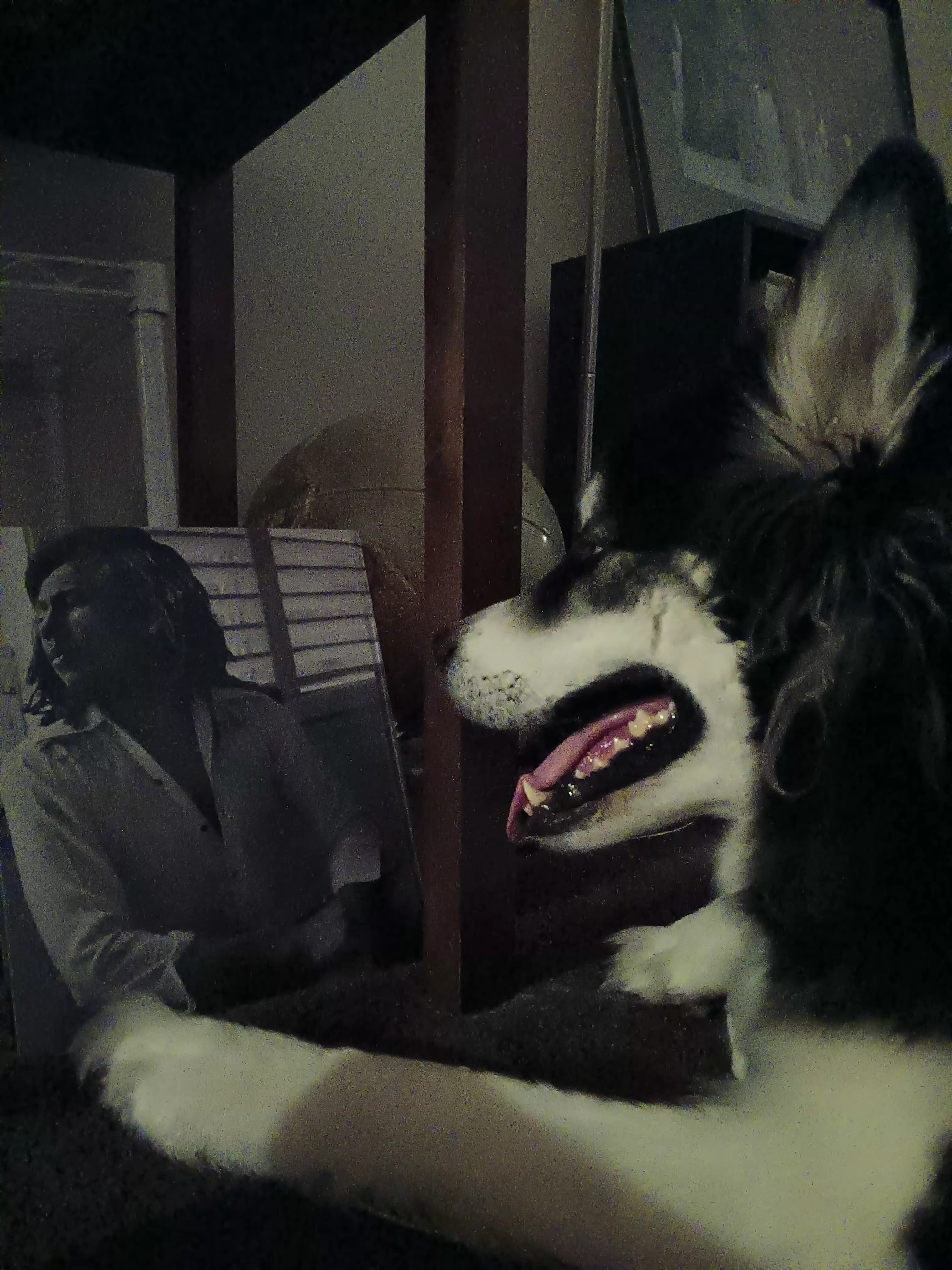
Boo is a genius. He is studying the picture. A less scrupulous human would open a YouTube and play him for money. Another fine Sunday. And congratulations for being the first site post with 500 hits last Sunday. It has happened since and surely will climb higher. I guess I should pay attention to that sort of thing, but I only know about it when WP sends their reports, and then when I actually look at them.
Brilliant again!
Leila
LikeLike
Leila
I haven’t seen all of Lynch’s (10 I think it is) full-length movies either, much less all of his short films. And some of them, like Inland Empire, I have seen parts of, but haven’t made it through the whole thing. MD is definitely worth it, I think it can even be placed beside something like Bergman’s The Seventh Seal (for sure). And yes, Twin Peaks was a great show!
Thanks for letting me know about 500! Great news!
Boo really is studying Bob Marley’s picture (or hanging out with it) – thank you for knowing this! He’s also touching it with his paw. He keeps going back over there and doing it again, too.
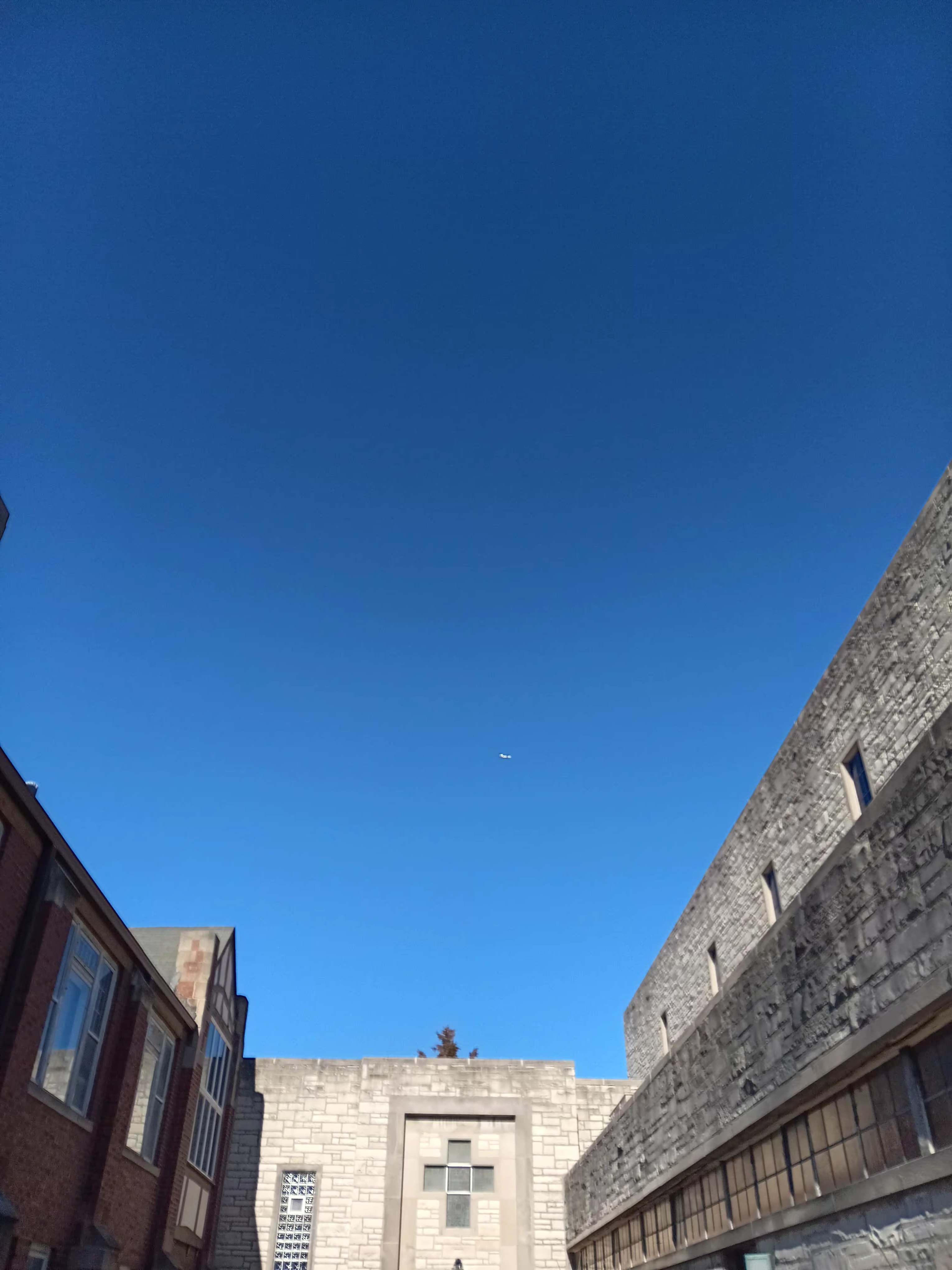
The picture of the church is an old Lutheran church right across from my apartment. I didn’t know there was a small white thing flying above the cross when I took the picture. I only saw that afterward and it gave me a bit of a chill (in a good way).
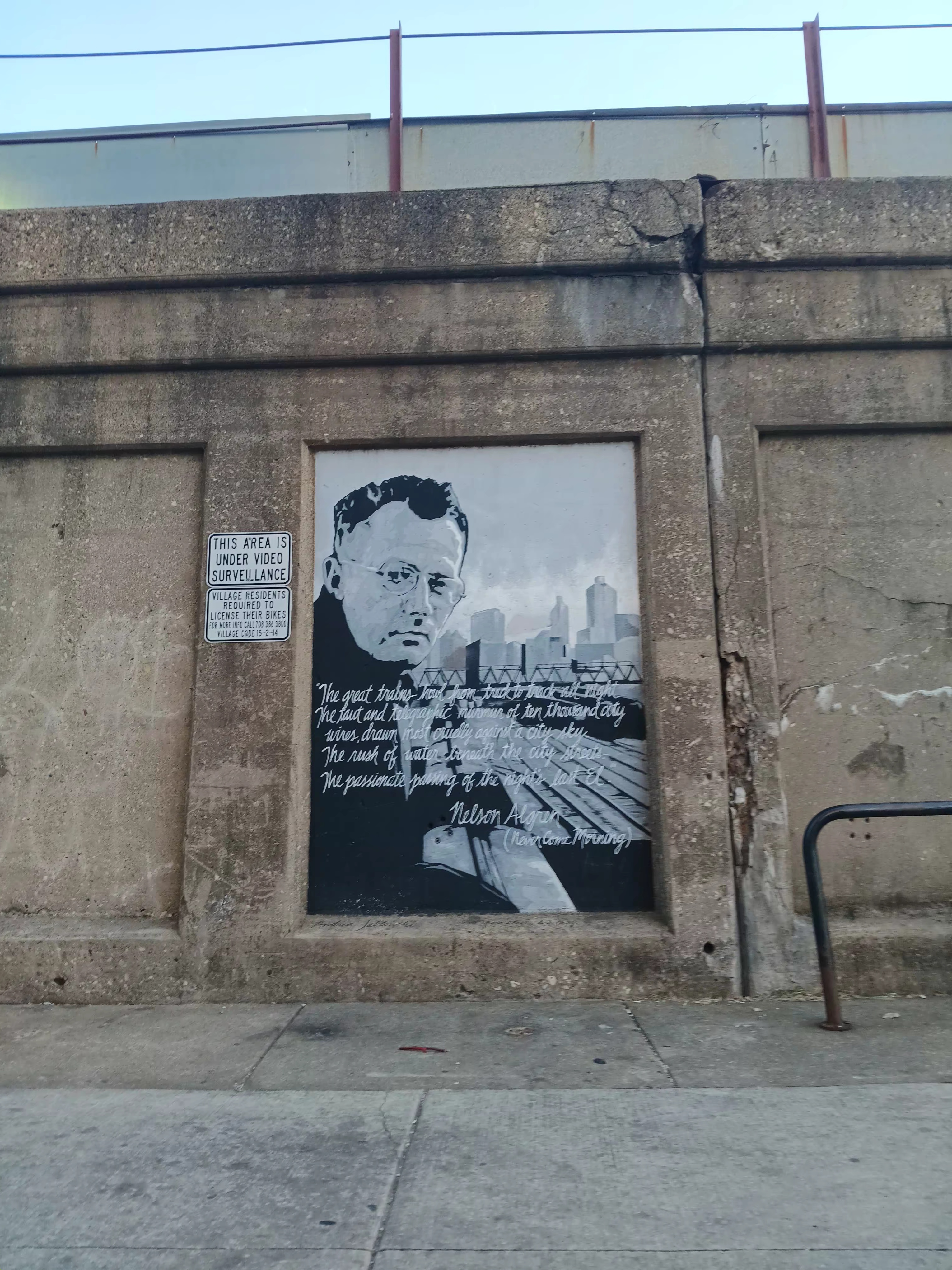
Nelson Algren is the fellow in the train track picture. He is a famous, a very famous, writer, in Chicago and environs. And weirdly almost unknown these days in the rest of the country. But the author of the phrases A Walk on the Wild Side and The Man with the Golden Arm (Lou Reed took the phrase from him). Nelson wrote a lot about street people, like one guy named Shorty who didn’t have any legs. His story collection THE NEON WILDERNESS is one of the greatest. Hemingway thought Nelson was brilliant and great.
Nelson has an essay about going to visit Hem in Cuba. He found the great man lying in bed with the covers up to his chin. When Hemmie saw who it was, he threw off the covers and leapt out of bed, fully dressed.
Thank you!
Dale
LikeLiked by 1 person
Dale,
I’m afraid I haven’t seen Mulholland Drive (indeed, the only Lynch works I’ve seen are a few episodes of Twin Peaks). And it’s fifty-odd years since I read any Emerson essays (back then, I definitely preferred the work of his pal, Thoreau). So I have to confine myself to the very measured and sensible final paragraphs of your piece…
Well said, Dale. We find ourselves living in dangerous times with the looming possibility of military threats as well as economic collapse. Things may get worse before they get better. But they will get better. bw mick
LikeLiked by 1 person
Dear Mick
Thank you for both your realism and your optimism. We are in desperate need of both right now.
I can also add, for the record, that I’m utterly ashamed of the things my country is doing right now.
But I don’t quite feel guilty, because I’ve been preaching against this sort of thing (in the classroom and elsewhere) my entire life.
The thugs and bullies will always be with us, but there will be a day of reckoning too, I do believe.
Dale
PS
The VERY best of Emerson is in his 16-line poem, “BRAHMA.” His most famous phrase is “the shot heard ’round the world”…
LikeLike
Yes, Mulholland Drive (sp). Tried to drive all of it while I lived in LA. It is not a continuous road, but intermittent. That could be part of the story. It was featured in Mulholland Falls (bad cops throw bad guys of the highway down a cliff).
Old age and hating my life has affected my memory, but it seems the name comes from an LA developer, maybe the guy who developed the aqueduct to LA.
mm
LikeLike
Greetings Mirthless
I admire your hard-headed refusal to pretend you enjoy Sunset City when you do not enjoy it. May you continue to have such a bad attitude for many years to come.
Yes, the road is a famous one, and it is a fabulous, not to say an amazing, drive: way up upon the spine of the mountains, Hollywood on one side, the valley on the other. Maybe everyone in America (and even the world) knows it from their dreams b/c it’s been in so many movies.
Drifter
LikeLike
RIP MLK, you deserve your rest as much as anyone ever did.
And shame on you, J. Edgar Hoover and your minions who went around spying on, wire-tapping, and trying to smear his name.
You were odious, creepy people who never did a single thing to keep America safe at any level from anyone. F U 2 for kicking Chaplin out of the country.
D
LikeLiked by 1 person
Well put Drifter
The amazing thing is he would not even be 100 yet. That was a lot of years missed due to murder. I so wish that he and the Kennedys and Lennon did not make themselves such easy targets. Yes faith is one thing–but it does not require people to be reckless with their lives. Even today you can shoot someone if you do not care what happens to you. King was in even more peril, which made no sense because he was non-violent as Jesus. Then again people like James Earl Ray (and his co-conspirators, if any–King family says so) do not operate logically.
Leila
LikeLike
Hi Drifter
Glad I got around to reading this! David Lynch movies to use an over used word are surreal–perhaps redefining the word.
Yes he does seem to be cut from the same cloth as E.A. Poe.
Mulholland Drive was such a bizarre and creepy movie that it sticks in the mind. Naomi Watts was brilliant.
“Lost Highway” is another one, starring Bill Pullman that is beyond disturbing — beautiful in its darkness. The crazy Robert Blake, adds another layer of salaciousness, and Patricia Arquette obliterates the idea of virtue. Watch who you put on the pedestal.
“Twin Peaks” is one that I can never get through the second season. A different director on the second season, unless I’m wrong. The reboot was very strange, too. Probably didn’t give it a chance.
“Blue Velvet,” with D. Hopper is also great! Hopper is monstrous, almost like an actual monster. Like the creep factor you spoke of.
“Being John Malkovich” is a strange one that seems like something Lynch would think of.
Terrific essay!
CJA
LikeLike
Fantastic article! I learned a lot from this.
LikeLike