(All wonderful images provided by Dr. Dale W. Barragar)
By Dr. Dale W. Barrigar
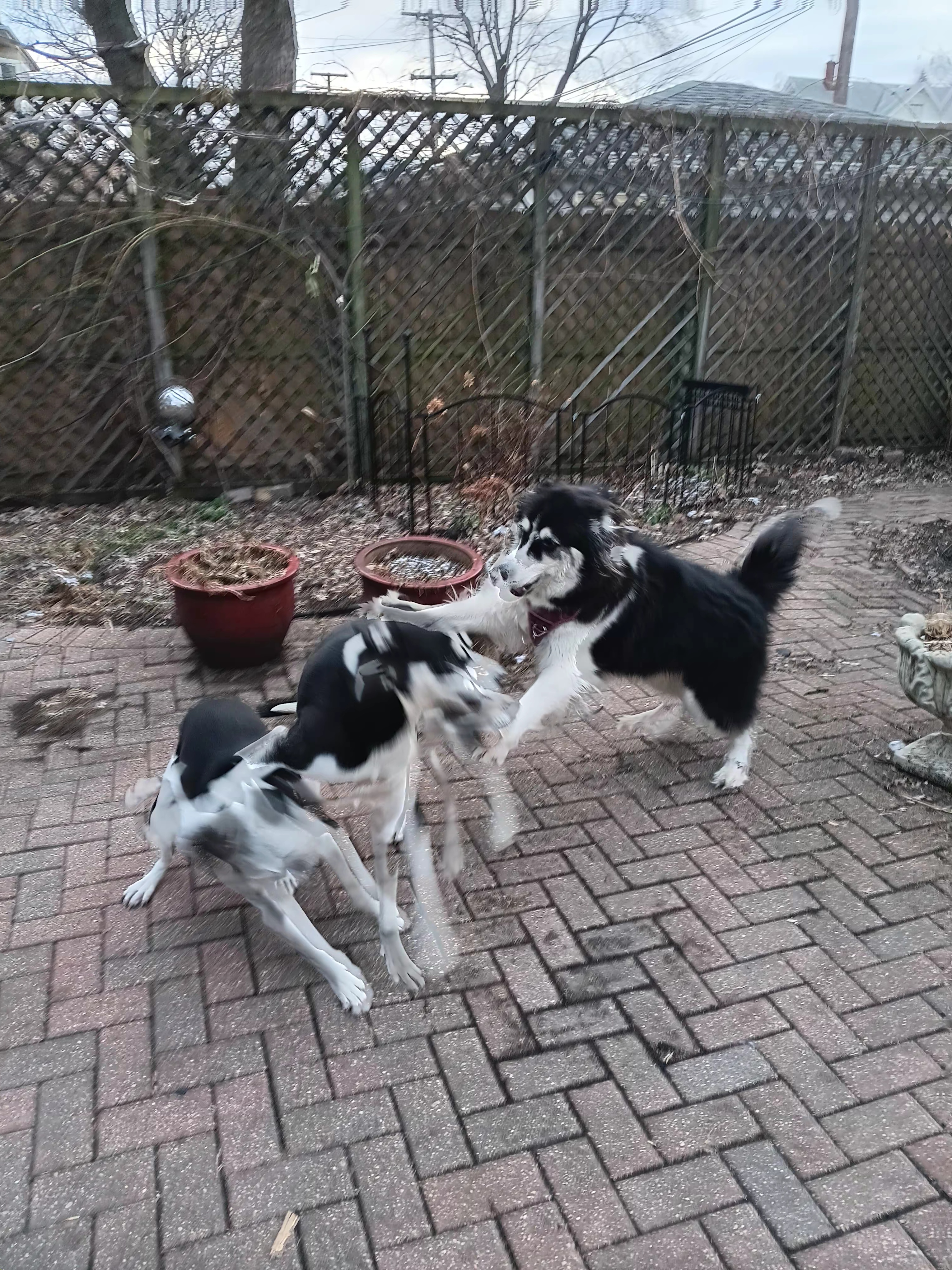
Herman Melville had his whale obsession; Hemingway had his bulls; Faulkner his bear; Jack London his dogs; Flannery O’Connor her peacocks; Poe his raven; Leila Allison has her Daisy Kloverleaf, and I have my dogs, Boo, Bandit, and The Colonel.
(Not that I’m comparing any of us; I’m simply pointing out the similarities.)
I’m aware that many people think I’m crazy because I have three dogs. Those who think this think this for a variety of reasons. All I can say is: maybe I am crazy. My dogs don’t seem to think I am (most of the time, which is the best one can hope for) and in a world like this world (this denatured society), that’s good enough for me.
My mind (not my brain) seems to be made up of one third critical connection-making faculties, one third visionary tendencies, and one third of something I will never be able to fathom, no matter how hard I try.
It’s worth considering what you think your own mind is composed of, if you have one and haven’t already done so. And to remember that it’s as much a part of nature as nature is; it IS nature.
I find great beauty in the motion of animals. It isn’t just Siberian Huskies and pit bulls play-fighting which fascinates me. The running of deer, the flying of birds, the climbing of squirrels, the swimming of octopuses, and any other kind of animal motion you care to name also does it, insects included.
For me, “beauty” means something ephemeral (or seemingly ephemeral) that has something eternal (or seemingly eternal) about it. This is the yin and yang, what Walt Whitman meant when he said, “Do I contradict myself? Very well then, I contradict myself.” (Everything that’s good has a bad version of it, and everything that’s bad has a good version.)
It remains to be seen if there really is any death. If there is, we won’t know it. In that sense, there is no death. Others die, but we do not (until we do). At least half of those who “die” never see it coming. In that sense, can they really be said to have died? One second they were here; the next second not so much. We are tormented by this; but they might be the lucky ones.
Trying to live forever will always be a fool’s game; and how could you ever think this world needs that much of you? Bow your head and move on. (But when it’s time, only when it’s time.)
Nature is the key, but what nature really is cannot be known by us (yet), least of all by what is called “modern science.” Modern science doesn’t deal with the Unseen (or the untestable), and the Unseen is obviously what animates nature.
And meanwhile, the bird still flies, the whales still ply the oceans, and “man’s best friend,” last time I checked, is still just as loyal as she, he or it has ever been. (Whether they put their pronouns in their bios is a matter of extreme indifference to me.)
NOTATION of Importance: Join “The Idiot” who calls himself “The Drifter” tomorrow for a celebration of the genius-turned-saint David Lynch two days after his one-year anniversary of passing from this mortal-coil world.
(The reference to Dostoevsky’s novel THE IDIOT is also an homage to Mr. Lynch, who called Dostoevsky and Kafka two of his favorite authors.
Many people have called The Drifter “an idiot” in the ordinary American sense of the term, for a wide variety of reasons, including (but not limited to) his utter incompetence at many practical tasks which a lot of people find quite easy to accomplish.
He here uses the term in reference to the way Dostoevsky used the term (in Russian) in his wonderful, sporadically beautiful novel, THE IDIOT.
(And there are many who would call him an idiot for doing so (without reading either him or the novel), which is fine).)




Dr. Dale W. Barrigar
 Saragun Springs
Doctor doctor
What a wonderful statement of Life by the Monochrome Pack. And it amazes how they produce a collective yet singular beauty (beauties). Animals live in the moment and do not look back. And I am happy to see that Miss Bandit, a refined lady of a certain age, won’t let herself be pushed around by the boys!
Leila
LikeLike
Sweet Miss Bandit says thank you, Leila!
And part of The Colonel’s greatness is that he can give the almost-supernaturally fast and agile Boo a run for his money, and sometimes outdo him. Both of them can perform physical stunts that truly look preternatural. All the time!
It’s five below (F) here today with the wind chill. Not only does this not bother Colonel and Boo, THEY LIKE IT!!
They lay around outside in the snow eating snow, rolling in snow, playing, lounging, and they do it for hours upon hours, even though it’s sub-zero temps (literally). Incredible.
dr. dr.
LikeLike
A fine essay. Any writing that can combine Kafka, Dostoyevsky, life and death, and above all dogs, can’t be beat in my book.
LikeLiked by 1 person
Thank you, David! Totally agree with you that the canine species is the best. D
LikeLiked by 2 people
Hi Dr. Dale W. Barragar
Wonderful pictures of your dogs! I showed my former wife Carisa the picture of Boo in the snow, and she said he was stunning! Then I showed her your other pictures, how they resemble. She really likes them.
Now I’m intrigued by “The Idiot,” by Dostoevsky I’m not sure if the world at large will take the time to understand “The Drifter,” and other geniuses like Dostoevsky They should, though.Reading seems to be something people don’t want to do unless its on social media.
The way you describe the mystery of nature really got my attention. The hidden quality, that is more and more being spied upon with technology. I have a so-called deer cam, myself.
I like how nature is a great theme in your work.
Humankind is so superior in its egotism. The world misses the creatures it deems lower, and their spectacular gifts of motion that you described. The magic.
Looking forward to your essay tomorrow!
CJA
LikeLike
Hi Christopher!
WOW! Carisa is a really cool name! I have a big thing about names, and I think names say a lot about who the person is, sort of like maybe we were all named BEFORE (not after) we were born (or conceived). (And by that I mean named by Someone Else not our human parents.) Anyway, it sounds like she is your artistic collaborator as well as ex-wife, all of the above of which is really cool! Tell her that me and Boo and The Colonel and Bandit said hi!
THE IDIOT is a great novel, especially the first hundred pages, which is sort of like its own novella, but the whole thing is great, too. It has some really great female characters in it. Dostoevsky’s characters are the best thing about him, he understood human nature (almost) like no one else. None other than Dr. Freud himself said the same thing, as did Dr. Einstein. I’m glad they agree with me!
I was reading the other day about how Einstein used to wander along the gutters picking up cigarette butts and packing the tobacco into his pipe (and then smoking it). He did this before he was famous, and he did it after he was famous, too. Amazing! He also used to go outside without shoes (all the time).
Is it cold there? Current “real feel” temp here = 7 F. More later!
D
LikeLiked by 1 person
Good dogs. Our string of cats has come to an end.
Wasting away in Sunset City. Makes death look less unpleasant.
LikeLike