The Crossed Star of Bethlehem, Chapter Seven: The Inescapable Touch of Sunset

Chapter Seven

The atavistic avatar dropped from space:

“I did it only to see the look on our face.”

1

On his way across the short overpass that unofficially connects Corson Street to Torqwamni Hill, Holly glances down at a small house below. It’s an ugly little fist-like rental that had gone up during the Second World War—as had countless others of its kind in Charleston. Like the caw of a crow or a bit of dandelion fluff getting stuck to your cheek, this house exists only in the moment you share with it. Yet nearly thirty years gone by, the same house had once unclenched and gave Holly a touch of honesty; thus it had it had earned in his mind its own small history.

Although subsequent tenants never draw the sun-yellowed Venetian blind that covers the house’s only large window, Holly knows that the living-room lies behind it. And he recalls a long gone summer night when, half drunk, he had crossed the overpass and saw three obese people (two women, one man) watching TV. All three were sitting in worn-out easy chairs too small for their rotund shapes, and each one had an immense Corning ware bowl of popcorn balanced on his and her lap. There had also been an equally portly little Chihuahua-mix that made successful rounds from bowl to bowl. It was obvious from the strong family resemblance that the oldest woman was the mother and that the other two were brother and sister. All had that flickering dimness of eye-light you see in the faces of people whose intellects hover between that of the “slow” and the mentally disabled (or “retarded,” which, as a proper pronoun, has gone the way of “Negro.”).

Even though Holly had been well-oiled by Happy Hour schooners sucked down at one of the nearby local shitholes, something poignant and everlasting accompanied him from there on. Although these were the type of people he’d lay silent scorn upon while watching them power-waddle toward the bus, this catching a glimpse of how it goes behind their veil had caused him pain. There was nothing sentimental or phony about what he had felt; yet every attempt at putting words to it failed to recreate the emotion. In time he realized that you cannot effectively describe an emotion until the emotion has ceased. It’s a good life lesson; invaluable to a poet.

Holly stops on the sidewalk, re-adjusts his heavy backpack and gazes into the west. Although the pewter clouds are thick and look pregnant with snow, the timer he always carries in his pocket has alerted him to the coming sunset. He always observes sunset even when it’s not visible. Down on Corson Street, the steady hum of Christmas Eve traffic speaks of a world in which the relative motion of the sun is irrelevant. An endless stream of headlights form halos in the frigid gloaming. Gloaming, now there’s a chestnut for you, Holly thinks. Yet within his insolence he knows that all things have souls in spite of their own indifference. This too is a good life lesson; it makes a poetry matter. He turns and moves east. Onward to Bethlehem.

2

Bethlehem Shelby hates Christmas. When the topic comes up, normally well-spoke Beth (who only curses here and there for a little spice) instantly falls into a coarse verbal assault on the subject; for her it is “Fucking-Christmas,” and she is seldom heard to refer to it as anything else—save for “Freaking-, Frigging- or Effing-Christmas” on the rare occasion when the sensitive type is present. No, no one hates Christmas more than Beth; and that goes for you and you and you and the Grinch and Scrooge, as well.

Christmas also happens to be Beth’s birthday. This year she turns fifty-eight. Although she is candid about her age throughout the year, and is not considered particularly vain by those few who know her, she refers to this circumstance as “That Goddam-Fucking-Christmas-Birthday.” Here, no euphemisms are substituted for the profanities; and if you happen to be the sensitive type, well, that’s just how it goes.

Although crass commercialization and the way goddam “Black Friday” won’t stop getting bigger until it is held on December, 26th annoy the holy hell out of Beth, it’s the memory of her widowed, working-class mother, Harry, skipping lunches and in all ways scrimping on herself from September on to make sure Beth got presents under the tree and something “special” for her birthday that had begun this hate. She also remembers crying into her pillow for only God knows for how long when, at thirteen, she had been informed of this situation by Harry’s best friend Fran, after Beth had launched into Harry the way thirteen-year-old girls will do—even those who have an IQ of 160 and are already working on their Masters in Mathematics. Although Beth is considered a decent human being, the only two things she hates more than Christmas are crying and feeling guilty. And not at all helping matters is the way her Holly knows about this serious business, yet continues to find her attitude toward the holidays as funny as the actions of that fierce and murderous little bunny in Python’s Search for the Holy Grail. Never a year passes without this little joke going up like a fucking-Christmas stocking.

Currently more peeved with Holly for again being late for their trip to the hospice than she is with the Season, Beth stands at the window and gazes out. The sun has just gone down and she knows that Holly is observing the event as though he were a goddam Inca priest. The silver sky has taken on a pinkish hue, which is indicative of snow. Beth lights a cigarette. Snow for fucking-Christmas, she thinks. Doesn’t God know He’s dead?

3

There are few clocks and calendars to be found in the rooms at the Catholic Hospice of Charleston. Nor is there a division of day and night that isn’t controlled by a switch. This matters little to the residents, for the mindless exist in a state of absolute now that requires no measurement, and the thinking dead live almost entirely in the past.

Fran is as exceptionally strong as a hospice patient can get. She is also a favorite of the nuns and the staff because she had once been an ER nurse who had later worked in geriatrics. She still thinks and speaks coherently and has yet to degrade to the point where soiling the bed doesn’t bother her. Of all the things she has lost or is losing the ability to do, Fran has steadfastly held onto using the toilet. Every time this goes her way, she prays extra hard for death to come, as to let her go out with this much dignity intact.

Fran should be dead by now. She has outlasted her original “expiration date” by two years since her original cancer diagnosis, yet nothing about this survival has had anything to do with advances in medicine. God’s will, she thinks without irony. She had insisted on leaving Beth’s house for the hospice on the Monday after Thanksgiving; she had figured that it would “be a short drive to Heaven from there”; but nearly a month has gone by, in which time Fran has heard the bell toll in the courtyard seven times. Donne was right: you must hear the chimes as your own, as others must accept yours as theirs.

A lifelong, progressive Catholic, Fran often sends God ironic prayers, but no matter what horrors befall her and the world, she has kept her faith as diligently as she has held her toilet. Perhaps a bit slack with the Sunday attendance during baseball season, Fran has never missed Christmas Mass, and this year has been no different. Although it is only Christmas Eve, time is a precious commodity at the hospice. Mass is held in the chapel on the hour every hour, and will be through tomorrow. It’s brought to the beds of those too fragile to be moved.

There are few private rooms that have windows in the hospice. But, in life (and, yes, in death and the church), if you’ve got the money you can die in a private room that has a window. Fran is seated in the expensive rocking chair that wealthy Beth (who had also “bought” the room) had given her as an early Christmas present (nearly all Christmas presents are of the “early” variety at the hospice). She is fully dressed and is wearing shoes for what she knows will be the last time in her life. She doesn’t want Bethlehem or Holly to find her lying in bed when they come by tonight, even though she’d very much would like to lie down. She looks out the window, which faces west. She spies a snow flurry spiraling down from the aluminum sky in the weak light of the winter sunset. Snow for Christmas.

4

Christmas 1958

Behold Harriet Shelby lying in her hospital bed. Harry’s a big-eyed pretty little thing who looks remarkably fresh for someone who had given birth to a daughter just two hours ago. She’s gazing out the window as the first flakes of snow drift down from the oddly back-lit salmon-colored sky. Snow for Christmas, she thinks. God lives.

Harry loves Christmas and snow, and this time both are a thousand times better than ever because she is seeing things through the recently discovered filter of morphine. At twenty, Harry has never had anything stronger than an aspirin. Just a little splash in a needle changes things so.

An equally young, extremely tall and wholesome young woman wearing a candy striper uniform appears in the doorway. She is carrying an almost comically large black purse, and she makes a great show of looking left, right, down and up before entering the room.

“Jesus H.,” Harry says. “Who the hell are you looking for, Frances—Santa?”

“You know goddam well who,” Fran says on her way over to the bed. “If Bull Nurse catches me giving you this stuff, I’ll be on bedpan duty till Valentine’s Day.”

“I didn’t know that nurses and stripers did that sort of thing,” Harry says with a highly affected shudder as she snatches her purse from Fran.

“Who do you think does it, Harriet, the Bed Pan Fairy?”

“Why yes,” Harry says, “I do think that—Oh, did you see Dan and the horde on their way out?”

“Hardly anyone else in this part of the joint—you’re the only mother in the entire ward,” Fran replies. “Your folks look elated, Dan seems sort of dazed…I suppose it won’t matter if I tell you there’s no smoking in bed?”

“Nope,” Harry says as she fetches her Winstons and a box of Red Devil matches out of her purse. Fran pulls the ashtray out of the bottom drawer of the nightstand. Harry brings a match off the stand’s top and takes a heavy drag off her cigarette. Fran suddenly breaks out a first magnitude smile.

“What’s the gag, Frannie?”

“Oh nothing,” Fran says as she motions Harry to lean forward. Fran sits down on the bed behind her closest friend and she begins to weave Harry’s long dark hair into a French braid. “I was just thinking about you having to change loaded diapers for the next eighteen months or so. It makes me feel good inside to think that Harry, real good—Holy shit! When did it start snowing?”

“Just now,” Harry says. “I really oughtn’t be giving you this,” she adds as she fishes a small gift-wrapped box from out of her purse. “Not with that wisecrack and all this volunteering at the hospital and reading to old people and all the other selfless Christly stuff you do. You make me look real bad, Saint Frances, when you do that sort of thing. We both know I was selfish, but really, was there a reason to put it out there in neon?”

Fran opens the package. It’s a charm bracelet. Somewhere deep inside, Fran knew that this was coming. Upon the passing of their mutual friend, Elsbeth Allison, that spring, only days after Harry’s death, Ellie’s granddaughter had told the tale of how her grandmother had been visited by Harry’s ghost in her final dreams and that there had been a charm bracelet involved.

Current day Fran stirs in her rocker. Her faith allows her to believe in such visions. She lets the happy dream go on without question.

5

Neither Beth nor Holly drive. Beth has never learned how, and Holly gave it up after he no longer could convince himself not to get behind the wheel while drunk (oddly, he never had an accident nor had he ever been cited for anything other than driving on expired license tabs). Beth’s inability is a longer story; boiled down it involves some kind of hitch in her powerful mind that doesn’t allow a “by the seat of the pants” sort of thinking to usurp what should be a mechanical process only. She does better in the abstract than she’d ever do merging on the highway.

They rely on cabs. Beth is such a fine and well-paying customer of Burl’s Taxi that she never has to wait longer than fifteen minutes for a hack, even on Christmas Eve in what is becoming a driving snow storm.

For a while they ride together in the backseat, in silence. The cabbies know Beth to be friendly, but not overly conversational. The only sounds are that of the car’s wipers and fucking-Christmas music on the radio.

“How was the sunset?” Beth asks, finally ending the Silent Treatment she had laid on Holly after he had arrived nearly forty-five minutes late. “Do we need to stop for a sack of goat blood, Inca priest?”

“They don’t keep time at the hospice, Bethlehem,” he replies. “As Harry would have said, ‘that’s awfully barn door after the cows.’” Holly winces. He usually doesn’t regret flipping Beth shit; it’s what they do—give and take. But regardless of Beth’s disdain for the holidays, this is the first Christmas she has spent without Harry and Fran and sometimes Ellie coming over to the house and getting squishy on wine while watching It’s a Wonderful Life. He almost apologizes, but he squeezes her hand instead.

“Will it be tonight?” Beth says with the purr she speaks in only when talking to herself or Holly.

Holly doesn’t answer the question directly, but Beth knows he soon will. She never looks too hard at it, but under certain circumstances had during the better than the fifty years they have known each other, Holly often sees the future.

“Ellie Allison once told me that ‘A life is the gift you get after the dream has died,’” Beth purrs. “I never knew what she meant by that until this year. You know how she’d get all philosophical around her third loganberry flip. I just thought it was another bit of drunken horseshit; but I know better now. “

“You’ve always known,” Holly says. “I recall that flick in which Marlene Dietrich told Orson Welles that he had no future—‘it’s all used up.’ But that doesn’t go for us just yet, Bethlehem. Come spring we’ve got a tree to plant and a grave to rob.”

She smiles and asks the cabbie if she may light a cigarette. It’s against the law, but he doesn’t mind.

“And the question remains,” Beth says as she brings a match off her thumbnail.

“Yes,” Holly says with a sigh. “It will happen tonight.”
The Crossed Star of Bethlehem, Chapter Six: A Hundred-year-old Man

Chapter Six

Sighs, echoing laughter, and half-remembered faces that belong to all-forgotten names gather in the pooling shadows of Corson Street; the ghosts gaze at Holly More as he walks alone in search of a hundred-year-old man. No matter how much money Charleston pours into the “revitalization” of the Corson district, its ghosts remain stubborn and continue to luxuriate in the riches of the poverty into which they had been born, thus lived, and brought home from their graves.

An ageless weeping-willow—gnarled and endowed with a sleepy wisdom by the salty winds that constantly assail it off Philo Bay—has changed little since Holly was a boy. Although Holly knows nothing of its origin, he is certain that the willow is an unplanned tree, whose critical seed blew in from the bay and took hold in the soil—so determined to live, that not even two nearby house fires or three major earthquakes could dissuade its fractal-reach into the sky. Nowadays the willow’s neighbors include a dealer in silk flowers and a tidy, albeit anal-retentive, mortician.

A verse takes shape in Holly’s mind:

From not weepy willow contrive my wreath;

Lay plastic greens and berries on thine door.

Show your sentimental, shallow-most grief;

Never display love extant beyond before.

“Eleven notes on the last,” Holly whispers. Eleven is an unlucky number. It seldom carries its own weight.

A young couple exits a retro-clothing shop. They are wholesome and attractive and move easily in the light gravity of youth. Their radiance is bulletproof, and is even enhanced by the raw October weather.

As brown is to orange, fresh faces are to cable-knit. Holly sighs. There might have been something in that line, but it’s already gone.

“I still hate the way that debate went last night,” the man said to the woman. “All that yelling. And we’re supposed to give one of them Lincoln’s old job?”

The young woman smiles sweetly, too briefly, at Holly, when the couple passes him by. “Right?” he hears her say. “It was all ‘You’re the antichrist!’ and ‘Oh yeah? Well, you’re the bigger, scarier antichrist!’”

They can take turns being the antichrist, Holly thinks. If you’ve seen one candidate debate, pretty lady, you’ve seen them all. Maybe what we need is a good old fashioned dictator, like Stalin—that way everyone will know who the antichrist is without guesswork.

The mournful, ululate warning bell of an unseen shipyard tram interrupts his thoughts. Holly pauses on the sidewalk and absently draws his jacket collar up to his chin. He has heard this sound all his life, and he always associates it with Beth, Harry and Saint Frances; three faces too near to his heart to ever be seen as ghosts.

Charleston wouldn’t exist without the Puget Sound Naval Shipyard. “Green” peace-and-love-types often spy irony in a hand of the American killing machine causing life to flourish; but that sort of thing doesn’t hold up well when you consider what Darwin had to say on the subject.

Alas, big items such as war and peace do not interest Holly. He’d rather have the latter, but he thinks that a serious alteration in the natural ways of humankind will have to happen before the former becomes unnecessary.

Want Ad:

Wholesome hippies seek geek antichrist;

The meek need not apply.

EOE

(Unless you are meek)

Holly likes this, except for the twenty-five notes. Twenty-five is unlucky. It stacks like money.

As a poet, Holly More is constantly on the lookout for an honest hundred-year -old man. He must be honest unto himself only. He must be clear and complete and yet neither relate nor compare to no other being or memory, even in paradox.

Holly’s lifelong friend, Bethlehem, knows about this quest. When they were children on Corson Street during the sixties and seventies, the hundred-year-old man was their by-word for interesting situations and objects one or the other had discovered in the alley that ran between Corson and Wycoff Avenue. On the Wycoff side of the alley stood a row of large turn-of-the-century houses that had been divided into apartments for the poor and working-class. Holly and his troubled mother had lived on the top floor of one of the tenements, while Beth and her fun-loving, widowed mother, “Harry,” had rented rooms in the basement. With Harry, you always got Saint Frances.

The alley still runs along between Corson and Wycoff—and although the old houses had succumbed to the wrecking ball twenty years back, the unreachable poor and those who live from paycheck to paycheck still inhabit the Wycoff side. But nowadays they do so in a monotonous row of low-income duplexes. It’s the same old story: plastic sheathed windows, shoes flung up over the lines, ignorant wanna-bee gangstas on the make, and unplanned kids everywhere.

Although Corson Street begins near the foot of Torqwamni Hill, follows the curve of Philo Bay, and eventually merges with the highway that leads out of Charleston, for Holly and Beth it actually began at The Temple of the Dow Lady Emporium and ended at the White Pig Tavern. In between lay Elmo’s Adult Books; Clarke’s Drugs; various dives; two or three Mom and Pop’s; possibly the only Masonic Temple on earth made entirely out of wood; a busy pawnbroker, and the A&P—at which Holly’s mother often got her cigarettes on the strength of a note she’d send along with her son. Not surprisingly to Holly, the Dow, Pig, Charleston Loans, and Elmo’s continue to do business to this day. These places, along with the alley, are the heaviest with ghosts.

Holly cuts through a vacant lot choked with grabby, feral blackberry brambles and hibernating Scotch broom to access the alley. He recalls how the hundred-year-old man got started in 1967:

“Wanna see a hunnert-year-old man?” Holly says.

Beth rolls her incredibly large kewpie-doll eyes and says, “Don’t talk like PWT.” At eight, Beth is a year older than Holly, and she’s already doing high school course work because her IQ shook out close to that of Tesla. She considers it her duty to keep her “boyfriend” from speaking like a poor white trash brush picker.

“Awright, then say ‘Mother may I’ and spell cup.” Holly has recently learned this witticism in second grade. He uses it plenty.

Beth shakes her head. Some things are just plain hopeless.

According to Beth, the only trouble with the hundred-year-old man was that there was one. Almost certainly in his eighties, he was knowingly referred to as “the Jew” by the landlady, Mrs. Wells: “Come Monday they squeeze every dime ‘til Liberty screams—it’s their christless way of doin’ business.”

Unlike everyone else, Holly found the hundred-year-old man interesting to observe. The fellow had a huge hook-nose, a corona of wispy white hair that splayed out from beneath a red beret, and was as hunched over as a fairy tale wizard. He’d beat about a cane with one hand and carried a perfectly filthy shopping bag in the other—and no matter how warm the day, he was never seen in any less than three sweaters. Looking back, the unlucky sneer that Mrs. Wells had laid in Jew depresses Holly. Although she could be quick with “Jew,” “colored” or “dago,” she had also been a kind woman who had never turned anyone out on account of what they were—except for hippies—Mrs. Wells had hell’s own fury toward hippies; she had lost a brother on Omaha Beach.

Although Beth had been unimpressed by Holly’s discovery, the phrase “hundred-year-old man” (in reference to an interesting discovery) somehow stuck to the kids’ private idiom and has remained active for half a century. During the sixties, hundred-year-old men would turn up everywhere in the alley. Once, it was a dead cat that the kids did their best to bury in the stony, switch-grass root-infested soil of the lot behind Elmo’s. At the “funeral,” Holly read something from the Bible that he had gotten from the lady who ran Good News—for quoting Holy Scripture seemed like the thing to do. Another time they stood in the shadows mystified by the sight of an obviously drunken young woman dancing with an imaginary partner at her window. Her blouse and bra had been equally imaginary. For months afterward Holly’s eyes would suddenly glaze over with memory, and Beth would goddam well know that he was thinking about “boobies.”

She seldom steps her best,

‘til she’s got it off her chest.

“That’s not good enough to be dirty,” Holly mutters. Then he spies a lost ghost wandering from shadow to shadow. It’s bad luck to be afraid of a ghost. Nor is it polite to stare. The thing to do is jump the first solid, unrelated thought that seeing the ghost summons in your mind—the one that comes right after, “Jesus, Christ, I think I see a ghost,” that is. It’s what lost ghosts do best; they resurrect misplaced hundred-year-old men.

Holly tags along with the ghost (yet he keeps a respectful distance) on its way up the alley toward the White Pig Tavern. Who are you? A junkie who nodded -off one time too many behind the Pig? A raincoat boy oozing his way out Elmo’s backdoor before heading home to be the man of the house—a bed-stain your wife didn’t understand? Did you catch the free peep-show the dancing lady starred in? Holly doesn’t worry about offending the ghost with his thoughts, for even lost ghosts know only the truth.

It doesn’t matter to Holly that the ghost is his own moving reflection passing across broken windows and over the surfaces of mud puddles. Nor is this to be considered madness. If anything, Holly is too well tuned to reality; to the degree that he must constantly escape it to protect his soul. Alcohol used to provide a safe haven, but it had turned on him as any self-respecting demon must. It had become evident within the bleak passages that had lain between debaucheries that he had stopped pulling his own weight, and thus had become unlucky. Even though Beth is wealthy and has yet to wholly drop the fantasy of a patron/artist relationship, Holly knew that he was a kept man mostly owing to Beth’s loyalty and inability to turn her back on a loved one. Holly quit drinking a couple of years back, and he now has a job—well, sort of. He’s the night custodian at the Temple of the Dow Lady, which is about the best a fifty-six-year-old notorious town drunk, womanizer, ex-actor, and fifty-cent poet—who does things such as not speaking on Thursdays because he’s got it in his head that Thursday is the day of the week in which people who talk too much talk most—can hope for.

The lost ghost sees both home and a hundred-year-old man. It follows a trail of shattered glass to a rise of cracked stone steps that lead to an elevated, weedy vacant lot. Holly climbs the steps and stops on the third. Three is a hit or miss number; you can never tell what it is up to.

Peter prayed to Jesus:

“Lord, I meant no harm;

For I got it straight from Judas,

‘Third time’s the charm.’”

Beth has a stunning memory. Although genius cannot be taught, she believes that there are certain doorways in the mind that anybody may enter and recover the past with clarity. “It all exists as it had been,” she has said time after time. “The brain’s like cloud storage. And I’m willing to wager that even your pickled egg of a temporal lobe still contains something—although I’m fairly certain that your overall brain is now as smooth and hard and small as a shoehorn. You shouldn’t have drunk away your crinkles, Sir Hollyhock—they’re what cause us to think.”

Whatever.

Although Holly knows that he is as likely to recreate the past the way Beth sees it as he is to begin thinking in logarithms, he does have his own genius for the recollection of emotional memory. Beth can take him back to a long gone afternoon and describe details down to the tilt of a miss-pulled window shade, and he believes her. (That’s the thing about dear Bethlehem—she cannot tell a lie because she has never needed to learn how to do so.) But he has a knack for sniffing his way back through time, following the long trail left behind by a certain feeling all the way back to that feeling’s lucky moment. He had awoken this afternoon with a quality that is best described as earned trust nibbling at his thoughts. Instinctively, he went to Corson Street and the alley to find the moment when the feeling had been pure. And in his jumping from here-to-there, then-back-here-after-another-there thinking process, he examines this hundred-year-old man.

This is an important third step. Mom died on this step—not on the sofa where I had found her; she finally passed in my mind and heart when Beth, Harry and Saint Frances spoke the truth to me until it stuck for keeps. It’s a hell of a thing to look into a face that knows that nobody gives a damn anymore. You see it in stray cats, mostly. And in the eyes of mothers who’d rather be dead than hear the voices any longer. Do demons still have plenty to say after the host has died? Maybe they linger and hoot on the lawn in the predawn darkness like party-goers who can’t quite get it through their heads that the host is dead.

Then the hundred-year-old man comes to Holly, as he knew it would. It’s a dirty trick to play on a memory, this pretending to be lost in unfocused dreams, all the while casting a line along the periphery for what is actually being sought. If you want to attract a squirrel, feed a crow.

Although his mother’s death when he was sixteen is something Holly thinks about at least ten times a day, it, as it goes with his thoughts on war and peace, is too vast to be made sense of. It’s the little things that live large, they build up unto themselves and, in time, compare to nothing, not even in the context of paradox. And when the timid yet persistent small image comes to his head, his deeply furrowed brow smoothens and he turns to face Holman House even though all there really is to see is an apathetic, slouchy cottonwood, which clings to the last of its leaves like that tree outside the sick window in the O. Henry story. Even though the image is clear in meaning, Holly’s imagination fills in the details:

“You’re old enough to do this for a lady without being told how,” Fran says holding out a delicate gold chain that holds a crucifix. Fran and Harry are busy getting ready to go out for the evening. The process is a religious rite of sorts, and takes no less than two hours to perform.

Harry glances up from a small mirror, which she only uses to add mascara to her already long lashes and gazes at Holly, a playful grin darts along her lips. “How old are you, kid?” she asks.

“Seven.”

“A year younger than me,” Beth chimes in. “Just like Pooh-bear and Christopher Robin.”

“I dunno, Frannie,” Harry says, still grinning. ”That boy looks like a born boob-snoop if I’ve ever seen one.”

Holly and Beth exchange knowing glances.

“Just because you date goose-necked guys doesn’t mean that I suffer from the same weakness, Harriet,” Fran says. “Come here, my little gentleman. Once you’ve mastered this skill, the ladies will crumble at your feet.”

“They’ll do it faster if you drop a twenty dollar bill,” says Harry.

“Never mind her,” Fran says. She hands Holly the necklace and sits in a kitchen chair. Then she holds her long blond hair up and aside to expose the back of her neck to him. “Loop it under my chin and fasten the clasp; don’t let your eyes wander over and down.”

“’Over and down,’” Holly says. Even at seven, he had known what that had meant. He has sympathy for men who had grown up in histories written by men. Holly met his father just once. It had been at a bar, and the only thing he took from that meeting was the desire not to repeat it. That set up had been awkward as hell; it was as much a hundred-year old man as ordering a pizza. Not surprisingly, the women in his life had no hand in arranging that terrible little comedy.

The mournful ululate wail of the still unseen shipyard tram reaches his thoughts once more. And the spell is broken, and the lot and the stairs become what they have been for decades, ruins given over to bramble and broom and neglect.

No verse comes from the memory; nothing will do, and any attempt would be unlucky. Holly almost pushes for such anyway, for he thinks that a posy ought to be tossed at this grave. But he finally thinks better of it. It would be the same as sneaking a peek over and down.

The Crossed Star of Bethlehem, Chapter Five: Time and Chance Happenneth to All Gods

Chapter Five

Holly spots a lucky omen far downhill: every backlit tree in a row of poplars along a stretch of the Port Washington Narrows is clasped like hands in prayer, except one. A single, stunted, sloppily unfurled poplar, unloved in shadows, holds the luck. It watches out for the others; it allows them to be confidently pretty by giving the eye something less to compare them to. “Unpoplar,” as Ogden Nash might’ve put it.

The golf course trees, however, don’t say much of anything to Holly. Coddled elms and hand-fattened maples protected against the harsh November winds that howl down the Narrows like steamed souls passing through cracks in hell, have little in the way of luck. They might as well be painted onto the surface of the eye. Stage prop trees.

“Are you ever going to hit the goddam ball?” Beth calls out. She had purposely sent her turn into the bunker because, well, just because.

“It could a cerebral hemorrhage,” says Fran, who is sitting in a golf-cart and smoking a joint. “He looks like a froze-up rock lizard.”

Beth concentrates her large and expressive eyes on Fran. “I hope the oxygen’s off while you do that,” she says. “I’d hate to explain two corpses to the cops.”

Fran pats the canister that lies beside her like a little dog that has gone to sleep. “’No worries,’ as everyone who ought to be worried most says nowadays,” Fran says. “Who better to trust with combustibles than a stoned old lady?”

“Tell me, Bethlehem,” Holly says, “why do your shots always end up in the worst possible places?” He then kicks the ball and a considerable amount of sand onto the fairway.

“Because you didn’t think of it first, reptile,” Beth says. She brings a match off her left boot-heel and lights a cigarette. “Consider it unlucky.”

The idea for golf had been concocted that morning in the nicotine and THC miasma of Beth’s house (where Fran now stays). Holly, a non-smoker, had once again observed that the atmosphere in the living room resembled what the air must be like on Neptune. “All right, Your Anus,” Beth had said, “maybe we ought to take Frannie out for some fresh air.” Upon hearing this exchange, Fran said, “Let’s go golfing. I want one last chance at beating the fourth green at Tor-Hill.”

Holly is fifty-six, Beth a year older. Even though both are plenty young, neither one have set foot on a golf course before today. Until a year ago, and even in her late seventies, Fran could have easily wiped the Torqwamni Hill Tribal Golf Course with her “students.” She was as fine an athlete as the city of Charleston has ever produced, but cancer has steadily robbed her of her physical grace. The oxygen canister became necessary a month ago; and, perhaps more telling, Fran’s dependence on morphine is no longer a concern to her physician. She’s allowed to take her pills “as needed,” and her refills are no longer the subject of dispute. “It’s a part of the process,” Fran, a former nurse whose mind remains as keen as ever, had recently said to Beth. “They watch you until it no longer matters to the law. Oh, I know how cold it sounds—but you should remember that an oncologist’s calendar is full of dying old patients. I mean, yes, we are all people, but unless it touches you personally, you’ve got to be detached to do your job right. And you could even say that the end-gamers have your back when it comes to protecting your immortal soul; dotty codgers have a way of crossing-up meds—It‘s not suicide if you’ve confused the green with the blue.”

They had decided to play a round as one person. Holly and Beth were to somehow get the ball onto the green where Fran would sink the putt. Although every rickety rise Fran takes out of the golf cart causes Beth’s heart to drop underground and wonder why she has allowed such a ridiculous event to come to fruition, she has to admit that she hasn’t seen Fran this happy in a long time.

Fran’s happiness withstanding; it has taken three hours and only God knows how many strokes for the threesome to arrive at the fourth fairway. Since that is the green Fran wants to at long last tame, the three of them have agreed to quit at four holes.

“What’s so funny, Hollister?” Beth asks. She had been aiming the ball at the squirrel-infested, bushy rough along the fairway, but had accidentally hit the first realistic-looking golf shot that either she or Holly had brought into the universe. The ball travelled sixty feet or so by air then bounced a similar distance onto the green and eventually stopped rolling twenty feet shy of the flag.

“I was thinking how you can’t help but do the right thing if given enough time,” Holly says. “You’ve always been kinder than you aim to be.”

Beth considers a verbal retort, but decides that The Finger is good enough.

“Look at that shitty break, would you,” Fran says. She raises a shaky palm and tilts it to the left. “I’ve pissed away a good sixty strokes here over the years because I’ve never beat the curve. I nearly wrapped this two-hundred-dollar putter around that spruce after a thirty-foot putt just hung on the lip. A damn breeze would have dropped it—oh, but hell no—God just let the ball hang there. It would still be doing so if I hadn’t launched the fucking thing into the pond.”

Holly and Beth help Fran out of the cart and follow her to the ball, then step back. While Fran takes her time to line up the putt, Beth begins to speak in a hushed, golf announcer whisper:

“Saint Frances of Rome Mary Josephine Bauer Bowers—confirmation name, Bernadette, is likely on her own here at the fourth green due to her continuing blasphemy and profanity directed at God and His mysterious ways.”

“Why should this time be different?” Fran says. “God doesn’t golf, my little star.”

A long list of the items that God also doesn’t do takes shape in Beth’s mind. But those vanish into the ether when she spies a pair of teenage girls clad in soccer uniforms passing by. Beth assumes that they belong to the nearby middle school, and that they’re most likely taking a shortcut. Her fantastic eyes aren’t just for show; they work well, and she easily reads “Stoppage-fucking- time” mouthed by one to the other, followed by a titter of giggles. The comment had obviously been directed at Fran.

How’s that, Miss Metaphor? Has someone played her full ninety and is waiting to hear the final whistle blow? It could very well be that she’s been carrying a yellow since the first half and yet continues to snipe at the ref, not giving a rat’s ass one way or the other that He’s notoriously touchy and quick to draw the red without a legit reason, Beth thinks. “Do you French your foster father with that mouth?” is what she says, loud enough to get it across to the kids.

The girls are no more than eleven, and both of their faces turn red with embarrassment and they scurry off into the tamed trees. Beth often regrets her mouth. Just a couple of little kids drying their wings, she thinks. It doesn’t help to discover that Fran and Holly are staring at her.

“Let’s beat them up for their lunch money,” Beth says. “We’ll buy a turkey. A person could easily roast a turkey in the time it takes some people to line up a putt.”

Fran smiles and shakes her head. Then she makes a facetious show of wetting her finger and checking the wind.

Holly smiles at Beth. “I saw a lucky omen in an unpoplar,” he says.

Throughout the fifty-plus year run of their extraordinary friendship, Holly has given Beth thousands of reasons for her to doubt his sanity. When they were children together on Corson Street, he often claimed that sadness creeps into late afternoon shadows the same way high pressure follows the low. He also saw hope and kindness in shriveled blackberries that lay among their plump and juicy “brothers and sisters” because the failed berries had selflessly improved the beauty of their siblings. Unlucky shadows; fortunate blackberries; and such things contain a special foretelling that heralds the sway of human events.

Beth trains her eyes on Fran. Nowadays, every time she looks at Fran without first steeling herself to do so, her heart breaks a little more. Fran and Holly are the only two persons alive whom Beth cannot recall first meeting. They seem to her as old as breathing and just as necessary. And I want her to die before the thing she becomes at night kills my sweet memories of her, Beth thinks, laying words to a selfish and scared and frustrated emotion she feels when Fran awakens a screaming brute in the wee-hour darkness. It’s an ugly little thought; but according to Holly’s way of seeing things, it will serve an altruistic purpose.

Beth sidles up beside Holly and takes his hand. Fran at last strikes her putt. The putter and ball combine makes the good click that happens only when the function is performed properly.

All three watch the immutable path of the ball, which approaches the cup at a long and steep angle.

“If this goes in,” Holly says, “she’ll live to see Christmas.”

The Crossed Star of Bethlehem, Chapter Four: The Bard of Oracle Park

Chapter Four

Oracle Park has one tree. It’s a little non-fruiting cherry that seems nervous because cherry trees usually grow in numbers. They typically line parkways and chatter amongst themselves like a backstage gaggle of pink-clad chorus girls. By itself, however, a cherry tree seems fretful. Now, a lone wolf oak is expected—for it has a greedy nature that sucks up the best of the soil and hastens the death of the grass around it. But not the cherry; they are used to sharing resources as though they are swapping garters and smoking off the same cigarette. One suspects that without intervention the little cherry in Oracle Park may die of anxiety, or from overdosing on too much sunshine and minerals. If this one survives, it will most likely grow to cast an uneasy shadow.

Holly More sits on Oracle Park’s only bench and does his best to assure the little cherry that everything will be all right. “Come spring, I will bring you a sister,” he says. He’d do so now, but there’s an omen against it: For three days running, the annual eastern Washington lowland wildfires have caused the sun to rise as bloody as Antares. Besides, it’s August, and Holly has always had it in his head that August is an unlucky month in which to sow. “No, we have to wait ‘til spring,” he says. “It’ll be all right. Come winter, you’ll sleep. Having a sister to awaken to will give you something to dream about.”

Holly is a poet, and being such, he has great sympathy for trees: they do so much for people and seldom get more than the axe and poems in return. Poems for, yet on, murdered trees, Holly thinks. He considers writing this in the notebook he has in his back pocket until he remembers what the notebook is made of (the cherry seems agitated enough as it is). Moreover, the idea seems to have come from without, not within—which means he is certain that he’s either read or heard the phrase before. “Too obvious,” he whispers. “Probably first writ the same week verse got invented.”

Most people confuse Oracle Park with a bus stop. Officially nameless, it’s little more than a vacant lot that has had a few dollars thrown at it; and considering its location in Charleston, Washington’s impoverished Torqwamni Hill neighborhood, it’s the type of place at which dime-bags and “rental cuddling” may most likely be purchased after sundown. In Holly’s mind there is only one of everything that exists in Oracle Park: one tree; one bench; one trash can; one swing set; one hedge; one sky, one poet. Being an artist, Holly is attuned to such things, and he has the enviable ability to ignore the facts that contradict his muse. He believes that no poetic image holds up upon too much examination—or under further introspection. After all, there is more than one living thing in the park—billions, if you factor in bacteria. But that too is all right: Poetry is a distilling process; it transforms plentiful pretty lies into single drops of unadulterated truth.

Holly is fifty-six and has achieved a face that’s Albert Einstein via Keith Richards—booze, mostly. Half a lifetime ago, he had been good looking in a fragile sort of way. He had had high cheekbones, which had served as lofty perches for a set of mated blackbird eyes; a smile that had gotten him out of most of the trouble it had caused, and as a serious actor who had studied at the prestigious Cornish Institute of the Fine Arts, he had developed a melodious voice that can still get across from a whisper all the way to the back row. But the same old story that has felled bigger talents dropped Holly, as well. Again—booze, mostly. That and his devouring need to hop from bed to bed, as though there was a Nobel Prize for such an activity waiting for him at the end, combined to kill his theatrical ambitions while they were still in utero.

An impossible bed enters Oracle Park. Holly watches the steady approach of his lifelong best friend and “patron,” Bethlehem Shelby. She is a neatly kempt, small woman who is a year older than Holly but appears much younger. Even though both of them know that Beth is the only reason why Holly isn’t dead, or in jail, or living out his days as an “Almost Person” beneath the Alaskan Way viaduct in nearby Seattle, theirs is an equal, symbiotic relationship in which no advantage may be gained (nor ever used) from ephemeral qualities—such as money and sobriety. Beth has a genius for higher mathematics, which has made her a fortune, and though quick witted, she has never been especially creative. Holly is creative to the point of raising the suspicion of mental illness (he believes in omens and an inner “oracle” that travels with him from place to place); yet when it comes to practicality, he’s someone who could drive a lemonade stand into bankruptcy. Together Holly and Beth form a third person, who is comfortable in silence, and who has the odd knack of speaking frankly in the most round about method possible.

Late summer is Beth’s least favorite time of the year; the air feels unclean, and she can always pick up on a note of affected melancholy in the song of the goldfinch—a perfunctory, rehearsed trill , that sings of a mythical winter that no goldfinch sticks around to see.

Even though it’s only a park in the most technical sense (someone from the city empties the trash once or twice a year), Oracle Park has a fine view of the Port Washington Narrows, which separates East and West Charleston. The Narrows communicates with Philo Bay, which in turn is a subject of the Puget Sound, which eventually leads to the Pacific Ocean, then the world. When they were children, Holly and Beth would sit on the dock at the Philo Bay boat launch and dip their bare feet in the perpetually frigid bay. She’d imagine children sitting on a dock across the globe in Japan, dipping their toes in what was essentially the same body of water.

As always, Beth’s smoking a cigarette. And just as always, her initial remarks to Holly do not match the affection she displays for him in her ineffably large eyes. “Sir Hollyhock,” she says, calling him by the nickname she has had for him (when peeved with him) since their shared childhood on Corson Street, “I’ve been looking for you. Your goddam cell is dead again. I really ought to tie a bell around your neck.”

“The world would be better off with some things uninvented, Woodsy,” Holly says. “Come spring,” he adds, with a motion toward the cherry, “I’m giving this tree a little sister.”

A briefest trace of an ancient annoyance transits Beth’s expressive eyes upon hearing “Woodsy,” but she lets it go. She sits down beside Holly on the bench and glances at the tremulous cherry tree. “That will involve physical labor,” she says, “as in digging a hole, lifting, planting, and making certain that the crows don’t take the sapling apart for their nests. I don’t see you and farming working out well. Still, that bell around your neck might scare off the crows.”

“I aim to do good,” Holly says. “You’ve got to get your senses fouled and hands dirty to do good. Those townies that stretch yoga pants and don pink tutus and go on weekend ‘fun runs’ for the benefit of the unwashed and diseased, think they do good, but they are only being nice. There’s nothing wrong with being nice—you ought to try it sometime, Woodsy—but nice isn’t good. Nowadays, however, I think you are learning that on your own. And you didn’t even have to plant a tree.”

It takes an agile mind, a lockdown memory, and patience to make sense of Holly. Fortunately for Beth, she has the first two qualities to the nth, and enough of the last to get by. Most people think that Holly is bottle-blown, or, at best, desultory; but Beth knows better. Throughout his life, Holly has always sidled up to what is really on his mind through endless, quite often mystifying asides. Before, during and after his long run with drunkenness (which he suddenly and startlingly gave up on without withdrawal or regret three years ago), he has been a verbal puzzle. This happens to the degree that Beth would wonder how he ever got himself across to other people if she didn’t already know that he didn’t bother. About ten years ago Holly went down to The Temple of the Dow Lady Emporium on Corson Street and had two laminated cards made. When he is feeling particularly antisocial, Holly carries them in his back pocket, tucked inside his always present notebook. The most used card has YES on one side, and NO on the other. The second card, the “special card,” caused perpetually composed Beth to laugh until she cried when she first saw it: I’M MUTE. NOT DEAF. AND I DON’T KNOW SIGN LANGUAGE, EITHER—EXCEPT ONE EXPRESSION I’LL DISPLAY IF YOU KEEP TALKING TO ME.

“Isn’t it funny how we’ve come full circle?” Beth says. “When we were kids I’d look for you up here on the hill, first. After I grew up I had to sift through the vile contents of the taverns and whorehouses to get a line on you. I guess finding you up here nowadays must be indicative clean living—that, and the bald fact that you’ve become as useless, down there, as a Tickle Me Elmo doll.”

Holly’s return smile reminds her that it’s time to send him to the dentist for a snugger set of dentures. “You’re getting less touchy about ‘Woodsy,’ Beth,” he says. “It used to take just one to win an ugly reply. Now I’ve got to do it twice. You’ve become better, almost nicer, if not yet good about Woodsy—maybe even quite wise.”

“As wise as an owl?” Beth asks. “As wise as Smoky the Bear’s pal, Woodsy Owl? As wise as ‘give a hoot, don’t pollute’?” Then mostly to herself she mutters, “And the shitty thing about it was that I did look like that goddam cartoon owl.”

“Have you ever heard Poems for, yet on, murdered trees, as a title, or in verse?” Holly, in a typical show of suddenly veering off one subject into another, asks.

Beth brings a kitchen match off the bench and lights a fresh cigarette. Not one to not give a hoot and pollute, Beth lays the butt of her previous cigarette and the spent match inside a tin she carries with her for such purpose. Whenever she is alone, or with Holly, her voice often drops into a thoughtful purr. “Nope,” she purrs. “But it sounds as worn to the cord as one of your old girlfriends. You’d do as well with ‘There once was a tree from Nantucket.’”

”It’s neither nice nor good,” Holly sighs.

“Your Aunt Frances—you do remember your Aunt Frances, don’t you?—thinks that your last book of verse is pretty good. She’s also stunned to see that you’ve actually sold a nice amount of copies of it.”

Holly blinks, and Beth knows that she has caught him off his guard. I guess I’ve jumped the subject on him, the poor dear, Beth thinks. Serves him right for the Woodsy cracks.

The “Aunt Frances” mentioned is currently Beth’s housemate and she’s at the White Pig Tavern watching baseball, nursing a long Mai Tai, trading friendly insults with the human ossuary who owns and runs the joint, and is “gacked to the nines”—albeit in a ladylike fashion—on prescribed marijuana and morphine, which dim the pain caused by terminal cancer. Fran is considered Holly’s aunt in the most stretched kind of way. He’s the son of the sister of Fran’s late husband’s first wife, yet Fran knew Holly long before she had met her husband to be. Fran was closer than a friend or a sister to Beth’s late mother, Harry, and through that relationship she had met and had developed affection for Beth’s little “tag-along” boyfriend, twenty years before she had married Ray Bowers.

“Death is lucky, Bethlehem, the best of the good,” Holly says softly. “The omens and oracle stand for it.”

Beth takes a thoughtful drag off her cigarette. She then gives Holly a playful nudge of the elbow, and a quick blink of a smile. Between You and I, even though its title is possibly as threadbare as the line about murdered trees, is her favorite poem written by Holly. It describes the soul of their mutual knowing, which isn’t composed of mostly secrets, but of an innate understanding of one another’s secret selves. Beth knows about the omens and the oracle that has actual sway in Holly’s beliefs and decisions. And he is the only one who understood early that Beth isn’t gay, as everyone else (Fran and her mother, included) believes, nor is she straight, nor an omnivore, nor even asexual in the strictest sense. A long time ago, after a clumsy, almost perfunctory sexual overture had threatened to extinguish their closeness, something that has always stuck with Beth had clicked in Holly’s mated blackbird eyes. “Oh, Jesus, Beth, I’m sorry. You are love.”

“I need your help with to do good by Fran,” she says.

“I know.”

She reaches out and takes his hand in hers. She again glances up at the little cherry tree. “A few months back, right after Harry died, I considered removing the urn of a jack-off who had been a bastard to her a long, long time ago from the cemetery; I even filched his temporary marker, but nothing else has come of it, yet.

Holly reacts to this as if Beth had told him she had chosen Kung Pau chicken over pizza for dinner last night; for in the run of their give and take relationship, she isn’t the only one who has to make allowances for peculiar thinking processes.

“Oracle draws a blank on that, Bethlehem; it requires further introspection.”

“Maybe, you’re right about the cherry tree,” she says, “maybe we ought to bring a little sister. Better to get cited for planting on city property than arrested for grave robbing.”

“Come spring,” he says.

“Come spring.”

The Crossed Star of Bethlehem, Chapter Three: God’s Secret Name

Chapter Three

“Fran,” Beth says, “do you know that tall people do not live as long as short people? It’s a scientific fact, and most likely why basketball has never caught on in Okinawa.”

Fran, who is exactly one foot taller than Beth, leans on her custom made left-handed putter, takes a thoughtful pull off a joint, exhales a stream of sticky smoke, and says, “Gulliver should have stomped you little creeps out when he had the chance.”

Continue reading

The Crossed Star of Bethlehem, Chapter Two: Saint Frances Everlasting

Chapter Two

Charleston’s White Pig Tavern became legal at the end of Prohibition. Built on the outskirts of town along an old wagon trail later to be named Corson Street, and not far from the Philo Bay docks of the Puget Sound Naval Shipyard, the Pig began as a “gentlemen’s club” whose sawdust floor often collected the blood and teeth of erudite scholars whose learned observations ran contrary to those of their colleagues. The need for shipyard labor during the Second World War caused Charleston to double in size; soon thereafter, the foot of the town’s rough and tumble, blue collar Torqwamni Hill district took shape around the Pig and Corson Street. For generations the Pig was where the hard hats met when the 4:20 whistle blew, and also the spot they took their girlfriends and wives to on Friday and Saturday nights.

Continue reading

The Crossed Star of Bethlehem, A Novella, Chapter One

Chapter One

“’Don’t move’? ‘Stay put’? Best mark thy lollipop-hole, Mouthy Munchkin, lest I break a ruby slipper off in your—“

Last Words, Wicked Witch of the East (Harriet Shelby’s Epitaph)

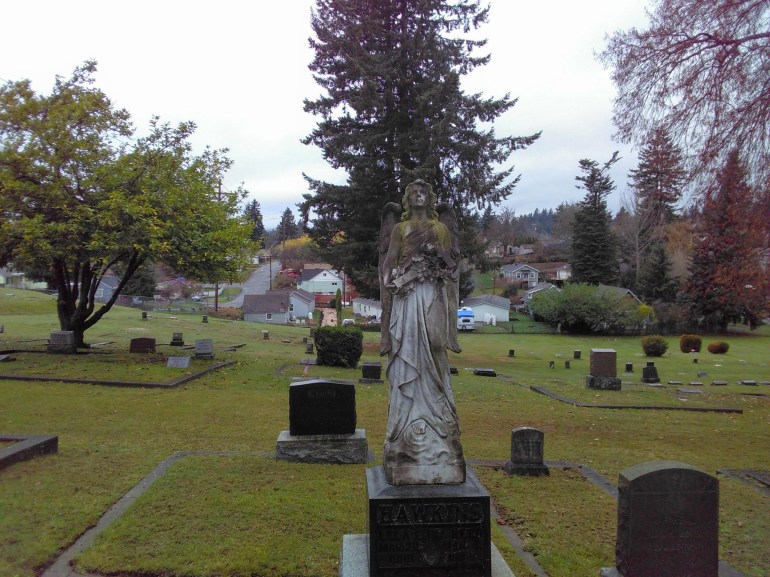
Twice in the past six years, Torqwamni County has mass-buried the ashes of indigents in New Town Cemetery at Charleston, Washington. After a year has gone by, unclaimed bodies are cremated at the taxpayers’ expense; one by one black plastic urns accumulate on the back shelves in the coroner’s office. A time once was when a church or a charity (or even a coroner’s office employee) saw to the proper burial of the ashes. Sadly, dying isn’t as cheap as it used to be; and scattering the ashes of a stranger at a state park (as allowed by law) seems more like taking out the trash than anything else. Right now there would be forty-nine urns whiling away amongst the unused this and that of the Torqwamni County Coroner’s Office, if a child hadn’t lighted the way.

Continue reading